Introduction
In the care of people with dementia the management of behavioral and psychological symptoms of dementia (BPSD) is a major issue. BPSD are a heterogeneous group of symptoms occurring in up to 78% of people living with dementia and include agitation, depression, anxiety, delusions, and hallucinations (Seitz et al., Reference Seitz, Purandare and Conn2010). BPSD are associated with various negative outcomes including decreased quality of life (QoL), increased health care costs and hospitalizations (Cerejeira et al., Reference Cerejeira, Lagarto and Mukaetova-Ladinska2012). The two primary modes of intervention for BPSD are psychosocial interventions (for example interpersonal management and psychological counseling) and pharmacological interventions involving psychotropic drugs (such as antipsychotics, benzodiazepines, and antidepressants) (Guideline Adaptation Committee, 2016). An expert round table meeting for the management of BPSD in Alzheimer's disease concluded that non-pharmacological interventions should be trialed first and if these are unsuccessful, then the least harmful medication should be trialed for the shortest time possible (Gauthier et al., Reference Gauthier2010). The use of psychotropic medications has been shown to be associated with negative outcomes such as rapid declines in cognition, increases in falls, stroke, and all-cause mortality (Rosenberg et al., Reference Rosenberg2012; Jennum et al., Reference Jennum, Baandrup, Ibsen and Kjellberg2015), and there is inconsistent evidence regarding the efficacy of these medications in people with dementia (Seitz et al., Reference Seitz2013). Although the rates of psychotropic medication prescription are better documented elsewhere in the world (de Mauleon et al., Reference De Mauleon2014), to date no analysis of psychotropic medication use in representative samples have been conducted in Australia. The only research done in Australia is at the city or state level and results are in some studies vary considerably reflecting the non-representative nature of the data (Westbury et al., Reference Westbury, Jackson and Peterson2010; Snowdon et al., Reference Snowdon, Galanos and Vaswani2011, Moyle et al., Reference Moyle2017). Without nationally representative research it is difficult to make a determination of systematic issues that may require intervention through change in practice or greater education for staff. The purpose of this study is to examine the prevalence of psychotropic drug prescription in a sample of Australian long-term care facilities (LTCs), specifically designed and sampled in a representative manner.
Method
Data were collected as part of a large cross-sectional, mixed methods study on QoL of people living with dementia drawn from a nationally representative, stratified random sample of 53 Australian LTCs (Beattie et al., Reference Beattie2015; Fielding et al., Reference Fielding, Beattie, O'Reilly and McMaster2016). The sample of facilities was designed to maximize representativeness of Australian LTCs, while still remaining practical in terms of expense and statistical considerations (Fielding et al., Reference Fielding, Beattie, O'Reilly and McMaster2016). LTCs with fewer than 25 beds were excluded from the sampling frame as were the small number of remaining facilities in areas remote from centers of population and those in the Northern Territory. Residents with pre-existing major mental illnesses (such as schizophrenia or bipolar disorder), Huntington's disease, Parkinson's disease or alcohol related dementia were excluded from the study. Informed consent to participate was obtained from participants personally where participants possessed the capacity to provide informed consent, and from legally authorized representatives (powers of attorney) when participants were not cognitively able.
Data and analyses
Data on each participant’s psychotropic medications and comorbid medical conditions were collected from their medical documentation. Psychotropic medications were grouped according to the WHO Anatomical Therapeutic Chemical Classification System (World Health Organization, 2006) into major class (e.g. antipsychotic, benzodiazepine), subclass (e.g. atypical antipsychotic, conventional antipsychotic) and specific medication (e.g. risperidone, olanzapine) and frequencies calculated. Information on BPSD displayed by individual participants was collected through questionnaires completed by staff members directly involved in the care of that resident. Data on depression was collected via the 12-item Geriatric Depression Scale (Yesavage et al., Reference Yesavage1982), with depression classed as a score of four or more. Agitation was assessed using the Cohen Mansfield Agitation Inventory – long form (CMAI) with the presence of agitation classified as “agitated” as determined by the scoring instructions (Cohen-Mansfield, Reference Cohen-Mansfield1991). Wandering and verbal behaviors were assessed with the Revised Algase Wandering Scale (RAWS) (Algase et al., Reference Algase, Beattie, Song, Milke, Duffield and Cowan2004) and Verbal Behavior Scale (VBS) (Beck et al., Reference Beck2011) respectively, as yes/no responses for the presence of these behaviors. The RAWS instrument was only administered to ambulant residents.
Frequencies were calculated for all of the background variables, including the standard demographic ones of age and gender, as well as health-related variables of stage of cognitive impairment, type of dementia, co-morbidities, and BPSD expression. Prevalence of medication prescription was calculated by determining the number of residents prescribed each specific medication then aggregating these into classes and subclasses. Potential associations between the main background variables (age, gender, stage of dementia, and BPSD expression) and medication prescription were investigated via logistic regressions with binary dependent variables for each of the major drug classes (antipsychotics, benzodiazepines, and antidepressants).
Results
The basic characteristics of the participants sampled are shown in Table 1. Participants were 446 residents, with a mean age of 86.0 (SD 6.8) years with a confirmed diagnosis of dementia and a mean MMSE score of 13.7 (SD 7.0).
Demographic and medical characteristics of the sample

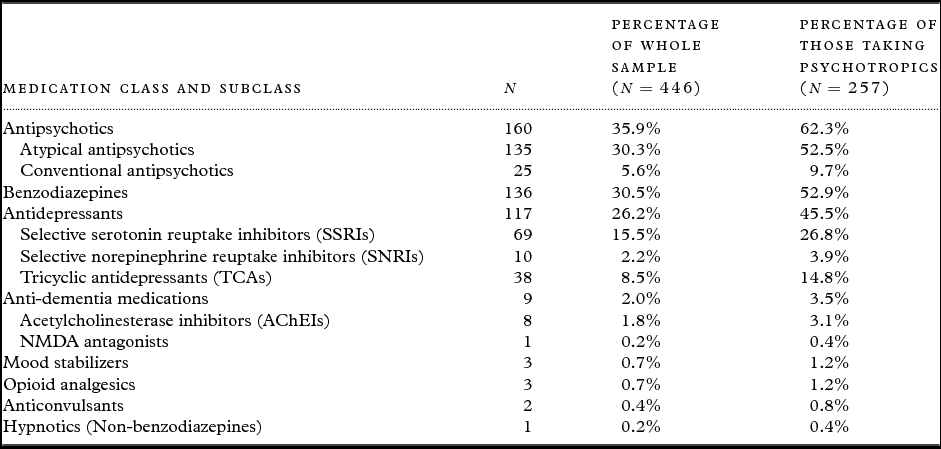
In total 37 different psychotropic medications across eight different classes were being prescribed to participants. The frequency and percentages of participants prescribed in each of the classes and subclasses of the drugs can be seen in Table 2.
Prevalence of psychotropic drug intake

Nearly three-fifths of the residents with dementia were prescribed at least one psychotropic medication (n = 257, 58%) and just over a quarter (n = 114, 26%) were being prescribed two or more medications. Among those who were prescribed psychotropics, the most frequently prescribed medications were antipsychotics, especially atypical antipsychotics (n = 135, 53% of all those prescribed antipsychotics). The most frequently prescribed atypical antipsychotic was risperidone (n = 105, 41%). Among the small number of participants prescribed conventional antipsychotics (n = 25, 6%), all but one was prescribed haloperidol. Nine different types of benzodiazepines were prescribed in the sample (n = 136, 53%), the most common being temazepam (n = 68, 27%). Antidepressants were also common with six types of selective serotonin reuptake inhibitors (SSRIs) (n = 69, 27%), three types of selective norepinephrine reuptake inhibitors (SNRIs) (n = 10, 4%), and four types of tricyclic antidepressants (TCAs) (n = 38, 15%) prescribed. Other classes of medications were also prescribed, but at much lower frequencies.
There were a number of participants who had medical conditions that were contraindicated or raised the risk of adverse outcomes. For example, antipsychotic medications were prescribed to 59 (37%) participants with an unspecified dementia diagnosis. Furthermore, of the participants listed as having a history of falls 18% (n = 7) were being prescribed benzodiazepines.
In order to maximize the cases analyzed, the logistic regression results presented in Table 3 do not include the wandering variable as it is not relevant for residents who are not ambulatory. In terms of understanding which residents had been prescribed antipsychotics, in the full model only depression severity is statistically significant. Compared to residents with no depression, those with depression were more likely to have been prescribed an antipsychotic medication. The odds ratios are high, 3.6 times more likely for mild depression and 3.0 for severe depression. In the full model, none of the variables entered shows a statistically significant relationship with the prescription of benzodiazepines. For antidepressants prescription, as expected, depression shows a significant effect; residents with mild depression are 2.1 times more likely to have a prescription, with those with severe depression 1.5 times more likely. In this model, age also showed a significant relationship with antidepressant prescription. Compared to the youngest age group (less than 80 years), the two older age groups were less likely to have an antidepressant prescription in place, with those aged 80–90 being half (0.50) as likely and those over 90 being one-fifth (0.20) as likely.
Logistic regression associations between drug classes and demographic and BPSD variables

The same models were tested with the wandering variable in place, which reduces the number of cases tested to 269 due to the removal of non-ambulant residents. Results were similar, so the data are not shown. Exceptions include that females were 0.50 less likely to have been prescribed antipsychotics than males and that the effect for severe depression on antidepressants was no longer significant. The wandering variable was not a significant predictor of any medication class prescription.
Discussion
The rates of prescription found in this study confirm that Australia has a similar prevalence of psychotropic drug prescription (58%) as has been described elsewhere in the world (Snowdon et al., Reference Snowdon, Galanos and Vaswani2011; de Mauleon et al., Reference De Mauleon2014). The results suggest there are several issues of concern in the Australian setting that warrant further investigation, as suggested by other authors (Moyle et al., Reference Moyle2017).
High prevalence of antipsychotics
Of most concern is the high prevalence of the prescription of antipsychotic medications, which constitutes more than three-fifths (n = 160, 62%) of the residents on psychotropic medications. Results from the regression analysis suggest that residents with depression were especially likely to have been prescribed antipsychotics (other things equal). There is solid evidence from large population based studies of LTC residents with dementia that taking atypical or conventional antipsychotics are associated with higher rates of strokes and mortality (Kleijer et al., Reference Kleijer, Van Marum, Egberts, Jansen, Knol and Heerdink2009; Jennum et al., Reference Jennum, Baandrup, Ibsen and Kjellberg2015). The Australian NHMRC Cognitive Decline Partnership Centre Clinical Practice Guidelines state that in most cases psychosocial strategies are the first-line treatment for BPSD and antipsychotic medications should not normally be prescribed. When BPSD are severe, antipsychotics may be considered subject to a risk-benefit analysis and discussion with the person with dementia and their carers. The medication should be started at low doses and increased if required under close monitoring of effects (Guideline Adaptation Committee, 2016).
With regard to risperidone specifically, in August 2015 the Australian Therapeutic Goods Administration (TGA) updated the risperidone usage guidelines to limit treatment to a maximum period of 12 weeks due to an increased risk of cerebrovascular events (Therapeutic Goods Administration, 2015).
All but one of the participants being prescribed conventional antipsychotics was given haloperidol, which is known to be associated with side effects such as over-sedation, hypotension, tardive dyskinesia, parkinsonian symptoms, and vascular collapse and is of questionable utility in treating BPSD (Lonergan et al., Reference Lonergan, Luxenberg, Colford and Birks2002). There is some evidence that mortality risks for haloperidol use in this population may be the highest among all the antipsychotics (Rossom et al., Reference Rossom, Rector, Lederle and Dysken2010; Langballe et al., Reference Langballe, Engdahl, Nordeng, Ballard, Aarsland and Selbaek2014).
Another factor that makes the high levels of antipsychotic prescription of concern are the high rates of other comorbidities known to increase stroke risk in this population, such as hypertension (n = 208, 48%), heart disease (n = 119, 27%), type two diabetes (n = 71, 16%), high cholesterol (n = 61, 14%), and previous stroke/transient ischemic attack (n = 48, 11%). Further compounding the cerebrovascular risk, 14% (n = 62) of the sample had a confirmed diagnosis of vascular dementia or mixed Alzheimer and vascular dementia. Another third of the sample (35%) (n = 153) had an unspecified form of dementia recorded on their medical chart, suggesting that the percentage with vascular issues could well be greater. For the 59 (39%) of these residents prescribed antipsychotics, physicians had evaluated the risks and benefits without the benefit of knowing the underlying dementia pathology.
High prevalence of benzodiazepines
Both guidelines, such as the Updated Beers Criteria (Brandt and Turner, Reference Brandt and Turner2014) and a systematic review (Defrancesco et al., Reference Defrancesco, Marksteiner, Fleischhacker and Blasko2015) recommend not using benzodiazepines for the treatment of insomnia, agitation, or delirium in people living with dementia, due to safety concerns, such as increased falls, cognitive decline, and mortality; in addition, common side effects include sedation, drowsiness, ataxia, amnesia, and confusion (Defrancesco et al., Reference Defrancesco, Marksteiner, Fleischhacker and Blasko2015). In this study, benzodiazepines were the second most common class of psychotropic medication administered (31% of those prescribed psychotropic medication). Furthermore, 9% (n = 38) of the residents were listed as having a history of falls on their medical chart and of these 18% (n = 7) were being prescribed benzodiazepines.
Choice of antidepressants
Clinical guidelines (#87 and #88) caution against the use of antidepressants for depression in individuals with dementia, due to little evidence of their efficacy (Guideline Adaptation Committee, 2016). This is thought to be due to depression in dementia being a result of damage to the brain and thus fundamentally different to depression in individuals without dementia (Wilkins and Forester, Reference Wilkins and Forester2016). There is evidence, however, that SSRIs may be effective in treating agitation in this population (Wilkins and Forester, Reference Wilkins and Forester2016). The regression results suggest that antidepressants were most likely to be prescribed to younger depressed residents, rather than agitated residents. However, TCAs are rarely prescribed to people living with dementia due to mixed results regarding efficacy, relatively frequent side-effects, and a high lethality index (Starkstein et al., Reference Starkstein, Mizrahi and Power2008; Guideline Adaptation Committee, 2016). In this study, just over a quarter of all the participants (26%) were prescribed at least one form of antidepressant, mostly SSRIs. Close to 40 residents (38) were taking TCAs, despite the contraindication of these drugs for people with dementia (guideline #87) (Guideline Adaptation Committee, 2016).
Low prevalence of anti-dementia medication
The overall number of residents being prescribed anti-dementia drugs was low (n = 9, 2%). Systematic reviews examining the efficacy of these medications have found that acetylcholinesterase inhibitors (AChEIs), such as donepezil, galantamine, and rivastigmine and the NMDA receptor antagonist memantine, can offer improvements in cognition, BPSD, and overall QoL and their use is endorsed by clinical guidelines (#69-#75)(Raina et al., Reference Raina2008; Rodda et al., Reference Rodda, Morgan and Walker2009; Guideline Adaptation Committee, 2016). Evidence-based clinical practice guidelines recommend that anti-dementia drugs are most beneficial to individuals with mild-moderate dementia; however, some evidence suggests improvements in more severely impaired individuals as well, so trialing medications in these individuals to determine effects is not without merit (Cummings, Reference Cummings2003). Given that only 2% of the population were being administered these medications, it is possible that these medications were under-prescribed. As with any medication, there are potential side effects that must be monitored so anti-dementia medications may not be suitable for all. The use of anti-dementia medications is generally preferable to medications such as antipsychotics and benzodiazepines in situations where psychosocial and environmental strategies have first proved to be unsuccessful in managing BPSD (Guideline Adaptation Committee, 2016).
Limitations
The main limitation of this research is that the data were collected to examine factors related to QoL of residents in LTCs; hence, the data collected could not be used to conclusively ascertain whether these medications were being prescribed in an appropriate manner. Background information such as alternative strategies that may have been previously trialed, duration and the reasons for prescription, individualized risk-benefit analysis undertaken prior to prescription and whether the effects of medications are closely monitored are crucial to determine whether actions are in accordance with best-practice. Data was collected cross-sectionally so does not contain information on medication changes over time. The following types of facilities were not represented in the sample: small (fewer than 25 beds), remote (distant from population concentrations), and those in the Northern Territory. However, the main strength of the paper is demonstrating the prevalence of the prescription of these drugs in a nationally representative sample of Australian LTCs. Previous analyses and those from other countries do not attempt representative samples and thus cannot claim to be presenting a true national prevalence figure.
Conclusion
The prevalence of psychotropic prescription found in this study may be indicative of over-prescription of antipsychotics and benzodiazepines, which may be more harmful than beneficial to residents. Rates of anti-dementia prescription are very low and suggest the possibility that greater prescription may improve cognition, BPSD, and QoL for people living with dementia. Overall, that a quarter of participants were prescribed multiple antipsychotic medications indicates a potential need for more frequent medication reviews or risk-benefit analyses. Trialing de-prescription of potentially harmful and/or unnecessary medications could result from such careful reviews.
More broadly, no psychotropic medications should be used as a first line treatment for BPSD; if psychosocial interventions prove unsuccessful, then classes of psychotropics that are considered to pose less likelihood of harm, such as anti-dementia medications and antidepressants could be introduced and their effects monitored. In a minority of cases, antipsychotics and benzodiazepines for a limited timeframe may be the most clinically appropriate medications. In this study, the respective prevalence of medications may indicate that these processes are not taking place in routine care in Australian LTCs.
It is recommended that further research in this area collect more in-depth information, which examines the whole process of clinical decision making and medications, and monitoring of patients’ response to treatment. Also, whether psychotropics are being used as a first line treatment for BPSD, and continued beyond recommended timeframes also warrants investigation. For results of such studies to be generalizable to the whole population, representative samples are imperative in helping researchers and clinicians understand and improve the prescribing process, in particular in LTCs.
Conflict of interest
None
Description of authors’ roles
Mitchell McMaster formulated the research question, analyzed the data, and wrote the paper. Elaine Fielding was involved in the study conception and design, the research question, data collection, data analysis, and writing the paper. David Lim was involved in writing the paper. Wendy Moyle was involved in the study conception and design, formulated the research question, data collection, data analysis, and writing the paper. Elizabeth Beattie was involved in the study conception and design, formulated the research question, data collection, data analysis, and writing the paper. The AusQoL Group were involved in the study conception and design and in supervising data collection and entry.
Acknowledgments
The AusQoL group (Elizabeth Beattie, Lynn Chenoweth, Deirdre Fetherstonhaugh, Elaine Fielding, Barbara Horner, Wendy Moyle, Maria O'Reilly and Andrew Robinson) conceived the project and supervised its data collection. We gratefully acknowledge the intellectual generosity and support of Professor Sheryl Zimmerman, Mary Lily Kenan Flagler Bingham Distinguished Professor in the University of North Carolina's School of Social Work, Chapel Hill, North Carolina, USA and of Emerita Professor Rhonda Nay during the conceptualization phase of the overall project. We also acknowledge the following people who were integral to data collection and/or data management on the project: Dominique Bird, Chanel Burke, Beatriz Cuesta-Briand, Sara Franklin, Katrina Fyfe, Wei He, Lina Karlsson, Joanna Lee, Jane O'Brien, Ash Osbourne, Laura Tarzia, Laura Tierney, and Leonie Tinsley.