


Functional foods (FF) have existed on the Swedish food market since 19901 and the number of FF products is increasing. However, the interests in and attitudes to FF among consumers is crucial if these foods are to be consumed and thereby exert their potential health benefits.
Factors influencing consumption of FF are, for example, trust in the effects of the foods, a belief that the foods are safeReference Korzen-Bohr and O'Doherty Jensen2, Reference Poulsen3 and having confidence in FFReference Urala and Lähteenmäki4. Some consumers perceive FF as unsafeReference Korzen-Bohr and O'Doherty Jensen2 or metaphorically associate FF with nuclear power or medicineReference Bäckström, Pirttilä-Backman and Tuorila5. Consumers recognise the FF as more healthy if it is similar to a healthy conventional food product than if the FF is similar to an unconventional or a new foodReference Korzen-Bohr and O'Doherty Jensen2, Reference Poulsen3. Positive attitudes towards FF among Finnish consumers are explained by their perception of FF as conventional foodsReference Urala and Lähteenmäki4.
The health benefits attributed to FF encourage some consumers to consume the products, for example those with CVDReference Anttolainen, Luoto, Uutela, Boice, Blot, McLaughlin and Puska6, high blood cholesterol levelsReference Niva7, Reference Lyly, Roininen, Honkapää, Poutanen and Lähteenmäki8 or bad subjective healthReference de Jong, Ocké, Branderhorst and Friele9. Further, beliefs about health benefits of healthy foods and having an interest in health in general predict purchase intention or willingness to consume FFReference Bogue, Coleman and Sorenson10–Reference Verbeke13. According to Urala & LähteenmäkiReference Urala and Lähteenmäki12 the strongest predictor of willingness to consume FF is the perceived personal reward, including pleasure and positive consequences from using FF.
Researchers are occupied with characterising the FF consumers according to demographic variables and different researchers claim that various variables are associated with consumption. Both higher and lower level of education correlates with positive attitudes to, greater consumption and acceptance of FFReference Urala and Lähteenmäki4, Reference Anttolainen, Luoto, Uutela, Boice, Blot, McLaughlin and Puska6, Reference de Jong, Ocké, Branderhorst and Friele9, Reference Verbeke14. However, when VerbekeReference Verbeke14 considered all demographic variables in a multivariate statistical analysis, any relation between education and attitudes to FF among consumers disappeared. Further, those having higher income or belonging to higher socio-economic groups have the highest awareness or consumption of FFReference Anttolainen, Luoto, Uutela, Boice, Blot, McLaughlin and Puska6, Reference Niva7, Reference Bogue, Coleman and Sorenson10.
When investigating differences in purchase behaviour between gender, results imply either higher interest in or greater consumption of FF among females than malesReference Poulsen3, Reference Niva7, Reference Bogue, Coleman and Sorenson10, Reference Verbeke13, Reference Huotilainen, Pirttilä-Backman and Tuorila15 or no gender differencesReference de Jong, Ocké, Branderhorst and Friele9, Reference Verbeke14, Reference Cox, Koster and Russell16. A reason for females to have higher interest in FF is their greater awareness of the relation between health and health-enhancing foods, as opposed to malesReference Bogue, Coleman and Sorenson10, Reference Roininen, Tuorila, Zandstra, de Graaf, Vehkalahti, Stubenitsky and Mela17. Further, the gender difference possibly depends on the type of FF product the consumer is asked about. Males appear more willing to use cholesterol-lowering products whereas females are more willing to try other FF, such as probioticsReference Niva7, Reference Huotilainen, Pirttilä-Backman and Tuorila15.
When investigating the differences in perception of FF between age groups older respondents perceive the use of FF as more rewardingReference Urala and Lähteenmäki4, Reference Urala and Lähteenmäki12 and they are more accepting towards the concept than younger respondents areReference Verbeke14. This relation is explained by the older respondents' own experiences with health problemsReference Verbeke14. However, other researchers claim that older consumers are less interested in FF than youngerReference de Jong, Ocké, Branderhorst and Friele9 or that the difference in attitudes between ages depends on which FF products are surveyedReference Niva7, Reference de Jong, Ocké, Branderhorst and Friele9, Reference Huotilainen, Pirttilä-Backman and Tuorila15.
According to this literature review the lack of consistency regarding which demographic factors influence willingness to consume FF is evident. Few scientific studies have investigated demographic characteristics of the Swedish FF consumers and their attitudes to FF. Therefore, the aim of the present study was to survey familiarity with, attitudes to and consumption of FF among Swedish consumers. More specifically, the aim was to investigate which demographic variables, diet-related problems, and attitudes to diet and health predicts consumption of FF among Swedish consumers.
Definitions, study population and methods
Definitions
The Swedish Code of Practice in the labelling of foods with health claims, called Health Claims in the Labelling and Marketing of Food Products, The Food Sector's Code of Practice was introduced in 1990. The Code mainly suggests three types of health claims on foods: generic nutrient function claim, generic reduction of disease risk claim and product-specific physiological claim 1. Primarily, the Code included generic claims and later, in 2001, the Code was extended to include product-specific health claims on foodsReference Asp18. The FF products used in the present survey were labelled with at least one of the three health claims. Therefore the phrase FF is herein defined as foods with health claims.
In a further perspective, the Swedish definitions of generic reduction of disease risk claim and product-specific physiological claim are comparable with the definitions used in the newly adopted EC regulation on Nutrition and Health ClaimsReference Borrell Fontelles and Korkeaoja19.
Study population
A questionnaire (see later) was mailed during the spring of 2005 to 2000 individuals aged 17 to 75 years, randomly selected from the Swedish national population register (Info Data, 2005). Non-responders received two reminders. Respondents could choose to receive a lottery ticket with a value of approximately €2·5 or not.
Questionnaire
The questions in the questionnaire were partly based on results from focus group interviews with consumers (E Landström, U-K Koivisto Hursti and M Magnusson, unpublished results). The focus groups revealed the respondents' requirement of pictures of FF in order to recognise them, as well as a description of the Swedish definition of FF. The FF presented in the questionnaire were available on the Swedish food market during the spring of 2005. The FF presented in the questionnaire were: (1) probiotic fruit-drinks (i.e. Proviva®, Scania Dairy Factory, Malmö, Sweden); (2) probiotic milk-products (i.e. Cultura Dofilus®, Arla Foods, Stockholm, Sweden; (3) a portion-sized yoghurt with muesli (Primaliv®, Scania Dairy Factory); (4) juice with added vitamins or minerals (i.e. Godmorgon® Apelsin +järn, Arla Foods); (5) cholesterol-lowering products (margarine and milk) (Becel pro.activ®, Unilever Bestfoods, Helsingborg, Sweden; Benecol®, Carlshamn Mejeri, Karlshamn, Sweden); (6) a fibre-rich bread with n-3 fatty acids (Pågen Leva®, Pågen AB, Malmö, Sweden); and (7) egg with n-3 fatty acids (Adelsö ägg, Adelsö, Sweden; Table 2). The respondents were asked if they had ever consumed/purchased each of the named FF (yes/no) and if so, whether they were willing to consume or purchase the FF again (yes/no/maybe). The respondents were asked if they had heard or read about FF before they read about them in this questionnaire (yes/no). If yes, they were asked where they had heard or read about it (ten media/social response alternatives, for example commercials on television, advertisements in newspaper, friends and health-care professionals).
The respondents who had consumed/purchased one or several FF were asked if they had felt an effect of the product (yes/no/did not expect an effect/do not know). The respondents were also asked if they consumed or purchased other FF products beside those presented in the questionnaire (yes/no/do not know); those answering yes were asked to state the name of the products used (open answer). The respondents were asked if they wanted more FF products on the food market (yes/no/do not know).
Functional food-scale
The scale measuring willingness to use FF (FF-scale; twenty-six items), developed by Urala & LähteenmäkiReference Urala and Lähteenmäki4, was included in the questionnaire (Table 3). The scale measures necessity for FF (NEC), confidence in FF (CON) and perceived reward from using FF (REW). The term ‘functional foods’ was translated to ‘foods with health claims’ in the Swedish version. Items were rated on a seven-point Likert scale (1 = completely disagree to 7 = completely agree). With permission of the originatorsReference Urala and Lähteenmäki4 the FF-scale (in Finnish) was translated into Swedish for the first time. After translation a Finnish-speaking researcher at Uppsala University translated the scale back to Finnish and the originator checked for misinterpretations. Due to administrative failure, one of the items (CON4) was lost in the questionnaire. As a result of the focus groups, two extra items were added to the scale. The items were: ‘I would buy a food with health claim if a GP, nurse or dietitian recommended it’ (Recommend) and ‘I happily pay a higher price for foods with health claims’ (Price).
Health attitude scale
The three dimensions (twenty items) of the validated Health Attitude Scale (HASReference Roininen, Tuorila, Zandstra, de Graaf, Vehkalahti, Stubenitsky and Mela17, developed by Roininen et al. Reference Roininen, Lähteenmäki and Tuorila20), were included in the questionnaire (Table 4). The scale measures: general health interest (GHI), natural product interest (NPI) and light product interest (LPI). The items in the scales were rated on a seven-point Likert scale (1 = I completely disagree to 7 = I completely agree). The HAS was previously translated to Swedish by Magnusson & Koivisto HurstiReference Magnusson and Koivisto Hursti21. After the printing of the present questionnaire, one of the items (NPI5) was identified as wrongly translated (original: ‘artificially flavoured’, translation: ‘artificially sweetened’). Due to administrative failure, one statement (LPI5) was omitted from the questionnaire. As a result of the focus groups, one extra item was included in addition to the original scale. The item was: ‘In my opinion the production of healthier food through new technologies is a good thing’ (Technology).
A pilot study (E Landström, unpublished results) revealed difficulties with answering negative items in the FF-scale and HAS because of double negations. Therefore, three out of twelve negative items in the original FF-scale and seven out of ten negative items in the original HAS were changed to positive, with permission from the originators.
Non-response analysis
The response rate for returned questionnaires was 48 % and an effort was made to determine the reasons for not responding. A short (one-page) questionnaire with a few demographic questions, questions regarding recognition of FF and a question concerning reasons for not responding was sent to 50 % (n 500) of the non-respondents: seventy-six (15 %) responded.
Statistical analysis
Statistical Package for Social Sciences version 14.0.1 (SPSS Inc., Chicago, IL, USA) was used to analyse the data. Due to the high number of statistical analyses the level of significance was adjusted according to Bonferroni22 to 0·001 to obtain an overall α level of 0·05. Descriptive statistics, independent sample t test, χ2 tests and logistic regression were used for statistical analyses. Factor analysis (Principal Axis analysis, Equamax Rotation) was used to reduce the data from the FF-scale and HAS. Ratings of negatively worded items in the scales were reversed before statistical analyses were performed.
Crude OR (99·9 % CI; Table 5) were calculated to determine consumer characteristics in relation to not consumed/purchased (0) or consumed/purchased (1) any of five different FF products (Table 5). Crude OR were also calculated to characterise non-consumers (0) or consumers (1) of any of the seven FF products, and those who had consumed/purchased none to two FF products (0) or three to seven FF products (1). To facilitate interpretation of the logistic regression analysis, mean values of the scorings in the dimensions in both scales (FF and HAS) were dichotomised and a cut-off point of 4·5 was chosen. Thus, mean score ≤ 4·49 was classified as low, and mean score ≥ 4·50 was classified as high.
The crude OR explained the relations between the dependent variables and the independent variables. Further, the crude OR was used to select which of the dependent and independent variables to insert into the multivariate model: the adjusted logistic regression. For variables to be inserted into the adjusted model they need to contain enough subjects in order to guarantee the strength of the analysisReference Munro23. Therefore, the independent variables age categories and civil status were excluded. The independent variables inserted in the adjusted logistic regression (99·9 % CI) were demographics, diet-related problems, use of dietary supplements and the dimensions in the FF-scale (five) and the HAS (three). In the adjusted logistic regression all selected independent variables were entered simultaneously into the model in order to control the OR for the effects of covariates. Among the dependent variables egg with n-3 fatty acids, portion-sized yoghurt with muesli and non-consumers/consumers were excluded from the adjusted logistic regression.
Results
In total 972 consumers responded to the questionnaire (response rate 48 %). There were more women (53 %) responding to the questionnaire compared to the Swedish population (50·4 %) and the mean age of the respondents was 45 years (Swedish population mean 40·2 years). Demographic characteristics and diet-related problems of respondents in comparison to the Swedish population and respondents' dietary supplement use are presented in Table 1.
Characteristics regarding demographics, use of dietary supplements and diet-related problems of respondents in comparison to the Swedish population
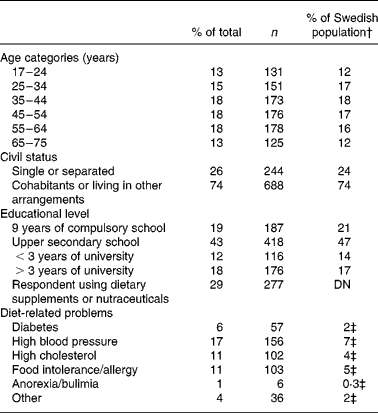
DN, data not available.
† Data from Statistics Sweden 2004, 2005.
‡ Data from Becker & PearsonReference Becker and Pearson32.
Comparisons between respondents and non-respondents
There were no significant differences between the respondents and the non-respondents regarding demographic variables such as educational level, gender and civil status. There was a higher, although non-significant, frequency of immigrants among the non-respondents (26 %, n 20) than among those responding to the original questionnaire (17 %, n 157).
Fewer of the non-respondents had heard or read about FF before they received the original questionnaire than the respondents (χ2(1) = 20·6, P < 0·001). The most frequently stated reasons for not completing the questionnaire were ‘did not have time’ (n 14, 18 %) and ‘a too long questionnaire’ (n 10, 13 %). Three persons (4 %) were not interested in the topic and two (3 %) did not know about the topic and could therefore not answer.
Consumption of functional foods
Most respondents (n 811; 83 %) had consumed/purchased at least one of the listed FF products. The female respondents (mean 2·63 (sem 0·07) products) had consumed/purchased more FF products than the males had (mean 2·1 (sem 0·08) products; t(916) − 5·41; P < 0·001). Differences between males and females regarding consumption/purchase of FF products are presented in Table 2. A significantly larger proportion of the females had consumed/purchased probiotic fruit-drinks and milk-products and fibre-rich bread than males (Table 2).
Consumption or purchase frequencies among respondents of functional food (FF) products targeted in the questionnaire (response alternatives were yes/no and those answering yes are presented)

† P values of 0·001 represent a significant difference between males and females.
‡ Primaliv® (Scania Dairy Factory, Malmö, Sweden).
§ Becel pro.activ® (Unilever Bestfoods, Helsingborg, Sweden) and Benecol® (Carlshamn Mejeri, Karlshamn, Sweden).
‖ Pågen Leva® (Pågen AB, Malmö, Sweden).
¶ Adelsö ägg (Adelsö, Sweden).
Of the respondents who had consumed/purchased a FF product between 83 and 100 % would consider consuming/purchasing the product again. All (n 18) of those who had consumed/purchased cholesterol-lowering milk would consider consuming/purchasing it again, 86 % (n 232) could consider consuming/purchasing the cholesterol-lowering margarine and 83 % (n 56) the portion-sized yoghurt with muesli. No gender differences were detected concerning the willingness to consume/purchase any of the FF products again.
Of those who had consumed/purchased a FF product, about 25 % (n 193) had perceived an effect of the food item. However, almost 45 % (n 353) did not perceive an effect or did not know if the food had had an effect; 30 % (n 240) did not expect the food item to have an effect.
Nearly 15 % (n 141) of the respondents claimed that they ate FF other than those presented in the questionnaire. Of these, 63 % (n 89) mentioned a correct FF and 37 % (n 52) mentioned other products, for example organically produced foods, foods with the green keyhole logotype (foods low in fat, sugar and high in fibre), conventional foods and so-called ‘health foods’. Of all the respondents, 29 % wanted more foods with health claims on the market.
The most common sources of information where the respondents had heard or read about FF were commercials on television (57 %), advertisements in newspapers or magazines (48 %) and food packaging (47 %). Other sources were brochures (19 %), the family (13 %), friends (14 %), dietitian, general practitioner (2·5 %) or nurse (1 %).
Functional food-scale
The factor analysis of the FF-scale resulted in a different loading than the originatorsReference Urala and Lähteenmäki4 (Table 3) have demonstrated before. Five interpretable dimensions with Eigenvalues >1, explaining 46 % of the variance, were identified (Table 3). Cronbach's α coefficients were between 0·72 and 0·87, indicating the dimensions' internal reliability.
Description of the statements, factor loading, means and standard deviations of the Functional food (FF)-scale, including the original factor codes

CON, confidence in FF; NEC, necessity for FF; R, negatively worded sentence; (R), previously negative sentence reworded to a positive in the present study; REW, reward from using FF.
The first dimension, ‘personal reward from using FF’, was focused on how FF could promote ones personal well-being, performance, health and mood. Those scoring high perceived consuming FF as more rewarding than did those scoring low. This dimension contained the new item ‘Price’. The second dimension, ‘benefits of FF’, addressed disease-preventing abilities of FF, the development of new foods through technology, healthy delicacies and the willingness to consume FF if a health-care professional recommended it. This dimension contained the new item ‘Recommend’. The third dimension concerned risk and harmful aspects associated with consumption of FF. All items in this dimension were negatively worded in the questionnaire and to facilitate the interpretation of the dimension scores were reversed. High scoring represents a belief that the FF are safe and trustful, thus the dimension was named ‘safety of FF’. The fourth dimension, ‘confidence in FF’, regarded confidence in FF, the need of the products and the safety of using the products. The fifth dimension concerned how meaningless and irrelevant FF are and how the information given about FF is exaggerated. All items in this dimension were negatively worded in the questionnaire and to facilitate the interpretation of the dimension scores were reversed. High scoring represents a supportive attitude towards the development of FF, thus the dimension was named ‘supporting FF’.
One of the highest mean values in the FF-scale was seen on item ‘Recommend’ (Table 3). A high score on ‘Recommend’ represents a higher likeliness of buying a FF if a health-care professional recommended it. The lowest mean values in the FF-scale were seen on item REW7 and item REW9, indicating the respondent's reluctance to bargain on taste for health and the respondent's unwillingness to pay a higher price for FF.
Health Attitude Scale
The factor analysis of the HAS resulted in three dimensions with Eigenvalues >1, explaining 46 % of the variance (Table 4). The dimensions (GHI, NPI and LPI) were labelled with the same names as those used by Roininen et al. Reference Roininen, Lähteenmäki and Tuorila20. The item: ‘I do not eat processed foods, because I do not know what they contain’ (NPI3) loaded higher in the dimension GHI (factor loading 0·27) than in NPI (factor loading 0·18). Therefore, keeping the item in GHI would be more appropriate but due to the minor difference in factor loading, it was decided to move the item into its original dimension. Cronbach's α coefficients were between 0·79 and 0·91, indicating the dimensions' internal reliability.
Description of the statements, factor loading, means and standard deviations of the Health Attitude Scale, including the original factor codes

GHI, general health interest; LPI, light product interest; NPI, natural product interest; R, negative sentence; (R), previously negative sentence reworded to a positive in the present study.
When analysing correlations between the five dimensions in the FF-scale and the three dimensions in the HAS, significant positive correlations were revealed between all five FF dimensions and LPI (r 0·25–0·50, P < 0·001), with the strongest correlation between Personal reward from using FF and LPI (r 0·50) and between Benefits of FF and LPI (r 0·49). Personal reward from using FF (FF-scale) correlated positively with NPI (r 0·22, P < 0·001). Personal reward from using FF, Benefits of FF and Supporting FF correlated positively with GHI (r 0·14–0·35; P < 0·001) with the strongest correlation between Personal reward from using FF and GHI.
Respondent characteristics associated with consumption of functional foods – crude OR
Crude OR from the logistic regression are displayed in Table 5. Respondents scoring high on the five dimensions in the FF-scale were more likely to have consumed/purchased fibre-rich bread with n-3, as well as more than three products, than those scoring low. When comparing non-consumers and consumers, the consumers were more likely to score higher on the dimensions Benefits of FF and Supporting FF. Respondents scoring high on the dimensions Personal reward from using FF, Benefits of FF and Supporting FF were more inclined to have consumed/purchased cholesterol-lowering products, than those scoring low on these dimensions. Those scoring high on the dimension Supporting FF were more inclined to have consumed/purchased probiotic milk-products than those scoring low.
Crude OR (99·9 % CI) for attitude characteristics, perceived effect, diet-related problems, use of dietary supplements and demographic variables, in relation to: not consumed/purchased (0) or consumed/purchased (1) any of the five functional food (FF) products below; non-consumers (0) or consumers (1) of any of the seven FF products in the questionnaire; and consumed/purchased none to two (0) or three to seven (1) FF products

OR values were significantly different from those of the reference (1·00): *P < 0·001.
Respondents scoring high on the GHI-dimension in the HAS were more likely to have consumed/purchased probiotic milk-products and fibre-rich bread with n-3 than respondents scoring low. Respondents scoring high on the LPI-dimension were more likely to have consumed/purchased cholesterol-lowering products than those scoring low.
The crude OR revealed that respondents perceiving an effect of a FF were more likely to have consumed/purchased probiotic products than those not perceiving an effect. Those with a diet-related problem were more likely to have consumed/purchased cholesterol-lowering products than those without a problem. Respondents using dietary supplements or nutraceuticals were more inclined to have consumed/purchased probiotic products and were more likely to have consumed/purchased at least one of the seven FF products than those not using dietary supplements or nutraceuticals.
Regarding demographic variables, females were more likely to have consumed at least one of the seven FF products in the questionnaire and were more likely to have consumed/purchased probiotic products and fibre-rich bread with n-3. Respondents with upper secondary school education were more likely to have consumed at least one of the seven FF products and were more likely to have consumed/purchased probiotic products than those with nine years of compulsory school. Respondents with more than three years of university education were more inclined to have consumed/purchased probiotic milk-products than those with nine years of compulsory school. Older respondents were less inclined to have consumed juice with extra vitamins and minerals than the youngest (17–24 years old).
Respondent characteristics associated with consumption of functional foods – adjusted OR
In the adjusted logistic regression respondents scoring high on the dimension Supporting FF were more inclined to have consumed/purchased more than three of the products presented in the questionnaire (OR(1) 2·09, P = 0·001) than those scoring low on this dimension. None of the other dimensions in the FF-scale and HAS demonstrated a significant effect on the likelihood of having consumed/purchased FF. Respondents with a diet-related problem (high blood pressure, high cholesterol or diabetes) were more inclined to have consumed/purchased cholesterol-lowering products (OR(1) 2·29, P = 0·001) than those without a diet-related problem. Respondents using dietary supplements or nutraceuticals were more likely to have consumed/purchased probiotic fruit-drinks (OR(1) 1·96, P = 0·001) than their counterparts. Those who had detected an effect of FF products were more likely to have consumed/purchased probiotic fruit-drinks (OR(1) 2·55, P = 0·001) and milk-products (OR(1) 2·40, P = 0·001) than those who had not detected an effect. Respondents with more than 3 years of university education were more likely to have consumed/purchased probiotic milk-product (OR(3) 3·32, P = 0·001), than those with nine years of compulsory school.
Attitudes to functional foods in relation to the perceived effect of functional foods and consumption of dietary supplements
Respondents perceiving an effect of a FF were scoring significantly higher on all five dimensions in the FF-scale than those not perceiving an effect (Table 6). Those consuming dietary supplements or nutraceuticals were scoring significantly higher on three of the five FF dimensions (Personal reward from using FF, Benefits of FF and Supporting FF) than those not consuming dietary supplements. No significant differences in scoring on the FF dimensions were revealed between respondents with a diet-related problem and their counterparts (Table 6).
Attitudes to functional foods (FF) among respondents who: perceived effect of FF or not; consumed dietary supplements and not; and had a diet-related problem or not

† P values of 0·001 represent a significant difference between groups.
Discussion
Most respondents of this questionnaire reported being familiar with the concept of FF and several of the presented FF products. However, caution should be taken in generalising the results as the sample could be biased towards consumers favouring the concept of FF.
Different characteristics of the Swedish consumers were associated with consumption of different FF products. Consumption of cholesterol-lowering products was associated with having a diet-related problem (high cholesterol, high blood pressure and diabetes) and consumption of probiotic products was associated with perceiving an effect of a FF. Those consuming the largest variety of FF were supporting the concept of FF. Among the mapped socio-demographic variables only high level of education was associated with more frequent use of one of the FF, that is, probiotic milk-products. Thus, according to the present results, other factors, rather than demographics, explain the consumption of FF in Sweden.
Attitudes to functional foods
Respondents perceiving the use of FF as personally rewarding and as beneficial in general had an interest for light products and were users of dietary supplements. Also, those perceiving a personal reward from eating FF had an interest in natural products and health in general. Thus, consumers already interested in their health had positive attitudes towards FF. The connection between attitudes to health, natural and light products and attitudes to FF in the present study is congruent with results from a recent Finnish studyReference Urala and Lähteenmäki4. Consumers with a general health interest have a positive attitude to FF and perceive the foods as necessary, rewarding to consume and health promotingReference Urala and Lähteenmäki4. The connection with interest in health and FF is supported by NivaReference Niva7 who reveal FF-consumers' extended interest in eating healthily as compared to non-consumers.
Positive attitudes to FF were demonstrated among respondents in the present study who had perceived a physiological effect of a FF. Whether the effects were clinically detectable or not was not in the scope of the present survey, thus the stated effects could represent both clinically true effects and placebo effects. However, acceptance of FF is associated with beliefs in effects of and benefits from FFReference Verbeke14. If a certain food claims possible improved well-being or reduced risk of disease, undetectable effects and unfulfilled promises could make the consumer distrusting and disappointed in this food. Therefore, believing in or perceiving the effects of FF determines acceptance of the foods.
Predicting the use of functional foods
Crude regressions demonstrated associations between consumption of FF and both demographic and attitudinal factors. However, consumer characteristics with respect to consumption of FF differed between products, which is also demonstrated by de Jong et al. Reference de Jong, Ocké, Branderhorst and Friele9, Urala & LähteenmäkiReference Urala and Lähteenmäki12, Reference Urala and Lähteenmäki24 and Lyly et al. Reference Lyly, Roininen, Honkapää, Poutanen and Lähteenmäki8. This indicates a problem with generalising consumer characteristics between different FF products, as different FF products attract different consumers.
In the adjusted regression several of the crude associations between consumer characteristics and consumption disappeared. However, one association among the social-demographic variables remained: those with a high level of university education were more likely to consume probiotic products than those with a low level of education. According to NivaReference Niva7, high level of education can explain consumption of certain products. However, previous research regarding this issue presents a complex and ambiguous pictureReference Urala and Lähteenmäki4, Reference Anttolainen, Luoto, Uutela, Boice, Blot, McLaughlin and Puska6, Reference de Jong, Ocké, Branderhorst and Friele9, Reference Verbeke14, claiming that both higher and lower levels of education correlate with consumption of and positive attitudes to FF.
The other remaining consumer characteristics predicting consumption of FF in the adjusted regression revealed that consumption of FF is related to the effects of the products and to health-consciousness rather than to socio-demographic variables. In previous studies the effects of socio-demographic variables on consumption of FF after multivariate adjustments appear complexReference Niva7 and vagueReference Verbeke14. Other factors, such as beliefs in the health benefits and presence of illness in the family or among relatives, rather explain the acceptance of FF than socio-demographicsReference Verbeke14.
Specifically, respondents with a diet-related problem, personally or in the family, were more likely to consume cholesterol-lowering products than those without a diet-related problem. The more frequent use of cholesterol-lowering products among consumers with CVD is supported by Anttolainen et al. Reference Anttolainen, Luoto, Uutela, Boice, Blot, McLaughlin and Puska6, Lyly et al. Reference Lyly, Roininen, Honkapää, Poutanen and Lähteenmäki8 and NivaReference Niva7. Apparently, consumption and acceptance of FF is more likely if there is illness in the family or among relativesReference Verbeke14. This indicates that the use of FF, at least for some consumers, is not for the purpose of prevention or reduction of disease risk, but rather for the medicine-like or therapeutic abilities of some FF.
Possibly, this therapeutic use of FF is caused by the human reluctance to find oneself in a dietary hazard and therefore benefiting from dietary changeReference Frewer, Scholderer and Lambert25. Thus, dietary changes take place once the hazard is obvious. For example, some reasons for postmenopausal women to disregard preventative actions against CHD are lack of experience with the disease and unawareness of their liability of the diseaseReference Korzen-Bohr and O'Doherty Jensen2. But individuals experiencing diet-related health problems, personally or in the family, are more inclined to inform themselves of the benefits of preventative opportunities, such as using FFReference Svederberg, Edwards, Kowrygo and Rejman26.
Promotion of functional foods
Contrary to the results demonstrated in the present study, the concept of FF was unfamiliar to most Swedish consumers in the year 2000Reference Becker27. However, ‘health claims’ have been used and regulated since 1990 on a voluntary basis by the Food Sector in SwedenReference Asp18. In the year 2000 about forty products with any type of health claim (not all in line with the Swedish Food Sector's Code of Practice) were identified on the Swedish marketReference Laser Reuterswärd28. Since the extension of the Food Sector's Code of Practice in 2001, foods can be labelled with product-specific health claims provided that the food has demonstrated significant physiological effects in clinical trialsReference Asp18. However, of forty applications for different food products, only seven have been accepted to carry product-specific health claimsReference Bryngelsson, Asp and Björck29.
Because of the absence of direct support from the Swedish government of the development and promotion of FF, the food industry has been forced to take a greater responsibility for the promotion of FF. As a result, information on FF comes from the manufacturers. Hence, the main sources of information about the FF products, stated by the respondents in the present study, were commercials on television and advertisements in newspapers and magazines. This indicates the impact of marketing on Swedish consumers' familiarity with the FF concept. Previously, consumers perceived manufacturers and producers as the least trusted informants regarding FFReference Korzen-Bohr and O'Doherty Jensen2. This could explain the sceptical attitude towards FF among Swedes and their distrust of the health claimsReference Becker27. The promotion of FF in Finland has been supported by the government through extensive funds to the universities and industriesReference Mark-Herbert30, possibly explaining the Finnish consumers' more positive attitude and trust in FF than among the Danes and the AmericansReference Bech-Larsen and Grunert31.
Methodological considerations
The response rate was 48 %. According to the additional questionnaire sent to those persons not returning the questionnaire after two reminders, the non-respondents did not differ in demographic variables as compared to the respondents. However, only seventy-six of the 500 non-responders returned the additional questionnaire. Fewer among the non-respondents had heard or read about FF compared with the respondents. This indicates that the respondents were more informed about the concept of FF. Perhaps a larger proportion of the respondents in the present study were concerned with healthy eating than in the Swedish population in general and thereby more acquainted with the concept of FF. This dilemma is difficult to avoid if participation is voluntary and the questionnaire concerns a specific topic, such as FF. Therefore, the findings in the present study should be generalised with caution. Additional studies, also covering issues other than FF, may provide further information to clarify this.
A larger proportion of the respondents had high blood pressure, high cholesterol and diabetes than respondents in a study of the Swedish populationReference Becker and Pearson32. A reason for the different results could be the wording of the questions. Becker & PearsonReference Becker and Pearson32 asked the respondents if they personally had experienced the diet-related problems listed, whereas in the present study the question concerned whether someone in the family had any of the named diet-related problems. Further, more consumers with diet-related problems possibly responded to the current questionnaire.
There was a different loading of the FF-scale in the present study but also in a previous studyReference Urala and Lähteenmäki4 compared to the originalReference Urala and Lähteenmäki4, indicating vaguely defined dimensions in the scale. The FF-scale is not divided into distinct dimensions, as the HAS, and the items in the scale resemble each other, possibly making the FF-scale unstable and changeable. Also, the HAS is proven valid cross-nationallyReference Roininen, Tuorila, Zandstra, de Graaf, Vehkalahti, Stubenitsky and Mela17, which has not been accomplished yet with the FF-scale. A reason for the different loading in the FF-scale could be the contrasting food cultures in Sweden and Finland (where the scale was developed), hence there are possible divergent attitudes to FF in the two countries.
The rewording of the negative to positive wording in some of the items in the FF-scale and the HAS possibly affected the factor structure. The principle behind positively and negatively balanced scales, that is, minimising the acquiescence bias, was not fully regarded. During a pilot test, problems with answering the negative items arose. Therefore, keeping the difficult negative items was considered to possibly weaken the validity of the results furtherReference Streiner and Norman33. It should be noted that the loadings of the items in the HAS, where most rewordings were done, did not differ from the originalReference Roininen, Lähteenmäki and Tuorila20.
Further, one item was left out in both scales and two new items were added to the FF-scale and one new item to the HAS. The added items were placed last in each of the scales in order to affect the outcome of the other items minimallyReference Streiner and Norman33. The added items did not demonstrate extended missing values or other divergences possibly affecting the factor loadings.
In conclusion, the present study revealed familiarity and use of FF among Swedish consumers. The study also demonstrated that different FF products attract different categories of Swedish consumers and that consumption of and positive attitudes towards FF is primarily related to factors like health-consciousness and perceived effect of FF. However, the study population may represent a more health-conscious segment of the Swedish population in general. Additional studies are therefore required to elucidate the attitudes and use of FF among different consumers.
Acknowledgements
This project was funded by VINNOVA, the Swedish Governmental Agency for Innovation System. Eva Landström was responsible for data collection, statistical analysis, and draft and manuscript preparation. Ulla-Kaisa Koivisto Hursti and Wulf Becker were, in co-operation with Eva Landström, responsible for the development of the questionnaire as well as critical discussion of analysis, draft and manuscript. Maria Magnusson was responsible for critical discussion of statistical analysis, draft and manuscript.



