1. Introduction
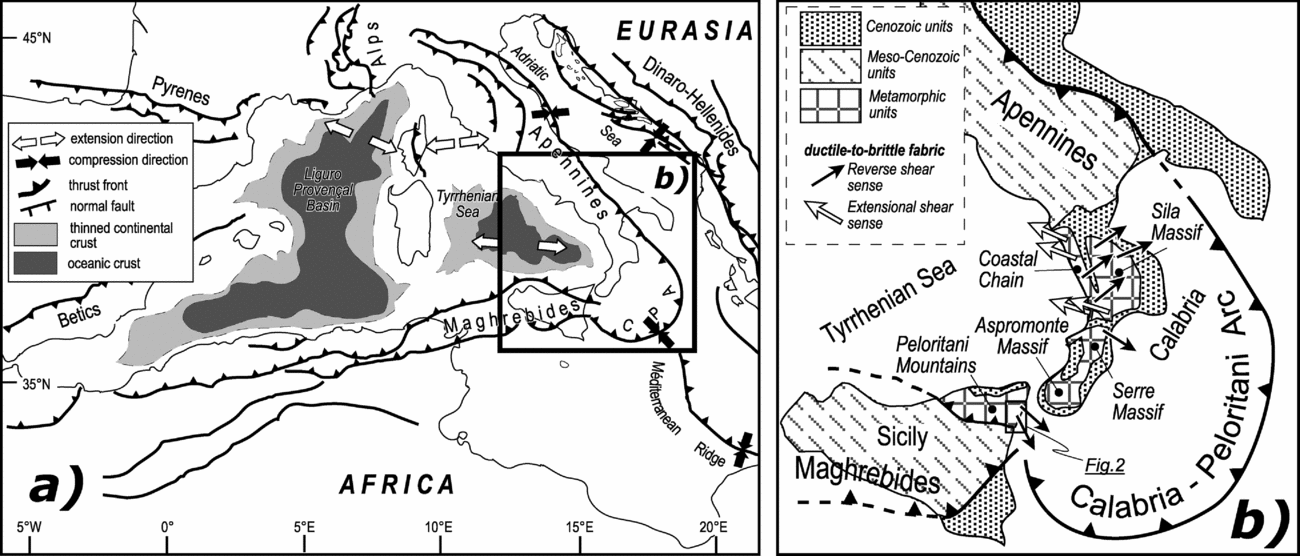
The Peloritani Mountains constitute the westward termination of the Calabria–Peloritani Arc (CPA) of southern Italy, an orogenic segment connecting the dominantly sedimentary thrust systems of the Apennines and the Maghrebides of the central Mediterranean region (Fig. 1a). Polymetamorphic oceanic- and continental-derived units are stacked in the tectonic edifice of the Calabria–Peloritani Arc (e.g. Ogniben, Reference Ogniben1969; Amodio Morelli et al. Reference Amodio Morelli, Bonardi, Colonna, Dietrich, Giunta, Ippolito, Liguori, Lorenzoni, Paglionico, Perrone, Piccarreta, Russo, Scandone, Zanettin-Lorenzoni and Zuppetta1976; Bonardi et al. Reference Bonardi, Giunta, Liguori, Perrone, Russo and Zuppetta1976, Reference Bonardi, Cavazza, Perrone, Rossi, Vai and Martini2001; Bouillin, Reference Bouillin1984; Rossetti et al. Reference Rossetti, Faccenna, Goffé, Monié, Argentieri, Funiciello and Mattei2001, Reference Faccenna, Piromallo, Crespo-Blanc, Jolivet and Rossetti2004). These metamorphic rocks record the history of subduction and exhumation during the Tertiary Alpine convergence between the African and European plates and the consumption of the intervening Tethyan oceanic domain (e.g. Dewey et al. Reference Dewey, Helman, Turco, Hutton, Knott, Coward, Dietrich and Park1989; Faccenna et al. Reference Faccenna, Piromallo, Crespo-Blanc, Jolivet and Rossetti2004). As such, they offer the possibility of studying the deformational and metamorphic recrystallization processes operating at depth during growth of the Alpine orogenic system. In particular, since most of the units involved in orogenic accretion are continental-derived, the Calabria–Peloritani Arc constitutes a key area for studying how buoyant continental material can be subducted at depth and accreted to form an orogenic wedge.
(a) Synthetic tectonic map of the Tyrrhenian–Apennine system in the framework of the central Mediterranean region (modified after Jolivet et al. Reference Jolivet, Faccenna, Goffé, Mattei, Rossetti, Brunet, Storti, Funiciello, Cadet, d'Agostino and Parra1998). (b) Geological sketch map of the Calabria–Peloritani Arc. Black and white arrows indicate, respectively, the reverse and the extensional ductile-to-brittle shear senses (hanging wall movement) detected in the basement units piled up in the Calabria–Peloritani Arc nappe stack (data from: Knott, Reference Knott1987; Dietrich, Reference Dietrich1988; Wallis Platt & Knott, Reference Wallis, Platt and Knott1993; Rossetti et al. Reference Rossetti, Faccenna, Goffé, Monié, Argentieri, Funiciello and Mattei2001, Reference Rossetti, Goffé, Monié, Faccenna and Vignaroli2004; Langone et al. Reference Langone, Gueguen, Prosser, Caggianelli and Rottura2006; this study).

The tectono-metamorphic evolution of the continental-derived units of the Calabria–Peloritani Arc are the subject of continuous debate, and open questions remain on: (i) their palaeotectonic attribution, ascribed either to the European (Ogniben, Reference Ogniben1969, Reference Ogniben1973; Bouillin, Reference Bouillin1984; Rossetti et al. Reference Rossetti, Goffé, Monié, Faccenna and Vignaroli2004) or the African (Haccard, Lorenz & Grandjacquet, Reference Haccard, Lorenz and Grandjacquet1972; Alvarez, Cocozza & Wezel, Reference Alvarez, Cocozza and Wezel1974; Amodio Morelli et al. Reference Amodio Morelli, Bonardi, Colonna, Dietrich, Giunta, Ippolito, Liguori, Lorenzoni, Paglionico, Perrone, Piccarreta, Russo, Scandone, Zanettin-Lorenzoni and Zuppetta1976; Bonardi et al. Reference Bonardi, Cavazza, Perrone, Rossi, Vai and Martini2001) plates; and (ii) their kinematic and tectonic evolution (Haccard, Lorenz & Grandjacquet, Reference Haccard, Lorenz and Grandjacquet1972; Amodio Morelli et al. Reference Amodio Morelli, Bonardi, Colonna, Dietrich, Giunta, Ippolito, Liguori, Lorenzoni, Paglionico, Perrone, Piccarreta, Russo, Scandone, Zanettin-Lorenzoni and Zuppetta1976; Knott, Reference Knott1987; Dietrich, Reference Dietrich1988; Platt & Compagnoni, Reference Platt and Compagnoni1990; Wallis, Platt & Knott, Reference Wallis, Platt and Knott1993; Bonardi et al. Reference Bonardi, De Capoa, Fioretti and Perrone1994, Reference Bonardi, Cavazza, Perrone, Rossi, Vai and Martini2001; Rossetti et al. Reference Rossetti, Faccenna, Goffé, Monié, Argentieri, Funiciello and Mattei2001, Reference Faccenna, Piromallo, Crespo-Blanc, Jolivet and Rossetti2004; Iannace et al. Reference Iannace, Bonardi, D'Errico, Mazzoli, Perrone and Vitale2005). Furthermore, both Alpine- (Dubois, Reference Dubois1970; Piccarreta, Reference Piccarreta1981; Rossetti et al. Reference Rossetti, Faccenna, Goffé, Monié, Argentieri, Funiciello and Mattei2001, Reference Faccenna, Piromallo, Crespo-Blanc, Jolivet and Rossetti2004) and Barrovian-type (Messina et al. Reference Messina, Compagnoni, Russo, De Francesco and Giacobbe1990; Bonardi et al. Reference Bonardi, Compagnoni, Messina, Perrone, Russo, De Francesco, Del Moro and Platt1992) metamorphic gradients are reported for these continental-derived units.
In this study, based on new field mapping and structural investigations, we first revise the nappe architecture of the eastern portion of the Peloritani Mountains and then describe the characteristics (in terms of structure and metamorphism) of the major shear zones bounding the exposed tectonic units. We provide evidence for progressive ductile-to-brittle, top-to-the-SSE shearing developed during HP to LP greenschist metamorphic conditions that we attribute to orogenic construction during active Apennine continental subduction. The results are then integrated with the existing background from the adjoining areas and are used (i) to present a new geodynamic model for the tectonic evolution of the Peloritani Mountains and (ii) to provide new constraints on the tectono-metamorphic evolution of the entire Apennine belt.
2. Geological background
The Alpine Peloritani belt consists of a series of south-verging continental-derived tectonic slices overlying the Apennine–Maghrebian domain (Lentini, Catalano & Carbone, Reference Lentini, Catalano and Carbone2000; Bonardi et al. Reference Bonardi, Cavazza, Perrone, Rossi, Vai and Martini2001). The geological mapping of this area is described in detail in Lentini, Catalano & Carbone (Reference Lentini, Catalano and Carbone2000) and Messina et al. (Reference Messina, Somma, Macaione, Carbone and Careri2004) and it will be summarized here. The tectonic edifice is structurally arranged in a reverse-order metamorphic stack, with the highest-grade metamorphic rocks above the lowest-grade ones. The main tectonic units are, from top to bottom: the Aspromonte unit, the Mela unit, the Mandanici unit, the Alì unit, the San Marco d'Alunzio unit, the Longi–Taormina unit and the Capo Sant'Andrea unit.
The Aspromonte unit is made of Hercynian high-grade metamorphic and intrusive rocks locally showing an Alpine metamorphic overprinting equilibrated in greenschist facies conditions (Messina et al. Reference Messina, Compagnoni, Russo, De Francesco and Giacobbe1990; Bonardi et al. Reference Bonardi, Compagnoni, Messina, Perrone, Russo, De Francesco, Del Moro and Platt1992). The Mela unit consists of Hercynian medium-grade gneisses, micaschists and amphibolites with eclogite relicts. This tectonic unit is affected by a penetrative ductile-to-brittle fabric, syn-kinematic with a Variscan low-pressure amphibolite metamorphism (Messina et al. Reference Messina, Perrone, Giacobbe and De Francesco1997). The Mandanici unit consists of a Palaeozoic basement (low-grade metaclastic rocks involving lenses of quartzites and metabasites) and a Jurassic–Oligocene sedimentary cover (e.g. Bonardi et al. Reference Bonardi, Cavazza, Perrone, Rossi, Vai and Martini2001). The metamorphic evolution of the Mandanici unit is still under debate. One group of authors refers the development of the polyphase metamorphic fabric to a Variscan orogenic event (Messina et al. Reference Messina, Somma, Macaione, Carbone and Careri2004; Somma, Messina & Mazzoli, Reference Somma, Messina and Mazzoli2005), whereas a second group recognizes the overprinting of an Alpine syn-greenschist metamorphic stage (Bonardi et al. Reference Bonardi, Giunta, Liguori, Perrone, Russo and Zuppetta1976; Zuppetta & Sava, Reference Zuppetta and Sava1987; Cirrincione & Pezzino, Reference Cirrincione and Pezzino1991, Reference Atzori, Cirrincione, Del Moro and Pezzino1994; Atzori et al. Reference Atzori, Cirrincione, Del Moro and Pezzino1994).
The Alì unit consists of a Permo-Triassic arenaceous–conglomeratic basement (‘Verrucano’-type for the oldest terrains) covered by a Lias–Cretaceous sequence, affected by a very low-grade metamorphic overprint (Bonardi et al. Reference Bonardi, Giunta, Liguori, Perrone, Russo and Zuppetta1976; Ferla & Azzaro, Reference Ferla and Azzaro1978; Cirrincione & Pezzino, Reference Cirrincione and Pezzino1991, Reference Cirrincione and Pezzino1994; Giunta & Somma, Reference Giunta and Somma1996). Some questions remain on the structural position of the Alì unit within the Peloritani edifice, as it crops out at both the bottom and the top of the Mandanici unit. Cirrincione & Pezzino (Reference Cirrincione and Pezzino1994) interpret the nature of the contact between the Alì unit and the Mandanici unit as stratigraphic, claiming the south-verging folding of the Mandanici unit. On the other hand, Ferla & Azzaro (Reference Ferla and Azzaro1978) propose that this contact is defined by south-verging thrust planes developed during the nappe stacking. The lowermost tectonic units (i.e. the San Marco d'Alunzio, the Longi–Taormina and the Capo Sant'Andrea units) show a similar stratigraphic succession, made of a Devonian polymetamorphic basement with a Mesozoic–Cenozoic sedimentary cover. Only pre-Alpine (Variscan in age) metamorphism has been reported from these units (e.g. Cirrincione, Atzori & Pezzino, Reference Cirrincione, Atzori and Pezzino1999; Bonardi et al. Reference Bonardi, Cavazza, Perrone, Rossi, Vai and Martini2001). The whole Peloritani tectonic edifice is unconformably covered by a late-orogenic sedimentary sequence of the Stilo–Capo d'Orlando Formation (Bonardi et al. Reference Bonardi, Giunta, Perrone, Russo, Zuppetta and Ciampo1980), whose basal deposits have been attributed a Burdigalian age (Bonardi et al. Reference Bonardi, De Capoa, Di Staso, Martìn-Martìn, Martìn-Rojas, Perrone and Tent-Manclùs2002).
Most of the previous studies have been devoted to the definition of the deformational phases affecting the Peloritani units (Amodio Morelli et al. Reference Amodio Morelli, Bonardi, Colonna, Dietrich, Giunta, Ippolito, Liguori, Lorenzoni, Paglionico, Perrone, Piccarreta, Russo, Scandone, Zanettin-Lorenzoni and Zuppetta1976; Bonardi et al. Reference Bonardi, Giunta, Liguori, Perrone, Russo and Zuppetta1976; Ferla & Azzaro, Reference Ferla and Azzaro1978; Zuppetta & Sava, Reference Zuppetta and Sava1987; Messina et al. Reference Messina, Compagnoni, Russo, De Francesco and Giacobbe1990, Reference Messina, Somma, Macaione, Carbone and Careri2004; Cirrincione & Pezzino, Reference Cirrincione and Pezzino1991, Reference Cirrincione and Pezzino1994; Atzori et al. Reference Atzori, Cirrincione, Del Moro and Pezzino1994; Giunta & Somma, Reference Giunta and Somma1996; Somma, Messina & Mazzoli, 2005). Structural data for the Mandanici and the Alì units show an overall south-verging deformational process, attributed either (i) two main folding events developed under epidiagenetic conditions (e.g. Cirrincione & Pezzino, Reference Cirrincione and Pezzino1991, Reference Cirrincione and Pezzino1994), or (ii) Late Oligocene piggy-back thrusting (Giunta & Somma, Reference Giunta and Somma1996; Giunta & Nigro, Reference Giunta and Nigro1999) controlling the terrigenous facies evolution and the stacking of the basement rocks. Recently, the tectonic contact between the Mandanici and the Alì units has been re-interpreted as a syn-orogenic extensional shear zone, considering the Mandanici metamorphism as pre-Alpine (Somma, Messina, & Mazzoli, Reference Iannace, Bonardi, D'Errico, Mazzoli, Perrone and Vitale2005).
The age of the Alpine deformation in the Peloritani Mountains is commonly referred to the Oligocene–Early Miocene (e.g. Amodio-Morelli et al. Reference Amodio Morelli, Bonardi, Colonna, Dietrich, Giunta, Ippolito, Liguori, Lorenzoni, Paglionico, Perrone, Piccarreta, Russo, Scandone, Zanettin-Lorenzoni and Zuppetta1976; Bonardi et al. Reference Bonardi, Giunta, Liguori, Perrone, Russo and Zuppetta1976; Cirrincione & Pezzino, Reference Cirrincione and Pezzino1994; Giunta & Somma, Reference Giunta and Somma1996; De Capoa et al. Reference De Capoa, Guerrera, Perrone and Serrano-Lozano1997; Giunta & Nigro, Reference Giunta and Nigro1999; Lentini, Catalano & Carbone, Reference Lentini, Catalano and Carbone2000). The available biostratigraphic data, derived from the Stilo–Capo d'Orlando Formation (Bonardi et al. Reference Bonardi, De Capoa, Di Staso, Martìn-Martìn, Martìn-Rojas, Perrone and Tent-Manclùs2002, Reference Bonardi, De Capoa, Di Staso, Estévez, Martín-Martín, Martín-Rojas, Perrone and Tent-Manclús2003) and the sedimentary cover of the Longi–Taormina unit (De Capoa et al. Reference De Capoa, Guerrera, Perrone and Serrano-Lozano1997), constrain the age of the late-stage stacking process to the Aquitanian–Burdigalian boundary. Radiometric analyses have been performed on the Mandanici and Aspromonte rocks. Rb–Sr analysis on phengite from the Mandanici unit (Atzori et al. Reference Atzori, Cirrincione, Del Moro and Pezzino1994) gives a mean value of 26±1 Ma, interpreted by the authors as the age of the Alpine metamorphism climax reached during the Peloritani stacking. On the other hand, De Gregorio, Rotolo & Villa (Reference De Gregorio, Rotolo and Villa2003) performed 39Ar–40Ar dating of muscovite and biotite from pervasive shear zones at the base of the Aspromonte unit and obtained ages spanning from 61 to 29 Ma. Finally, fission track apatite thermochronology from the Mandanici unit constrains timing of the final exhumation of the continental-derived basement units to the Early Miocene (21.1±5.2 Ma; Thomson, Reference Thomson1994).
3. Structural analysis
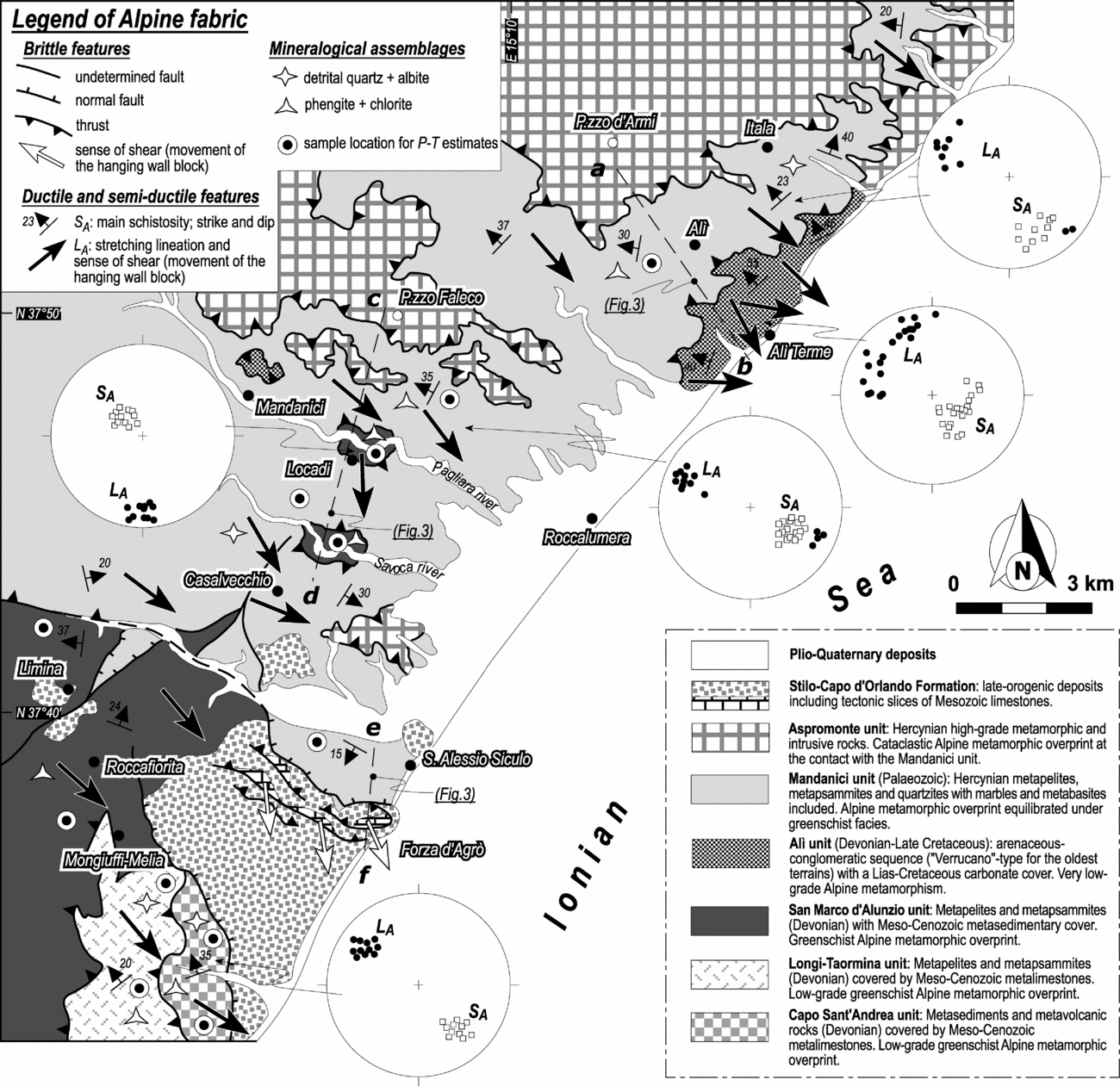
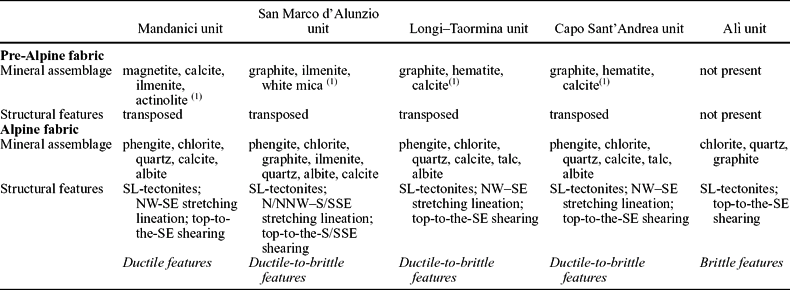
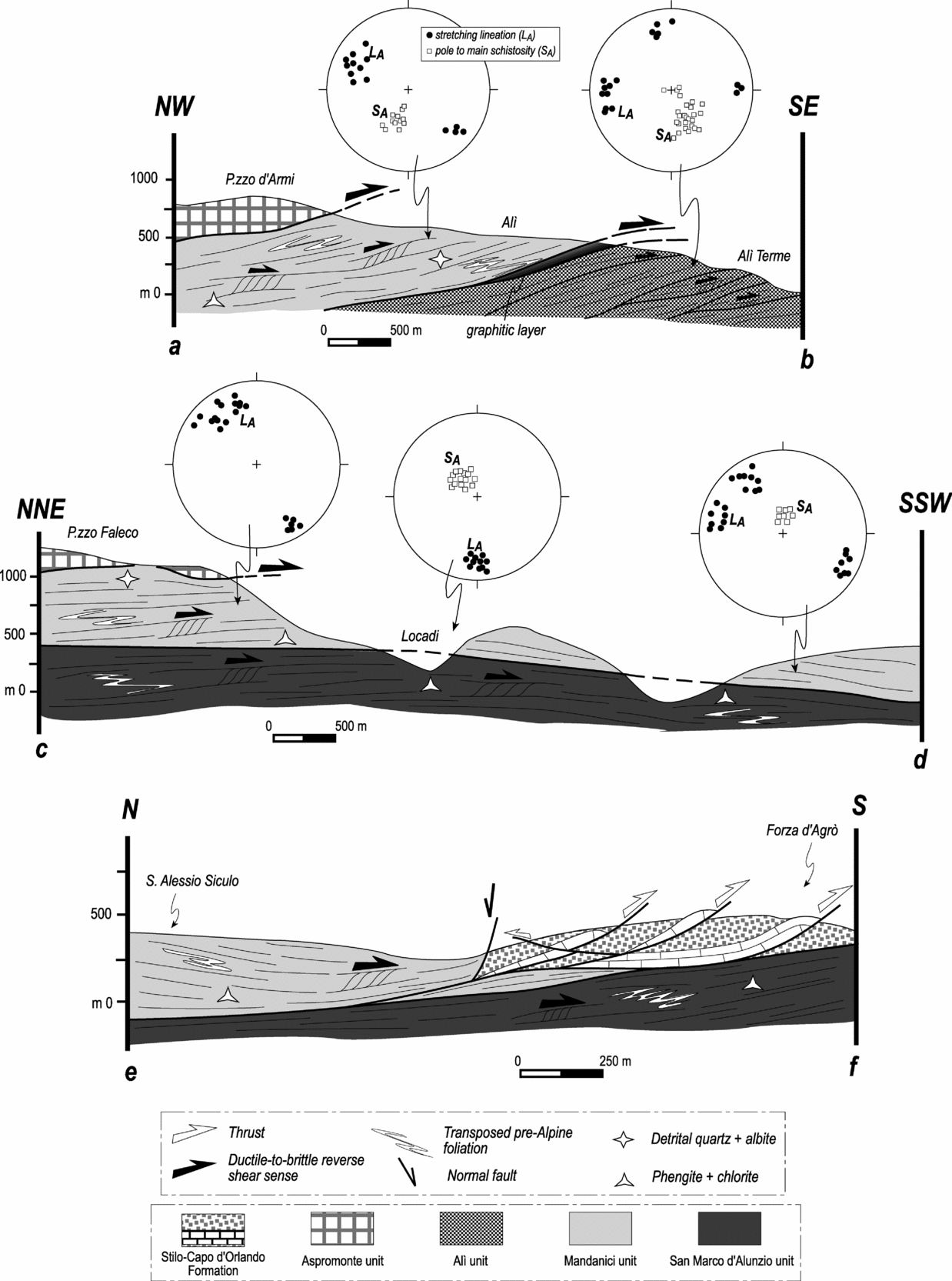
Structural investigations were primarily addressed to define the kinematics of the major shear zones bounding the tectonic units piled up in the eastern portion of the Peloritani Mountains. The main Alpine plano-linear fabric of each unit is described in terms of strike and dip of the foliation (SA), and trend and plunge of the stretching lineation (LA). These data are integrated together with the direction of tectonic transport (defined as the movement of the hanging wall block) obtained by the analysis of the meso- and the micro-scale kinematic indicators (e.g. Passchier & Trouw, Reference Passchier and Trouw1996) in sections oriented orthogonal to the main foliation and parallel to the main stretching lineation (X–Z sections of the finite strain ellipsoid). The results are presented in the structural–geological map of Figure 2, together with indication of the main Alpine mineralogical assemblages found in each tectonic unit (see also Table 1). The structural architecture of the Peloritani nappe edifice in the study area is then synthesized in the cross-sections shown in Figure 3.
Synthetic geological map of the eastern Peloritani Mountains (modified and readapted after Lentini, Catalano & Carbone, Reference Lentini, Catalano and Carbone2000). The Alpine SL-fabric is shown together with the associated sense of shear (arrows). Representative stereoplots (Schmidt net, lower hemisphere projection) are also given.

Relationships between metamorphism and deformation in the tectono-metamorphic units of the Peloritani orogenic belt

(1)after this work and Messina et al. Reference Messina, Somma, Macaione, Carbone and Careri2004
Schematic cross-sections showing the structural relationships between the main tectonic units that made up the eastern Peloritani nappe stack (see Fig. 2 for cross-section locations and the legend). In the cross-section e–f, the vertical scale is doubled. The stereoplots (Schmidt net, lower hemisphere projection) show the attitude of the Alpine plano-linear (SA–LA) fabric in the different tectonic units.

3.a. The Aspromonte–Mandanici contact
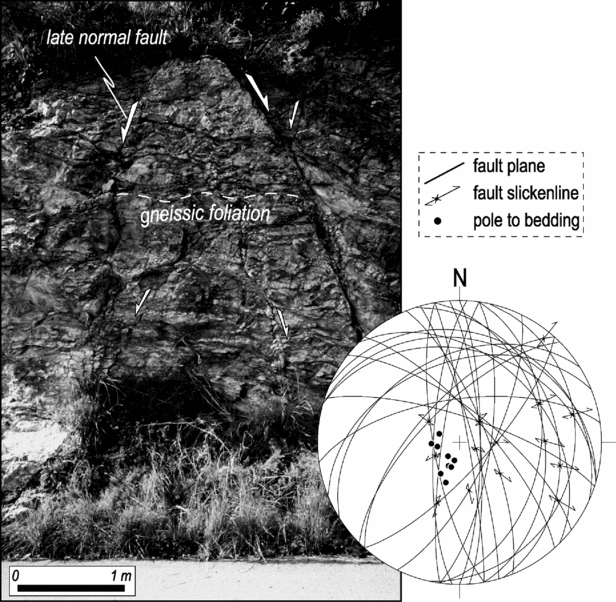
The Aspromonte unit consists of a tectonic megaslice made of dominant paragneisses and subordinate orthogneisses and amphibolites, Hercynian in age. In the study area, we did not recognize the eclogite relicts of the Mela unit (e.g. Messina et al. Reference Messina, Somma, Macaione, Carbone and Careri2004). According to many authors (e.g. Bonardi et al. Reference Bonardi, Giunta, Liguori, Perrone, Russo and Zuppetta1976; Messina et al. Reference Messina, Somma, Macaione, Carbone and Careri2004), the occurrence of the Alpine metamorphic overprint in the Aspromonte unit is poorly developed and limited to narrow semi-brittle shear zones occurring at the contact with the underlying Mandanici unit. This tectonic contact consists of flat-lying cataclastic shear surfaces (see also Lentini, Catalano & Carbone, Reference Lentini, Catalano and Carbone2000) (Figs 2, 3). Kinematic analysis documented dominant top-to-the-S/SE shearing features, such as SC-structures and C′-type shear planes. Post-orogenic N–S-striking, high-angle extensional faults (Fig. 4) dissect the Aspromonte–Mandanici contact.
Late high-dipping normal faults occurring in the Aspromonte unit. The collected structural data represented in the steroplot (Schmidt net, lower hemisphere projection) document a general E–W-trending maximum extension direction.

3.b. The Mandanici-Alì contact
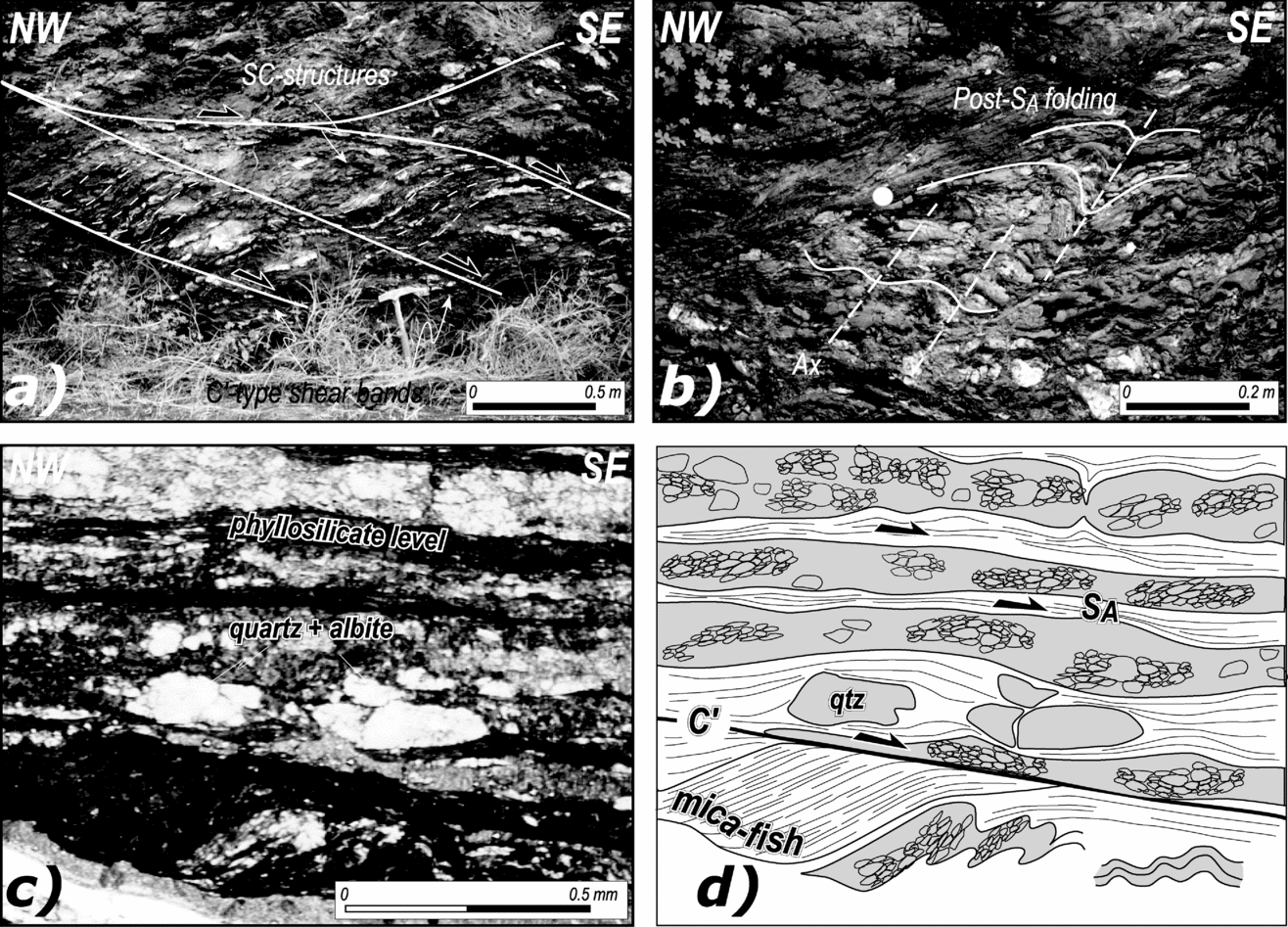
Detailed observations of this contact were done in the area near Alì village (Fig. 2). The contact is marked by a gently NW-dipping, top-to-the-SE shear zone, in which a metre-thick graphitic fault gouge occurs (cross-section a–b in Fig. 3). Much of the shear deformation is accommodated within the Mandanici unit that indeed consists of an SL-tectonite. The SA foliation in the Mandanici unit is generally flat-lying, with a mean dip towards the WNW. It is defined by the mineralogical assemblage made of phengite (Si4+=3.24–3.29 atoms per unit formula, a.p.u.f.)+chlorite(Mg/[Mg+Fe2+]=0.65–0.70)+albite+quartz. The LA stretching lineation is marked by quartz–phengite composite associations, showing a main NW–SE to NNW–SSE trend (stereoplots in Figs 2, 3). In sections parallel to LA and perpendicular to SA, various types of kinematic indicators were observed at any scale. In particular, at the meso-scale, SC-fabric and C′-type shear bands provide a general top-to-the-SE/SSE shear sense (Fig. 5a). Texturally late, high-angle, NW-dipping crenulation cleavage overprints the ductile shear feature, attesting for the progressive evolution of shearing towards brittle-dominated conditions (Fig. 5b). At the micro-scale, oblique foliation, SC-fabric and mica-fish are always coherent with the top-to-the-SE sense of shear (Fig. 5c, d). An increased deformation was noted in the Mandanici unit approaching the boundary with the underlying San Marco d'Alunzio unit, where diffuse mylonitization occurs.
The Alpine fabric in the Mandanici unit. (a) SC-structures and C′-type shear bands indicating top-to-the-SE sense of shear. (b) Texturally late folding of the Alpine mylonitic fabric (Ax=axial surface). (c) Thin section and (d) interpretative line drawing showing the growth of chlorite–white mica composite associations along the C-surfaces and around ductile-to-cataclastic deformed quartz grains (natural light). qtz=quartz.

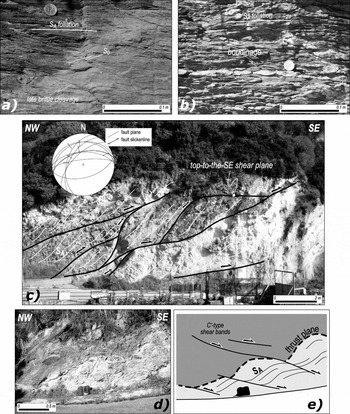
In the Alì unit, the SA foliation transposes the primary sedimentary layering during boudinage of the most competent layers (Fig. 6a, b). At the meso-scale, this unit consists of the coalescence of imbricated shear lenses along NW-dipping, semi-brittle, metre-thick shear zones (Fig. 6c). A marked textural reorganization occurs along these shear zones, and calcite+albite associations define the main NW–SE stretching lineation. The SA foliation is penetrative within the shear domains and is defined by chlorite–calcite–albite composite associations. SC-fabric with associated C′-type shear bands systematically indicate a top-to-the-SE/SSE sense of shear (Fig. 6d, e).
The Alpine fabric in the Alì unit. (a) The Alpine foliation (SA) overprinting the pristine sedimentary layering (S0). (b) Boudinage and transposition of S0 during formation of SA. (c) SE-verging thrust fault systems affecting the upper portions of the unit. The steroplot (Schmidt net, lower hemisphere projection) illustrates the collected structural data. (d) and (e) Synthetic C′-type shear bands overprinting the early thrust contact, indicating top-to-the-SE shearing.

3.c. The Mandanici–San Marco d'Alunzio contact
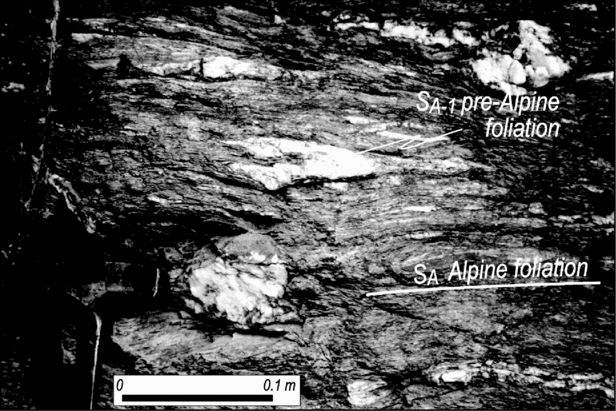
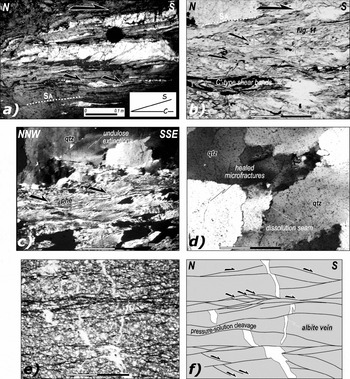
This tectonic contact is well exposed along the stream cuts of the Pagliara and Savoca rivers (Fig. 2), where it consists of a flat-lying ductile-to-brittle shear zone (cross-section c–d in Fig. 3). The ductile deformational fabric in the San Marco d'Alunzio unit is defined by a penetrative plano-linear fabric (SL-tectonite) that reworks and transposes an early one (possibly pre-Alpine), preserved as rootless folds within the SA main foliation (Fig. 7). The Alpine mineralogical assemblage is defined by the crystallization of phengite (Si4+ = 3.14–3.19 a.p.u.f.) + chlorite (XMg = 0.45–0.50)+quartz+albite. The main stretching lineation is mostly provided by quartz+phengite associations and generally trends from NNW–SSE to N–S. Development of a mylonitic fabric is observed in the San Marco d'Alunzio unit at both micro- and meso-scale. Shear sense criteria (as provided by SC-fabric and C′-type shear bands and mica-fish structures) are always consistent with a top-to-the-SSE/S tectonic transport (Fig. 8a–c). At the micro-scale, shearing is systematically associated with the crystallization of phengite–chlorite pairs along the C-surfaces (Fig. 8b, c). Quartz microfabric shows evidence of ductile deformation that is highly inhomogeneous at the thin section scale. Crystal plastic deformation of quartz is mainly indicated by patchy undulose extinction, whereas subgrain boundaries are poorly developed. Inhomogeneity of deformation is documented by the presence of diffuse deformation bands and the effects of dissolution–precipitation creep. Local concentration of deformation into mica layers is also observed, with dissolution of quartz enhanced along quartz–mica interfaces (Fig. 8c). Coarse-grained quartz crystals show dissolution seams at the grain edges and the diffuse presence of healed micro-fractures (Fig. 8d). Ductile shearing progressively evolves towards more brittle conditions with the development of top-to-the-SSE/S cataclastic shear zones, dominantly assisted by dissolution–precipitation creep (Fig. 8e, f).
The Alpine foliation (SA) obliterating the pre-Alpine metamorphic fabric (SA–1) in the San Marco d'Alunzio unit.

The Alpine fabric in the San Marco d'Alunzio unit. (a) Meso-scale top-to-the-S kinematic indicators. (b) Micro-scale top-to-the-S kinematic indicators (oblique foliation; C′-type shear bands). Thin section is in natural light. (c) Thin section (crossed polars) showing the inhomogeneous character of the Alpine deformation. Ductile flow is mainly accommodated at the quartz–mica interface. Quartz crystal shows moderate patchy undulose extinction and minor fracturing. C′-type shear bands indicate top-to-the-S shearing. (d) Enlargement of the quartz grains in (c), showing structures typical of pressure-solution creep. (e) Thin section (natural light) and (f) interpretative line drawing attesting to predominant pressure-solution deformation associated with top-to-the-S shearing. phe=phengite; qtz=quartz.

3.d. The San Marco d'Alunzio–Longi–Taormina contact
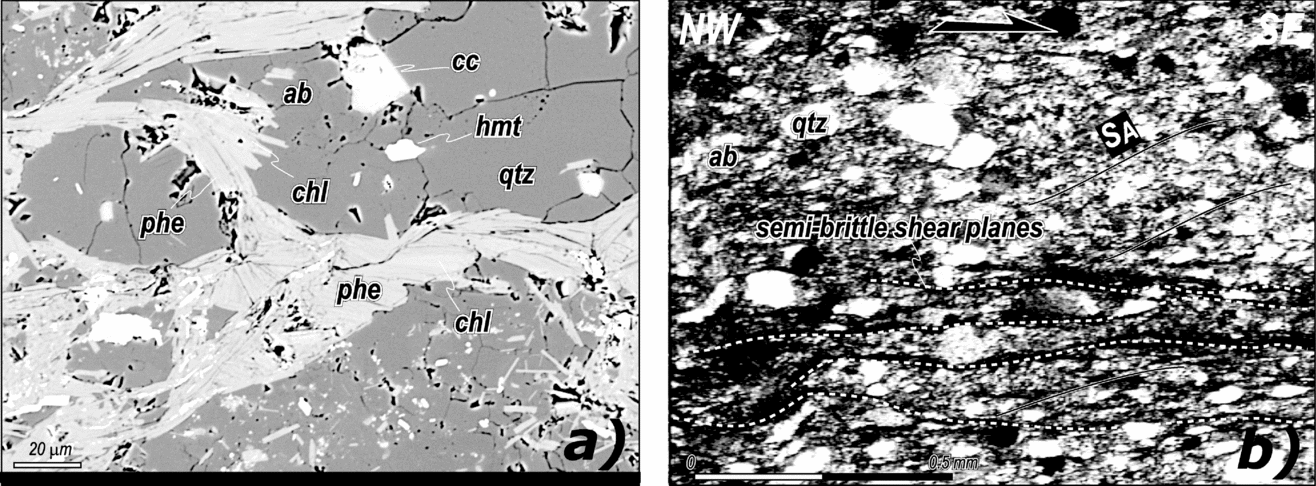
This tectonic contact is marked by N–S-striking ductile-to-brittle shear zones, often reworked by late sinistral transpressive and normal fault systems. In the Longi–Taormina unit the main Alpine mineralogical assemblage is composed by phengite (Si4+=3.30–3.38 a.p.u.f.) and chlorite (XMg=0.48–0.56) along the SA foliation, seldom in association with quartz, albite and minor calcite and hematite (Fig. 9a). The deformational fabric consists of plano-linear structures, developed under non-coaxial (top-to-the-SE) shearing. Fluid-assisted pressure-solution was recognized as the main operative deformational mechanism.
(a) BSE image showing phengite–chlorite composite associations and quartz grains defining the Alpine SA foliation in the Longi–Taormina unit. (b) Photomicrograph (crossed polars) showing the Alpine semi-brittle deformational fabric in the Capo Sant'Andrea unit attesting to top-to-the-SE shearing. ab=albite; cc=calcite; chl=chlorite; hmt=hematite; qtz=quartz; phe=phengite.

3.e. The Longi–Taormina–Capo Sant'Andrea contact
Located in the southeastern portion of the study area, this tectonic contact is represented by a roughly N–S-striking ductile-to-brittle shear zone, often dissected by late normal and transcurrent faults. The attitude of the tectonic contact is sub-horizontal or gently dipping towards the WNW, always parallel to the SA foliation attitude in both the tectonic units. The Alpine fabric in the Capo Sant'Andrea unit consists of semi-brittle deformational structures developed under top-to-the-SE shearing as attested by the oblique foliation (Fig. 9b). The main Alpine mineralogical assemblage is represented by phengite (Si4+=3.18–3.35 a.p.u.f.), chlorite (XMg=0.50), quartz, calcite and albite.
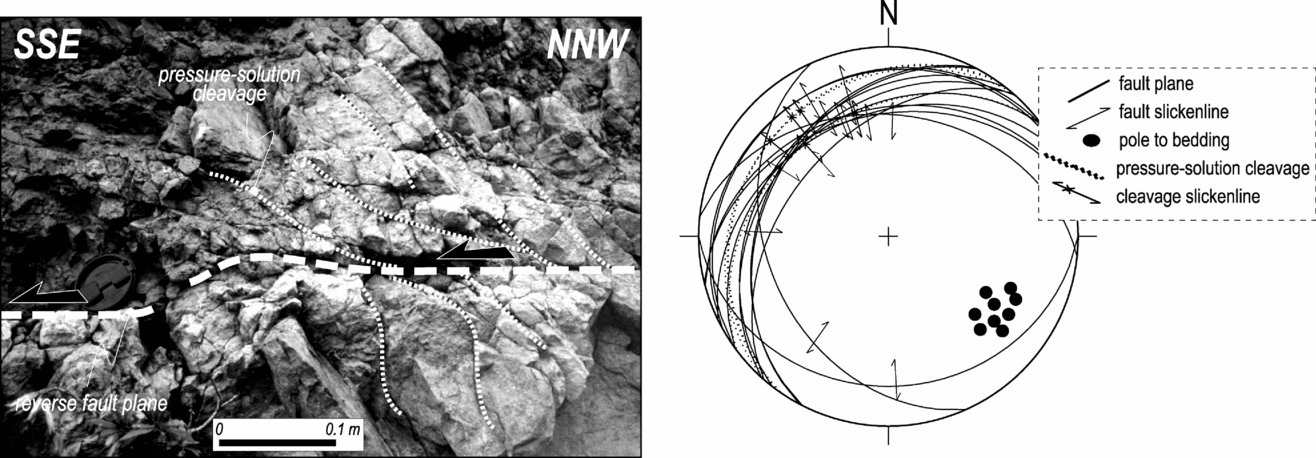
Near Forza d'Agrò (Fig. 2), the turbiditic sequences of the Stilo–Capo d'Orlando Formation include mega-blocks of Mesozoic limestones, commonly interpreted as olistoliths (Bonardi et al. Reference Bonardi, De Capoa, Di Staso, Estévez, Martín-Martín, Martín-Rojas, Perrone and Tent-Manclús2003 and references therein). The limestone blocks are systematically bounded by N/NW-dipping tectonic surfaces that determine an overall imbricate fan structure (cross-section e–f in Fig. 3). Kinematic criteria are dominantly provided by SC-structures and indicate top-to-the-S/SE shearing (Fig. 10).
Brittle deformation features recorded in the Mesozoic limestone tectonic slices enclosed within the sedimentary sequence of the Stilo–Capo d'Orlando Formation. Kinematic indicators (oblique pressure-solution cleavage defining a SC-fabric) are coherent with a top-to-the-SSE sense of shear. The stereoplot shows the collected structural data (Schmidt net, lower hemisphere projection).

4. P–T conditions during the Alpine shearing
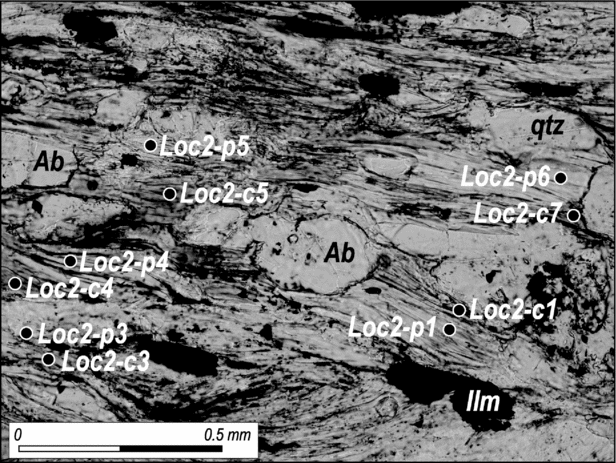
In this study, relationships between the Alpine shearing and the associated P–T evolution were estimated by considering the chemical equilibria of coexisting mineral phases at the thin section scale. In particular, the P–T estimates were based on the chlorite–white mica local equilibrium method (Parra, Vidal & Jolivet, Reference Parra, Vidal and Jolivet2002) by choosing texturally equilibrated chlorite–mica pairs growing along the Alpine shear bands in the different tectonic units of the Peloritani nappe edifice (Figs 8b, Figs 11). The consistency of the obtained petrological data is given by the application of the same method of calculation applied to the same mineralogical assemblage in all the tectonic units showing an Alpine overprint.
Enlargement of Figure 8b showing locations of representative microprobe analyses carried out on phengite– chlorite pairs used for P–T calculations. Thin section is in natural light. Ab=albite; Ilm=ilmenite; qtz=quartz.

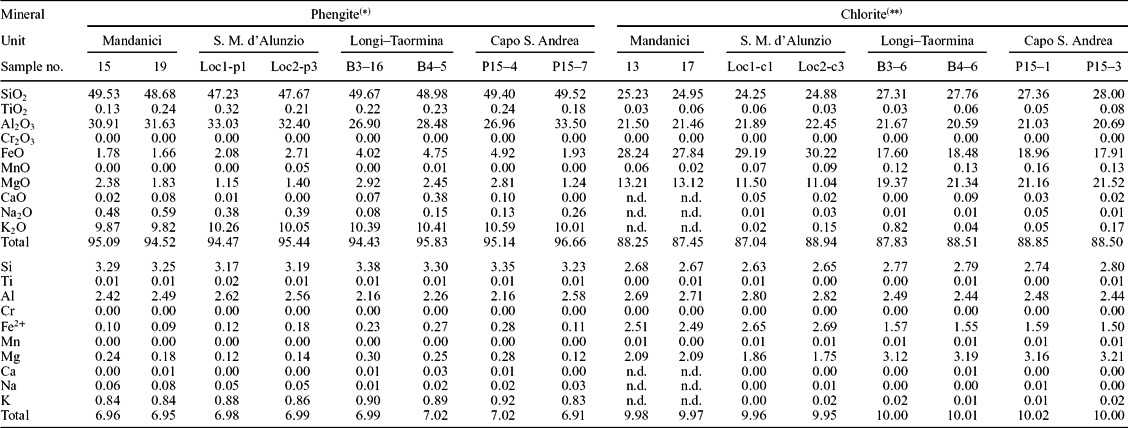
The sample locations for P–T estimates are shown in Figure 3. Representative analyses and structural formulae of phengite and chlorite are reported in Table 2. Details of the analytical method are listed in the Appendix.
Representative electron microprobe analyses of phengite and chlorite
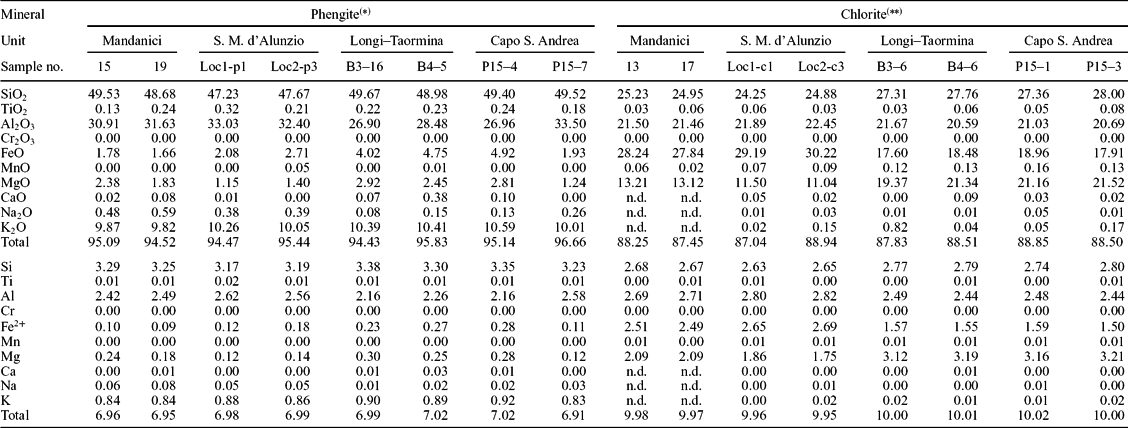
All iron considered as FeO. n.d.= not detected.(*)Amounts of cations are based on 11 oxygens. (**)Amounts of cations are based on 14 oxygens.
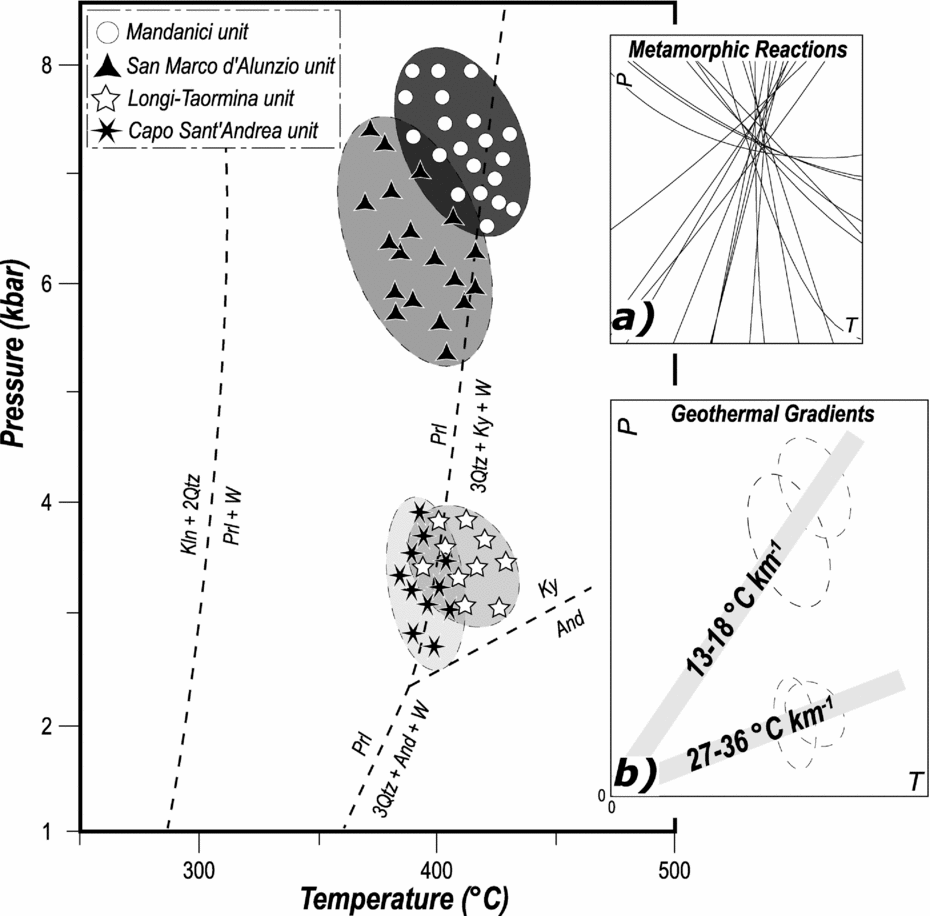
To evaluate the metamorphic P–T conditions, we applied the thermodynamic dataset of Berman (Reference Berman1990) delivered with TWQv2.02 software (Berman, Reference Berman1991). In addition, for chlorite and white mica, the non-ideal solution models of Vidal, Parra & Trotet (Reference Vidal, Parra and Trotet2001) and Parra, Vidal & Agard (Reference Parra, Vidal and Agard2002) have been used. The thermobarometric estimates were defined by considering the intersection of 19 calculated univariant equilibria in the P–T field, with a set of four of them being linearly independent. The considered end-member components of both chlorite and white mica and the list of the univariant equilibria are given in the Appendix. In the ideal case, all equilibria (1) to (19) should intersect in a single point defining the P–T conditions of the metamorphic equilibration of the rock specimen. Scattering of the intersection is due to poorly known thermodynamic properties as well as due to non-equilibrium compositions of the minerals used for the calculation. The latter case becomes obvious when the range of scattering of the intersections is large, i.e. >60 °C. Consequently, such chlorite–muscovite pairs have not been further considered. The overall error 1σ of P–T conditions for samples with well-defined equilibria intersections is estimated to be ±30 °C and ±2 kbar. In Figure 12, each symbol represents the centre of equilibrium curve intersections.
P–T estimates of the Alpine metamorphic overprint as recorded in the Mandanici, San Marco d'Alunzio, Longi–Taormina and Capo Sant'Andrea units. The inset boxes show (a) the trend of the 19 calculated univariant equilibria for the chlorite–white mica mineralogical equilibria, and (b) the trend of the geothermal gradients obtained from the P–T estimates. See text for further details. And=andalusite; Kln=kaolinite; Ky=kyanite; Prl=pyrophyllite; Qtz=quartz; W=water.

For samples belonging to the Mandanici and the San Marco d'Alunzio units, P–T conditions were obtained by the intersections of all 19 univariant equilibria listed in the Appendix. Chlorite–phengite pairs from the Mandanici unit indicate pressure in the range of 6.5–8 kbar at 375<T<440 °C. Similarly, chlorite–phengite equilibria from the San Marco d'Alunzio unit result in 5<P<7.5 kbar and 360<T<430 °C (Fig. 12). For samples belonging to the Longi–Taormina and the Capo Sant'Andrea units, the thermobarometric conditions were defined by the intersections of the univariant equilibria (1), (2), (4), (5), (7) and (8), which provide P values in the order of 3–4 kbar and 380<T<440 °C and 2.5–4 kbar and 375<T<420 °C, respectively (Fig. 12).
Two major points can be extracted from these data: (i) the Alpine shearing was equilibrated within the HP (Mandanici and San Marco D'Alunzio units) or the LP (Longi–Taormina and Capo Sant'Andrea units) greenschist facies field; and (ii) a progressive increase in the pressure conditions can be observed when moving from the lowermost tectonic units (the Longi–Taormina and the Capo Sant'Andrea units) to the overlying ones (the Mandanici and the San Marco d'Alunzio units). The estimated P–T metamorphic conditions conform to distinctly different geothermal gradients during progress of the Alpine orogenic metamorphism in the Peloritani Mountains (Fig. 12). In particular, assuming a lithostatic thermobaric gradient of 27 MPa km−1, a geothermal gradient of 13–18 °C km−1 and 28–36 °C km−1 can be calculated for the HP and LP groups of units, respectively. This metamorphic configuration refers to the tectonic processes through which the nappe stacking of the Peloritani units occurred.
5. Discussion
5.a. Structural interpretation
With the exception of the main body of the Aspromonte unit, our meso- and micro-scale structural observations document the development of a penetrative Alpine syn-metamorphic plano-linear fabric associated with ductile-to-brittle top-to-the-S/SE shearing in the all of the continental-derived units that make up the Peloritani nappe stack. The analysis of the kinematic indicators at any scale indicates that there is not a structural break in terms of shearing and kinematic features inside the tectonic edifice. A systematic top-to-the-S/SE (i.e. towards the Apennine–Maghrebian foreland) shearing is observed when moving from the ductile-dominated domain (mylonites of the Mandanici and the San Marco d'Alunzio units) to the brittle-dominated domain (discrete reverse fault systems in the Alì unit). The estimates of P–T conditions during the Alpine shearing document an overall inverse-type nappe arrangement within the Peloritani tectonic edifice, when moving from the structurally highest tectonic unit (the Mandanici unit) to the lowermost ones (the Longi–Taormina and the Capo Sant'Andrea units). As documented in several orogenic domains, the juxtaposition of tectonic units in an inverse-order metamorphic sequence can be framed in a tectonic scenario dominated by orogenic thickening and nappe emplacement of rootless metamorphic and non-metamorphic rocks along major reverse-sense shear zones (e.g. England & Thompson, Reference England and Thompson1984; Spear, Hickmott & Selverstone, Reference Spear, Hickmott and Selverstone1990; Srivastava & Mitra, Reference Srivastava and Mitra1996). These findings therefore constrain the tectonic evolution of the Peloritani Mountains in a scenario of a continuous stacking of crustal units. In this sense, we found no evidence of extensional processes active during convergence as proposed by Somma, Messina & Mazzoli (Reference Iannace, Bonardi, D'Errico, Mazzoli, Perrone and Vitale2005).
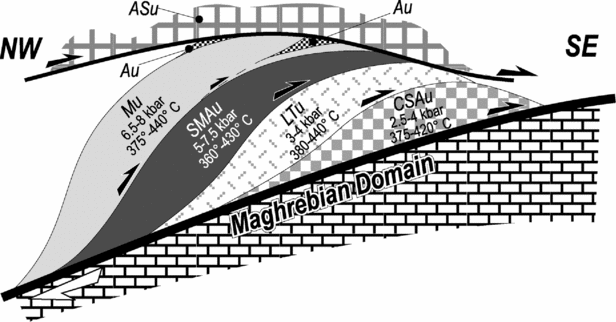
Taking into account (i) the general northwestern dipping attitude of the SA foliation at regional scale (Fig. 2 and cross-section a–b in Fig. 3), (ii) the sub-horizontal attitude of the gneissic mega-slices of the Aspromonte unit lying on top of the whole nappe edifice, and (iii) the lack of evidence for the Alpine overprint in the Aspromonte unit itself, it is reasonable to consider the eastern Peloritani Mountains as a S/SE-vergent antiformal stack (e.g. Butler, Reference Butler2004) in which the Aspromonte unit defines the roof thrust of the entire tectonic edifice (Fig. 13). Our structural and kinematic data also document that the top-to-the-S/SE compressional shearing involved the sedimentary sequences of the Stilo–Capo d'Orlando Formation. The deformational structures then attest that nappe stacking evolved in time and space towards more superficial crustal levels. The piggy-back model proposed by Giunta & Somma (Reference Giunta and Somma1996) and Giunta & Nigro (Reference Giunta and Nigro1999) is considered here as the most appropriate one to explain the latest deformational structures recognized in the study area.
Schematic structural model for the nappe stacking order in the eastern Peloritani Mountains. The structural architecture is interpreted in terms of a S/SE-verging nappe stack. Au: Alì unit; Asu: Aspromonte unit; CSAu: Capo Sant'Andrea unit; LTu: Longi–Taormina unit; Mu: Mandanici unit; SMAu: San Marco d'Alunzio unit. Not to scale.

5.b. Tectonic synthesis
The collected structural data have documented that the Alpine orogenic construction involved a significant component of S/SE-directed non-coaxial flow in the Peloritani region. This shear sense is globally compatible with the polarity of subduction and nappe emplacement during the Apennine orogeny. P–T estimates attest that this non-coaxial shearing took place at a maximum depth of about 20 km (Mandanici unit). Deformation at the metamorphic climax continued during exhumation and progressed toward more brittle conditions with the same kinematics. The thermobarometric estimates indicate that orogenic thickening did not occur under the suppressed geothermal conditions typical of subduction-zone metamorphism (i.e. metamorphic gradients ≤10 °C km−1; e.g. Spear, Reference Spear1993). Rather, they conform to a Barrovian metamorphic gradient (with values up to 35 °C km−1) that is instead distinctive of a continental subduction setting (e.g. Thompson & England, Reference Thompson and England1984; Spear, Reference Spear1993; Goffé et al. Reference Goffé, Bousquet, Henry and Le Pichon2003). Furthermore, the lack of HP ophiolitic units in the Peloritani nappe edifice suggests that the oceanic subduction was probably very limited in this area with respect to other sectors of the Calabria–Peloritani Arc (i.e. in the Coastal Chain and Sila Massif of Calabria; Rossetti et al. Reference Rossetti, Goffé, Monié, Faccenna and Vignaroli2004). The age of the continental subduction in the Peloritani Mountains can be constrained by using the geochronological data from Atzori et al. (Reference Atzori, Cirrincione, Del Moro and Pezzino1994) and De Gregorio, Rotolo & Villa (Reference De Gregorio, Rotolo and Villa2003), which allow inference of a Late Oligocene age for the Alpine metamorphism in the Peloritani region. The latest stage of deformation can be placed in the Aquitanian–Burdigalian interval, based on apatite fission track thermochronology (Thomson, Reference Thomson1994) and the age of the sedimentary deposits involved in the stacking process (De Capoa et al. Reference De Capoa, Guerrera, Perrone and Serrano-Lozano1997).
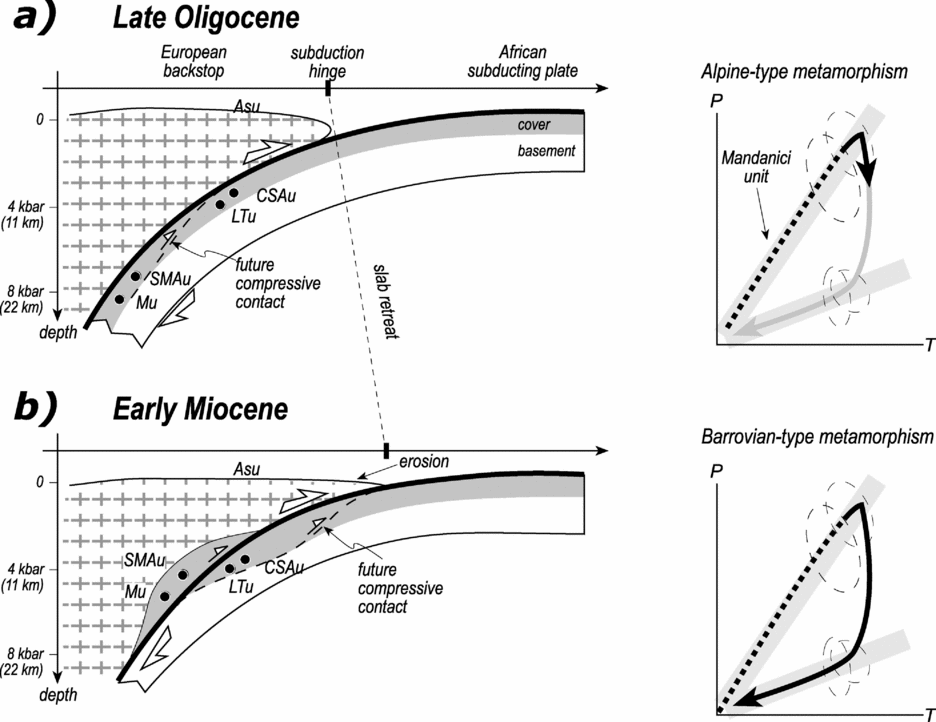
Based on these arguments, the orogenic evolution of the Peloritani Mountains has to be referred to a geodynamic scenario dominated by continental subduction framed within the Tertiary convergence between the African and European plates after the consumption of the intervening Liguro-Piemontese oceanic domain during the building up of the Apennine chain (e.g. Faccenna et al. Reference Faccenna, Piromallo, Crespo-Blanc, Jolivet and Rossetti2004). We propose a model of subduction and exhumation where the continental units were dragged downward along with the subducting lithosphere and were accreted to the upper plate in a hinterland-dipping backstop configuration in a period spanning from Late Oligocene to Early Miocene time (Fig. 14). In particular, kinematics reconstructed within the nappe edifice suggest that the structural architecture may correspond to shearing within the inner portions of the orogenic wedge in the region, delimited by the subducting African plate at depth and by the European rigid backstop at the rear. The way back to the surface for the subducted material was controlled by (i) buoyancy forces, (ii) forces due to shearing and (iii) the geometry of the backstop (e.g. Cloos, Reference Cloos1982), concomitant with the erosion process at the top of the stack (e.g. Platt, Reference Platt1993). In this scenario, the Peloritani continental units affected by pervasive Alpine tectono-metamorphic overprint (Mandanici, San Marco d'Alunzio, Longi–Taormina and Capo Sant'Andrea units) are placed on the subducting plate, whereas the Aspromonte unit is considered as a remnant of the European backstop (Fig. 14a). During the early stages of continental subduction, orogenic accretion occurred under relatively suppressed geothermal conditions (metamorphic gradients of 13–18 °C km−1) and the accretionary wedge grew at the expense of the continental sectors proximal to the collisional front (from which the Mandanici and the San Marco d'Alunzio units originated). The active front then migrated towards the SE, with the involvement of the more external tectonic units (i.e. the Longi–Taormina and the Capo Sant'Andrea units) in a regime of higher geothermal gradient conditions (in the order of 30 °C km−1). The underthrusting of new tectonic slices was accompanied by the nearly isothermal exhumation of the earlier buried ones that constituted the new backstop of the orogenic system (Fig. 14b). Assembly of the tectonic units occurred under Barrovian-type metamorphic conditions, resulting in a SE-verging antiformal stack. The units belonging to the more external portions of the African margin were, instead, progressively scraped off from the downgoing subducting plate and accreted under brittle conditions to form a thrust-and-fold belt (Giunta & Somma, Reference Giunta and Somma1996; Giunta & Nigro, Reference Giunta and Nigro1999). The in-sequence thrust front migration in the proximal foreland caused the final exhumation of the Peloritani metamorphic edifice and its tectonic juxtaposition onto the Maghrebian domain (Maghrebian flysch units and external Panormide units; Bonardi et al. Reference Bonardi, Cavazza, Perrone, Rossi, Vai and Martini2001), with the deformation of the intervening Stilo–Capo d'Orlando Formation occurred at the Aquitanian–Burdigalian boundary (e.g. Bonardi et al. Reference Bonardi, Giunta, Perrone, Russo, Zuppetta and Ciampo1980, Reference Bonardi, De Capoa, Di Staso, Martìn-Martìn, Martìn-Rojas, Perrone and Tent-Manclùs2002).
Two-stage synthetic geodynamic scenario for possible tectonic evolution of the Peloritani Mountains in the framework of the Apennine orogeny. The formation of the Peloritani wedge occurred by the continuous accretion of continental-derived material during progressive outward migration of the accretionary front, passing from a subduction-type (a) to a Barrovian-type (b) metamorphic gradient. Abbreviations for the tectonic units as in Figure 13. Not to scale; locations of the main tectonic structures are only indicative.

5.c. Regional implications
The P–T deformational history reconstructed for the orogenic segment of the Peloritani Mountains can be framed with the tectonic evolution of the Calabria–Peloritani Arc and the Apennine belt as a whole.
In the eastern portions of the Sila Massif (Fig. 1b), Hercynian granitoid rocks of the Aspromonte unit are involved in a top-to-the-NE thrusting onto the Mesozoic sequences of the Longobucco Group with deformation of the intervening Late Oligocene–Aquitanian Paludi Formation (Bonardi et al. Reference Bonardi, De Capoa, Di Staso, Perrone, Sonnino and Tramontana2005). Similarly, in the Serre Massif (Fig. 1b), the Hercynian basement is sliced into three nappes emplaced during the Alpine orogeny (Langone et al. Reference Langone, Gueguen, Prosser, Caggianelli and Rottura2006). The contacts between the Alpine nappes are outlined by mylonitic rocks in which the kinematic indicators are mostly consistent with a top-to-the-SE shear sense. This suggests continuity of the Early Miocene Africa-verging compressional front all along the external domains of the Calabria–Peloritani Arc. Timing of the orogenic accretion can be tentatively correlated with the activation of the Early Miocene extensional detachment tectonics exposed westward in the Sila Massif and Coastal Chain (Rossetti et al. Reference Rossetti, Goffé, Monié, Faccenna and Vignaroli2004; Fig. 1b). In this view, the Calabria extensional domain should have corresponded to an orogenic sector located in an internal position with respect to the position of the Apennine subduction front. This argues for the compression–extension pair being active on the growing Calabria–Peloritani orogen since at least Early Miocene time. Neogene crustal thinning and the subsequent continental break-up in the southern Tyrrhenian area (e.g. Faccenna et al. Reference Faccenna, Mattei, Funiciello and Jolivet1997) might have erased post-orogenic extensional features in the hinterland domain of the Peloritani area.
In the inner sectors of the northern Apennine chain (the northern Tyrrhenian Sea; Fig. 1a), a similar coexistence of the compression–extension pair has been documented (Jolivet et al. Reference Jolivet, Faccenna, Goffé, Mattei, Rossetti, Brunet, Storti, Funiciello, Cadet, d'Agostino and Parra1998). There, the continental-derived metamorphic sequences record P–T conditions documenting both Alpine- and Barrovian-type metamorphic gradients. In particular, the data show an eastward increase in the metamorphic gradient that occurs concomitant with the change from oceanic (c. 7 °C km−1) to continental (15–20 °C km−1) subduction (Jolivet et al. Reference Jolivet, Faccenna, Goffé, Mattei, Rossetti, Brunet, Storti, Funiciello, Cadet, d'Agostino and Parra1998). Similarly, in northern Calabria, Alpine metamorphism is recorded in both oceanic- and continental-derived units, but Barrovian-type metamorphic gradients are also reported from some continental-derived tectonic slices within the orogenic pile (Piccarreta, Reference Piccarreta1981; Bonardi et al. Reference Bonardi, Compagnoni, Messina, Perrone, Russo, De Francesco, Del Moro and Platt1992; Rossetti et al. Reference Rossetti, Goffé, Monié, Faccenna and Vignaroli2004; Langone et al. Reference Langone, Gueguen, Prosser, Caggianelli and Rottura2006). Based on the available geochronological data, the oceanic subduction occurred in Paleocene–Eocene times, whereas transition to continental subduction can be placed at the Eocene–Oligocene boundary. Continental subduction then continued up to the Early Miocene during the progressive eastward retreat of the Apennine subduction boundary (Jolivet et al. Reference Jolivet, Faccenna, Goffé, Mattei, Rossetti, Brunet, Storti, Funiciello, Cadet, d'Agostino and Parra1998; Rossetti et al. Reference Rossetti, Faccenna, Goffé, Monié, Argentieri, Funiciello and Mattei2001, Reference Faccenna, Piromallo, Crespo-Blanc, Jolivet and Rossetti2004; Brunet et al. Reference Brunet, Monié, Jolivet and Cadet2000).
The results from this study allow the proposition of a common tectonic context for the evolution of the Apennine belt, dominated by (i) the transition from oceanic to continental subduction and, hence, from Alpine- to Barrovian-type metamorphic gradient and (ii) the progressive eastward migration of the compression–extension pair. In a scenario dominated by continental subduction, the increase of geothermal gradient can be explained by difficult deepening of the geotherms during tectonic coupling between the continental upper and lower plates (Goffé et al. Reference Goffé, Bousquet, Henry and Le Pichon2003). Nevertheless, in the Mediterranean area, the transition from oceanic to continental subduction was synchronous with the fast retreat of the subducting plates and the onset of back-arc extension at c. 30 Ma (Jolivet & Faccenna, Reference Jolivet and Faccenna2000; Faccenna et al. Reference Faccenna, Piromallo, Crespo-Blanc, Jolivet and Rossetti2004). In this sense, lithospheric delamination (Bird, Reference Bird1979) has been claimed as a feasible mechanism to allow significant portions of the crust to be subducted into the mantle and to generate upper-plate back-arc extension synchronously with the outward migration of the compressional fronts and the exhumation of deep-seated units in the Mediterranean hinterland (Jolivet et al. Reference Jolivet, Faccenna, Goffé, Burov and Agard2003). As a result, we argue that lithospheric delamination may have contributed to the efficiency of the continental subduction during the eastward retreat of the Apennine front and the concomitant extension (Channel & Mareshall, Reference Channell, Mareschal, Coward, Dietrich and Park1989) and magmatism (Serri, Innocenti & Manetti, Reference Serri, Innocenti and Manetti1993) in the Tyrrhenian region.
6. Conclusions
The structural architecture of the Peloritani Mountains of eastern Sicily provides an outstanding example of an orogenic segment developed during continental subduction. The recognized top-to-the-SE nappe stacking is here framed within the continuous underthrusting of continental material at the Apennine subduction front. Correlations with the adjoining areas allow re-interpretation of the whole Calabria–Peloritani Arc as a constitutent element of the Africa-verging Apennine orogeny. These new findings attest that: (i) the continental-derived metamorphic units recording different P–T histories were assembled to form the Apennine orogenic wedge: (ii) the contrasting metamorphic signatures were probably linked to the mode of subduction (oceanic or continental) and, hence, the palaeogeographic configuration of the active margin; (iii) lithospheric delamination facilitated the underthrusting of continental material during the retreat of the Apennine front.
Acknowledgements
We are grateful to R. Funiciello for the continuous support and encouragement. M. Serracino is thanked for technical assistance during microprobe analyses. The accurate reviews and the constructive criticism of J. Imber and an anonymous reviewer helped to improve the manuscript. The editorial handling of M. Allen and J. Holland is also thanked.
Appendix
Mineral compositions for samples belonging to the San Marco d'Alunzio unit were measured with a CAMECA SX 50 electron microprobe at the CNR laboratories of the University of Rome ‘La Sapienza’. Samples from the Mandanici, Longi–Taormina and the Capo Sant'Andrea units were measured with a CAMECA SX100 electron microprobe at the University of Stuttgart. Both sets of analyses were performed in static beam mode (focussed or 5 μm in size) at 15 kV and 15 nA, using natural minerals and synthetic phases as standards. Raw data have been processed with the PAP software module delivered by CAMECA.
Chlorite end-members: daphnite (Daph: Fe5Al[AlSi3O10] (OH)8), Fe-amesite (FeAm: Fe4Al2[Al2Si2O10](OH)8), Mg-amesite (Am: Mg4Al2[Al2Si2O10](OH)8), and clinochlore (Chl: Mg5Al[AlSi3O10](OH)8).
White mica end-members: Fe-celadonite (FeCel: KFe2+Al[Si4O10](OH)2), Mg-celadonite (MgCel: KMgAl [Si4O10](OH)2), muscovite (Ms: KAl2[AlSi3O10](OH)2), and pyrophyllite (Prl: Al2[Si4O10](OH)2).
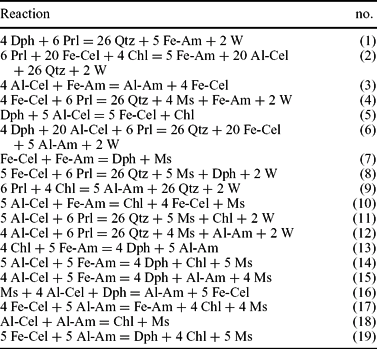
The list of the chlorite–white mica univariant equilibria considered for P–T estimates is given in Table A1.
List of chosen univariant equilibria obtained from the chlorite–white mica association, in addition to quartz (Qtz) and water (W)
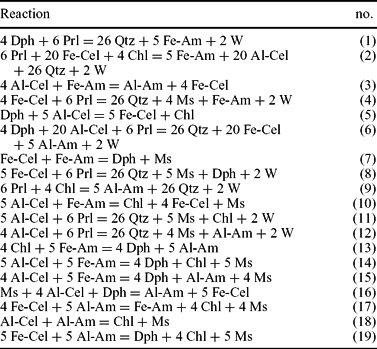
Abbreviations: Al-Am: Al-amesite; Al-Cel: Al-celadonite; Chl: clinochlore; Dph: daphnite; Fe-Am: Fe-amesite; Fe-Cel: Fe-celadonite; Ms: muscovite; Prl: pyrophyllite