1. Introduction
This paper presents a framework for a rigorous analysis of land rights and, more broadly, access to land in Africa. How resources are accessed and used in a society is clearly a key issue both in terms of economic development and institutional economics. The common economists' answer is through the concept of property rights as a socially enforced right to select uses of an economic good (Demsetz, Reference Demsetz1967). Property rights are not person–things relations, but relations among persons arising out of their relations to things (Ely, 1914, cited in Schmid, Reference Schmid1987: 23). They range from formal arrangements to informal customs and are therefore established and enforced not only by formal legal rules, but also by social conventions (Libecap, Reference Libecap1989). A system of property rights helps organize the economic and social relationships that define incentives, who are the actors of the economic game, and the conditions of access to resources. Property rights therefore circumvent the individuals' opportunity fields, enhance interdependence between actors, and determine whose interest counts when interests are conflicting (Schmid, Reference Schmid1987; Libecap, Reference Libecap1989). As such, property rights constitute a central institution, bearing allocative as well as distributive functions.
Economists have particularly focused their interest on the conditions of evolution and comparative efficiency of broad categories of property rights: open access (no property), communal property, private property, and state property. In the African context, and regarding more specifically land issues, the attention has been focused on the evolution of customary land rights, their individualization, commodification, and securization. The issues of changes in land law, land titling and the development of land markets have taken central stage (Bruce and Migot-Adholla, Reference Bruce and Migot-Adholla1994; Platteau, Reference Platteau1996; Deininger and Feder, Reference Deininger, Feder, Gardner and Rausser2001; de Janvry et al., Reference De Janvry, Gordillo, Platteau and Sadoulet2001; Deininger, Reference Deininger2003). These analyses, largely influenced by the new institutional economics, have produced powerful insights and results. However, they often present three weak points. First, Africanist economic studies tend to oversimplify property relationships to land and to essentialize property concepts. The general categories of private versus communal property, or modern versus customary systems, do not provide an adequate framework for the understanding of the variety of property rights encountered in the African context. The question of how property systems work on the ground tends to be largely overlooked. Furthermore, the identification of the land rights and rights-holders seem too often self-evident, taken for granted, conceptually as well as in terms of empirical capture. Second, if one excepts gender studies at the household level (Udry, Reference Udry1996; Dey Abbas, Reference Dey Abbas, Haddad, Hoddinott and Alderman1997; Lastarria-Cornhiel, Reference Lastarria-Cornhiel1997; Gray and Kevane, Reference Gray and Kevane1999; Yngstrom, Reference Yngstrom2002; Whitehead and Tsikata, Reference Whitehead and Tsikata2003), intra-family land relationships usually remain as a black box, even if kinship relations constitute a major institution governing access to land and land management. Third, the concept of household as the main analytic unit regarding resource access may be questioned in a number of situations in Africa, where men and women separately conduct productive enterprises within households and where the family relationships regarding access to productive resources and transfers of wealth are far from circumscribed within the limits of the conjugal and residential unit (Ancey, Reference Ancey1975; Gastellu, Reference Gastellu1978; Guyer, Reference Guyer1981; Guyer and Peters, Reference Guyer and Peters1987; Koopman, Reference Koopman1991). Even if the diversity of decision centres and objective functions has been recently introduced in theoretical models that conceptualize the household as constituted of ‘separate spheres’ (Carter and Katz, Reference Carter, Katz, Haddad, Hoddinott and Alderman1997; Fafchamps, Reference Fafchamps, de Janvry, Gordillo, Platteau and Sadoulet2001), most economic analyses dealing with land issues in Africa still rely on the concept of the household as a unit making sense regarding the land rights, and more broadly land access.
I consider the content of the rights, the identification of the rights-holders, the actors' interactions regarding rights, and more broadly access to land as deserving careful empirical investigation. The paper focuses on rights, but without ignoring that access cannot always be cast in terms of property rights attached to a specific resource (Ribot and Peluso, Reference Ribot and Peluso2003). Drawing insights from institutional economics as well as legal and economic anthropology, I present a conceptualization which might facilitate the disentangling of customaryFootnote 1 land rights and land units through a comprehensive perspective (in a Weberian sense), with a focus on the intra-kin group dimension. This family dimension does not just concern gender relations; it also involves intergenerational dimensions, as well as kinship relations beyond the nuclear family and the household. The family is a fundamental governance structure (Pollak, Reference Pollak1985) whose internal organization, with its distribution of rights, directly impacts economic behaviour regarding land issues (land access and use, land transfer through market and non-market devices, land conflicts). The intra-family dimension of the land issue has potentially a major impact on the content of the rights and on the transfer of these rights. Ownership is never an unrestricted right, but restrictions are usually seen as imposed by the State; here, restrictions imposed by the family system are privileged. The intra-family perspective also raises the issue of the securization of land access. The intra-family tensions or conflicts regarding land, especially the inter-generational tensions, seem to be a largely under-evaluated factor of land insecurity. There is no precise definition of the family in economics or anthropology, but family usually emphasizes the marriage bonds and the ties of filiation. ‘Family’ as used in this text includes both agnates (descent group, sharing a common ancestor, or descending one from the other) and affines (persons linked through marriage). De facto, the approach combines the familial (kinship by filiation or alliance, that need not be localized) and household (as residential units, regardless of whether its members are linked by kinship) dimensions.
The framework developed in the paper is seen as better fitted to land-constrained and commoditized agricultural societies, where land rights tend to be defined more precisely. In these areas, where the possibility of clearing new land is regressing or already disappeared, one can conceptualize as such ‘family property’, ‘land estates’, ‘land rights’, because individuals and family units have defined rights to specific areas of land (Peters, Reference Peters2004: 274).
The discussion proceeds as follows. The first part of the paper presents a framework that can be mobilized in an economic ethnography of land rights in a context of customary land rights in Africa. The second part considers the question of land units. The last part discusses the relevance of the approach from methodological, theoretical, and development situation perspectives. Some elements of illustration are drawn from the author's long-term research experience among matrilineal Baoules (originating from Central Ivory Coast, the Baoules are part of the large Akan group) settled in the village of Djimini-Koffikro, in Lower Ivory Coast (see Colin and Ayouz, Reference Colin and Ayouz2006; Colin, Kouamé, and Soro, Reference Colin, Kouamé and Soro2007).
2. Deciphering land rights: the elementary quincunx
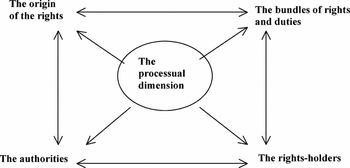
The micro-analytic approach presented here combinesFootnote 2 (Figure 1):
• The exploration, at the level of the land estates, of four sets of variables describing (i) the content of the bundles of rights and associated duties; (ii) the rights-holders; (iii) the origin of these rights, i.e. the way they were acquired; (iv) the authorities which eventually intervene in the definition of the rights, the identification of the rights-holders, and the sanction when rights are violated. The focus is on agricultural land without considering its possible heterogeneity (especially regarding the type of use: grazing versus agricultural production, etc.). A fifth set of variables could describe more precisely the object of property (types of land, but also trees, water, natural resources).
• The exploration of the social interactions around land rights and more broadly land access, combining in a processual perspective: (i) the ‘biography’ of the land estates, (ii) rights-holders' life trajectories and strategies regarding land access, (iii) the principles mobilized to justify or contest land claims, (iv) extra- and intra-family land tensions and conflicts, and the way they are handled and (possibly) resolved.
The elementary quincunx

The identification of the content of the bundles of rights and duties, the rights-holders, the origin of these rights, and the authorities, allows one to decipher from a synchronic perspective the key components of the intra-family land access. From a diachronic perspective, it offers the opportunity to rigorously pinpoint changes in these components, such as, in the context of the study illustrating this paper, the shift from a specific bundle of rights held by a pioneer at the time of the agricultural frontier to another bundle of rights held by his heir or a purchaser of his estate. The framework sketched here is primarily methodological and conceptual, and thus does not pretend to offer the clues to identify the socio-economic, political, or technical conditions driving changes such as an individualization of land rights, a monetarization of land access, a shift in family authorities, etc.
Four sets of variables
The bundles of rights and duties
The concept of bundle of rights (following Maine) as applied to agricultural land usually helps to distinguish between: (i) the rights related to the use of the land – use right stricto sensu (which can be exclusive or not), right to appropriate the return from the land, right to bring long-term improvements such as planting perennial crops, fencing, draining; (ii) the rights to transfer the preceding rights – temporarily or permanently, through market (land lease through fixed or share contracts, land sale, pledging, mortgaging) or non-market (loan, gift, bequeath, inheritance) devices; (iii) the administration rights – rights to define others' rights by controlling land access, use and transfer, and therefore who is excluded, the essence of property boiling down fundamentally to the matter of exclusion. The concept of ownership right corresponds to a situation where one holds the full bundle of rights. Deciphering the bundles of rights is a prerequisite to test the hypothesis of a trend towards the individualization and commodification of land rights.Footnote 3
The effectiveness of rights, i.e. the extent to which they enable the access to and transfer of a resource, is a function of their enforceability or security. Evidently, a right cannot be effective or exercised, whether temporarily or permanently, if there is a threat to that right or to the rights holder. No enforceability means no property right (Bromley, Reference Bromley1989). The issue of the security of land rights is widely discussed in the Africanist literature; a key point of this paper is that this issue also makes sense from an intra-family perspective. The effectiveness of a type of right furthermore depends on the specific restrictions that bear on it. These include temporal restrictions (e.g., the intra-family transfer of the use right on a plot during a specific cropping season, versus without a time limitation) and restrictions concerning use (e.g., reduction in the choice of crops to cultivate).
Rather than merely focusing on rights, one has to consider the total nexus of rights and duties. The rights–duties framework derives from Hoefeld (Reference Hoefeld1913) and was used by J. R. Commons in his Legal Foundations of Capitalism (1924). Following Gouldner (Reference Gouldner1960), one can distinguish: (i) A's right against B implying a duty of B to A: A has the right to use that plot; B has the duty not to interfere. (ii) A's duty to B implying a right of B against A: as the elder of a group of siblings who benefited a gift of land, A has the duty to let his brother B access a plot of land; B has a use right on that land. (iii) A right of A against B implying a duty of A to B: as the heir of the family estate, A has the right to control the land return, but he also has the duty to provide for the family's fundamental needs. (iv) A duty of A to B implying a right of A against B: in Western Africa, autochthonsFootnote 4 often grant to migrants rights to land through tutorat, a customary patronage relationship, according to a principle of moral economy – that one should get access to the resources necessary for his subsistence. The autochthon's duty of assistance regarding the ‘outsider’ creates the autochthon's right to the outsider's gratitude, expressed through everyday civilities and through offering gifts after harvest and on important social occasions, such as funerals (Chauveau, Reference Chauveau, Kuba and Lentz2006).
Identifying bundles of rights requires caution. First comes the issue of specifying the object of the right. That point can be illustrated with intra-family delegation of use rights.Footnote 5 This delegation may correspond to a right as a socially enforceable claim held in virtue of being part of the family group – what Schmid (Reference Schmid1987) calls a status transaction, corresponding to transfers governed primarily through the role associated with one's social position and necessary to discharge a social obligation. The question then is ‘A right to what?’: to land or to receive assistance? In the case of Baoule family groups in Djimini, if a father proceeds to an inter vivo gift of land to his children as a group of siblings, each child holds an indisputable right over the land, even if it is managed by one of them; no one can be excluded. However, intra-family delegations of use rights do not correspond in most cases to an intrinsic right of access to land. The beneficiaries have a right to be assisted by their father (or the heir), and this assistance takes the form of a delegation of land use right, but it could take another form (helping setting a small business, giving some cash, etc.). They could then be excluded from land access and this would be seen as socially legitimate. In other words, that A has a duty to care for his children and, in order to do so, grants them access to land, does not translate into a right they would have over this land. Intra-family access to land may also come as a counterpart of some service (especially implying labour) and then approximate an intra-family bargained transaction. It may as well result from an act of benevolence of the rights-holder, reflecting the discretionary power, the good will, of the assignor (a grant transaction, in Schmid's terms). Loaning a plot of land to one's brother-in-law does not correspond to a right that the beneficiary would have over land, but to a non-obligatory transfer, a favour.
Second, one should be careful in avoiding reifying the concept of land rights. As put forward by Whitehead and Tsikata (Reference Whitehead and Tsikata2003), the use of ‘rights language’ to describe land claims in indigenous systems suggests that the claims are strong and unambiguous. Social science researchers insist on the fact that in the African context, access to land remains largely conditioned by the actors' social inscription, and on processual dimension of access to land and conflict resolution, i.e. on the social embeddedness of that access (Biebuyck, Reference Biebuyck, Herskovits and Harwitz1964; Guyer, Reference Guyer1981; Berry, Reference Berry1993; Juul and Lund, Reference Berry2002; Benjaminsen and Lund, Reference Benjaminsen and Lund2003). The usual coexistence and interplay of different systems of norms and enforcement may create a room for manoeuvre for the actors, even within the family group, regarding who is entitled with which rights. As a classical illustration of this legal pluralism and its potential implications for intra-kinship land rights, one can mention the coexistence of the children's legal right to inheritance (such as under the 1964 Family law in the Ivory Coast), and of the customary system of inheritance within the uterine lineage, in matrilineal groups. The solution to avoid that risk of reifying the concept of rights or mobilizing it mechanically is not to reject it, but to introduce a processual perspective in the research and to include in the analysis access to land that does not relate directly with rights (cf. infra).
Lastly, beyond the potential risk of reifying these rights, another major potential limitation in identifying intra-family land rights originates from the links between the family groups and other social entities that may interfere in the content of rights and duties at the family level. In other words, the risk is to lose the big picture in focusing on intra-family land rights. The transfers of rights in the African context, which are often embedded socially and politically, give an illustration of that point. In southern Ivory Coast, the tutorat relationship regulates both the transfer of land rights and the life of ‘outsiders’ into the host community. Two interlinked aspects come then together: rights and obligations regarding access to land, and rights and obligations regarding group membership (Chauveau et al., Reference Chauveau, Colin, Jacob, Lavigne Delville and Le Meur2006).Footnote 6 In other words, in such a context the bundle of land rights cannot be captured independently of the socio-political dimension.Footnote 7
The rights-holders
The different components of the bundle of rights regarding land access, transfer, or administration may be held by different individuals or groups of individuals. The identification of the social entities holding the rights is critical for the analysis of property relations. These social entities may be the individual members of the family group, defined by their social identity (status), or the family as the jural entity, when there is corporate control over at least part of the components of the bundle of rights (Appell, Reference Appell1983). Other possible social entities holding rights over land could be, in given situations, households, corporations, lineages, earth priests, etc., but I shall focus on intra-family land rights. The identification of the rights-holders (including in their gendered dimensionFootnote 8) means locating the decision-making levels within the morphology of the family group, and making explicit the rights considered. In a dynamic perspective, that allows us to specify the relations between the developmental cycle of the group (Goody, Reference Goody1958) and access to land: as the position of an individual in the family changes, his relations to the family estate shifts accordingly (Gray, Reference Gray, Gray and Gulliver1964; Shipton and Goheen, Reference Shipton and Goheen1992). Shifts that are more dramatic can also be highlighted, such as an evolution in the inheritance and authority patterns, or the segmentation of the family groups and its impact on the distribution of land rights. The issues of the individualization of land rights, or exclusionary processes regarding vulnerable groups such as women or youth, can be handled more rigorously.
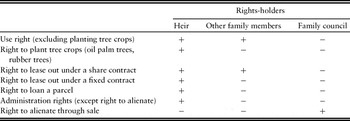
The identification of the rights-holders within Baoule family groups in Djimini-Koffikro and the rights they hold (corresponding at least to a temporary use right) will be presented in more detail in the next section as an acute understanding of that issue requires taking simultaneously into account the origin of the rights. One can however sketch through Table 1 the link between the elements of the bundle of rights and the different types of rights-holders in the case of an inherited parcel.
Rights and rights-holders in Baoule family groups in Djimini-Koffikro (inherited parcel)

Identifying the rights-holders is not straightforward and requires specific empirical attention. Some of the rights-holders may be outside the family group, in situations characterized by the lack of full ownership, such as in a context of access to land through tutorat. Among kin, rights-holders may be located outside the residential unit: the family members who move to town, to another region, or another country, may still hold rights over land. In the case of migrants settling in another region and building land estates there, some of the administration rights over these estates (especially the designation of the heir) may be held by family elders still living in the region of origin. Diachronically, the identification of the rights-holders is evidently time-indexed, due to the evolving composition of the family group. Furthermore, it runs into the risk of ignoring ‘latent’ rights-holders, who may claim their rights only in specific circumstances. In the situation studied in lower Ivory Coast, the development of a very active lease market induced family members who migrated to town to claim access to land in order to lease out a plot of family land.
The origin of the rights
A hypothesis is that the way land rights were acquired may largely determine the content of the rights and the identity of the rights-holders within the family, with a possible distinction between rights over inherited land versus rights over purchased land (Goody, Reference Goody1958; Berry, Reference Berry1993). This can be illustrated with the case of the Baoules in Djimini (one finds similar results in the case of patrilineal Senoufo settlements in the same area, Soro and Colin, forthcoming).
On land cleared or purchased, Baoule pioneers or purchasers held an individual ownership right (including the possibility to sell) – as noticed supra, the transfer of the full bundle of rights through land sales has to be linked, in this context, to the lack of the tutorat relationship. However, through inheritance the pioneer or purchaser's individual ownership right usually turns into a family property – such a shift from individual to family property through inheritance is also described in Ghana by Hill (Reference Hill1963). Inheritance extinguishes rights of exclusive control, and the heir is expected to serve as a ‘trustee’ for the family, even if he is accorded extended use rights. The erosion of the trusteeship principle is the subject of extensive comments regarding land tenure in sub-Saharan Africa. In the case of the Baoules who settled in Djimini-Koffikro, the infringement of the customary inheritance rules, when it occurs, is primarily concerned with the succession of generations (the rule being that each generation is ‘exhausted’ before transmission to another generation) and the devolution in uterine line. Nevertheless, this mutation changes the beneficiaries of the trusteeship principle more than the principle itself: inheritance continues to bear a family rather than individual dimension and there is still one single heir (no fragmentation of family land at time of inheritance).
Inter vivo gifts are quite common among the Baoules on land cleared or purchased. Regarding land received as such a gift, the parcel concerned is no longer considered as belonging to the donor's estate, and the transfer is seen as definitive. The gift can be made to an individual (a child, most often), but also as a common parcel to the donors' children, under the responsibility of the oldest son; a polygamist planter may give one common plot to the children he had with each of his wives. In the case of a gift to siblings, all brothers and sisters have a use right on the land, and decisions regarding tree planting, or leasing out land, require an agreement among the siblings. The donee holds the full bundle of rights, except the right to sell or to give, as long the donor is alive. Even after the donor's death, selling the parcel is seen as impossible, and no case has been documented. Two registers intertwined in actors' discourses, flowing from the same moral principles: first, ‘land is scarce, it has to be maintained in the family for the following generation’; second, ‘my father (or my uncle, etc.) gave it to me in order to use it; he would turn in his grave and I would suffer the consequences if I sell it. Look at what happened to A’ (a young Baoule heir who sold inherited land and died not long after).
On inherited land, the bundle of rights is usually distributed as follows in Baoule families in Djimini. The right to alienate is controlled by the family council. The shift from the de facto pioneers' individual private property to a family property contributes to explain the closure of the land sales market, quite active at the end of the pioneer phase (Colin and Ayouz, Reference Colin and Ayouz2006). The right to a permanent use of the land through the planting of tree crops (oil palm tree, rubber tree) and the right to appropriate the return from the plantation are individual and exclusive rights, vested in the heir. These rights come along with the duties linked to the status of heir, i.e. the obligation to take on the charge of the family solidarity. The heir also holds the short-term use right to produce pineapple or food crops. He can delegate temporary use rights (excluding the possibility to plant perennial tree crops) to members (including absentees) of the segment of matri- or (more and more) patrilineage considered as legitimate stakeholders, usually as counterpart of his duty of assistance. The point explicitly stated in that case is that ‘if I refuse to leave them a plot, I would have to face their problems, I would have to give them money if they are in trouble. That way, they can't ask me more. . .’. The right to temporary transfer use rights outside the family varies according to the type of arrangement and the individuals. The general principle is that the heir holds exclusively the right to lend or lease out a plot under a cash-lease. Family members may sometimes be allowed to lease out with a cash lease, but that corresponds usually to situations where the heir was not able to answer what was seen as a ‘real need’. On the other hand, any beneficiary of a delegation of use right on family land can lease it out under a share contract, instead of directly cultivating that plot.Footnote 9 The principle is that the beneficiary could not lease out another plot as long as the first one has not been returned by the tenant. As mentioned earlier, it often happens that absentee family members ask for a plot to lease out to get some extra income.Footnote 10
The members of the family group who can potentially claim an access to land may differ according to how the family head's ownership right (or proprietorship right, when he has control over the full bundle of rights except the right of alienation) was established. On land he purchased or received as an individual gift, the owner has full discretionary power and may privilege his children. On land managed by one individual but received as a gift to a group of siblings, the other siblings cannot be excluded. With land inherited within a matrilineage, the members of the heir's lineage segment have priority, rather than his children.
Eventually, the case of Baoule family groups in Djimini-Koffikro highlights three property ‘master categories’ (Benda-Beckmann, Benda-Beckmann, and Wiber, Reference Benda-Beckmann (von), von Benda-Beckmann, Wiber, von Benda-Beckmann, von Benda-Beckmann and Wiber2006) rooted in the origin of the appropriation: (i) own property (mi assiè), corresponding to land cleared, purchased, or received as an individual gift (the owner's bundle of rights including – land cleared or purchased – or not – land received as a gift – the possibility to sell); (ii) co-ownership, regarding land received as a gift by siblings (ye assiè); (iii) family property, corresponding to inherited land (nanan assiè).
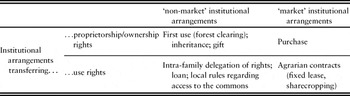
Some specific comments may be useful, regarding the usual distinction between market and non-market institutional arrangements to build or transfer definitely or temporarily land rights (Table 2).
Main institutional arrangements to build or transfer land rights

The typology could be made more complex, but what has to be underlined is that the limits between the different cells of the table are far from being always clear – where to draw the line between a lease and a loan accompanied by a gift from the beneficiary to the landholder? This ‘blurredness’ may be related with the definition of the concepts used (can an intra-family land transfer that comes as an implicit counterpart of a labour investment be considered as belonging to the same register as an extra-family agrarian contract?), but also points to the issue of institutional change (transition from a loan with a symbolic gift to a land lease, as the gift ceases to be symbolic). The point is therefore not to define ex ante those categories, but to consider these categories and their limits as objects to investigate. Setting down the origin of the rights as an object of empirical research allows discussing issues such as land commoditization, or the impact of non-market land transfers (inheritance, gift), on the structure of the domestic groups and land distribution. It is for example evident that monetary land transfers operated through a neo-tutorat relationship cannot be equated with a sale in the usual economists' sense.
The authorities
Who specifies and enforces the rules? Institutional economists emphasize the role of the legal system and of the state. Here, attention is focused more specifically on intra-family levels of authority (beyond these, of course, the village land and/or political authorities, the formal state apparatus, etc. may intervene). Among families, the level of authority may vary according to the type of right considered and the origin of the ownership right: family head, ‘trustee’, family council. In the Baoule family groups in Djimini-Koffikro, regarding an inherited parcel, designating the heir and selling a parcel is in the hand of the family council; the decision to plant tree crops lies with the heir, and the short-term management of family land (intra-family delegation of use rights, leasing out land, etc.) may be the concern of a caretaker designated as representative by an absentee heir. In the case of parcels bought or obtained through the direct clearing of the forest, the family council intervenes only to designate the heir or in case of an intra-family conflict.
The processual perspective
The systematic exploration of the four fields of variables that have just been set up sheds considerable light on intra-family land issues, but presents the risk, already mentioned, to reify and to give a mechanistic interpretation of rights, and to artificially ‘freeze’ evolving categories. The processual perspective, which puts in motion (and interaction) these four sets of variables, should avoid such risk and constitutes a crucial dimension in the research framework. The shift from a structural-functionalist to a processual perspective is particularly clear in anthropology. For a long time, the structural-functionalist perspective, assuming homogeneity and stability, treated as invariants the social units and the rules organizing social interaction (Van Velsen, Reference Velsen (van) and Epstein1979; Guyer and Peters, Reference Guyer and Peters1987). The individual action was seen as fully determined by the individuals' status and well specified rights and duties. There was no issue of choice and issue of change in such a ‘rule-centered paradigm’ (Comaroff and Roberts, Reference Comaroff and Roberts1981). The processual approach fundamentally questions this perspective, by considering that rules exist but operate in the presence of indeterminacy, ambiguity, uncertainty, and manipulability, and therefore that interactions include elements of regularity as well as elements of indeterminacy (Moore, Reference Moore1978: 39, 40). This perspective opens the ground up to both a study of the individuals' behaviours and interactions under a system of rules, and a study of the changes in the rules through social interaction – in Moore's terms, the intermingling ‘processes of situational adjustments’ and ‘processes of regularization’ (1978: 50).
Taking into consideration actors' interactions around the rights allows us to dissolve the exaggerated dichotomy between actors and institutions. Through such a change of perspective, the rules are no longer seen as fully and univocally determining actors' behaviour, the rights are no longer ‘given’, the actors' strategic games open a range of indeterminacy. This processual perspective opens up fruitful perspectives regarding land rights and land access in Africa (Berry, Reference Berry1993, Reference Biebuyck, Herskovits and Harwitz2002; Juul and Lund, Reference Juul and Lund2002; Benjaminsen and Lund, Reference Benjaminsen and Lund2003). However, as argued by Pauline Peters (Reference Peters2004), the approach that privileges flexibility and negotiability in analyses of social relationships over land tends to forget that there are winners and losers in such ‘negotiations’, in a context of increasing competitive and conflictual relations over land. Another risk this processual perspective opens is to produce a hyper-relativist interpretation of the social interaction, to see it as only the result of perpetual negotiations. The rules, the principles, and more largely the institutions might then be seen as mere rhetorical artefacts mobilized by the actors in a strategic way, according to their interest of the moment. However, while the rules change, they do not change continuously and they do not all change simultaneously. The principles that legitimize the rights may be instrumentalized, if not manipulated, by the actors in order to profit from new opportunities, but they may also be seen by the actors as self-evident at a given point in time and this may effectively ground their practices. The value systems that guide the actors' rationale do evolve, but at a given time, the content of a right, or the identity of the right-holder, may be seen as self-evident, not open to discussion, and regulate quite effectively and in a stable pattern the social interaction, including land rights and land practices (on the cognitive dimension of institutions, see Douglas, Reference Douglas1986; Hodgson, Reference Hodgson1988). In other words, introducing a processual approach does not mean excluding the structural/institutional dimension.
Africanist scholars working within the processual paradigm lay great stress on the fact that customary rules cannot be seen as laws that determine the outcome of interactions and conflicts in a straightforward fashion, but are rather loosely constructed repertoires, which moreover sometimes contradict one another (Comaroff and Roberts, Reference Comaroff and Roberts1981; Berry, Reference Berry1993). Rules of inheritance, for example, usually define categories of potential heirs rather than directly designing the heir, and disputes over inheritance may mobilize contradictory registers of legitimization. For instance, a usual contradiction and source of conflict among the Baoules who settled in Lower Ivory Coast (also mentioned elsewhere in Africa) is the tension between inheritance along uterine lines and the principle according to which labour creates rights, when the deceased's sons or widow helped creating plantations.
It is the social game around rights and principles that produces a given configuration of land practices. The principles justifying the content of the rights, the identity of the rights-holders or the identity of the authorities – or legitimizing the contestation of the rights, the rights-holders or the authorities – are usually made quite explicit during phases of tensions or conflicts (Comaroff and Roberts, Reference Comaroff and Roberts1981; Moore, Reference Moore1987). Focusing on actual interactions between actors, the processual perspective is able to throw light on how an event came about through the narrative specific to the situation. The family group Z will briefly illustrate how customary principles and actors' strategies intermingle concretely. Z settled in Djimini in the 1920s. After his death in 1968, the family council designated within the matrilineage his heir (NA). NA just came to Djimini to dispose of Z's material belongings and returned home without assuming his duties. Z's oldest son, KY, took on the office of family head and the control of the family land, with agreement of the family council. He later bought additional parcels. In 1994, part of one of these parcels was the object of a gift to his uterine cousin YC. This gift illustrates actors' strategic moves regarding land rights. Even if NA did not assume the charge of the customary inheritance and if Z's son took on that charge, the family council never formally removed NA. Today, NA is dead and if KY were to die, the risk still exists that NA's heir (YC) could claim the inheritance. The fact that KY gave land to YC corresponds explicitly to a manoeuvre to avoid such a claim: he considers that because the gift has been accepted, it would be illegitimate for YC to claim any more land from his estate.
A comprehensive and processual approach focuses the analysis on the effective conditions of access to land, and not on the ‘rights’ as stated in the local system of norms. Quite often, economists' analysis of land issues in the African context relies on group interviews or rapid rural appraisal methodologies to identify land rights and rights-holders. Quisumbing et al. (Reference Quisumbing, Payongayong, Aidoo and Otsuka2001: 178-179), for example, regarding research conducted in Ghana, state that: ‘Because people seldom consider land rights under different land-tenure institutions explicitly and systematically, it took considerable time to arrive at consensus on each question. This experience led us to believe that it is not feasible to obtain accurate information on land rights from interviews with individual households and that community perceptions are more reliable’. The position advocated here is radically critical regarding such methodological choice. Group interviews might be useful during an exploratory phase, but it is clear that if the objective is to understand the actual land practices (who does what with which plot of land, under which conditions), one needs to mobilize other methodological devices. Through group interviews and rapid appraisal, the probability is high of dramatically underestimating conflicting interests and strategic behaviour regarding access to land, and of just getting a mere expression of the local system of norms, rather than the bases of the effective practices. The study of actual land practices calls rather for fieldwork techniques based on detailed investigation requiring the researcher's close acquaintance with individuals over a lengthy period of time (Van Velsen, Reference Velsen (van) and Epstein1979). The approach presented hence calls for an economic ethnography of access to land – ethnography in the sense of personal and durable insertion of the researcher in the local society, with in-depth contextualized investigations. This does not constrain the research to a mere microscopic and particularist perspective. It is seen, on the contrary, as leading to the production of a type of result that lays out a better foundation for comparative work, including large-scale comparison. Such an ethnography is grounded in detailed contextualized analysis of the working of land estates, through: (i) an identification of the family group (including non-residents) and the place of agriculture in the actors' livelihood portfolios; (ii) the biography of land estates, at the parcel level; (iii) an examination of land use, plot by plot and individual by individual; (iv) a description and analysis of land tensions and conflicts. The methodology privileges case studies – the trade off between breadth and depth being resolved in favour of the latter – but does not exclude subsequent systematization in data collection. The economic ethnographic research such as the one advocated here can indeed considerably improve the design of large-scale surveys on land rights (and more broadly land access), allowing gain in precision and reduction in biases, and the sharpening og research questions. The challenge is to belie the Bambara proverb: ‘The stranger only sees what he already knows’.
3. From land rights to land units
Any empirical research relies on appropriate units of observation/data collection, and units of analysis. In the African context, there is not always isomorphism between units of production (who works with/for whom?), units of consumption (who eats from the same ‘kitchen’?), units of residence (who lives together with whom?), or budget units (who pays what type of expenses for whose benefit – alimentation, education, health or matrimonial expenses, etc.?). The suggestion then is not to look for the operating unit (such as the household), but rather for these different units, which may or may not overlap (Gastellu, Reference Gastellu1978; Yanagisako, Reference Yanagisako1979; Wilk and Netting, Reference Wilk, Netting, Netting, Wilk and Arnould1984; Guyer and Peters, Reference Guyer and Peters1987). The issue of the land unit, or rather the land units, had yet to be raised explicitly. As discussed above regarding land rights, identifying land units (as any socio-economic unit) runs into the risk of mechanistic interpretations. Again, the issue is to resist the opposition between structures and processes. The research position adopted here is that the question of the land units is meaningful, but these units should not be seen as the mechanical product of a system of univocal and intangible rules. Exploring empirical situations through the ‘elementary quincunx’ allows identifying different land units at the intra-family level.
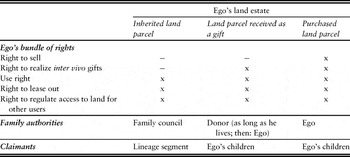
Two broad types of land units, bearing both social and spatial dimensions, can be distinguished. These land units, which may or may not overlap, have to be posited regarding kinship relations and residential, production (especially regarding labour investments), consumption, and budget units (I do not develop this point here, due to space constraints). The first type of land unit refers to proprietorship or ownership rights and to the jural units controlling these rights. The land parcel corresponds to the elementary proprietorship or ownership unit. I define it, regarding a given parcel of land, as the isomorphism between: (i) the person or group holding the proprietorship/ownership rights; (ii) the origin of the land appropriation (initial forest clearing, inheritance, purchase, etc.); (iii) the intra-familial authority that may control some of the administration rights, beyond the proprietor/owner; (iv) the group of claimants, i.e. the group of persons eligible for accessing that parcel, beyond the proprietor/owner. The claimants may have a status right over the parcel (the proprietor/owner cannot exclude them but nevertheless controls their access to land) or may have access (i.e. get a use right) to the parcel, not because they are entitled, but as the counterpart of a proprietor/owner's social duty to them. The land parcel clearly differs from the crop field (area devoted to one crop or one type of intercropping). The land estate corresponds to the full set of land parcels over which an individual or a family holds proprietorship or ownership rights. In the case of a family land estate, the heir operates usually as a trustee. He may have extended use rights but does not control all the administration rights and has to manage the land in accordance with his duties regarding the family. As illustrated in Table 3, in the case of Baoule family groups in Djimini-Koffikro, what may appear at a first glance as a homogenous land estate may be rather a composite land estate, built up from land parcels of different origins, over which may be indexed different structures of rights and different claimants.
Ego's land parcels and land estate

The second type of land units refers to use rights and to the jural units controlling these rights. The cultivation parcel (which may be composed of several crop fields) corresponds to the elementary spatial unit managed by an individual (or a corporate group) for his own benefit: (i) whatever ownership right he holds over it – it may be his own land, family land, borrowed or leased-in land; and (ii) whatever the use he makes of it – direct productive use, leasing it out. The use right over that parcel may not be exclusive. It is, for example, usual in the parcel(s) dedicated principally to food crop production for the family, that the Baoule man plants yams and the women (his wife/wives, daughters, etc.) plant cassava, partly for the household's consumption and partly for sale on their own account. The landholding corresponds to all cultivation parcels managed by an individual for his own benefit. With the exception of leased-out parcels, it corresponds to the land-basis of the agricultural production unit.
In some cases – such as when the proprietor/owner does not reside locally – the everyday management of the land estate (or part of it) may be delegated to a ‘caretaker’, thereby defining a ‘care-taking unit’. The caretaker may be or may not be one of the heir's relatives. He may get or not a financial or material counterpart, such as access to a plot for his own use. He may be in charge of short-term transfer rights (leasing out), but he usually then has no right to the rent. The key point is that this agency relation does not give a right over the product of the land. Identifying the care-taking units is important for at least two reasons. First, they are the locus of potential classical agency problems; second, because of the risk of confusing the caretaker with the owner in one-shot surveys.
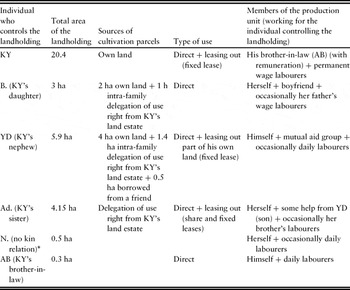
The family group Z we already met will illustrate the land units issue in the context of Djimini. During the pioneer phase, Z cleared a first parcel (P1, 16.7 ha); later on, he bought another parcel (P2, 5.45 ha). His land estate was then composed of two land parcels. After his death, as his customary heir did not take charge of the inheritance, his oldest son (KY) took on the control of the family land. In 1972 and 1976, KY bought two additional parcels (P3, 7.8 ha, and P4, 8 ha). In 1994, the full parcel P4 was the object of inter vivo gifts: 4 ha to his uterine nephew YD, and respectively 2 ha to his uterine cousins (YC and YA). Lastly, in 1995 KY gave 2 ha on parcel P3 to his daughter B (his only child ‘interested in agriculture’). This evolution thus resulted in five land estates: KY's composite land estate (two land parcels inherited and one bought) and four land estates (composed of only one land parcel each) coming from the inter vivo gifts from KY to his daughter, his nephew, and his cousins. KY, who works and lives in Abidjan and very rarely comes to Djimini, entrusted the management of the oil palm tree plantation covering the full parcell P1 to his brother-in-law, as a wage labourer. He designated his sister Ad. as his representative for the management of the remaining land, mostly dedicated to intra-family use right delegation. As Ad. leased out under fixed leases a large portion of parcel P2 (4 ha of 5.45), she was ‘relieved of her duty’. It is her son YD (who denounced to his uncle his mother's ‘abuses’) who replaced her as the caretaker of these lands.
If we turn now to land holdings and cultivation parcels, in its current configuration this case shows the articulation of six landholdings nested in or overlapping with KY's land estate (Table 4).
Landholdings (KY case, 2002)

Note: *Widow of a former permanent wage labourer, who still lives in KY residential unit in Djimini-Koffikro.
This single case illustrates the combination of land rights and land units within a family group. YD, for example, in 2002: (i) manages parcels P2 and P3 of his uncle's estate as a caretaker. On these parcels, he organizes the intra-family temporary delegation of use rights, including for his own benefit; (ii) he has the full control over the use of his own land; (iii) he borrows an extra parcel outside the family land estate, on which he produces pineapple for one cropping season. The family Z case also shows that the household is far from being the only relevant unit regarding the allocation and transmission of land rights in the context of these Boualé family groups.
4. Discussion and conclusion
The framework sketched out in this paper for an economic ethnography of land access should be useful in the analysis of the ways the land resource is controlled and managed among family groups. This approach can contribute to an empirical analysis of issues such as inter-generational and gender-based land relations, of institutional change (such as the individualization and commoditization of land rights), of the intra-family impact of land policies, of the productive use of the land resource, etc. It allows us to capture how much of the activity of the members of the family (or household) is referable to the family (or household) as a unit, and the degree to which the family (or household) operates as a corporate unit. From an institutional economics perspective, it should allow a richer empirical analysis, with a better identification of property rights, of the social units holding those rights, and of their role in the local economic organization. In the remaining part of the paper, I will just touch on briefly some of these issues.
Methodological insights. This paper questions the view of the household as the sole and always pertinent unit of analysis regarding land issues. Disentangling, through preliminary case studies, the bundles of rights and identifying the types of land units that characterize the situation under study should allow one to better focus large-scale empirical data collection and analysis, especially if these units are disjunctive. To give a concrete illustration, numerous economic studies regarding land issues in developing countries are grounded in land/labor or consumers ratios, on ratios regarding specific land use compared to total land availabilities, etc. The issue then is to define what to put in the numerator and in the denominator. Taking into account the possible diversity of the land units and considering the type of land units meaningful with regard to the question at hand should make the researchers more sensitive to possible major biases in their grounding assumptions or in the conclusions they reach.
The productive use of the land. A crucial task set up for property rights economics is to show how the content of property rights affects the allocation and use of resources. The point highlighted in this paper is that this question is meaningful at the intra-family level and that the approach proposed here could help in tackling that issue. As a matter of fact, the causality runs in two ways. At a given point in time, the system of intra-family land rights and duties is given and delimitates the productive use of the land (who can use the land, and how, e.g. who can plant tree crops on which plot). However, opportunities to expand agricultural production may lead to efforts to change intra-family organization of production and allocation of land, i.e. to redefine land rights and even the conditions of group membership.
The individualization and commodification of land rights. The concepts of individualization and commoditization are useful in discussing the broad sweep of changes in land tenure systems. There is however considerable ambiguity when these terms are used generically without a careful empirical screening. An economic ethnography approach should avoid such ambiguities. Taking into account seriously the intra-family dimension may for instance be indispensable for understanding the formation of the supply on the land markets, in terms of quantities and types of transactions. It could also allow one to rigorously document empirically, in an inverse causality, the incidence of the development of land transactions on intra-family land rights and land management.
Gender and inter-generational issues. Gender issues rightly have turned out to be a major concern in research on land issues as well as in land policies. The question of the inter-generational land relations has unfortunately not yet been recognized as such a major issue (for the role of the youths in violent conflicts in Africa, see infra and Chauveau, Reference Chauveau2005; Richards, Reference Richards2005). Tackling these questions through empirical research conducted along the lines suggested in this paper could strengthen the analysis and, in terms of policy concerns, the diagnosis.
Interpreting intra-family land rights delegations. The intra-family temporary land transfer is sometimes theoretically interpreted as a device to mitigate commitment failures (Fafchamps, Reference Fafchamps, de Janvry, Gordillo, Platteau and Sadoulet2001). Other interpretations see these transfers as reflecting an inclusive (rather than exclusive) conception of property, with intra-family rules organized along not only economic, but also socially integrative, functions (Chauveau et al., Reference Chauveau, Colin, Jacob, Lavigne Delville and Le Meur2006). An ethnographic exploration of land rights and land units could support, refute, or refine the interpretations that can be given to intra-family transfers of land rights (from the delegation of use rights, to inter vivo gifts covering all or most of the administration rights) and deal with the issue of intra-family governance costs. The holders of administration rights clearly face a trade-off between favouring their own access to land, and satisfying family members' demand. This is even more evident when the development of a lease market raises the opportunity cost of allowing family members (especially women and youths) access to family land.
Tensions and conflicts. Institutional economics literature on land issues tends to ignore (except in the gender dimensions) the family as a locus of tensions and conflicts regarding the way rules governing access to land are applied, or regarding attempts to change these rules. These tensions are quite common regarding intra-family land management, the transfer of rights through inheritance, and more generally land transfers (Peters, Reference Peters2004). Regarding the land as a family patrimony, an important issue is the tension between the heir's use of the land (or transfer of land outside the family, through leases for example) for his own profit, versus his role as trustee supposed to consider the common interest of the family group. This issue is particularly acute when land transfers cease to be organized along a status/grant rationale and move toward more individualistic intra-family bargaining (Amanor, Reference Amanor2001). Intra-family land tensions can even translate into inter-communities conflicts, such as in the Aboure country (close to Djimini-Koffikro), where in 2001 young Aboures tried to expel Burkinabe pineapple growers leasing land. This conflict reflected to a large extent intra-family tensions among the autochthonous population, the young Aboures criticizing the elders for leasing out too much of the land they inherited and not sharing the land rent (Colin, Kouamé, and Soro, Reference Colin, Kouamé and Soro2007).
The identification and formalization of land rights. The formalization of property rights through land titling is at the heart of numerous current land policies in Africa. These policies directly raise the issue of the identification of the rights and the rights-holders. The procedures for this identification and recording usually focus on some components of the bundle of rights, and privileges one rights-holder. The risk (documented empirically) is then to turn into ‘owners’ individuals who were in fact representative of a group of rights-holders, or had a mere role of arbitration or moral authority. A generalized procedure of land rights recognition and titling could not afford, evidently, to adopt the ethnographic perspective suggested in this paper. However, a preliminary research conducted with such a perspective should reduce the risk of crude biases and identify the situations where such a policy could be handled with reasonable chance of success.