Introduction
The introduction of Bluetooth technology has represented a significant advance in the wireless technology used in mobile phones. However, the widespread use of Bluetooth technology has raised questions regarding possible health effects. Consequently, the biological effects of this technology have become an issue of public and scientific concern.
Bluetooth devices are used in close proximity to the auditory system; thus, this may be the most affected system. It has not been conclusively proven that short term exposure to the electromagnetic field emitted by mobile phones causes auditory damage.Reference Garcia Callejo, Garcia Callejo, Pena Santamaria, Alonso Castaneira, Sebastian Gil and Marco Algarra1–Reference Sievert, Eggert and Pau5 However, long term exposure to mobile phones has been linked to hearing loss.Reference Oktay and Dasdag6, Reference Kerekhanjanarong, Supiyaphun, Naratricoon and Laungpitackchumpon7 The hearing effects of Bluetooth devices have not yet been studied. In general, Bluetooth devices are used for longer time periods, in comparison to mobile phones, and are usually kept on ‘standby’ when not in use.
What is Bluetooth?
Bluetooth technology is a global standard for short range, radio frequency transmission which was developed to enable wireless connectivity. Bluetooth devices operate in the unlicensed industrial, scientific and medical bandwidth (2.400 to 2.485 GHz). They are categorised into three classes, the commonest of which are class two devices; these produce up to 2.5 mV and have a range of up to 10 m, similar to most mobile phones.Reference McDermott-Wells8 Both mobile phones and Bluetooth devices emit non-ionising electromagnetic radiation.
The Bluetooth wireless headset device has been claimed to reduce the effects of electromagnetic radiation on the auditory system. The average specific absorption rate of these devices is thought to be far below that of mobile phones.
The present study assessed the effects of a specified period of Bluetooth device usage on human hearing, in both standby and active modes.
Materials and methods
This study aimed firstly to study potential changes in hearing function as a consequence of Bluetooth device usage, as determined by changes in distortion product otoacoustic emissions (DPOAEs) and pure tone audiometry (PTA) at suprathreshold levels.
The study also aimed to detect any difference in hearing threshold change after using Bluetooth devices in standby versus active modes.
Ethical approval to conduct the study was obtained from the University of Malaya medical ethics committee. Written consent was obtained from each participant before testing.
The study methodology was as follows.
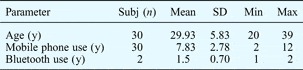
The study group consisted of 30 healthy volunteers (mean age 29.93 years; range 20–39 years) without any evidence of hearing or ear disorders. As shown in Table I, all participants had a previous history of non-Bluetooth mobile phone use (mean period of use 7.83 years). Only two participants had previously used a Bluetooth headset device (for a mean of 1.5 years).
Subject age and previous device use

Subj = subjects; SD = standard deviation; Min = minimum; Max = maximum; y = years
Participants comprised 10 (33 per cent) men and 20 women (67 per cent). The site of testing was the left ear for 18 people (60 per cent) and the right for the remaining 12 (40 per cent), based on participant preference.
All participants satisfied the following inclusion criteria: (1) no history of otological disorders and/or family history of hearing disorders; (2) no subjective hearing loss or tinnitus; (3) no exposure to severe noise; and (4) no history of ototoxic drugs.
In all participants, otoscopic examination showed a normal tympanic membrane. Hearing threshold levels in both ears were no worse than 20 dB at any of the audiometric frequencies between 0.5 and 16 kHz. Normal tympanograms and acoustic reflexes were obtained for both ears.
The study session began with the collection of baseline PTA and DPOAE measurements. We utilised a Madsen Orbiter 222 audiometer for PTA measurements and a Madsen Capella device for DPOAE measurements (Madsen, Taastrup, Denmark).
Pure tone audiometry measured hearing in the high frequency ranges from 10 to 16 kHz. We also tested speech frequencies (i.e. 250 Hz to 8 kHz) as part of our baseline measurements, to detect any hearing loss in this range. Pure tone audiograms were recorded and assessed. Participants were considered to have hearing loss if hearing thresholds exceeded 25 dB. Hearing loss was then averaged for each frequency tested.
Distortion product otoacoustic emissions were measured using a Madsen Capella cochlear emission analyser, and recorded as DPgrams. The stimulus was given at 65 dB for f1 and 55 dB for f2. Responses were measured at 1, 2, 4 and 6 kHz.
All audiological measurements were carried out in a predetermined order, in a soundproof room.
Participants were then exposed to a Bluetooth headset device (Sony Ericsson model HBH-PV710) paired with a mobile phone (Sony Ericsson model Z310i; Sony Ericsson, Shenzhen, China), at frequencies between 2.4 and 2.5 GHz, in standby mode, for 6 hours. Their hearing was then evaluated as before; these results were designated as ‘post one’).
Subsequently, participants were exposed to a Bluetooth headset device running in active mode at full power, for 10 minutes. The exposure consisted of speech at typical conversational level, emitted from the Bluetooth device. Participants' hearing was then evaluated again, in the same manner and order as before; these results were designated as ‘post two’.
Results
All our participants had normal hearing prior to Bluetooth exposure. Testing was well tolerated, and there were no complaints of subjective ill-effects after Bluetooth device usage.
We designated our results as pre-test, post one (after 6 hours on standby mode) and post two (after 10 minutes of emitted conversation).
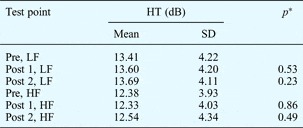
All hearing thresholds were averaged for both low frequencies (i.e. 250 Hz to 8 kHz) and higher frequencies (i.e. 10 to 16 kHz). We used a paired t-test to analyse PTA values, in order to compare hearing thresholds both for pre-test versus post one values and for pre-test versus post two values. A p value of less than 0.05 was considered significant. There were no statistically significant differences in PTA-assessed hearing threshold, comparing pre-test versus post one values and pre-test versus post two values, at any tested frequency (Table II).
Low and high frequency PTA: pre-test vs post 1 & 2 results

*Using paired t-test. See text for definition of post 1 and post 2 results. PTA = pure tone audiometry; HT = hearing threshold; SD = standard deviation; pre = pre-test; LF = low frequency; HF = high frequency
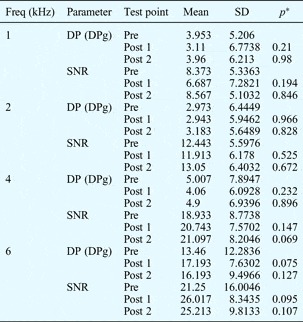
Distortion product otoacoustic emission results were analysed, using a paired t-test, to assess differences between the distortion product and the signal to noise ratio at 1, 2, 4 and 6 kHz. Again, a p value of less than 0.05 was considered significant. We assessed the significance of differences between pre-test versus post one values and pre-test versus post two values, for both distortion product and signal to noise ratio. No statistically significant differences were seen (Table III).
DPOAE: pre-test vs post 1 & 2 results

*Comparing pre-test vs post 1 and pre-test vs post 2 results, using paired t-test. DPOAE = distortion production otoacoustic emission; Freq = frequency; SD = standard deviation; DP = distortion product; Pre = pre-test; SNR = signal-to-noise ratio
Discussion
Many studies have assessed the effect of mobile phones on hearing and hearing aids. However, to our knowledge there has been no previous objective assessment of the effect of Bluetooth headset devices on the auditory system.
It has now become standard practice to measure the specific absorption rate of mobile phones. This is an effective measure of the amount of energy absorbed by biological tissue.
The current limits for safe exposure to electromagnetic fields are based on the International Commission on Non-Ionizing Radiation Protection criteria, which are 2 W/kg in any 10 g for the head and body, 4 W/kg for extremities, and 0.08 W/kg for the entire body for an average of 6 minutes.9
The mobile phone used in the current study had a specific absorption rate of 0.70 W/kg (for 10 g). We requested from the manufacturer the exact specific absorption rate for the Bluetooth device used in our study, but our enquiries were unsuccessful. (In contrast to mobile phone legislation, manufacturers are not legally required to reveal the specific absorption rates of class two and three Bluetooth devices.)
However, we note that a study conducted by the Swiss Federal Office of Public Health reported the specific absorption rate of a Bluetooth headset to be between 0.00319 and 0.01 W/kg, for both class two and three devices operated up to 13 cm from the body.10
The effects of electromagnetic fields have been widely studied, and much data have been published on this topic in recent years. The main health issue concerns the role of electromagnetic fields in tumorigenesis. A recent meta-analysis by Hardell et al. found a ‘consistent pattern of association between mobile phone use and ipsilateral gliomas and acoustic neuromas[,] using [a] >10 year latency period’.Reference Hardell, Carlberg, Sodenquist and Mild11 Electromagnetic field exposure has also been linked to the development of parotid gland tumours on the side ipsilateral to mobile phone use.Reference Sadetzki, Chetrit, Jerus-Hakak, Cardis, Deutch and Duvadeni12
Previous studies have also documented local discomfort in the region of the pinna and cheek following prolonged mobile phone use (e.g. an increase in warmth, a sense of ear fullness and a tingling sensation), which was significantly greater in individuals using mobile phones for longer periods.Reference Sandstörm, Wilén, Oftendal and Mild13 In our study, despite Bluetooth device exposure in standby mode for 6 hours, none of our study participants complained of any discomfort around the pinna.
The effects of electromagnetic radiation on the auditory system have been widely studied. Short term exposure to mobile phone electromagnetic fields has been shown to have no adverse effect on hearing.Reference Garcia Callejo, Garcia Callejo, Pena Santamaria, Alonso Castaneira, Sebastian Gil and Marco Algarra1–Reference Sievert, Eggert and Pau5 However, long term exposure has been linked to decreased ipsilateral hearing, especially at high frequencies, which corresponds to the duration of exposure. High frequency loss has been specifically linked to mobile phone electromagnetic field exposure, with duration of exposure corresponding to the degree of hearing loss.Reference Oktay and Dasdag6, Reference Kerekhanjanarong, Supiyaphun, Naratricoon and Laungpitackchumpon7, Reference Panda, Jain, Bakshi and Mukshal14
• Prolonged mobile phone use is known to reduce ipsilateral hearing
• Bluetooth devices expose the auditory system to electromagnetic radiation, but effects are unknown
• This study assessed the effect of Bluetooth device usage on subjects' hearing, via pure tone audiometry and distortion product otoacoustic emission measurement
• No significant hearing effects were detected
The current study found no significant difference between high frequency hearing thresholds before and after short term use of a Bluetooth device.
Furthermore, our DPOAE measurements indicated no statistically significant decrease in hearing in the test ear. Mild cochlear abnormalities have been demonstrated by DPOAE measurement before hearing loss is detectable by PTA.Reference Kemp15 Distortion product otoacoustic emission testing has the advantages of being completely objective, quick and painless.
Interestingly, Panda et al. recently found that some people who used mobile phones for more than 30 minutes per day had absent DPOAEs, and that this could occur in either ear.Reference Panda, Jain, Bakshi and Mukshal14 In contrast, other studies reported no deterioration in DPOAE measurement parameters after electromagnetic field exposure.Reference Uloziene, Uloza, Gradeuskiene and Safaris4, Reference Oktay and Dasdag6, 9 Similarly, our study found no alteration in DPOAE parameters following Bluetooth device usage, either in standby mode (6 hours) or active mode (10 minutes).
Some drawbacks of our study should be mentioned. We did not monitor our volunteers' compliance during the 6 hour period of Bluetooth standby usage. In addition, our sample size was limited to only 30 participants. Our study was designed as a pilot study to investigate the effects of acute, short term exposure to the electromagnetic field of a Bluetooth headset device; thus, our results give no information on long term or cumulative effects. Further studies are needed to determine whether prolonged and/or repeated exposure causes adverse effects.
Conclusion
Exposure to the electromagnetic field emitted from a Bluetooth headset device, in standby mode for 6 hours and in active mode for 10 minutes, does not cause any measurable hearing effects, as assessed by high frequency PTA and DPOAE measurement.
Acknowledgement
This study was financed using a University of Malaya Research Grant (number UMRG105/09HTM).