Introduction
The National Gallery of Ireland (NGI) is the country's premier art institution. It houses the nation's collection of fine art, amounting to over 16,000 works representing all the major European schools of art. It is also home to a comprehensive collection of library and archival material relating to the visual arts. Comprising close to 100,000 volumes and substantial archival holdings, this collection is an important resource for anyone interested in researching art in Ireland.
The Collections: the NGI Art Library, the ESB Centre for the Study of Irish Art, the Yeats Archive, the Institutional Archive and the Sir Denis Mahon Library and Archive, cover national and international art from the middle ages onwards. Consisting of monographs, catalogue raisonnés, exhibition catalogues, collection catalogues, pamphlets, ephemera, journals, auction catalogues and e-resources, rare and antiquarian publications, in addition to remarkable manuscript holdings, this world-class art research collection is unrivalled in Ireland. It plays an invaluable role supporting the work of the gallery and is regularly consulted by artists, students, scholars and academics, museum professionals, art dealers, collectors and members of the public.
Historical background
Since its doors first opened to the public in 1864, the gallery space has expanded significantly. The original building and the three wings added over the years all incorporated library facilities in their original plans. Surprisingly, however, for more than a century, until 1968, there was no dedicated publicly accessible space for the library and archives collections; and today there is still no one space fully dedicated to the collection. There are many reasons why this unusual situation came about in Ireland's National Gallery. Historical developments, external factors and internal priorities all impacted on the efforts to secure a permanent and suitable location for the collection, the consequences of which are still evident today.
1854–1900: The foundation and early years of the National Gallery of Ireland
In 1854 ‘An Act to provide for the Establishment of a National Gallery of Paintings, Sculpture, and the Fine Arts, for the Care of Public Library, and the Erection of a Public Museum, in Dublin’ was passed into law.Footnote 1 Ten challenging years followed and resulted, in 1864, in the opening of a state-of-the-art museum building and the beginnings of a national art collection for Ireland.
The discussions at the time of the campaign for a National Gallery also addressed the need for a public library for the city of Dublin. The city was already home to a number of important libraries such as those in Trinity College, King's Inns, Royal Irish Academy and Royal Dublin Society. All were accessible to learned gentleman but there was nothing catering to the needs of the growing number of literate people amongst the middle and lower classes. It was decided to incorporate Marsh's library into the plan for the new National Gallery. Archbishop Marsh's Library was Ireland's first public library, established in 1707. By the 1850s it was in a dilapidated state. Moving Marsh's library to the new National Gallery would, it was believed, safeguard the collection and make the library more accessible to the public; and the inclusion of a library in the new development would also help the Treasury to look favourably on funding for the Gallery. Marsh's Board of Governor's viewed this as a positive move and Marsh's librarian took little persuasion: the move to fashionable Merrion Square would include a new house for him as part of the deal.
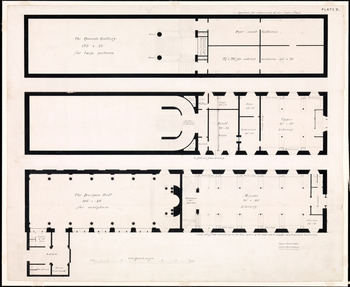
From a librarian's perspective, things were looking very good indeed for the future National Gallery of Ireland. Francis Fowke's architectural designs had incorporated a designated library space including a librarian's office and upper library accommodation on the first floor as well as an entrance vestibule and lower room space for the library on the ground floor (Fig. 1).
Floor Plan by Francis Fowke, NGI.6917.

Unfortunately, the new library for Dublin as planned never came to pass and the transfer of Marsh's collection to the National Gallery never took place. Library concerns slid down the priority list. The space originally allocated to the library in the gallery would remain unfinished for the next twenty years and the library administrative spaces were quickly taken over by the gallery's director. Finally, in the 1880s the space was reallocated to the new National Portrait Collection — the development of which was regarded as a priority for the institution.
From the opening of the gallery in 1864, its library was left without a dedicated space in which the collection could grow, impacting on the consistency of the collection's development. There was nowhere for readers to conduct research which resulted in a diminished awareness of the collection, leaving a legacy which unfortunately persists to this day.
However, despite this, the library's holdings expanded significantly over the decades. A collection of research material relating to the artworks evolved, initially developed in an informal manner, as is often the case with museum library collections. Acquisitions were primarily made by the directors or received as part of donations and gifts. Many scholars, collectors and foreign dignitaries gifted to the collection and the more significant acquisitions were noted in the gallery's minute books. In the early years, this growing collection was housed in the director's office. It was essentially only available for the use of the director and board members. There were no library staff employed to facilitate public access. Three major gifts to the library would eventually impact on space provided for the collection. The Milltown Gift in 1897, the Yeats Archive in 1995 and the Sir Denis Mahon Library and Archive in 2010.
A new century
In 1897 Countess Milltown made a gift to the gallery of the contents of her home at Russborough House, County Wicklow. The Milltown Gift, an important Grand Tour collection, consisted of pictures, sculpture, engravings, silver, furniture, and, in the words of the Gallery Director, Sir Walter Armstrong, ‘an excellent reference library of books (which the National Gallery finds the need of)’.Footnote 2
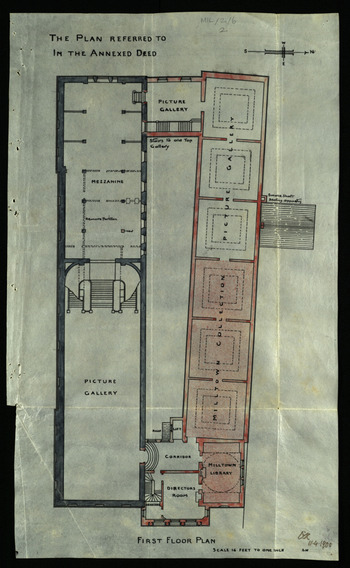
The terms of the gift dictated that the collection was to be presented to the public in dedicated rooms, and would be known as the Milltown Memorial. Finally, and as a direct result of this gift, the Treasury granted funding for an extension to the gallery. Work on the new wing, to include a library space, began in 1900. The library was to be located at the end of a suite of galleries on the upper floor beside the director's office (Fig. 2).
Milltown Wing Floor Plan. NGI Archives.

Three years after the new wing had opened the ‘Milltown Memorial’ finally opened to the public in 1906. But contrary to media reports, which welcomed the opening of an art library which would be accessible to the public; in reality it appears that the Milltown Library remained closed most of the time with no additional staff hired to operate the facility. On the death of the Countess Milltown in 1914 the galleries were de-installed to allow for other art works to be hung. In 1918 Captain Turton, who inherited Russborough House, looking to furnish his new home, wrote to the gallery, requesting a long loan of the Milltown Library, as well as the bookcases. The Governors and Guardians agreed to the proposal ‘provided that the damage done to the walls be made good by him’Footnote 3 and the bookcases replaced.
The walls were repaired but the bookcases were never replaced and the Milltown Library closed after being in existence for only twelve years – marking another major setback in the quest for the right library space for the National Gallery of Ireland.
Against the backdrop of the drama of the Milltown Memorial, the NGI Library continued to develop. By 1919 the registrar had been given the responsibility of ‘keeping the Board's library up to date’ and ’for the proper arrangement and safe custody of all the books and periodicals therein’.Footnote 4
Although no record exists of the number of volumes in the collection until much later, the holdings of the library today indicate that it was of a substantial size by the 1920s. The journal collection dated back to the mid-19th century and there was also an important auction catalogue collection that pre-dated the foundation of the gallery. Many scholars, collectors and dignitaries representing various countries made gifts to the collection and the more significant acquisitions were noted in the gallery's minute books. Around this time the collection was considered large enough to require organisation and cataloguing. Ms. Fitzgerald is the first employee hired to work on the gallery's library collection – albeit on a temporary basis. Italian Renaissance art expert, Robert Langton Douglas, gallery director from 1916–1923, believed that the gallery needed key art history reference books and insisted that they were essential for the staff and the public for the study and full appreciation of the art collection. Langton Douglas made quite a number of purchases for the library during his tenure and is believed to have paid for the cataloguing of the library collection himself. However, despite the continuing expansion of the collection and slight improvements in terms of its management the collection remained in the director's office, inaccessible to all but a select few.
The gallery struggled through the revolutionary period which was followed by civil war and independence. The gallery suffered an extended period of neglect and continuous demands for greater funding and more space for the collections remained unaddressed. The director, Thomas Bodkin, outlined the difficulties in annual reports from the 1930s – lack of staff and low salaries, inadequate storage conditions and limited space for the collections; and in relation to funding, the gallery was receiving less than it had under the British administration. For the library, the inadequate storage conditions lead to material being removed from the collection and placed in the National Library of Ireland and the Oireachtas Library (i.e. the library of the Irish Parliament).
Throughout the 1950s, the gallery continued to seek government funding to refurbish and increase its size. The efforts finally come to fruition in 1968 with the opening of the Beit Wing. This new wing provided space for a restaurant, new exhibition galleries and also delivered a lecture theatre, a conservation studio and a library. The opening of a library was a significant development for the academic community. The History of Art Departments had recently been established in University College Dublin (1965) and Trinity College (1966) and the library had an important role to play supporting scholarship arising from these new academic courses. At long last, the library collection was publicly accessible resulting in the appointment of dedicated staff to manage the collection.
By the 1980s, however, it was clear that the space was not working – it did not meet reader's expectations and was already encountering storage problems. The space eventually became filled to capacity and many books were moved off-site and researchers were no longer served. There was no access for the public or staff and the space had in effect ceased to function as a library.
This lamentable situation was to continue for close to ten years. Frustrations amongst the staff and academic and arts communities grew. Under growing pressure from the media, public, and academic community, the NGI governors and guardians explored options that included making the library a staff-only facility, closing the library down altogether, or putting it under the management of the bookshop, the success story of the gallery at that time. When EU funding was eventually secured for a new wing in the 1990s a new library was to be a major part of this development. Unfortunately due to planning objections, these plans were abandoned and other solutions had to be sought. Reconfiguring the Georgian house adjacent to the gallery at No. 5 Clare Street into a library was explored and also abandoned. By the late 1990s discussions with government departments finally concluded that the basements of two Georgian houses on Merrion Square which were linked to the gallery complex would be refurbished as a library reading room, and the 1968 space would become a store.
The rehabilitation of the gallery's library service was underway. In a revised and much compromised building plan the new Millennium Wing would also provide for two additional research spaces and two stores - the Yeats Archive and the ESB Centre for the Study of Irish Art. In 1995 the artist Anne Yeats gifted to the gallery the extensive archive of her uncle, Jack B. Yeats, considered one of Ireland's most important artists. The provision of a dedicated space was part of the terms of the gift. In addition to this, the gallery's long time ambition to establish a research centre to support the study of Irish art was realized. Within five years the library and archive collections finally had spaces and could provide public access.
The spaces occupied by the collections today are a combination of newly built spaces and re-purposed areas never intended for library use. These have been developed and added to over the years. In 2015 the Sir Denis Mahon Reading Room located in No. 90 Merrion Square was opened. Sir Denis Mahon, the renowned Italian Baroque scholar and collector, gifted his entire personal library and archive to the NGI in 2010.
These dedicated spaces have given the library and archive collections a future, allowing for the long-term development of the collections, providing workable storage, work and research spaces. This has led to the re-positioning of the library and archive department within the gallery putting it in a stronger place then it has been at any time in the gallery's history.
Public engagement
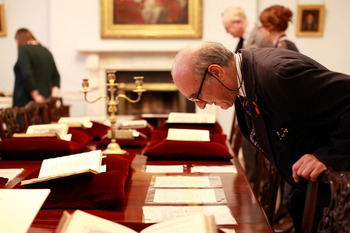
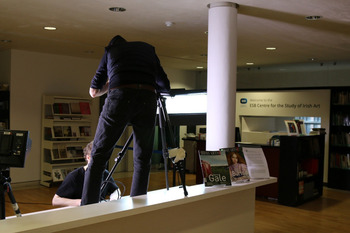
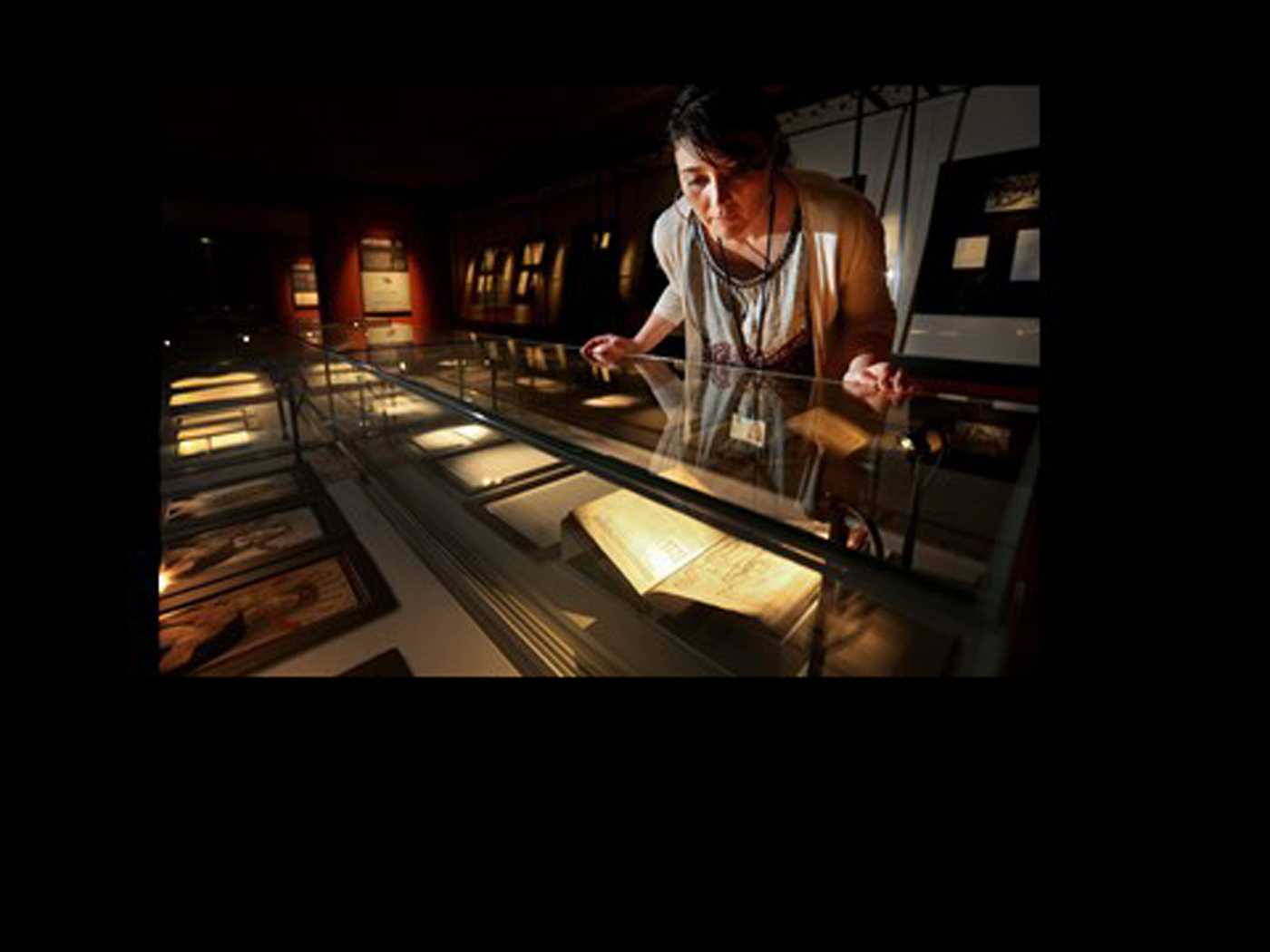
While traditional research remains a central focus of the library and archives operation, direct public engagement with the collection has become increasingly important. In addition to the traditional library spaces, the picture galleries and education spaces are being used to connect the public with the library and archives through: displays, regular tours and lectures, seminars and open days etc. It is clear that the public has an appetite for interacting with, and learning more about, these collections. These efforts now form an ongoing part of the institution's main public program. Library staff regularly provide tours of the library and archives, present seminars and lectures, work with contemporary artists and have an active exhibition programme (Figs. 3,4,5).
Tour of Sir Denis Mahon Library and Archive.

Artist at work in the ESB Centre for the Study of Irish Art.

Library and archives exhibition.

Future plans
The successful public engagement developments have increased awareness of the rich holdings of the library and archives. The maintenance and development of this program remains a high priority for library and archives staff. This, together with the new phase of growth and development in the gallery's research facilities, have highlighted the drawbacks of the current spaces which will be addressed in the gallery's future development plans.
The gallery's refurbishment programme, completed in 2017, focused on public spaces and the art collection stores. The next phase of development will focus on the facilities and services in the gallery. It will provide a new wing with education spaces, conservation studios and, for the library and archives, a state-of-the-art research centre and storage facilities.
The right space
The National Gallery of Ireland is now working towards developing a space that will be a centre for art research, scholarship, and for learning and discovery to foster imagination and creativity. This newly planned facility will deliver a state-of-the art resource for Ireland's most important art research collections, providing urgently required space for growth, and to develop and safeguard historically and culturally important collections for future generations. This will ensure the continued development of the gallery's role in acquiring, preserving and making publicly accessible research collections relating to the visual arts both nationally and internationally and most importantly, will allow for increased public access to the gallery's library and archives.
The road ahead
Many challenges lie ahead as the gallery moves forward with the new building project. Over the course of its history despite setbacks, disappointments, and false dawns, the National Gallery of Ireland has succeeded in developing an exceptional art research collection. Increasing research activity and public engagement have secured the collections future development. The gallery is determined to move forward with this plan once and for all. The future looks challenging but bright, as the library and archives shift closer to finally getting the right space.
A version of this article was presented as a paper at the IFLA Art Libraries Section Satellite Conference in Chicago, 9–11, August 2016.