“I'm not going in [the house] again yet. I know I should have to get through the Looking-glass again – back into the old room – and there'd be an end of all my adventures!”
So, resolutely turning her back upon the house, [Alice] set out once more down the path, determined to keep straight on till she got to the hill. . . .
“You ca'n't possibly do that,” said the Rose: “I should advise you to walk the other way.”
This sounded nonsense to Alice, so she said nothing
— Lewis Carroll, Through the Looking-Glass Footnote 1Imagine a story featuring a dreamy descent underground, grotesquely gigantic and dwarfish carnality, a prodigious pool of body fluid, cartwheels and pratfalls, cornucopian helpings of food and drink, antic playgrounds, riddling language and name games, repeated nonsense (re)verses, various negative capabilities, mathematical miracles, voyages of discovery, cycles of crowning and uncrowning, not to mention metalists like the previous catalogue in this sentence. It seems curious that this tangled tale, Lewis Carroll's in the Alices, has never been linked to the Carnival tradition typified by François Rabelais's Gargantua and Pantagruel (1532–64) even though our imagined story equally describes Rabelais's glorious epic. At least, it's never been linked much beyond Northrop Frye's suggestion that “[t]he Alice books are perfect Menippean satires, and so is [Charles Kingsley's] The Water-Babies, which has been influenced by Rabelais” (310) and Martin Gardner's note to Looking-Glass that Medieval and “Renaissance chess games were sometimes played with human pieces on enormous fields” as in “Gargantua and Pantagruel” (135, n. 2). And yet, to spin William Empson's memorable take on Freudian readings (357), one has only to tell Alice's story to make it a carnival tale.Footnote 2
Even that crucial Carrollian term curious recalls Rabelais's fascination with “curiosities” (Bakhtin 445) like those the “all-thirsty” giant Pantagruel sends his father Gargantua “from the island of Nowhere” (401; bk. 4, ch. 4). Rabelais's curiosities, to circle the logic, also recall Carroll's own curious inventions, like his inside-out Wonderland Postage-Stamp Case (Cohen 491–93). And Nowhere provides just one of Rabelais's whimsical upside-down utopias, the topsy-turvy ambivalence of which so resembles Carroll's quixotic queendoms. Alice learns that to ascend a hill she must adventure downward or backward, while the “language of Upside-down Land” approximates a kind of Rabelaisian “Jabberwocky,” an “imaginary language, meaning nothing” (161; bk. 2, ch. 9). Somewhat like Alice and her readers, Rabelais's Thaumaste, “in Greek, ‘Wonderful,’” has even left “my home and come here, indifferent to the weariness of the journey, the anxiety of a voyage by sea, the strangeness of different lands, solely for the purpose of seeing and conferring . . . about certain passages of philosophy, and geometrical divination, and also of cabalistic knowledge” (190–91; bk. 2, ch. 18). Again anticipating Alice and her readers' responses, Panurge, the quester for the Holy Bottle, queries Pantagruel because he has discovered only a kind of riddling song “which keeps repeating itself and never comes to an end. All you've offered me are ironies, jokes, and contradictory repetitions. They all negate each other. Which am I suppose to pay attention to?” (269; bk. 3, ch. 10). Richard Kelly calls Carroll “the left-handed man in a right-handed world” (2); and Carroll's thousands of viewings through wet-plate cameras even presented a Rabelaisian world “upside down and backward” (Stoffel 36), which Looking-Glass recreates in its “effect[s] of living backwards” (L 196; ch. 5).Footnote 3
Allon White's liminal approach to cultural history notes the nineteenth century's initial “‘disowning’ of carnival, and the gradual reconstruction of the concept of carnival as the culture of the Other” (102). If Alice's Adventures in Wonderland and Through the Looking-Glass (1865, 1871) appear somewhere near the Victorian midpoint of this “gradual reconstruction,” they also represent the highpoint – which in carnival may mean the low point – of a cultural (r)evolution in which Carroll demonstrably participated. For example, in November 1839 and February and July 1840, P. W. Banks published a three-part essay in Fraser's Magazine, “Of Rabelais,” which uncannily anticipates Mikhail Bakhtin's classic modern study Rabelais and His World. Banks stresses the “monstrous and irreproducible growths” and “bodily refection” of “eating and drinking” mythologized in “the miracle-teeming voyage in search of the magic bottle” (Nov. 516, 521), plus the tale's locus in “the land of dream” (Feb. 219) and focus on the educational value of curiosity (July 65–75). Indeed, Banks's citation of “Rabelais's own account of the contents of an apothecary's bouctique,” sounds suggestively like Carroll's “shop . . . full of all manner of curious things” (L 201; ch. 5) and the inventive kingdom of thingdom with which the gentle White Knight protects himself. Banks even emphasizes the Rabelaisian “attributes of gentleness”:
Banks further demonstrates the churchman Rabelais's “transgression of the church's rules” and his representations of “the condition of the Fall!” which, as in the Alices, lends “a substratum of melancholy” to his upside-down lands. The “Fall!” also seems captured in Rabelais's repeated “high saults, bounding in the aire, . . . leap[ing] over a stile or pale, turn[ing] short in a ring both to the right and left hand” (Nov. 528, 520; July 78). Like all of Carroll's cartwheeling, gyroscopic balancing acts, “dancing round in a ring” (L 182; ch. 4), and educational “Reeling and Writhing” (W 98; ch. 9), Rabelais's curvilinear revolutions against linear rules and rulers approximate “what the Greeks call ‘circle-learning’” (July 65). Such gnostic gymnastics, carnival's uncrowning glory for Bakhtin, recreate the unus mundus by way of the cheeky mundus inversus:
The system of these movements is oriented in relation to the upper and lower stratum; it is a system of flights and descents into the lower depths. Their simplest expression is the primeval phenomenon of popular humor, the cartwheel, which by the continual rotation of the upper and lower parts suggests the rotation of earth and sky. This is manifested in other movements of the clown: the buttocks persistently trying to take the place of the head and the head that of the buttocks. (353)
Terry Castle's contention that “By the mid-nineteenth-century . . . the culture of the carnival and fair had been fragmented, and its few vestiges relegated to the sentimental realm of folkloristic ‘survivals’” (100) consequently must be qualified since Victorian writers like Banks persisted in preserving and promoting carnival themes. For example, Charlotte Brontë's remarks on the 1843 Brussels carnival, “The Carnival is just over, and we have entered upon the gloom and abstinence of Lent” (Gaskell 252), suggest what Samuel Kinser calls “the old plot of Carnival-Lent enmity [which] certainly interested Rabelais” (56). Brontë stages this plot in the surreal festival near the end of Villette (1853), and Carroll recreates it throughout the Alices. Dickens's celebration of Sleary's circus performers in Hard Times (1854) stresses their ability to “jump over everything,” their “habit of balancing,” and their “remarkable gentleness and childishness” (77; bk. 1, ch. 6), which clearly prove more educational than M'Choakumchild's Utilitarian theory. If Sleary's name ironically sounds like Theory when lisped, his speech disorder eloquently “Slearizes” that carnival cannot be theorized: “People mutht be amuthed. They can't be alwayth a learning, nor yet they can't be alwayth a working, they an't made for it” (308; bk. 3, ch. 8). And Signor Jupe's gentle, sad-clown figure (like the White Knight's) owes something to Dickens's bittersweet Memoirs of Joseph Grimaldi (1838), the era's most famous clown.Footnote 4
Further, W. H. Wills's article “A Popular Delusion” (1850) in Dickens's Household Words chants the various delights of the London fish market Billingsgate, a commonplace for the kind of disorderly speech – linguistic libertas and heteroglossic cacophony – riddling the Alices. Bakhtin discusses at length the “special genre of billingsgate,” in “which various speech patterns,” especially praise/abuse ambivalence, “excluded from official intercourse could freely accumulate” (16–17). Wills's point seems to be “utterly to subvert established notions of Billingsgate” (in an ironic yeabynay reversal) by saying “nay” to those very values which Bakhtin later celebrates: “No crowding, no elbowing, no screaming, no fighting: no ungenteel nick-names, no foul-mouthed females hurling anathemas at their neighbors' optics; no rude requests to despatch ourself suddenly down to the uttermost depth the human mind is capable of conceiving” (115,114). Harry Stone contends that Dickens added material (113), including the circus simile of “a fine salmon [that] sparkled and twinkled like a silver harlequin,” the characteristic carnival pun on spirits, “a company of generous spirits – connected with a Brewery, perhaps,” and the carnivalesque episteme of pregnant death, “The undertaker laughed monstrously at a joke” (121–22). Dickens's additions, then, suggestively subvert Wills's subversion of billingsgate subversions. The carnival ambivalence here, which Bakhtin calls the “ambivalent fullness” of billingsgate (421), further implies the ambivalence of a carnivalized fish market featuring eels and oysters, which the Alices also feature, but which are normally linked with lent, not carnival. For post-Bakhtinians like Kinser, however, “amalgamating . . . characteristics of Carnival and Lent in a single monstrous” (118) personality, product, or process, as Carroll does with his hybrid pig-baby, becomes a primary rhythm in carnival double-voicing. Perhaps the most notorious example of such Victorian double-talk occurs in John Davidson's controversial “Ballad of a Nun” (1895) in which a previously cloistered nun discovers “Life's dearest meaning” at the town carnival by surrendering “her passion's hoard” to a Christlike young man. When she insists that she can “keep the Carnival” within the convent walls, the Virgin Mary, who has been masquerading as the nun, approvingly welcomes her back to the cloister (ll. 61, 86, 128).
Many Victorian novels reference billingsgate ambivalence. Even before the “wild times of carnival” in Vanity Fair (1848), for example, Mr. Osborne, finishing “his observations upon the soup, . . . made a few curt remarks respecting the fish, also of a savage and satirical tendency, and cursed Billingsgate with an emphasis quite worthy of the place” (Thackeray 734; ch. 63, 162; ch. 13). Such (meta)satire not only labels Osborne a carnival agelast or unlaughing lenten hypocrite (Bakhtin 212–13) like Carroll's Queen of Hearts, but also suggests the dystopian undercurrents of carnival that post-Bakhtinians like Michael André Bernstein stress: “when the tropes of Saturnalian reversal of all values spill over into daily life, they usually do so with a savagery that is the grim underside of their exuberant affirmations” (6). Here, as with the Alices, questions of carnival tone, irony, and referentiality are crucial. They are also critical in George Eliot's representation of “the merry spirits of the Carnival” (191; bk. 1, ch. 20) in Romola (1863), which she partially based on Goethe's “The Roman Carnival” with its famous conclusion, “life, taken as a whole, is like the Roman Carnival, unpredictable, unsatisfactory and problematic” (469).Footnote 5 Eliot pits “the old debauched Carnival” against Lent masquerading as “the new Carnival” and becoming “a sort of sacred parody of the old” (408–09; bk. 3, ch. 44). Again, utopian and dystopian energies seem suspended, ambivalently, in the balance here. Walter Besant appears less ambivalent in The French Humorists (1877) since the chapter on Rabelais praises his Carrollian “farrago of nonsense” and barrage of “absurdities and extravagancies” (108, 111). Besant hopes that “England will yet learn to appreciate [Rabelais] more largely” as a “glorious wit and satirist” because he relevantly finds “benevolence, forethought, [and] care for the happiness of creation” in Rabelais's “wondrous formation of the body, in the courses of the seasons, in the instincts of animals, in the great and awful mystery of birth and death, in growth and decay, in the annual sleep of the world and its annual waking” (126, 125). Such devotion inspired Besant to create the Rabelais Club, comprised of “seventy or eighty members,” including eminent Victorians like George Meredith, Thomas Hardy, Andrew Lang, Henry James, and Robert Louis Stevenson. From 1880 to 1888, the Club “formed three volumes called Recreations of the Rabelais Club” (Autobiography 240–41), which contain sixty-eight Rabelaisian essays, tales, and poems.Footnote 6
As an ordained deacon in the Church of England, Lewis Carroll's religious beliefs might seem resistant to such a carnival subculture. But as Robert M. Polhemus argues in Comic Faith, “four of the men whose work is central to the development of comic prose fiction – Erasmus, Rabelais, Swift, and Sterne – were ordained clerics and professional churchmen,” which signifies a vital connection between faith and folly, praying and playing, besides suggesting “a massive change taking place in cultural sensibility” (13). In “An Easter Greeting to Every Child Who Loves Alice,” often printed after Wonderland, Carroll posits that some readers “may blame me for thus mixing together things grave and gay.” Nevertheless, “I do not believe God means us thus to divide life into two halves – to wear a grave face on Sunday” and to think “He does not also love to . . . hear the merry voices of the children, as they roll among the hay” (162–63). As Sir Toby belches to the Clown in Twelfth Night, “Dost thou think, because thou art virtuous, there shall be no more cakes and ale?” (Shakespeare 2.3.105–07).
Archdeacon Grantly's compensatory recourse to his secret “volume of Rabelais,” hidden away so he can privately “amuse himself with the witty mischief of Panurge” (98–99; ch. 8) in Trollope's The Warden (1855), was never an option for Carroll. Rather, he resembles Browning's praying–by-playing “Fra Lippo Lippi” (1855), whose art “sing[s] out carnival” with “a double step,/Mak[ing] his flesh liker and his soul more like” (ll. 46, 206–07). Indeed, Carroll publicly indulges his carnival pleasures in the Alices, which can be read as nursery versions of Gargantua and Pantagruel, preceding his own The Nursery Alice (1889). Whether he was specifically influenced by Rabelais or was simply a “kindred spirit” within the carnivalesque tradition remains unknown. What is clear, however, is that the Alices abound in carnival motifs which reveal neglected, or at least previously unconnected values. For example, Susan Sherer's contention that Carroll's many “characters positioned with their heads facing downwards” signifies their rejection of reality (4) overlooks his characters critically confronting the “grotto” values of grotesque realism (Bakhtin 31–32); Nina Auerbach's perceptive analysis of “redemptive monstrosity,” especially Carroll's hybrid pig-baby (59, 54), unfortunately neglects its crucial carnival context.
We focus here on the interconnected motifs of underground descent, monstrous plenitude, prandial and pantagruelian excesses, and billingsgate liberties, which converge in the White Knight episode, Carroll's locus festivus. Before pursuing Alice's adventures at the carnival, though, we should address a perennial problem, the (differential) relationships between Wonderland and Looking-Glass, which clarify the changing configurations in Carroll's carnivalism. Donald Rackin has been most persuasive in emphasizing differences, seeing Wonderland as the chaotic “bad dreams of an infantile psyche” and Looking-Glass as the clearly structured “dream of a much more mature psyche, one well on its way to satisfactory integration and a conscious grasp of fear, time, evil, and death” (69–70). Remembering that Carroll “had sent” Alice “straight down a rabbit-hole, to begin with, without the least idea what was to happen afterwards” (Gardner 8, n. 1) in his preliminary Alice's Adventures Under Ground (1864), we could follow Rackin, arguing that Carroll grew more conscious of his Rabelaisian implications sometime before writing Looking-Glass. He implemented these in the latter tale which contains roughly sixty percent of the more than two hundred carnivalesque references in both books. Pushing Rackin's argument further, we might add (with ludic logic) that Carroll also realized and then rejected the “post-Bakhtinian” rage-filled carnival he unwittingly created in Wonderland and softened it with “Bakhtinian” optimism in Looking-Glass.
The anthropologist Victor Turner's play model for liminal rites of passage provides a more suggestive approach, especially his explanation of the relationships between (early tribal) liminal and (later technological) liminoid phenomena. The cultural break(down) occurs somewhere near the Alices' mid-nineteenth century. Turner often cites Rabelaisian “carnivals and festivals” (25); and such playful “forms of topsy-turveydom” appear ambivalent when the “‘threshold’ is protracted and becomes [an underground] ‘tunnel,’ when the ‘liminal’ becomes the ‘cunicular.’” For Turner, “this is particularly the case in initiation rituals, with their long periods of seclusion and training of novices rich in the deployment of symbolic forms and esoteric teachings” (42, 41). Somewhat like Wonderland, the liminal stresses inversions, obligations, cyclic renewal, and ergic/ludic complements, while somewhat like Looking-Glass, the liminoid suggests subversions, options, continuity, and work/play corollaries. If these dyads don't exactly distinguish the Alices, though, Turner emphasizes that in antistructural “liminality is [always already] secreted the seed of the liminoid” (44).
The books' paradoxical relationships, however, seem also like the revolutionary geometries in the “Lobster Quadrille,” a four-sided dance in five figures. And this kind of shape-shifting configuration provides an even better – a more playfully Rabelaisian and Carrollian – way to “imagine” the carnivalesque interrelations between Wonderland and Looking-Glass than Rackin's straightforward psychological paradigm or Turner's hybrid cultural model. For example, the geometric play suggests Rabelais and Carroll's shared delight in figural contrast: “Rabelais continually used the traditional folklore method of contrast, the ‘inside out,’ the ‘positive negation’” (Bakhtin 403); and “characteristic of Carroll [was] his love of sharp contrast” (Gardner 138, n.1), particularly in figurative pairs. Such contrasts further suggest their related delight in metalogic and semiotics (Rabelais's English Scholar Thaumaste loses an uproarious game of obscene signs to Panurge, and Carroll published The Game of Logic in 1887).Footnote 7 We should remember, though, that while some of Carroll's contrasts appear logically valid, like those between the two Queens and two Knights, others seem masked identities like those between the Tweedles and even between the Lion and the Unicorn since Carroll never clearly differentiates them as, say, Reason and the Imagination (or Gladstone and Disraeli). Thus, his praise of folly constantly plays with sunny shades of likeness and unlikeness, which Gilles Deleuze pertinently calls two intertwined “readings of the world”: one “invites us to think difference from the standpoint of a previous similitude or identity; whereas the other invites us to think similitude and even identity as the product of deep disparity” (261). For example, Carroll acknowledges that Looking-Glass's binary “alternation of Red and White [squares] is perhaps not so strictly observed as it might be” (L 133; “Preface to the 1897 Edition”). As Tweedledee would say, “Contrariwise . . . if it was so, it might be; and if it were so, it would be; but as it isn't, it ain't. That's logic” (L 181; ch. 4) – though not exactly the either/or logic of the excluded-middle that seems satirized here.Footnote 8 With the same kind of playful dialogism, Rabelais's cartography is parceled into (un)like upside-down countries like Pantagruel's “country of Utopia” (220; bk. 2, ch. 29) and Panurge's “kingdom of folly.” This latter nonsensical place “of Fou – or craziness – is quite sensibly located near the town of Tou – or everything” (360; bk. 3, ch. 46).
The most suggestive way to imagine such “utopian” relationships between Wonderland's and Looking-Glass's play figures may be through the Greimesian or semiotic square, whose philosophical games of axiological assertion, contradiction, implication, and complementarity Rabelais and Carroll would equally appreciate (see Greimas and Cortés 308–11). Fredric Jameson encourages readers to “to bricolate [from the square], that is, in plainer language, simply to steal the pieces that interest or fascinate us, and to carry off our fragmentary booty to our intellectual caves” (viii). In this underground context, Pantagruel advises Epistemon “to be properly Pythagorean and four-sided” (by interrelating law, theology, medicine, and philosophy); and Rabelais practices creative varieties of “this Pythagorean method” (320; bk. 3, ch. 29, 462; bk. 4, ch. 37). Wonderland and Looking-Glass both play philosophically fast and loose with “real”/“unreal” axes in Carroll's four-sided “utopian” square: utopias or the self-enclosed “no-places” featured in Elizabeth Sewell's The Field of Nonsense, like the “Caucus Race” and “Jabberwocky”; eutopias or the bountiful “good places” of the undersea school and Alice's coronation; dystopias or the nightmarish “bad places” of the Knave's trial and “The Walrus and the Carpenter”; and eudystopias or the “good bad places” grounded in all the fortunate falls in the Alices. Heterotopias, the motley or “heteroglossic places” of pangeneric carnival, also inform and coordinate both tales, circling their squares into mandalas by taking all sides and more, like the Sheep's gyroscopic teetotum (L 202; ch. 5), but without becoming all-totalizing. Jean Jacques Lecercle relevantly notes the semiotic relations of “the ‘empty square’ (case vide)” to be something like the unshaped, blank map for finding a snark: “the element in the structure which, meaningless itself, moves from position to position and gives them meaning by establishing a network of relationships” (14).Footnote 9 Michel Foucault likewise counters any “hierarchized ensemble of places” with more playfully horizontal “emplacements” or “heterotopias,” which “have the curious property of being connected to all the other emplacements” (176–78). In this philosophical (non)sense, which resembles Thaumaste's “geometrical divination,” Wonderland and Looking-Glass's congruent geometries warrant treating them interchangeably. As Carroll might say, all snarks are boojums, you see.
The “proregressive” motif of underground descent, which then reverses into an ascent, not only promises the eudystopian ricorso of the fortunate fall, but again posits that both tales may revolve into hybrid heterotopias through Alice's wonderfully painful, gnostic quest for truth and self-knowledge.Footnote 10 As earth-diver, Alice reprises Rabelais's Persephone and her carnivalesque gospel that “underground there are vast treasures and wonderful things.” Further, considering that Carroll improvised Alice's descent during that memorable July 4th voyage on the Isis, what a curious coincidence that Rabelais's “Isis, meaning She Who Is Secret, Hidden, Concealed” underground, can enlighten her worshipers' “understanding both of Herself and of Her creatures” as they “travel the road of divine understanding and the pursuit of knowledge” (621–22; bk. 5, ch. 48) like Alice.
Alice initially finds “herself falling down what seemed to be a very deep well” (W 12; ch. 1), and Pantagruel advocates “diving even as far as the bottom of that bottomless well in which, according to Heraclitus, the truth is said to be hidden” (192; bk. 2, ch. 18). The Dormouse tells Alice that Elsie, Lacie, and Tillie – the Liddell sisters' surrogates – all “lived at the bottom of a well” and “lived on treacle” since it “was a treacle-well” (W 75; ch. 7). Like Rabelais's repeated motif of tripe (Bakhtin 162–64,221–25), truthful treacle is also a brand of carnivalesque “gay matter” (Bakhtin 195), which joyfully joins contraries and evades categories: “treacle is anomalous in the classification of liquids and solids, being in neither one nor the other set” (Douglas 37). Digesting treacle as a carnival eucharist (like tripe) satisfies what Panurge terms “the first rule of philosophy – which is: Know yourself” (307; bk. 3, ch. 25).Footnote 11 And Alice famously ponders, “‘Who in the world am I?’ Ah, that's the great puzzle!” while creatures, like the Caterpillar, constantly ask, “Who are you?” (W 23; ch. 2, 47; ch. 5). By metonymic extension, everything else appearing in grotesque Rabelaisian containers, such as the “large cauldron which seemed to be full of soup” (W 60; ch. 6), also produces cornucopian well-being.
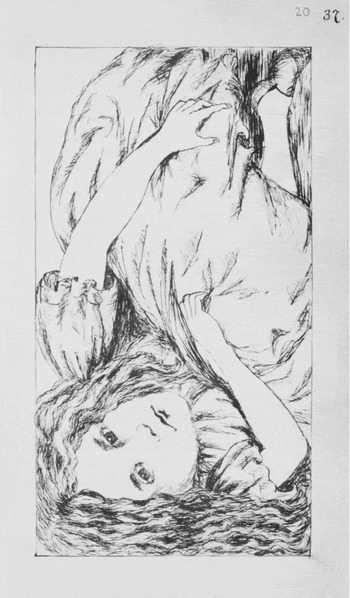
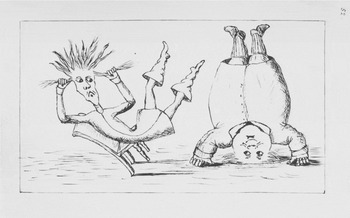
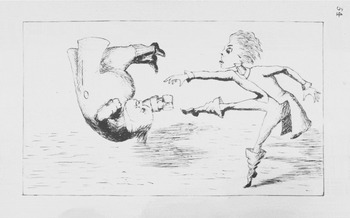
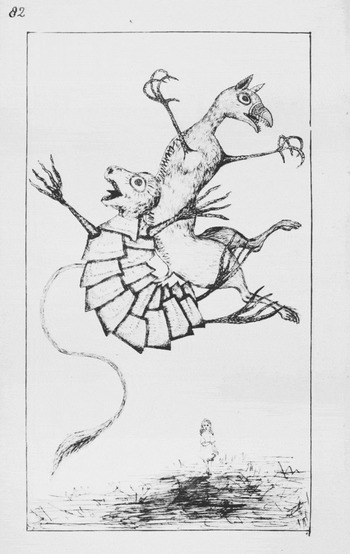
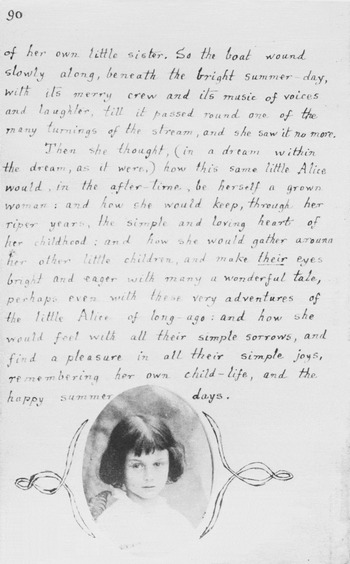
Many of Carroll's original illustrations to Under Ground graphically feature carnival's descent motif: the mouse's telltale tailpiece (28; ch. 2), though it's not technically an illustration; Alice upside-down in the tiny room (37; ch. 2; Figure 6); lizard Bill kicked up (and down) the chimney (43; ch. 2); Father William standing on his head (52; ch. 3; Figure 7), “turn[ing] a back-somersault” (54–55; ch. 3; Figure 8), even balancing an eel on his nose (58; ch. 3); the Mock Turtle and Gryphon “turn[ing] a somersault in the sea” (82–83; ch. 4; Figure 9); and Alice Liddell's 1859 upper-torso photograph ascending from the bottom of the page (like Persephone from underground) between the graphically-split last words “summer days” (90; ch. 4; Figure 10). In fact, this final example kept its own “underground” secret (of Alice's eternal return) for over a hundred years until 1977 when Morton Cohen discovered Carroll's only drawing of Alice hidden under the photo (127). As Bakhtin implies, such a significant carnival “image of pregnant death” operates on a personal, but also on cultural and cosmic levels: “a peculiar mimicking of death-resurrection: the same body that tumbles into the grave rises again, incessantly moving from the lower to the upper level (the usual trick of the clown simulating death and revival)” (352, 354).
Lewis Carroll, “Alice Upside-down in the Tiny Room.” Alice's Adventures Under Ground (1864; New York: Dover, 1965). Courtesy of Dover Publications.

Lewis Carroll, “Father William Standing on His Head.” Alice's Adventures Under Ground. (1864; New York: Dover, 1965). Courtesy of Dover Publications.

Lewis Carroll, Father William “turn[ing] a back-somersault.” Alice's Adventures Under Ground. (1864; New York: Dover, 1965). Courtesy of Dover Publications.

Lewis Carroll, The Mock Turtle and Gryphon “turn[ing] a somersault in the sea.” Alice's Adventures Under Ground. (1864; New York: Dover, 1965). Courtesy of Dover Publications.

Charles Ludwig Dodgson (Lewis Carroll), photograph of Alice Liddell, 1859. Illustration in Alice's Adventures Under Ground. (1864; New York: Dover, 1965). Courtesy of Dover Publications.

The related “image of a clownish carnivalesque uncrowning” and crowning (Bakhtin 79) appears in Alice's ultimate uncrowning of the Royals in Wonderland when she disobeys the Queen's command of silence: “‘Who cares for you?’ . . . (she had grown to her full size by this time). ‘You're nothing but a pack of cards!’” (L 124; ch. 12). And it reappears more emphatically with her own crowning at the Eighth Square in Looking-Glass, though it's also subtly reinforced by John Tenniel's illustration of the Red King asleep with “a tall red night cap on, with a tassel, . . . snoring loud – ‘fit to snore his head off!’” (L 188; ch. 4). Here the King seems both figuratively decapitated and literally uncrowned by his talismanic foolscap, which reappears when the looking-glass menagerie of guests puts “glasses upon their heads like extinguishers” resembling, as Gardner notes, “hollow cones” (L 264, n.17; ch. 9). Even Haigha's illustrated march-hare ears (L 224; ch. 7) look like uncrowning ass's ears, especially since his court jester appearance and posture familiarly parody the White King (as well as recalling the ass-eared harlequin on the original title-page of fellow Punch illustrator Thackeray's Vanity Fair). Carnival cycles of uncrowning reinforce the eternal temporality of personal, cultural, and cosmic cycles because, like the White Rabbit's pocket watch, the playful figure of Time itself “is the true hero of every feast, uncrowning the old and crowning the new” (Bakhtin 219). As Jonathan Arac puts it, “In full carnival festivities the primary performance is the mock crowning and subsequent uncrowning of the king of carnival, the Lord of Misrule. . . . In this cyclical process the pathos within the jollity becomes evident, the sadness of vicissitude and death as well as the promise of change and renewal” (487). Thus, the crabby “Classical master” at Wonderland's undersea school teaches “Laughing and Grief” (W 98; ch. 9), a bittersweet mishmash like Carroll's magazine Mischmasch (Cohen 49–50).
Rabelais's gargantuan tale of giants represents monstrous plenitude not only in literal and figurative “lovely horn[s] of plenty,” like the codpiece which is “long” and “large” and “loaded to the brim” (24; bk. 1, ch. 8), but also in hybrids like “unicorns” with “staglike heads, the feet of an elephant, a tail like a wild boar, and a sharp black horn . . . like a turkey's crest” (592; bk. 5; ch. 30). No wonder Alice “always thought Unicorns were fabulous monsters”; more wonder, though, that the Unicorn “always thought [children] were fabulous monsters!” Thereafter he dubs Alice “the Monster,” and she in turn grows “quite used to being called ‘the Monster,’” finding herself an uncertain medley of “animal – or vegetable – or mineral” (L 229–31; ch. 7) powers. Carroll's most telltale monstrous example, however, is surely the hybrid baby the Duchess lets fly at Alice: “a queer-shaped little creature . . . just like a star-fish,” but “snorting like a steam-engine,” and finally “turn[ing] into a pig” – potentially, in fact, “a rather handsome pig” (W 63–64; ch. 6). In challenging conventional categories of classification and representation, such monstrous demonstrations create food for thought beyond Bakhtin's utopian conclusion that the “leading themes of [carnival] images of bodily life are fertility, growth, and brimming-over abundance” (19).Footnote 12
To be sure, both Rabelais and Carroll stress pleasure principles of plenitude in lengthy lists and large numbers. Rabelais, for example, spends two chapters listing liquors and foodstuffs (divided generally into meat and fish, 502–07; bk. 5, chs.59–60); and Carroll catalogues epic chess pieces but also more mundane series like the Tweedles' “arms full of things – such as bolsters, blankets, hearth-rugs, table-cloths, dish-covers and coal-scuttles” (L 191; ch. 4). Fundamentally, these carnival lists link lower and upper categories, cultures, classes, and grammatical cases – cabbages and kings are equally a head. This is not mere make-believe; rather it makes belief in the impossible a reality. As the Priestess of the Holy Bottle tells Pantagruel, drinking assures that “nothing is impossible” (614; bk. 4, ch. 43), and the White Queen tells Alice that she's “believed as many as six impossible things before breakfast” (L 199; ch. 5). Rabelais and mathematics don Dodgson/Carroll also preach apocalyptic gospels of miraculous infinitude, particularly with the millenarian number one thousand: Brother Mincemeat, for example, greets Gargantua with “a thousand hugs, a thousand handshakes and pats on the back, a thousand hello's and how-are-you's” (90; bk. 1, ch. 31). Similarly, the heteroglossic “chorus of voices” at the train station greets Alice with another millenarian litany: “time is worth a thousand pounds a minute!”; land “a thousand pounds an inch!”; smoke “a thousand pounds a puff!”; and language “a thousand pounds a word!”(L 169–70; ch. 3).
Monstrous poundage also recalls the carnival figure Fat William and his traditional personification “of ‘much’ and ‘more’ abundance” (Bakhtin 292), which previews both somersaulting Father William “grown most uncommonly fat” and Carroll's fascination with “‘much of a muchness’” (W 50; ch. 5, 77; ch. 7), like “the egg [that] only got larger and larger, and more and more human” till it turned into upper-case “HUMPTY DUMPTY himself” (L 207; ch. 6). As Timothy Hyman demonstrates, “Eggs,” forbidden by Lent, “were always pervasive in Carnival,” but a “huge empty egg” (25, 21) was associated with pompous foolishness (like Humpty's vanitas). And this kind of cautionary carnivalism qualifies the pantagruelian flow theory Rabelais celebrates in the wine barrel which “will flow eternally” (246; bk. 3, Prologue) and Carroll features in his old curiosity shop “full of all manner of curious things” which “flow about so.” In fact, Alice's “plaintive tone” (L 201; ch. 5) here implies a dystopian mutability canto. As Julia Kristeva writes, carnival excavates culture's “underlying unconscious: sexuality and death,” sometimes even beyond the pleasure principle: “‘I wish the monstrous crow would come!’ thought Alice” (L 193; ch. 4). Carnival's Menippean elements further probe “[p]athological states of soul, such as madness, split personalities, daydreams, dreams, and death” (78, 83). Carroll grounds Kristeva's analysis in hybrid Alice's “pretending to be two people” (W 18; ch. 1), the Cheshire Cat's moronic refrain, “we're all mad here. I'm mad. You're mad” (W 66; ch. 6), and that oxymoronic “unwelcome bed” and “melancholy maiden” (L 135; Preface to the 1897 edition), which in Looking-Glass's prefatory verses (as in Persephone's vertical swings) elegiacally link maiden, mother, and crone. In other words, carnival monstrosities make us reconsider what is natural and unnatural by dissolving constructed boundaries between the two. Janusian monsters, such as Dodgson/Carroll, two-personed Alice, and Jabberwocky, ambiguously embody “two meanings packed up into one word” (L 215; ch. 6). They represent the mystery of two-in-one like Aristophanes's circling androgynes in Plato's The Symposium, or Love Feast, cited so often by Rabelais – Carroll “steeped himself in Plato” (Cohen 44) and believed with his Duchess, “‘tis love, that makes the world go round!” (W 92; ch. 9). Fun-loving monsters thus play guides on Rabelais's double path of ambi-valence, which James Kincaid finds so characteristic of the Alices: “The necessarily ambivalent attitude toward Alice . . . makes it impossible for the reader to find a consistent position or a comfortable perspective” (93).
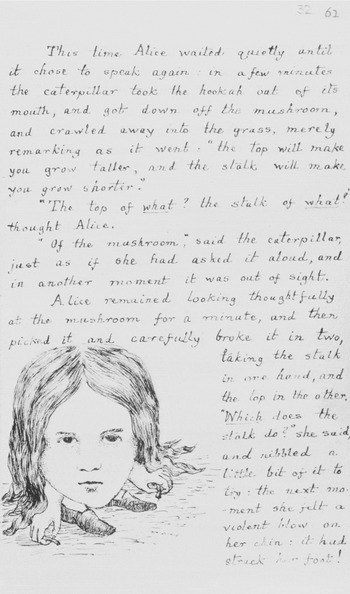
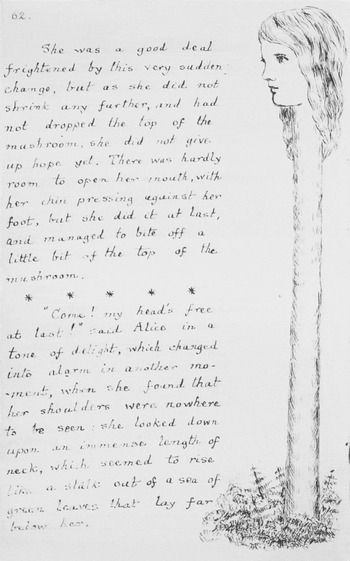
Just as Alice must actualize all her inner resources, or at least the healthy contraries of innocence and experience, she must also accept the monstrous growing pains of stretching back-and-forth between carnival versions of dwarfs and giants, between being three inches tall and becoming “nearly two miles high,” as the Red Queen contends (W 120; ch. 12). Carroll's traditional “Nobody” or Nemo games – “Nemo is the free carnivalesque play with official negations and prohibitions” (Bakhtin 414) – connote various values, but one is certainly that carnival celebrates the carnal. Consequently, Alice's ability “to see Nobody!” coming down the road (L 223; ch. 7) comically suggests her carnival plight of being no body, and even of having no body (Carroll's original illustrations represent her disembodiment [Under Ground 23; ch. 1, 35; ch. 2, 61–2; ch. 3, Figures 11 and 12; 88; ch. 4]) and of needing to become fully incarnate, that is, fully carnivalized. The Cheshire Cat's disembodied grin monstrously parodies this number one carnival rule. At the same time, Alice must learn how to hold onto the protean real, as Menelaus must do with Proteus in The Odyssey and Stephen Dedalus must do in his “seaspawn and seawrack” seaography lesson in Ulysses's “Proteus” chapter (Joyce 37). Still, Alice's most instructive lesson is learning to deal with that transforming pig-baby monster and the carnival perspective it represents.
Lewis Carroll, Illustration [Alice disembodied] from Alice's Adventures Under Ground. (1864; New York: Dover, 1965). Courtesy of Dover Publications.

Lewis Carroll, Illustration [another version of Alice disembodied] from Alice's Adventures Under Ground. (1864; New York: Dover, 1965). Courtesy of Dover Publications.

Alice famously tells the Red Queen she has learned “a very curious thing”: “every poem was about fishes in some way. Do you know why they're so fond of fishes, all about here?” The White Queen then recites another poem about fishes, one ending with a riddle, “Which is easiest to do,/Un-dish-cover the fish, or discover the riddle?” (L 263–64; ch. 9). The carnival answer is that it's easiest to blow the fish's cover, which Alice has just accomplished by noting the centrality of the ambiguous fish symbol that betokens both life-denying fasting and the life-renewing biorhythms of diving and resurfacing like Persephone. It's more difficult to “discover the [related] riddle” of hegemonic (versus popular) culture's control of carnival values under the lenten pretense of so-called “national security” like the Queen of Hearts trying to control the croquet game with threats of decapitation. Discovering the riddle, however, would figuratively uncover and awaken the dormant carnival remains under the fish cover-up. These remains can appear as marvelously monstrous as the animated Leg of Mutton at the crowning of Alice's new regime or as mome as the “bellowing,” “whistling,” and “sneez[ing]” rath-pigs in Jabberwocky. Carroll's raths may be hors d'oeuvres of another color, but like other Rabelaisian tidbits, these displaced, green little piggies have “lost their [cultural] way” far “from home” (L 216; ch. 6). And they need readers to find their way back to the carnival. Victorian readers might even discover cultural analogies in the famous homeless pig that the old woman in the children's tale tries to lead over the stile. As Dickens joked to the Administrative Reform Association in 1855, speaking of the Houses of Parliament which burned down in 1834 and were not yet rebuilt, “the national pig is not nearly over the stile yet; and the little old woman Britannia, hasn't got home tonight.” Dickens's little piggy allusion was followed by “Loud laughter and cheers” (Speeches 205, editor K. J. Fielding's emphasis).
No matter how hard Carroll tries to defend pigs and decrown fishes in his emblematic battles between carnival and Lent, pigs often get a raw deal in his works after the Alices. In The Hunting of the Snark (1876), the Barrister dreams of a trial where the Snark “was defending a pig” against a charge of “Treason,” otherness's alleged betrayal of orthodoxy. But the lenten jury, certainly no carnival peers, sentences the accused to “Transportation for life,” the death sentence of Lent's life-long victory over carnival, though “the pig had been dead for some years” (773–75; 6th Fitt). Carroll's preliminary sketches to Sylvie and Bruno (1892), illustrating Lady Muriel's poem about three badgers returning baby herrings all the way home in their mouths (rather than eating them [419–22; ch. 17]), represent the self-sacrificing, unfed badgers with pigs feet and snouts (reproduced in Guiliano 151,153). In Sylvie and Bruno Concluded (1893), “The Pig's Tale” portrays an overweight porker who can't play leapfrog until a frog “with fishy eye” teaches him “how to jump!”; but it proves an unhealthy and ultimately “fatal jump” (727–28; ch. 23).
Just as nonsense needs sense to create new “sense,” however, Umberto Eco finds carnival and culture healthily linked: “Without a valid law to break, carnival is impossible” (6). And Kinser sees carnival's traditional battle between pigs and fish, like that between Fat Tuesday and Ash Wednesday, as eternally and evenly matched. Even when pork sausages are slain, the Holy Grail descends from heaven to revive the porkers because Lent and carnival need each other as much as humanity needs both to survive with any kind of life quality (Kinser 106–08). Rabelais's famous parody of this celestial trope features the airborne and monstrous “heavy-fatted, heavenly gray pig, with great, flapping wings,” which drops “more than twenty-seven barrels of mustard to the ground,” while screaming “Mardi Gras! Mardi Gras! Mardi Gras!” And this flying porker appears graphically pedagogical as “A Pig Teaching Minerva” (469–70; bk. 4, ch. 41). Carroll's own lesson, though less didactic, seems just as confident of carnival's porcine powers and their links with lenten fish. His riddling art transubstantiates the baby into a “star-fish” which, in turn, converts to carnival's holy sacrament, the pig “flying” to Alice. The Walrus and Carpenter's last supper of oysters provides a related kind of lenten feasting, particularly when the Walrus wonders “whether pigs have wings” (L 185; ch. 4). Rabelaisians know a hugely famous pig that does, indeed, sport wings. And at the end of Wonderland, Carroll's baby/pig, much like Alice's photo, is miraculously reborn: “once more the pig-baby [appears] sneezing on the Duchess's knee” (W 126; ch. 12); likewise at Looking-Glass's final coronation feast, three hybrid guests, “who looked like kangaroos,” begin “eagerly lapping up the gravy, ‘just like pigs in a trough!’” (L 264; ch. 9). Like Carroll's drawing of Alice disinterred in 1977, Carroll's self-identification with pigs was unburied in 1974 with the miraculous emergence of the missing “Wasp in a Wig” episode at a Sotheby auction. If Gardner is right to wonder if sometimes “Carroll, perhaps not consciously, spoke through his Wasp like a ventriloquist” (“Introduction” 291), then the Wasp's verse confession to Alice seems one more carnival resurrection of his wigged-out pig:
No wonder Rabelais's “Maître Gaster or Belly,” the porcine “lord of abundance,” happily weds “good lady Poverty” or lenten “Indigence” and procreates Love, “that noble child, mediator of heaven and earth, as Plato claims in his Symposium” (498; bk. 5, ch. 57). Also no wonder part-time vegetarian Carroll “always” vacillated between eating “meat or fish” (Letters 2: 914).
During Alice's provocative love feasts, she, like Rabelais, “always took a great interest in” prandial and pantagruelian excesses, in “questions of eating and drinking,” having learned that “something interesting is sure to happen, . . . whenever I eat or drink anything” (W 75; ch. 7, 38; ch. 4). In carnival's (per)version of the wasteland, Rabelais's inebriated chorus comically chants, “If I don't drink, I'll be dry: to me, that would be death” (17; bk. 1, ch. 5). Carroll invokes the same kind of “dryasdust” drinking joke after “hot and thirsty” Alice eats the “very dry” biscuit which the Red Queen offers with a typical carnival non-sequitur, “Thirst quenched, I hope?” (L 165–66; ch. 2).Footnote 14 Carnival dishes also always run away with the spoons and animate the material universe with spiritual potential. Rabelais's “hams picked themselves up and trotted about, and goblets flew” (17; bk. 1, ch. 5), while wine bottles summon even more spirits during Alice's chaotic coronation feast, seizing “a pair of plates, which they hastily fitted on as wings, and so, with forks for legs, went fluttering about in all directions” (L 265; ch. 9). We'll hear more about Rabelais's Holy Bottle, but another of Carroll's bottles features the same delightful, divine-life cocktail: “a sort of mixed flavour of cherry-tart, custard, pine-apple, roast turkey, toffy, and hot buttered toast” (W 17; ch. 1). Just as Rabelais employs tripe stew as his crucial image of life's depth and complexity, Carroll uses the Mock Turtle's “Beautiful, beauti-FUL SOUP!” (W 108; ch. 10) as his cornucopian stock-in-trade. As he indicated after developing Under Ground into Wonderland, “I added many fresh ideas, which seemed to grow of themselves upon the original stock” (Gardner 8, n.1). Carroll became curator of Christ Church's Senior Common Room in 1882, and his chief duty was “maintaining” its “creature comforts,” especially “the quality of the wine cellar” (Kelly 24) – though his Alices had already figuratively performed this valuable service by producing and preserving carnival spirits.
But carnival's prandial and pantagruelian tropes run much deeper. Pantagruel's “deep scholarly desire to see, learn, and understand” by questioning “the oracle of the Holy Bottle” provokes him to seek the underground temple and “sing an ancient Greek wine song” celebrating “O Bottle/So full/Of wonders!” The Holy Bottle then belches its climactic carnival philosophy, “Trink !” which requires a “joyous gloss” from the underground Priestess Baqbuc: “Trink is an oracular word, celebrated and understood everywhere on earth, and says to us: Drink,” for “drinking . . . makes men human” (441; bk. 4, ch. 25, 615–16; bk. 5, ch. 45, 617; bk. 5, ch. 46). That is, one must drink life to the lees to reach full human potential and satisfaction, which Carroll also suggests at the very beginning of Alice's underground adventures: “she found a little bottle . . . and tied round the neck of the bottle was a paper label, with the words ‘DRINK ME’ beautifully printed on it in large letters.” (W 16; ch. 1). So, Carroll's carnival tale begins where Rabelais's leaves off, but obviously it provides more than a tailpiece (though it provides that, too, in its tailing mouse tale). It further suggests that drinking life fully is just one of carnival's many self-creative talents which Alice must learn and practice. Writing is another. At the beginning of Looking-Glass, Alice “could find nothing but a bottle of ink”; but “hundreds of voices” finally carol, “Then fill up the glasses with treacle and ink,/Or anything else that is pleasant to drink” (L 147; ch. 1, 260–61; ch. 9).
When Humpty Dumpty packages double meanings in the single word glory, his wordplay practices billingsgate liberties with a “nice knock-down argument” and “un-birthday presents” (L 213; ch. 6) – in reverse, “a carnival game of negation” and the dialogism of “two-faced Janus,” which “abuses while praising and praises while abusing” (Bakhtin 412, 165). Bakhtin's double-crossing chiasmus here even gently parodies Rabelais's repeated philosophic use of chiasmus: whether as carpe diem, “Men weren't created for hours: hours were created for men” (96; bk. 1, ch. 41), or as “The new bride was crying while she laughed, and laughing while she cried” (423; bk. 4, ch. 15), which characteristically joins (laughing) Democritus with (weeping) Heraclitus. Perhaps in compensation for his stammering, Carroll likewise delights in eloquent mirror-writing like the concise beauty-beast equation “Alice – Mutton: Mutton – Alice” (L 261; ch. 9) or the Mad Tea Party's antithetical play with carnival desires, “You might just as well say, . . . that ‘I like what I get’ is the same thing as ‘I get what I like’!” (W 71; ch. 7).Footnote 15
Conversations, “nice knock-down argument[s]” dialogically riddled with praise-abuse ambivalence, abound in the Alices. She tries to “manage [them] herself” (L 194; ch. 5) by reversing or turning (another favorite word) philosophic table talks into authentic conversion experiences like Coleridge's “Conversation Poems.” Alice is always rudely contradicted and fails, but her efforts do offer opportunities for reader conversion. For example, Alice's talk with Humpty “wasn't at all like conversation” (L 208; ch. 6), and yet his arguments suggest the negative capability of the “un-” prefix which, with birthdays, provides gifts 364 days a year. Rabelais's speech-acting nonsense poet Raminagrobis (“Don't eat, but eat for two when you do./Undo whatever's redone”) also performs this kind of yea-and-nay mysticism: “Every time he says yes, he also says no: he can't help speaking the truth” (298; bk. 3, ch. 21, 300; bk. 3, ch. 22). This, in turn, becomes carnival's via negativa when the reader realizes that Alice's ability to “see Nobody” in particular allows her to envision any and every body in general during her conversation with the White King. Rabelais terms such glorious tomfoolery “antonomastic empty-headed colossality” (299; bk. 3, ch. 22); Bakhtin more clearly declares that Rabelais's “softening of the dividing lines between proper and common nouns has the goal of expressing praise-abuse in a nickname” (459). When Alice testifies she knows “Nothing” about the theft of tarts, the judging Red King chiastically mumbles that her evidence is “‘important – unimportant – unimportant – important –’ as if he were trying which word sounded best.” Accordingly, some jurors “wrote it down ‘important,’ and some ‘unimportant,’” while frustrated Alice concludes “it doesn't matter a bit” (W 120; ch. 12). Readers, though, presumably reach more positive conclusions about the value of dialogism in Carroll's climactic trial of Love and Reason.
In the same way, all the arguments about names replay “a carnivalesque game of names” (Bakhtin 461) that swings between the gay and grave. Humpty says Alice is “a stupid name” but must “mean something” authentic rather than artificially constructed. His own “name means the shape I am. . . . With a name like yours, you might be any shape, almost” (L 208; ch. 6). The utopian point, repeated often in the Alices, is that names should intrinsically reflect, not culturally confer, identity – even though dystopian nominalism more usually imprisons life and selfhood. Given the comic shape Alice is in, her identity might potentially be anything and everything, which is more seriously suggested in the wood “where things have no names,” reflecting the Gnat's previous wood/would wordplay (L 176,171; ch. 3). The Gnat's pun implies that the woods of adventure represent the liminal “woulds” of subjunctivity and their freedom from coercive indicative and imperative modalities. In this whimsical mood, natural fawns and cultured little girls would achieve meaningful communitas. In the Alices such carnivalesque “‘Gay Grammar’” and “linguistic clownery” (Bakhtin 468, 472) reach their peak in the Knave of Hearts' epistle and one of the Duchess's morals. The verse epistle preaches carnival's epistemic reversals, emphasizing that “trust” in a life of apparent “chance” sets one “free” from both grammatical rules and governing rulers:
Put quite “simply,” the Duchess's moral, “Never imagine yourself not to be otherwise than what it might appear to others that what you were or might have been was not otherwise than what you had been would have appeared to them to be otherwise,” plays wonderfully with negatives, subjunctivities, appearances, and alterities to provide carnival encouragement. In fact, “Be what you would seem to be” (W 93; ch. 9) seems to be Carroll's version of Rabelais's carnival philosophy at the Abbey of Desire, “DO WHAT YOU WILL” (124; bk. 2, ch. 57).
Finally, the White Knight chapter, “It's My Own Invention” (L 233–49; ch. 8), which Alice “always remembered most clearly,” reprises Carroll's dominate carnival values: redemptive descent (the Knight's “upside-down” box and repeated “tumbling” over “headlong into a deep ditch”); reassuring plenitude (“all the things” the resourceful Knight invents “to be provided for everything” and the “plenty of practice” he devotes to balanced life-riding); prandial enjoyment and mutuality (“inventing a new pudding during the meat-course” and the Aged, Aged Man “drink[ing] my noble health”); and billingsgate liberties and delightful speech disorders (“the mice keep the bees out – or the bees keep the mice out” and the Aged Man's “mutter[ing] mumblingly and low,/As if his mouth were full of dough”). Carroll quickly proclaims his carnival context by comparing the tumbling White and Red Knights to “Punch and Judy.” Lower-class Punch is the heir apparent of Pulcinella who “arose out of the depths of the peoples” and traditionally engages in “mock disputes and verbal tournaments,” sometimes even “being elected the king of clowns” (Bakhtin 472, 247). As carnival model for the periodical Punch (for which Tenniel drew cartoons), the laughing “moral philosophy of Punch!” practices the same Democritean qualities Rabelais stressed: “parading in the glories of his motley” and “advocat[ing] education by example” (Lemon 1).Footnote 16
The aristocratic White Knight, on the other hand, has been read beyond Carroll's self-portrait; John Hinz argues, for example, that “the figure of the ridiculous White Knight” is “almost certainly . . . modeled after Don Quixote” (153). In the carnival tradition of Grail parodies, however, which “travestied elements reflecting the King Arthur cycle” (Bakhtin 342) and where “often the carnivalesque is triggered . . . by the most pressing of [wasteland] wants” (Bernstein 149), the “gentle foolish” White Knight personifies the Pure Knight Percival, who must practice compassion to find the Grail. Tennyson represents Percival as something like a visionary dreamer, Wolfram von Eschenbach and Malory a conflicted quester, Chrétien de Troyes and Wagner a Holy Fool. In these complicated senses, Percival seems not unlike Carroll himself, whom Cohen regards as “an enigma, a complex human being who has so far defied comprehension” (xxi).Footnote 17
Not only is the White Knight's adversary “a Knight, dressed in crimson armour” like Percival's traditional opponent, “the Vermilion Knight of the Forest of Quinqueroi,” who plays artificial fool to Percival's natural fool. But the “beautiful and charming maiden” Cunneware relevantly laughs (like Alice) when she meets Percival, even though she “had not laughed in more than six years.” Another fool appears (Rabelais lists over 200 kinds of fools, 340–48; bk. 3, ch. 38), predicting that Cunneware, now weeping, “shall not laugh [again] until she beholds that man who is to have supreme mastery of chivalry” (de Troyes 350–55), presumably by unseating the Red Knight, making Cunneware laugh, and finding the Grail. Percival easily accomplishes the first task and assumes the red armor, as if absorbing the other Knight's carnal powers. In one tradition, Percival's name even suggests piercing the vale between such polar opposites (Campbell 247), but Wolfram's famous magpie metaphor for Percival seems more relevant both to Carroll, for whose “old Magpie” Alice fails to feel compassion (W 35; ch. 3), and to carnival's praise-abuse ambiguity: “Blame and praise alike befall when a dauntless man's spirit is black-and-white-mixed like the magpie's plumage” (3). Carroll's White Knight, too, wins “a glorious victory” over his Red Knight and provokes in Alice “a little scream of laughter.” Resembling a sad harlequin, he also invents a conical helmet “like a sugar loaf,” takes repeated pratfalls, mixes hybrids like “gun-powder and sealing-wax,” plays name games, and becomes especially creative when assuming carnival's upside-down posture: “the more downwards I am, the more I keep inventing new things.” And such creative outbursts buffer his falls in life. Like the White Knight, Alice looks sad, and so he finally “sing[s] a song to comfort” her about an antic and antique bricoleur needing compassion like himself, which suggests the Grail must still be found – at least by Carroll's reader.
What's curious about the White Knight's tangled ballad is not so much that whimsical quester for “butterflies,” “haddocks' eyes,” and “the wheels of Hansom-cabs,” who “seem[s] distracted with his [own] woe.” The curious thing is that the narrator plays Pantaloon double to this antiquated Harlequin as he considers his own carnivalesque ways and means “To dye one's whiskers green,” grow “a little fatter,” and “keep the Menai bridge from rust/By boiling it in wine.” In fact, the White Knight's telling Alice the dogged narrator's tale of the Aged Man's tale is like stammering Dodo Dodgson merrily chasing his own tale as he plays both Harlequin and Pantaloon. That is, the Aged Man, narrator, and Knight's shared carnival creativity, shared also with Alice and her readers, implies that its reservoir of compassion already flows within us in what Wallace Fowlie calls the archetypal Clown's Grail. And yet Carroll's emotional ambivalence remains curious here. Alice must feel something for the discouraged but compassionate Knight, who obviously feels much more for her when he tries “to comfort” Alice with song. The song, however, self-identifies the stammerer Carroll with the stuttering Aged Man, who again “muttered mumblingly and low,/As if his mouth were full of dough” like Demosthenes curing his speech disorder with a mouthful of pebbles, Aristophanes fighting the hiccups to deliver his parable on love in The Symposium, but especially tongue-tied Percival struggling to verbalize compassion for the “ancient man” Anfortas, his uncle and wounded Grail King, and thereby envision the Holy Cup (Malory 380–81).
I don't know if Carroll was familiar with the old carnival tale of “Harlequin and the Stutterer,” but Cohen suggests that Carroll's “failure to correct his speech impediment was the overarching symbol of his entire life” (533). The tale provides a relevant conclusion to our reading of the Alices and, perhaps, a more relevant cure for Carroll himself.Footnote 18 Once upon a time, a stutterer is conversing with Harlequin, but cannot spit out a particularly tongue-twisting word. He shakes, sweats, gags, and seems near death when Harlequin suddenly catapults head-over-heels into his stomach, forcing the stutterer to regurgitate the buried word as if suffering birth spasms. Harlequin's profound compassion heals the stutterer and delivers his word to the world so that all can live happily ever after (or at least until the end of carnival season). This story sounds like an eutopian dream, but as Carroll might ask in closing, what do you think it is? I would only say that if you feel ambivalence, you are traveling down Rabelais's and Humpty's glorious double path. Simply tell Alice's story, and you'll make it a carnival tale.