Introduction
More than 64 million of people living in the Asia-Pacific region are estimated to suffer from dementia by the year 2050. In Singapore alone, with the rate of population aging at the rate of 3% per year, the number of people living with cognitive impairment is expected to double to 52,600 by the year 2020 (Asia Pacific Members of Alzheimer's Disease International, 2010). The burden on family members and other caregivers who are involved in caring for people with cognitive impairment has been recognized for at least three decades (Zarit et al., Reference Zarit, Reever and Bach-Perterson1980). In many Asian societies where filial piety is an esteemed value, the societal norm of assigning caregiving responsibility of infirmed elders to their families, is still very much intact. For instance, family members with or without the help of domestic helper accounted for 90% of main caregivers for persons with dementia in one study (Choo et al., Reference Choo, Low, Karina, Poi, Ebenezer and Prince2003). It is therefore important to be able to measure and understand the multifaceted components of caregiver burden among family members in the Asian context as part of holistic dementia management.
The Zarit Burden Interview (ZBI) (Zarit et al., Reference Zarit, Reever and Bach-Perterson1980) has been used to assess caregiver burden in different countries with good reliability and validity (Herbert et al., Reference Herbert, Bravo and Preville2000; Chan et al., Reference Chan, Lam and Chiu2005). Over the years, there is a shift toward embracing caregiver burden as a multidimensional concept beyond just a total score on the ZBI (Ankri et al., Reference Ankri, Andrieu, Beaufils, Grand and Henrard2005). Traditionally, personal and role strain were described as the only components of burden measured by the ZBI, based upon the seminal work of Whitlatch et al. in Reference Whitlatch, Zarit and von Eye1991. Derivation of shorter forms of the ZBI adhered strictly to this dual-dimensional premise (Bedard et al., Reference Bedard, Molloy, Squire, Dubois, Lever and O'Donnell2001; Kumamoto et al., Reference Kumamoto and Arai2004). Nevertheless, subsequent studies strongly suggest the multidimensionality of the ZBI beyond personal and role strain (Ankri et al., Reference Ankri, Andrieu, Beaufils, Grand and Henrard2005; Leggett et al., Reference Leggett, Zarit, Taylor and Galvin2010). In two recent Asian studies which describe the multidimesionality of ZBI among dementia caregivers of persons with dementia (Ko et al., Reference Ko, Yip, Liu and Huang2008; Lu et al., Reference Lu, Wang, Yang and Feng2009), a distinct dimension of burden describing caregiver concerns about doing more (item 20) and doing a better job (item 21), was identified. This dimension shares a similar construct with the term ‘worry about care giving performance’ described by Leggett et al. in their study of burden among caregivers of persons with Lewy body dementia. Because of societal expectation and a strong sense of obligation to care for family members with dementia in many Asian societies (Ko et al., Reference Ko, Yip, Liu and Huang2008; Lu et al., Reference Lu, Wang, Yang and Feng2009), the concept of multidimensionality of the ZBI and the significance of this dimension of ‘worry about care giving performance’ merit further exploration in the Asian context.
In addition, previous validity and comparative studies of the ZBI focused largely on comparisons between different types of dementia rather than differences across various stages of dementia severity. Prevailing evidence supports a positive correlation between the total ZBI scores with increasing severity of dementia (Herbert et al., Reference Herbert, Bravo and Preville2000). One study reported a difference of 30.4 in mean total ZBI scores between the Clinical Dementia Rating (CDR) 1 and 3 stages (Ankri et al., Reference Ankri, Andrieu, Beaufils, Grand and Henrard2005). Research also indicates that caregivers of persons with cognitive impairment as early as the stage of mild cognitive impairment (MCI) already began to experience some degree of distress (Garand et al., Reference Garand, Dew, Eazor, DeKosky and Reynolds2005). However, little is known regarding how caregivers will endorse their perceived burden in the different dimensions of the ZBI across the spectrum of disease severity from the MCI stage through to more advanced stages of dementia.
Thus, our primary aim was to examine the multidimensionality of the ZBI in a predominantly Chinese multiethnic Asian population and to explore how the different dimensions of burden will vary across the severity spectrum of cognitive impairment. The secondary objective was to study the relationships between the different dimensions with caregiver and disease characteristics.
Materials and methods
Population
The study sample consisted of consecutive dyads of community-dwelling older adults with cognitive complaints and their primary family caregiver presenting for the first time to the Cognition and Memory Disorder Service of the Tan Tock Seng Hospital in Singapore, from the period of 1st June to 31st December 2009. The memory clinic accepts referrals for evaluation of cognitive complaints in ambulatory patients. The study was approved by the Institutional Review Board of the National Healthcare Group.
The inclusion criteria were: (1) Primary caregiver of a family member diagnosed with cognitive impairment, and (2) completion of the 22-item ZBI questionnaire. Primary caregiver was defined as the family member who was most involved in the provision of day-to-day care and who was familiar with the patient's medical and social condition. We excluded caregivers who were nonfamily members (e.g. domestic helper, friend, etc.); caregivers who were unable to understand English or Chinese; caregivers who had previously been counseled on dementia care prior to the interview; and caregivers of institutionalized patients. Over the six-month time frame, there were 208 patients presenting for the first time at the memory clinic who completed clinical evaluation by the physician and nurse clinician. Of these, 60 had incomplete ZBI (patients who are living alone, caregivers that are not contactable, no primary caregivers as defined are identified, or missing data) and 18 were diagnosed with normal cognition. Thus, a total of 130 recipients and caregivers were included in the study.
Assessment, diagnosis, and staging
Details of the evaluative approach at the memory clinic have been described previously (Lim et al., Reference Lim, Chin, Lam, Lim and Sahadevan2005). Briefly, all patients underwent clinical evaluation, standard blood investigations, and neuroimaging and neuropsychological testing where appropriate. Patients were assessed in English (if spoken as their first language) or their native language, with the help of an interpreter if required. A consensus meeting was conducted after all results were available to determine the diagnosis, etiology, and staging of cognitive impairment using multidisciplinary inputs from the physician, nurse clinicians, and psychologist.
We used the National Institute of Neurological and Communicative Diseases and Stroke/Alzheimer's Disease and Related Disorders Association criteria for diagnosis of Alzheimer's Disease (AD) (McKhann et al., Reference McKhann, Drachman, Folstein, Katzman, Price and Stadlan1984), and State of California Alzheimer's Disease Diagnostic and Treatment Centers criteria for vascular dementia (VaD) (Chui et al., Reference Chui, Victoroff, Margolin, Jagust, Shankle and Katzman1992). For the staging of cognitive impairment, a global CDR score was assigned to each patient (Morris et al., Reference Morris1993). A CDR of 0 indicates no cognitive impairment; CDR 0.5 can indicate either MCI or very mild dementia; CDRs 1, 2, and 3 indicate mild, moderate, and severe dementia, respectively. Convergent validity of the CDR scale to discriminate the milder stages of dementia has been demonstrated locally (Lim et al., Reference Lim, Chin, Lam, Lim and Sahadevan2005). MCI subgroup was operationally defined in accordance with the International Working Group criteria (Petersen, Reference Petersen2004), with objective cognitive impairment in neuropsychological testing determined via local validation to correspond to >1.0 SD below education-adjusted means obtained from earlier local normative studies (Sahadevan et al., Reference Sahadevan, Lim, Tan and Chan2002; Chan et al., Reference Chan, Tay and Chong2011).
Instruments
The ZBI is a 22-item instrument for measuring the caregiver's perceived burden of providing care. The 22 items are assessed on a 5-point Likert scale, ranging from 0 = “never” to 4 = “nearly always.” Item scores are added to give a possible total score ranging from 0 to 88, with higher scores indicating greater burden. The English version of ZBI was used whenever possible. For caregivers who were unable to read or understand English, a Chinese version of the 22-item ZBI was used. These versions of the 22-item ZBI (English and Chinese) have recently been validated in the local and regional settings (Chan et al., Reference Chan, Lam and Chiu2005; Seng et al., Reference Seng2010).
Functional evaluation comprised Barthel's index for basic activities of daily living (BADL) (Collin et al., Reference Collin, Wade, Davies and Horne1988) and Lawton's and Brody's scale for instrumental activities of daily living (IADL) (Lawton et al., Reference Lawton and Brody1969). The BADL measures ten basic self-care functions and is scored from 0 to 100, while the Lawton IADL ranges from 0 to 23 in the assessment of more complex functions such as housekeeping, shopping, handling finances, and meal preparation.
The Chinese Mini-Mental Status Examination (CMMSE) has been locally validated and modifications to suit the cultural context of Singapore include omitting the question on season and combining two questions on patient's town and country into a single question, thus yielding a total score of 28 (Sahadevan et al., Reference Sahadevan, Lim, Tan and Chan2000). The Neuropsychiatric Inventory Questionnaire (NPI-Q) is a caregiver–informant interview covering 12 neuropsychiatric symptom domains in terms of frequency, severity, and caregiver distress (Kaufer et al., Reference Kaufer2000). In our study, only the response in terms of severity, ranging from mild to severe (1–3), was extracted for analysis.
Statistical analysis
Descriptive and analytical statistics were performed using SPSS (version 16.0; SPSS, Inc., Chicago, Ill., USA). We first ascertained the factor structure of the 22-item version of ZBI using principal component analysis and varimax rotation. For each derived factor, we calculated the item-to-total ratio (ITR) using the ratio of the total item score within the individual factor to the maximum possible score of that factor. Because of the loading of different number of items onto each factor, we chose ITR over mean factor scores to give a better representation of the magnitude of burden endorsed within each factor, and to allow comparison between factors. We plotted the variation of ITR for each factor against disease severity as measured by CDR. We also studied the relationships between ITR and caregiver characteristics. Links between factors scores and disease characteristics variables were determined with inferential statistical tests using Pearson's r coefficient. The level of statistical significance was set at 0.05.
Results
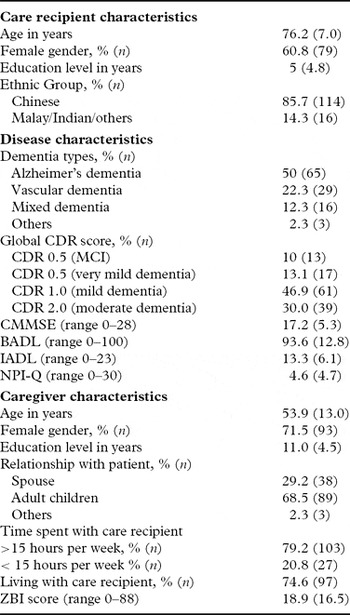
Characteristics of caregivers and care recipients (Table 1)
The final sample of 130 caregivers comprised mainly ethnic Chinese (85.7%), females (71.5%), and adult children (68.5%) as caregivers. Caregivers had a mean age of 53.9 years (SD = 13.0) and 11 years (SD = 4.5) of formal education. About 79.2% of caregivers spent more than 15 hours per week with recipient while 74.6% of them lived together. The mean age of the care recipients was 76.2 years (SD = 7.0) and the majority were female (60.8%). Among patients with dementia, the major etiology was Alzheimer's disease (50%), followed by vascular dementia (22.3%) and mixed dementia (12.3%).
Sample characteristics (n = 130)

Mean (SD) unless otherwise stated.
BADL: Barthel's Index of Basic Activities of Daily Living; CMMSE: Chinese Mini-Mental State Examination; CDR: Clinical Dementia Rating; IADL: Lawton's and Brody's Scale for Instrumental Activities of Daily Living; NPI-Q: Neuropsychiatric Inventory Questionnaire; ZBI: Zarit Burden Interview.
About half of the recipients were rated CDR 1 (46.9%) followed by CDR 2 (30%), CDR 0.5 dementia (13.1%), and MCI (10%). The mean CMMSE, BADL, and IADL scores were 17.2 (SD = 5.3), 93.6 (SD = 12.8), and 13.3 (SD = 6.1) respectively. The mean NPIQ score was 4.6 (SD = 4.7). Mean ZBI score was 18.9 (SD = 16.5), and ranged from 0 to 71 (possible score from 0 to 88). Cronbach's alpha value was 0.919 and mean item score was 0.874.
Factor analysis of the 22 ZBI items (Table 2)
Factor analysis was appropriate as the Kaiser–Meyer–Olkin measure of sampling adequacy was 0.870, and the Bartlett test of sphericity was 1,613 (p < 0.0001). Factor analysis yielded five factors with an eigenvalue greater than 1 but the four-factor solution was chosen because it provided better groupings of items within the factors in terms of conceptual and clinical relevance. The four factors accounted for 62.2% of total variance. Item 7 was loaded into factor 1 as it correlates more strongly with factor 1 than factor 4 (r = 0.395 vs. 0.253); a unique factor comprising only factors 20 and 21 is also consistent with the results of prior studies (Knight et al., Reference Knight, Fox and Chou2000; Ko et al., Reference Ko, Yip, Liu and Huang2008; Lu et al., Reference Lu, Wang, Yang and Feng2009).
Principal component analysis on the 22 items of the ZBI (varimax rotation, four-factor extraction, loadings >0.400)

Boldtype indicates factor to which item is allocated.
The first factor, accounting for 40.6% of variance, represented demands of care and social impact on the caregiver. The second (9.7% of variance) represented confidence or control over the situation, while the third (6.4% of variance) and fourth (5.6% of variance) represented psychological impact on caregiver and worry about performance, respectively. There were good correlations between factors 1–3 with total ZBI (factor 1: 0.910, p < 0.001; factor 2: 0.807, p < 0.001, and factor 3: 0.874, p < 0.001), and with each other (Range: 0.663–0.715, p < 0.001). In contrast, factor 4 correlated only moderately with total ZBI (0.310, p < 0.001) and poorly with factors 1–3 (factor 1: 0.107 (NS); factor 2: 0.072 (NS), and factor 3: 0.209, p < 0.05).
Item to total ratio between factors by disease severity (Figure 1)
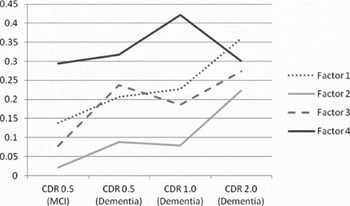
Distinct patterns for the factors were observed across the severity of cognitive impairment. For factors 1–3, ITR increased as the severity advanced but with a different pattern. ITR for factors 1 and 2 increased in a comparable manner with the former constantly endorsed higher than the latter. Factor 3 had low ITR in MCI, tripled to 0.24 at CDR 0.5 (very mild dementia) and further increased slightly to 0.27 at CDR 2. As for factor 4, it was endorsed higher than other factors from MCI through to CDR 1, peaking 0.42 at CDR 1 and reducing to 0.30 at CDR 2.
Relationship between factors with caregiver and disease characteristics
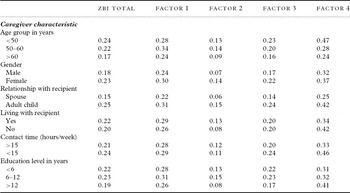
For the total ZBI score, caregiver characteristics of age below 50 years, female gender, adult children, living with care recipient, and lower education level were associated with higher ITR (Table 3). Individual factors followed a similar trend, with the notable exception of factor 4; caregivers who were not living with recipient, had shorter contact time and had higher education, endorsed higher factor 4 ITR scores.
Item to total ratio between caregiver characteristics with ZBI total and individual factor scores

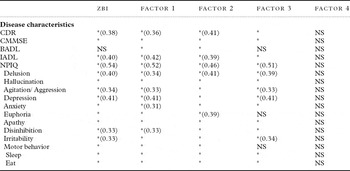
With regard to disease characteristics, factors 1–3 were significantly correlated with disease severity as measured by CDR, CMMSE, and patients’ IADL functional status (Table 4). In contrast, factor 4 was not related to any of the disease characteristics. In the area of mood and behavior, although factors 1–3 were significantly related to almost all domains within the NPI-Q score, the strength of the relationships differs. When only those with moderate to strong strength of correlation were considered (r value >0.3; Cohen, Reference Cohen1988), a discernible pattern emerged. Factor 1 was related moderately to certain aspect of recipients’ mood and behavior such as delusion (r = 0.34), aggression (r = 0.33), depression (r = 0.41), anxiety (r = 0.31), and disinhibition (r = 0.33; all p < 0.001). For factor 2, the score increased with delusion (r = 0.41) and euphoria (r = 0.39; all p < 0.001). Lastly, factor 3 was linked to delusion (r = 0.39), agitation (r = 0.33), depression (r = 0.41), and irritability (r = 0.34; all p < 0.001).
Correlation between disease characteristics with ZBI total and individual factor scores

* p < 0.05.
Correlations with values of r > 0.3 are displayed in parentheses.
BADL: Barthel's Index of Basic Activities of Daily Living; CMMSE: Chinese Mini-Mental State Examination; CDR: Clinical Dementia Rating; IADL: Lawton's and Brody's scale for Instrumental Activities of Daily Living; NPI-Q: Neuropsychiatric Inventory Questionnaire; ZBI: Zarit Burden Interview.
Discussion
Our study confirms and further adds to the increasing body of evidence about the multidimensionality of ZBI and the importance of going beyond the global score. As far as we are aware, this is the first study to explore the multidimensionality of the ZBI across the spectrum of disease severity. We identified worry about caregiving performance, not typically reported in earlier ZBI studies, to be significantly endorsed in our study population even as early as the MCI stage. In addition, we introduced the use of ITR as a novel method to describe the magnitude of burden within each factor that also allows for comparison across factors with different item loadings. We were able to illustrate that different caregiving dimensions behave differently across the spectrum of disease severity in our population. We further determined the relationship between these dimensions with caregiver and disease characteristics.
Our results suggest four factors: (1) demands of care and social impact; (2) confidence over the situation; (3) psychological impact; and (4) worry about caregiving performance. This is in agreement with earlier studies (Knight et al., Reference Knight, Fox and Chou2000; Ankri et al., Reference Ankri, Andrieu, Beaufils, Grand and Henrard2005; Leggett et al., Reference Leggett, Zarit, Taylor and Galvin2010) that the multidimensionality of ZBI exists beyond the traditional two factors. In our data, the first three factors correspond to the conventional dimensions of personal and role strain (Whitlatch et al., Reference Whitlatch, Zarit and von Eye1991; Herbert et al., Reference Herbert, Bravo and Preville2000; Kumamoto et al., Reference Kumamoto and Arai2004). Factors 1 and 2 can be viewed as role strain (stress due to role conflict) and factor 3 as personal strain (how personally stressful the experience is). In addition, we have found factor 4, corresponding to the dimension of worry about performance in more recent studies (Ankri et al., Reference Ankri, Andrieu, Beaufils, Grand and Henrard2005; Ko et al., Reference Ko, Yip, Liu and Huang2008; Leggett et al., Reference Leggett, Zarit, Taylor and Galvin2010), to be an important dimension of burden in our population as well.
The dimensions of burden endorsed by the caregivers varied across the spectrum of disease severity. The first three factors appeared to have less significance at the MCI stage. However, as the disease progresses, role strain (factors 1 and 2) appeared to increase steeply after CDR 1, whereas personal strain (factor 3) experienced by the caregivers was relatively similar from CDR 0.5 (very mild dementia) to CDR 2. This is not unexpected as similar to a previous study (Ankri et al., Reference Ankri, Andrieu, Beaufils, Grand and Henrard2005), role strain was found to be significantly linked to the ADL function and behavioral symptoms of care recipients. As the disease progresses in severity, higher physical dependency and accompanying behavioral disorders translate into higher demand on the caregiving role. On the contrary, personal strain correlates better with behavior than recipients’ physical abilities. Thus, unlike the stage-dependent increase in role strain, the burden of personal strain is distributed over the disease stages after CDR 0.5 (very mild dementia) in accordance with the NPIQ scores.
Our study also sheds some light about the unique characteristics of factor 4 (worry about performance). Unlike the other three factors, factor 4 was endorsed highest at every stage of the disease, even as early as the MCI stage, and peaked at CDR 1. Factor 4 also correlated poorly with the other three factors and was not linked to any of the disease characteristics. Caregivers who were not living with recipient or who spent less than 15 hours per week of contact time were more likely to have a higher factor 4 score. The construct of this dimension merits further exploration: does it represent a negative component of guilt (Losada et al., Reference Losada2010), or does it represent a more benign construct of conscientious worry and anxiety about caregiving performance in relation to anticipated elevated levels of task-related responsibilities (Garand et al., Reference Garand, Dew, Eazor, DeKosky and Reynolds2005)? Further studies in different care and ethnocultural settings are required to further delineate this construct.
Three salient considerations are worth highlighting. First, our sample comprised caregivers of persons with early stages of cognitive impairment including the predementia MCI stage. This could have contributed to the overall lower level of caregiving burden in our study. For instance, the mean total ZBI score in our study was 18.9, which falls into the “mild” range according to the proposed cutoffs (Zarit et al., Reference Zarit and Zarit1987) and is lower than the mean score of 26.5 in the Ankri 2005 study. Second, it is important to keep in mind the possible influence of sociocultural factors on caregiver burden. For example, in our sample of predominantly Chinese ethnicity, caregivers who are younger and adult children tend to express more burden of care in all dimensions, similar to a study of Hong Kong Chinese (Chan et al., Reference Chan, Lam and Chiu2005). In contrast, in a multiethnic Southeast Asian study that involved a higher proportion of Malays and Indians (about 50%) than Chinese (38.6%), the reverse pattern is seen: burden score was higher for older caregivers as well as spouses (Choo et al., Reference Choo, Low, Karina, Poi, Ebenezer and Prince2003). Choo and colleagues also noted that being Chinese predisposes to greater burden than the other ethnic groups. It is therefore possible that there may be interethnic differences in how caregivers perceive burden in the Asian context. Third, it would be misleading to use factor mean score for interfactor comparisons. For instance, the means for factors 1 and 4 in the MCI stage were 9.1 and 2.9, respectively, which would have given the erroneous impression that factor 1 was higher endorsed. Using ITR scores, however, it is obvious that factor 4 was more highly endorsed than factor 1 at the MCI stage (0.36 vs. 0.29) (Figure 1).
Comparison of item to total ratio between factors by disease severity

Several limitations to our study should be noted. First, self-care impairment and level of dependency may be as important as the dimension of burden in understanding care burden. These variables were not measured in our study. Second, our data may not be generalizable to other populations. We included family caregivers who are caring for recipients with a spectrum of disease biased toward the earlier stages of cognitive impairment. Caregivers such as friends or employed help may not experience burden in the same manner or to the same degree with changes in disease severity. In addition, we have used two different language versions of the 22-item ZBI to accommodate for the multilingual population in this study. Other limitations include convenience sampling for our study and a smaller sample size than earlier studies, although our sample size of 130 comfortably fulfils recognized tests of sampling adequacy. The small data size for patients in substages of CDR 0.5 (MCI) and CDR 0.5 (very mild dementia) precluded statistical analysis for significance. Lastly, when parallel analysis (Hayton et al., Reference Hayton, Allen and Scarpello2004) was applied, two factors instead of four were identified. Although we submit that the “Eigen value more than 1” criterion used in this study may overestimate the number of factors, a more inclusive approach is consistent with the exploratory nature of our study and corroborated by the results of prior studies. Nevertheless, this study was meant to explore the pattern of burden in the sample population rather than a confirmatory one and therefore, future studies are needed to confirm our findings.
Conclusion
Our study adds to the understanding on the specific dimensions of burden relevant to caregivers of persons with cognitive impairment in a predominantly Chinese multiethnic Asian population. The data suggest that the multidimensionality of ZBI should include worry about performance in addition to the traditional factors of role and personal strain. These factors behave differently across the spectrum of disease severity and have distinct relationships with disease and caregiver characteristics. ITR is superior to means as a measure of comparing burden across factors with different item loadings. In future studies, confirmatory factor analysis of the four-factor solution should be done with a sufficient sample size. They should also aim to further explore the construct of worry about performance, determine the generalizability of our findings to other Asian and non-Asian populations, as well as study the validity of shorter forms of ZBI which reflect dimensions beyond the traditional dual-factor structure.
Conflict of interest
None.
Description of authors’ role
W. K. Cheah and W. S. Lim designed the study, carried out the statistical analysis, and wrote the paper. H. C. Han and P. V. Anthony helped in the design of the study, collected the data, and assisted with paper writing. M. S. Chong designed the study, supervised the data collection, and contributed to the final paper.
Acknowledgments
The authors would like to thank Dr Mark Chan Peng Chew and Cindy Yeo Ying Ying of Tan Tock Seng Hosptial for their substantial contribution in acquisition of data from the memory clinic.