1. Introduction
In the 1950s and early 1960s the extent to which electronic music was recognised as a coherent, global praxis was limited. Rather, praxis and discourse in electronic music at this time appeared somewhat fragmented and parochial, characterised by a heterogeneous range of activities pursued in more-or-less isolated enclaves. To essentialise, momentarily: musique concrète was practised in France; elektronische Musik was practised in Germany; tape music and computer music were practised in the United States and Canada. These main ‘principalities’ of the nascent idiom of electronic music differed in both technical means and aesthetics. Musique concrète involved the musical adaptation of real-world recorded sounds following largely intuitive criteria, whereas elektronische Musik favoured the ordering of synthesised tones according to premeditated, essentially serial criteria. Computer music involved – obviously – the use of computers, largely to produce scores or emulate the sounds of traditional musical instruments, whereas so-called tape music – exemplified by the work of Cage and others – appeared largely disconnected from European aesthetic concerns despite being in some respects technically similar. Limited awareness of activities in other parts of the world was exacerbated by comparatively irregular opportunities for travel or other forms of international exchange, and perpetuated by a relatively meagre literature base that tended to reflect rather than challenge parochialism.
The scenario just outlined is, of course, a quite blunt generalisation, since in reality local practices varied and overlapped considerably. However, there was yet to emerge – in the relevant literature of the late 1950s and early 1960s – evidence of any firm consensus that these fragmented, multidisciplinary activities might be considered parts of a single, apparently coherent, idiom. Technical, aesthetic and geographic fragmentation was characteristic of the nascent idiom of electronic music at this time. Electronic music had yet to develop a coherent global identity.
I suggest that Hugh Davies (1943–2005), through his electronic music research and documentation in the 1960s, represented electronic music for the first time as an apparently coherent, international, interdisciplinary praxis. Born in the south of England, Davies attended London’s Westminster School where, in 1961, he produced his first piece of written electronic music research. He went on to read music at Worcester College, Oxford, and from 1964 to 1966 lived in Cologne, where he worked as personal assistant to the avant-garde composer Karlheinz Stockhausen. In 1967 he became a founding member of the Society for the Promotion of New Music’s (SPNM) newly formed electronic music sub-committee – among the first formal bodies to support electronic music activities in the UK – and went on to become a founder-member of the Electro-Acoustic Music Association of Great Britain (EMAS) and the International Confederation of Electroacoustic Music (ICEM). As well as becoming well known as a performer of avant-garde and improvised musics, and as a builder of bespoke, often idiosyncratic, musical instruments, Davies held many positions of influence within the international electronic music community.
In his published and unpublished writings from the 1960s Davies specifically commented upon the fragmented nature of the electronic idiom and identified the need to think of it more holistically. Even in his earliest writings on the subject there is evidence of an attempt to adopt a less parochial, more international, perspective. Davies emphasised the role of internationalisation as a potent source of musical innovation, both in the fledgling idiom of electronic music in particular and in avant-garde music more generally. He also sought to convey a sense of the interdisciplinary nature of electronic music by drawing parallels with the techniques of painting, sculpture and other musical traditions such as popular music and jazz, and by documenting a broad range of interdisciplinary collaborations. Throughout this period Davies worked toward the production of a comprehensive inventory of electronic music, beginning in earnest with his ‘Discography of Electronic Music and Musique Concrète’, published in 1964, which listed recordings available on record and magnetic tape (Davies Reference Davies1964b). This endeavour reached its acme in 1968 when Davies published his Répertoire international des musiques électroacoustiques / International Electronic Music Catalog (Davies Reference Davies1968), a 330-page volume in which he attempted to list every single piece of electronic music ever composed anywhere in the world: 39 countries, 560 studios and 4,950 works, were represented. In the Catalog Davies represented the erstwhile separate disciplines of musique concrète, elektronische Musik and tape music (etc.) holistically, under the umbrella term ‘electronic music’ (‘musiques électroacoustiques’). He also included several appendices that documented the use of electronic music techniques in non-musical disciplines such as painting, poetry, sculpture and computing, and in other musical disciplines such as popular music and jazz. The Catalog thus represented the realisation of Davies’s efforts to represent electronic music as a coherent, international, interdisciplinary praxis.
By contrast, the earlier literature that was available in the late 1950s and early 1960s – that is, the body of literature that Davies had available to him in the course of his research – had tended to focus for the most part upon specific developments in one or other disciplinary or geographic area. Or, it made mention only of the ostensibly ‘main’ schools of musique concrète, elektronische Musik and tape music, and situated any other activities as peripheral. The tripartite musique concrète / elektronische Musik / tape music model that emerged out of this discourse formed the backbone of what has subsequently become a canonical version of electronic music history that represents the full extent of electronic music’s international and interdisciplinary scope at best only partially, and in a way that is heavily biased in favour of those ‘main’ schools and the geographic locales and disciplinary interests that they represented. One of the interesting characteristics of Davies’s documentation is that, by drawing attention to the many other disciplinary and geographic areas in which relevant activities took place in the 1950s and earlier, it challenged the hegemony of the Paris, Cologne and New York schools at a time when that canonical view of electronic music history was itself only just beginning to take hold. It is, however, a matter of curiosity that this challenge appears – at least until recent years – to have been largely unsuccessful – that is, it has been the canonical view of electronic music history just described that has dominated the textbooks.
2. Davies’s Sources
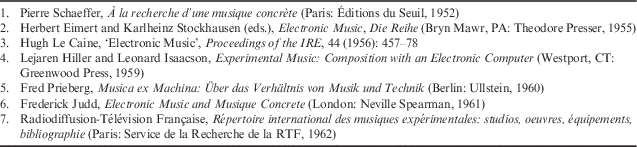
My argument begins with an exploration of seven texts on electronic music published between 1952 and 1962, representing the main published texts on electronic music that were referenced by Davies in his own research. These are summarised in Table 1. The purpose here is to demonstrate that, although each of these texts represents the international, interdisciplinary scope of electronic music to some limited extent (and some represent it more fully than others), no single one of them represents it to the extent that it was subsequently envisioned by Davies. Much of Davies’s research was primary, ‘obtained from private conversations and letters in answer to requests for information of various kinds’ (Davies Reference Davies1963a). Those published texts that are discussed here have been chosen because: (a) they were identified by Davies as sources ‘of particular value’ (Davies Reference Davies1963a); (b) they are large-scale – books, or extended articles – rather than shorter pieces, and; (c) they focus entirely on electronic music, rather than mentioning it only as a small part of a wider discussion.
Published sources identified as key in Davies’s research

Schaeffer (Reference Schaeffer1952) and Eimert and Stockhausen (Reference Eimert and Stockhausen1955) provide primary accounts of two of the original disciplines that fed the nascent idiom of electronic music: musique concrète and elektronische Musik. There is a certain amount of debate, in each of these texts, around the sometimes conflicting artistic ideals underlying these two schools of thought, but no significant reference to anything outside that essentially French-versus-German debate.
Le Caine’s text provides a mainly North American perspective on how, technically speaking, to produce complex timbres on the electronic equipment available at the time (Le Caine Reference Le Caine1956). Le Caine was based in Ottawa, Canada, where alongside a day job as an atomic physicist he designed and built electronic musical instruments. In his 1956 article Le Caine describes some of his own instruments, as well as other work carried out in Canada and United States. He also describes the instruments used at the musique concrète and elektronische Musik studios in Paris and Cologne, so that the international perspective is slightly wider than the US and Canada alone. There is a short section on ‘animated sound’ – the production of sound by drawing wave shapes directly on to optical cinema film – and so, to some limited extent, interdisciplinarity beyond the immediate field of electronic and concrete music is at least alluded to if not explicitly addressed.
Hiller and Isaacson focus upon new American developments in computer-assisted composition – that is, the use of a computer not for actual sound production, but to generate a musical score algorithmically, which is then performed by humans on acoustic musical instruments (Hiller and Isaacson Reference Hiller and Isaacson1959). They use the term ‘computer music’ to refer to this. Hiller and Isaacson’s book includes a chapter on other experimental music techniques that were being developed at the time, including musique concrète, elektronische Musik and American experiments in ‘tape music’ by John Cage and others. They also briefly mention the RAI studio in Milan. Hiller and Isaacson state that, although related, their own work has no direct precedent in any of these other activities. It is, if you like, yet another disciplinary branch of the electronic music phenomenon.
Prieberg’s Musica ex Machina: Über das Verhältnis von Musik und Technik appears to be the most diverse of the sources Davies consulted in terms of the breadth of its international and disciplinary coverage. It is also the only substantial secondary source whose main purpose is to summarise and interpret previous work in the field rather than focusing solely on recent developments in a particular disciplinary area. Prieberg situates electronic music in the broader context of the relationship between man and machine, and makes occasional references to work in other disciplines, such as the cybernetic sound sculptures of Nicholas Schöffer. There is a section entitled ‘Influences of Jazz’: reference to another musical discipline. In terms of geographic coverage, there are separate sections on electronic music in Milan, Warsaw and Rome, Cologne, Darmstadt, Holland and Belgium, New York and Baden Baden, as well as sections on electronic music in Israel and Japan, two areas that are not referred to in any of the other literature under discussion (Prieberg Reference Prieberg1960). (However, Israel and Japan have only two pages dedicated to them, compared to nineteen pages dedicated to electronic music in Cologne and Darmstadt.) In terms of Davies’s own style of documentation, Prieberg’s book appears to have been quite influential. Davies referred to it as ‘the most useful book yet issued, … unfortunately not yet translated into English’ (Davies Reference Davies1964b: 207). (Prieberg’s book remains untranslated into English, although an Italian translation was published a few years after the original German text (Prieberg Reference Prieberg1963).)
Judd’s Electronic Music and Musique Concrete [sic] (Judd Reference Judd1961) is aimed at the amateur electronics enthusiast, which could be regarded as yet another disciplinary fragment of the electronic music mosaic. It includes technical and practical information about circuit building and tape editing techniques, and only very briefly mentions some of the better-known composers using those techniques. Judd’s book was criticised by Davies on the grounds that
Little is said about the actual music … Where actual compositions are discussed the author shows little knowledge of what is being done elsewhere, and of the aims of composition of any kind. In particular, the third appendix, which contains a wealth of references to be followed up, includes inaccurate information. (Davies Reference Davies1964b: 207)
The text entitled Répertoire international des musiques expérimentales (RIME) was a publication made by the research office of the French national radio and television company RTF (ORTF 1962). It was conceived as a directory of information on existing electronic music studios and their equipment and compositions, designed to facilitate the exchange of information between studios and practitioners worldwide. It represented twenty electronic music studios in fifteen countries (Belgium, Canada, Denmark, Germany, Finland, France, Iceland, Italy, Japan, the Netherlands, Norway, Poland, Sweden, Switzerland and the US). RIME was criticised by Davies for its incompleteness, and the somewhat haphazard way in which it was put together. The choice of which studios to include, for example, was essentially arbitrary, based on those studios that the compilers already knew about and asked to participate. There was no attempt at comprehensiveness. Such criticisms were rather diplomatically alluded to in the preface to Davies’s Catalog (Davies Reference Davies1968: iii–iv), but more directly addressed in Davies’s unpublished undergraduate thesis:
The most detailed list of compositions [to date] is given in Répertoire International des Musiques Expérimentales, which unfortunately contains a considerable number of inaccurate details, and wrong dates, compositions omitted altogether, and other details. This is partly due to its method of compilation: detailed questionnaire [sic] were sent out to studios (six studios are, for some unaccountable reason, omitted), which must in some cases have been answered in a completely different arrangement of details from that in which they were finally printed; thus thirteen of the twenty-five compositions listed from the Cologne studio are wrongly dated, some by as much as three years, and at least four works composed within the period covered are not listed at all … [Furthermore] many [works from all over the world] were not composed in official studios, and thus do not come under the scope of the RTF pamphlet. (Davies Reference Davies1963a)
Thus, although RIME evidenced the beginnings of attempts around this time to think of electronic music as an international phenomenon, the picture it presented – as amply noted by Davies – was patchy and incomplete.
What is apparent in the published literature on electronic music that Davies consulted, then, is a certain disciplinary and geographic fragmentation: musique concrète and elektronische Musik in Europe; instrument-building, computer music and tape music in North America; and some passing reference across the body of literature as a whole to an even wider interdisciplinary field that includes (inter alia) crossover with practical electronics and sculpture as well as other musical traditions such as jazz and popular music. What is not apparent is any single publication that fully represents the international and interdisciplinary scope of electronic music as Davies would go on to document it (although there are some suggestions of travel in that direction, particularly in Prieberg and RIME).
3. Davies’s Writings
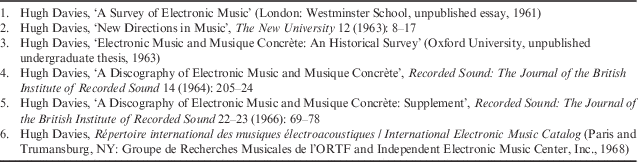
Hugh Davies’s electronic music research began in 1961, while he was still a pupil at London’s Westminster School, with a brief, two-page essay entitled ‘A Survey of Electronic Music’ (Davies Reference Davies1961). In 1963 he published an article, ‘New Directions in Music’, in the journal The New University (Davies Reference Davies1963b), which was soon followed by his undergraduate dissertation (Davies was, by this time, a music student at Worcester College, Oxford), a 30,000-word study entitled ‘Electronic Music and Musique Concrète: An Historical Survey’ (Davies Reference Davies1963a). In 1964 Davies’s ‘Discography of Electronic Music and Musique Concrète’ (Davies Reference Davies1964b), commissioned two years earlier by the British Institute of Recorded Sound, was published, with a supplement appearing two years later (Davies Reference Davies1966). From 1964 to 1966 Davies worked as personal assistant to Karlheinz Stockhausen. As a consequence there was something of a gap in his publications record during those years, although he did continue to write, and in fact began work on his Catalog towards the end of that period. The latter part of 1966, and most of 1967, was spent compiling the Catalog, which was published in April 1968. Table 2 provides a summary of Davies’s own writings that are referred to in this article. This is not an exhaustive list of Davies’s written output during the period in question, but represents a more than adequate sample for present purposes.
Davies’s published and unpublished writings referred to in this paper
4. Defragmentation
In his writings from this period Davies identified the need to think of electronic music holistically. He specifically drew attention to its currently fragmented state by pointing to the range of different terminologies used in different parts of the world, referencing elektronische Musik in Germany, musique concrète and musique sur bande in France, and musica su nastro in Italy, as well the use of terms such as ‘music for tape-recorder’ by John Cage and ‘organized sound’ by Edgard Varèse. ‘This proliferation of different names for what is basically the same kind of music’, he observed, ‘shows that a considerable number of composers in different countries are all trying to find a workable idiom’ (Davies Reference Davies1963b: 11). In his undergraduate thesis he suggested that ‘a general word is needed to describe the whole medium collectively’ (Davies Reference Davies1963a: 27). In doing so Davies sought to rationalise and consolidate apparently related, yet – as far as one might understand from the preceding literature – largely discrete praxes.
Davies’s project was, then, a defragmentation exercise of sorts.Footnote 1 However, it is important to note that, for Davies, the process of defragmentation was not the same thing as a process of homogenisation. He did not believe that one single genus of electronic music ought to be propagated the world over. On the contrary – as ought to become obvious in the following discussions about international and interdisciplinary exchange – the very development of the electronic idiom at this point in time in fact depended, as far as Davies was concerned, on there being a variegated range of distinct praxes. Davies’s main concern was that this range of distinct praxes should be conceived of holistically rather than as a series of disparate fragments.
5. Classification By Nation
Davies’s writings evidenced consistent attempts to conceive of electronic music as a truly global, international phenomenon. Although rudimentary at first, such efforts can be found even in Davies’s earliest writings on the subject, dating from 1961, where Davies drew attention to ‘a large international group of composers’ attached to the WDR studio in Cologne, and named those composers specifically along with their nationalities:
[Elektronische Musik] came into being … at the studio of the Studio of the Cologne Radio Station … Its directors are Herbert Eimert, Karlheinz Stockhausen and Fritz Enkel (technical), and there is a large international group of composers attached to it: Paul Gredinger, Giselher Klebe, Gottfried Michael Koenig (Germany), Pierre Boulez (France), Luigi Nono, Franco Evangelisti (Italy), Henri Pousseur (Belgium), Cornelius Cardew (England), Ernst Křenek (USA), Bo Nilsson (Sweden), Mauricio Kagel (Argentina), and György Ligeti (Hungary). (Davies Reference Davies1961: 1; my emphasis)
This might at first seem like a trivial, even naïve, essay-writing strategy, but I suggest that it actually represented the beginnings of an attempt on Davies’s part to characterise electronic music as a far wider international phenomenon than had ever been fully shown in any single publication up to that point. In the same essay Davies indicated the existence of studios in various different countries throughout the world, in addition to those at Paris and Cologne, noting studios in Belgium, Canada, England, Holland, Israel, Italy, Japan and Poland. From the outset, then, there was a conspicuous attempt, in Davies’s electronic music documentation, to adopt a broad international perspective that was largely absent from preceding publications.
What emerged in Davies’s subsequent writings was a clear tendency to organise and classify material by nation. In the introduction to his ‘Discography’ Davies chronicled the establishment of electronic music studios around the world in (consecutively) the USA, Canada, Japan, Holland, Italy and Switzerland, Belgium, Denmark, England, Finland, Iceland, Israel, Norway, Poland and Sweden (Davies Reference Davies1964b: 206–7). In his article ‘New Directions in Music’ he charted developments in avant-garde music in different parts of the world including England, Italy, Japan, Poland, the USA and Yugoslavia, while in his undergraduate thesis he systematically surveyed activities in twenty different countries: Belgium, Canada, Czechoslovakia, Denmark, England, Finland, France, Germany, Holland, Hungary, Israel, Italy, Japan, Norway, Poland, Russia, Spain, Sweden, the USA and Yugoslavia.
Within these lists of countries there will be noted an abundance of nations outside of those Western European and North American countries that tended to dominate high-profile avant-garde music activities in the 1960s, including northern and eastern European nations (Denmark, Finland, Iceland, Norway, Sweden; Czechoslovakia, Poland, Yugoslavia) as well Middle- and Far-Eastern nations such as Israel and Japan, and the then Soviet Russia. This emphasis on, as it were, fringe nations corresponds with Davies’s participation, as a student, in what he described as ‘small-scale campaigning’ activities to promote the avant-garde musics of non-Western-European countries. In particular, Davies campaigned for the distribution, in the UK, of avant-garde music scores from Japan and Poland that were, as yet, unavailable (Davies Reference Davies1964a). Davies’s advocacy of the avant-garde musics of under-represented nations provides further evidence that he took an active interest in challenging the hegemony of the Western European and North American nations as the dominant forces in avant-garde and electronic musics. Davies’s tendency to organise and classify by nation in his documentation was not a mere organisational device, then, but rather a way of representing electronic music as a truly global praxis.
6. International Exchange As Catalyst
Davies’s documentation conveyed a vivid sense of the maturation of the electronic idiom, from naïve experimentation towards a fully fledged medium. One of the most important drivers of this process of maturation, Davies believed, was the exchange of musical ideas – aesthetics, languages, traditions – across international boundaries. Specifically, he pointed to the developmental avenues opened up via the hybridisation, or cross-fertilisation, of already-developed international musical traditions. Davies felt that if the time-honoured musical traditions of various different parts of the world could be hybridised, this would provide a range of highly developed aesthetic avenues along which contemporary avant-garde music could develop. This was preferable, in Davies’s view, to abandoning tradition altogether and simply inventing new musical languages, forms or syntaxes on the spot, as he criticised some composers of the European and American avant-garde of doing. Such on-the-spot inventions he referred to as ‘parlour games’ (Davies Reference Davies1963b: 9). Davies’s belief in the catalytic power of international exchange provides a further rationale for his tendency to organise and classify by nation: one cannot draw attention to exchange across boundaries without first drawing attention to the boundaries themselves.
For Davies, international exchange provided a deeper gene-pool of highly developed local traditions that could be drawn upon. Examples given by Davies included the Japanese composer Yoritsune Matsudaira – who, to Davies’s mind, successfully combined elements of Western avant-garde and traditional Japanese musics – and the Polish composer Witold Lutosławski – who performed a similarly successful hybridisation of Western and traditional Polish frameworks. Of Matsudaira, Davies wrote:
He had a Western training as well as a thorough grounding in traditional Japanese music, and he has put both to good use in his recent music. The forms of many of his works are based on traditional Japanese styles like the Bugaku and Gagaku. The integration of the two cultures is well-achieved in his work, giving it a freshness that is often lacking in European work of the same period. (Davies Reference Davies1963b: 13)
The message here is that true musical innovation comes not from the hasty invention of novel curiosities or gimcrack new musical languages, but from the artful application of rarefied techniques such as those found in time-honoured musical traditions. One way in which this essentially conservative view could be reconciled with ultimately forward-looking agenda of the avant-garde was via the process of hybridisation, as espoused by Davies in a stance on musical innovation that was a curious blend of traditionalist and progressive. Davies emphasised the role of internationalisation as a potent source of musical innovation, both for avant-garde music generally and for the fledgling idiom of electronic music in particular, and it was this belief in the catalytic power of international exchange – I suggest – that provided a significant part of his motivation for thinking of electronic music globally.Footnote 2
7. Visits To Electronic Music Studios By Overseas Composers
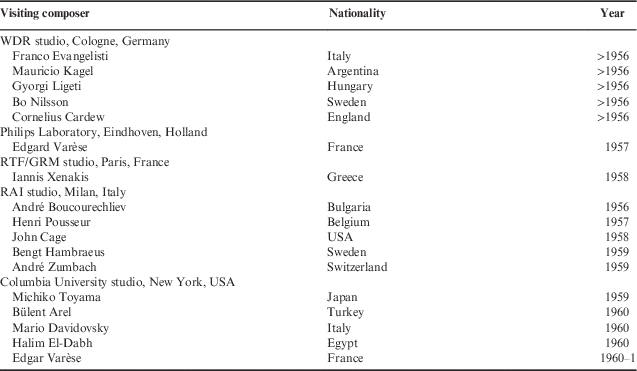
Davies’s belief in progress via internationalisation provides a context in which we can interpret his documentation – in his undergraduate thesis – of visits to electronic music studios by composers from overseas. In light of his preoccupation with international exchange this can be interpreted as an attempt to highlight the catalytic influence that such visits had upon the development and maturation of the electronic idiom in the late 1950s and early 1960s. Davies specifically mentioned visits by non-native composers to – among others – the WDR studio in Cologne, the Philips Laboratory in Eindhoven, the RTF/GRM studio in Paris, the RAI studio in Milan and the Columbia University studio in New York (Davies Reference Davies1963a: 33, 40–3, 51, 69–70). Some of the visits documented by Davies are summarised in Table 3.
Some visits to electronic music studios by overseas composers mentioned by Davies in his undergraduate thesis
Davies mentioned these international visits, I claim, not only as a matter of interest, but as a way of suggesting that the visits themselves played a catalytic role in the maturation and aesthetic diversification of the electronic medium in its formative years. This is not so much explicitly stated as implied in the text of Davies’s dissertation. For instance, of the RAI (Milan) studio Davies made the following comments. Note how observations about the studio’s typical compositional style are immediately followed by a discussion of non-native composers, implying an influence of the one upon the other:
The most prominent European studio to be set up since those in Paris and Cologne is that in Milan. Since the pointillistic trend of the first works by Berio and Maderna the studio has seen the creation of works with clear and simple formal construction (this has been comparatively rare in the history of tape music) and considerable lyrical feeling. The first visitor to this studio was André Boucourechliev, who later visited Le Club d’Essai … In 1957 the Belgian composer Henri Pousseur created Scambi I and II, indeterminately arranged elements of fixed material, which can be realised into a piece in a similar way to a performance of Stockhausen’s Klavierstück XI. The next visitor to Milan was Marc Wilkinson, the first English composer to compose a piece in a properly equipped studio … In [1958] John Cage created the four tapes of Fontana Mix, which, like Scambi, consist of material to be organised into a piece … In 1959 Bengt Hambraeus created Konstellationer II at Milan. His previous electronic works were Doppelrohr II, composed at Cologne in 1955, and some background music for radio programmes created at the Stockholm radio station … Another visitor to Milan in 1959 had also had previous experience in tape music, the Swiss composer André Zumbach … Until 1960 all the guest composers at Milan were from other countries, with the exception of Mario Migliardi … (Davies Reference Davies1963a: 38–42)
Composers’ nationalities were conspicuously and frequently mentioned, and in some cases other studios they visited were also named. The process of international exchange was thus foregrounded, all the more so with Davies’s explicit observation that – with only one exception, which I will return to shortly – ‘all the guest composers … were from other countries’.
Similarly, after a quite lengthy discussion of (mainly) non-native visitors to Le Club d’Essai in Paris, Davies made the following observations:
1958 marks the beginning of a reorganisation of Le Club d’Essai. The official name of the studio, and all connected work, was changed to Le Groupe de Recherches Musicales de la RTF in 1957, from Le Groupe de Recherches de Musique Concrète, originally applied in 1951. This is indicative of the changing attitudes to composition … The scope of the studio was widened with works by a number of new composers, [including] Mavena by the Yugoslavian Ivo Malec … and Diamorphoses and Concret PH by Yannis Xenakis [sic] from Greece. Diamorphoses is a good example of the new type of musique concrète that was now being produced. While still based on concrete sounds ‘recorded through a microphone’, the treatment of them renders them unrecognisable: the resulting sounds are the kind of abstract sounds that were also coming to be used in [elektronische Musik]. (Davies Reference Davies1963a: 22)
Thus, as a further example of the catalytic effects of international visits, Davies pointed to the fusing of the erstwhile parochialised disciplines of musique concrète and elektronische Musik into a hybrid form that incorporated aspects of both, citing Xenakis’s Diamorphoses as an example. He noted a similar trend at the WDR studio in Cologne, where developments, he suggested, ‘went from [one] extreme of the possibilities opened up by tape music towards a more general, centralised [path]’ (Davies Reference Davies1963a: 29). In my interpretation, Davies believed that this ‘centralisation’ was due, in no small part, to the diversification in aesthetics and techniques brought about by international exchange.
8. Interdisciplinary Exchange As Catalyst
There is also evidence to suggest that Davies viewed interdisciplinary exchange as a catalyst for the maturation and diversification of electronic music, although the extent to which this was systematically explored in his earlier writings was somewhat more limited than was the case with international exchange. Nonetheless, if we accept that distinct musical domains such as popular music and jazz – or elektronische Musik and musique concrète, for that matter – might be considered separate ‘disciplines’, then it will be seen that a tendency to highlight interdisciplinary hybridisations was apparent in Davies’s writing.
Davies noted, for example, that André Hodeir was ‘well-known in the field of jazz, perhaps better-known in the jazz world than in the avant-garde one’ (Davies Reference Davies1963a: 7). In this case interdisciplinarity was clearly highlighted through allusion to the meeting of (ostensibly separate) jazz and avant-garde ‘worlds’. (Hodeir composed Jazz et Jazz, for piano and tape, at the RTF studio in Paris in 1951–2.) Similarly, Davies made mention of the fact that Dieter Schönbach ‘has composed film music … which combines elements of [elektronische Musik], musique concrète and jazz’ (Davies Reference Davies1963a: 58). Once again, the fusion of erstwhile separate musical disciplines was highlighted as a salient characteristic.
Perhaps the most illustrative example, however, concerned the visit of the Italian composer Mario Migliardi to the RAI studio in Milan. Davies noted that ‘until 1960, all the guest composers at Milan were from other countries, with the exception of Mario Migliardi, who in 1958 began experimenting with the synthesis of electronic music with popular music and jazz’ (Davies Reference Davies1963a: 44). The significance, here, rests in the fact that Davies presented Migliardi not as a visiting composer from a foreign country, but as a composer bringing influences from two ‘foreign’ disciplines: popular music and jazz. In other words, he framed the influence of outside disciplines in the same way that he framed the influence of overseas visitors: as the mediators of a richer idiom.
9. Interpreting Davies’s International Electronic Music Catalog
Davies’s preoccupation with international and interdisciplinary exchange as the arbiters of a fully mature electronic music idiom provides a context for understanding his International Electronic Music Catalog. The Catalog is a book of 330 pages listing – ostensibly – every piece of electronic music produced anywhere in the world up to the end of 1966 (and some from January to April 1967). It was arranged alphabetically by country, and, within each country, individual electronic music studios were listed alphabetically by city. Under each studio, there followed a list of all the electronic music compositions realised there. A detailed description of the Catalog and its features is unnecessary for present purposes, but can be found elsewhere (Mooney Reference Mooney2013).
Davies’s decision to organise the Catalog by country was not a mere organisational device, but a reflection of his belief in the importance of international exchange as a mediator of musical innovation. Here are some reasons for suggesting that. First, the simple fact that the Catalog is organised by country straight away implies that Davies considered national boundaries to be a significant factor in electronic music. It seems to lend itself to the idea that each country might represent a distinct electronic music culture, or electronic music style. Whether or not this is true, it seems in line with Davies’s preoccupation with international cross-fertilisation as a potent force in avant-garde music. Second, the fact that the Catalog was alphabetically organised meant that it represented all nations as equals, or at least attempted to. Unlike many other texts on the history of electronic music, the Catalog did not afford privileged status to Germany, France and the USA, but rather represented those nations as equals alongside less canonised ones. This is in line with Davies’s campaign to place non-canonical avant-garde musics on an equal footing with those of the European–American mainstream. Finally, it should be taken into account that organising the Catalog by country was not the easiest of all possible options, and in fact presented quite considerable difficulties during the compilation process, not least in the frequent cases where a composer began work on a piece in one studio and completed it in another. In the early stages of compiling the Catalog it was put to Davies that it would be much easier to arrange the Catalog by composer. Davies conceded that this would indeed be easier, but counter-argued that organisation by composer ‘doesn’t give so clear a picture’ as organising by country (Weidenaar Reference Weidenaar1966).Footnote 3 This further supports the interpretation that Davies wanted a clear picture of electronic music activity in different geographic areas and was willing to pursue that particular approach even though it was not the easiest possible option. He chose geographic organisation because it fitted his agenda of international exchange.
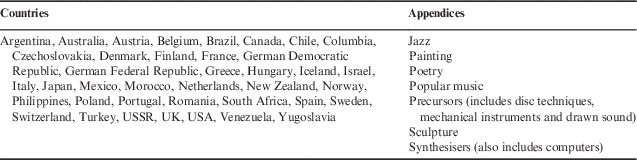
The extent to which the catalytic effects of interdisciplinary exchange were systematically explored in Davies’s early writings was somewhat limited, but this is taken further in the Catalog, in which several appendices were provided that drew attention to the use of electronic music techniques in disciplines outside the immediate sphere of electronic music. These are listed in Table 4. These appendices drew attention to disciplinary boundaries not as a way of suggesting entirely separate, impermeable domains, but – on the contrary – as a way of foregrounding the many instances of bi-directional exchange across those boundaries.
Countries represented in Davies’s Catalog, and titles of the appendices that are relevant to the discussion in this paper. These provide a convenient representation of the international and interdisciplinary scope of the Catalog.
There is evidence to support this interpretation in the way that these appendices were structured. The Jazz appendix, for instance, included a separate list that identified which of the composers listed in it specialised in jazz:
Of the above composers, the following specialize in jazz: Dissevelt, Hodeir, James, Migliardi, Russo, Sheff, Smith. (Davies Reference Davies1968: 289)
Implicit in this statement is the suggestion that the other composers listed in this appendix – Ahlstrom, Ashley, Byrd, Deutsch, Eaton, Greussay, Kaegi, Mumma, Parmegiani and Trythall – did not specialise in jazz. Group 1, Dissevelt et al., was thus identified as belonging to the discipline of jazz, whereas Group 2, Ahlstrom et al., was identified as not belonging to that discipline, instead belonging ‘natively’ to the discipline of avant-garde electronic music. In effect, different classifications were allocated to, on the one hand, the composers in group 1, who have a background in jazz and have gone on to make use of electronic techniques as electronic music ‘immigrants’, and, on the other, the composers in group 2, who are ‘native’ electronic music composers who have dabbled in jazz. The boundary between disciplines – jazz, electronic music – was established in order to demonstrate the reciprocal exchange of techniques and influences across it. Similar organisational strategies were employed in the other appendices. These represent, I suggest, an attempt on Davies’s part to illustrate the spread of electronic music beyond its native territory, and – conversely – the reciprocal influence of outside disciplines upon the traditionally avant-garde domain of electronic music.
10. Conclusion
Davies’s representation of electronic music as an international, interdisciplinary phenomenon was not perfect. Like any other epistemological construction, it was contingent upon many essentially arbitrary factors. When Davies compiled the Catalog he sent a questionnaire to studio managers. In it, he did not ask open questions but, rather, asked about particular things and – implicitly – excluded others. For example, he asked studio managers to provide information on the use of electronic music techniques in painting and sculpture but did not ask about the use of such techniques in conjunction with, say, dance. How might the picture painted by the Catalog have been different, one wonders, had Davies asked different questions in the rubric he sent to studio managers? Similarly, Davies asked studio managers to classify electronic music works according to his own predetermined system of functional classifications (concert works, operas, etc.). Studio managers were not allowed to invent their own classifications, and there is some evidence to suggest that this might have compromised the final representation somewhat, particularly in relation to musical cultures whose ontologies and paradigms were at odds with the essentially Western perspective adopted by Davies in his classifications. The general point here is that, although Davies’s representation of electronic music did much to challenge the hegemony of the dominant Western European and North American schools, it inevitably introduced its own biases.
Nonetheless, Davies’s Catalog arguably remains to this day the most complete record of international, interdisciplinary electronic music activity up to the end of 1967. In the 1990s the Catalog was used as the basis of a new project – Internationale Dokumentation Elektroakustischer Musik (EMDoku) (Hein Reference Hein1999) – which has since been identified by Teruggi as the closest thing in existence to a complete inventory of all electronic music (Teruggi Reference Teruggi2004). It is not surprising, then, that many subsequent publications on electronic music history have referenced the Catalog. An initial, non-exhaustive, survey has identified some fifty-eight different texts (mainly books, book chapters and journal articles) published between 1968 and 2014, whose arguments are substantiated with data drawn from the Catalog. These include two prominent textbooks that cite the Catalog as the basis for some quite general assertions about the nature of electronic music history. Manning, in Electronic and Computer Music, speaks of an ‘exponential growth’ in electronic music during the 1960s (Manning Reference Manning2004: 401–2). Similarly, Thom Holmes, in Electronic and Experimental Music, notes that the number of electronic music studios worldwide increased dramatically between 1948 and 1966 (Holmes Reference Holmes2012: 154). In both cases, statistics from the Catalog are provided as the evidence. Such examples point to the Catalog’s totemic status as a unique record of historical activities in electronic music. Landy, in an article on the musicology of electroacoustic music, goes so far as to use a single footnote reference to the Catalog as a general pointer to the entire ‘history of [electroacoustic] music (and its pre-history)’ (Landy Reference Landy1999: 64).
Furthermore, the structure of the Catalog – its systems of classification and information architecture – is quite conspicuously reflected in the body of literature that cites it. A number of studies focus on the electronic music of a particular nation or geographic area, for instance, reflecting the Catalog’s alphabetic organisation by country (Zajicek Reference Zajicek1995; Dal Farra Reference Dal Farra2006; Kuljuntausta Reference Kuljuntausta2008). There are also a number of published articles that reflect the interdisciplinary areas addressed in the Catalog’s appendices, such as Cross’s article on electronic music history pre-1953 – one of the first published texts to reference the Catalog – (Cross Reference Cross1968) and Wendt’s article on the history of electro-acoustic approaches to sound poetry (Wendt Reference Wendt1985). Other studies make more specific use of the different types of data that Davies chose to include, such as articles by Emmerson (Reference Emmerson2007: 150) and Manning (Manning Reference Manning2006) that correlate trends in the number of audio channels with developments in the techniques and aesthetics of electroacoustic music in its formative years.
Further work is needed in order to fully understand and evaluate the historiographic consequences of the Catalog’s influence upon discourses of electronic music history. To what extent exactly, and with what consequences, do subsequent published histories of electronic music rely upon data provided in the Catalog, for instance? What, precisely, are the biases inherent in the Catalog, and to what extent are these perpetuated and reinforced by subsequent studies that cite it? In what ways might Davies’s representation of electronic music as an international, interdisciplinary praxis be criticised, and what might be the implications of such criticism for the field of electroacoustic music studies? A detailed appraisal of these questions is in progress and will form the basis of a future study. For the time being, suffice to say that Davies’s electronic music documentation – in particular his International Electronic Music Catalog – provided what was at the time, by a wide margin, the broadest international and interdisciplinary representation of the electronic medium available. Davies’s motivation for representing electronic music in this way had to do with his conviction that the exchange of mature, rarefied techniques and aesthetics across national and disciplinary boundaries provided diverse avenues along which the idiom could develop, without recourse to the kinds of superficial novelty or incestuous self-referentiality that, he believed, would follow from continued developments within the geographic and disciplinary confines of the dominant Western European and North American traditions. In effect, Davies’s Catalog mapped the territory of electronic music, for the first time, as a truly international, interdisciplinary field, and, in a sense, actually defined that field.