The role of recasts in second language (L2) learning has been one of the most hotly debated topics in interaction research and, as such, has been at the center of controversy and scholarly discussion (see Ellis & Sheen, Reference Ellis and Sheen2006; Long, Reference Long2007; Nicholas, Lightbown, & Spada, Reference Nicholas, Lightbown and Spada2001, for relevant issues and research findings). More recently, L2 interaction researchers have become interested in comparing recasts with prompts, including metalinguistic feedback, clarification requests, elicitations, and repetitions in terms of their effects on L2 development (Ammar, Reference Ammar2008; Ammar & Spada, Reference Ammar and Spada2006; Ellis, Reference Ellis and Mackey2007; Ellis, Loewen, & Erlam, Reference Ellis, Loewen and Erlam2006; Loewen & Nabei, Reference Loewen, Nabei and Mackey2007; Lyster, Reference Lyster2004; Lyster & Izquierdo, Reference Lyster and Izquierdo2009; McDonough, Reference McDonough and Mackey2007; Nassaji, Reference Nassaji2009; Sheen, Reference Sheen and Mackey2007; Yang & Lyster, Reference Yang and Lyster2010). Individual differences in working memory capacity (WMC), however, a potentially crucial factor that may affect the effectiveness (i.e., the capability of producing an effect) of corrective feedback during interaction, has not been considered in this line of research.
Working memory (WM), as an important cognitive construct, has been researched extensively in the field of cognitive psychology (see Baddeley, Reference Baddeley2007; Conway, Jarrold, Kane, Miyake, & Towse, Reference Conway, Jarrold, Kane, Miyake and Towse2007a; Cowan, Reference Cowan2005; Jarrold & Towse, Reference Jarrold and Towse2006; Miyake, Reference Miyake2001; Miyake & Shah, Reference Miyake and Shah1999, for various theories and models of WM and its theoretical developments) and found to be significantly correlated with higher order cognitive behaviors (reading, reasoning, general fluid intelligence, etc.). In a similar manner, WM has also been discussed and studied in the field of SLA in terms of its relation to L2 learning (e.g., Geva & Ryan, Reference Geva and Ryan1993; Harrington & Sawyer, Reference Harrington and Sawyer1992; Havik, Roberts, van Hout, Schreuder, & Haverkort, Reference Havik, Roberts, van Hout, Schreuder and Haverkort2009; Juffs, Reference Juffs2004, Reference Juffs2005; Kormos & Sáfár, Reference Kormos and Sáfár2008; Mackey, Adams, Stafford, & Winke, Reference Mackey, Adams, Stafford and Winke2010; Mackey, Philp, Egi, Fujii, & Tatsumi, Reference Mackey, Philp, Egi, Fujii, Tatsumi and Robinson2002; Miyake & Friedman, Reference Miyake, Friedman, Healy and Bourne1998; Robinson, Reference Robinson2005b; Sagarra, Reference Sagarra and Mackey2007, Reference Sagarra and Han2008; Tokowicz, Michael, & Kroll, Reference Tokowicz, Michael and Kroll2004; Trofimovich, Ammar, & Gatbonton, Reference Trofimovich, Ammar, Gatbonton and Mackey2007; Walter, Reference Walter2004; see also Williams, Reference Williams, Gass and Mackey2012, for a review of WM research and L1-L2 learning). Only a few studies, however, have attempted to investigate whether and how WMC affects the efficacy of corrective feedback on the development of L2 linguistic forms (Mackey et al., Reference Mackey, Philp, Egi, Fujii, Tatsumi and Robinson2002; Sagarra, Reference Sagarra and Mackey2007; Trofimovich et al., Reference Trofimovich, Ammar, Gatbonton and Mackey2007). In fact, no empirical study has ever explored the relationship between WMC and the effects of different types of corrective feedback on the acquisition of L2 forms. The present study was specifically designed to examine how individual differences in WMC mediate the role of recasts and metalinguistic feedback in L2 learning as well as the relative effects of recasts and metalinguistic feedback on L2 development (i.e., recasts vs. metalinguistic feedback).
RECASTS IN L2 LEARNING
Long (Reference Long2007) defined a corrective recast as “a reformulation of all or part of a learner’s immediately preceding utterance in which one or more nontargetlike (lexical, grammatical, etc.) items is/are replaced by the corresponding target language form(s), and where, throughout the exchange, the focus of the interlocutors is on meaning, not language as object” (p. 77). Two crucial contributing factors to beneficial effects of recasts on language learning are semantic contingency or transparency and an immediate juxtaposition of learners’ erroneous output and corrective recasts (Long, Reference Long, Ritchie and Bhatia1996, Reference Long2007). It is likely that L2 learners understand all or part of their interlocutor’s message contained in a recast because it is a semantically contingent, reformulated version of their nontargetlike utterance. This promotes semantic transparency, which in turn enables learners to utilize more attentional resources to focus on form and form-function mapping. An immediate juxtaposition of an erroneous utterance and a corrective recast also allows learners to process a cognitive comparison of the two forms that are in contrast, which likely leads them to perceive the form contained in a recast as a correct alternative to their erroneous form (see also Doughty, Reference Doughty and Robinson2001, for a similar discussion).
Research to date on L2 interaction has successfully provided empirical evidence for a facilitative role of recasts in L2 development (see Doughty & Varela, Reference Doughty, Varela, Doughty and Williams1998; Han, Reference Han2002; Ishida, Reference Ishida2004; Iwashita, Reference Iwashita2003; Leeman, Reference Leeman2003; Long, Inagaki, & Ortega, Reference Long, Inagaki and Ortega1998; Mackey, Reference Mackey2006; Mackey & Philp, Reference Mackey and Philp1998; McDonough & Mackey, Reference McDonough and Mackey2006; Révész, Reference Révész2009; see also Long, Reference Long2007, for a review and Mackey & Goo, Reference Mackey, Goo and Mackey2007). Some classroom-based descriptive research has discussed recasts in terms of the extent to which they lead to uptake, casting doubt on their effectiveness in L2 learning on account of relatively fewer instances of learner uptake following recasts (Lyster & Ranta, Reference Lyster and Ranta1997; Panova & Lyster, Reference Panova and Lyster2002; but see Braidi, Reference Braidi2002; Ohta, Reference Ohta, Hall and Verplaeste2000; Oliver, Reference Oliver1995; Sheen, Reference Sheen2004, for different results regarding learner uptake following recasts, along with Gass, Reference Gass, Doughty and Long2003; Mackey & Philp, Reference Mackey and Philp1998; McDonough & Mackey, Reference McDonough and Mackey2006, for arguments against immediate uptake as a measure or predictor of L2 learning). Triggered by this skepticism over the role of recasts in L2 development, L2 researchers have recently compared recasts with prompts such as metalinguistic feedback, clarification requests, elicitations, and repetitions (Ammar, Reference Ammar2008; Ammar & Spada, Reference Ammar and Spada2006; Ellis, Reference Ellis and Mackey2007; Ellis et al., Reference Ellis, Loewen and Erlam2006; Loewen & Nabei, Reference Loewen, Nabei and Mackey2007; Lyster, Reference Lyster2004; Lyster & Izquierdo, Reference Lyster and Izquierdo2009; McDonough, Reference McDonough and Mackey2007; Nassaji, Reference Nassaji2009; Sheen, Reference Sheen and Mackey2007; Yang & Lyster, Reference Yang and Lyster2010). Overall findings in this line of research suggest that recasts are not as effective as other types of feedback, such as metalinguistic feedback, clarification requests, repetitions, and so forth (Ammar, Reference Ammar2008; Ammar & Spada, Reference Ammar and Spada2006; Ellis, Reference Ellis and Mackey2007; Ellis et al., Reference Ellis, Loewen and Erlam2006; Lyster, Reference Lyster2004; Sheen, Reference Sheen and Mackey2007; Yang & Lyster, Reference Yang and Lyster2010). Three studies showed nonsignificant differences between recasts and other feedback types (Loewen & Nabei, Reference Loewen, Nabei and Mackey2007; Lyster & Izquierdo, Reference Lyster and Izquierdo2009; McDonough, Reference McDonough and Mackey2007). Nassaji (Reference Nassaji2009) reported that recasts led to a higher rate of corrections on the immediate and delayed posttests than elicitation moves (or prompts in Lyster’s sense). His finding, however, was based on a small set of descriptive data (i.e., percentage data) and thus needs to be further tested in future research.
These overall findings, which suggested that recasts are not as effective as other forms of feedback (e.g., prompts), may be attributable to several factors. For example, developmental readiness has been considered as a potential mediating factor. Mackey and Philp’s (Reference Mackey and Philp1998) findings indicate that developmentally more advanced learners may benefit more from recasts than do developmentally unready learners. Researchers have similarly shown that recasts are more effective for more proficient learners than for less proficient learners (see Ammar, Reference Ammar2008; Ammar & Spada, Reference Ammar and Spada2006; Trofimovich et al., Reference Trofimovich, Ammar, Gatbonton and Mackey2007). It has also been suggested in previous research that the beneficial effects of recasts depend, to a great extent, on how they are encoded (intonation, length, number of changes, etc.); that is, perceptual salience may affect the noticeability of recasts (e.g., Egi, Reference Egi2007; Loewen & Philp, Reference Loewen and Philp2006; Philp, Reference Philp2003; Sheen, Reference Sheen2006). Generally speaking, short or partial recasts—with one or two corrective changes—are more effective in facilitating noticing than long or full recasts with more changes. The type of target structure may also determine the effectiveness of recasts in L2 development. In other words, recasts work with some linguistic areas or some grammatical structures, but not with others (Iwashita, Reference Iwashita2003; Leeman, Reference Leeman2003; Long et al., Reference Long, Inagaki and Ortega1998; see Mackey, Gass, & McDonough, Reference Mackey, Gass and McDonough2000, for discussion on learner perception of recasts with respect to different linguistic areas). Long (Reference Long2007) suggests that unobtrusive implicit negative feedback (e.g., recasts) works for salient linguistic features and more explicit feedback (e.g., metalinguistic feedback) for communicatively redundant and phonologically nonsalient linguistic items (e.g., past tense -ed). He also notes that recasts may be more effective for linguistic structures and forms that are hard to learn and thus require long-term treatments, compared to easy structures and forms, which short-term treatments of explicit feedback may be sufficient to learn.
Another important mediating factor, considering the fact that previous research has indicated a potential role of WMC in L2 learning (Geva & Ryan, Reference Geva and Ryan1993; Harrington & Sawyer, Reference Harrington and Sawyer1992; Havik et al., Reference Havik, Roberts, van Hout, Schreuder and Haverkort2009; Kormos & Sáfár, Reference Kormos and Sáfár2008; Miyake & Friedman, Reference Miyake, Friedman, Healy and Bourne1998; Robinson, Reference Robinson2005a, Reference Robinson2005b; Sagarra, Reference Sagarra and Mackey2007, Reference Sagarra and Han2008; Skehan, Reference Han2002; Tokowicz et al., Reference Tokowicz, Michael and Kroll2004; Walter, Reference Walter2004; see also Williams, Reference Williams, Gass and Mackey2012, for a review), is individual differences in WMC. Learners with high WMC may notice more recasts (Mackey et al., Reference Mackey, Philp, Egi, Fujii, Tatsumi and Robinson2002) and benefit more from recasts than those with low WMC (Sagarra, Reference Sagarra and Mackey2007). It is interesting to note that Trofimovich and colleagues (2007) did not find any significant role of WMC in learning through recasts. Given these inconsistent findings and the paucity of relevant studies, much more research on the impacts of WMC on the role of recasts in L2 learning needs to be conducted to get more clear-cut evidence of the relationship between WMC and recasts. It is also worth exploring how WMC affects the positive effects of other forms of corrective feedback on L2 development.
WMC AND L2 LEARNING
Working memory, generally viewed as “the ability to maintain information in an active and readily accessible state, while concurrently and selectively processing new information” (Conway, Jarrold, Kane, Miyake, & Towse, Reference Conway, Jarrold, Kane, Miyake, Towse, Conway, Jarrold, Kane, Miyake and Towse2007b, p. 3), has been considered a crucial cognitive construct in human cognition and has been extensively researched in cognitive psychology. This has generated a barrage of theoretical explanations along with numerous experimental studies on the nature of WM and its relation to higher order cognitive behaviors (Baddeley, Reference Baddeley2007; Conway et al., Reference Conway, Jarrold, Kane, Miyake and Towse2007a; Cowan, Reference Cowan2005; Jarrold & Towse, Reference Jarrold and Towse2006; Miyake, Reference Miyake2001; Miyake & Shah, Reference Miyake and Shah1999, for a review of models, theoretical developments, and relevant research findings). Due to space constraints and because of its relevance to the present study, among the varied theoretical models of WM that have been proposed since Baddeley and Hitch’s (Reference Baddeley, Hitch and Dornic1974) early multicomponent model, only Engle and his colleagues’ executive attention theory will be briefly mentioned.
According to the executive attention theory, individual differences in WMC that result in performance differences in cognitive tasks derive mainly from individual variation in domain-general executive attention processes (i.e., processes involving cognitive control of attentional resources) and, to some extent, from variation in domain-specific storage and rehearsal processes (Engle, Reference Engle2002; Engle, Kane, & Tuholski, Reference Engle, Kane, Tuholski, Miyake and Shah1999; Engle, Tuholski, Laughlin, & Conway, Reference Engle, Tuholski, Laughlin and Conway1999; Kane, Bleckley, Conway, & Engle, Reference Kane, Bleckley, Conway and Engle2001; Kane, Conway, Hambrick, & Engle, Reference Kane, Conway, Hambrick, Engle, Conway, Jarrold, Kane, Miyake and Towse2007). More recently, Kane and colleagues (2007) went so far as to suggest that “a third variable, representing a low-level executive attention capability, influences functioning on all of these selective-attention, WM-span, and memory-retrieval tasks (and, presumably, on indices of Gf as well)” (p. 34).Footnote 1 Empirical evidence that lends support to their recent proposal has been found in previous research on memory-independent tasks such as dichotic listening (Conway, Cowan, & Bunting, Reference Conway, Cowan and Bunting2001), antisaccade (Kane et al., Reference Kane, Bleckley, Conway and Engle2001), and Stroop tasks (Kane & Engle, Reference Kane and Engle2003), in which high-span participants performed better than their low-span counterparts.
Although the exact nature of WM and of individual variation in WMC is still inconclusive and controversial among cognitive psychologists, there is a general consensus on the predictive power of WMC for complex cognitive tasks; that is, WMC has been found to be highly correlated with general intellectual abilities such as reasoning and general fluid intelligence (Conway, Cowan, Bunting, Therriault, & Minkoff, Reference Conway, Cowan, Bunting, Therriault and Minkoff2002; Conway, Kane, & Engle, Reference Conway, Kane and Engle2003; Engle, Tuholski, et al., 1999; Kane et al., Reference Kane, Hambrick, Tuholski, Wilhelm, Payne and Engle2004; see also Ackerman, Beier, & Boyle, Reference Ackerman, Beier and Boyle2005, for a meta-analysis and Kane, Hambrick, & Conway’s, 2005, response to Ackerman et al.’s findings) as well as language comprehension (see Daneman & Carpenter, Reference Daneman and Carpenter1980, Reference Daneman and Carpenter1983; Just & Carpenter, Reference Just and Carpenter1992; King & Just, Reference King and Just1991; MacDonald, Just, & Carpenter, Reference Just and Carpenter1992; Swanson & Berninger, Reference Swanson and Berninger1995; see Daneman & Merikle, Reference Daneman and Merikle1996, for a meta-analysis).
Working memory has also been discussed as a potentially critical component of language aptitude in the field of SLA (e.g., Miyake & Friedman, Reference Miyake, Friedman, Healy and Bourne1998; Robinson, Reference Robinson2005a; Skehan, Reference Han2002) and has been investigated with respect to whether and how individual differences in WMC are related to reading comprehension (e.g., Geva & Ryan, Reference Geva and Ryan1993; Harrington & Sawyer, Reference Harrington and Sawyer1992; Walter, Reference Walter2004), grammar learning (e.g., Mackey et al., Reference Mackey, Philp, Egi, Fujii, Tatsumi and Robinson2002; Robinson, Reference Robinson2005b; Sagarra, Reference Sagarra and Mackey2007; Trofimovich et al., Reference Trofimovich, Ammar, Gatbonton and Mackey2007), the processing of redundant grammatical forms (Sagarra, Reference Sagarra and Han2008), syntactic processing (e.g., Havik et al., Reference Havik, Roberts, van Hout, Schreuder and Haverkort2009; Juffs, Reference Juffs2004, Reference Juffs2005; Miyake & Friedman, Reference Miyake, Friedman, Healy and Bourne1998), potential reactive effects of think-alouds (Goo, Reference Goo2010), overall L2 proficiency as well as four major skills (e.g., Kormos & Sáfár, Reference Kormos and Sáfár2008), first language (L1)-L2 translation strategies of learners with study-abroad experiences (e.g., Tokowicz et al., Reference Tokowicz, Michael and Kroll2004), the noticing of corrective feedback (e.g., Mackey et al., Reference Mackey, Philp, Egi, Fujii, Tatsumi and Robinson2002; Trofimovich et al., Reference Trofimovich, Ammar, Gatbonton and Mackey2007), and modified output production (e.g., Mackey et al., Reference Mackey, Adams, Stafford and Winke2010; Sagarra, Reference Sagarra and Mackey2007). Particularly relevant to the present study are those that examined the potential relationship between individual differences in WMC and the role of corrective feedback in L2 learning. Four studies, in this regard (Mackey et al., Reference Mackey, Philp, Egi, Fujii, Tatsumi and Robinson2002, Reference Mackey, Adams, Stafford and Winke2010; Sagarra, Reference Sagarra and Mackey2007; Trofimovich et al., Reference Trofimovich, Ammar, Gatbonton and Mackey2007), are briefly summarized.
In a small-scale exploratory study, Mackey and colleagues (2002) investigated the role of WMC in interaction, noticing, and L2 English question development. Working memory was measured via three memory tasks (nonword recall and L1 and L2 listening span tasks), and composite scores were used. The study found that more noticing (of recasts) occurred among high-span learners, whereas less noticing was associated with low-span learners. The beneficial effects of recasts on English question development by high-span learners were evidenced in the delayed posttest, but interestingly not in the immediate posttest, in which more development seemed to occur among low-span learners, a result that appears somewhat counterintuitive. Sagarra (Reference Sagarra and Mackey2007) examined the effectiveness of computer-delivered oral recasts and the role of WM in learning Spanish gender and number agreement. She found that WM measured via a reading span task was related to the performance of the recast group on both written and oral face-to-face interaction tasks in a statistically significant way, but not to that of the control group on either measure. According to her report, WM was also found to be associated with the amount of targetlike modified output. Again, no relationship between WM and targetlike modified output was evidenced in the performance of the control group. However, Trofimovich and colleagues (2007) found no significant relationship between WMC and L2 learning through recasts. They expanded the scope of inquiry and explored whether and how individual differences in attention control, phonological memory, WM, and analytic ability affect the extent to which learners notice, and benefit from, recasts. Their Francophone English as a second language (ESL) learners participated in a series of cognitive tasks as well as computer-based treatments and test activities. Although their results showed some impacts of individual differences in attention control, analytical ability, and phonological memory on grammatical accuracy or lexical learning, WM was not found to have played any significant role in the learning of the targets. No significant correlations were found between noticing and any of the four factors, including WMC, operationalized in their study. In a more recent study, Mackey and colleagues (2010) provided some evidence of the role of WM in L2 learning opportunities by showing that WM measured via a L1 (English) listening span task was associated with the production of modified output following corrective feedback. Working memory capacity, on the basis of the WM composite span scores (processing + recall) and the recall portion of the WM test, was positively correlated with the amount of modified output during interaction (four communicative tasks); that is, learners with higher WMC tended to produce more modified output than those with lower WMC.
Given the observed implications of WMC in L2 learning in Mackey and colleagues’ (2002, 2010) and Sagarra’s (Reference Sagarra and Mackey2007) studies, Trofimovich and colleagues’ (2007) findings are somewhat surprising. Obviously, such mixed findings indicate that more research—preferably with larger samples—needs to be conducted to confirm or disconfirm the validity of the findings observed in these studies and to further examine the interrelationship among WMC, noticing, modified output, and L2 development.
PRESENT STUDY
As discussed in the introduction, WM has undoubtedly emerged as a topic of pivotal importance in cognitive psychology and SLA. What has been evidenced and confirmed in most of these studies is that WMC is strongly correlated with higher-order cognitive tasks such as language comprehension, general fluid intelligence, L2 learning, and so forth (see, however, Caplan, Waters, & DeDe, Reference Caplan, Waters, DeDe, Conway, Jarrold, Kane, Miyake and Towse2007; Juffs, Reference Juffs2004, Reference Juffs2005, for counterevidence and counterargument with respect to syntactic processing). With regard to the present study, if WMC is related to noticing or modified output production, as suggested in Mackey and colleagues (2002, 2010) and Sagarra (Reference Sagarra and Mackey2007), it can be speculated that the beneficial effects of corrective feedback may, to some extent, depend on individual differences in WMC, as supported by Sagarra (Reference Sagarra and Mackey2007) in the case of recasts.
The possible link between WMC and effects of corrective feedback on L2 learning is supported by the executive attention theory briefly described previously (e.g., Engle, Reference Engle2002; Engle, Kane, et al., 1999; Engle, Tuholski, et al., 1999; Kane et al., Reference Kane, Conway, Hambrick, Engle, Conway, Jarrold, Kane, Miyake and Towse2007). High-span learners are able to actively maintain relevant information provided via corrective feedback in a readily accessible state for future reference and use while processing meaning during interaction, on account of their superior use of attention-control processes. Lower-span learners, in contrast, are more susceptible to interference (i.e., being distracted by the obligation to process meaning during interaction), which is due mainly to their coarsely grained attention-control mechanisms. Thus, they are less able to maintain linguistic information—provided via corrective feedback on their nontargetlike utterances—in an accessible form, compared to high-span learners.
It then stands to reason that any potential influence of WM on the effectiveness of different forms of feedback may depend on, among other things, the level of explicitness or implicitness of given feedback because the necessity of attention-control processes and the level of the required processes tend to be determined by how explicit or implicit given feedback appears to L2 learners. Therefore, metalinguistic feedback,Footnote 2 an explicit form of feedback usually defined as linguistic information on a target provided by means of grammatical terms (e.g., past tense or definite article), was selected for the present study to compare with recasts, which are considered to be on the implicit side of the continuum (see Ellis et al., Reference Ellis, Loewen and Erlam2006, for a comparative discussion of recasts and metalinguistic feedback; also Ellis & Sheen, Reference Ellis and Sheen2006; Long, Reference Long2007, for discussion on implicitness of recasts). Moreover, given that metalinguistic feedback has been compared with recasts in recent interaction research and has been found to be more effective at promoting L2 learning than recasts (e.g., Ellis, Reference Ellis and Mackey2007; Ellis et al., Reference Ellis, Loewen and Erlam2006; Sheen, Reference Sheen and Mackey2007), the selection of metalinguistic feedback was also intended to further an understanding of the relative effects of one type of feedback over another (i.e., recasts vs. metalinguistic feedback) by providing evidence that confirms or disconfirms relevant previous findings.
The present study was designed to investigate whether (and how) WMC measured via L1 reading span and operation span tasks is related to the effectiveness of recasts and metalinguistic feedback as well as their relative effects on the acquisition of a syntactic phenomenon, English that-trace filter, in interaction-driven L2 learning contexts. This study was guided by two principal research questions:
1. Is there any difference between recasts and metalinguistic feedback in their effectiveness in the acquisition of the English that-trace filter?
2. Does WMC mediate the efficacy of recasts and/or metalinguistic feedback on the acquisition of the English that-trace filter?
METHOD
Linguistic Target
The English that-trace filter was selected as the linguistic target—see the example in (1)—for three reasons: communicative redundancy, susceptibility to individual differences in WMC, and rare exposure to the target. First, it is communicatively redundant because it is purely syntactic and does not affect comprehension of a given wh-question, although it is violated. This communicative redundancy of the target necessitates focus on form intervention through corrective feedback. Second, in addition to its communicative redundancy, this particular structure requires selective attention to notice the deletion of the nonmeaning-bearing element that only when the subject (not the object) of the embedded clause is moved. This makes the structure difficult to acquire unless attentional resources are properly controlled. Considering that cognitive control is a critical component of WM (Engle, Reference Engle2002; Engle, Kane, et al., 1999; Engle, Tuholski, et al., 1999; Kane et al., Reference Kane, Conway, Hambrick, Engle, Conway, Jarrold, Kane, Miyake and Towse2007), it can be reasonably assumed that individual differences in WMC likely affect the acquisition of this particular target structure during interaction. Third, this syntactic phenomenon is neither specifically dealt with in ESL or FL grammar books nor explicitly taught in classroom contexts. Additionally, because English wh-questions involving wh-movement across two clausal boundaries from the subject position of the embedded clause are not frequently used in everyday conversation, L2 learners’ exposure to the that-trace filter in naturalistic or incidental learning contexts is also limited. Thus, it appears crucial to provide L2 learners with some opportunities to receive focus on form intervention to acquire the target construction. Also, for the same reason, the selection of this particular syntactic phenomenon was assumed, to some extent, to minimize impacts of potentially confounding factors (e.g., prior learning or exposure). As shown in the examples in (1), when wh-movement originates from the subject position of the embedded clause, the existence of the conjunction (or complementizer) that renders the sentence ungrammatical.
(1) a. *Who do you think that likes Mary?
“Who do you think likes Mary?”
b. *Who do you think that won the game?
“Who do you think won the game?”
Participants
The original pool included a total of 95 English as a foreign language (EFL) learners at a Korean university. Their proficiency was considered as intermediate on the basis of their performance on a series of English exams administered by their native speaker (NS) teachers. They were all elementary education majors from six classes, and were randomly assigned to either one of the two treatment conditions (recasts and metalinguistic feedback) or the control condition. Thus, there were two classes per condition. Participants excluded from the statistical analyses were those who did not finish the entire experiment or those whose performance on the background (or processing) portion of each of the two WM span tasks, the reading span task, and the operation span task (see details on the two span tasks in the Tasks and Materials section for more information in this regard) was below 80% in accuracy.Footnote 3 The final pool consisted of 54 learners (male, n = 19, and female, n = 35): recast (n = 14), metalinguisitc feedback (n = 32), and control (n = 8). Their ages ranged from 18 to 32 (M = 22.32, SD = 3.42), and they had studied English for 11.32 years on the average (SD = 3.01). Of the 54 learners in the final pool, 8 learners (14.8%) had been to English-speaking countries such as the United States, the United Kingdom, Australia, Canada, the Philippines, and Hong Kong—mostly for travel or for short-term (1 or 2 months at the longest) language courses.
Design
The study employed a pretest-posttest design. Each participating class was randomly assigned to one of three conditions: recasts, metalinguistic feedback, and control. The NS teacher (also the researcher in the second treatment session) provided either a full recast (i.e., a reformulated sentence with a change or two made to the learner’s nontargetlike utterance) or metalinguistic feedback (i.e., linguistic information related to the well-formedness of the learner’s original utterance) whenever learners produced nontargetlike utterances that violated the that-trace filter during the treatment activities, as shown in Examples (2)–(3).Footnote 4 For the metalinguistic group, the definition of a subordinate clause as compared to a main clause was provided in their L1 before the first treatment. To control modified output opportunities, as in Leeman (Reference Leeman2003) and Long and colleagues (1998)—because they may impact L2 learning (e.g., McDonough, Reference McDonough2005; Nobuyoshi & Ellis, Reference Nobuyoshi and Ellis1993; Swain, Reference Swain, Gass and Madden1985, Reference Swain, Cook and Seidlhofer1995, Reference Swain and Hinkel2005)—the NS teacher’s prompt (“Okay, let’s move to the next item”), immediately following the provision of corrective feedback, prevented opportunities for learners of both treatment conditions to modify their initial ungrammatical utterances, as in (2)–(3):
(2) Recast:
Learner: Who does John think that is reading a newspaper?
NS teacher: Who does John think is reading a newspaper? Um . . . It’s Bill. Okay, let’s move to the next item.
(3) Metalinguistic feedback:
Learner: Who does John think that is reading a newspaper?
Researcher: Don’t use the conjunction “that” when you ask about the subject of the subordinate clause. By the way, it’s Bill. Okay, let’s move to the next item.
The control group participated only in the pretest, posttest, and WM span tasks.
Tasks and Materials
Treatment Tasks.Two one-way information gap activities were carried out in a classroom setting. At the beginning of the first treatment session, a drawing depicting a graduation party was projected on a large screen in front of the class. All learners received a handout that contained 15 sentences, 10 of which were critical sentences designed to elicit wh-movement involving the that-trace filter, and 5 of which were distractors to elicit wh-object movement from the embedded or subordinate clause. The sentences described items—both people and objects—shown in the drawing, two examples of which are provided in (4):
(4) a. John thinks that __________ is reading a newspaper.
b. John thinks that the bartender is making _________.
As can be seen, each sentence had a blank to be filled in with the name of the item that a given sentence was intended to describe. Learners were instructed to ask their NS teacher a question about the name of each item necessary to complete the corresponding sentence; they were required to use the verbs in both the main clause and the subordinate clause (e.g., think and read in 4a and think and make in 4b). The NS teacher—who already had relevant information—provided the class with the name of the item. Learners conducted another activity of the same kind with the researcher in the second treatment session using a different drawing depicting an art gallery scene.
Reading Span (RSPAN) Task. The RSPAN task is one of the most popular verbal WMC measures (Conway et al., Reference Conway, Cowan, Bunting, Therriault and Minkoff2002; Daneman & Carpenter, Reference Daneman and Carpenter1980; Engle, Tuholski, et al., 1999; Kane et al., Reference Kane, Hambrick, Tuholski, Wilhelm, Payne and Engle2004) because it involves maintaining to-be-remembered items (e.g., the last word of each sentence) in a readily accessible state for later recall while processing information for a different task (e.g., reading each sentence and deciding on its semantic appropriateness). Following this tradition, a timed L1 reading span task modified from Kane and colleagues’ (2004) study was developed for the present study using Microsoft PowerPoint. The task consisted of 42 Korean sentences that described various family relations and what family members and relatives should be called (e.g., correct: Younghee should call her mom’s older brother keun-oe-sam-chon; incorrect: Younghee should call her dad’s older brother keun-oe-sam-chon—Keun-a-beo-ji is correct). All 14 Korean simple consonants and 5 double consonants were utilized as recall items and equally distributed, although never twice in the same set. The sentences were distributed in sets of 2, 3, 4, or 5 sentences. A total of 12 sets of sentences were included, with 3 sets for each set size (i.e., 2, 3, 4, and 5). Set sizes were randomized so that learners were prevented from guessing the number of sentences (or the number of recall items, for that matter) in the following set. Prior to the actual task, instructions were provided that included three practice sets of size 2 (i.e., 2 sentences in each set). During the actual task, learners read sentences in sets of 2, 3, 4, or 5 sentences. They were given 7,000 ms to read each sentence, decide whether it was a correct statement, and put a check mark on the answer sheet. A Korean consonant then automatically appeared and remained on the slide for 1,000 ms, followed by either a new sentence or a recall cue (i.e., ???). When the recall cue appeared on the slide, they were required to recall the Korean consonants shown in the preceding set and write them down in the order of presentation on the other side of the answer sheet. They were given 4,000 ms for set size 2; 6,000 ms for set size 3; 8,000 ms for set size 4; and 10,000 ms for set size 5, as determined in a pilot test.
Operation Span (OSPAN) Task. An additional verbal WM span measure, an OSPAN task, was employed to ensure construct validity. An OSPAN task is another complex span measure that has been widely utilized and accepted as tapping verbal WMC since Turner and Engle’s (Reference Turner and Engle1989) first version (Conway et al., Reference Conway, Kane and Engle2003; Kane et al., Reference Kane, Hambrick, Tuholski, Wilhelm, Payne and Engle2004; Rosen & Engle, Reference Rosen and Engle1998; Tokowicz et al., Reference Tokowicz, Michael and Kroll2004; Unsworth, Reference Unsworth2007; Unsworth & Engle, Reference Unsworth and Engle2007; see Unsworth, Heitz, Schrock, & Engle, Reference Unsworth, Heitz, Schrock and Engle2005, for an automated version). Like the RSPAN task, it necessitates the operation of WM by getting participants to maintain to-be-remembered items for later recall while solving math problems. For the present study, an OSPAN task modified from Unsworth and colleagues’ (2005) study (their automated version) was developed, using Microsoft PowerPoint. A total of 42 mathematical operations (e.g., (2 × 3) +1 = ?) were generated. The Korean consonants were used as recall items and were equally distributed (again not twice in the same set). The mathematical operations were distributed in sets of 2, 3, 4, or 5, with three sets for each set size; set sizes were randomized. Addition, subtraction, multiplication, and division were all counterbalanced. In the actual task, learners silently read each mathematical operation on a slide that was shown for 3,000 ms and was followed by another slide that showed a number as a possible answer to the operation and a dichotic option Yes or No? They were given 3,000 ms to decide whether the number provided was a correct answer to the operation and to put a check mark on the answer sheet. On the next slide, a Korean consonant appeared and was shown for 1,000 ms, automatically followed by another mathematical operation or a recall cue (i.e., ???). When the learners were presented with the recall cue at the end of each set, they were supposed to recall the consonants shown in the preceding set and write them down in the order of presentation on the other side of the answer sheet. For the recall part of the task, they were given 4,000 ms for set size 2; 6,000 ms for set size 3; 8,000 ms for set size 4; and 10,000 ms for set size 5, as determined in a pilot test. Three practice sets of size 2 were used before the actual task.
Grammaticality Judgment Test (GJT).Forty-eight pairs of declarative-interrogative sentences were developed for the test using Microsoft PowerPoint with 32 critical items and 16 distractors. Each pair consisted of one declarative sentence with an underlined noun phrase (NP)—either the subject or the object of the embedded or subordinate clause—and one interrogative sentence that asked about the underlined NP, two examples of which are shown in (5):
(5) a. They think that Jeff loved Jennifer.
Who do they think that loved Jennifer?
b. They think that John is going to marry Sarah next month.
Who do they think is going to marry Sarah next month?
The pairs or items were randomly distributed (i.e., stratified randomization) and grouped into two batches of 24 pairs (type A and type B): one for the pretest and the other for the posttest. Of those 24 in each test, 16 critical items—containing 8 grammatical and 8 ungrammatical interrogatives—involved the that-trace filter, and the remaining 8 items (all grammatical) were distractors involving wh-movement from the object position of the embedded clause. In the actual test, learners were instructed to judge the grammaticality of the interrogative that asked about the NP underlined in the declarative sentence presented on each slide and to then put a check mark in the appropriate box (e.g., grammatical, ungrammatical, or I don’t know) within 10,000 ms.Footnote 5 For example, the sample item in (5a) includes an ungrammatical interrogative that violates the that-trace filter, whereas the interrogative sentence in (5b) conforms to it. Each new slide was programmed to appear every 10,000 ms. The GJT slides were saved to each of the computers in the lab prior to the actual tests and were administered individually. Immediately after all the judgment items were presented, learners were instructed to return to the GJT slides and correct the interrogatives that they had judged ungrammatical.
Written Production Test. Forty declarative sentences—30 critical items and 10 distractors, each of which included an underlined NP—were developed and randomized via stratified randomization to cater to two versions of paper-and-pencil tests (type A and type B): one for the pretest and the other for the posttest. Each test consisted of 15 target sentences designed to elicit wh-movement involving the that-trace filter and 5 distractors designed to elicit wh-movement from the object position of the embedded clause. Learners were required to produce an interrogative sentence asking about the NP underlined in each sentence provided. The underlined NP was always either the subject or the object of the embedded clause. As shown in the examples in (6), each sentence contained two verbs—one in the main clause and the other in the embedded or subordinate clause—as in, They think that Jeff likes Sarah (e.g., think and like in this sentence), and learners were specifically instructed to include both verbs in their interrogatives:
(6) a. They believe that John is working as a waiter at a Korean restaurant.
b. They think that Mike designed Jane’s jacket.
Procedure
Data were collected over four experimental sessions. All sessions took place in a computer lab located in a university building. The two WM span tasks were administered during the first session. It took approximately 15 min for learners to finish each WM span task. The order was counterbalanced; that is, the RSPAN was followed by the OSPAN for one of the two classes assigned to each condition, whereas the OSPAN was first administered to the other class, followed by the RSPAN. Three days later, learners engaged in the pretest session: a GJT and a written production test. The GJT was preceded by the written production test to avoid any potential influence of positive evidence on learner performance on the written production test (via grammatical sentences in the GJT). A brief instructional session on both tests was conducted before the actual tests. The pretest session took approximately 50 min. The first treatment session was held on day 7, in which learners carried out a one-way information gap task with the NS teacher, which lasted approximately 20 min. On day 10, learners carried out another one-way information gap activity with the researcher (20 min). Immediately after the second treatment, the GJT and written production posttests were administered, followed by an exit questionnaire. Approximately half of the learners in each group took type A of each test in the pretest session and type B in the posttest, and the other half took type B of each test in the pretest session and type A in the posttest session. As for the control group, the WM span tasks were administered on day 1. The control group also participated in the pretest and posttest sessions on days 4 and 10, respectively.
Scoring
For the background or processing part of each WM span measure (e.g., the true-false part of the RSPAN task and the mathematical operation part of the OSPAN task), 1 point was given for each correct answer, but no point for an incorrect answer. Percentage scores were computed on the basis of the learners’ performance on the processing parts of the tasks. As for the recall part of each WM span measure, a partial-credit load scoring procedure was utilized (see Conway et al., 2005, for other scoring procedures and an overall methodological review); that is, 1 point was awarded for each correctly recalled item in its correct serial position within a set, and no point for an incorrectly recalled or unrecalled item. Proportions were then calculated. With regard to the GJT and the written production test, 1 point was awarded for each correct judgment, for a total of 16 on the GJT, and 1 point for each correct production, for a total of 15 on the written production test. In the GJT, I don’t know was interpreted as the learner having no knowledge about the that-trace filter, and hence no point was given. Additionally, in the case of ungrammatical sentences in the GJT, 1 point was given only to a correct judgment accompanied by the provision of a grammatical version. Errors unrelated to the target were ignored in the scoring of learner performance on the error-correction part of the GJTs and the written production tests (e.g., Who does John thinks . . . ?).
For the interrater reliability of the scoring process, approximately 20% of the entire data were also scored by an independent rater and then submitted to Cohen’s kappa (κ = .942). A Cronbach’s alpha coefficient was also computed to estimate the internal consistency reliability of each measure (WM tests and pretests): RSPAN (α = .834), OSPAN (α = .828), GJT type A (α = .701), GJT type B (α = .715), and written production type A (α = .912). No reliability coefficient was found for written production type B, due to the fact that all participants got zeros. The Pearson correlation between the two WM span measures—on the recall part—showed statistical significance with a large effect size (r = .580, p < .01); that is, the two WM span measures tapped a more or less similar, although not identical, construct. The significance level was set at .05 for all statistical tests. All numeric values (e.g., r, R2, and F- and p-values) were rounded to three decimal places (e.g., p = .652).
RESULTS
To make sure that the three groups did not differ from one another in terms of their WMC, two one-way ANOVAs were conducted on the WM span tasks. No statistically significant difference was found, which indicates that the three groups were more or less homogeneous with regard to their WMC: F (2, 51) = 0.467, p = .629 for RSPAN, F (2, 51) = 0.431, p = .652 for OSPAN. Similarly, two one-way ANOVAs on the pretests were performed with regard to the learners’ knowledge of the that-trace filter before the experiment. The ANOVAs did not show any statistically significant between-group differences, which suggested that all three groups began the experiment on an equal footing: F (2, 51) = 0.808, p = .451, for the GJT; F (2, 51) = 0.335, p = .717, for the written production test.
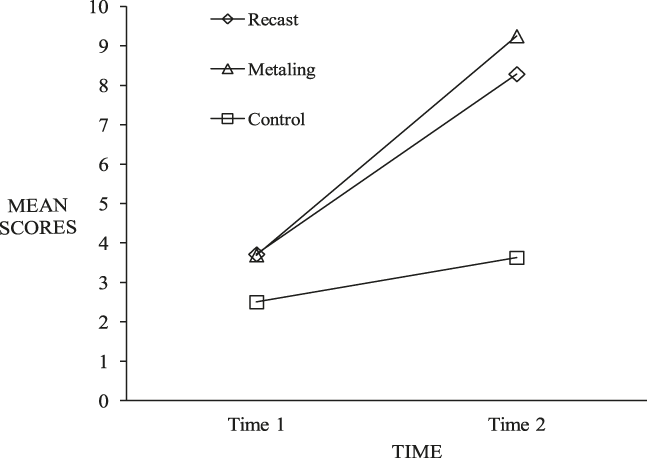
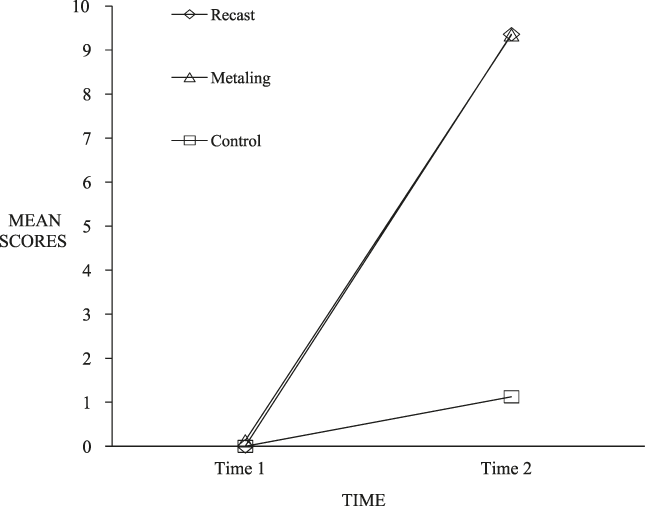
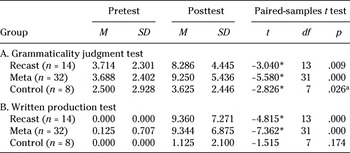
The first research question dealt with the relative efficacy of one type of feedback over another on the acquisition of the that-trace filter. First, to decide whether to use ANCOVAs, regression analyses were conducted with each WM span as a predictor variable and each posttest measure as an outcome variable to examine how learners’ overall WM scores were related to their posttest performance. No significant results were found: For the GJT as an outcome variable, F (1, 52) = 3.180, p = .080, R = .240, R 2 = .058, adjusted R 2 = .039; with RSPAN as a predictor variable, F (1, 52) = 1.135, p = .292, R = .146, R 2 = .021, adjusted R 2 = .003; with OSPAN as a predictor variable, and as for the written production test as an outcome variable, F (1, 52) = 1.837, p = .181, R = .185, R 2 = .034, adjusted R 2 = .016; with RSPAN as a predictor variable, F (1, 52) = 0.291, p = .592, R = .075, R 2 = .006, adjusted R 2 = −.014. Due to this nonsignificant impact of WMC on learners’ posttest performance as well as to the lack of significant between-group differences in WMC, the decision was made to conduct a 2 × 3 mixed ANOVA, rather than a repeated-measures ANCOVA, with time (pre- to post-) as a within-subjects variable and group (recast vs. metalinguistic feedback vs. control) as a between-subjects variable on learner performance on each dependent variable measure (see Table 1, part A, and Figure 1 for the GJT performance and Table 1, part B, and Figure 2 for the written production).
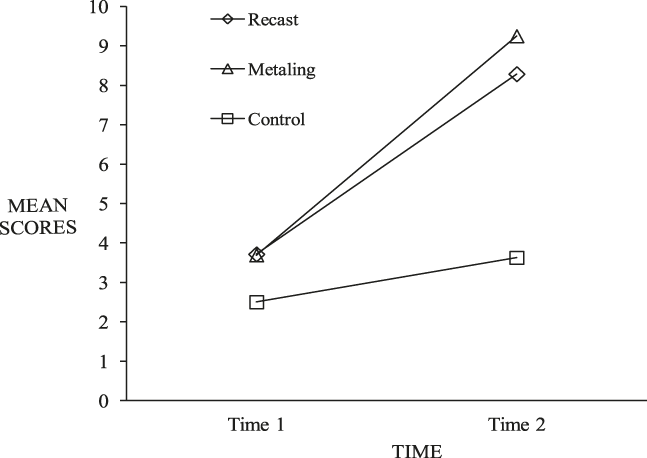
Pre- to post-development on the that-trace filter in the grammaticality judgment test.
Pre-to-post development on that-trace filter in the written production test.
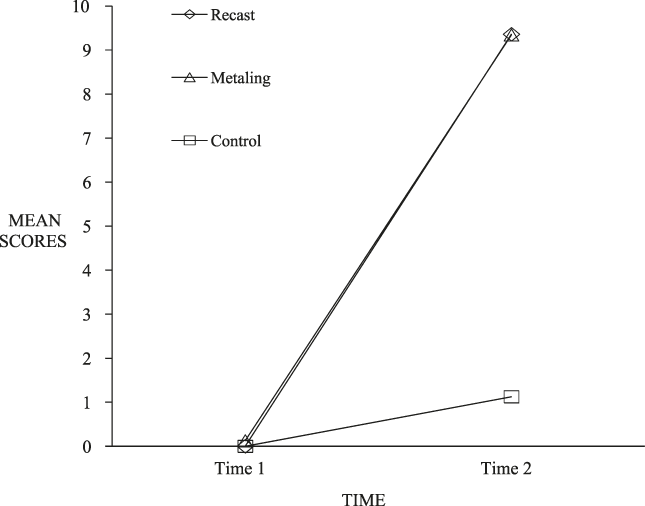
Results of the grammaticality judgment test and written production test

a Not one single learner in the control group was able to correct any sentence that he or she judged ungrammatical, that is, their pre-to-post improvement does not represent their knowledge and can thus be ignored.
* p < .05.
The results of the mixed ANOVA on the GJTs showed a statistically significant main effect of time, F (1, 51) = 20.193, p = .000; ηp2 = .284,Footnote 6 and of group, F (2, 51) = 4.651, p = .014, ηp2 = .154, but no significant Time × Group interaction effect, F (2, 51) = 2.287, p = .112, ηp2 = .082. All three groups performed significantly better on the posttest than on the pretest, contributing to the significant pre-to-post difference. Given that no significant between-group difference was found in the ANOVA on the pretest, it is logically assumed that the significant main effect of group is due to the effects of the treatment activities mirrored in learner performance on the posttest. In a follow-up analysis—due to the violation of the assumption of homogeneity of variances checked via Levene’s statistic (p = .020)—the Brown-Forsythe procedure and Dunnett’s T3 post hoc pairwise comparisons were performed on the posttest. The Brown-Forsythe procedure showed a significant difference between the groups in learner performance on the posttest, F (2, 40.597) = 6.382, p = .004. According to the Dunnett’s T3 post hoc comparisons, both experimental groups (i.e., the recast and metalinguistic feedback groups) significantly outperformed the control group on the posttest (p = .014 for the recast vs. control groups and p = .001 for the metalinguistic feedback vs. control groups), but no statistically significant difference was observed between the two (p = .894).
Another 2 × 3 mixed ANOVA with time as a within-subjects variable and group as a between-subjects variable was conducted on the written production tests, the results of which revealed a significant main effect of time, F (1, 51) = 38.240, p = .000, ηp2 = .429; of group, F (2, 51) = 5.651, p = .006, ηp2 = .181; and of time × group interaction, F (2, 51) = 5.061, p = .010, ηp2 = .166. As in the case of the GJT, the Brown-Forsythe procedure and Dunnett’s T3 pairwise comparisons were performed on the posttest because of the violation of the assumption of equal variances. A statistically significant between-group difference in their performance on the posttest was found in the Brown-Forsythe procedure, F (2, 29.299) = 7.412, p = .002, and Dunnett’s T3 post hoc comparisons clearly showed that both experimental treatment groups performed significantly better than the control group (p = .003 for the recast vs. control groups and p = .000 for the metalinguistic feedback vs. control groups). However, as in the case with the GJT, no significant difference was observed between the two experimental groups (p = 1.000). The significant Time × Group interaction effect appears to be attributable to the fact that the metalinguistic group performed better than the recast group on the pretest, but the recast group, on the contrary, outperformed the metalinguistic group on the posttest, although the difference was negligible in either case.
The second research question was intended to examine how WMC was related to the effectiveness of each feedback type in the acquisition of the that-trace filter. Simple linear regression analyses were performed with each WM span as a predictor variable and pre-to-post gain scores as an outcome variable. Pre-to-post gain scores were calculated in terms of proportion—that is, by dividing the number of correct posttest items minus the number of correct pretest items by the number of incorrect pretest items—namely, normalized gain scores (Hake, Reference Hake1998).
As for the recast group, WMC measured via RSPAN significantly predicted the beneficial effects of recasts on learner performance on both dependent variable measures—F (1, 12) = 10.884, p = .006, ß = .690, R 2 = .476, adjusted R 2 = .432, for the GJT, and F (1, 12) = 8.478, p = .013, ß = .643, R 2 = .414, adjusted R 2 = .365, for the written production test. WMC measured via OSPAN also significantly predicted the improved performance of the recast group on both measures: F (1, 12) = 5.668, p = .035, ß = .566, R 2 = .321, adjusted R 2 = .264, for the GJT, and F (1, 12) = 5.933, p = .031, ß = .575, R 2 = .331, adjusted R 2 = .275, for the written production test.
With regard to the metalinguistic group, WMC measured via RSPAN was not significantly related to the efficacy of metalinguistic feedback on learner performance on either test: F (1, 30) = 2.004, p = .167, ß = .250, R 2 = .063, adjusted R 2 = .031, for the GJT, and F (1, 30) = 0.075, p = .786, ß = .050, R 2 = .002, adjusted R 2 = −.031, for the written production test. Likewise, the improved performance of the metalinguistic group was not predicted by WMC measured via OSPAN: F (1, 30) = 1.151, p = .292, ß = .192, R 2 = .037, adjusted R 2 = .005, for the GJT, and F (1, 30) = 0.239, p = .629, ß = −.089, R 2 = .008, adjusted R 2 = −.025, for the written production test.
In sum, for the first research question, on the relative efficacy of recasts over metalinguistic feedback on the acquisition of the that-trace filter, the results of the mixed ANOVAs, the Brown-Forsythe procedures, and the Dunnett’s T3 pairwise comparisons showed no statistically significant difference between the two experimental groups in their performance on either dependent variable measure. The experimental groups, however, performed significantly better than the control group in both measures. With regard to the second research question, on the role of WMC in the effectiveness of recasts and metalinguistic feedback, the simple linear regression analyses showed that WMC significantly predicted the beneficial effects of recasts on the development of the that-trace filter evidenced in learner performance on both dependent variable measures (on the basis of normalized gain scores), but it failed to predict the improved performance of the metalinguistic group on either measure.
DISCUSSION
The present study was designed to examine the relative efficacy of recasts compared to metalinguistic feedback on the acquisition of the that-trace filter and the role of individual differences in WMC. The findings suggest that learners can benefit, to a more or less similar extent, from recasts and metalinguistic feedback, and that WMC may mediate the effectiveness of recasts, but not of metalinguistic feedback, in L2 development. Unlike previous studies that compared recasts with metalinguistic feedback and reported the superiority of metalinguistic feedback over recasts (e.g., Ellis, Reference Ellis and Mackey2007; Ellis et al., Reference Ellis, Loewen and Erlam2006; Sheen, Reference Sheen and Mackey2007), recasts in the present study were found to be as beneficial as metalinguistic feedback. One plausible reason for this may be that modified output production was not allowed in the present study, as opposed to most feedback studies, in which modified output opportunities were not controlled (e.g., Ammar & Spada, Reference Ammar and Spada2006; Ellis, Reference Ellis and Mackey2007; Ellis et al., Reference Ellis, Loewen and Erlam2006; Lyster, Reference Lyster2004; Sheen, Reference Sheen and Mackey2007). As Swain (Reference Swain, Cook and Seidlhofer1995, Reference Swain and Hinkel2005) notes, modified or pushed output provides opportunities for learners to notice their linguistic problems and test hypotheses in relation to the form in focus, which can contribute to L2 development (e.g., McDonough, Reference McDonough2005; Nobuyoshi & Ellis, Reference Nobuyoshi and Ellis1993). For example, McDonough (Reference McDonough2005) examined the effectiveness of modified output opportunities provided via clarification requests in English question development and found modified output to be the only significant predictor. In their small-scale study, Nobuyoshi and Ellis (Reference Nobuyoshi and Ellis1993) also observed the beneficial effects of modified output on the acquisition of English past tense verbs. Considering that recasts are not as effective in eliciting modified output as prompts such as metalinguistic feedback (see Lyster & Ranta, Reference Lyster and Ranta1997; Panova & Lyster, Reference Panova and Lyster2002), the blocking of modified output opportunities in the present study may have affected the metalinguistic group far more than the recast group. Additionally, by controlling for modified output opportunities, and given the somewhat structured treatment activities used in the present study, recasts were provided in a context similar to a tightly controlled experiment, despite the fact that the experiment was carried out in a classroom setting. This may have led learners to pay more attention to recasts than they would have in a much less controlled classroom setting in which modified output was allowed.Footnote 7
Of particular interest is the finding that suggests WMC mediates the efficacy of recasts—but not of metalinguistic feedback—on L2 learning. This may be interpreted as reflecting two different mechanisms for how noticing occurs. Metalinguistic feedback is, by nature, explicit and obtrusive; if it has occurred, the noticing of metalinguistic feedback is externally driven. The type of metalinguistic feedback used in the present study (e.g., Don’t use the conjunction “that” when you ask about the subject of the subordinate clause) clearly and explicitly informed learners that the conjunction that should be deleted. Noticing may have occurred in a rather straightforward manner with relatively less cognitive effort to attend to form during interaction, compared to implicit forms of feedback that do not explicitly draw learners’ attention to form. It can be postulated that cognitive control of attentional resources may not necessarily have been in active operation for metalinguistic feedback to be noticed.
The noticing of recasts, however, necessitates cognitive control of attentional resources because it requires learners to engage in cognitive comparisons (Doughty, Reference Doughty and Robinson2001). Noticing a linguistic gap through a cognitive comparison is most likely to occur when a learner’s initial erroneous utterance is stored in a readily accessible state so that it can be retrieved without delay when compared with an incoming targetlike utterance contained in a recast. Involved in cognitive comparisons, therefore, are learner-internal cognitive capacities that allow learners to maintain their erroneous utterances while they process meaning and then to compare them with targetlike utterances provided via recasts. The extent to which learners can perform cognitive comparisons may vary depending on their ability to exploit semantic contingency or transparency. Cognitive comparisons are facilitated and implemented effectively and accurately when semantic transparency is detected successfully and promptly so that more attentional resources can be allocated to cognitive comparisons of linguistic features. In other words, cognitive control of attentional resources is inevitable during the process of noticing recasts.
With the type of recasts utilized in the present experiment, it stands to reason that learners in the recast group experienced even more intense competition for attentional resources. To elaborate, recasts provided during interaction were full recasts—the corrective nature of which may often go unnoticed—as opposed to partial recasts, which are generally considered more effective in drawing learners’ attention to their linguistic gaps (see Egi, Reference Egi2007; Loewen & Philp, Reference Loewen and Philp2006; Philp, Reference Philp2003; Sheen, Reference Sheen2006, for more discussion). The type of recasts provided was somewhat unique in that they involved deleting a constituent (i.e., that), as opposed to replacing one with another or modifying it. Given the fact that the conjunction that can be deleted in various instances, especially in informal speech or writing (e.g., at the beginning of clauses that follow such verbs as say, think, etc.), it may have been quite challenging for some learners to notice the corrective nature of recasts in the present experiment.
The noticing of recasts as corrective feedback is an attention-demanding task and hence necessitates a domain-general, attention-control mechanism viewed as an essential element of WMC (e.g., Engle, Reference Engle2002; Engle, Kane, et al., 1999; Kane et al., Reference Kane, Conway, Hambrick, Engle, Conway, Jarrold, Kane, Miyake and Towse2007), whereas such a cognitive control mechanism is not particularly required for the noticing of metalinguistic feedback, due to its explicit and obtrusive nature. Thus, it is rather unsurprising that WMC was related to the effectiveness of recasts but not of metalinguistic feedback in the acquisition of English the that-trace filter. In other words, it is the intrinsic involvement of domain-general, executive attention processes (i.e., attention-control processes) in the noticing of recasts that may differentiate recasts from metalinguistic feedback with respect to the role of WMC in the effectiveness of the two feedback conditions. Supportive evidence for this line of interpretation can be found in previous research on WMC in cognitive psychology, which indicates that WM span differences arise only when a given task is cognitively challenging, and thus require cognitive control of attentional resources (e.g., Conway & Engle, Reference Conway and Engle1994; Kane & Engle, Reference Kane and Engle2000; Rosen & Engle, Reference Rosen and Engle1998). Even supposing that only a simple attention-control mechanism operates in noticing recasts, individual differences in WMC still impact the extent to which learners notice recasts because WMC variation is also mirrored in learner performance on simple attention-control tasks (e.g., Conway et al., Reference Conway, Cowan and Bunting2001; Kane et al., Reference Kane, Bleckley, Conway and Engle2001; Kane & Engle, Reference Kane and Engle2003).
The present interpretation of the significant correlation between WMC and recasts in terms of noticing is supported by Mackey and colleagues’ (2002) finding that suggests high-span learners are more likely to notice recasts than low-span learners. Consequently, individual differences in WMC may well mediate the extent to which L2 learners benefit from recasts, especially if in fact noticing is an essential condition for L2 development to occur, as Schmidt argues (1990, 1995, 2001). It is thus odd that Trofimovich and colleagues (2007) found no significant relationship between WMC and the noticing of recasts (and L2 learning). They attributed the nonsignificant correlation to the saliency of recasts and the measure of noticing employed in the study (see their explanations on p. 187). Additionally, a close examination of their WM task offers another plausible reason for the nonsignificant role of WM in noticing and L2 learning. The letter-number sequencing test used to measure WM in their experiment may have failed to tap learners’ ability to maintain information in a readily accessible state and simultaneously process incoming information. Unlike other more generally used verbal WM span tasks (e.g., reading, operation, and counting spans) that are designed to suppress or minimize rehearsal (see Conway et al., 2005, regarding methodological issues), the letter-number sequencing task seems to have allowed participants enough time to rehearse to-be-sequenced items, and to have rendered the entire task cognitively less challenging. The task may have been sensitive to the processing and executive aspects of WM, as they claimed, but the storage demand did not seem to be incorporated into the task at the level required for other more frequently used verbal WM span tasks.
The present study found that recasts were as effective as metalinguistic feedback in the learning of the that-trace filter, which may, to some extent, be attributable to the blocking of modified output production. This methodological control—designed to prevent modified output from playing a role as a potential confound—seems to have contributed to increasing the amount of attention paid to recasts because of the highly structured treatment procedure, which was similar to that of a lab-based study. At the same time, it seems to have decreased the possibility of benefiting from metalinguistic feedback, given that modified or pushed output is considered to be facilitative of L2 learning (McDonough, Reference McDonough2005; Nobuyoshi & Ellis, Reference Nobuyoshi and Ellis1993; Swain, Reference Swain, Cook and Seidlhofer1995, Reference Swain and Hinkel2005) and that metalinguistic feedback is more likely than recasts to lead to modified output production (Lyster & Ranta, Reference Lyster and Ranta1997; Panova & Lyster, Reference Panova and Lyster2002). The study also showed that WMC significantly predicted the effectiveness of recasts, but not of metalinguistic feedback. This finding can be interpreted as indicative of the fact that the noticing of recasts necessitates executive attention processes, which is a critical component of WM (Engle, Reference Engle2002; Engle, Kane, et al., 1999; Kane et al., Reference Kane, Conway, Hambrick, Engle, Conway, Jarrold, Kane, Miyake and Towse2007), whereas the noticing of metalinguistic feedback is accomplished in a much more straightforward manner. In other words, compared to the noticing of recasts, noticing metalinguistic feedback does not require learners to use executive attention processes, and thus WM. This line of interpretation of the results regarding the relationship between WMC and the type of feedback in terms of noticing is still a speculation (although a quite plausible explanation), until further evidence can be obtained along with supportive data in relation to noticing.
LIMITATIONS AND FUTURE RESEARCH
As with most empirical research, the present study is also subject to some limitations. First and foremost, the sample size of the recast group (n = 14) included in the data analyses is not large enough to make any strong or generalizable claim regarding the relationship between WMC and recasts, although the results regarding the role of WMC in the effectiveness of metalinguistic feedback were obtained using a relatively large sample (n = 32). Second, both dependent variable measures employed in the present study (i.e., GJTs and written production tests) were specifically designed to test learners’ grammatical knowledge of the that-trace filter. Learners’ ability to use their knowledge of the that-trace filter in conversational interaction, however, was not measured in the present study. Other measures including oral performance tests need to be utilized to provide more reliable findings in future research. Because the type of structure may differentially affect the effectiveness of corrective feedback (Ellis, Reference Ellis and Mackey2007; Iwashita, Reference Iwashita2003; Leeman, Reference Leeman2003; Long et al., Reference Long, Inagaki and Ortega1998; Sagarra, Reference Sagarra and Mackey2007), other structures in English or structures in other foreign or L2s should be tested in future research to confirm or disconfirm the present findings.
Another important methodological issue to consider in future research is related to the use of L2 WM span measures. Only L1 WM span measures were employed in the present study, due to lingering concerns about the learners’ L2 (intermediate) proficiency affecting their performance on L2 WM span tasks. Given significantly high correlations between L1 and L2 span measures evidenced in previous research (Juffs, Reference Juffs2004; Mackey et al., Reference Mackey, Philp, Egi, Fujii, Tatsumi and Robinson2002; Miyake & Friedman, Reference Miyake, Friedman, Healy and Bourne1998; Osaka & Osaka, Reference Osaka and Osaka1992; Osaka, Osaka, & Groner, Reference Osaka, Osaka and Groner1993), it is unlikely that utilizing L2 WM span tasks would have changed the overall results observed in the present study. However, because being highly correlated is, of course, not isomorphic with being identical, it is worthwhile to employ L2 WM span tasks—insofar as they are appropriate for learners’ proficiency—so that any new insights into the relationship between corrective feedback and WMC can be brought to light.
An interesting follow-up study may be one that investigates how the noticeability of recasts affects the relationship between WMC and the efficacy of recasts on L2 learning. It may be that WMC significantly predicted the efficacy of recasts on the acquisition of the that-trace filter in the present study because the recasts used were difficult to notice due to the two unfavorable characteristics discussed previously. Future research should then examine whether WMC can also predict the efficacy of short or partial recasts that are relatively easy to notice (see Egi, Reference Egi2007; Loewen & Philp, Reference Loewen and Philp2006; Philp, Reference Philp2003; Sheen, Reference Sheen2006, for more on this issue), or whether other implicit types of feedback with low noticeability are also related to WMC.
Finally, because the sizes of the samples used for the treatment groups were not large enough to conduct extreme-groups comparisons, the interaction between the type of corrective feedback (e.g., recasts vs. metalinguistic feedback) and the level of WMC (e.g., high vs. low) was not examined. This interaction question may provide additional implications regarding the relative efficacy of different types of corrective feedback. It has yet to be seen whether there is any significant interaction between the two variables. More rigorous research that takes into consideration the methodological issues and the potential research topics mentioned in this section may assure a more definitive picture of the relationship between WMC and corrective feedback in terms of the extent to which WMC predicts the relative efficacy of different types of feedback on L2 development.