- AAM
Archiepiscopal Archives, Malta (now in Floriana)
- AC
Atti Civili
- AIM
Archives of the Inquisition, Malta (now in Mdina)
- AO
Acta Originalia
- CEM
Curia Episcopalis Melitensis (now in Mdina)
- Lib. Bapt.
Liber Baptizatorum
- Lib. Def.
Liber Defunctorum
- Lib. Matr.
Liber Matrimoniorum
- NAV
Notarial Archives, Valletta
- PA
Parish Archives (kept in the parishes)
- Proc.
Proceedings of the Inquisition
- RS
Registrum Supplicatiorum
- SA
Status Animarum
1. INTRODUCTION
Early modern Europe was a world on the move.Footnote 1 People left their homes to escape religious persecution or infectious disease, to look for a job or perhaps to enter the anonymity of the towns and escape the face-to-face life of the village. In Naples, Italy in 1790 immigrants made up 20 per cent of the population. Similar percentages of immigrants were to be found in Florence and Foggia, but in Mantua 40 per cent of the population were said to be immigrants and in Turin and Rome 50 per cent.Footnote 2 In England too, according to Alan Macfarlane, village populations were surprisingly mobile; static rural communities, he contends, are an historical fallacy,Footnote 3 a myth invented in the late nineteenth century to differentiate between modern industrialized ‘society’ and stable village ‘communities’.Footnote 4 Peter Laslett was equally impressed with the mobility found in the seventeenth-century villages of Clayworth and Cogenhoe which contrasted ‘most sharply … with … expectations of a settled, agrarian, familial society, with only elementary means of communication, highly localized market relations and above all a profound attachment to a particular place’.Footnote 5
Was mobility also high in eighteenth-century Malta and, if so, did this ‘rootlessness’ have any effect on social relations? Did it lead in some way to a change from a neighbourly village society to a more individualistic one? The concept of individualism has been a preoccupation in British historiography since the work of Christopher Hill, Alan Macfarlane and Keith Thomas.Footnote 6 Lately, Keith Wrightson has reiterated the belief that ‘perhaps neighbourliness did indeed decline in early modern England’.Footnote 7 Is there any evidence for a similar shift in Maltese society or were there any factors that had a stabilizing effect on the population and held parish communities together?
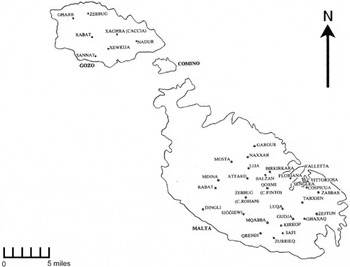
These questions are considered here using a detailed case study focusing on St Mary's (Qrendi) in the period 1750–1798. This 400-acre parish, dominated by the dome of the church, lies in the south-east of Malta, 11 kilometres from Valletta, the island's capital. As Figure 1 shows, Qrendi sits huddled amongst the parishes of Mqabba, Kirkop, Safi and Żurrieq.
Maltese parishes in the eighteenth century.

2. THE DATA SOURCES
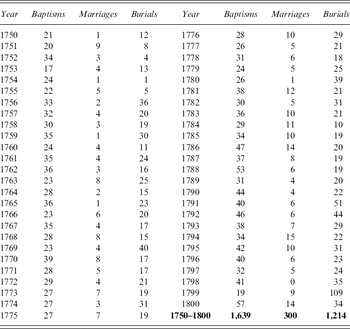
The research reported here is based on an assortment of different documents. First there are Qrendi's registers of the rites of passage associated with vital events. In the period from 1750 to 1798 the Qrendi registers record details of some 1,600 baptisms, 300 marriages and 1,200 burials; these have been used to compile family reconstitution forms (see Table 1).Footnote 8
Baptisms, marriages and burials at Qrendi, 1750–1798

Sources: Liber Baptizatorum, ii (1716–1807); Liber Matrimoniorum, ii (1718–1862); Liber Defunctorum, ii (1717–1869).
Family reconstitution relies on the quality of the records used and, despite every effort to be thorough, the historian can only base his analysis upon the information available. In Qrendi, as elsewhere on Malta, frequent pastoral visitations by the bishops must have been an incentive for incumbents not wishing to be reprimanded for carelessness to be accurate in their reporting. Furthermore, Synodal decrees reminded parish priests of their duty to be careful when recording vital events. For example, the Synod of 1703, under Mgr Davide Cocco Palmieri, ordered priests to make entries in the most meticulous manner, according to the form laid down in the Roman Catholic ritual.Footnote 9 In the case of Qrendi, Don Antonio Mizzi, who was the parish priest from 1756 to 1804 – that is for most of the period under study – did not need such admonitions. Jesuit-trained, he appears to have known his duties only too well. He noted meticulously in the death register both the demise of very young infants, including those who ‘flew to heaven’ after only an hour or two,Footnote 10 as well as the stillborn (foetui inanimatus).Footnote 11 It is notable that Don Mizzi's arrival in the parish coincided with a large rise in the number of burials recorded in the parish register (see Table 1). Even individuals who died away from the parish, generally in hospital or even abroad, appear to have found a place in the registers although, of course, it cannot be certain that all such events were recorded. All the same, the turnover in the parish was so high that only 96 out of 481 marriages (20 per cent) could be compiled for this study, following the couple from marriage to the death of one spouse or to 1880, whichever occurred sooner. It is on this limited sample of reconstitutions that the main demographic dynamics in this study have been based.
The parish registers are complemented by the Stati Liberi, which identified people who had been abroad but had returned and asked to be married, and by the Status Animarum. The latter documents, as in other Catholic countries, are extremely plentiful.Footnote 12 They were primarily compiled by the parish incumbents each Easter to verify whether their parishioners had gone to confession and received communion in the course of the preceding year, but included every member of a household, even babies. These documents provide a most useful tool for the social historian. Besides detailing the size of populations and the number and size of households within communities, they also reveal an important development of the Church's activities. The Counter-Reformation Church was not interested solely in the religious practices of its members; it also wished to become involved in the social life of its people. The parish priests therefore indicated on the lists the poor, the unmarried, the sick, the disabled, the separated couples, the servants, the widows and widowers – in fact, all those to whom they could offer help.Footnote 13 By comparing one Status Animarum list to another a basic indication of rates of mobility in the intervening period can be estimated; it is possible to calculate the turnover of population in the parish and to identify those referred to by David Souden as ‘movers’ and ‘stayers’.Footnote 14 It should be noted, however, that Souden's terms referred to those moving over the course of their lifetime. Here ‘movers’ has to refer to those who were found in an early list but not a later one, when the lists may have been compiled only a few years apart.
The government's notarial archives are another useful documentary source. They provide information relating to marriage contracts but especially to wills. In Roman times, wills were simply private legal documents that regulated the transmission of property. When they reappeared in the twelfth century they had a religious purpose: the establishment of pious bequests. The problem with wills from eighteenth-century Malta is that very few people had either property or cash to bequeath to their heirs. They were so poor that they were buried gratis ex amore Dei – ‘free for the love of God’ – or else they gave what little cash they had to the parish priest to pay for their funeral and burial.Footnote 15 Nevertheless, where wills do exist they provide information on kinship links, religious networks, inheritance practices, debt and credit, as well as some idea of the economic activities amongst the will-makers and within the wider community.Footnote 16
Finally, a vast amount of churchwardens' reports are available in Malta. Those for Qrendi run from 1701 through 1789.Footnote 17 They are a commentary on the affairs of this tiny rural community, showing the balance sheets of the income and expenditure of the parish and its officials.Footnote 18
3. A HISTORY OF QRENDI
Between 1530 and 1798 Malta was governed by the theocratic Order of St John. The arrival of these ‘monks bearing arms’, also known as ‘Hospitallers’, was a milestone in the history of the island and the start of modern Malta, no longer regarded as part of Sicily but as having an identity of its own.Footnote 19 The ‘monks’ brought security to the island, allowing commerce, agriculture, the building industry and corsairing (from corso – a legal form of piracy) to thrive. This prosperity was reflected in the increase of population from 20,000 in 1530 to 100,000 in 1798. During this period the new towns of Valletta, Floriana, Vittoriosa, Senglea and Cospicua rose up around the harbour area and thirteen new parishes were established.Footnote 20
Qrendi became a parish in 1680, when it was carved out of St Catherine's (Żurrieq). According to the Status Animarum of 1758, it was one of the smallest parishes in Malta, with just 667 inhabitants, but by 1779 its population had reached 832. By comparing the names of those present at these two dates we can establish that 336 of the persons recorded in 1779 had not been resident in 1758 and that only 326 of the persons living in the community in 1758 were still to be found there in 1779; in other words 331, or 49.6 percent had disappeared. What had happened to them?
(a) Mortality
The parish registers show that death had struck down 178 or (53.7 per cent) of all those inhabitants who had disappeared between 1758 and 1779. In this period the Status Animarum indicates that the average annual population of the parish was 750, with approximately 22 burials per year on average. This made the death, or at least the burial, rate roughly 28.5 per thousand inhabitants. There were 642 live births while 9 stillbirths were recorded. One hundred and forty-four infants died aged under one year in the same period, making the infant mortality rate 224 per thousand live-born children. Infants tended to be baptised the same day they were born or at the latest the next day, some being so weak that they had to be baptised by the midwife.Footnote 21 Some families appear to have had more than their fair share of misery. For example, Giuseppe Spiteri and his wife Natalitia were married on 30 September 1759. In 1763 they buried a one-year-old child. In 1768 they lost Salvatore, at just nine days old, and he was followed into the graveyard by his sister Maria, aged eight and a half in 1769, and by his three-month-old brother Francesco in 1772. Out of five children born only Bernardo reached adulthood, but he too succumbed, aged 21 years, in 1786.Footnote 22
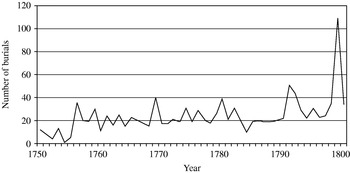
Figure 2 throws into relief the repetitive mortality crises that the parish of Qrendi experienced in the second half of the eighteenth century. In 1756, the parish register records 36 burials, a marked increase on the number recorded in the previous six years. The increase may possibly be a consequence of the arrival of Don Mizzi and an improvement in record-keeping. The number of burials fluctuated at around 20 per year for the next twelve years but in 1769 there were 40 deaths. From 1770 through 1779 the annual number of burials again lay around 20 but in 1780 39 of the inhabitants died, largely as a result of smallpox.Footnote 23 In 1791 and 1792 a total of 95 deaths occurred. In 1799, a year after Napoleon had invaded Malta, the death toll reached 109, a result of the revolt of the Maltese against the French.Footnote 24 The parish of Qrendi, therefore, suffered five major mortality crises, when deaths rose to twice their normal level or more, in a fifty-year period.
Annual burials in Qrendi, 1750–1800. (Source: Liber Defunctorum, ii (1717–1869).)

Apart from the 178 inhabitants who died between 1758 and 1779 there were another 153 Qrendin who are unaccounted for by the end of this period. What had happened to them? Had they gone to live in another parish? Had they left the island?
(b) Migration
Malta was an island but the sea did not cut it off from the rest of the world. Unlike Sardinia, it ‘lay on the paths of the great sea routes’ making it of key importance in the centre of the Mediterranean.Footnote 25 It was, for instance, the chief market for Moslem slaves in the eighteenth century,Footnote 26 while its lazaretto (quarantine house) and warehouses attracted the ships of all nations.Footnote 27 The number of artisans who settled on the island is a striking indication of this flow of people into Malta: foreign-born blacksmiths, shoemakers, book-binders, hair-dressers, jewellers, gilders, embroiderers, cutlers, tailors, actors, shipwrights, dyers, hemp-carders, weavers of silk, linen and fustian cloth are all recorded living on the island in the 1700s.Footnote 28
The influx of foreigners was counterbalanced by an exodus of Maltese. Braudel assures us that all the Mediterranean islands exported their people and mentions Corsica as the island of emigrants par excellence.Footnote 29 Malta was no less important and its surplus population was spread all over Christian Europe and beyond. Spain was an especially favoured destinationFootnote 30 but so also was France, where the Maltese enjoyed dual nationality.Footnote 31 The Maltese were also to be found in the Italian states and PortugalFootnote 32 while others ventured as far as MartiniqueFootnote 33 and Havana.Footnote 34 One Giuseppe of Valletta manufactured chocolate in 1773 in Lima, Peru, where Giovanni Delcore of Cospicua, an innkeeper, also lived.Footnote 35
Qrendi does not appear to have fitted into this general Maltese picture. There was not one single example recorded in the period 1750–1798 of a Qrendi inhabitant applying to the bishop's curia for the necessary documentation to allow him or her to be married abroad. Most (74.8 per cent) of the 135 applications for such testimonials, which would act as proof that the applicant was not already married, came from the cities on the island, though there were also four instances each from the rural parishes of Qormi, Żebbuġ, Żejtun and Rabat.Footnote 36 References to Qrendi inhabitants living abroad in the late eighteenth century are extremely rare. One such case refers to Giuseppe Scicluna who was in domestic service at Firmo in Calabria, now part of southern Italy, between 1747 and 1750,Footnote 37 while the death register reports that Giovanni Lorenzo Zahra ‘migrated from this life’ at Cagliari, on the island of Sardinia, on 9 July 1780.Footnote 38 Two other Qrendi inhabitants, Vincenzo Barbara and Angelo Farrugia, had passed away in the Sicilian towns of Vittoria and Terranova (now known as Gela) in Sicily in 1778 and 1779 respectively.Footnote 39
Nevertheless, while the Qrendin may have been reluctant to settle in other lands, they fully participated in Reher's ‘culture of mobility’.Footnote 40 The Stati Liberi inform us that in this same period fifteen soldiers and sailors from the parish were ‘con le galere’ (serving with the galleys). They did not necessarily work on the ships of the Order of St John; the records show that Giuseppe Farrugia enlisted on 15 February 1777 with a corsair ship for six months under Captain Giorgio Mitrovich.Footnote 41
The horizons of those who stayed behind spread beyond the village boundaries, too. Movement between parishes was on a considerable scale – even though it should be stated that on Malta parishes lie within reasonable walking distance of each other. This accounts for there being little seasonal movement of persons in search of work as distances were so short that labourers could return home in the evening.Footnote 42 Nor does there appear to have been the considerable movement of servants seen elsewhere; only one girl from Qrendi was found to be in service in Valletta.Footnote 43
The historic records show that the Qrendin stood as sponsors at baptisms or marriages and attended the funerals of their relatives and friends in other parishes. Still others travelled to Mdina to attend a session of the law-courts (corte capitaniale) or to Vittoriosa to testify at the court of the Inquisition;Footnote 44 others made their way to nearby Żurrieq to make their wills. Some ventured to Valletta to bring home wine and wheat or to buy maize for the pigs.Footnote 45 It is noted that in 1783 Giuseppe Magro walked to Siġġiewi to buy 2 rotoli of raw cotton (macalugio),Footnote 46 but peasants in Qrendi had to be on the move principally because the extremely small pieces of land they owned were scattered across the parish if not in other parishes. For example, the eight plots that one farmer leased from the Holy Office in 1784 were dispersed across three parishes – Żurrieq, Siġġiewi and Mqabba.Footnote 47
The Qrendin also left their village for reasons connected with ill-health. The impression that in traditional society people died at home is a myth, at least in this region of Malta. According to the parish death registers, which indicate the places of both death and burial, between 1757 and 1797 142 parishioners passed away in hospital.Footnote 48 Except for two women who died at Santo Spirito and Saura Hospitals on 10 November 1758 and 9 March 1793 respectively, they all expired at the Sacra Infermeria at Valletta.Footnote 49
(c) Nuptiality
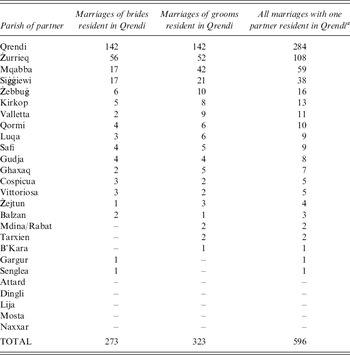
A sure indication of the dense contacts that the inhabitants had with other parishes is the choice of marriage partners. Women generally married in their own parish and even if they did not, for instance because they were chosen for a marriage legacy,Footnote 50 their marriage appears in the registers of both villages. Bridegrooms were much more likely to be married elsewhere on the island, and the celebration of their marriages can only be located by a time-consuming search through all of Malta's parish registers. As Table 2 shows, between 1750 and 1797 142 of 273 girls from Qrendi (52 per cent) married men from inside their own parish, but 181 of the 323 Qrendi men (56.1 per cent) preferred to choose women from elsewhere. Naturally, in the case of both sexes it was from the nearby parishes of Żurrieq, Mqabba and Siġġiewi that most partners were found but it must be noted that 9 girls and 13 men chose their partners from the ‘distant’ maritime cities of Valletta, Cospicua, Vittoriosa and Senglea. We cannot say, therefore, that the parish was endogamous.Footnote 51
Origin of marriage partners chosen by brides and grooms resident in Qrendi at the time of marriage, 1750–1797

a In the first row of the table both partners are from Qrendi.
Sources: Marriage registers of all 26 Maltese parishes were consulted.
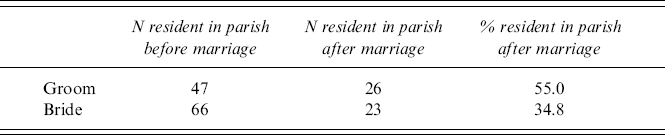
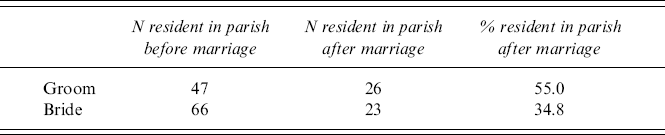
Where did couples reside after marriage?Footnote 52 And what part did the movement of persons in and out of the village as marriage partners play in total migration? Having identified where a marriage took place, and knowing the origins of both partners, the introduction of new wives and husbands into Qrendi society can be recovered by observing their presence in later lists of inhabitants. Table 3 indicates, for example, that of the 47 men recorded in Qrendi in 1759, 26 (55.5 per cent) remained in the village after marriage, to be recorded in the Status Animarum of 1778. Of 66 women recorded in the village in 1759 and observed to marry, only 23 (34.8 per cent) were still resident there in 1778. Thus, more women than men were introduced into the village.
Residence after marriage of brides and bridegrooms from Qrendi (1750–1778)
Source: PA (Qrendi), Lib. Matr ii (1718–1862).
One other possible means of identifying where the couple resided after marriage is to check whether they baptised their first child in Qrendi. Of course, the couples might baptise their child elsewhere, for example in their parish of origin if, say, one or other set of grandparents still lived there. For instance, Don Mizzi, Qrendi's parish priest, baptised the child of Antonio and Rosa Zahra from St Catherine's on 27 March 1776. However, he made it clear that he did so with the permission of the couple's parish priest, recording it as ‘de licentia Rev. D. Josephi Agius, parroci casal Zurrici’.Footnote 53 Out of 182 women, 111 (61 per cent) had their first child baptised in the parish in the period 1750 to 1785. Of course, this does not necessarily mean that they stayed in the village for the rest of their lives. In fact, only 72 of them (65 per cent) had their death recorded in Qrendi; the others must have departed to another parish.
Is it possible to ascertain the reasons for the choice made by couples on their place of residence? Work was an important determinant but if occupations may be indicative they cannot offer conclusive proof. For example, Carlo Grech took up residence at Cospicua in 1749. Being a sailor on board one of the Order's ships, the San Giovanni, it is possible to assume he might have wanted to be near his place of work.Footnote 54 While the towns were a natural attraction, as Braudel has pointed out,Footnote 55 so too was the land, and a husband with fields in his own parish would probably not have been free to move to Qrendi. If the couple were found in Qrendi this might suggest that the wife did not get on well with her mother-in-law. That this situation was not uncommon is hinted at by the proverbs ‘omm ir-ragel moqlija fit-tagen’ (‘the husband's mother is cooked in a pan’) and ‘biex l-indanna toqghod mal-kenna id-dar trid tkun genna’ (‘the mother-in-law can live with her daughter-in-law only if the house becomes heaven’).Footnote 56 Mother–daughter relationships were, by contrast, usually close on Malta; by preference a new wife would have preferred to stay in her village and, if possible, near her parents.Footnote 57 When, for example, Maria Magro from Qrendi married Pietro Borg on 14 August 1768, she took up residence next door to her mother – as did Margarita Caruana, who married in January 1764, and Catarina Axiach, who married in July 1778.Footnote 58
4. BUILDING SOCIAL COHESION
(a) Religion
Despite the considerable ebb and flow of migrants in and out of Qrendi, it is possible to demonstrate that there were mechanisms in place to build an ‘edifice of collective trust’Footnote 59 which encouraged integrative ties to bolster village cohesiveness. Religion, in the ritual and the teachings of the Catholic Church, can be seen to have played a major role in promoting interaction between neighbours. Parishioners could only partake of the body of Christ, as part of the Eucharist, if they had been reconciled with their enemiesFootnote 60 and the commandments laid out in the second table of the Decalogue set out an individual's duties to his or her neighbours. The commandment ‘Thou shalt not steal’ was to be interpreted to include not only theft and robbery but also an exhortation against usurers, ‘who by their exorbitant rates of interest, plunder and destroy the poor’. Likewise, ‘Thou shalt not bear false witness against thy neighbour’ was extended to include detractors and those who fomented divisions and promoted quarrels.Footnote 61
This ‘Christian brotherhood’, or ‘social miracle’ as John Bossy calls it,Footnote 62 appears to have led to a genuine state of harmonious social relations. Inevitably, however, some villagers did cause injury or provoke disquiet. The parish lists mention forzati (galley convicts)Footnote 63 and there are references to two cases of homicideFootnote 64 and one example of rape.Footnote 65 Records relating to the Inquisition mention the village bully, Francesco Muscat ir-Ruman (the Roman), a tenant farmer. The general populace were so afraid of this quarrelsome man that, according to one villager, they were unwilling to report him.Footnote 66 He was alleged to have both pelted neighbours' houses with stones and, together with Salvatore Zarb, roamed at large at night singing defamatory songs on some of their doorsteps. In 1785 he entered the house of Catarina Formosa and set fire to a pile of thistles in the kitchen.Footnote 67 Three years later he was in trouble again, charged with stealing a pig in addition to pestering Giuseppe Farrugia.Footnote 68
In general, however, people appear to have understood the obligations of neighbourliness.Footnote 69 Locals used the phrase ‘ir-regina tigi bzonn il-vicina’ (‘the queen may need her neighbour’) believing that in time of need no one can be as helpful as a neighbour, and that – ‘ahjar ghajrek minn dellek’ (‘your neighbour is better than your shadow’).Footnote 70 Doors were left ajar so that neighbours could call on each other to borrow small items and even if shut they could be easily opened by pulling a string attached to the lock. In economic dealings too people also seem to have trusted one another sufficiently to have been willing to lend money.Footnote 71 Several references in wills to unpaid sums of money that heirs had to recover or pay back bear testimony to this.Footnote 72
Thus social integration was rooted and identified in the traditional Christian moral teaching of charity. The churchwardens, for instance, noted in 1745 the payment of 8 tarì for the redemption of a slave from the parish.Footnote 73 A better clue to the depth of community solidarity was, however, the cashFootnote 74 that testators ordered to be distributed to the pauperum Domini Nostri Jesu Christi – ‘the poor of Our Lord Jesus Christ’, as Angelo Mangion put it in 1768.Footnote 75 In 1656 Vincenzo Spiteri left a sum of money so that bread could be donated to the poor of the parish. He also bequeathed two fields so that their rent would be spent on six tumuli of wheaten bread for the poor each year.Footnote 76
Other testators left money for the burial of those who would have been buried gratis Footnote 77 and dowries were provided for poor unmarried girls. In 1631 Agostino Ferrar left 100 scudi to the confraternity of the Holy Rosary so that the interest from the sum would be given to a girl every two years.Footnote 78 Servants too could benefit from the generosity of their masters. In 1742 Don Giovanni Paolo Asciach left 50 scudi to his servant, who was also to get six tumuli each of wheat and meschiato (a mixture of wheat and barley) every year for the rest of her life.Footnote 79
All the same, the people's devotion to their town or village (pajjiżhom) expresses best the communal dimension of the parish or the feeling of brotherhood.Footnote 80 As Michael Kenny has observed for ‘Ramosierra’, a village in Castille, the people were drawn together by external pressures, which begot a mentality whereby ‘Everything of one's own is best, and everything of others’ worse.'Footnote 81 Despite their close contiguity in a crowded island, Maltese parishioners strove to retain their separate identities.Footnote 82
This devotion to one's parish helped to promote a remarkable unity of popular feeling, which transcended the gulf that separated the social classes. At first this solidarity may seem strange because parish churches generally reflected the social divisions within their communities in a variety of ways. Women, for instance, usually sat in the nave and men in the transepts. Attendance at church was a social occasion and could be socially divisive. Those who, like Mattheolo Camilleri, did not have the ‘proper apparel’Footnote 83 failed to go to church at Easter,Footnote 84 or else heard the ‘morrow Mass’ purposely said at dawn for their convenience.Footnote 85 Others in want of decent clothing may have gone to one of the several filial churches instead of the parochial church.Footnote 86 Social differences were conspicuous even in death. Most people were buried in common graves but the privileged few had their own burial sites, with an engraved flagstone to mark their resting-place.Footnote 87
Nevertheless, the church drew the people together in several ways. Except for a nominal entrance fee, the three confraternities of the parish were open to all residents.Footnote 88 They drew on a wide social base, including both men and women, rich and poor. Unlike the Valletta brotherhoods (fratellanzi), such as that of S. Luigi Gonzaga, which recruited its members from the upper class,Footnote 89 or that of S. Monica, reserved only for artisans,Footnote 90 Qrendi's confraternities were inclusive, identified with no particular class or trade. In general the fratellanzi brought heterogeneous strands of society together in bonds of brotherhood. Throughout Catholic Europe they were one of the principal forms of social interaction that enabled the people to express both piety and Christian fraternity, which overcame inherent social divisions. As the members shared the sacraments and cared for one another, they built a strong community. Their ‘togetherness’ was especially shown at death. Members of the fratellanzi prayed before the holy sacrament that their recently departed brother or sister would have a safe journey (viatico) to the other world before accompanying the funeral procession from the house of the deceased to the church where the corpse was buried. In other words, the confratello/consorella felt that he/she would not face life and death alone.Footnote 91
The communal solidarity of the parish can also be understood from the people's concern for their church.Footnote 92 By the early eighteenth century Qrendi's magnificent Baroque church had been built but the parishioners continued to lay out an impressively high proportion of their revenues on such furnishings as the pulpit,Footnote 93 the confessionals,Footnote 94 the organFootnote 95 and the choir stalls.Footnote 96 Altars were delicately sculpted, gilded and endowed with lights while renowned artists such as Nicola Buhagiar and Francesco Zahra were commissioned to paint images of saints such as St JosephFootnote 97 and Our Lady of the Rosary.Footnote 98
This collective effort was worthwhile because a parish's prestige depended largely upon the parish church and the villagers drew together to present it in the most favourable light. This cohesiveness was especially strong on Assumption Day (15 August), the feast of the parish's patron saint, when the inhabitants tried to impress the swarm of villagers who arrived from other localities. On such occasions the church was beautifully transformed by a mass of colour and ablaze with light from hundreds of altar candles.Footnote 99
(b) Kinship
The involvement of the people in the running of the parish was a reflection of their solidarity. In the words of Peter Laslett, ‘the more important the common responsibilities of any community, presumably, the stronger the association between its members, because each one's interest is engaged’.Footnote 100 Nevertheless, despite the importance of the local community, the ties of kinship were the principal social bonds; as the Qrendin would have said, ‘id-demm qatt ma jsir semm’ – (‘blood never becomes poison’). Relationships with kin were seen as being so strong that people were called not only by their name but also by their kin group's nickname, for instance, ‘ta buras’ (‘big-headed’)Footnote 101 or ‘bin il far’ (‘the rat's son’).Footnote 102 In this way the individual acquired a firm identity and did not remain anonymous. ‘Is he not the son of Joseph the carpenter?’ expresses a much-acknowledged Maltese attitude that ‘Like breeds like.’ There was, and is, a firm belief that ‘id-demm jigbed (ir-razza tigbed)’ – ‘heredity is all-important’. Furthermore the individual's status in the community depended on the virtues or vices of his ‘clan’; thus it could be said, ‘ghidli bin/t min int u nghidlek x'int’ (‘tell me whose son/daughter you are and I will tell you who you are’).Footnote 103
The system of name-giving is a reflection of the assertion of kinship and lineage solidarity. In Qrendi, children, especially the first born, were often given their grandparents' names. From a sample of 147 first births 85 (57.8 per cent) were so named, most of them being named after their father's father or mother. Second names could then be drawn from the mother's side of the family. Giuseppe Barbara provides an example of this with his eldest son, born on 23 May 1786, whom he named Salvatore for his father and Giuseppe for his father-in-law.Footnote 104 Both these grandfathers were alive when their grandson was born, but examples of when a dead grandfather's or grandmother's name was passed on to a child abound.Footnote 105 Such ‘remaking’ of a dead member of the lineage was regarded as a duty. People emphasized their ties of affection to the departed and honoured their memory. According to Christiane Klapisch-Zuber, this custom expressed the idea by which ‘an ancestor or a close relative would find himself reincarnated in a newborn child through the attribution of his given name’.Footnote 106
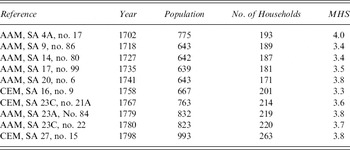
Such interrelationships among Maltese families is a further indication that the family was ‘overwhelmingly important in the social organization of Mediterranean Communities’.Footnote 107 However, it must be stressed that in Qrendi, as in the rest of Malta and in other European countries in the eighteenth century, people did not live in complex households.Footnote 108 Extended families were found only as a rare anomaly. The belief that extended families were characteristic of pre-industrial and peasant societies while nuclear or conjugal families were more representative of modern economic and social life has now been largely discreditedFootnote 109 and the Status Animarum lists for Qrendi, which enumerate all household members, are clear proof that, in general, households in the parish were small, averaging no more than four persons for each household across the eighteenth century (see Table 4).
Mean Household Size (MHS) in Qrendi, selected years 1702–1798

Note and sources: The Status Animarum (SA) are to be found in the Archiepiscopal Archives, Malta (AAM) and the Curia Episcopalis Melitensis (CEM).
The nuclear family, consisting of husband, wife and children, was the overwhelmingly predominant household form. In 1758, according to the Status Animarum, there were 122 married couples in Qrendi. Of these, 20 lived on their own and 100 with their unmarried children. Only one couple had an additional grandchild living with them, while another shared their household with an apparently unrelated woman who had separated from her husband. Even widows and widowers preferred to live on their own and it was extremely uncommon for them to reside with other relatives in the absence of a spouse or a child. There is only one single instance of a widow co-residing with her married daughter and just two widows had a grandchild living with them.Footnote 110
Despite a lack of communal living, kinship was of great consequence in the social structure of village communities in Malta, a vital element in social organization. Kinswomen aided one another in childbirth and kinsmen shared the work at harvest time. Kin looked after orphaned children of their relatives,Footnote 111 and a separated wife would go and stay with her mother.Footnote 112 Kin also took steps to preserve or restore harmony. One such instance concerned Catarina Farrugia, who sued her mother over the inheritance of her father. Their kin succeeded in persuading both parties to make a notarized agreement on 26 March 1748.Footnote 113 Practical and emotional support was also provided in sickness and old age. For example, when 57-year-old Angelo Dimech moved to his daughter's house it may be inferred that he was feeling unwell since he died shortly afterwards, on 9 August 1779.Footnote 114 People also associated their kin with prayer. Of a random sample of twenty wills made by notary Tommaso Magri in 1717–1776, nine testators included payments for masses for their dead parents, brothers and sisters. This may underscore the close attachment to one's immediate family, but testators could also bequeath their possessions to more distant kin.Footnote 115 For example, in 1728 Giuseppa Camilleri left one-third of her property to her brothers and sisters but another third went to her nephews and nieces, the sons and daughters of her sister, Imperuzza.Footnote 116
(c) Spiritual kinship
Kinship ties in Malta were so strong that where they did not exist they were supplemented by fictional kinship or spiritual relationship through godparenthood.Footnote 117 The latter term, which also goes by the name of compadrazgo, includes the whole network of ties initiated by the sponsoring of a child at baptism and is a useful tool for understanding the construction of a community. Spiritual kinship may be used to intensify kinship networks by the selection of existing kin as godparents, but it could also be used to extend the networks by drawing unrelated persons such as friends and neighbours into the system.Footnote 118
John Bossy, working on early modern Europe, has argued that godparents were frequently kinsmen.Footnote 119 Barbara Hanawalt and Will Coster have, however, contested this claim for medieval and early modern England respectively. Louis Haas and Christiane Klapisch-Zuber also argue that kinship was not a major criterion for the selection of sponsors in Renaissance Florence.Footnote 120
Unfortunately we cannot conclusively establish a significant proportion of relationships between godparents and their godchildren in eighteenth-century Qrendi. From a total of 433 godparents who are listed in the baptismal register between 1750 and 1798, family reconstitution allows only 86 (20 per cent) to be identified with certainty, confirming their relationship to the child being baptised. Forty-six of these (53.5 per cent) were identified as uncles or aunts. Grandparents were the next most commonly identifiable group, mirroring modern custom in many western European countries. In southern France, for example, grandchildren frequently use the terms parrain (godfather) or marraine (godmother) to refer to their grandparents.Footnote 121
Godparenthood signified a relationship not only with the child being baptised but also with its parents. On Malta the man who sponsored a child at baptism and the child's father addressed each other with the endearing term xbin, which, while it may not necessarily have signified a blood relationship, certainly suggested a firm bond.
Godparents were expected to establish a particularly strong union with the child. This connection was expressed by a special terminology: the sponsor addressed the child as filjozz/a (godson/goddaughter) who reciprocated with parrinu/a (godfather/godmother). By pronouncing ritual words and responding for the child during the baptismal ceremony the godparents essentially played the role of intercessors. ‘Do you reject Satan and all his works and his empty promises?’, the priest asked, to which they answered, ‘I do.’Footnote 122 This religious obligation carried with it the duty to exercise, according to the catechism of the council of Trent,
a constant vigilance over their spiritual children, and carefully to instruct them in the maxims of a Christian life; so that these may show themselves throughout life to be what their sponsors promised in the solemn ceremony.
Particularly, they were to encourage them to observe chastity, love justice and cling to charity, as well as teaching them the Creed, the Lord's Prayer, the Ten Commandments and the rudiments of the Christian religion.Footnote 123
There is no firm evidence, however, that godparents assumed the spiritual guardianship of their godchildren. If sponsors did not take their role of spiritual executors seriously, thereby ignoring the spiritual origin of godparenthood, did they help in the material wellbeing of their godchildren? An expression of this duty was the sum of money known as ‘strina’, given as a token by eighteenth-century godparents in Malta to their godchild on New Year's Day. For example, Don Ignazio Saverio Mifsud, a local antiquarian, noted in his diary the payment of a small sum of money, 4 tarì 10 grani, on 1 January 1764 to a child he had held at baptism.Footnote 124
Godparents could be especially helpful to their godchildren later on in life.Footnote 125 The Maltese would view the choice of a person without social significance as a godparent as amounting to a rejection of the political aspect of the institution of godparenthood. When seeking a sponsor beyond their immediate kin, parents in eighteenth-century Qrendi, like those in present-day Vasilika in Greece,Footnote 126 looked among their social superiors, asking a priest or the village doctor's son, for example.Footnote 127 Fifty-five such elite persons held a child at baptism in Qrendi between 1770 and 1779, while Domina (Lady) Maria Spiteri, the wife of the chierico (a cleric in minor orders) Salvatore, held six children, five girls and one boy, at the baptismal font between 1780 and 1786.
5. CONCLUSION
To conclude, this article has taken up the question of whether a high degree of mobility within a community reduced the incidence of neighbourliness, taking Qrendi as a case study. It was established that the turnover rate of the population in the parish in the second half of the eighteenth century was 51 per cent. Death was responsible for 53.7 per cent of those who disappeared, while the others went to live in some other parish. However, Qrendi was not a disheartening place to live in.Footnote 128 The population exhibited significant social cohesion and collective action. Various means cemented the parishioners into a united community. Religious obligations, especially charity, were one unifying factor. Other binding elements were the people's intense devotion to their birth parish and the obligations of kinship, whether real or adoptive.