


Introduction
Post-traumatic stress disorder (PTSD) is a significantly disabling psychological condition, which can develop following exposure to traumatic experiences. For those with PTSD, trauma often brings about profound, lasting, structural changes to one's sense of self (Brewin, Reference Brewin2011). Consequently, individuals with PTSD often struggle to incorporate the traumatic experience into their self-concept (Brewin, Reference Brewin2011; Horowitz, Reference Horowitz1976; Janoff-Bulman, Reference Janoff-Bulman1992), perceive their self to be permanently changed, damaged or fragmented (Abdollahi et al., Reference Abdollahi, Moradi, Hasani and Jobson2012; Brewin, Reference Brewin2011; Dunmore et al., Reference Dunmore, Clark and Ehlers1999; Ehlers et al., Reference Ehlers, Maercker and Boos2000), have negative erroneous appraisals about the self (Ehlers and Clark, Reference Ehlers and Clark2000), and experience overall alterations in the construct of their self-concept (e.g. Berntsen and Rubin, Reference Berntsen and Rubin2007; Jobson and O'Kearney, Reference Jobson and O'Kearney2008; Sutherland and Bryant, Reference Sutherland and Bryant2005). Such negative changes to the self predict a greater risk of developing PTSD and a poorer response to treatment (Dunmore et al., Reference Dunmore, Clark and Ehlers2001; Ehlers et al., Reference Ehlers, Clark, Dunmore, Jaycox, Meadows and Foa1998; Halligan et al., Reference Halligan, Fink, Marshall and Vallar2003).
Research has increasingly applied self-related concepts, which were developed in the domain of social psychology, to mental health research. One such concept is self-complexity. Self-complexity (Linville, Reference Linville1985, Reference Linville1987) refers to an individual's knowledge about himself or herself and reflects the number and diversity of self-aspects that an individual has developed for each of the important and meaningful aspects of their life (Pilarska and Suchanska, Reference Pilarska and Suchanska2015). It is the dimensionality underlying one's self-concept (Rafaeli-Mor and Steinberg, Reference Rafaeli-Mor and Steinberg2002). Self-complexity consists of two parts: the number of self-aspects (e.g. roles, relationships, activities or contexts) that one uses to cognitively organize knowledge about the self (e.g. teacher, friend, daughter), and the degree of relatedness amongst the self-descriptions (e.g. happy, curious, artistic) (Linville, Reference Linville1985, Reference Linville1987). Linville's (Reference Linville1985, Reference Linville1987) model of self-complexity is founded on four basic assumptions. First, the self is multifaceted and consists of multiple aspects, each held in memory as nodes within an associative network and representing a meaningful domain of one's life. The self-aspects may include information about specific events and behaviours, generalizations developed from repeated observations of one's own behaviour, or other self-relevant knowledge (Linville, Reference Linville1985; McGuire and Padawer-Singer, Reference McGuire and Padawer-Singer1976). Second, affect is associated with specific aspects of the self. Self-aspects may have positive associations, negative associations (e.g. someone may feel positive when thinking about him or herself as a friend but negative when thinking about him or herself as an employee) or a complex combination of the two (an athlete may acknowledge that sometimes their performance is good, making them feel proud, but at other times it may be poor, resulting in the athlete experiencing shame). Third, people differ in the complexity of their self-representations. In addition to having numerous self-aspects, it is also important that the self-aspects are differentiated (e.g. ‘mother’ – ‘kind, honest, fun’ and ‘employee’ – ‘hardworking, motivated, honest’). Whilst partial overlap is to be expected (e.g. ‘honest’ relates to both mother and employee), total overlap is problematic because if one aspect of the self is challenged, considerable overlap in self-descriptions means that other aspects of the self are also likely to be affected. Fourth, individual aspects of self unite to create an overall view of the self. Namely, whilst we hold numerous self-aspects, we also create an overall sense of self which represents an accumulation of these individual aspects.
These four assumptions led to the stress buffering hypothesis (Linville, Reference Linville1985), which proposed that for those facing stressful life experiences, greater self-complexity serves as a buffer against stress-related disorders. Specifically, the more complex an individual's representation of the self, the less impact a negative life experience will have on the individual's affect and self-appraisal. This is because for a complex self-representation, other areas of the self are not as closely linked in memory to the self-aspect affected by the negative experience. By maintaining distinctions among several aspects of the self, there is an increased likelihood that an individual will maintain positive feelings about some self-aspects, which act as a buffer against negative experiences and the development and maintenance of stress-related disorders.
Although there is intuitive attraction for this hypothesis, research examining this proposition has yielded a complex and inconsistent pattern of findings (Rafaeli-Mor and Steinberg, Reference Rafaeli-Mor and Steinberg2002). Koch and Shepperd (Reference Koch and Shepperd2004) suggest in their narrative review that there is a positive, moderating relationship between self-complexity and coping. However, other accumulating research suggests that there is little support for self-complexity as a stress buffer (e.g. McConnell, Reference McConnell2011; McConnell and Strain, Reference McConnell, Strain, Sedikides and Spencer2007; Rafaeli-Mor and Steinberg, Reference Rafaeli-Mor and Steinberg2002). Indeed, Rafaeli-Mor and Steinberg (Reference Rafaeli-Mor and Steinberg2002) in their meta-analysis found that there was a small but reliable relationship between greater self-complexity and worse psychological adjustment. This has lead researchers to consider whether self-complexity may also be associated with its own psychological costs. For instance, there may be considerable stress associated with having to enact multiple, and potentially conflicting, self-aspects (Ryan et al., Reference Ryan, LaGuardia and Rawsthorne2005) and individuals may feel overwhelmed by the number of roles and responsibilities they are managing (McConnell and Strain, Reference McConnell, Strain, Sedikides and Spencer2007). Linville (Reference Linville1987) also suggested that maintaining many distinct self-aspects may in itself be a source of chronic, low-level stress as a result of multiple demands on time and attention. Additionally, research suggests that people seem to be less equipped to deal with stressful happenings as their self-complexity increases (McConnell and Strain, Reference McConnell, Strain, Sedikides and Spencer2007). Brook et al. (Reference Brook, Garcia and Fleming2008) examined whether the effects of multiple identities (one facet of high self-complexity) on well-being depends on the number of identities and relationship between them. Brook et al. found that viewing oneself as having multiple identities may be beneficial for well-being if the individual perceives those identities as being in harmony with each other. However, multiple identities may lead to lower well-being if the identities conflict with each other. Therefore, the relationship between self-complexity and psychological adjustment seems to be more complex than originally proposed.
Self-complexity has been studied in relation to several psychological variables including depression (e.g. Campbell et al., Reference Campbell, Chew and Scratchley1991), narcissism (Rhodewalt and Morf, Reference Rhodewalt and Morf1995), bipolar disorder (Alatiq et al., Reference Alatiq, Crane, Williams and Goodwin2010), auditory hallucinations (Bell and Wittkowski, Reference Bell and Wittkowski2009), eating disorders (Constantino et al., Reference Constantino, Wilson, Horowitz and Pinel2006), stress (Ryan et al., Reference Ryan, LaGuardia and Rawsthorne2005), borderline personality disorder (Parker et al., Reference Parker, Boldero and Bell2006), and social anxiety (Stopa et al., Reference Stopa, Brown, Luke and Hirsch2010). However, there is only one study, of which we are aware, that has studied self-complexity in terms of post-traumatic adjustment. Morgan and Janoff-Bulman (Reference Morgan and Janoff-Bulman1994) investigated the implications of self-complexity for long-term psychological adjustment following traumatic life events. They examined self-complexity separately for both positive and negative self-characteristics. Students who had either experienced trauma or had never experienced trauma completed an adapted version of Linville's (Reference Linville1985) self-complexity task. They found that there was no significant difference between the trauma and non-trauma groups in terms of levels of self-complexity. However, for the trauma group positive self-complexity was strongly associated with better adjustment, while for the non-trauma group self-complexity was unrelated to adjustment. Negative self-complexity was associated with poorer adjustment in both groups. Amongst the trauma group, psychological adjustment was best predicted by greater positive self-complexity. In contrast, for the non-trauma group adjustment was best predicted by less negative self-complexity. This study aligns with the seminal work of Woolfolk and colleagues (Reference Woolfolk, Novalany, Gara, Allen and Polino1995) who examined the relationship between self-complexity and the variables related to self-evaluation. They found that self-complexity consisted of two components: positive self-complexity and negative self-complexity. Negative self-complexity was related to higher levels of psychopathology.
Morgan and Janoff-Bulman (Reference Morgan and Janoff-Bulman1994) provide initial support for the role and utility of self-complexity in post-traumatic adjustment. Specificallly, their results suggest that following trauma positive self-complexity is associated with better adjustment, whilst negative self-complexity is associated with poorer psychological adjustment. However, the study focused on general post-traumatic emotional distress, rather than specified PTSD symptoms, and used a sample of university students, impacting on its generalizability. Furthermore, over 20 years have passed since this paper was published and it has yet to be replicated. There have been considerable advances in the area of self-complexity that should now be considered when investigating self-complexity and adjustment. Notably, McConnell et al. (Reference McConnell, Renaud, Dean, Green, Lamoreaus, Hall and Rydell2005) have illustrated the importance of perceived self-aspect control in self-complexity research. This is especially important to consider given the role perceived control plays in the development and maintenance of PTSD.
Control pertaining to the self refers to the ability to regulate one's thoughts, emotions and action tendencies in order to behave consistently with goals, requirements, rules and standards (Baumeister et al., Reference Baumeister, Gailliot, DeWall and Oaten2006). Control has been shown to have positive consequences for well-being and health, while low levels of control have been found to be associated with symptoms of anxiety, depression, binge eating and alcohol abuse (Tangney et al., Reference Tangney, Baumeister and Boone2004). McConnell et al. (Reference McConnell, Renaud, Dean, Green, Lamoreaus, Hall and Rydell2005) examined the role of perceived self-aspect control in influencing the relationship between self-complexity and subsequent outcomes. In this study control was defined as one's ability to exercise authority over elements of themselves. McConnell and colleagues hypothesized that having many diverse self-aspects would only be beneficial when individuals percieved that they had control over their multiple self-aspects. However, if individuals perceived that they lacked control over their self-aspects (e.g. self-aspects were imposed by others or unstable in nature), their availability may not be beneficial. The researchers found strong support for their hypothesis. That is, for those with less control over their self-aspects, greater self-complexity was significantly associated with poorer physical and psychological outcomes. This pattern was attenuated for those who reported greater control over their self-aspects. However, McConnell and colleagues only looked at self-aspect control in relation to perceived stress and depression, and did not consider positive and negative self-complexity, and these constructs have yet to be applied to PTSD. Considering control in research investigating the role of self-complexity in PTSD is important because one of the core feautures of a traumatic event is the absence of predictability and control (Jones and Barlow, Reference Jones and Barlow1990). Mental defeat (e.g. a state of cognitively surrendering one's autonomy) has been found to impede recovery from PTSD (Ehlers et al., Reference Ehlers, Clark, Dunmore, Jaycox, Meadows and Foa1998). Likewise, attempts to exert control over the traumatic situation has been found to be protective of the development of PTSD (Ehlers et al., Reference Ehlers, Maercker and Boos2000).
The aim of the current research was to investigate self-complexity in trauma survivors with and without PTSD. Specifically, we investigated whether trauma survivors with and without PTSD differed in levels of self-complexity. Acknowledging the self-complexity literature is mixed in terms of the relationship between self-complexity and psychological adjustment, we based our first hypothesis on the initial theorizing on self-complexity (e.g. Linville, Reference Linville1985, Reference Linville1987). We predicted that those with PTSD would have lower levels of overall self-complexity than those without PTSD. Second, we investigated whether trauma survivors with and without PTSD differed in levels of positive and negative self-complexity. We hypothesized that, as in Morgan and Janoff-Bulman (Reference Morgan and Janoff-Bulman1994), valence would influence findings. Specifically, those with PTSD would have higher levels of negative self-complexity and lower levels of positive self-complexity than those without PTSD. Third, the study examined whether perceived control mediated the relationship between self-complexity and PTSD symptoms. We hypothesized that the influence of self-complexity on PTSD operates via one's perceived control over being able to manage their multiple self-aspects.
Method
Participants
An adult sample of trauma survivors (N = 205) was recruited from the general population by posters in public places, advertisements in local newspapers and contacts with organizations that provide treatment for trauma survivors. All participants had experienced a trauma that met PTSD Criterion A in the Diagnostic and Statistical Manual of Mental Disorders (4th edition, DSM-IV-TR; American Psychiatric Association, 1994). Participants were allocated to one of two groups – those who met diagnosis for PTSD (PTSD group, n = 103) and those who did not meet diagnosis for PTSD (non-PTSD group, n = 102) on the basis of their completion of the Post-traumatic stress Diagnostic Scale (PDS; Foa et al., Reference Foa, Cashman, Jaycox and Perry1997).
Measures
Self-complexity
Self-complexity was measured using the Showers (Reference Showers1992) modification of the ‘trait sorting task’. In this task participants were asked to think of different aspects of themselves (e.g. roles, relationships, activities) and to put these descriptions at the top of columns on the online record form. They were told to create as many self-aspects as were meaningful to them and to stop when generating new ones became difficult. They were then presented with a page listing 54 self-descriptions (20 positive, 20 negative, seven positive trauma-related and seven negative trauma-related). The 20 positive and 20 negative self-descriptions were obtained directly from Showers’ study and widely used in self-complexity research. In addition to these routinely used self-descriptions, 14 trauma-specific self-descriptions were included (seven positive: hopeful, adaptive, wise, secure, strong, safe, resilient; and seven negative: damaged, fearful, vulnerable, hurt, victim, suffering, traumatizedFootnote 1 ). This approach followed previous research which has examined other disorders and similarly included disorder-specific self-descriptions (e.g. Showers and Larson, Reference Showers and Larson1999). Participants were instructed to select the self-descriptions that described each aspect of themselves. Participants did not have to use all of the self-descriptions provided and could reuse self-descriptions. This measure has been found to have good validity and test–retest reliability (r = .71) (Showers et al., Reference Showers, Abramson and Hogan1998). A computerized version of the self-complexity task has been routinely used in the literature (Brown and McConnell, Reference Brown and McConnell2009; McConnell et al., Reference McConnell, Renaud, Dean, Green, Lamoreaus, Hall and Rydell2005; Renaud and McConnell, Reference Renaud and McConnell2002).
As in McConnell et al. (Reference McConnell, Renaud, Dean, Green, Lamoreaus, Hall and Rydell2005) and Morgan and Janoff-Bulman (Reference Morgan and Janoff-Bulman1994), to calculate self-complexity the H-statistic was used (Attneave, Reference Attneave1959). The following formula was used: H = log2 n – (∑n i log2 n i)/n, where n is the total number of self-descriptions available to the participant and n i is the number of self-descriptions that occur within each particular group combination. A computer program was created using C++ to conduct the above calculation. Separate complexity calculations were performed for the positive and negative adjectives, as done in previous research (e.g. Morgan and Janoff-Bulman, Reference Morgan and Janoff-Bulman1994; Showers, Reference Showers1992; Showers and Larson, Reference Showers and Larson1999). Positive self-complexity was equivalent to the differentiation of positive traits used across all self-aspects. Negative self-complexity was equivalent to the differentiation of negative traits used across all self-aspects. Self-complexity scores were also calculated for positive and negative non-trauma-related self-complexity and for positive and negative trauma-related self-complexity. Supplemental Table 1 provides an example of four different participants’ self-aspects.
Control
The control ratings of McConnell et al. (Reference McConnell, Renaud, Dean, Green, Lamoreaus, Hall and Rydell2005) were used to measure self-aspect control. Participants re-visited each self-aspect they had provided in the self-complexity task and were asked to rate how much control they felt they had over each self-aspect, using a scale ranging from 1 (I have no control over it at all) to 7 (I control it completely). They were then asked to report the extent to which the self-aspect was self-initiated on a scale ranging from 1 (started solely by others) to 7 (started solely by me). Finally, they were asked to assess how stable the self-aspect was on a scale ranging from 1 (very unstable) to 7 (very stable). As in McConnell et al., an overall control score was computed for each participant by calculating the mean of the three control related questions. In the current study the measure had excellent internal consistency (α = 0.98).
Trauma symptoms
The PDS was developed to provide a self-report instrument to assist with the DSM-IV diagnosis of PTSD. Parts I and II contain trauma-screening questions that correspond to PTSD Criterion A in the DSM-IV-TR. Part III contains 17 items that assess PTSD symptoms which are rated by participants for the past month on scales from 0 (not at all) to 3 (almost always). The ratings of the items are summed to calculate a total severity score (ranging from 0 to 51, with higher scores indicating the presence of greater symptomatology). There are then questions assessing duration of the symptoms (Criterion E) and impairment of functioning (Criterion F). To meet PTSD diagnostic criteria on the PDS, a participant must meet Criterion A, endorse a broad enough range of symptoms to meet Criteria B (re-experiencing: at least one re-experiencing symptom is endorsed), C (avoidance: at least three avoidance symptoms are endorsed), and D (increased arousal: at least two arousal symptoms are endorsed), have symptoms present for more than 1 month, and indicate that the disturbances are causing significant impairment in at least one area of functioning (i.e. a screening diagnosis of PTSD is made only if all six DSM-IV-TR criteria are endorsed). The PDS has good convergent validity with the Structured Clinical Interview (Spitzer et al., Reference Spitzer, Williams, Gibbon and First1990; see also Foa et al., 1993). In the current study internal consistency was excellent (α= 0.98).
Depressive symptoms
Due to the high co-morbidity between PTSD and depression (Breslau, Reference Breslau2002), it is good practice to measure depression as standard in PTSD research. The Centre for Epidemiologic Studies Depression Scale (CES-D; Radloff, Reference Radloff1977) consists of 20 self-rated items that measure depression symptoms in the previous week. Scores range from 0 to 60, with the higher scores indicating the presence of more symptomatology. The CES-D provides cut-off scores (e.g. 16 or greater) that aid in identifying individuals at risk for clinical depression. The CES-D has good psychometric properties (Devins et al., Reference Devins, Orme, Costello, Binik, Frizzell, Stam and Pullin1988; Radloff, Reference Radloff1977) and had good internal consistency in this sample (α= 0.94).
Procedure
This study obtained ethical clearance from the University Research Ethics Committee. The study was administered online using the website www.surveymonkey.com. Participants firstly provided informed consent and then completed demographics, the self-complexity task, control ratings for each self-aspect, PDS and CES-D. Participants were fully debriefed and given the opportunity to enter a prize draw to win a £10 Amazon voucher.
Results
Participant characteristics
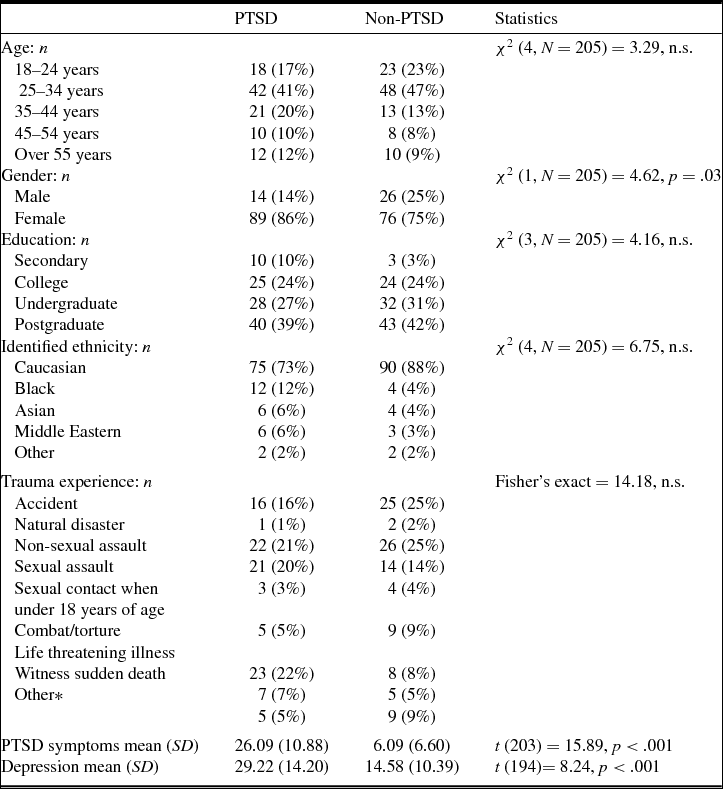
Participant characteristics are presented in Table 1. The groups did not differ significantly in terms of age, education, ethnicity and index trauma experience. However, they did differ significantly in terms of gender. When the analyses were conducted controlling for gender, a similar pattern of results emerged. As expected, the PTSD group scored significantly higher than the non-PTSD group in terms of PTSD and depression symptoms (see Table 1). Self-aspects reported by participants were idiosyncratic and varied, and thus, in line with previous self-complexity research (e.g. McConnell et al., Reference McConnell, Renaud, Dean, Green, Lamoreaus, Hall and Rydell2005), were not considered in the analyses.
Participant characteristics for the PTSD and non-PTSD groups

PTSD, post-traumatic stress disorder; PTCI, post-traumatic cognitions inventory. *Other = police protection, drug overdose, waking up during surgical procedure, suicide attempt. n.s., not significant.
Self-complexity
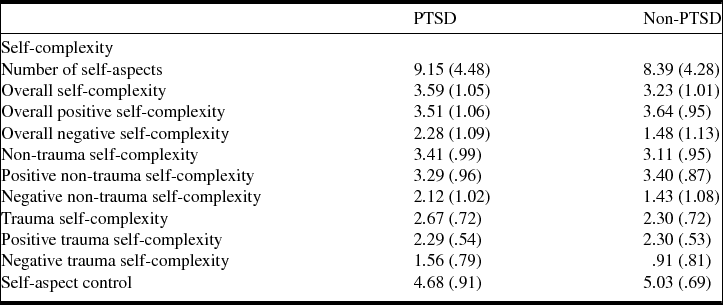
Self-complexity group means are presented in Table 2.
Self-complexity scores for participants with and without post-traumatic stress disorder

Hypothesis 1: Overall self-complexity
Contrary to hypothesis 1, the PTSD group scored significantly higher in terms of overall self-complexity, t (202) = 2.50, p = .01, d = 0.35; overall non-trauma-related self-complexity, t (202) = 2.25, p = .02, d = 0.31; and overall trauma-related self-complexity, t (202) = 3.58, p < .001, d = 0.51, than the non-PTSD group.
Hypothesis 2: Valence of self-descriptions
In order to consider valence of the self-descriptions, three separate 2 (valence; positive, negative) × 2 (group; PTSD, non-PTSD) mixed analysis of variances (ANOVAs) were used for overall, non-trauma and trauma-related self-descriptions.
In terms of overall self-complexity, the valence × group interaction was significant, F (1,202) = 28.02, p < .001, η 2 = .12. Follow-up analyses found that the PTSD group scored significantly higher than the non-PTSD group in terms of negative self-complexity, t (202) = 5.19, p < .001, d = 0.72, but did not differ significantly in terms of positive self-complexity, t (202) = .93, p = .36, d = 0.13. Paired t-tests found that for both the PTSD, t (102) = 9.82, p < .001, d = 1.44, and non-PTSD groups, t (100) = 17.29, p < .001, d = 2.07, self-complexity was significantly greater for positive than negative self-complexity.
When considering non-trauma-related self-complexity, the valence × group interaction was significant, F (1,202) = 23.73, p < .001, η 2 = .11. Follow-up analyses found that the PTSD group scored significantly higher than the non-PTSD group in terms of negative self-complexity, t (202) = 4.74, p < .001, d = 0.66, but the groups did not differ significantly for positive self-complexity, t (202) = .89, p = .37, d = 0.12. Paired t-tests found that for both the PTSD, t (102) = 9.96, p < .001, d = 1.18, and non-PTSD groups, t (100) = 16.68, p < .001, d = 2.01, self-complexity was significantly greater for positive than negative self-complexity.
When considering trauma-related self-complexity, the valence × group interaction was significant, F (1,202) = 20.72, p < .001, η 2 = .09. Follow-up analyses found that the PTSD scored significantly higher than the non-PTSD group in terms of negative self-complexity, t (202) = 9.965.88, p < .001, d = 0.81. The groups did not differ significantly in term of positive self-complexity, t (202) = .07, p = .95, d = 0.02. Paired t-tests found that for both the PTSD group, t (102) = 8.37, p < .001, d = 1.08, and non-PTSD group, t (100) = 15.33, p < .001, d = 2.03, self-complexity was significantly greater for positive than negative self-complexity.
Self-aspect control
Self-aspect control group means are presented in Table 2. The PTSD group scored significantly lower than the non-PTSD group in terms of self-aspect control, t (203) = 3.09, p < .01, d = 0.43.
Hypothesis 3: Role of self-aspect control
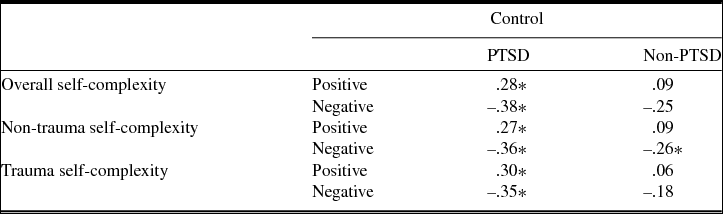
When examining the relationships between control and self-complexity, as shown in Table 3, for the PTSD group all of the correlations were significant; higher levels of control were significantly correlated with higher levels of positive self-complexity and lower levels of negative self-complexity. For the non-PTSD group the only significant correlation was between lower levels of control and greater negative non-trauma-related self-complexity.
Correlation coefficients between self-aspect control and self-complexity

PTSD, post-traumatic stress disorder. *Correlation is significant at the < 0.008 (Bonferroni corrected level), d.f. = 193.
For the PTSD group, we investigated whether self-aspect control mediated the relationship between self-complexity and PTSD symptoms. Analyses were conducted using the PROCESS (Hayes and Preacher, Reference Hayes, Preacher, Hancock and Mueller2013) add-on for SPSS. Analysis with the PROCESS macro facilitates the use of non-parametric bootstrapping. Bias-corrected 95% confidence intervals based on 10,000 bootstrapped samples are reported for the indirect effects. In this method, confidence intervals that do not include zero indicate that the mediation is significant (Preacher and Hayes, Reference Preacher and Hayes2004). The results of the mediation analyses are presented in supplemental Table 2.
First, we investigated whether self-aspect control mediated the relationship between non-trauma-related positive and negative self-complexity and PTSD. The 95% bias-corrected confidence interval around the bootstrapped mean for the indirect effect for positive self-complexity was: LL = –1.62, UL = –0.05, and for negative self-complexity was: LL = .30, UL = 2.28, suggesting that the relationship between non-trauma-related self-complexity and PTSD symptoms was mediated by self-aspect control. Second, we investigated whether self-aspect control mediated the relationship between trauma-related positive and negative self-complexity and PTSD symptoms. The 95% bias-corrected confidence interval around the bootstrapped mean for the indirect effect for positive self-complexity was: LL = –3.21, UL = –0.13, and for negative self-complexity was: LL = 0.21, UL = 2.73, suggesting that the relationship between trauma-related self-complexity and PTSD symptoms was also mediated by self-aspect control.
Discussion
The aim of this study was to investigate self-complexity in PTSD. First, contrary to our first hypothesis, it was found that the PTSD group had significantly greater overall self-complexity than those without PTSD. Our hypothesis was based on initial theorizing on self-complexity, namely, that greater self-complexity is associated with better psychological adjustment (Linville, Reference Linville1985, Reference Linville1987). However, our findings are consistent with accumulating research demonstrating that greater self-complexity is associated with poorer psychological outcomes (e.g. McConnell et al., Reference McConnell, Strain, Brown and Rydell2009; McConnell and Strain, Reference McConnell, Strain, Sedikides and Spencer2007; Rafaeli-Mor and Steinberg, Reference Rafaeli-Mor and Steinberg2002). Second, the PTSD group had significantly greater negative self-complexity (both trauma-related and non-trauma-related) than the non-PTSD group. However, the two groups did not differ significantly in terms of positive self-complexity. Third, those with PTSD reported significantly lower levels of control over aspects of self than those without PTSD. For those with PTSD higher levels of self-aspect control was significantly correlated with higher levels of positive self-complexity and lower levels of negative self-complexity. For those without PTSD, the only significant correlation was between higher levels of self-aspect control and lower levels of negative non-trauma-related self-complexity. Finally, for those with PTSD, self-aspect control was found to mediate the relationship between self-complexity and PTSD symptoms.
In line with previous research, our findings provide no support for self-complexity as a stress buffer (McConnell and Strain, Reference McConnell, Strain, Sedikides and Spencer2007; Rafaeli-Mor and Steinberg, Reference Rafaeli-Mor and Steinberg2002). Rather, those with PTSD had greater self-complexity than those without PTSD. Thus, in the instance of PTSD, self-complexity may be associated with its own psychological costs. High levels of self-complexity in those with PTSD may be associated with difficulties enacting multiple self-aspects (Ryan et al., Reference Ryan, LaGuardia and Rawsthorne2005) and being less equipped to deal with stressful happenings (McConnell and Strain, Reference McConnell, Strain, Sedikides and Spencer2007). Additionally, those with PTSD, irrespective of the self-descriptions being trauma or non-trauma related, constructed a self-representation which contained multiple independent negative self-descriptions to a greater extent than those without PTSD. However, those with and without PTSD did not differ significantly when considering the construction of a self-representation that contained multiple independent positive self-descriptions. These findings in part support the findings of Morgan and Janoff-Bulman (Reference Morgan and Janoff-Bulman1994). Specifically, greater negative self-complexity was found in those with PTSD than those without PTSD. However, the protective mechanism of positive self-complexity in relation to PTSD was not found. It is worth considering the notion that negative self-complexity may reflect a measure of greater negative content in one's self-concept, as opposed to the organization of the individual's self-concept being especially complex or negatively structured. Therefore, these findings may reflect those with PTSD revealing negative self-concept content rather than negative self-concept structure and representation. However, when we included number of negative self-descriptions used as a covariate, those with PTSD still had significantly greater negative self-complexity than those without PTSD.
The Self Memory System (Conway, Reference Conway2005) suggests that trauma memories are encoded in strong association with the goals of the working self (i.e. a collection of self-images and personal goals which function to guide and regulate current cognition, emotion and behaviour; see Conway, Reference Conway2005) activated during a trauma. Consequently, when one goal is reactivated, associated goals and the associated trauma memory may too be triggered, leading to PTSD symptoms. For example, if an individual had an accident whilst driving, their beliefs about themselves as a driver (e.g. competent, capable) may become inadvertently associated with the trauma memory. Post-trauma when the self-aspects associated with driving are activated the trauma memory is potentially triggered, resulting in associated PTSD symptoms. The self-complexity theory also draws on associative networks. It is likely that self-descriptions are in part associated with one another through goals of the self-system. Thus, those who represent themselves as many differentiated negative aspects may find that if those individual aspects are connected to the same goal, the activation of one aspect potentially triggers all negative self-descriptions. Furthermore, our findings support the notion that for PTSD sufferers trauma may activate negative pre-existing identities and block access to positive identities (Brewin, Reference Brewin2011).
Those with PTSD perceived less control over their self-aspects than those without PTSD. Previous research indicates that perceived lack of control in relation to the trauma and its sequelae is characteristic of PTSD and a plays a role in the maintenance of PTSD (Ehlers and Clark, Reference Ehlers and Clark2000). Specifically, such cognitions evoke negative emotions and encourage individuals to engage in dysfunctional coping mechanisms, which in turn enhance the symptoms of PTSD (Ehlers and Clark, Reference Ehlers and Clark2000). Our findings highlight that this lack of control in PTSD extends to the self-concept. For those with PTSD, participants who felt like they had more control over the different aspects of themselves, experienced lower levels of negative self-complexity and higher levels of positive self-complexity. This finding extends the findings of McConnell et al. (Reference McConnell, Renaud, Dean, Green, Lamoreaus, Hall and Rydell2005) to the realm of PTSD. These findings can be theoretically explained by suggesting that the extreme stress one experiences during a trauma may lead to feelings of loss of control (Ehlers et al., Reference Ehlers, Maercker and Boos2000), which extends to the self and is related to how trauma survivors negatively perceive themselves after a trauma. Moreover, self-aspect control was found to mediate the relationship between self-complexity and PTSD symptoms for trauma survivors with PTSD. This suggests that the influence of self-complexity on PTSD symptoms operates through reductions in perceived self-aspect control. These findings support research that suggests that PTSD arises from events which are out of one's perceived control and attempts made by individuals to exert control over traumatic situations have been found to be protective against the development of PTSD (Ehlers et al., Reference Ehlers, Clark, Dunmore, Jaycox, Meadows and Foa1998). Brewin (Reference Brewin2011) suggests that PTSD symptoms can be reduced by consciously reasserting perceived control. Our results also seem supportive of this suggestion and indicate that reasserting control over the self may be fundamental for the reduction of PTSD. For example, if a trauma survivor percives that there are several aspects to their self-concept (e.g. mother, teacher, friend, writer) but that they have very little control over these aspects, such perceptions may perpetuate a loss of control and autonomy and pose an ongoing threat to the self, in turn maintaining PTSD symptoms (Ehlers and Clark, Reference Ehlers and Clark2000). Thus, increasing control in relation to certain self-aspects may result in improved self- appraisals and improved sense of control, and consequently, a reduction in PTSD symptoms.
Clinical interventions that reduce negative self-perceptions and increase one's sense of control over the self may be of benefit in the treatment of PTSD. PTSD guidelines (e.g. NICE, 2005) consider the impact of the trauma on the self and suggest that treatment targets survivor's control over the trauma memory and symptoms. PTSD treatment targets post-trauma structural changes to self-concept and negative self-related appraisals (Brewin, Reference Brewin2011; Ehlers and Clark, Reference Ehlers and Clark2000). These findings highlight the importance of PTSD treatments also targeting negative self-complexity. The self-complexity task may be an effective tool to explore the impact of the trauma on the self in PTSD treatment. For instance, during cognitive restructuring, the self-complexity task may be useful in generating common negative trauma-related self-cognitions (e.g. ‘I am useless’ or ‘I am a victim’). It may also assist clinicians in assessing the influence of trauma on perceived knowledge about certain self-aspects (e.g. roles, relationships), the positive and negative affect associated with each self-aspect, and degree of relatedness amongst self-descriptions. It could also be used as a tool to explore perceived pre-trauma self-organization, current self-organization and ideal future self-organization and in helping a client establish greater control over their self-concept.
There are several limitations worth noting. First, a cross-sectional design was selected. Therefore, we are unable to make causal inferences regarding self-complexity and PTSD (Showers et al., Reference Showers, Zeigler-Hill and Limke2006). Consequently, it remains unknown as to whether pre-existing group differences existed in self-complexity resulting in an increased predisposition to developing PTSD or self-complexity changed as a result of experiencing trauma and/or experiencing PTSD symptoms (i.e. the sequelae of the trauma, and particularly the experience of having PTSD, may have an impact on an individual's sense of self and perceived control). Second, although the PDS has good convergent validity with the Structured Clinical Interview, future research should use a structured clinical interview to derive formal diagnoses as the PDS only provides a preliminary determination of PTSD diagnostic status (Foa et al., Reference Foa, Cashman, Jaycox and Perry1997). Third, the standard self-complexity algorithm (i.e. H-statistic) has been found to do a reasonable job of measuring self-complexity (McConnell and Strain, Reference McConnell, Strain, Sedikides and Spencer2007). However, it needs to be acknowledged that some concerns have been raised regarding this algorithm (e.g. Rafaeli-Mor et al., Reference Rafaeli-Mor, Gotlib and Revelle1999). We selected this measure of self-complexity because it was used in McConnell and colleague's (Reference McConnell, Strain, Brown and Rydell2009) study investigating the role of control in self-complexity and Morgan and Janoff-Bulman's (Reference Morgan and Janoff-Bulman1994) study of self-complexity and trauma-related distress. Given that the primary aim of the current study was to apply McConnell's approach to the area of PTSD, we selected the same approach used by these researchers. Additionally, while the self-aspects used in the current study were the same as those used in previous research (e.g. Showers, Reference Showers1992), our sample used a range of self-aspects (e.g. some participants used more trait descriptors, whilst other participants selected self-aspects that were relational) (see supplemental Table 1). It was beyond the scope of this study to examine how the type of self-aspect influenced findings. Future research would benefit from investigating whether self-aspect type plays a role in post-traumatic psychological adjustment. Fourth, research highlights the influence of culture on self-concept (e.g. social roles, communal and private aspects of self) and potential implications of these differences in PTSD (see Jobson, Reference Jobson2009). Whilst the sample was culturally diverse, we could not investigate cultural differences in self-complexity in PTSD. This would be interesting to examine in future research. Finally, the study used a heterogeneous sample of trauma survivors. Trauma type may have influenced findings as different trauma experiences (e.g. interpersonal, prolonged versus single episode) may have different influences on the self. However, when the analyses we conducted included trauma type (i.e. using the breakdown of the specific trauma categories, prolonged versus single episode, interpersonal versus non-interpersonal) as a covariate, the same pattern of results emerged. Despite these limitations, this study found that those with PTSD had significantly higher levels of negative self-complexity than those without PTSD. For those with PTSD, lack of self-aspect control was significantly associated with greater negative self-complexity and lower positive self-complexity. Finally, for those with PTSD perceived self-aspect control mediated the relationship between self-complexity and PTSD symptoms. Future research should strive to explore the potential clinical implications of how issues related to self-complexity and self-aspect control can be utilized in the treatment of PTSD.
Supplementary material
To view supplementary material for this article, please visit https://doi.org/10.1017/S1352465817000431
Acknowledgements
Financial support: This research received no specific grant from any funding agency, commercial or not-for-profit sectors.
Conflicts of interest: The authors have no conflicts of interest with respect to this publication.




Comments
No Comments have been published for this article.