Today, political observers take for granted the idea that Democratic partisanship, economic liberalism, and racial liberalism cohere under a common programmatic banner, just as Republican partisanship is associated with economic conservatism and greater resistance to government programs to redress problems of racial inequality. But the emergence of these linkages is a relatively recent phenomenon. Prior to the 1930s, Republican elites provided greater (if often only tepid) support for civil rights than their Democratic counterparts. By the mid-1960s, however, New Deal liberalism was clearly identified with racial liberalism and Republican conservatism had become identified with greater opposition to governmental action to redress racial inequalities.Footnote 1
What role did the mass public play in this critical transformation? It is well-established that African Americans' movement into the Democratic Party in the mid-1930s provided an incentive for some northern Democratic politicians to support civil rights.Footnote 2 This incentive became more salient in the 1940s as wartime migration greatly increased the African American population in several northern swing states.Footnote 3
Nonetheless, until recently, prevailing accounts have generally treated the civil rights realignment as a case of elite-driven choice at a “critical juncture.” In an influential study, Edward Carmines and James Stimson argue that the two parties took similar positions straddling civil rights in the 1940s and 1950s, with Republicans if anything a bit to the left of their Democratic counterparts.Footnote 4 The critical juncture transforming this alignment occurred in 1963–64, as Lyndon Johnson and Barry Goldwater took sharply different stands on the Civil Rights Act of 1964. Once national party leaders made this dramatic break, party activists soon followed their lead, polarizing on civil rights policy, and the mass public gradually followed along. This reshuffling of party coalitions launched the post-New Deal party system in which Democrats were identified as the party associated with African Americans and civil rights, while Republicans were identified with racial conservatism. Lyndon Johnson's often-quoted—though perhaps apocryphal—observation as he signed the Civil Rights Act that “we have lost the South for a generation,” nicely set the stage for the view that elite choice at a critical moment drove the racial realignment. Given its importance, the civil rights case is often taken as a leading example for the idea that public opinion generally follows cues from national party elites, with mass partisans polarizing on issues when these elites provide clear, distinct cues.Footnote 5
I argue that national politicians did not have nearly so much discretion as they wrestled with civil rights. The parties had already been remade beneath them. Below the surface a series of developments dating back to the 1930s and 1940s had transformed both parties so that the intra-party pressures in favor of an embrace of racial liberalism were much stronger on the Democratic side while Republicans had stronger incentives to position themselves to the Democrats' right on civil rights. This paper takes up one major aspect of this party transformation: among northern whites, both Democratic partisanship and economic liberalism were linked to support for the major civil rights initiatives on the agenda by the late 1930s and early 1940s. In the south, though partisanship was unrelated to civil rights support, economic conservatives were more strongly anti-civil rights than were economic liberals. These mass-level connections had important implications for politicians: for Republicans to make civil rights their issue, they would have had to overcome the deep skepticism of their own economically conservative core partisans. For northern Democrats to skirt the issue, they would have had to ignore the views of their own core partisans—economic liberals and the growing number of African American Democrats.
This argument builds upon a growing body of work challenging the elite-driven view of the civil rights realignment. Anthony Chen and others have shown that northern office-holders and state parties began to polarize on civil rights in the mid-1940s, with Democrats adopting the more liberal position.Footnote 6 For example, northern Democratic members of Congress surpassed northern Republicans in their support for discharge petitions aimed at forcing civil rights measures to the House floor in the mid-1940s.Footnote 7 Northern Democratic state party platforms also became more pro-civil rights than their GOP counterparts in the mid-1940s.Footnote 8
An important question raised by this work is whether the shifts in Congress and in state parties corresponded to changes in mass opinion. At the mass level, did New Deal liberalism become associated with racial liberalism in the 1930s-40s or did economic liberalism only become joined with racial liberalism much later, after the rise of the civil rights movement and the crystallization of elite positions? Were Republican elites ignoring—or responding to—their constituents as they positioned themselves to the right of northern Democrats in the 1940s? By systematically examining the earliest available opinion surveys, it becomes clear that New Deal liberalism had become tied to civil rights support at the mass level early on, shortly before Democratic state parties and members of Congress surpassed Republicans in their civil rights support and long before national party elites took a decisive stand.Footnote 9
The patterns of mass opinion described here are not interpreted as the cause of the realignment. But they meant that the wind would be at the back of pro-civil rights liberal Democrats—such as Hubert Humphrey (D-MN) and Paul Douglas (D-IL), both elected to the Senate in 1948—who supported civil rights. Similarly, rank-and-file Republican voters' greater skepticism towards government policies promoting civil rights provided a permissive backdrop for entrepreneurial conservative politicians as they sought to build a coalition with southern whites. These results suggest that, at least when it comes to the important civil rights case, understanding party realignment requires moving well beyond elite cues and considering both the mass and meso-levels of the parties and the linkages across those levels.
Indeed, translating the permissive mass opinion context into an actual change in national party alignments required the confluence of two forces. First, state party activists and rank-and-file members of Congress, each standing on electoral bases independent of the national party, redefined the parties' stances towards civil rights in many states and localities. Second, the African American-led civil rights movement raised the salience of the civil rights issue, forcing national politicians to choose sides rather than simply to straddle the issue.Footnote 10 These two developments reinforced one another: civil rights activists pushed Democratic politicians to put legislation onto the agenda at the state and national levels; these legislative efforts then further raised the salience of the issue and helped sharpen the divisions between pro- and anti-civil rights forces. I do not argue that northern Democrats were, on the whole, intense in their support for civil rights in the late 1930s and 1940s. But they were to the left of their GOP counterparts, with economically-liberal Democrats particularly likely to support civil rights policies. The rise of the African-American-led civil rights movement was a necessary precondition for this nascent Democratic liberalism on civil rights to become a potent political factor—but the early mass alignments make it clear that the Democratic Party was the more likely “home” for civil rights once activists forced the issue to the top of the agenda.
To assess the development of public opinion towards civil rights, this paper draws upon the earliest available mass survey data. Starting in the mid-1930s, polling companies surveyed the public on a monthly basis. Questions on civil rights are spotty in these early polls, but there are useful items assessing civil rights policy attitudes that go back to 1937.
While opinion polls conducted in the 1930s and 1940s have numerous problems that have limited their use by scholars, the National Science Foundation has funded an extensive effort led by Adam Berinsky and Eric Schickler to make the data suitable for analysis.Footnote 11 The Berinsky-Schickler team recoded the datasets and put together a series of post-stratification weights that partially address the problems introduced by the quota-sampling techniques used in the 1930s–40s.Footnote 12 The recodes and weights have been made publicly available through the Roper Center at the University of Connecticut. This paper makes use of the early survey data, along with additional civil rights-related questions on surveys through the 1960s.Footnote 13
In measuring racial liberalism, I draw upon a wide range of questions, including items on anti-lynching legislation, banning the poll tax, military integration, and combating job discrimination. The earliest surveys generally do not include party identification; as a result, I classify partisans using a dummy variable for Democratic vote choice in the last presidential election.Footnote 14 In coding economic liberalism, I identify all questions that asked about the government's role in the economy (e.g. business regulation, government ownership of industry, government spending on relief and other social programs, and labor policy).Footnote 15 Respondents are coded as economically liberal if they provide the liberal response more often than the conservative response to the set of economic policy items in the survey. To facilitate comparisons with the partisanship measure, the economic liberalism measure also ranges from 0 to 1, with conservatives scored 0, moderates scored .5, and liberals scored 1. The results for economic liberalism need to be interpreted with some caution, as the specific items used to construct the measure change across the surveys; therefore, one cannot assume that the variable taps the exact same concept in the same way across each data point. However, close inspection suggests that there is little reason to believe that there is an overall trend in the measure's quality; as a result, the consistency of the results over time is likely a meaningful indicator of a significant and relatively stable relationship.
I focus here on white respondents in order to separate out the impact of the changing racial composition of the Democratic Party. While northern African Americans clearly played a crucial role in changing the party's stance towards civil rights, it is important to determine whether there is also change among white partisans. The implications for our understanding of New Deal liberalism would be different if all of the mass-level change was attributable to Democratic gains among African Americans.Footnote 16
The discussion is organized as follows. In section 1, I show that among northern whites, both Democratic partisanship and economic liberalism were associated with support for the major civil rights initiatives on the agenda in the late 1930s and 1940s. These results suggest that once the African-American-led civil rights movement mobilized sufficiently to force civil rights to the top of the agenda, northern Democratic voters were the most likely to be responsive. Although partisanship was uncorrelated with civil rights views among southern whites, economic conservatism was related to more conservative civil rights views. This connection between economic and racial conservatism in the south provided fertile ground for the GOP's eventual “southern strategy.” Section 2 addresses an important limitation of the civil rights—partisanship alignment: the tie between civil rights liberalism and Democratic partisanship in the north is less clear when it comes to racial prejudice and social segregation than when it comes to lynching, the poll tax, fair employment, and to the more general idea of government action to counter discrimination against African Americans and other minorities.Footnote 17 Northern Democrats' views in the 1930s–50s—more supportive than Republicans' when it comes to many civil rights policies, but not when it comes to policies that encourage more intimate social mixing—presage the ambivalence that northern Democrats would exhibit towards busing and related measures in the 1970s and beyond. Rather than viewing these later troubles as a backlash against new civil rights demands, they reflected enduring tensions in the Democratic Party with respect to elements of the civil rights agenda.
Section 3 considers the sources of the linkages between New Deal economic liberalism and racial liberalism. I argue that cues from national party elites do not account for the patterns in the survey data. While the surveys' limitations require considerable caution in making a positive causal argument, I draw upon qualitative evidence suggesting that the ideological meaning of New Deal liberalism sharpened in the late 1930s due to changes in the groups identified with Franklin Roosevelt's program and due to the controversies embroiling New Dealers in 1937–38. Following the 1936 election, it was widely observed that Roosevelt's coalition now included CIO unions, African Americans, Jews, and the “left” more generally. Each of these groups backed civil rights and their newly prominent place in the New Deal coalition may have sent the message that the New Deal brand now included support for bold social and political change, including civil rights. At the same time, the series of controversies and set-backs that the Roosevelt administration faced in 1937–38—including the wave of CIO sit-down strikes, court-packing, a devastating recession, and FDR's attempted party purge—further sharpened the political battle lines and fed efforts to associate the New Deal with “radicalism.”Footnote 18 As New Deal liberalism took on a more explicitly ideological cast, I suggest that it continued to attract those who were receptive to the prospect of social and political transformation (including civil rights), while it repelled those who instead feared the potential for upheaval.
I conclude by arguing that these findings have important implications for our understanding of the New Deal coalition and New Deal liberalism more generally. In contrast to the common view that the New Deal coalition represented a stable equilibrium rooted in a north-south bargain to ignore the race question in order to facilitate building the welfare state, I suggest that the coalitional alignment and ideological linkages forged in the 1930s meant that the Democratic Party was at war with itself from the late 1930s onwards. Even as top party leaders sought to tamp down on civil rights issues, important actors within the party worked to heighten their salience, seeking to vanquish their southern opponents and thus to fulfill their vision of the true meaning of New Deal liberalism. In doing so, northern members of Congress and state party officials reflected the views of core groups in the northern Democratic coalition and the greater support for civil rights among economically liberal northern Democratic voters.
I. Partisanship, Economic Liberalism and the Early Civil Rights Policy Agenda
Civil rights advocates focused most of their legislative efforts in the 1930s and 1940s on four issues: federal action to protect African Americans from the continued threat of lynching in the south; a ban on the poll tax, which disfranchised African Americans and poor whites across much of the south; efforts to fight discrimination in the military; and enactment of fair employment practices legislation (FEPC) to prevent racial discrimination in hiring. The major survey houses—especially Gallup—asked about each of these topics as they became prominent on the political agenda.
For each survey item, I compare the level of support for the pro-civil rights position among northern white Democrats to that of northern white Republicans. In addition, for both southern and northern respondents, I compare the level of civil rights support among economically liberal and economically conservative respondents. The online appendix tables present the full question wording, marginal totals for each question, and responses broken down by party and region for each item.
In addition to cross-tabulations, I estimate the same bivariate regression model separately for each civil rights item in each survey, with support for the pro-civil rights position (scored from 0 to 1) as the dependent variable and either partisanship (scored 1 for Democratic voters and 0 for Republicans) or economic liberalism (scaled from 0 to 1, with moderates scored .5) as the independent variable. To facilitate presentation of the results across so many different indicators, I rely mainly upon time series plots of the coefficient estimates and 95% confidence intervals from this simple model.Footnote 19 This strategy makes it easier to assess whether the magnitude of the relationships changes over time.Footnote 20 Adding a series of demographic controls to the baseline model does not change the results, indicating that the relationships are not a simple product of the changing demographic composition of the parties.Footnote 21
The findings are remarkably robust across the four issues: from early on, northern white Democrats are more supportive of the pro-civil rights position on each issue. Similarly, economic liberals in both the north and the south are more likely to take the pro-civil rights position.Footnote 22 While the size of the association varies across indicators, there is little evidence of a trend in the magnitude over time. Indeed, such watershed events as President Harry Truman's endorsement of a broad civil rights program in 1948 leave little evident trace in the relationship between partisanship and civil rights views at the mass level. As discussed in greater detail below, these results suggest that cues from national party elites did not drive patterns in mass opinion on civil rights.
Anti-Lynching Legislation
The NAACP made anti-lynching legislation its top priority in the 1920s and 1930s, believing that the gross injustices involved would make possible a momentum-building victory in Congress.Footnote 23 As a result of the NAACP's efforts, legislation requiring the national government to step in when local authorities failed to act against a lynching became the main item on the congressional civil rights agenda in the 1930s. Congress wrestled with anti-lynching bills several times, with legislation passing the House in 1922, 1937, and 1940, but in each case the NAACP's hopes were dashed by Senate filibusters.
The first poll with a civil rights attitude item was conducted in January 1937, as Congress considered the anti-lynching bill. Gallup asked about this legislation on six surveys from 1937–40; an additional six Gallup surveys in 1947–50 asked more generally about whether the federal government should have the right to “step in and deal with the crime” when a lynching takes place, or whether this should “be left entirely to the state and local governments.” The earliest surveys—conducted from January through November 1937—showed roughly a 60%-25% majority in favor of the lynching bill. However, when the question wording was changed in December 1937 and January 1940 to include specific information about the punishment for counties that countenance a lynching, the respondents leaned only slightly in favor of the legislation (44%-40% in 1937 and 49%-42% in 1940). The 1947–50 items on the federal government's role also generally revealed a closely divided national public (see online Appendix Table 1 for details).
The surveys conducted in January to November 1937 show little or no relationship between Democratic vote choice and support for the lynching bill among northern whites. Starting in December 1937, however, there is a clear relationship: northern white Democratic voters were about 10 points more supportive than their Republican counterparts. Northern Democrats backed the lynching bill by a 50%-33% margin in the December 1937 survey, while northern Republican voters were split, 43%-43%. Three years later, Democratic voters favored the bill 52%-39%, while Republicans opposed it by a 50%-42% margin.
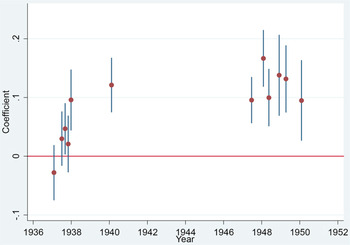
Figure 1a presents the results of separate bivariate OLS models run for each survey, with vote choice in the last presidential election used to predict support for federal action against lynching. The results suggest that the party gap opened up in December 1937 and remained about the same over the next thirteen years. The point estimates indicate that a change from Republican to Democratic vote choice is associated with a 12 percentage point shift in support for action against lynching. While Harry Truman was the first Democratic President to embrace racial liberalism explicitly—particularly in his 1948 campaign—the inter-party gap appears about the same before and after this transition.
Relationship between Democratic Vote Choice and Support for Federal Intervention Against Lynching, 1937–1950. Northern whites
Dependent and independent variables are scored 0,1; point estimate and 95% confidence interval presented for each survey.

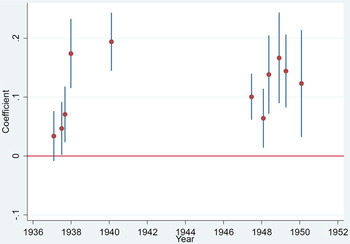
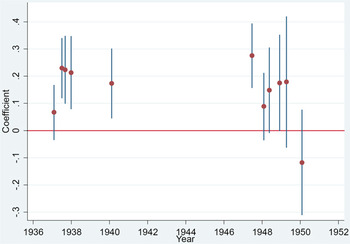
Figures 1b and 1c present the results when economic liberalism is used to predict views on lynching among northern and southern whites respectively. In both regions, there is a consistent positive association between economic liberalism and support for action against lynching by late 1937.Footnote 24 While the magnitude of the point estimates varies across surveys, a shift from economic conservatism to liberalism is typically associated with a 10 to 20 percentage point shift in lynching views in both the north and the south. It is important to emphasize that economic items that seem unlikely to have even remote racial implications—e.g. government ownership of the railroads—are as closely tied to views on lynching as are items on issues that potentially have racial implications (e.g. government help for the unemployed).Footnote 25
Relationship between Economic Liberalism and Support for Federal Intervention Against Lynching, 1937–1950. Northern whites
Dependent variable is scored 0,1; independent variable ranges from 0 to 1.

Relationship between Economic Liberalism and Support for Federal Intervention Against Lynching, 1937–1950. Southern whites
Dependent variable is scored 0,1; independent variable ranges from 0 to 1.

One question these results raise is whether economic liberalism or partisanship is more relevant to racial attitudes in the north. The evidence suggests both matter. When I estimate a model predicting northern whites' support for the lynching bill—pooling the data for all of the post-December 1937 surveys and including a separate intercept for each survey—both economic views and partisanship have a significant impact. The point estimate for presidential vote is .09 (SE = .01) in the model accounting for economic liberalism (as compared to .12 without controlling for economic views), while the point estimate for economic views is .11 (SE = .01).
An alternative approach is to classify individuals based on both their vote choice and ideology. This allows a closer examination of potential interactions between these traits. Paul Sniderman and Edward Stiglitz highlight the concept of “sorted partisans”—individuals for whom ideology and partisanship are in alignment—arguing that such individuals will behave in distinctive ways as compared to partisans with views that are out of synch with their party.Footnote 26 Indeed, the gap between economically liberal Democrats and economically conservative Republicans is especially large. In the December 1937 Gallup survey, economically liberal Roosevelt voters favored the lynching bill by a lopsided 60%-28% margin, while economically conservative Alf Landon voters opposed it, 53%-33%.Footnote 27 Across all of the post-December 1937 surveys, the gap between economically liberal Democratic voters and economically conservative Republicans averages 20–25 points.Footnote 28 This compares favorably to the substantive magnitude of the estimates when demographics are used to predict support for action against lynching. For example, college educated respondents are only 4 points more supportive than are those with only a grade school education, while urban residents are 10 points more supportive.Footnote 29
In sum, support for federal action against lynching was higher among northern Democratic voters and economic liberals starting in late 1937. As of 1937, however, northern Democrats in the House of Representatives were less clear in their support for lynching legislation than were northern Republicans: they were less likely to sign the discharge petition promoting the legislation and they were more likely to support a watered-down alternative to the NAACP's favored version of the bill.Footnote 30 However, by the mid-1940s, northern House Democrats had surpassed the Republicans in their willingness to support action against lynching.Footnote 31 While mass-based pressures may not explain this shift, the opinion data suggest that northern representatives came to act in ways that were consistent with their constituents' relative levels of support for federal action against lynching.
The Poll Tax
The poll tax became a prominent issue by 1940 as civil rights advocates focused more attention on barriers to African American voting in the South.Footnote 32 Liberal activists also backed the effort because they believed that the poll tax contributed to the disproportionate power of southern conservatives by disfranchising both African Americans and poor whites. The failure of Roosevelt's purge against southern conservative members of Congress in 1938 made reforms of southern election laws more urgent, with legislation to ban the poll tax repeatedly introduced in Congress starting in 1939.
Gallup asked a national sample about banning the poll tax on six occasions from December 1940 through February 1953. Respondents in several southern states were asked about eliminating the poll tax “in this state” on two additional occasions in 1941. A substantial majority of the national population favored banning the poll tax throughout this period: the smallest margin was 63%-26% in 1940; the most lopsided was 72%-21% in 1953 (see online Appendix Table 2). From the start in 1940, northern white Democratic voters were more supportive of banning the poll tax than were northern white Republicans.
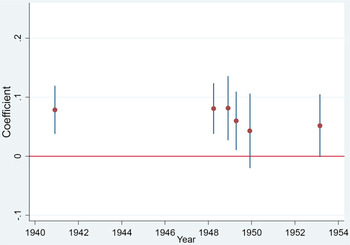
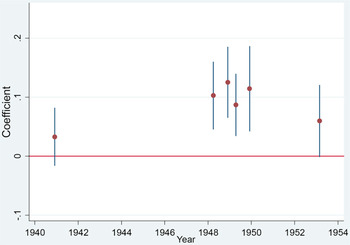
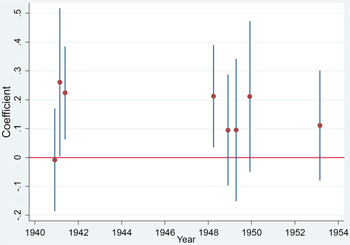
A bivariate OLS model predicting support for the poll tax ban among northern whites, estimated separately for each survey, suggests that Democratic vote choice is associated with support for the ban across each survey from 1940 to 1953, with little variation in the size of the association (see Figure 2a). The point estimates are generally a bit smaller than in the lynching case. With such a lopsided margin in favor of banning the poll tax, the item fails to separate weak from strong civil rights supporters. Indeed, even southern whites leaned in favor of the poll tax ban, though less decisively than did northerners (see online Appendix Table 2). The results for economic liberalism are somewhat more variable—perhaps due to the varying quality of the liberalism measures—but nonetheless suggest that there was a significant association between economic liberalism and support for an end to the poll tax among whites in both the north and the south (see Figures 2b and 2c).
Relationship between Democratic Vote Choice and Support for Poll Tax Ban, 1940–1953. Northern whites
Dependent and independent variables are scored 0,1.

Relationship between Economic Liberalism and Support for Poll Tax Ban, 1940–53. Northern whites
Dependent variable is scored 0,1; independent variable ranges from 0 to 1.
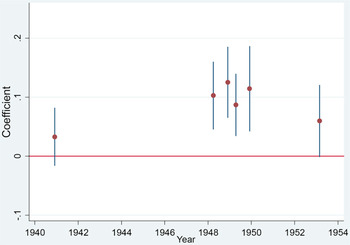
Relationship between Economic Liberalism and Support for Poll Tax Ban, 1940–53. Southern whites
Dependent variable is scored 0,1; independent variable ranges from 0 to 1.

As with the lynching items, views on civil rights continue to be associated with partisanship and economic views when both variables are included in the same model. When I estimate a pooled model predicting northern whites' support for the poll tax ban—with a separate intercept for each survey—both economic views and partisanship have a significant impact, though the size of association is smaller than for the lynching items.Footnote 33
When one examines interactions between partisanship and economic views, “sorted partisans” are also once again particularly far apart. Economically liberal Democrats are a full 12 points more in favor of the poll tax ban than are conservative Republicans (see online Appendix Figure 2). By contrast, moderate Democrats are just over 7 points more favorable than conservative Republicans, and economically conservative Democrats and liberal Republicans are both about 4 points more favorable than are economically conservative Republicans.Footnote 34
Military Integration
While lynching and the poll tax were the main items on the sparse congressional civil rights agenda in the late 1930s and early 1940s, discrimination in the U.S. military became more salient with the onset of World War II. The NAACP and other civil rights advocates began a drive for improved treatment of African American troops in 1940 and the issue became increasingly prominent in the 1940s.Footnote 35
A June 1942 Gallup survey asked respondents about integrating the U.S. military.Footnote 36 Northern white Roosevelt voters were just six to seven points more supportive than northern white Wendell Willkie voters: Willkie voters opposed integration by a 53%-38% margin; Roosevelt voters opposed it by 47%-45%.Footnote 37 But when one isolates economic liberals who voted for Roosevelt and compares them to economic conservatives who voted for Willkie, there is a much bigger gap, with economically-liberal Democrats backing military integration by a 56%-40% margin and conservative Republicans opposing it 58%-35%. Thus, six years before Truman's executive order desegregating the military, economically liberal northern white Democrats backed integration at the mass level, while economically conservative Republicans opposed it. It is worth emphasizing that the integration question—like the earlier poll tax and lynching questions—made no mention of the position of any Democratic or Republican elites. When Gallup asked again about military integration in May 1948—amidst Truman's civil rights initiatives—the gap between Democratic and Republican voters was about ten points—so a bit larger than in 1942, but not by much (see online Appendix Table 2).
Fair Employment Policy
Job discrimination became the single most prominent civil rights issue in the mid-1940s.Footnote 38 Following Roosevelt's reluctant creation of a Fair Employment Practices Committee during the war—due to pressure from African American civil rights leaders, most notably A. Philip Randolph—there were repeated efforts to enact FEPC legislation at the national and state level. More so than lynching, the poll tax, and military integration, fair employment practices continued to occupy a top place on the political agenda for several decades, allowing comparisons of public opinion over a long time span.
Gallup first asked about fair employment practices in 1945, one year after Republicans adopted a national platform endorsing the legislation while the Democratic platform was silent on the issue. The Gallup item focused on state laws, rather than federal legislation, which is a potential advantage since it separates out concerns about federalism. Gallup worded the question in two ways on the survey: half the respondents were asked about a state law barring discrimination by employers; the other half were instead asked about a state law requiring “employees to work alongside persons of any race or color.”Footnote 39 Respondents split evenly (44%-44%) on the ban on employer discrimination, while opposing requiring employees to work alongside people of other races by a 57%-34% margin (see online Appendix Table 3). But in both cases, FDR voters were substantially more supportive than were Dewey voters. Northern white FDR voters supported a state ban on employer discrimination by a 52%-31% margin, while Dewey voters opposed the ban, 51%-39%. Although FDR supporters were much less supportive when the wording focused on integrated workplaces, they still were significantly more likely to back the proposal than were GOP voters.Footnote 40
Economic liberalism is also strongly related to support for state fair employment practices. When one isolates economically liberal FDR voters and compares them to economically conservative Dewey voters, the gap is even bigger: economically liberal FDR voters backed a ban on employer discrimination by a 59%-26% margin, while economically conservative Dewey voters opposed it 59%-31%. Given that Dewey himself was a key advocate of New York's FEPC law—and that the legislation mentioned in the survey question focused on a state, rather than national law—it is striking that Republican voters were so much more opposed than Democratic voters at this early stage in the civil rights process.Footnote 41
Southern whites overwhelmingly opposed fair employment practices in the 1945 survey, regardless of party. Nonetheless, southern economic liberals were about 10 points more likely to back a ban on discrimination than were southern economic conservatives: 24% of the liberals backed the ban on employer discrimination, as compared to 14% of moderates and 13% of conservatives.Footnote 42 While this degree of support among southern economic liberals is far from impressive, it reinforces the more general message that economic views were related to racial attitudes, even among white southerners in the Jim Crow era. The same questions regarding state fair employment laws were asked again in July 1947, eliciting a similar pattern of responses (see online Appendix Table 3).
Gallup continued to ask about fair employment laws in the late 1940s and 1950s but with the focus now on federal rather than state legislation. The results tell the same story as the polls from the mid-1940s: there is a substantial gap between northern Democrats and Republicans in their support for government intervention against employment discrimination. The gap varies in size across surveys but without an evident trend. For example, a March 1948 Gallup survey asked how far the federal government ought to go “in requiring employers to hire people without regard to their race, religion, color, or nationality” (online Appendix Table 3, item 4). The survey was taken shortly after Truman announced his civil rights program and thus is more vulnerable to the concern that elite cues were driving the responses. But the 1948 results are much the same as in the earlier surveys: white northern Dewey voters overwhelmingly opposed the federal government requiring non-discrimination (59%-27%), while white northern Roosevelt voters narrowly backed it (41%-39%).Footnote 43 The mass-level connection between New Deal liberalism and racial liberalism had become strong even as national elites were just beginning to grapple directly with the issue.
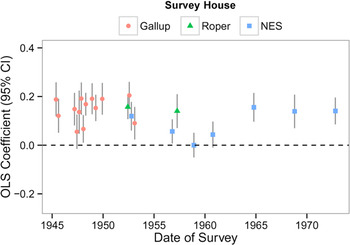
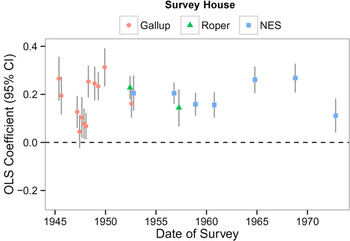
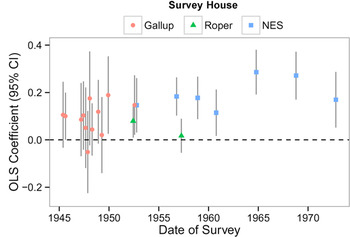
Figure 3a presents the same bivariate OLS model estimated separately for each poll with a fair employment question from 1945–72, using presidential vote choice to predict northern whites' support for action to prevent job discrimination. While the early items are entirely from Gallup, the NES and Roper began to ask about job discrimination policy in 1952. In each case, the dependent variable is recoded to range from 0 to 1 (see online Appendix 2 for detailed coding). With few exceptions, the results suggest a strong, consistent relationship between voting Democratic and support for action against job discrimination. Democratic vote choice is typically associated with a .1 to .2 increase on the 0 to 1 scale in support for policies to combat racial discrimination in employment. When economic liberalism is substituted for presidential vote choice, the results are similar in the north, with a consistent relationship evident in nearly every poll (see Figure 3b). For southern whites, economic views also appear to be tied to views on action against job discrimination; although the relationship falls short of statistical significance in several of the polls, it is positive in all but one case (see Figure 3c). On balance, the evidence thus suggests that economic conservatism and racial conservatism were connected at the mass level in the South long before Barry Goldwater entered the scene.
Relationship between Democratic Vote Choice and Support for Fair Employment Policies among Northern whites
Dependent and indep. variables range from 0 to 1.
Note: NES 1956–60 items refer to “jobs and housing.”

Relationship between Economic Liberalism and Support for Fair Employment Policies among Northern whites
Dependent and indep. variables range from 0 to 1.

Relationship between Economic Liberalism and Support for Fair Employment Policies Among Southern whites
Dependent and independent variables range from 0 to 1.

When one pools the data across multiple surveys and allows for interactions between partisanship and economic views, the results are similar to the lynching and poll tax cases. Due to the differences in the kinds of questions asked by the different survey houses, the pooled analysis focuses on the Gallup polls, which span 1945–1953. Regression models with a series of dummy variables for each partisan/ideological group indicate that economically liberal Democratic voters are .25 points more supportive of government action to combat job discrimination than are economically-conservative Republican voters on the 0 to 1 scale (see online Appendix Figure 3).Footnote 44 For each party, economic liberals are more supportive of FEPC. At the same time, for each ideology level, Democrats are more likely to back FEPC than are Republicans. These patterns hold up when controls for demographics are added.Footnote 45
The partisan and ideological gap was not confined to anti-lynching legislation, the poll tax, military integration, and fair employment practices—though these were the most discussed issues on the civil rights legislative agenda in the 1940s. At a more general level, when Roper asked in 1947 how certain “racial and religious” groups are treated in this country, 37% of northern white Democrats agreed that “strong measures” are needed to help these groups, as compared to 24% of Republicans.Footnote 46 Furthermore, 41% of economically liberal white Democrats favored strong measures, as compared to just 21% of economically conservative Republicans.
The bottom line is that starting in the late 1930s, northern Democrats and economic liberals supported the leading civil rights policies on the national agenda more than northern Republicans and economic conservatives. Long before Lyndon Johnson and Barry Goldwater asserted themselves on these issues—and even before Harry Truman's well-publicized civil rights push—New Deal liberalism and support for key civil rights policies were clearly associated with one another at the mass level.
II. Segregation, Prejudice, and the Partisan Gap on Civil Rights
Even as northern Democratic voters supported fair employment and other civil rights reforms to a greater extent than their Republican counterparts, the partisan differences did not hold across the board. In particular, two areas in which the partisan gap in the north was weaker underscore the challenges that the Democratic Party would face down the road. First, the evidence with respect to racial prejudice among whites is more mixed than is the evidence concerning civil rights policy. That is, white northern Democrats were not consistently less prejudiced than were white northern Republicans during this period, even as they were more likely to endorse government action to combat government and employer discrimination.Footnote 47 For example, a 1944 NORC survey showed that white FDR voters were eight points more likely than Republicans to say that African Americans are as intelligent as whites, but were seven points less likely to agree that “Negro blood” is the same as “white blood.” More generally, the party gap on prejudice items is smaller than for policy issues. This finding is consistent with Sniderman and Carmines' results showing only a modest correlation between racial prejudice and measures of ideology and partisanship in the 1990s.Footnote 48
Second, and perhaps not surprisingly given the low correlation between prejudice and partisanship, the partisan gap on civil rights policy in the 1940s–50s—as well as later—is smaller and less consistent when it comes to issues that involve close social contact between the races. This is evident in early surveys that ask about eating at integrated restaurants or having an African American nurse.Footnote 49 It also persists in the late 1940s when Gallup asked about integrating bus and rail travel: there is generally only a small relationship with partisanship among northern whites.Footnote 50 Similarly, evaluations of the Brown decision on school segregation show little, if any, tie to partisanship. While some items relating to social segregation do show a significant partisan gap—such as the soldier integration items in 1942 and 1948—for the most part the tie between partisanship and civil rights views is small and inconsistent on this set of issues.
This difference may also explain one wrinkle worth noting in the fair employment analysis presented above: when questions about job discrimination also refer to housing—as in the NES 1956–60 surveys, which ask about “jobs and housing” (unlike the 1952 and 1964–1972 NES)—the partisan gap in support for government action is smaller than in the other surveys (see Figure 3a). While it is possible that the relatively small partisan gap in 1956–60 is due to the muddled national party messages on civil rights in the late 1950s, the Roper item on fair employment from 1957—which asks only about jobs but not housing—generates the same substantial inter-party gap as the 1952 NES (and earlier and later surveys that also focus on jobs). As a result, it is at least plausible that “housing” signified something very different for respondents from “jobs,” generating the different results.
Interestingly, when one turns to surveys conducted in the years following the 1964 election, the difference between questions focused on job discrimination and inter-racial social contact persists. For example, in the 1972 NES, white northern Democratic identifiers are more supportive of federal action to ensure equal job opportunities for blacks than are white northern Republicans (39%-36% in favor among Democrats, as compared to 40%-32% opposed among Republicans). By contrast, Democratic and Republican identifiers are very similar in their general views on segregation (40% of Democrats favor desegregation over “strict segregation” or “something in between,” as compared to 39% of Republicans).Footnote 51
Despite the persistent similarities between northern Democrats and Republicans on issues relating to segregation in the 1940s-70s, economic liberalism was, with few exceptions, clearly tied to support for policies to promote integration. For example, while partisanship was less related to views on the NES items relating to “jobs and housing” than to items relating solely to jobs, economic liberalism had a strong relationship to both sets of items (see Figure 3b). Similarly, when the NES asked about whether the federal government should stay out of the issue of school integration in 1956–60, economic liberalism was strongly tied to respondent attitudes even as partisanship bore only a weak, inconsistent relationship.Footnote 52 The relationship between economic liberalism and support for school desegregation and other forms of integration held up in later surveys as well.
In sum, the linkage between partisanship and views on prejudice and segregation among northern whites is weaker and less consistent than is the linkage on such civil rights issues as lynching, the poll tax, and job discrimination. To the extent that battles over open housing and busing would reveal the limits of many northern Democrats' commitment to civil rights, these limitations reflected enduring features of the party-civil rights alignment rather than a result of a post-1964 backlash. At the same time, economic liberalism was tied to northern whites' views across the full range of civil rights issues throughout the time period examined here. It is not obvious why both partisanship and economic views appear to be related to support for some civil rights policies, while only ideology is strongly tied to others. But even as one recognizes northern white Democrats' ambivalence on questions of integration, northern Republicans appear to have entered the 1960s primed to be receptive to racially conservative appeals. GOP voters had long taken the more racially conservative stance across a range of civil rights issues than their northern Democratic counterparts. Thus, it should be no surprise that when Gallup began asking about the Kennedy administration's civil rights policies in 1962, Republicans were far more eager to criticize the administration from the right (“pushing too fast”) than the left (“pushing too slow”) on racial integration.Footnote 53
III. Explaining the Linkages
The great question that emerges from the evidence presented thus far is: what explains the alignment between Democratic partisanship, economic liberalism, and racial liberalism among northern whites that was already evident by the late 1930s? Unfortunately, there are many obstacles standing in the way of a definitive answer, including the absence of racial policy survey questions prior to 1937, the lack of panel data, and the limited number of potential explanatory variables that are included on a consistent basis in the early surveys. While recognizing the limitations in the data, I argue that changes in the groups identified with Roosevelt's program, combined with the series of controversies over the sit-down strikes, court-packing, and Roosevelt's attempted party purge, helped to sharpen the political battle lines. In this new context, New Deal liberalism took on a more explicitly ideological cast, one which I suggest appealed to citizens who were receptive to bold social and political change (including civil rights), while repelling those threatened by the prospect of major social and political transformations.
Although it is clear that civil rights support was tied to Democratic partisanship and economic liberalism in the late 1930s, the evidence that these connections were new is suggestive but not definitive. The Gallup surveys conducted prior to December 1937 show little indication that Democrats were more supportive of action against lynching than were Republicans; while this may be attributable to the lopsided response distribution for the question used in those surveys, the poll tax items in the 1940s had a similar lopsided distribution and yet showed Democrats to be more supportive than Republicans. The surveys from 1940 also indicate that new FDR voters were more supportive of action against lynching and the poll tax than were voters who had backed FDR in 1936. For example, in a January 1940 survey, northern whites who had not voted for FDR in 1936 but identified him as their current choice favored the lynching bill by a 70%-30% margin, as compared to the 58%-42% margin for 1936 FDR voters.Footnote 54 Similarly, the December 1940 Gallup survey showed that 1940 vote choice was more strongly related to support for the poll tax ban than was 1936 vote choice.Footnote 55 These findings suggest that the relationship between support for civil rights and vote choice tightened between 1936 and 1940 and thus that it makes sense to look to this period in seeking to understand the connection between partisanship and civil rights views.Footnote 56
At a minimum, one can reject several seemingly plausible explanations that have important theoretical implications. A fierce scholarly debate focuses on whether racial prejudice explains the contemporary linkage between civil rights policy views and partisanship.Footnote 57 However, it is unlikely that a simple prejudice story accounts for the early emergence of a linkage between partisanship and views on civil rights. The gap between northern white Democrats and Republicans in racial prejudice is small and inconsistent in these early surveys. While racial prejudice has a powerful impact on civil rights attitudes, that relationship cannot account for the association between partisanship and racial policy views evident in the 1940s.Footnote 58
Second, it is difficult to argue that cues from national party elites generated the mass-level connections discussed here. Several leading accounts of the civil rights realignment—and of the dynamics of mass opinion more generally—have emphasized how cues from top party leaders are crucial drivers of mass-level change. In their classic studies, both Carmines and Stimson and John Zaller depict top party leaders as sending signals about where their parties stand and voters recognizing these cues and adjusting their policy views—or under certain circumstances, their partisanship—accordingly.Footnote 59 The most visible national Democratic leader before 1945, Franklin Roosevelt, kept quiet on civil rights for fear of alienating southern Democrats in Congress. There were several prominent Democrats who did advocate for civil rights early on, including Eleanor Roosevelt and Robert Wagner (D-NY). The First Lady was friends with several African American leaders throughout the 1930s and increasingly was publicly identified as a civil rights advocate. However, her most visible pro-civil rights actions—such as her stand against segregation at the first convention of the Southern Conference on Human Welfare in 1938 and her resignation the following year from the Daughters of the American Revolution in response to the group's refusal to allow African American singer Marian Anderson to perform at Constitution Hall—occurred after the mass-level linkages between civil rights and partisanship first became evident. Similarly, Wagner, along with Edward Costigan (D-CO) and Joseph Gavagan (D-NY), were lead sponsors of the lynching legislation pending in Congress in the mid-to-late 1930s. However, Democratic leaders in the House and Senate provided no support for the bill and House Republicans backed the legislation more strongly than did northern Democrats in 1937. Furthermore, in the 1936–44 presidential elections, the Republican national platform said more about civil rights and advocated a more liberal position than the Democratic platform.Footnote 60 In sum, the inconsistent cues emanating from top party leaders in the late 1930s are not a likely explanation for the early linkage between civil rights policy views and partisanship in the north.
National Democrats did eventually send clear signals of their civil rights liberalism, particularly in 1948 when Truman made a major push for civil rights legislation and the party adopted a liberal civil rights plank at its national convention (though Truman's forces had sought a weaker platform plank in order to prevent a southern bolt). The elite cues perspective would thus lead us to expect a much sharper tie between partisanship and civil rights views in 1948. But the inter-party gap was about as big before 1948 as it was during and following the campaign (see Figures 1–3).Footnote 61 Indeed, on all 12 survey items asking about lynching, the poll tax, soldier integration, and fair employment practices from December 1937 to December 1947, there is a clear gap separating northern white Democrats and Republicans, with Democrats taking the more liberal position.Footnote 62 It simply does not appear that the relationship between civil rights views and partisanship (or ideology) tightened amid the 1948 campaign or in its immediate aftermath. There are well-documented instances in which party elite cues on issues precede—and encourage—mass partisan polarization.Footnote 63 But in this case mass partisan and ideological cleavages formed before clear signals from national elites.Footnote 64
Third, changes in the demographic group composition of the parties fail to account fully for the relationship between New Deal Democratic liberalism and racial policy liberalism.Footnote 65 Across the vast majority of civil rights items, controlling for a wide range of demographic variables does not eliminate—and generally barely changes—the estimated relationships among the key variables of interest.
This still leaves open the possibility that the partisan differences on civil rights are particularly sharp among certain subgroups in the electorate—and such subgroup differences could provide clues about the origins of the partisan differences. To explore this possibility, I estimated a series of models pooling data across surveys, analyzing northern whites' support for each set of policies with numerous repeated items (anti-lynching policies, the poll tax ban, and fair employment practices) as a function of Democratic presidential vote. This time, however, the models are estimated separately for a variety of demographic groups, with an intercept included for each survey.
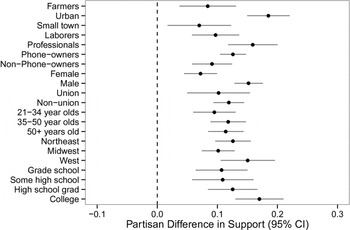
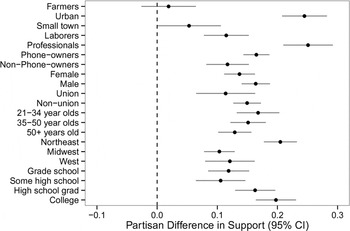
Figures 4a and 4b present the results when support for action against lynching and support for fair employment legislation are the dependent variables.Footnote 66 The results are remarkably consistent across groups: for both lynching and fair employment, Democratic presidential vote is significantly associated with the pro-civil rights position across class groups (laborers, professionals, phone-owners, non-phone owners, union members, non-union members), regions (Northeast, Midwest, West), age groups, gender categories, and education levels. The sole estimate to fall short of statistical significance is for farmers on fair employment policy. The association between Democratic voting and support for civil rights is strongest among urban residents; it is also somewhat higher for professionals and college graduates. But the relationship is still strong and statistically significant even for those with only a grade school education, suggesting that the connection between partisanship and civil rights views was by no means restricted to a narrow slice of the electorate and reached even those with lower socioeconomic status.Footnote 67
Presidential vote and views on anti-lynching bill, by demographic group

Presidential vote and FEPC, by demographic group

These results cast doubt on the idea that the partisanship-ideology-civil rights linkage emerged as a straightforward product of group-membership based politics. This is not simply a story of Democratic CIO members supporting the civil rights agenda promoted by their leaders. It also does not appear simply to be a story of educated Democrats responding to subtle cues emanating from party leaders.Footnote 68
Nonetheless, changes in the group composition of the Democratic Party in the 1930s likely promoted linkages among racial liberalism, Democratic partisanship, and economic liberalism.Footnote 69 More specifically, the incorporation of the CIO, African Americans, and other left-leaning groups, into the Democratic coalition in the mid-1930s helped reshape the popular meaning of New Deal liberalism, linking it to support for aggressive social change, including civil rights.
With the 1936 elections, CIO unions, African Americans, Jews, and urban liberals emerged as core voters in the Democratic coalition outside the South. News coverage at the time repeatedly made reference to these new Democratic constituents and how they had the potential to redefine the party.Footnote 70 These same groups were prominent civil rights supporters.Footnote 71 Thus, even as Roosevelt kept silent on civil rights, the incorporation of these groups held the potential to transform how the mass public viewed the Democratic Party and New Deal liberalism. These groups' support for civil rights and their simultaneous association with the New Deal may have sent the message to voters that the New Deal Democrat brand includes—or ought to include—civil rights. These cues need not have been limited to group members. Indeed, some voters were likely repulsed by these new groups' ties to the New Deal, while other voters viewed them more favorably. Urban voters may have been particularly aware of the changing composition of the party coalition, and thus were quicker to respond to it, with conservatives increasingly repelled by the new associations and liberals more receptive.
The CIO emerged as an especially salient group to many voters in the late 1930s, as it put forward a bold policy agenda and used assertive organizing tactics—such as the highly controversial sit-down strike—that made it a lightning rod for conservatives and a hero to many on the left.Footnote 72 Rather than just focusing on shop floor concerns or benefits for its members, the CIO, led by John L. Lewis, quickly developed a broad program that pushed for dramatic expansions of the New Deal welfare state, including national health care, expanding Social Security to cover farm and domestic workers, and civil rights protections for African Americans. In doing so, it became identified as the leading force for liberal Democratic aspirations. In addition to insider lobbying, the CIO undertook mass mobilization to support liberal candidates and oppose conservatives in both primaries and general elections. As J. David Greenstone argues, the CIO made labor unions into a major electoral organization of the Democratic Party, taking on many functions ordinarily performed by a party.Footnote 73 In a series of articles, Ira Katznelson and his collaborators demonstrate that the CIO's drive to unionize the South on an interracial basis scared southern Democrats and helped move them to oppose New Deal labor policies.Footnote 74 At the same time, the CIO helped reshape the Democratic Party in the north, creating the infrastructure for a more ideological, ambitious party agenda. Writing in 1937, Stanley High highlighted the CIO's growing organizational muscle and concluded that “for its long-time importance, the Roosevelt program stands in greater need of the kind of support that [CIO President] Mr. Lewis can rally than of the apparently more significant backing of the party's conservatives.”Footnote 75
Before the CIO entered the scene, the labor movement was by no means identified with civil rights; instead, AFL unions generally had a poor record on race (and continued to have at best a mixed record long after the CIO became a competitor). One indicator of labor's distance from civil rights in the pre-CIO era is that a 1934 petition circulated by the NAACP urging Roosevelt to support anti-lynching legislation included signatures from governors, mayors, attorneys, ministers, journalists, and college presidents, but no labor union officials were identified as signatories.Footnote 76 Just a few years later, the CIO would assume a prominent role in such pro-civil rights organizations as the Southern Conference on Human Welfare (formed in 1938), the National Committee to Abolish the Poll Tax (formed in 1942), and the National Council for a Permanent FEPC (formed in 1943). From very early on, CIO organizers and leaders understood that organizing African Americans would be crucial to the union's success. Their promises of fair treatment for African American workers were a widely noted, major transformation in the labor movement. By 1937–38, the CIO had forged a well-publicized alliance with the National Negro Congress, a leading left-wing African American group, and had begun to develop a warm relationship with the NAACP, which solidified over the next few years.Footnote 77 Within the CIO, unions with a strong African American presence were often among the most aggressive in their advocacy both for civil rights and for a bold liberal program, reinforcing the connection between civil rights and economic liberalism.Footnote 78
In late-1930s America, the CIO stood out among white-led organizations in highlighting its support for civil rights.Footnote 79 The CIO News, the official weekly distributed to CIO households across the U.S., included many articles promoting civil rights initiatives soon after it began publishing in December 1937. For example, the January 29, 1938 issue included an article headlined, “CIO Attacks Filibuster on Lynching Bill.” When the CIO-backed Labor Non-Partisan League issued a list of major bills it was monitoring in February 1938, the lynching bill was placed alongside legislation on strikers' rights, wages and hours, and farm tenants.Footnote 80 Subsequent CIO News stories promoted the poll tax ban and FEPC. More generally, the CIO News sought to link the issues of labor rights with policies against racial discrimination under the common rubric of “civil rights.” Thus, many stories referred to the right-to-strike as a “civil right,” just as other stories referred to African Americans' struggle in similar terms. In the CIO vocabulary, the enemies of African American rights and of labor rights were the same: southern “Tories,” business interests that sought to weaken labor by dividing workers on the basis of race, and even fascists from abroad. Indeed, the CIO and allied left-wing groups repeatedly pointed to Hitler and the Nazis as a threat both to labor and to racial and religious minorities, juxtaposing fascism to liberal New Deal principles.Footnote 81
Mainstream news coverage of the CIO also regularly highlighted its civil rights support. Thus, the New York Times report on the group's first constitutional convention noted that “there was considerable cheering and the delegates rose to their feet when a resolution was adopted entitled ‘Unity of Negro and White Workers’ and which pledged the C.I.O. to ‘uncompromising opposition to any form of discrimination, whether political or economic, based upon race, color, creed or nationality.’”Footnote 82 A systematic search of the New York Times reveals a big increase in the number of articles that associate the CIO and labor movement more generally with African Americans and the civil rights cause: after just 5 stories on the topic in 1936, there were 27 stories in 1937 and 29 stories the following year.Footnote 83
By summer 1937, southern Democrats had begun to take notice of the threat the CIO posed to white supremacy in their region. Eugene Cox (D-GA), a leader of the emergent conservative coalition, took to the House floor on June 30, 1937 to denounce the CIO in a long speech that tied the organization to communism and civil rights: “it is the declared intention of John Lewis, Sidney Hillman, and other Committee for Industrial Organization officials to invade the South and to organize both the white and the Negro labor … they have preached social and political equality … if minions of the Committee for Industrial Organization attempt to carry through the South their lawless plan of organization, if they attempt to demoralize our industry, to corrupt our colored citizens, to incite race hatreds and race warfare, I warn them here and now that they will be met by the flower of southern manhood and they will reap the bitter fruits of their own.”Footnote 84 Meanwhile, southern opponents of the lynching bill characterized its lead supporters as pro-CIO agitators seeking the votes of a “little group” (i.e. African Americans).Footnote 85 Southerners were not the only ones to link CIO “radicalism” to racial change: in an article highlighting the CIO's ties to communism, the Chicago Tribune noted portentously that “another activity in which the communists and C.I.O. are cooperating is organization of the Negroes.”Footnote 86
It is difficult to know how much causal weight to put on the CIO's push for civil rights in shaping whites' attitudes. The direct effects probably were limited. When one models views on lynching, the poll tax, and fair employment practices as a function of respondents' demographic characteristics, CIO membership is generally a statistically significant predictor, but the substantive size of the association is modest: CIO members are generally about .02-.08 more supportive of these initiatives (on a 0 to 1 scale) than non-members. But the CIO—along with allied groups, such as the Labor Non-Partisan League, NAACP, the American Civil Liberties Union, the Southern Conference on Human Welfare, and the Union for Democratic Action (a forerunner of the Americans for Democratic Action)—may have had an impact even on non-members by shaping the meaning of liberalism to include civil rights.
Therefore, the CIO's significance is not primarily a matter of its immediate, direct role as a cue-giver. Instead, it rests in how the inclusion of the seemingly radical CIO as a visible force in the Democratic coalition may have, over time, changed how the parties were perceived by both supporters and opponents. At the same time, African American activists in the NAACP and National Negro Congress, among other groups, worked to keep the pressure on these urban liberals to incorporate civil rights into their agenda.
A related possibility is that the meaning of New Deal liberalism became sharpened amidst the Democrats' travails of 1937–38. The fierce reaction against the sit-down strikes, court-packing, and the party purge, along with the deep recession, led some members of the broad Roosevelt coalition of 1936 to peel off from the party, thus sharpening the ideological division between FDR's supporters and opponents. The emergence of a viable conservative opposition to New Deal liberalism in 1937–38 may have generated a clearer sense among voters of what it means to be a “New Deal Democrat” and what it means to be anti-New Deal. Likewise, the prominent role of the CIO and other left-leaning groups in the Democratic coalition presumably was most likely to alienate those voters who had a more modest view of the New Deal's aspirations.
Indeed, a recurrent theme in news coverage by 1938 was the new division between ardent “100% New Dealers” and conservative southern Democrats, along with their GOP allies. Descriptions of the “New Deal” coalition often noted its dependence on the votes of CIO unions, northern African Americans, and urban ethnic groups.Footnote 87 Meanwhile, the most prominent opponents of this urban-oriented liberalism included the increasingly vocal conservative southern Democrats who explicitly linked the “100% New Dealers” to the threats posed by the CIO, communism, and racial change.Footnote 88 In that context, the meaning of New Deal liberalism in American politics increasingly became defined by a fierce ideological debate over whether reformers' goal of further extending the reach of the New Deal would lead to a more just society, or alternatively, to dangerous radicalism and disorder.Footnote 89
This sharpening of lines may have helped foster a closer alignment between New Deal economic liberalism and racial liberalism. That is, the individuals who continued to support FDR and the Democrats amidst the setbacks and controversies of 1937–38 may have also been more likely to be the type of people who support the broad activist government required to safeguard civil rights. Similarly, the types of people who drifted away from Roosevelt and the Democrats as the meaning of New Deal economic liberalism sharpened in the late 1930s may have been the same kinds of people reluctant to support broad social change, such as civil rights. In other words, as New Deal economic liberalism came to signify a strong governmental role in promoting economic opportunities for the lower classes and empowerment of such previously subordinated groups as labor unions, this programmatic vision resonated with the same kinds of people who were likely to see government activism to help racial minorities as appropriate, while alienating those threatened by social change and disorder.Footnote 90 The strength of the linkage between partisanship and civil rights views in urban areas may reflect the extent to which political debate in cities took on a particularly ideological tenor amid the activity of CIO unions and other liberal and left-wing groups.
IV. Conclusion
The finding that New Deal liberalism and support for civil rights were linked at the mass level by the late 1930s has important implications for our understanding of the New Deal coalition and New Deal liberalism. Several leading accounts by historians and political scientists have suggested that the New Deal coalition that formed in the 1930s rested upon a long-term bargain in which northern Democrats agreed to avoid addressing civil rights policy in return for southern Democrats' cooperation in building the New Deal welfare state.Footnote 91 For example, Katznelson writes that “well into the 1950s, non-southern Democrats proved willing to trade local control and segregated utilization of federal funds in order to win southern support to overcome Republican opposition to welfare state spending and services. Under the terms of this ‘deal,’ even federal veterans' hospitals in the South remained segregated … at no time [prior to the 1960s] did the liberal wing abandon its social policy alliance with the South or the conditions it imposed on African Americans.”Footnote 92 Franklin Roosevelt's refusal to push even for anti-lynching legislation, for fear of alienating southern Democrats whose votes he needed for his legislative priorities, underscores the extent to which the New Deal coalition seems to have been underwritten by an agreement to ignore civil rights demands.Footnote 93 Although some revisionist accounts have pointed to behind-the-scenes Roosevelt maneuvers to promote racial equality,Footnote 94 scholars have generally emphasized the timidity with which the New Deal addressed the problems facing African Americans.Footnote 95
The critical interpretation of Roosevelt's racial record correctly identifies the deep flaws in New Deal legislation, but misses the extent to which the party's transformation in the 1930s placed its northern and southern wings at loggerheads. The New Deal created a new political coalition and a new set of ideological linkages that contributed in crucial ways to the civil rights realignment. This coalition and the associated ideological linkages did not materialize in the 1960s as a long-delayed aftershock of the New Deal; it took shape in the late 1930s, as the terms of political debate were reshaped into a battle pitting the urban liberalism of CIO unions, 100% New Dealers, Jews, and (increasingly) African Americans against conservatives, especially southern conservatives, and their Republican allies.Footnote 96
Roosevelt and other top party leaders wanted to sidestep the civil rights issue, but by the 1940s many other actors within the party—CIO unions, rank and file members of Congress, state and local party leaders, and activists on the left—believed civil rights held the key to creating a truly liberal national party. Katznelson is right that southern Democrats acted as a veto player, limiting what these liberals could accomplish legislatively.Footnote 97 But from the start, many northern liberal Democrats did not stand idly by as the south blocked their vision for a truly liberal party. Just as southerners attacked the northern wing of the party through damaging investigations and legislation targeting unions and linking the New Deal to communism,Footnote 98 northern liberal Democrats assaulted their southern counterparts by signing discharge petitions to force civil rights bills to the House floor. By the mid-1940s, the average northern Democrat in Congress was thirty percentage points more likely to sign discharge petitions forcing civil rights bills to the floor than was the typical northern Republican.Footnote 99 At the same time, state Democratic parties in the north were putting forward more pro-civil rights platforms than their same-state GOP counterparts.Footnote 100
Rather than a “deal” resting on northern Democrats' alleged indifference about race, the New Deal coalition was at war with itself from the late 1930s through the 1960s. In prosecuting this war, anti-labor southern Democrats and pro-civil rights northerners were acting in ways that were consistent with the views of their constituents.Footnote 101 Rather than viewing the New Deal coalition as a stable equilibrium that ultimately was brought down by external events in the 1960s, important actors within the party were working to undermine the coalition starting in the late 1930s. The version of New Deal liberalism articulated by CIO unions, African Americans, and other urban liberals in the late 1930s—and incorporated into the commitments of rank-and-file northern members of Congress and state parties—was unacceptable to the southern wing of the party, and the southerners responded to this threat by seeking to weaken the same labor unions that were essential to electing northern Democrats.
In their landmark study of the civil rights realignment, Carmines and Stimson correctly emphasize the unsettled nature of civil rights politics within the national parties as of the late 1950s and early 1960s.Footnote 102 Many national Democratic elites—such as John F. Kennedy and Adlai Stevenson—sought to straddle the issue, avoiding a clear stand that would alienate their party's southern wing. At the same time, many northern Republican elites—such as Richard Nixon—also avoided taking a clear stand but were at least somewhat supportive of the civil rights cause. The national leaders of both parties saw the explosive potential of the civil rights issue—not just to realign the electorate but to empower new actors within each party. While some leaders—Hubert Humphrey and Barry Goldwater come to mind—were eager to embrace that potential, others were not. The open-endedness of the situation highlighted by Carmines and Stimson captures this essential dilemma facing national party elites.
In responding to this dilemma, however, party leaders' room to maneuver was greatly limited by a series of changes in party coalitions and ideological linkages that date back to the late 1930s. These developments included the mass-level alignment of racial liberalism with economic liberalism and Democratic partisanship among northern whites; the increased role of African Americans in the Democratic coalition in the north (and the reluctance of economically liberal African Americans to vote Republican);Footnote 103 the gradual reorientation of northern Democratic state parties in the 1940s to become more of a home for racial liberals; the efforts of northern Democratic members of Congress to force civil rights measures to the floor even as that challenged a key pillar of the national party coalition; the early alignment between economic liberalism and less strident racial conservatism in the south, and, starting in the late 1950s, the capture of revived southern state Republican organizations by activists who articulated an extreme brand of both racial and economic conservatism.Footnote 104
A multi-layered historical perspective that incorporates both institutional and mass-level dynamics thus offers a way to move beyond the debate concerning whether the civil rights realignment was the product of elite choice at a critical juncture or instead was determined by deep structural forces. National political elites—such as Kennedy, Nixon, Johnson, and Goldwater—faced genuine decisions on how to position themselves and where to try to take their parties on civil rights. The trade-offs involved meant that there was nothing automatic or predetermined about the decisions that resulted. However, national political leaders were making these decisions in a context in which economic liberalism and racial liberalism had long been linked together at the mass level and in which key groups within the Democratic coalition were pushing hard for a liberal stance on civil rights. These group and mass-level dynamics had already been working their way through the state parties and rank-and-file congressional membership when national elites were finally forced to choose sides.
Indeed, if one examines mass opinion on most leading civil rights issues, the content of state party platforms, or rank-and-file House members' support for forcing civil rights issues onto the agenda, the realignment on race had already largely taken place in the north by the end of the 1940s. But with the (partial) exception of Truman, most top national Democratic leaders sought to avoid a definitive break with the southern wing of the party. The African-American-led civil rights movement's use of direct action in the 1950s and 1960s played the decisive role in making civil rights the top issue on the national agenda and thereby forcing national elites finally to choose sides.Footnote 105 The earlier developments in mass opinion, state parties, and among rank-and-file members of Congress, however, shaped which party was likely to be more responsive once the civil rights movement forced the issue to a breaking point. The civil rights realignment therefore emerges as an example of how close attention to historical sequencing and to interactions across multiple levels can enhance our understanding of political change.Footnote 106
Beyond the implications for our understanding of the civil rights realignment and the New Deal coalition, this study suggests the potential benefits of integrating behavioral and historical analyses. There is a strong tendency for particular kinds of topics to be studied with particular methods. But there are important benefits to breaking through the de facto congruence of what we study with the methods we use to study it. The combination of historical and behavioral evidence is essential for establishing that elite cues cannot explain why racial policy attitudes and economic views became linked. The timing is simply wrong and one cannot learn this without working with both sorts of data. But more broadly, integrating historical and behavioral evidence can be critical for adequately addressing the kinds of big questions that Americanists ought to engage.Footnote 107 If we study the civil rights realignment solely through snapshots of behavioral data—e.g. simply relying upon public opinion polls—we will have no way of knowing how it connects to what is going on in Washington and other political venues or how those events might have influenced the patterns that we uncover among the mass public. We will know the relevant correlations, but not understand how those correlations fit into a broader political process. By contrast, if we focus our attention on elite maneuvering or organizational politics (e.g. the relationship between the CIO as an organization and civil rights organizations or the Democratic party leadership), we will lack any sense for whether and how these elites and organizations are responding to and interacting with their constituents—which is crucial for thinking about the nature of democratic accountability.
Understanding the civil rights realignment—how an issue that both national parties' leaders sought to avoid rose to the top of the national agenda and helped realign the parties—requires a multi-layered, temporal approach that is attentive to both mass opinion and elite maneuvering over time. Otherwise, we will focus attention on one slice of the story and miss the connections that actually drive the process. Beginning in the late 1930s, the mass-level alignment between civil rights liberalism and economic liberalism meant that northern Democratic voters were more open to civil rights reform than were Republican voters. As civil rights advocates, including the NAACP, African American voters, CIO unions, Jews, and the Americans for Democratic Action, made an increasingly aggressive push for change, this more permissive environment allowed them to win control of the Democratic Party. Partisan change began at lower levels, first at the state and local level, notably among northern Democratic House members. By the time national party leaders were eventually forced to choose sides on civil rights, their choices only consolidated a partisan realignment that had begun decades before.
Supplementary Materials
Appendix 1–2, Online Figures 1–4, and Tables 1–3