Introduction
Falls in long-term care residents with dementia represent a costly but unsolved safety issue with serious negative consequences for the quality of life. Sixty percent of the nursing home residents fall at least once a year (Fuller, Reference Fuller2000). These falls often result in injuries, a loss of independence, and early death (Kannus et al., Reference Kannus, Sievänen, Palvanen, Järvinen and Parkkari2005). Old adults with dementia have two to three times higher fall rates than old adults without cognitive impairments (Eriksson et al., Reference Eriksson, Strandberg, Gustafson and Lundin-Olsson2009b) and have lower recovery rates after an injurious fall (Allan et al., Reference Allan, Ballard, Rowan and Kenny2009). Over the past decade, fall prevention in long-term care residents with dementia has become an important topic.
Despite a recent surge in the number of fall prevention intervention studies, there is a lack of successful fall prevention programs for long-term care residents with dementia (Kosse et al., Reference Kosse, Brands, Bauer, Hortobagyi and Lamoth2013; Bunn et al., Reference Bunn2014). The development of an effective fall prevention program requires information concerning factors that induce falls (Allan et al., Reference Allan, Ballard, Rowan and Kenny2009; Kröpelin et al., Reference Kröpelin, Neyens, Halfens, Kempen and Hamers2013). Complex interactions among these factors underlie the many falls in old adults (Davison and Marrinan, Reference Davison and Marrinan2008). Factors contributing to falls in old adults include age, male sex, incontinence, psychoactive medication use, previous falls, mobility assistance, wandering and a loss of balance (Delbaere et al., Reference Delbaere2008; Fonad et al., Reference Fonad, Wahlin, Winblad, Emami and Sandmark2008; Eriksson et al., Reference Eriksson, Strandberg, Gustafson and Lundin-Olsson2009b; Whitney et al., Reference Whitney, Close, Jackson and Lord2012a; de Groot et al., Reference De Groot2013). However, long-term care residents with dementia have additional risk factors compared with those present in community-dwelling old adults (Eriksson et al., Reference Eriksson, Gustafson and Lundin-Olsson2008) and the combination of simultaneously present co-morbidities, cognitive impairments, and frailty substantially increases the fall risk (Whitney et al., Reference Whitney, Close, Lord and Jackson2012b). It is therefore a research priority to identify specific factors and their interactions to reduce fall rate among long-term care residents with dementia. If this effort is successful then the next step would be the development of personalized and effective fall prevention programs (Quigley et al., Reference Quigley, Bulat, Kurtzman, Olney, Powell-Cope and Rubenstein2010; Kröpelin et al., Reference Kröpelin, Neyens, Halfens, Kempen and Hamers2013). Therefore, the objectives of the present study were to:
-
(1) determine fall rate, fall-related injuries and circumstances of these falls in terms of time, location and whether or not a fall was witnessed by the staff, and
-
(2) examine the relationship between patient characteristics, classified into seven domains (demographics, activities of daily living (ADL) performance, mobility, cognition and behavior, vision and hearing, medical conditions and medication use), and fall rate in long-term care residents with dementia.
Methods
Participants
This study was conducted in a Dutch nursing home providing long-term residential (in-patient) care. The research population consisted of residents living on a 20-bed closed psychogeriatric ward between September 2011 and April 2013. All residents had a diagnosis of dementia and were unable to live independently. The psychogeriatric ward had seven single and seven double bedrooms, with showers and lavatories in the hallway. Most residents spent their day in a shared living room.
The Ethical Committee of the Center of Human Movement Sciences at the University Medical Center Groningen approved the research proposal. Because participants were unable to sign the informed consent, we obtained consent from the legal representative of each resident.
Data collection
The data collection was prospective and naturalistic; patient characteristics and falls were observed and recorded during a 19 months long period. Information about patient characteristics already available in the long-term care facility was analyzed with respect to fall rate. For the purpose of the present study, we performed no additional measurements.
fall characteristics
The staff recorded all witnessed and unwitnessed falls on a structured fall incident form. An event was considered as a fall when the staff saw a patient landing on the floor or a patient was found lying on the floor as a result of a fall. The fall incident form allowed the staff to record the precise time and location of a fall, whether the fall was witnessed or not, and the consequences of the fall (e.g. bruises, injuries). To optimize data collection, we reviewed patients’ charts once a week. Of all falls, 15 falls were only recorded in the patient charts and not registered on the fall incident form. Fall rate was expressed as the mean number of falls per year per resident.
patient characteristics
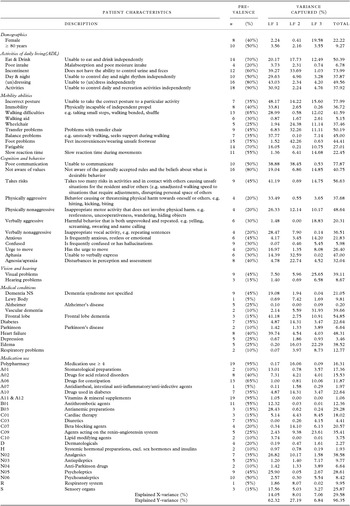
Patient characteristics were extracted from the electronic medical records consisting of standard nursing home charts and structured questionnaires. Medical records had the following categories of information: demographics, ADL, mobility, cognition and behavior, vision and hearing, and medical conditions. Furthermore, the resident's on-going medication use was extracted from the pharmacist's drug records and categorized according to the anatomical therapeutic chemical (ATC) classification system (WHO Collaborating Centre for Drug Statistics Methodology, 2013). Table 1 summarizes the patient characteristics. Due to the representation of the information in the nursing home charts and the proposed statistical analyses, the characteristics were binary coded as being present or not.
Prevalence of the patient characteristics in the research population (n = 20) is presented in the left column. The variance captured by each latent factor (LF) for the characteristics is presented in the right columns. The explained variance in patient characteristics (X) and fall rate (Y) per latent factor is presented in the last rows.

Data analyses
We report mean, standard deviation, percentage, range and frequency with respect to fall rate, circumstances of falls, and patient characteristics.
To determine the relationship between 66 patient characteristics and fall rate, a multivariate PLS regression analysis was performed. Fall rate was predicted from the set patient characteristics. This prediction was achieved by the identification of underlying latent factors, which best modeled fall rate, thereby explaining as much as possible of the covariance between patient characteristics and fall rate (Eriksson et al., Reference Eriksson, Johansson, Kettaneh-Wold, Trygg, Wikström and Wold2006, Reference Eriksson, Lundquist, Gustafson and Lundin-Olsson2009a; Abdi, Reference Abdi2010).
To have equal importance of the variables, the binary coded patient characteristics (Table 1) were pre-processed by setting means to zero. Fall rate, a continuous variable, was positively skewed, and was therefore log-transformed to obtain a normal distribution. Thereafter, the mean was set to zero and standard deviation to one.
The PLS model was evaluated by cross-validation (method: venetian blind; number of data splits: 4). The optimal number of latent factors was determined by stop adding latent factors as soon as the predicted residual sum of squares (PRESS) decreased. The following output parameters were generated to evaluate the model quality and to quantify the relationship between patient characteristics and fall rate: R 2, variance captured in patient characteristics, weight and score plots, the variable importance on projection (VIP) and regression coefficients.
R 2 denotes the goodness of fit of the model. The amount of variance in patient characteristics captured by the models latent factors provides an indication of the relevance of the characteristics in the prediction of fall rate. A characteristic is considered completely relevant if its modeling power is 100%, characteristics with a modeling power around 4.5% (latent factor/number of patient characteristics) are of little relevance. Score and weight plots illustrate the relationship between observations (the included patients) and patient characteristics, respectively, with respect to the latent factors. To determine the importance of each characteristic of interest in the final model, the VIP and the variables regression coefficient were calculated. The VIP summarizes the importance of patient characteristics in the PLS model; a VIP score > 1 is considered important. The regression coefficient is a measure of the association between each patient characteristic and fall rate; a higher value indicates a stronger association.
The PLS analyses was performed using the PLS_toolbox for MATLAB (version 3.7.1; Eigenvector Research Inc., Wenatchee, WA, USA).
Results
Patient and fall characteristics
During the study period, a total of 23 patients resided in the closed psychogeriatric ward. Three residents were excluded due to incomplete data, leaving data from 20 patients for analysis (mean age 79.5 years; range 55–95). Table 1 shows the patient characteristics.
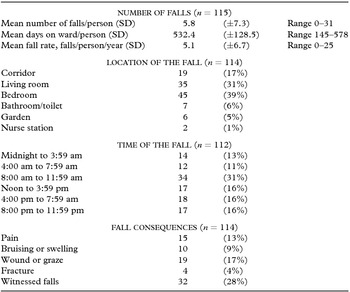
A total of 115 falls (mean 5.1 ± 6.7 falls/person/year) occurred during the study period. The staff witnessed 28% of falls. Seventeen residents (85%) experienced one or more falls during the study period: three residents did not fall, three fell once, and 14 residents fell more than once. Falls most frequently occurred in the bedroom (39%) and common living room (31%). Falls occurred independently of the time of day, most at 11 am (15%). Twenty-nine percent of the falls resulted in an injury (e.g. bruises, fractures). Two patients suffered a hip fracture and died within a month from complications. Table 2 gives an overview of location, time and consequences of falls.
Fall characteristics

Fall-related factors
PLS-regression analysis was used to determine the relationship between 66 patient characteristics and fall rate. The optimal model contained three latent factors, explaining 96% of the overall variance in fall rate, with a fit of 0.92 (R 2). The first latent factor explained 62.3% of the variance in fall rate, the second 27.2% and the third 6.8% of the data's variance. In addition to patients’ characteristics, Table 1 also shows the variance captured in each patient characteristic by the three latent factors of the model. Patient characteristics most relevant to the first latent variable were: incorrect posture (48%), unable to (un)dress independently (43%), taking risks (41%), having frontal lobe dementia (41%), presence of heart failure (40%), incontinence (39%) poor communication (39%) and having balance problems (38%). By the second latent factor most variance was captured in foot problems (42%) and poor communication (38%). The third factor captured most variance in the presence of vascular dementia (32%) and visual problems (26%).
Figure 1 shows the importance of the patient characteristics in the model and their relation to fall rate. The most important variables associated with high fall rates (positive regression coefficient, high VIP score) were: foot problems, walking difficulty, balance problems, fatigability, frontal lobe dementia, taking risks, physically aggressive, diabetes and taking drugs for diabetes (A10), use of analgesics (N02), beta blockers (C07) and psycholeptics (N05). Conversely, heart failures, incorrect posture, immobility, incontinence, inability to control day and night rhythm, aphasia and poor communication were associated with low fall rates.
The importance of the patient characteristics (VIP; right axis) in the model and the direction of the association with fall rate (regression coefficient; left axis). The variables of interest are ranked according to their VIP-values and regression coefficients. Variables at the left side of the figure are associated with a lower fall rate, and variables on the right side are associated with a higher fall rate. Characteristics with VIP>1 (above the dotted black line; right axis) are important to the model.

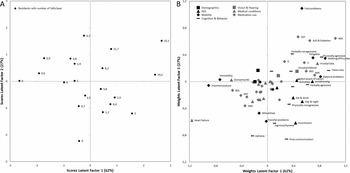
The association between the residents and patient characteristics in relation to fall rate is visualized in Figure 2. The position of residents in a given direction in the score plot is influenced by patient characteristics lying in the same direction in the weight plot. Patients in the higher right quadrant had overall a high fall rate, whereas persons clustered in the lower left quadrant had a lower fall rate.
Score plot (A) shows the relationship between the residents and displays the fall rate of each resident. Coupled to the weight plot (B) the inter-relatedness among the patient characteristics and fall rate is revealed. Patient characteristics and residents at the lower left quadrant are associated with lower fall rates, and variables at the higher right quadrant are associated with higher fall rates.

Discussion
The two objectives of the present study were to (1) determine fall rate, fall-related injuries and circumstances of falls, and to (2) examine the relationship between patient characteristics and fall rate in long-term care residents with dementia. The main findings were that 85% of the included residents fell once or more, falls had serious consequences, were most often unwitnessed, and occurred in the bedroom and living room. Furthermore, the model on the relation between patient characteristics and fall rate included three latent factors capturing 96% of the variance in fall rate. Mobility impairments, measures of disinhibited behavior, diabetes, and use of analgesics, beta blockers and psycholeptic drugs were strongest associated with a higher fall rate. In contrast, immobility, heart failure, and poor communication were associated with low fall rate.
The high fall rate and its serious consequences found in the present study were comparable with the rates reported previously in similar patients and facilities (Eriksson et al., Reference Eriksson, Strandberg, Gustafson and Lundin-Olsson2009b; Deandrea et al., Reference Deandrea2013; Stenhagen et al., Reference Stenhagen, Ekström, Nordell and Elmståhl2013). However, the high percentage of residents who fell and the serious consequences are alarming and reaffirm the need to increase the efficacy of fall prevention in long-term care residents with dementia.
A large number of falls occurred without the staff being present at the incident. Therefore, for 72% of the falls the exact cause of the fall is unknown. To prevent a fall, it is important to know what happens before and during a fall. Recent studies have shown that falls in common areas in a nursing home occur due to incorrect weight shifting during walking, sitting down and when changing position while standing (Robinovitch et al., Reference Robinovitch2013). As in previous studies, most falls occurred in the bedroom and common areas (Rapp et al., Reference Rapp, Becker, Cameron, König and Büchele2012). To get more insight into the exact circumstances, it may be necessary to monitor common areas and also bedrooms during the entire 24 h period. Monitoring could be accomplished by using optical sensors in combination with learning algorithms that can detect critical events in behavior, e.g. restlessness during sleep. Such monitoring could prevent falls by providing feedback to the patient before making a high risk movement or the monitoring system could signal nursing staff for help (Kosse et al., Reference Kosse, Brands, Bauer, Hortobagyi and Lamoth2013).
To investigate the relationship between patient characteristics and fall rate, PLS regression was used. The advantages of PLS regression is that it can handle a large number of variables (i.e. patient characteristics,) small sample sizes, and multicollinearity. This analytical approach provides a detailed view of which patient characteristics and in what combinations are important to predict falls. Furthermore, in contrast to other methods used to identify fall risk factors, PLS regressions handles heterogeneous population (Eriksson et al., Reference Eriksson, Lundquist, Gustafson and Lundin-Olsson2009a).
The PLS-regression model showed that patients who were still mobile, but had mobility impairments (e.g. foot problems, walking difficulties), had the highest fall rate. Mobility impairments are often related to slow gait, postural instability and increased postural sway, factors exhibited by elderly patients who fall frequently and particularly by those who suffer from cognitive impairments (Davison and Marrinan, Reference Davison and Marrinan2008; Taylor et al., Reference Taylor, Delbaere, Mikolaizak, Lord and Close2013). Foot abnormalities or poor footwear are also known to increase fall risk (Davison and Marrinan, Reference Davison and Marrinan2008). These findings suggest that there is a need to minimize mobility loss. Recent studies have shown that exercise therapy is effective in improving mobility and fall prevention in residents with dementia (Mirolsky-Scala and Kraemer, Reference Mirolsky-Scala and Kraemer2009; Roach et al., Reference Roach, Tappen, Kirk-Sanchez, Williams and Loewenstein2011). Additionally, when such efforts are combined with checking and providing appropriate footwear, e.g. comfortable and firm shoes, anti-slip socks, the fall rate could be lowered.
Results of the present study also showed that residents with frontal lobe dementia and disinhibited behavior are more likely to fall more often than those with other types of dementia. This observation is in contrast with data from earlier studies, suggesting that a diagnosis of Lewy body dementia and vascular dementia was associated with falls (Eriksson et al., Reference Eriksson, Gustafson and Lundin-Olsson2008). However, it is possible that residents with frontal lobe dementia in combination with disinhibited behavior take more risks in situations that are difficult to cope with and this may consequently lead to a higher fall rate.
Mobility and diabetes were strongly correlated according to the PLS model. Complications from diabetes-induced peripheral neuropathy can reduce sensation at the feet, which in turn affect gait and balance, and ultimately increasing the risk of fall (Schwartz et al., Reference Schwartz2002; Maurer et al., Reference Maurer, Burcham and Cheng2005). Furthermore, the model showed that analgesics, psycholeptics and beta blockers were also positively associated with fall rate. The weight plot in Figure 2 shows that the use of psycholeptics was closely related to measures of disinhibited behavior, because psycholeptics have a calming effect and are therefore often prescribed to residents with challenging behavior (e.g. wandering, aggression) (Westbury et al., Reference Westbury, Jackson and Peterson2010). Analgesics and psycholeptics tend to increase fall frequency and are therefore called FRIDs (de Groot et al., Reference De Groot2013). In addition, beta blockers can cause or worsen orthostatic hypertension which is also a known risk factor for falls (Milos et al., Reference Milos, Bondesson, Magnusson, Jakobsson, Westerlund and Midlöv2014). The potential beneficial effects of FRIDs and drugs causing or worsening orthostatic hypertension should be weighed against their side effects. Our data suggest that physicians should be even more carefully than before consider prescribing such drugs for these patients, and when appropriate actually reduce the dose which may lead to a lower rate of falls.
Incontinence is often indicated as a fall risk factor in old adults and is used in many fall prediction tools. However, our results indicate that incontinence in nursing home residents with dementia does not differentiate between higher or lower fall rates. Moreover, the prevalence of incontinence in fallers versus non-fallers in long-term care residents with cognitive impairments is equally distributed (see also, Whitney et al., Reference Whitney, Close, Jackson and Lord2012a). The results from studies in community-dwelling old adults or long-term care residents without dementia may therefore not be generalized to the long-term care residents with dementia. Probably, the effects of physical and mental disorders in combination with polypharmacy are so large in long-term care residents with dementia that incontinence is less influential on fall rate.
Current literature is especially focused on factors associated with an increased fall risk, not on factors decreasing the fall rate. Our study showed that heart failure, poor communication and immobility were associated with a lower fall rate. Assessing the relationship between those patient characteristics reveals that the combination of severe mobility problems, cognitive impairments (poor communication), and the existence of factors that make the resident less active (heart failure) cause sedative behavior and consequently decreases the fall rate because residents are less active.
Limitations
In the present study, long-term care residents with dementia were recruited from a single nursing home. Although we were able to fit the PLS model satisfactorily to the data, the low participant number limits the generalizability of the results to other patient groups. When more long-term care facilities and residents with dementia are included it might be possible to validate our model in a larger population and develop a more sensitive and sophisticated model of fall risk prediction which could be useful in the clinical setting. Still, our data provide sufficient information for the nursing home staff to start a fall prevention program in patients and environments similar to those in the present study. Further research should seek ways to individualize fall prevention programs more effectively and incorporate in this effort monitoring sensors and individualized fall risk profiles.
Future studies should also consider that patient characteristics such as cognitive status and medication use could change over time. To gain insight into these fluctuations and the effect thereof onto the model, data should be collected over a longer time span and all changes should be reported accurately, frequently and routinely, which is rarely the case in daily practice of nursing homes. Finally, in addition to the 66 patient characteristics identified in the present study, more transient factors such as changes in mood, sleep, blood pressure, wandering and dehydration could be added to the model to predict fall risk (Quigley et al., Reference Quigley, Bulat, Kurtzman, Olney, Powell-Cope and Rubenstein2010).
Conclusion
Patients with dementia living in long-term care facilities fall frequently. Most of these falls occur unwitnessed. Reduced mobility, cognitive impairment related to disinhibited behavior, diabetes, and the use of analgesics, beta blockers and psycholeptics are associated with a higher fall rate. Moreover, being immobile, inactive and unable to communicate is associated with a lower fall rate. The used analytic approach provided a detailed view of the fall risk factors and their interactions in long-term care residents with dementia and could increase the efficacy of fall prevention programs. To increase the accuracy of fall prediction, future studies will need to identify risk factors that are transiently involved in falls and characterize in more detail the conditions present before and during a fall.
Conflict of interest
None.
Description of authors’ roles
C.J.C. Lamoth and N.M. Kosse created the concept and design of the study. N.M. Kosse managed the acquisition of data. C.J.C. Lamoth, M.H. de Groot and N.M. Kosse analyzed the data and wrote the draft of the full manuscript. All authors critically revised the manuscript and approved the final version.
Acknowledgments
This study was part of the project “Telemedicine & Personalized Care – project fall prevention” and co-financed, in the context of the INTERREG IV A Program Deutschland-Netherlands, by the European Regional Development Fund (ERDF) and the Ministries of Economic Affairs of the Netherlands and the German states of Nordrhein-Westfalen and Niedersachsen, and the Institut Universitaire de France. We certify that the studies sponsors had no involvement in the study design, in the collection, analysis and interpretation of data, in the writing of the manuscript, or in the decision to submit the manuscript for publication.