Overview of the Iranian Health System
Structure
Iran is a developing country with a population of about 79 million distributed across thirty-one provinces. In 2016, its total gross domestic product (GDP) was (current US$) 418.98 billion (1). Financing and service provision in Iranian health care follows a public cooperative system with a hybrid model structure (Reference Yazdani and Jadidfard2). In 1986, medical education was integrated into the Ministry of Health, which was renamed the Ministry of Health and Medical Education (MoHME), to establish a more coordinated approach to healthcare provision and medical education (Reference Lankarani, Alavian and Peymani3).
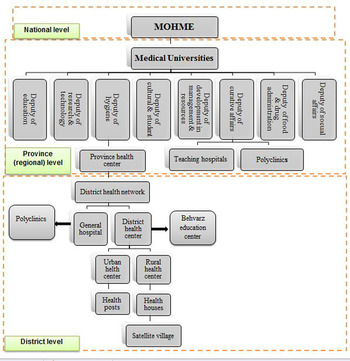
The health system is organized across three levels: national, provincial (regional), and district (Figure 1). At the national level, the MoHME is responsible for public health, medical treatment, and medical education (Reference Yazdani and Jadidfard2). At the provincial level, the MoHME delegates its responsibilities to medical universities, of which there is at least one in every province. At the district level, public health and medical treatment are delegated to healthcare networks. At this level, education is solely related to public education, in-service training, and the training of local healthcare workers (Behvarz) (Reference Mehrdad4).
Fig. 1.Schematic structure of the Iranian health system.
Funding
Healthcare financing in Iran does not follow any defined pattern, and different government, private, and charity sectors participate in the system (Reference Davari, Haycox and Walley5). The three main sources of funding in the health system are the public budget, social health insurance, and out-of-pocket payment (Reference Davari, Haycox and Walley6). The total health expenditure has risen from 4.6 percent of the GDP in 2000 to 6.9 percent in 2016; 41 percent of the latter being contributed by public resources (1;7). There are four main public health insurance schemes in Iran: the Social Security Insurance Organization, the Medical Services Insurance Organization, the Armed Forces Medical Services Insurance Organization, and the Emdade-Emam Committee Health Insurance (Reference Davari, Haycox and Walley5).
Provision of Services
The healthcare delivery system in Iran consists of three levels: primary, secondary, and tertiary. Primary health care is provided by approximately 2,000 rural and urban health centers. In addition to providing primary care, these centers supervise the activities of rural health houses and urban health posts. Basic healthcare services in rural areas are provided by local health workers (Behvarz) (Reference Jadidfard, Yazdani and Khoshnevisan8). Secondary and tertiary healthcare services are based in urban areas and are limited to the 900 general and teaching hospitals. The government funds 554 of these hospitals, which are administrated by medical universities under the supervision of the MoHME (Reference Doshmangir, Rashidian and Jafari9).
Payment of Healthcare Professionals
At the primary care level, family physicians' fees are based on capitation and a bonus scheme for special cases (Reference Takian, Doshmangir and Rashidian10). Other members of the healthcare teams (e.g., midwives and health specialists) receive a monthly salary. At the secondary and tertiary levels, a combination of monthly salary and fee-for-service payment is used (Reference Davari, Haycox and Walley6).
Health Technology Assessment (HTA) in Iran
Health technologies produce many improvements in patient care and quality of life (Reference Arab-Zozani, Bagheri Faradonbeh and Jaafari Pooyan11). There are, however, significant concerns about adopting new technologies, including their impact on healthcare expenditures and end-user expectations. Over the last decade, these concerns have led to an increased interest in HTA in Iran (Reference Raftery, Young and Stanton12). HTA is a form of policy research that seeks to couple evidence with decision making. It examines the short- and long-term consequences of implementing a health technology (13;14) (equipment, drugs, procedures, and organizational and support systems) by assessing its effectiveness, safety, efficacy, and cost-effectiveness, as well as relevant organizational, social, ethical, and legal implications (Reference Chalkidou, Li and Culyer15). In this report, we describe the 10-year history of the HTA program in Iran, including its accomplishments and implementation challenges.
Genesis
Iran's health system has experienced profound changes in recent decades, particularly in how health technologies enter the system. During the 1960s and 1970s, new health technologies were introduced without scientific assessment. Recently, there has been increased scrutiny of advanced health technologies, and HTA is now seen as an important step in controlling the entry of new technologies into the health system (Reference Carlsson16).
HTA has been discussed in Iran since the late 1990s. In October 2007, an HTA secretariat was officially formed in the Department of Health Economics, Center for Network Development and Health Promotion within the MoHME (17;18). In the beginning, HTAs were conducted by trained faculty members from the medical universities at the request of the secretariat. In 2010, the HTA office was moved to the Heath Technology Assessment, Standardization, and Tariff Department under the Deputy of Curative Affairs in the MoHME (Reference Arab-Zozani, Jalilian and Oskouei19).
An HTA infrastructure has been established in all universities that teach medical sciences. The mission of the HTA office is to assess technologies using a systematic process, with the aim of promoting evidence-informed decision making. At first, the HTAs mainly evaluated capital equipment, but with increasing experience and expansion of research capacities in the universities and research centers, more generalized assessments were undertaken of noncapital equipment, as well as new and older technologies (Reference Doaee, Oliyaeemanesh and Nejati17;Reference Doaee, Olyaeemanesh and Emami18;Reference Olyaeemanesh, Doaee and Mohammadreza20).
Thus, the development of HTA in Iran comprised five steps: identifying graduates trained in HTA in Iran and other countries; establishing an HTA Scientific Committee; selecting the first topics for assessment; developing regulations that use HTA results to determine approvals for the introduction of costly medical equipment (>US$50,000) into the health system; and partnering with research deputies in the medical science universities to conduct HTA projects and health system research (Reference Doaee, Oliyaeemanesh and Nejati17;Reference Arab-Zozani, Majdzadeh and Sarbakhsh21).
Creation of a National Model
A secretariat was set up to carry out several tasks including receiving topics from universities applying for technology entry; prioritizing topics; calling for project orders; ordering, following up, and sponsoring the projects; running the Scientific Committee and tracking its decisions; writing, publishing, and disseminating reports; and preparing executive instructions based on the outcomes of the projects. Initially, three types of evaluations were conducted: Type I known as Elementary; Type II known as Medium; and Type III known as Excellent. The stages, duration, and required credits for each of these evaluations are provided in Supplementary Table 1.
In the early years, assessments were not comprehensive and generally only assessed the safety and effectiveness of a technology. However, the need for HTA within the health system expanded to service providers, policy makers, researchers, lawmakers, managers, pharmaceutical and medical equipment companies, and patients. At the same time, the HTA Core Model became the world's leading HTA framework (Reference Mehrdad4). Therefore, the HTA Office, in collaboration with the Center for Development of Medical Education of Shahid Beheshti University of Medical Sciences, designed and created a local HTA model for Iran, in the form of a book, over a period of 11 months (Reference Davari, Haycox and Walley5).
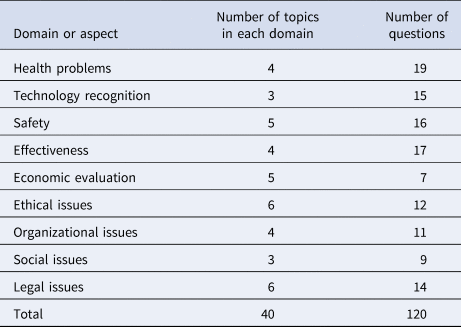
The model outlined the following nine aspects of a health technology that can be examined: health problems, technology recognition, safety, effectiveness, ethical, economic, organizational, social, and legal. There is a separate chapter in the book for each aspect as well as descriptive tables that provide a complete guide for researchers in the field of HTA (Reference Yazdani and Jadidfard2). Guidance on defining the topic, drafting the research questions, and collecting the necessary data is provided for each of the nine domains. A list of the domains, topics, and questions that have been examined using the present model are presented in Table 1. For further details about questions on each domain, please refer to Supplement 2.
Table 1.Number of domains, topics, and questions
Horizon Scanning
It is expected that the collaborative and voluntary research centers (Clinical Knowledge Management Centers) assess emerging health technologies to facilitate dissemination and use of horizon scanning knowledge in the country's HTA area. In doing so, these centers can promote the use of effective and preferred modern technologies in Iran. Consequently, the HTA Secretariat has developed regulations that cover the interactions between the HTA secretariat and the horizon scanning centers with respect to staffing, training, reporting, priority setting, and evaluation (see Supplement 3).
Capacity Building
In Iran, education in HTA has been promoted by holding short-term courses, workshops, and seminars. So far, ten training courses and workshops have been held in medical science universities and numerous lectures on economic evaluation and HTA have been conducted. In addition, a master's program in HTA was started in 2010, and admissions have been increasing rapidly each year since (Reference Arab-Zozani, Majdzadeh and Sarbakhsh21). At present, four campuses (Tehran University of Medical Sciences, Iran University of Medical Sciences, Yazd University of Medical Sciences, and Kerman University of Medical Sciences) have received permission to train students in this field (approximately twenty students annually). Graduates are active in HTA offices within the medical science universities as well as the partner research centers.
HTA Projects
The first HTA project conducted assessed the use of positron emission tomography scanning for the screening, diagnosis, treatment, and follow-up of cancer. Other projects included assessing dual-source computed tomography scanning and 3 Tesla magnetic resonance imaging for diagnosing diseases, hyperbaric oxygen therapy for treating diabetic foot ulcers, halothane for anesthesia, and high-intensity focused ultrasound for treating prostate cancer. According to the Iranian National Institutes of Health Research (NIHR), the number of completed projects for years 2014, 2015, 2016, and 2017 were 17, 8, 14, and 23, respectively. The most common topic areas were diagnostic devices, drugs, and surgical devices.
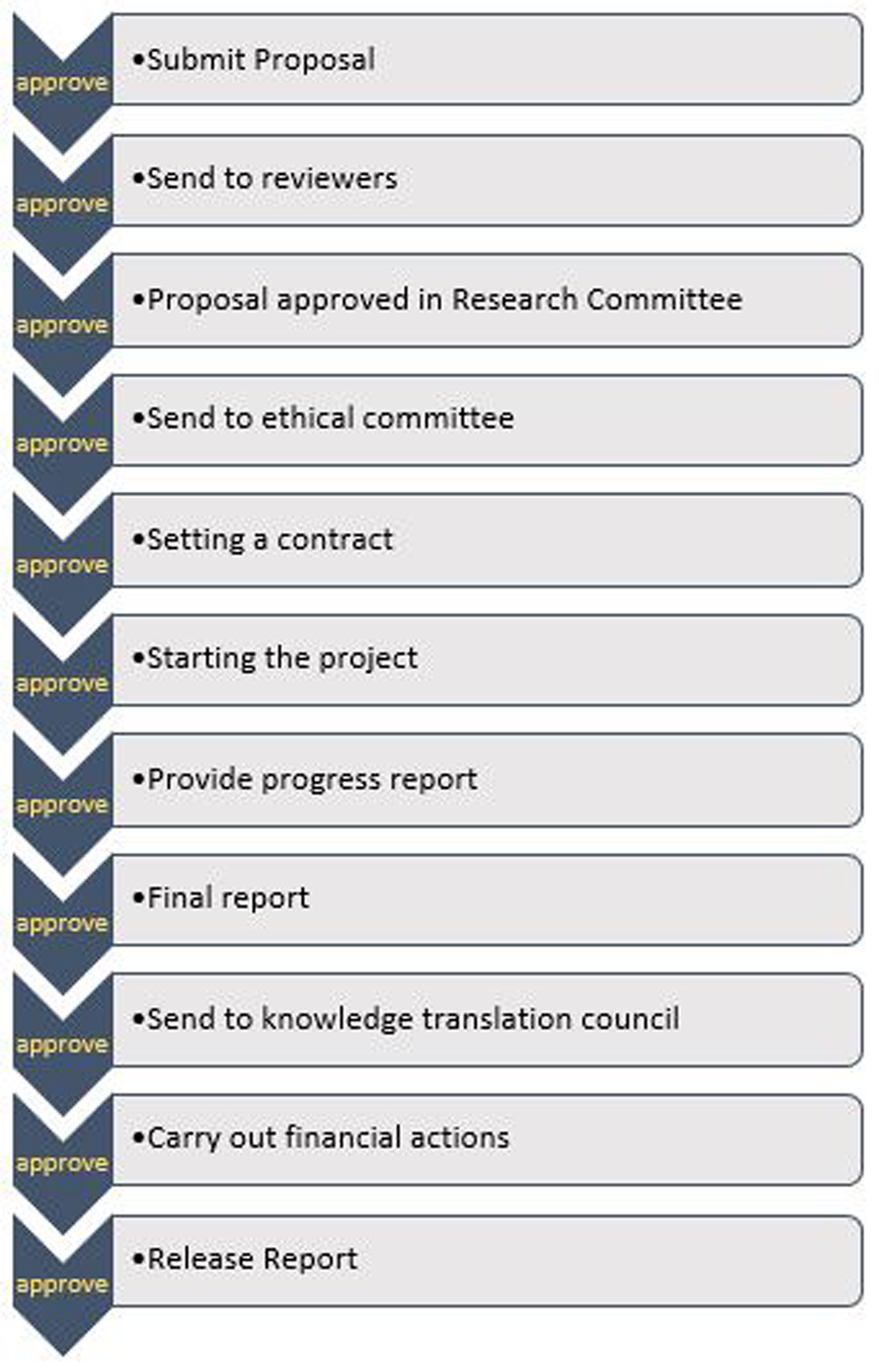
All phases of an HTA project, from beginning to end, are managed by the NIHR. The NIHR announces HTA projects on their Web site and researchers from universities and research centers submit proposals for each project using a standardized form. The work process for HTA projects is shown in Figure 2.
Fig. 2.Work process of health technology assessment projects.
Barriers and Facilitators
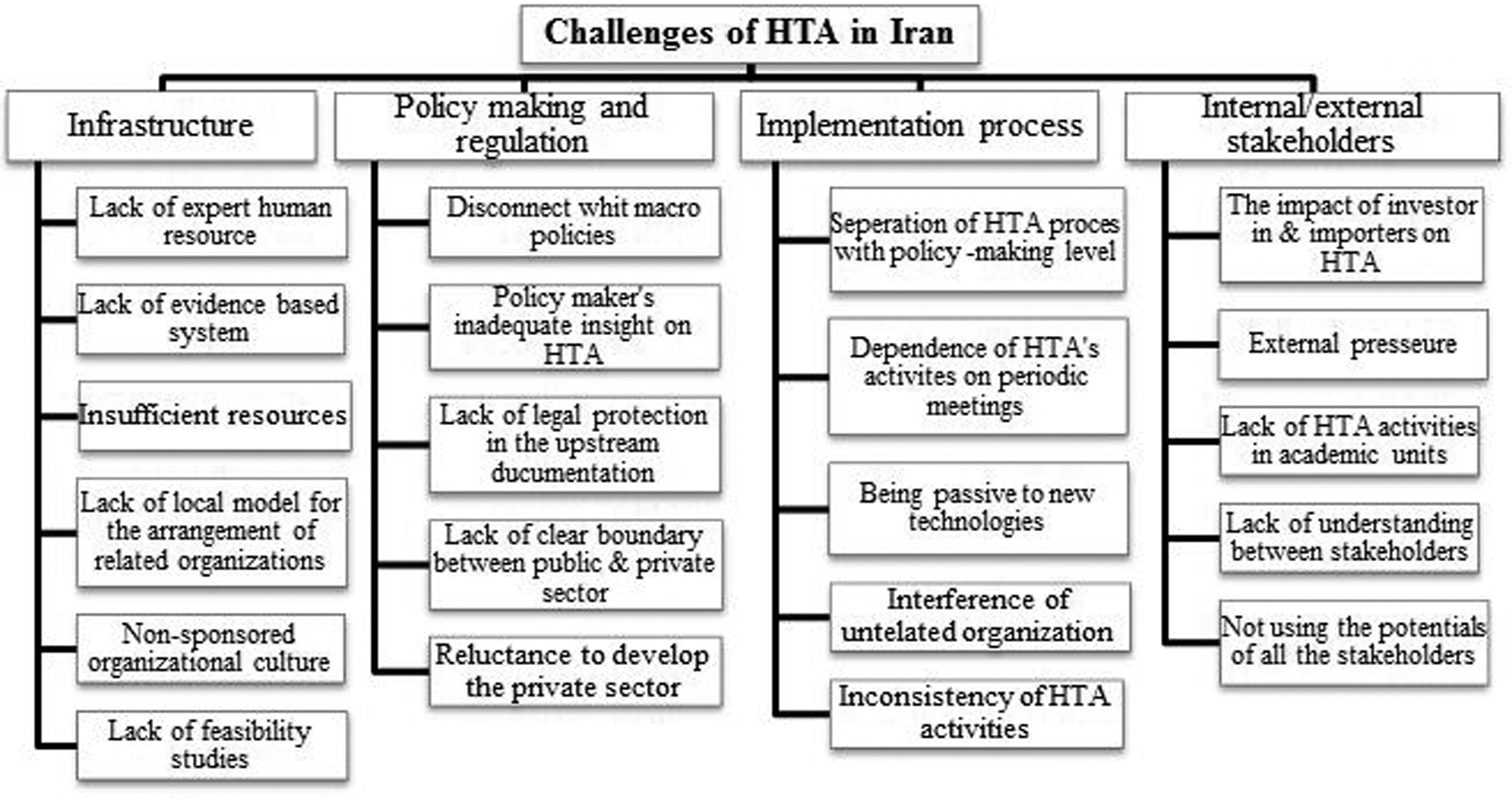
Since its inception, HTA in Iran and elsewhere has always been a challenging endeavor. Some studies have examined these challenges using quantitative and qualitative methods of research (Reference Mohtasham, Yazdizadeh and Zali22–Reference Yazdizadeh, Shahmoradi and Majdzadeh24). The main challenges in implementing HTA fall into four broad categories: infrastructure, policy making and regulation, implementation processes, and internal/external stakeholders (Figure 3). Potential solutions and facilitators in the field of infrastructure include establishing an independent entity for managing conflicts of interest in the HTA process and facilitating access to existing data or, potentiality, collecting data at a national level. Legislation is suggested to facilitate decision making through partnerships among policy makers, clinicians, and patients and ensure that all stakeholders benefit from the results of HTA projects. To improve implementation, a systematic approach to HTA is suggested that includes creating multidisciplinary teams of experts in HTA, with health economics, statistics, and related clinical specialties; preparing a technology roadmap based on horizon scanning results; appraising the quality of the HTA projects; and using a standardized reporting format. These solutions may help address the challenges related to stakeholders, and to developing knowledge and awareness of HTA and its benefits. Formulating a strategic plan to overcome barriers and increase commitment to and participation in HTA processes among all stakeholders will result in better utilization of HTA results.
Fig. 3.Challenges of HTA in Iran.
Conclusion
HTA has only a short history in Iran. While the efforts made so far have been good, there is still much room for improvement. The current system must be switched from passive to active mode. Becoming active requires ensuring that all stakeholders participate in conducting and implementing HTA projects, attracting high-level policy makers, launching an active system to identify and introduce new technologies, establishing a nongovernmental organization to carry out the projects, developing a monitoring system to improve the quality of the results, and employing HTA specialists in the design, implementation, and evaluation of all projects. Resolving existing challenges can pave the way for increasing the efficiency and transparency of the HTA process, to the ultimate benefit of the health system and its stakeholders.







 You have
Access
Overview of the Iranian Health System
Structure
Iran is a developing country with a population of about 79 million distributed across thirty-one provinces. In 2016, its total gross domestic product (GDP) was (current US$) 418.98 billion (1). Financing and service provision in Iranian health care follows a public cooperative system with a hybrid model structure (Reference Yazdani and Jadidfard2). In 1986, medical education was integrated into the Ministry of Health, which was renamed the Ministry of Health and Medical Education (MoHME), to establish a more coordinated approach to healthcare provision and medical education (Reference Lankarani, Alavian and Peymani3).
The health system is organized across three levels: national, provincial (regional), and district (Figure 1). At the national level, the MoHME is responsible for public health, medical treatment, and medical education (Reference Yazdani and Jadidfard2). At the provincial level, the MoHME delegates its responsibilities to medical universities, of which there is at least one in every province. At the district level, public health and medical treatment are delegated to healthcare networks. At this level, education is solely related to public education, in-service training, and the training of local healthcare workers (Behvarz) (Reference Mehrdad4).
Schematic structure of the Iranian health system.
Funding
Healthcare financing in Iran does not follow any defined pattern, and different government, private, and charity sectors participate in the system (Reference Davari, Haycox and Walley5). The three main sources of funding in the health system are the public budget, social health insurance, and out-of-pocket payment (Reference Davari, Haycox and Walley6). The total health expenditure has risen from 4.6 percent of the GDP in 2000 to 6.9 percent in 2016; 41 percent of the latter being contributed by public resources (1;7). There are four main public health insurance schemes in Iran: the Social Security Insurance Organization, the Medical Services Insurance Organization, the Armed Forces Medical Services Insurance Organization, and the Emdade-Emam Committee Health Insurance (Reference Davari, Haycox and Walley5).
Provision of Services
The healthcare delivery system in Iran consists of three levels: primary, secondary, and tertiary. Primary health care is provided by approximately 2,000 rural and urban health centers. In addition to providing primary care, these centers supervise the activities of rural health houses and urban health posts. Basic healthcare services in rural areas are provided by local health workers (Behvarz) (Reference Jadidfard, Yazdani and Khoshnevisan8). Secondary and tertiary healthcare services are based in urban areas and are limited to the 900 general and teaching hospitals. The government funds 554 of these hospitals, which are administrated by medical universities under the supervision of the MoHME (Reference Doshmangir, Rashidian and Jafari9).
Payment of Healthcare Professionals
At the primary care level, family physicians' fees are based on capitation and a bonus scheme for special cases (Reference Takian, Doshmangir and Rashidian10). Other members of the healthcare teams (e.g., midwives and health specialists) receive a monthly salary. At the secondary and tertiary levels, a combination of monthly salary and fee-for-service payment is used (Reference Davari, Haycox and Walley6).
Health Technology Assessment (HTA) in Iran
Health technologies produce many improvements in patient care and quality of life (Reference Arab-Zozani, Bagheri Faradonbeh and Jaafari Pooyan11). There are, however, significant concerns about adopting new technologies, including their impact on healthcare expenditures and end-user expectations. Over the last decade, these concerns have led to an increased interest in HTA in Iran (Reference Raftery, Young and Stanton12). HTA is a form of policy research that seeks to couple evidence with decision making. It examines the short- and long-term consequences of implementing a health technology (13;14) (equipment, drugs, procedures, and organizational and support systems) by assessing its effectiveness, safety, efficacy, and cost-effectiveness, as well as relevant organizational, social, ethical, and legal implications (Reference Chalkidou, Li and Culyer15). In this report, we describe the 10-year history of the HTA program in Iran, including its accomplishments and implementation challenges.
Genesis
Iran's health system has experienced profound changes in recent decades, particularly in how health technologies enter the system. During the 1960s and 1970s, new health technologies were introduced without scientific assessment. Recently, there has been increased scrutiny of advanced health technologies, and HTA is now seen as an important step in controlling the entry of new technologies into the health system (Reference Carlsson16).
HTA has been discussed in Iran since the late 1990s. In October 2007, an HTA secretariat was officially formed in the Department of Health Economics, Center for Network Development and Health Promotion within the MoHME (17;18). In the beginning, HTAs were conducted by trained faculty members from the medical universities at the request of the secretariat. In 2010, the HTA office was moved to the Heath Technology Assessment, Standardization, and Tariff Department under the Deputy of Curative Affairs in the MoHME (Reference Arab-Zozani, Jalilian and Oskouei19).
An HTA infrastructure has been established in all universities that teach medical sciences. The mission of the HTA office is to assess technologies using a systematic process, with the aim of promoting evidence-informed decision making. At first, the HTAs mainly evaluated capital equipment, but with increasing experience and expansion of research capacities in the universities and research centers, more generalized assessments were undertaken of noncapital equipment, as well as new and older technologies (Reference Doaee, Oliyaeemanesh and Nejati17;Reference Doaee, Olyaeemanesh and Emami18;Reference Olyaeemanesh, Doaee and Mohammadreza20).
Thus, the development of HTA in Iran comprised five steps: identifying graduates trained in HTA in Iran and other countries; establishing an HTA Scientific Committee; selecting the first topics for assessment; developing regulations that use HTA results to determine approvals for the introduction of costly medical equipment (>US$50,000) into the health system; and partnering with research deputies in the medical science universities to conduct HTA projects and health system research (Reference Doaee, Oliyaeemanesh and Nejati17;Reference Arab-Zozani, Majdzadeh and Sarbakhsh21).
Creation of a National Model
A secretariat was set up to carry out several tasks including receiving topics from universities applying for technology entry; prioritizing topics; calling for project orders; ordering, following up, and sponsoring the projects; running the Scientific Committee and tracking its decisions; writing, publishing, and disseminating reports; and preparing executive instructions based on the outcomes of the projects. Initially, three types of evaluations were conducted: Type I known as Elementary; Type II known as Medium; and Type III known as Excellent. The stages, duration, and required credits for each of these evaluations are provided in Supplementary Table 1.
In the early years, assessments were not comprehensive and generally only assessed the safety and effectiveness of a technology. However, the need for HTA within the health system expanded to service providers, policy makers, researchers, lawmakers, managers, pharmaceutical and medical equipment companies, and patients. At the same time, the HTA Core Model became the world's leading HTA framework (Reference Mehrdad4). Therefore, the HTA Office, in collaboration with the Center for Development of Medical Education of Shahid Beheshti University of Medical Sciences, designed and created a local HTA model for Iran, in the form of a book, over a period of 11 months (Reference Davari, Haycox and Walley5).
The model outlined the following nine aspects of a health technology that can be examined: health problems, technology recognition, safety, effectiveness, ethical, economic, organizational, social, and legal. There is a separate chapter in the book for each aspect as well as descriptive tables that provide a complete guide for researchers in the field of HTA (Reference Yazdani and Jadidfard2). Guidance on defining the topic, drafting the research questions, and collecting the necessary data is provided for each of the nine domains. A list of the domains, topics, and questions that have been examined using the present model are presented in Table 1. For further details about questions on each domain, please refer to Supplement 2.
Number of domains, topics, and questions
Horizon Scanning
It is expected that the collaborative and voluntary research centers (Clinical Knowledge Management Centers) assess emerging health technologies to facilitate dissemination and use of horizon scanning knowledge in the country's HTA area. In doing so, these centers can promote the use of effective and preferred modern technologies in Iran. Consequently, the HTA Secretariat has developed regulations that cover the interactions between the HTA secretariat and the horizon scanning centers with respect to staffing, training, reporting, priority setting, and evaluation (see Supplement 3).
Capacity Building
In Iran, education in HTA has been promoted by holding short-term courses, workshops, and seminars. So far, ten training courses and workshops have been held in medical science universities and numerous lectures on economic evaluation and HTA have been conducted. In addition, a master's program in HTA was started in 2010, and admissions have been increasing rapidly each year since (Reference Arab-Zozani, Majdzadeh and Sarbakhsh21). At present, four campuses (Tehran University of Medical Sciences, Iran University of Medical Sciences, Yazd University of Medical Sciences, and Kerman University of Medical Sciences) have received permission to train students in this field (approximately twenty students annually). Graduates are active in HTA offices within the medical science universities as well as the partner research centers.
HTA Projects
The first HTA project conducted assessed the use of positron emission tomography scanning for the screening, diagnosis, treatment, and follow-up of cancer. Other projects included assessing dual-source computed tomography scanning and 3 Tesla magnetic resonance imaging for diagnosing diseases, hyperbaric oxygen therapy for treating diabetic foot ulcers, halothane for anesthesia, and high-intensity focused ultrasound for treating prostate cancer. According to the Iranian National Institutes of Health Research (NIHR), the number of completed projects for years 2014, 2015, 2016, and 2017 were 17, 8, 14, and 23, respectively. The most common topic areas were diagnostic devices, drugs, and surgical devices.
All phases of an HTA project, from beginning to end, are managed by the NIHR. The NIHR announces HTA projects on their Web site and researchers from universities and research centers submit proposals for each project using a standardized form. The work process for HTA projects is shown in Figure 2.
Work process of health technology assessment projects.
Barriers and Facilitators
Since its inception, HTA in Iran and elsewhere has always been a challenging endeavor. Some studies have examined these challenges using quantitative and qualitative methods of research (Reference Mohtasham, Yazdizadeh and Zali22–Reference Yazdizadeh, Shahmoradi and Majdzadeh24). The main challenges in implementing HTA fall into four broad categories: infrastructure, policy making and regulation, implementation processes, and internal/external stakeholders (Figure 3). Potential solutions and facilitators in the field of infrastructure include establishing an independent entity for managing conflicts of interest in the HTA process and facilitating access to existing data or, potentiality, collecting data at a national level. Legislation is suggested to facilitate decision making through partnerships among policy makers, clinicians, and patients and ensure that all stakeholders benefit from the results of HTA projects. To improve implementation, a systematic approach to HTA is suggested that includes creating multidisciplinary teams of experts in HTA, with health economics, statistics, and related clinical specialties; preparing a technology roadmap based on horizon scanning results; appraising the quality of the HTA projects; and using a standardized reporting format. These solutions may help address the challenges related to stakeholders, and to developing knowledge and awareness of HTA and its benefits. Formulating a strategic plan to overcome barriers and increase commitment to and participation in HTA processes among all stakeholders will result in better utilization of HTA results.
Challenges of HTA in Iran.
Conclusion
HTA has only a short history in Iran. While the efforts made so far have been good, there is still much room for improvement. The current system must be switched from passive to active mode. Becoming active requires ensuring that all stakeholders participate in conducting and implementing HTA projects, attracting high-level policy makers, launching an active system to identify and introduce new technologies, establishing a nongovernmental organization to carry out the projects, developing a monitoring system to improve the quality of the results, and employing HTA specialists in the design, implementation, and evaluation of all projects. Resolving existing challenges can pave the way for increasing the efficiency and transparency of the HTA process, to the ultimate benefit of the health system and its stakeholders.
Supplementary material
The supplementary material for this article can be found at https://doi.org/10.1017/S0266462319003489