INTRODUCTION
In an increasing number of women with primary breast cancer, treatment with radical mastectomy has been replaced by local excision of the tumour and post-operative breast irradiation. Randomised controlled trials have demonstrated that breast irradiation after lumpectomy reduces the local recurrence of cancer and increases the likelihood of disease control.Reference Jacobson, Danforth, Cowan, d'Angelo, Steinberg, Pierce, Lippman, Lichter, Glatstein and Okunieff1–Reference Veronesi, Cascinelli, Mariani, Greco, Saccozzi, Luini, Aguilar and Marubini7 Therefore, breast conservation therapy has been proven equivalent to the radical mastectomy, in means of disease control, but with obviously better cosmetic outcome.
Currently, the most commonly used schedules for whole-breast irradiation after breast-conserving surgery is 2-Gy daily fractions given five times a week to a total dose of 45–50 Gy over 5 weeks with the optional addition of a boost to the primary site of 10–16 Gy in 5 to 8 daily fractions. Such a schedule is close to the tolerance of normal breast tissue. This conventional radiation scheme stems from concern that fraction sizes of larger than 2Gy might increase the likelihood of the late effects on healthy tissue toxicity. Normal tissue endpoints, such as breast fibrosis, skin telangiectasia, brachial plexus neuropathy and shoulder stiffness, have been defined for studying the sensitivity of various tissues to different dose and fractionation schedules.
Over the last several years, there has been renewed interest in the use of hypo-fractionation for whole breast irradiation. The main controversy focuses on whether a single hypo-fractionated treatment regimen can be identified that is at least equivalent to 50 Gy in 25 fractions in every clinically relevant respect, including a range of late adverse effects. It is certain that some forms of hypo-fractionation are unsuitable for treating the axilla and supraclavicular fossa by virtue of the sensitivity of brachial plexus to fraction size. However, interest in hypo-fractionation (fewer fractions of more than 2 Gy) is based on two postulated clinical benefits. The first is that breast cancer is more sensitive to fraction size than formerly thought, so that fewer larger fractions maintain current levels of anti-tumour effect without increasing late adverse effects. The second is that shorter overall treatment times (accelerated hypo-fractionation) may be more effective in patients with rapidly proliferating tumours. Recent randomised trials have confirmed that hypo-fractionation whole-breast irradiation is equivalent to more conventional whole-breast irradiation with respect to local recurrence and cosmetic outcome.Reference Whelan, MacKenzie, Julian, Levine, Shelley, Grimard, Lada, Lukka, Perera, Fyles, Laukkanen, Gulavita, Benk and Szechtman8–12
Interest in hypo-fractionation is based also on the practical advantages to patients and health services. Treatment given with the fewest possible fractions over the shortest possible time (reduced number of visits) offers several advantages in terms of convenience, time, cost and quality of life for patients. Given the high incidence of breast cancer in our society, a shorter fractionation schedule would also produce savings to health-care budget and decrease waiting lists in busy radiotherapy centres.
The purpose of this review is to evaluate the effectiveness of the use of hypo-fractionated schedules to whole-breast irradiation based on the most recent data analysis and outcomes given in literature.
METHOD
Radiobiological issues
Radiobiological models have been developed to predict improvement in therapeutic ratio (the balance between tumour cell and normal tissue damage). The most commonly used and clinically acceptable model is the linear-quadratic, which assumes a double mechanism for cell kill accounting for non-repairable (α) and repairable (β) damage; the ratio of these components is a measure of the fractionation sensitivity of different tissues. The mathematical equation for this model introduces the term of Biologically Effective Dose (BED). It can be written as

where n is the number of fractions, d is the dose per fraction and α/β is inherent radiation sensitivity value for the tumour or normal tissue in question.Reference Barendsen13 BED is a measure of the biological dose delivered by a particular combination of dose per fraction and total dose to a given tissue characterised by a specific α/β ratio.
The model can be used to compare different modifications of the radiation schedule such as hyper-fractionation, hypo-fractionation and accelerated fractionation. The model suggests that when the α/β ratio of a tumour is greater than that of the critical normal tissue, a lower dose per fraction and increased total dose (hyper-fractionation) is likely to be more effective. When the α/β ratio of the tumour is the same or less than that of the critical normal tissue, then a larger dose per fraction (hypo-fractionation) with a modest decrease in total dose may be equally or potentially more effective than conventional fractionation. Examples here include melanoma and possibly prostate cancer.
The α/β value is a practical descriptor of the sensitivity to fraction size. Values of α/β in the range of 1–6 Gy are typical of late responding tissues, with higher values (≥10 Gy) typical of squamous carcinomas and early responding tissues. The hypothesis relevant to the present discussion is that α/β values for breast cancer are closer to those of late normal tissues responses than to human squamous carcinomas. An α/β value in the range of 4–5 Gy was first estimated for the response of locally advanced and recurrent chest wall breast in the early 1950s and analysed using the linear quadratic model in the mid-1980s.Reference Rosenstein, Lymberis and Formenti14–Reference Douglas18 More recently, an estimate of 4 Gy was reported for the fractionation sensitivity of breast cancer.Reference Yarnold, Ashton, Bliss, Homewood, Harper, Hanson, Haviland, Bentzen and Owen9–Reference Owen, Ashton, Bliss, Homewood, Harper, Hanson, Haviland, Bentzen and Yarnold10
RESULTS AND DISCUSSION
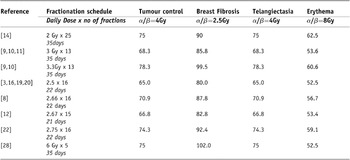
Previously published studiesReference Clark, Whelan, Levine, Roberts, Willan, McCulloch, Lipa, Wilkinson and Mahoney3,Reference Olivotto, Weir, Kim-Sing, Bajdik, Trevisan, Doll, Lam, Basco and Jackson19–Reference Livi, Stefanacci, Scoccianti, Dicosmo, Borghesi, Nosi, Simontacchi, Mangoni, Paiar, Ponticelli, Nori, Chiavacci and Biti22 and several randomised trialsReference Whelan, MacKenzie, Julian, Levine, Shelley, Grimard, Lada, Lukka, Perera, Fyles, Laukkanen, Gulavita, Benk and Szechtman8–11 have reported and evaluated hypo-fractionation schemes in comparison with standard fractionation schedule of 50 Gy in 25 fractions for whole-breast irradiation. To compare the different dose fractionation schedules, a conversion to BED using equation (1) was done. Table 1 shows analytically the different fractionation schedules reported in literature together with the calculated BEDs for tumour control in addition to the early responses.
BED (Biologically Effective Dose) values calculated for published hypofractionated radiation schedules in breast cancer

The tumour control BED values were determined using an α/β value of 4 Gy. It is not yet clear whether a repopulation factor is required in other than squamous or transitional cell cancers for both of which there is evidence of accelerated repopulation. There is probably no significant time factor in breast cancer subject to adjuvant radiotherapy after tumour excision. In addition, hypo-fractionated treatments are accomplished within a period that is shorter than the lag period even in the tumour and acutely responding tissues. The median Tpot value for breast cancers has been reportedReference Haustermans, Fowler, Geboes, Christiaens, Lerut and van der Schueren23 to be roughly 13 days and use of this relatively high value would produce only small decreases in BEDs. The BED values of most hypo-fractionation schedules result in tumour control BEDs roughly equivalent to a 50-Gy standard treatment.
Regarding normal tissues, the selection of the α/β value used for these calculations were based on those reported in previous studies for the late effects of fibrosis and telangiectasia, in addition to the acute radiation reactions of erythema and desquamation; these values were 2, 4, 8 and 11 Gy, respectively.Reference Thames, Bentzen, Turesson, Overgaard and Van den Bogaert24–Reference Kurtz27 The BED values for acute radiation responses of erythema and desquamation were lower for all hypo-fractionation schedules. Late response BEDs for most hypo-fractionation schedules were in a similar range to the BED for the standard treatment of 50 Gy in 25 fractions.
Clinical experience
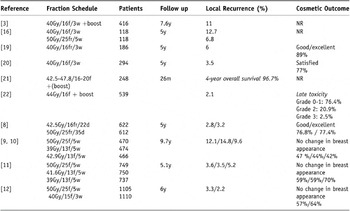
Prospective studies and case series of patients treated with hypo-fractionation after breast-conserving surgery report excellent rates of local control, good cosmetic outcomes, and limited irradiation morbidity (Table 2). Analytically, Clark et al.Reference Clark, Whelan, Levine, Roberts, Willan, McCulloch, Lipa, Wilkinson and Mahoney3 reported the results of a randomised trial of whole-breast irradiation 40 Gy in 16 daily fractions over 22 days plus a boost to the primary site of 12.5 Gy in 5 daily fractions over 7 days versus no radiation in women with node negative breast cancer treated with breast-conserving surgery; 416 patients received whole-breast irradiation. At a median follow-up of 7.6 years, the risk of local recurrence in irradiated patients was 11%. Cosmetic outcome was not reported, but no significant radiation morbidity was observed.
Review on published studies evaluating hypofractionated radiation schedules for breast cancer treatment

NR= not reported
Yamada et al.Reference Yamada, Ackerman, Franssen, MacKenzie and Thomas16 comparing 40 Gy in 16 fractions with conventional fractionation reported overall survival to be 84% at 5 years for both groups. The local recurrence rate at 5 years was found 12.7% and 6.8%, respectively, but the difference was not statistically significant (p = 0.09).
Olivotto et al.Reference Olivotto, Weir, Kim-Sing, Bajdik, Trevisan, Doll, Lam, Basco and Jackson19 reported a randomised trial evaluating the effect of acetyl salicylic acid on reducing the late effects of radiotherapy. The intervention was shown to have no effect on late radiation morbidity. In this study, 186 women with T1 2 node negative breast cancer, treated with breast-conserving surgery and axillary dissection received whole-breast irradiation of 44 Gy in 16 fractions over 22 days using a standard tangential wedged-pair technique. Additional boost irradiation was not used. At 5 years, the overall rate of local recurrence was 6%. An excellent-to-good cosmetic outcome as assessed by the physician was observed in 89% of patients.
Shelley et al.Reference Shelley, Brundage, Hayter, Paszat, Zhou and Mackillop20 reported results of the effectiveness of the schedule 40 Gy in 16 fractions in 294 patients. Overall 5-year survival and disease specific survival were 87.8% and 92.1% respectively. After a minimum duration of 6 years between treatment and cosmetic assessment, 77% of patients reported that they were very satisfied with overall appearance of the breast. The 5-year breast-relapse rate was reported to be 3.5%.
Fujii et al.Reference Fujii, Hiratsuka, Nagase, Tokiya, Yoden, Sonoo, Murashima, Iha and Imajyo21 reported a fractionation schedule of 42.5–47.8 Gy in 16–20 fractions with 10–13.3 Gy in 4–5 fractions as boost for positive margins. The actuarial 4-year overall survival rate was 96.7%. Radiation dermatitis developed in 221 out 248 patients and radiation pneumonitis was observed in 15 patients.
Livi et al.Reference Livi, Stefanacci, Scoccianti, Dicosmo, Borghesi, Nosi, Simontacchi, Mangoni, Paiar, Ponticelli, Nori, Chiavacci and Biti22 reported results of the effectiveness of the schedule 44 Gy in 16 fractions in 539 patients with a tumour bed boost (10 Gy) given by electrons. The 5-year actuarial rate for local relapse rate was 2.1%. Considering late toxicity, the majority of the patients (76.4%) had grade 0–1 toxicity. Grade 2 toxicity occurred in 20.9% of patients and Grade 3 in 2.5%.
Randomised trials
Two important randomised trials have evaluated the issue of hypo-fractionation in breast cancer. The first randomised trial performed by the Ontario Clinical GroupReference Whelan, MacKenzie, Julian, Levine, Shelley, Grimard, Lada, Lukka, Perera, Fyles, Laukkanen, Gulavita, Benk and Szechtman8 involved 1,234 patients with early-stage, lymph node-negative breast cancer after lymphadenectomy. In this study, they compared two fractionation schedules (42.5 Gy in 16 fractions and 50 Gy in 25 fractions) with doses per fraction of 2.6 Gy and 2 Gy, respectively. Baseline cosmesis at start of radiation therapy (83.8% in short-term arm and 82.6% in long-term arm) was comparable with the post-radiation therapy cosmesis. Moderate to severe radiation morbidity was infrequently observed. At 5 years, the percentages with Grade 2 or 3 radiation skin toxicity were 3% for the standard course of whole breast irradiation and 3% for the accelerated hypo-fractionated schedule and for subcutaneous fibrosis 5% and 7%, respectively. Their study supported the use of a shorter course of radiation therapy for patients with the most favourable infiltrating ductal carcinomas. Whelan et al.Reference Whelan, MacKenzie, Julian, Levine, Shelley, Grimard, Lada, Lukka, Perera, Fyles, Laukkanen, Gulavita, Benk and Szechtman8 reported a 5-year local relapse-free survival of 96.8% after 50 Gy in 25 fractions of 2 Gy and 97.2% after 42.5 Gy in 16 fractions of 2.67 Gy (no statistical difference).
For the past few years, Yarnold et al.Reference Yarnold, Ashton, Bliss, Homewood, Harper, Hanson, Haviland, Bentzen and Owen9 have been studying hypo-fractionated radiation therapy regimes in patients with early-stage breast cancer after local tumour excision. In their recently reported trial, they analysed 1,410 women with invasive breast cancer (tumour stage 1–3) who were randomly assigned into one of three radiation therapy regimens: 50 Gy given in 25 fractions, 39 Gy given in 13 fractions, or 42.9 Gy given in 13 fractions. The primary end-point was late change in breast appearance compared with postsurgical appearance, scored from annual photographs blinded to treatment allocation. The sensitivity of breast cancer to dose/fraction was estimated to be 4 Gy similar to that estimated for the late adverse effects in healthy tissue from breast radiotherapy. Results from the randomised trialReference Yarnold, Ashton, Bliss, Homewood, Harper, Hanson, Haviland, Bentzen and Owen9 showed (i) after a minimum 5-year follow-up the risk of scoring any change in breast appearance after 50 Gy in 25 fractions, 39 Gy in 13 fractions and 42.9 Gy in 13 fractions was 39.6, 30.3 and 45.7%, respectively, from which an α/β value of 3.6 Gy (95% Cl 1.8–5.4) was estimated; (ii) after a median follow-up of 9.7 years for the 838 (95%) patients who survived, the risk of ipsilateral tumour relapse after 10 years was 12.1% in the 50 Gy group, 14.8% in the 39 Gy group and 9.6% in the 42.9 Gy group The sensitivity of beast cancer to dose per fraction was estimated to be 4 Gy similar to that estimated for the late adverse effects in healthy tissue from breast radiotherapy.
Based on these findings of the United Kingdom Standardization of Radiotherapy (START), a trialReference Owen, Ashton, Bliss, Homewood, Harper, Hanson, Haviland, Bentzen and Yarnold10 was initiated in 1999 to compare whole-breast irradiation of 50 Gy in 25 fractions over 5 weeks with 41.6 Gy or 39 Gy in 13 fractions over 5 weeks. In addition, the UK START B trial11 was also initiated comparing 50 Gy in 25 fractions over 5 weeks with a schedule of 40 Gy in 15 fractions over 3 weeks to confirm results of the Canadian trial.
In Trial A 2,236 patients were randomised to the three groups (Table 2). Patients with early breast cancer (T1-3a N0-1, M0) treated with breast-conserving surgery with complete macroscopic excision or mastectomy were eligible. Boost irradiation and lymphatic radiation were optional. The protocol specified end-points were tumour relapse, late normal tissue effects and quality of life. Late normal tissue effects are assessed by breast photographs, clinical examination and quality of life questionnaires. At a median follow-up of 5.1 years, rates of loco-regional relapse were similar in all treatment groups: 3.6% after 50 Gy, 3.5% after 41.6 Gy and 5.2% after 39 Gy. With respect to photographic change in breast appearance, no significant difference was noted between 50 Gy and 41.6 Gy, whereas less change was noted in breast appearance for 39 Gy. The trial resulted that breast cancer is as sensitive to fraction size as the late reacting normal tissues.
In the START B trial, 2,215 women were assigned to the two different radiation schedules (Table 2). Eligibility characteristics were similar to the START A trial. At a median follow-up of 6 years, the rate of local-regional tumour relapse at 5 years was 2.2% in the 40 Gy group and 3.3% in the 50 Gy group. Both photographic and patient self-assessments indicated lower rates of late adverse effects after 40 Gy than after 50 Gy.
In order to determine the potential useful limits of hypo-fractionation, the ongoing UK FAST trialReference Yarnold, Bloomeld and LeVay28 compares two doses (5.7 Gy and 6 Gy) in five fractions over 5 weeks with a control dose of 50 Gy in 25 fractions with 900 women in follow-up. If the predicted late adverse effects of once-weekly 5.7–6.0 Gy fraction sizes are confirmed in the current FAST trial, it may justify future evaluation of accelerated hypo-fractionated radiotherapy.
CONCLUSIONS
The use of hypo-fractionation for breast irradiation, initially discarded as potentially too toxic, has seen a resurgence in the last 10 years. However, research from irradiation of cell cultures suggest that certain adenocarcinomas including breast cancer are associated with low α/β ratio supporting the idea that hypo-fractionation is likely to be effective. There are now long-term data from case series, cohort studies and randomised trials supporting the idea of hypo-fractionation for breast cancer, giving similar rates of local control and radiation morbidity as seen with conventional fractionation. Potential benefits of hypo-fractionation include better convenience for patients, less direct costs of treatment and potentially less acute toxicity. Thus, in the light of radiobiological and clinical supporting evidence, a growing number of groups evaluate hypo-fractionated and accelerated whole-breast irradiation schedules.
Other approaches using hypo-fractionation are also being investigated using IMRT to deliver whole-breast irradiation.Reference Freedman, Anderson, Goldstein, Ma, Li, Swaby, Litwin, Watkins-Bruner, Sigurdson and Morrow29 Implications of dose-escalated IMRT are also under test in the forthcoming UK IMPORT Trial. The hypothesis is that higher doses per fraction to high-risk areas and lower fraction sizes to low-risk areas of the breast will offer a clinically superior and cost-effective approach of matching dose intensity to tumour recurrence risk compared to standard sequential boost techniques.
Residual uncertainties regarding the use of hypo-fractionation schedules for whole-breast irradiation focus on the period of follow-up required before comparisons of late adverse effects and local tumour control are reliable enough to change practice. Indeed, the demonstration of all these would need follow-up data nearing 15 years and should allow for referrals of all sizes, shapes and ages of breasts with consideration of all advances in treatment planning techniques. The challenge will be to determine the useful limits of hypo-fractionation. This may affect future decision-making in the course of radiotherapy for breast cancer and can have widespread implications in breast cancer throughout the world.
Meanwhile, genetic microarray studies have identified that breast cancer is composed of a number of different subtypes, which may have different susceptibilities to different anticancer agents including chemotherapy and molecular targeted treatments.Reference Sørlie, Perou, Tibshirani, Aas, Geisler, Johnsen, Hastie, Eisen, Rijn, Jeffrey, Thorsen, Quist, Matese, Brown, Botstein, Eystein Lønning and Børresen-Dale30 Additionally, certain subtypes of breast cancer may be heterogeneous with respect to genetic expression and importantly the micro-environment. Data from other cancer suggest that hypoxic tumours may respond less well to accelerated fractionation schedules of radiation. Future biological and translational research will be necessary to determine if all subtypes of breast cancer are equally well controlled with hypo-fractionation.