


%20--%3e%3c!DOCTYPE%20svg%20PUBLIC%20'-//W3C//DTD%20SVG%201.0//EN'%20'http://www.w3.org/TR/2001/REC-SVG-20010904/DTD/svg10.dtd'%3e%3csvg%20version='1.0'%20id='Layer_1'%20xmlns='http://www.w3.org/2000/svg'%20xmlns:xlink='http://www.w3.org/1999/xlink'%20x='0px'%20y='0px'%20width='64px'%20height='64px'%20viewBox='5.5%20-3.5%2064%2064'%20enable-background='new%205.5%20-3.5%2064%2064'%20xml:space='preserve'%3e%3cg%3e%3ccircle%20fill='%23FFFFFF'%20fill-opacity='0'%20cx='37.785'%20cy='28.501'%20r='28.836'/%3e%3cpath%20fill='%23595959'%20d='M37.441-3.5c8.951,0,16.572,3.125,22.857,9.372c3.008,3.009,5.295,6.448,6.857,10.314%20c1.561,3.867,2.344,7.971,2.344,12.314c0,4.381-0.773,8.486-2.314,12.313c-1.543,3.828-3.82,7.21-6.828,10.143%20c-3.123,3.085-6.666,5.448-10.629,7.086c-3.961,1.638-8.057,2.457-12.285,2.457s-8.276-0.808-12.143-2.429%20c-3.866-1.618-7.333-3.961-10.4-7.027c-3.067-3.066-5.4-6.524-7-10.372S5.5,32.767,5.5,28.5c0-4.229,0.809-8.295,2.428-12.2%20c1.619-3.905,3.972-7.4,7.057-10.486C21.08-0.394,28.565-3.5,37.441-3.5z%20M37.557,2.272c-7.314,0-13.467,2.553-18.458,7.657%20c-2.515,2.553-4.448,5.419-5.8,8.6c-1.354,3.181-2.029,6.505-2.029,9.972c0,3.429,0.675,6.734,2.029,9.913%20c1.353,3.183,3.285,6.021,5.8,8.516c2.514,2.496,5.351,4.399,8.515,5.715c3.161,1.314,6.476,1.971,9.943,1.971%20c3.428,0,6.75-0.665,9.973-1.999c3.219-1.335,6.121-3.257,8.713-5.771c4.99-4.876,7.484-10.99,7.484-18.344%20c0-3.543-0.648-6.895-1.943-10.057c-1.293-3.162-3.18-5.98-5.654-8.458C50.984,4.844,44.795,2.272,37.557,2.272z%20M37.156,23.187%20l-4.287,2.229c-0.458-0.951-1.019-1.619-1.685-2c-0.667-0.38-1.286-0.571-1.858-0.571c-2.856,0-4.286,1.885-4.286,5.657%20c0,1.714,0.362,3.084,1.085,4.113c0.724,1.029,1.791,1.544,3.201,1.544c1.867,0,3.181-0.915,3.944-2.743l3.942,2%20c-0.838,1.563-2,2.791-3.486,3.686c-1.484,0.896-3.123,1.343-4.914,1.343c-2.857,0-5.163-0.875-6.915-2.629%20c-1.752-1.752-2.628-4.19-2.628-7.313c0-3.048,0.886-5.466,2.657-7.257c1.771-1.79,4.009-2.686,6.715-2.686%20C32.604,18.558,35.441,20.101,37.156,23.187z%20M55.613,23.187l-4.229,2.229c-0.457-0.951-1.02-1.619-1.686-2%20c-0.668-0.38-1.307-0.571-1.914-0.571c-2.857,0-4.287,1.885-4.287,5.657c0,1.714,0.363,3.084,1.086,4.113%20c0.723,1.029,1.789,1.544,3.201,1.544c1.865,0,3.18-0.915,3.941-2.743l4,2c-0.875,1.563-2.057,2.791-3.541,3.686%20c-1.486,0.896-3.105,1.343-4.857,1.343c-2.896,0-5.209-0.875-6.941-2.629c-1.736-1.752-2.602-4.19-2.602-7.313%20c0-3.048,0.885-5.466,2.658-7.257c1.77-1.79,4.008-2.686,6.713-2.686C51.117,18.558,53.938,20.101,55.613,23.187z'/%3e%3c/g%3e%3c/svg%3e)
%20--%3e%3c!DOCTYPE%20svg%20PUBLIC%20'-//W3C//DTD%20SVG%201.0//EN'%20'http://www.w3.org/TR/2001/REC-SVG-20010904/DTD/svg10.dtd'%3e%3csvg%20version='1.0'%20id='Layer_1'%20xmlns='http://www.w3.org/2000/svg'%20xmlns:xlink='http://www.w3.org/1999/xlink'%20x='0px'%20y='0px'%20width='64px'%20height='64px'%20viewBox='5.5%20-3.5%2064%2064'%20enable-background='new%205.5%20-3.5%2064%2064'%20xml:space='preserve'%3e%3cg%3e%3ccircle%20fill='%23FFFFFF'%20fill-opacity='0'%20cx='37.637'%20cy='28.806'%20r='28.276'/%3e%3cg%3e%3cpath%20fill='%23595959'%20d='M37.443-3.5c8.988,0,16.57,3.085,22.742,9.257C66.393,11.967,69.5,19.548,69.5,28.5c0,8.991-3.049,16.476-9.145,22.456%20C53.879,57.319,46.242,60.5,37.443,60.5c-8.649,0-16.153-3.144-22.514-9.43C8.644,44.784,5.5,37.262,5.5,28.5%20c0-8.761,3.144-16.342,9.429-22.742C21.101-0.415,28.604-3.5,37.443-3.5z%20M37.557,2.272c-7.276,0-13.428,2.553-18.457,7.657%20c-5.22,5.334-7.829,11.525-7.829,18.572c0,7.086,2.59,13.22,7.77,18.398c5.181,5.182,11.352,7.771,18.514,7.771%20c7.123,0,13.334-2.607,18.629-7.828c5.029-4.838,7.543-10.952,7.543-18.343c0-7.276-2.553-13.465-7.656-18.571%20C50.967,4.824,44.795,2.272,37.557,2.272z%20M46.129,20.557v13.085h-3.656v15.542h-9.944V33.643h-3.656V20.557%20c0-0.572,0.2-1.057,0.599-1.457c0.401-0.399,0.887-0.6,1.457-0.6h13.144c0.533,0,1.01,0.2,1.428,0.6%20C45.918,19.5,46.129,19.986,46.129,20.557z%20M33.042,12.329c0-3.008,1.485-4.514,4.458-4.514s4.457,1.504,4.457,4.514%20c0,2.971-1.486,4.457-4.457,4.457S33.042,15.3,33.042,12.329z'/%3e%3c/g%3e%3c/g%3e%3c/svg%3e)
Introduction
An estimated 30%–50% of prescribed outpatient antibiotics are unnecessary or inappropriate. Reference Hersh, King, Shapiro, Hicks and Fleming-Dutra1 Antibiotic overuse is associated with increased patient harm. Reference Hicks, Chien, Taylor, Haber and Klugman2 Prospective audit and feedback (PAF) effectively reduces antibiotic prescribing. Reference Milani, Wilt and Entwisle3,Reference Liew, Lee and Tay4 Patient outcomes-centered provider feedback, like adverse drug effects (ADEs) feedback, effectively changes behavior. Reference Reese, Mixon and Matheny5,Reference Schwartz, Shuldiner and Langford6 However, few PAF reports provide antibiotic ADE feedback.
At Vanderbilt University Medical Center (VUMC), outpatient adult antibiotic-associated ADE rates are unknown. We aimed to: (1) assess antibiotic ADEs via retrospective electronic data extraction using billing codes and evaluate process challenges; (2) determine ADE rates, antibiotic appropriateness, and associated billing codes via manual chart review at eight VUMC walk-in clinics (WICs); and (3) pilot a system to log patient calls and return visits for ADEs to enhance data capture.
Methods
Defining and capturing antibiotic ADEs via international classification of diseases (ICD)-10 codes
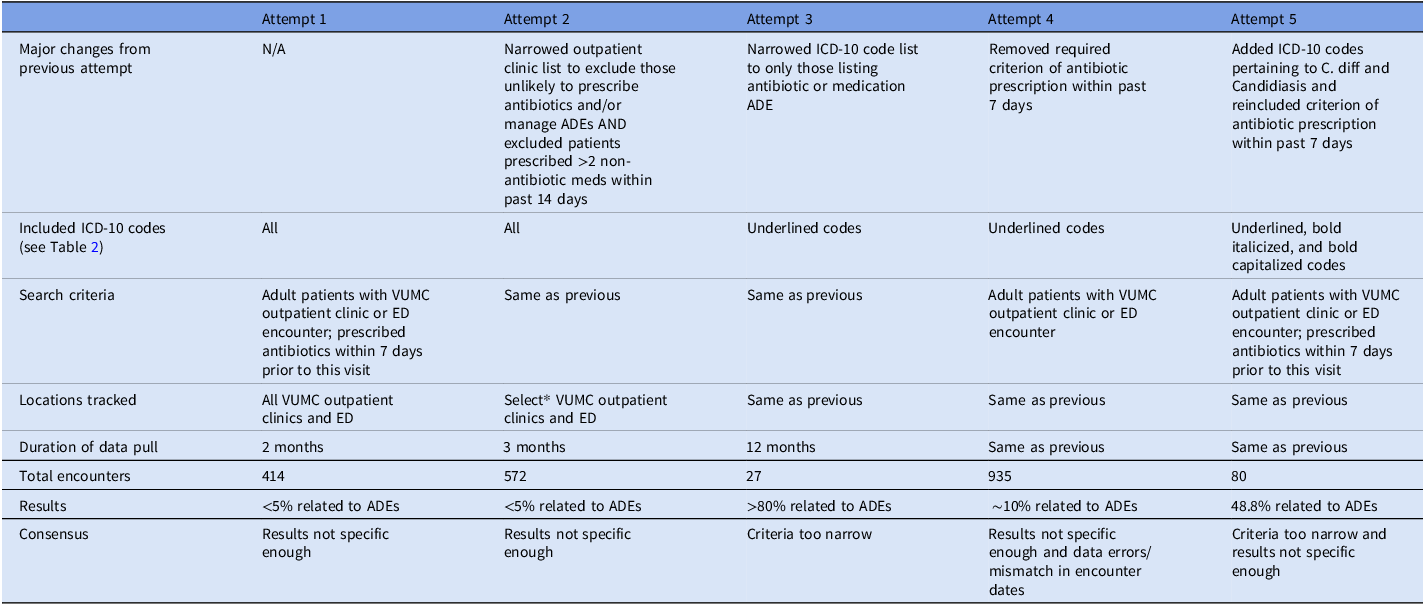
We attempted to automate the identification of antibiotic-associated ADEs via electronic medical record (EMR) billing data. Based on experience, three authors (NP, MS, SO) compiled 134 ICD-10 codes representing potential common side effects from antibiotics experienced by adults (Table 1). Adult outpatient and emergency department encounters were included, excluding those that led to admission. Criteria evolved across five iterative exploratory attempts resulting in manipulation of time frame, clinics included, and ICD-10 codes to attempt to optimize yield. Manual chart review was performed on >10% of encounters (selected via a random number generator) for attempts 1, 2, and 4, and on all encounters for attempts 3 and 5 (Table 2).
ICD-10 codes classified by organ system

ALL CAPS and bold codes relate to Clostridium difficile; Bold italicized codes relate to candidiasis; Underlined codes related to adverse drug events.
Attempts at capturing antibiotic ADEs via electronic data pull

*Primary care clinics, walk-in clinics, medical sub-specialty, and surgical sub-specialty clinics.
Manual EMR review to ascertain ADE ICD-10 codes and evaluate antibiotic appropriateness
After limited success, focus shifted to estimating antibiotic ADE incidence and identifying ICD-10 codes used by providers to document antibiotic ADEs via retrospective chart review of encounters within 14 days of antibiotic prescription from eight VUMC WICs (8/1/23–10/31/23). Subsequent visit notes were manually reviewed for antibiotic ADEs, and billing codes were analyzed. For ADE cases, appropriateness of initial antibiotic choice, dose, and duration were assessed independently (NP, MZ) using national guidelines (Supplemental Table 1) and local antibiogram. Inappropriateness was defined as: (1) a non-first-line agent used without contraindication; or (2) a duration >3 days longer than recommended. Discordances were resolved by consensus.
Prospective antibiotic ADE capture
Further, WIC clinicians responsible for patient phone calls or return visits at these clinics were asked to voluntarily complete a REDCap survey (Supplemental Figure 1) when patients called or returned with antibiotic ADE symptoms within 14 days of receiving antibiotics at any outpatient VUMC clinic or ED (11/1/23–4/30/24). All REDCap entries were chart reviewed for antibiotic appropriateness using the same criteria described above.
Results
Electronic data extraction using ICD-10 codes
Results from the attempted electronic capture of patient encounters related to suspected antibiotic ADEs varied (Table 2). A range of 27–935 potential antibiotic ADE encounters were identified, of which <5% up to 81.5% were true antibiotic ADE encounters.
Retrospective chart review
From retrospective chart review of 1059 unique patient encounters (8/1/23–10/31/23), 69 (6.5%) had antibiotic ADEs documented in subsequent visits (Supplemental Figure 2). Antibiotic ADEs were the primary reason for the visit in 39 visits (56.5%), and secondary complaints in 30 visits (43.5%). Of the 69 encounters with documented antibiotic ADEs, 17 (24.6%) utilized a diagnosis/billing code that indicated a medication adverse event (Supplemental Table 2), more often in encounters when ADEs were the visit’s primary complaint.
The REDCap survey (11/1/23–4/30/24) recorded 45 patient calls and 3 return visits with antibiotic ADEs, 0.3% of 16,274 WIC visits with antibiotics during that same time.
Antibiotic appropriateness
Of the 69 retrospective chart reviews and 48 REDCap survey antibiotic ADEs, 17/69 (24.6%) and 6/48 (12.5%) antibiotic prescriptions were not indicated. Of the 94/117 (80.3%) combined that were indicated, 31/94 (33.0%) prescriptions had a wrong antibiotic selection (14/31, 45.2%), dose (11/31, 35.5%), or duration (7/31, 22.6%) (Supplemental Figure 3).
The most frequently reported side effect was gastrointestinal upset (43/11, 36.8%), followed by vaginal candidiasis (28/117, 23.9%) and rash (27/117, 23.1%). Less common side effects included facial/throat swelling, oral candidiasis, headache, fatigue, dizziness, and mouth sores/ulcers.
For our REDCap survey cohort, 13/48 (27.1%) reported no improvement in symptoms with antibiotic use.
Discussion
Outpatient antibiotic ADEs are not uncommon. Sustainable, efficient tracking remains challenging. Antibiotic-related billing codes (Table 1, underlined codes) are underused, and repeated attempts to identify ADEs electronically using ICD-10 codes—including those for symptoms or related infections like candidiasis—were unsuccessful.
Retrospective review of patients who received antibiotics revealed challenges in building a reliable electronic auditing tool. Among 69 encounters with documented antibiotic ADEs, 17 (24.6%) used ADE-related billing codes. Most used carryover diagnoses or symptomatic codes (eg, rash) without association with suspected causative medications, highlighting difficulties in using symptomatic ICD-10 codes for antibiotic ADE capture. Voluntary REDCap survey reporting accurately captured patient calls but grossly underestimated incidence and added significant documentation burden, limiting its sustainability and overall utility.
Few studies have successfully used ICD-10-based algorithms to track outpatient antibiotic ADEs in adults and highlight struggles with limited specificity, Reference Plasek, Amato and Salem7 and/or low sensitivity, especially for certain infections. Reference Livorsi, Linn, Alexander, Heintz, Tubbs and Perencevich8 Hence, while ICD-10 codes can support monitoring of antibiotic use, when used alone, they lack the accuracy to reliably capture outpatient antibiotic ADEs in adults.
Outpatient ADEs are likely under-reported and/or under-documented. The discrepancy between ADEs documented as secondary complaints and those reported by phone suggests patients are more likely to call to report ADEs rather than schedule visits. Implementing a standardized system for logging ADE-related patient calls could improve capture, but most EMRs currently lack associated diagnosis codes, limiting electronic tracking. Emerging AI tools like natural language processing (NLP) offer promise in identifying ADEs from unstructured notes; Reference Golder, Xu, OConnor, Wang, Batra and Hernandez9,Reference Chen, Gu and Ji10 however, standardization and integration challenges persist.
Notably, 23/48 (47.9%) of surveyed patients reported partial or no symptom improvement with antibiotic prescription, supporting the need for ongoing outpatient AS.
Limitations
Limitations included limited generalizability given single-center design including only adult encounters in WICs and short-term antibiotic ADEs occurring within 7–14 days of initiation. The REDCap survey participation was voluntary, likely leading to missed in-person encounters from busy WIC providers; however, three clinicians (EN, RT, AZ) handled all WIC phone calls, ensuring high capture of ADEs via calls. Survey responses involved some provider clinical judgment, which could misattribute complaints to antibiotics rather than other causes. Overall, these limitations more likely led to under-estimation of antibiotic ADE’s. Further, due to its exploratory nature, ICD-10 code search criteria and time frames varied across extraction attempts limiting direct comparison of quantitative yield across different strategies and their yield compared to the rate estimated by chart review. Finally, our strict criteria for antibiotic appropriateness, especially regarding duration, may have misclassified some longer courses as inappropriate.
Conclusion
Despite limitations, including likely under capture of antibiotic ADEs, our study showed that antibiotic ADEs are not uncommon, affecting at least >1 in every 20 outpatients who receive antibiotics, but lack of accurate ICD-10-code-based methods to capture antibiotic ADEs limits surveillance and intervention. Utilizing voluntary reporting increased capture of antibiotic ADE patient calls but was not comprehensive nor efficient. There is a critical need for innovative approaches and advanced tools to accurately identify and extract antibiotic ADE data to improve surveillance and reporting to support better patient safety and clinical outcomes.
Supplementary material
The supplementary material for this article can be found at https://doi.org/10.1017/ash.2026.10356.
Acknowledgements
None.
Financial support
None reported.
Competing interests
All authors report no conflicts of interest relevant to this article.
Research transparency and reproducibility
The datasets generated and analyzed during this study are not publicly available due to patient privacy and institutional policy restrictions. Deidentified data may be available from the corresponding author upon reasonable request and with appropriate institutional approvals. No custom code was used in this study.



 Open access

