Introduction
Ixodes uriae White is the only tick species found in Antarctica, and in our research area at Palmer Station it feeds predominantly on Adélie penguins. At the beginning of the summer the ticks leave their off-host aggregation sites, feed on penguins, then subsequently return to their off-host habitats, where they remain until the next summer (Benoit et al. Reference Benoit, Yoder, Lopez-Martinez, Elnitsky, Lee and Denlinger2007). These ticks have been implicated as a competent vector for Borrelia spirochetes (Olsen et al. Reference Olsen, Duffy, Jaenson, Gylfe, Bonnedahl and Bergström1993) and tick-borne viruses (Nuttall Reference Nuttall1984), and are thought to impact development, cause anaemia, alter the thermoregulation, and even lead to the death of penguins (Gauthier-Clerc et al. Reference Gauthier-Clerc, Clerquin and Handrich1998, Mangin et al. Reference Mangin, Gauthier-Clerc, Frenot, Gendner and Le Maho2003). In this report, we note a striking increase in the number of fed ticks found near Adélie penguin rookeries in 2007 compared to 2006, suggesting that the longer and warmer summer of 2007 may have permitted more ticks to find their hosts. High levels of parasitism could be detrimental to the already declining Adélie penguin populations near Palmer Station (Fraser & Patterson Reference Fraser, Patterson, Battaglia, Valencia and Walton1997).
Materials and methods
Numbers of non-fed and fed ticks were counted from five aggregation sites in January 2006 and 2007. Two of the aggregations, located on Humble Island, were 3 and 4 m from the nearest penguin rookeries; the other three colonies were on Cormorant Islands (2, 4, and 6 m from the nearest penguin colonies). No other bird nests or other hosts were noted within 10 m, except for occasional visitors. In order not to skew the results the ticks counted during the first year were returned to the colonies. The numbers of fed and non-fed nymphs and adult females were recorded. Males do not host feed and thus were not used for this study; larvae were not included in the survey because the small, non-fed larvae are hard to find. Temperatures for the tick colonies were determined using HOBO temperature recorders (Onset Computer, Pocasset, MA, USA) according to Schulte et al. (Reference Schulte, Elnitsky, Benoit, Denlinger and Lee2008) in 2006 and 2007. ANOVA was used to compare results.
Results
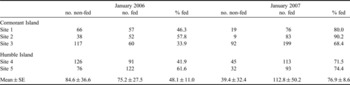
There was no difference in the total number of ticks present in the two years. Although different numbers of ticks were present at the five sites, the numbers at each site were fairly consistent between the two years (Table I). The major difference was in the proportion of fed ticks between the two years: significantly more fed individuals were present in the second year (ANOVA; P < 0.05). Differences were evident between individual colonies, but the frequencies of blood feeding were consistently higher at all sites during the second year. The percentage fed in 2006 varied from 42–62% and in 2007 from 68–90% (Table I). Temperatures during the 2005–2006 summer near Palmer Station were consistently above 0°C only after 5 December, but during the 2006–2007 summer, temperatures exceeded 0°C by 18 October, nearly seven weeks earlier.
Frequency of blood feeding in adult females and nymphs of Ixodes uriae collected near Palmer Station, Antarctica, on two successive years.

Discussion
Recently, studies have identified continued warming as a threat to the survival of penguins (Le Bohec et al. Reference Le Bohec, Durant, Gauthier-Clerc, Stenseth, Park, Pradel, Grémillet, Gendner and Le Maho2007). This suggests factors that increase with high temperature may negatively affect the Adélie penguins near Palmer Station. In this study, we document a higher proportion of engorged ticks in 2007 than in 2006 at five different aggregation sites. This increased tick feeding, along with the ability of I. uriae to transmit Lyme disease-like spirochetes and the observed decrease in penguin breeding, suggests the possibility that an increased parasite load may be increasing stress on the penguins. It is also important to note that chicks of other birds are negatively impacted by heavy tick infestations, even to the point where mortality is increased (Bergstrom et al. Reference Bergstrom, Haemig and Olsen1999). One possible reason for the higher proportion of fed ticks is that temperatures in the tick habitat rose above 0°C nearly seven weeks earlier in the summer of 2006–2007 than in the summer of 2005–2006 (Schulte et al. Reference Schulte, Elnitsky, Benoit, Denlinger and Lee2008). This period of higher temperature early in the summer corresponds with the time when many ticks are host questing, a response that only occurs when temperatures are above freezing, when snow cover is reduced, and when extended periods of darkness are still prevalent. The potentially extended feeding time may allow more ticks to locate a host. This could shorten the life cycle of I. uriae to a minimum duration of four years, a characteristic of this species in warmer regions where they routinely feed every year (Murray & Vestjens Reference Murray and Vestjens1967, Frenot et al. Reference Frenot, De Oliveira, Gauthier-Clerc, Deunff, Bellido and Vernon2001). The size of the Adélie penguin populations could also influence the incidence of tick blood feeding. We have no specific information on population size of the penguins, but there was no obvious difference between these two years. Also, based on recent trends, it is likely that the population dropped somewhat from 2006 to 2007 (Fraser & Patterson Reference Fraser, Patterson, Battaglia, Valencia and Walton1997). Our current observations, of course, are not sufficient to link cause and effect, but the results point to a potential relationship that may merit further monitoring if the warming trend continues and the Adélie penguin population continues to dwindle near Palmer Station.
Acknowledgements
This research was funded by NSF grants (OPP-0413786 and OPP-0337656). Antarctic support for this research was provided by the staff of Palmer Station.