Introduction
The nasal conchae are important anatomical structures of the nasal cavity located along the lateral nasal wall. The middle and superior nasal conchae, and the occasionally seen suprema concha, are parts of the ethmoid bone, while the inferior nasal concha is a distinct bone.Reference Navarro, Draf and Stamm 1 In the human embryo, the ethmoturbinal and the maxilloturbinal structures are the forerunners of the nasal conchae, and become apparent during the 8th to 10th weeks of fetal life.Reference Bolger, Kennedy, Bolger and Zinreich 2 The inferior nasal concha develops from the maxilloturbinal structure, while the uncinate process and the middle, superior and suprema conchae develop from the ethmoturbinal structure.Reference Bolger, Kennedy, Bolger and Zinreich 2
The term concha bullosa is generally used to describe pneumatisation of the middle concha and, rarely, of the upper or the lower conchae.Reference Unlu, Altuntas, Aslan, Eskiizmir and Yücel 3 The first medical description of pneumatisation of a middle concha was by Santorinus in 1739, while the first case of inferior concha bullosa was reported by Zinreich et al. in 1988.Reference Uzun, Aslan, Mahmutyazicioglu, Yazgan and Savranlar 4 , Reference Zinreich, Mattox, Kennedy, Chisholm, Diffley and Rosenbaum 5 Although pneumatisation of the middle concha is a frequent clinical finding, inferior concha bullosa is a rare occurrence.Reference Dawlaty 6 Inferior concha bullosa presents as an air sac inside the concha, which may be connected to the maxillary sinus.Reference Stammberger 7 The condition can be unilateral or bilateral.Reference Dawlaty 6 , Reference Dogru, Doner, Uygur, Gedikli and Cetin 8
This article presents a very rare case with bilateral pneumatisation of the superior, middle and inferior conchae in a patient with relevant symptomatology.
Case report
A 23-year-old man consulted our clinic for continuous nasal congestion, nasal drip and intermittent facial pain of 10 years' duration. The patient did not describe any history of nasal trauma.
Anterior rhinoscopy and nasal endoscopic evaluation revealed that the nasal septum was slightly deviated to the right, the nasal mucosa was slightly congested, both inferior conchae were hypertrophied, and the nasal mucosa was pale with some serous discharge.
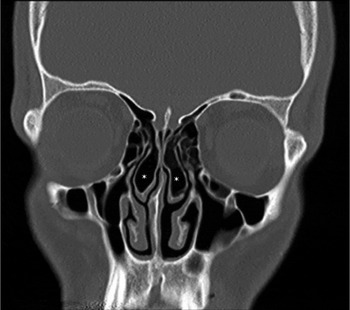
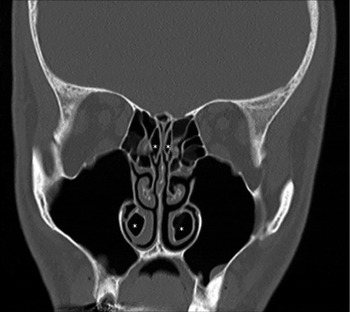
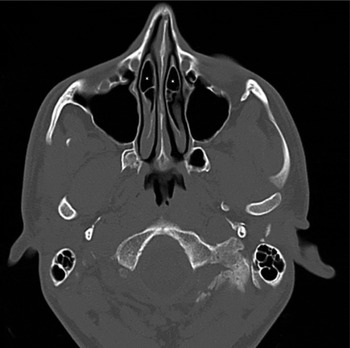
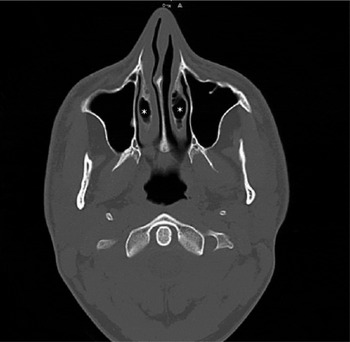
Paranasal sinus computed tomography (CT) with coronal, axial and sagittal views revealed that the inferior, middle and superior conchae were pneumatised bilaterally (Figures 1 to 4). However, the pneumatisations in all three conchae, bilaterally, were not so expansive as to make them apparent in the same coronal CT view. The air sacs in the pneumatised inferior conchae were isolated from the maxillary sinus and did not extend the entire length of the inferior turbinates. Both of the middle conchae bullosa were expansive. The septum was slightly deviated to the right, and agger nasi cells were present bilaterally.
Coronal computed tomography section showing bilateral, expansive middle turbinate pneumatisation.

Coronal computed tomography section showing bilateral superior and inferior turbinate pneumatisation.

Axial computed tomography section showing bilateral, expansive middle turbinate pneumatisation.

Axial computed tomography section showing bilateral inferior turbinate pneumatisation.

Under general anaesthesia, the limited septal deviation was seen endoscopically to consist of a protruding, cartilaginous septal spur, which was excised under endoscopic guidance. Lateral marsupialisation was performed for both middle conchae pneumatisations. For the two inferior conchae pneumatisations, the bullous structures were reduced by crushing, radiofrequency ablation and ‘out-fracture’, consecutively. Since the two superior conchae pneumatisations were not causing any significant clinical pathology, they were left untouched.
There were no post-operative complications. Follow-up evaluation indicated that the patient's headache and nasal obstruction had resolved, and he had no further complaints.
Discussion
The nasal conchae are important structures for the maintenance of normal nasal function. They warm, humidify and filter the inhaled air, thus regulating nasal air flow.Reference Cankaya, Egeli, Kutluhan and Kiriş 9 With the extensive usage of CT imaging as a diagnostic tool, variations in conchal anatomy are now more frequently encountered, and their significance regarding nasal air flow regulation and sinus disease aetiology is better understood.
Nasal obstruction usually originates from septal deformity or conchal hypertrophy. Frequently, the main causes of conchal hypertrophy are allergic rhinitis, vasogenic rhinitis, septal deviation and mucosal hypertrophy. Changes in conchal skeletal structure or increased respiratory mucosa volume may constrict the nasal passage. Due to its negative effect on paranasal sinus ventilation and mucociliary cleaning of the middle meatus, concha bullosa is thought to play a role in the development of sinusitis.Reference Stammberger 7 Symptomatic patients may require surgical intervention.
Anatomical variation of the nasal conchae is not uncommon. It is vital that otolaryngologists and radiologists are well aware of such anatomical variation when evaluating patients with nasal and paranasal sinus disease. Concha bullosa is the most frequently encountered anatomical variant of the middle concha; thus, the term concha bullosa generally implies middle concha bullosa. Concha bullosa is the partial or complete pneumatisation of the bulbous or lamellar sections of the nasal concha. There is ample information in the medical literature on the symptomatology and diagnosis of, and the therapeutic strategies for, the bullous middle conchae; however, the same is not true for inferior concha bullosa.Reference Unlu, Altuntas, Aslan, Eskiizmir and Yücel 3 , Reference Dogru, Doner, Uygur, Gedikli and Cetin 8 Without CT imaging, it is difficult to differentiate clinically between a hypertrophied inferior concha and pneumatisation. In the presented patient, the endoscopic view of the nasal cavity was not distinctive for pneumatisation of the turbinates, but CT imaging allowed us to diagnose the pathology. Inferior concha bullosa is usually asymptomatic, and detected as a random finding on paranasal sinus CT scans. Asymptomatic inferior concha bullosa does not require treatment.Reference Unlu, Altuntas, Aslan, Eskiizmir and Yücel 3
In those cases in which both the inferior and the middle conchae are pneumatised, the septum is either straight or only slightly deviated. In our patient, the septal deviation was limited to a septal spur, a protruding cartilaginous structure which was excised endoscopically.
In cases of inferior concha bullosa, Dogru et al. proposed excision of the lateral surface of the inferior concha anteroposteriorly.Reference Dogru, Doner, Uygur, Gedikli and Cetin 8 Ozcan et al. performed out-fracture in a case of inferior concha bullosa.Reference Ozcan, Gorur and Nass Duce 10 Unlu et al. noted that partial turbinectomy for inferior concha bullosa cases without an extension into the maxillary sinus, and partial resection of the inferior concha for those that have, would lead to iatrogenic inferior meatal antrostomy.Reference Unlu, Altuntas, Aslan, Eskiizmir and Yücel 3 These authors stated that such an approach would impair maxillary sinus physiology, and would induce a phenomenon of mucus recirculation between the natural ostium and the point of antrostomy. In Yang and colleagues' retrospective, 2008 study of 59 238 sinonasal CT scans taken over 12 years, only 16 patients presented with inferior concha bullosa, of which only 2 had the condition bilaterally.Reference Yang, Chong, Wang, Xian and Chen 11
Despite Yang and colleagues' huge series, they encountered no cases of bilateral triple turbinate pneumatisations, as seen in our patient. Despite an extensive search of the medical literature, we could locate only one description of extensive turbinate pneumatisation involving anywhere near as many conchae as in our patient: a report published in 2003 by Braun and Stammberger, describing pneumatisation of five of the six conchae.Reference Braun and Stammberger 12 These authors preferred to resect only the lateral surface of the middle concha bullosa, in order to improve nasal air flow, and left the other turbinates intact so as not to affect mucociliary drainage.
In our patient, we chose to correct the septal deviation by endoscopic septoplasty under general anaesthesia, and then performed lateral marsupialisation of both middle conchal pneumatisations. For the two inferior conchae pneumatisations, we preferred reduction of the isolated bullous structure by crushing, radiofrequency ablation of soft tissue, and out-fracture of the whole inferior conchae. The superior conchae pneumatisations were left intact since they had no visible pathological consequences.
-
• Concha bullosa is pneumatisation of intranasal conchae (generally the middle concha)
-
• Cases of superior and inferior concha bullosa are rare
-
• A very rare case of bilateral triple conchae pneumatisations is reported
-
• The term ‘conchae bullosis’ is proposed for such cases, instead of ‘conchae bullosa’
The number of multiple concha bullosa cases in the medical literature is gradually increasing, with the presented case having the greatest number of involved conchae reported to date. We believe that increased reporting of symptomatic cases of single and multiple conchal pneumatisations will facilitate the development of a case-specific surgical approach for such patients.
In light of our patient's multiple conchal pneumatisations, we propose, as an addendum to current medical terminology, that such multiple turbinate pneumatisations be termed ‘conchae bullosis’ rather than ‘conchae bullosa’, in a similar fashion to the use of nasal polyposis as the plural form of nasal polyp.
When planning surgery, the relationship of the bullous conchae to the maxillary sinuses, the nasal septum, and the inferior and middle meatus should be taken into consideration. Computed tomography plays an important role in diagnosis and treatment planning. Asymptomatic cases do not require treatment.