As healthcare becomes more focussed on patient-centred care, healthcare systems and physicians across the United States are becoming increasingly focussed on maximising patient satisfaction.Reference Detsky and Shaul 1 This recent focus on patient experience has made patient satisfaction a healthcare quality metric that can be used to evaluate healthcare systems and physicians.Reference Detsky and Shaul 1 , Reference Fenton, Jerant, Bertakis and Franks 2 Patient satisfaction survey scores have been used in adult medicine for over 10 years. In addition, the latest data show that only 2.2% of hospitals achieve a five-star rating. 3 To combat these issues, Consumer Assessment of Healthcare Providers and Systems (CAHPS)® surveys were created to measure patient experience. New surveys are being developed to measure the experience in new areas such as emergency departments, nursing homes, and hospice care, but the investigation of paediatric data is limited.
Patient satisfaction not only affects hospitals rankings, but also impacts physicians individually. Although every physician’s goal is to heal his or her patient, ensuring a positive patient experience has been shown to have a positive impact on health outcomes – for example, it has been shown that satisfied patients are more adherent to physician recommendations.Reference Glickman, Boulding and Manary 4 – Reference Beach, Sugarman, Johnson, Arbelaez, Duggan and Cooper 6 In terms of physician impact, satisfied patients are more loyal to their physicians.Reference Fenton, Jerant, Bertakis and Franks 2
Patient satisfaction surveys
Families play an essential role in the health of children, and excellent paediatric care has to be centered on the family as well as the child.Reference Glickman, Boulding and Manary 4 Methods to improve healthcare and patient satisfaction are unique depending on the medical specialty. Unlike many other medical specialties, physicians and institutions that specialise in paediatric care have dual patients – the actual patient and the child’s parent(s) and/or caregivers.Reference Homer, Marino and Cleary 7 In paediatrics, parent(s) and/or caregivers of children are required to consent to medical treatments, and therefore are heavily involved in patient care. Owing to their central role in patient care decisions, parent(s) and/or caregivers can evaluate their experience with their children’s physicians. As a result, parental satisfaction is an important outcome in paediatric care, and hospitals that care for children focus on improving their quality of care based on parental reports of satisfaction.Reference Homer, Marino and Cleary 7
Paediatric cardiology
Paediatric cardiologists care for children with a gamut of severity from benign murmurs to life-threatening cardiovascular problems. Regardless of the severity of the case, parents are, naturally, nervous when their children are referred for a cardiology evaluation. Family expectations are high regardless of the severity of diagnosis. This requires that both parents and/or caregivers and their children receive high-quality medical services, including emotional support from their healthcare providers. Therefore, it is crucial that paediatric cardiologists understand how to create the most effective and supportive patient experience for both the parents and their children.
A range of studies on how to increase patient satisfaction ratings exist, but they lack the specificity of key factors to adequately guide doctors and hospitals on how to improve patient experience.Reference Thiedke 5 , Reference Nichols, Horner and Fyfe 8 Determining clear, focussed approaches will help physicians meet patient expectations while also improving quality of care. Although many patient satisfaction surveys are being used to evaluate hospital performance, adequate number of studies have not been carried out to improve service performance based on physician specialty. Understanding patient needs specifically by specialty would inform specialists about how they might focus their efforts to improve patient experience and, ultimately, create better health outcomes. This article illustrates key factors that have the most impact on overall patient experience in the ambulatory paediatric cardiology setting.
Methods
This was a retrospective study of 2468 children satisfaction survey responses collected by Press Ganey (South Bend, Indiana, United States of America) from 1 January, 2013 to 28 February, 2015 (26 months) through convenience sampling in the area of outpatient paediatric cardiology at an academic integrated Children’s Health System. Survey responses are from the parent(s) and/or caregivers of outpatients who visited paediatric cardiologists across several locations in four states: Florida, Delaware, Pennsylvania, and New Jersey. Given that these data were collected for purposes of quality assurance, response rate and response bias are issues that cannot be addressed and are noted as limitations of our study in the discussion. However, it is important to note that these data are “real-life” data, and, although limited in research design, they are highly used in practice.
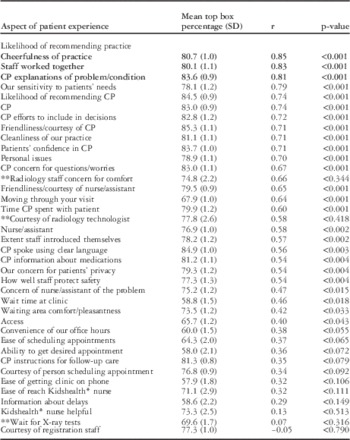
Respondents were invited to complete a survey if they had an appointment with a paediatric cardiologist; thus, responses include the experiences of outpatient care received by children with a wide range of symptom severity and cardiovascular problems. Surveys were sent to patients’ parent(s) and caregivers via United States Postal Service or via e-mail after a patient ambulatory paediatric cardiology visit. Patients’ parent(s) and/or caregivers completed the standard Press Ganey Physician Specialties Survey®, which consists of 39 factors regarding patient experience, see Table 1 for full survey.
Associations between likelihood to recommend (LTR) and patient experience.

CP=care provider
* Kidshealth is a Nemours Center for Children’s Health Media that is dedicated to the creation of health-quality, family-friendly media aimed at helping parents and kids understand children’s health issues
**Based on 3 months data
Participants were asked to rate their experience on 39 factors of patient experience, and were rated on a 1–5 Likert-scale: a score of 1 demonstrated a “poor” experience, whereas a score of 5 demonstrated “very good” experience. To protect patient anonymity, other data including patient demographics and encounter information – for example, dates, physician seen, etc. – were removed before release to the research team. Moreover, this study was submitted to the Nemours Institutional Review Board and was determined to be a quality-improvement project.
Data management and statistical analyses
Likelihood to recommend is the standard measure reported in hospital studies of this type; moreover, it is known that the likelihood to recommend the care provider heavily influences the overall likelihood to recommend. Congruent with studies of this type, in this study, likelihood to recommend was treated as the dependent variable. The remaining items – a total of 38 – from the patient satisfaction survey were considered independent variables – that is, factors describing other aspects of the practice, including staff, physician, and healthcare facility.
Top-box monthly scores (% of scores with a 5 out of 5 rating) were used to test the association between likelihood to recommend and patient experience. Tests of association were conducted with a Pearson Product-Moment correlation (r). All tests were two-tailed, and a p-value <0.001 was considered statistical significant. Statistical tests were performed in SPSS 23.0 (IBM; Armonk, New York, United States of America).
Results
Although 16 of our survey questions resulted in strong and significant correlation coefficients (r>0.6), this study focussed on the significant correlations with the strongest coefficient. It was found that the three strongest indicators of the likelihood to recommend the practice were “cheerfulness of practice” (r=0.85, p<0.001), “staff working together” (r=0.83, p<0.001), and “care provider explanations of problems or condition” (r=0.81, p<0.001). The associations that demonstrated the lowest significant correlation coefficients (r>0.6), representing weaker indications of the likelihood to recommend the practice, were “friendliness/courtesy of nurse/assistant” (r=0.65), “moving through your visit” (r=0.64), and “time care provider spent with patient” (r=0.60; all p<0.001).
Although not significant, it is important to note the weakest correlations were related to “information about delays”, “Kidshealth nurse helpful”, “wait for X-ray tests”, and “courtesy of registration staff”, with correlation coefficients of 0.29 (p<0.149), 0.13 (p<0.513), 0.07 (p<0.316), and −0.05 (p<0.790), respectively (see Table 1).
Discussion
Patient experience is becoming an important quality measure in healthcare. Higher patient satisfaction is associated with lower inpatient mortality rates, and lower 30-day, risk-standardised hospital re-admission rates.Reference Glickman, Boulding and Manary 4 , Reference Boulding, Glickman, Manary, Schulman and Staelin 9 Understanding the importance of patient experience is essential, especially by paediatric cardiologists because of the spectrum of severity from benign murmurs to life-threatening cardiovascular problems seen in their patient population.
This study aimed to establish the key determinants of patient satisfaction in paediatric cardiology. Although the patient–physician relationship is a core component of patient satisfaction, the results suggest that cheerfulness of the practice, a cohesive staff, and a care provider’s explanations of problems or conditions influence patients’ overall experience for an ambulatory paediatric setting. The following suggestions are provided to help physicians improve these components of their practice and are supported by other studies that have focussed on how to accomplish these goals.
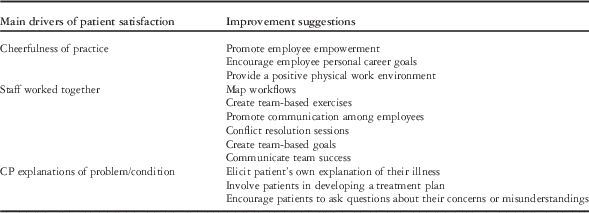
In the present study, the strongest predictor of overall patient satisfaction in paediatric cardiology was “cheerfulness of practice.” Our findings support previous studies that have documented compassion, willingness to help, and promptness of a physician’s staff as the most important factors within staff care that attributed to patient satisfaction.Reference Otani, Kurz and Harris 10 Institutions and healthcare practices can create and promote a cheerful environment by promoting employee empowerment, encouraging employees to have personal career goals, providing a positive physical working environment, and overall showing employees that they are cared for.
The second strongest predictor of overall patient satisfaction was how well staff worked together. Numerous tasks are involved in a patient’s ambulatory visit, for example, registration, rooming, ordering studies, making referrals, and refilling prescriptions. Having numerous tasks that are often complex can increase the chance of either a medical error or a lapse in service experience. By mapping these workflows, a team can uncover waste and unsafe practices, inform improvement efforts, and serve as a valuable team-based exercise.Reference Sinsky, Willard-Grace, Schutzbank, Sinsky, Margolius and Bodenheimer 11 This efficient system can reduce complexity. In addition, employers can nurture team spirit by promoting communication among employees, clarifying the common goals of the work they are doing, working out ways to resolve conflicts among employees, making sure team members interact and have a voice at meetings, and communicating team success.
The third strongest predictor of overall patient satisfaction was how well the cardiologist explained problems and conditions. The relationship between doctors and patients affects patients’ biological and psychological quality of life, compliance, and satisfaction.Reference Dorr Goold and Lipkin 12 Previous studies have demonstrated that patient satisfaction with outpatient care is strongly influenced by the clinician providing clear information that addresses a patient’s concerns.Reference Homer, Marino and Cleary 7 In addition, it is important for a physician to elicit a patient’s own explanation of his or her illness and involve patients in developing a treatment plan.Reference Dorr Goold and Lipkin 12 Doctors can ensure that patients and their families have their concerns addressed by directly asking them to recall the information they understood and by encouraging them to ask questions about their concerns or misunderstandings. This gives patients and their families the sense that they have been heard and have some sense of control over their illnesses and treatments.
Although these parameters are helpful for paediatric cardiologists, this study did not include patients who were admitted to the hospital. In addition, patients were not screened for condition severity or for tenure with the physician. Patient satisfaction surveys have limitations only based on the nature of how they are obtained. First, satisfaction survey data are not random. Thus, we recognize that there is an issue of bias and response rate that limit external validity and to a lesser extent internal validity. Moreover, the surveys used in this study were mail and e-mail based, and therefore excluded participants who did not have a permanent address, access to the internet, or illiterate. Second, children surveys are completed by parents and/or caregivers, not by the patients themselves. Thus, perceptions of care are not a measure of the patient’s experience only. There are also many adults who are seen by paediatric cardiologists; therefore, there is a possibility the surveys were completed by patients who were not representative of the paediatric population. In addition, although paediatric cardiologists have cases varying in severity, a majority of patients do not have life-threatening diseases. Therefore, a further limitation in this study is that these results likely represent what is important to parents of children who do not have life-threatening diseases. Parents of children with more severe diseases may have ranked what they found to be important differently. Finally, patient satisfaction surveys are site specific, and therefore have limited generalisability, such as our findings and those of other research groups. These are methodological issues that could affect what a patient considers important throughout his or her patient experience as well as the results obtained in our study.
Ultimately, the cheerfulness of practice, a cohesive working staff, and a physician’s explanations of problems and conditions were the most significant drivers of patient experience in paediatric cardiology. This study focussed on determining the three most impactful components of patient experience and also to provide information on how physicians can make appropriate changes to improve their patient satisfaction scores (summarized in Table 2). Although it may seem likely that these components may also be prioritised in other paediatric specialties, further studies can be performed to understand how differently the patient experience components can vary with specialty. In addition, future studies focussed on paediatric cardiology can include observing how enhancing certain aspects of patient experience can affect patient outcomes.
List of suggestions that may help improve patient satisfaction in paediatric cardiology care settings.

CP=care provider
Finally, although components of patient experience, such as dealing with appointment scheduling and wait times, did not have a high correlation with patient satisfaction scores; nevertheless, they should not be deemed insignificant, as they still affect overall patient experience.
Conclusion
Patient experience has become a central focus to health systems across the United States. As the field of patient experience design continues to grow, it is important for specialists and specialty systems to focus on the aspects of patient experience that can most greatly contribute towards meeting patient needs. This is especially important in the field of paediatric cardiology where parents seek care for their children with potentially life-threatening conditions. For other families referred to a paediatric cardiologist for non-life threatening conditions, such as heart murmur, syncope, and chest pain, the level of concern of parents can also be extremely high. Therefore, re-assurance and clear communication by the cardiologist are essential. This study demonstrated that the three most important aspects of patient experience with respect to paediatric cardiologists were the cheerfulness of their practice, a cohesive staff, and a care provider providing explanations of their problems or conditions. These aspects of patient experience serve as the strongest indicators of excellent patient satisfaction ratings. Awareness of how doctors can personalise a patient’s experience is vital to achieve greater patient satisfaction and, ultimately, better patient outcomes.
Acknowledgements
This study was submitted to the Nemours Institutional Review Board and was determined to be a quality-improvement project.
Financial Support
This research received no specific grant from any funding agency or from commercial or not-for-profit sectors.
Conflicts of Interest
None.