Introduction
Psychologists agree that personality is shaped by a combination of physiological and enduring social factors (McCrae, Costa, Ostendorf, Angleitner, Hrebícková, Avia, Sanz, Sánchez-Bernardos, Kusdil, Woodfield, Saunders & Smith, Reference McCrae, Costa, Ostendorf, Angleitner, Hrebícková, Avia, Sanz, Sánchez-Bernardos, Kusdil, Woodfield, Saunders and Smith2000). However, relatively little research has been carried out on the effect of social, cultural and linguistic factors on personality traits at an individual level (Pervin & Cervone, Reference Pervin and Cervone2010). As researchers in multilingualism we are keen to find out whether bilinguals’ personality profiles might differ from the personality profiles of monolinguals, and whether the difference might extend to multilinguals.
We argue that a high level of multilingualism and multiculturalism represents the kind of enduring sociocultural influence that can shape personality. More specifically, we investigate whether multilingualism and the experience of having to function in a foreign language and culture for a certain length of time makes people more tolerant of ambiguity. Case studies and small-scale studies suggest that this might be the case (Bakalis & Joiner, Reference Bakalis and Joiner2004; Kinginger, Reference Kinginger2008). Individuals who are tolerant of ambiguity are more likely to perceive ambiguity positively (Budner, Reference Budner1962).
By focusing on the possible link between multilingualism and Tolerance of Ambiguity (TA) using a very large sample of participants (N = 2158), we hope to shed light on the psychological effects of multilingualism/multiculturalism. We see our study as an important complement to the rich ongoing research on the cognitive consequences of bi- and multilingualism (see Bialystok, Craik & Luk, Reference Bialystok, Craik and Luk2012).
In the following section we will look at the research on psychological aspects of multilingualism. We will then present our research instrument, the adapted Tolerance for Ambiguity Scale (Herman, Stevens, Bird, Mendenhall & Oddou, Reference Herman, Stevens, Bird, Mendenhall and Oddou2010), the design of our empirical study, our research questions and hypotheses. Subsequently, we will test four hypotheses using the data, collected through an online questionnaire. The findings will be discussed in the subsequent section. Finally, we will draw some conclusions and consider the implications of our findings for multilingualism research.
Literature review
We define multilinguals as people with at least partial mastery in a number of languages. In this we follow the recent trend in research to use the terms multilingualism and multilingual “in a broad, inclusive sense, in such a way that they include the concepts of bilingualism and bilingual within their respective ambits” (Aronin & Singleton, Reference Aronin and Singleton2012, p. 7). We will therefore use the terms “monolingual”, “bilingual”, “trilingual”, “quadrilingual”, “pentalingual” and “sextalingual”, which offers us a more specific categorisation of multilinguals to compare with monolinguals. We will also point out that all these terms can cover very different linguistic profiles, and we will present a more precise measure of multilingualism and multiculturalism, namely global language proficiency (representing the sum of oral and written knowledge in various languages).
Research on the effect of multilingualism on personality
The abundance of research on cognitive effects of bi- and multilingualism stands in contrast with the more limited interest in its potential psychological effects (Dewaele & van Oudenhoven, Reference Dewaele and Stavans2009). Some research has been carried out showing that participants knowing more languages typically report lower levels of communicative anxiety in their various languages, including their L1 (Dewaele, Reference Dewaele2010a, Reference Dewaeleb; Dewaele, Petrides & Furnham, Reference Dewaele and Li Wei2008). The knowledge of more languages, and the advanced knowledge of multiple languages have also been linked to higher levels of Openmindedness – which has much in common with TA (Furnham, Reference Furnham1994) – (Dewaele & Stavans, in press; Dewaele & van Oudenhoven, Reference Dewaele and Stavans2009, Korzilius, Van Hooft, Planken & Hendrix, Reference Korzilius, Van Hooft, Planken and Hendrix2011). People knowing more languages have been found to have higher levels of Cognitive Empathy (Dewaele & Li Wei, in press). These studies suggest that multilingualism is an enduring factor that can have a small but significant effect on some personality traits.
Research on Tolerance of Ambiguity
Furnham (Reference Furnham1994) points out that TA has been used in various branches of psychology where it was conceived as a property of cultures, organisations and individuals. Budner (Reference Budner1962) defined TA as the “tendency to perceive ambiguous situations as desirable” (p. 29). He argues that an ambiguous situation or stimulus may be defined as “one which cannot be adequately structured or categorised by the individual because of the lack of sufficient cues” (p. 30) and is characterised by one of the following three attributions: novelty, i.e. “a completely new situation in which there are no familiar cues” (p. 30); complexity, i.e. “a complex situation in which there are a great number of cues to be taken into account” (p. 30); and insolubility, i.e. “a contradictory situation in which different elements or cues suggest different structures” (p. 30).
Budner's measure remains popular in management and organisational psychology (McLain, Reference McLain1993). Psychologists have focused on various aspects of TA while maintaining Budner's original idea. McLain (Reference McLain1993), for example, defines TA as “a range, from rejection to attraction, of reactions to stimuli perceived as unfamiliar, complex, dynamically uncertain, or subject to multiple conflicting interpretations” (p. 184).
According to Furnham and Ribchester (Reference Furnham and Ribchester1995) TA “refers to the way an individual (or group) perceives and processes information about ambiguous situations when confronted by an array of unfamiliar, complex or incongruent cues . . . The person with low tolerance of ambiguity experiences stress, reacts prematurely, and avoids ambiguous stimuli. At the other extreme of the scale, however, a person with high tolerance of ambiguity perceives ambiguous situations/stimuli as desirable, challenging, and interesting and neither denies nor distorts their complexity of incongruity” (p. 179). TA is negatively correlated with measures of rigidity, authoritarianism, machiavellianism and dogmatism (Furnham & Ribchester, Reference Furnham and Ribchester1995).
Researchers have investigated the relationship between TA and a range of variables. We will focus on a small number of studies that are relevant to our research questions. Seravalle (Reference Seravalle2011) looked at foreign accents from a listener's perspective and linked perceptions of foreign accents to TA scores. Her argument is that “foreign accent, from a listener's point of view, is in essence ambiguous” (pp. 227–228). She hypothesised that a foreign accent could trigger discomfort and closure among individuals with low levels of TA, while individuals with higher levels of TA would display more flexibility and adaptability, leading on average to more successful performance (p. 228). These hypotheses were confirmed in a study with 150 listener-judges who were students at the University of London. The lower the level of TA, the harsher the judgements across all categories (p. 231).
In the same vein, Reiterer, Singh and Winkler (to appear) reported that high ability imitators scored higher on articulatory flexibility, possibly because they “must still possess this openness to build new phonetic categories on an ad-hoc basis, and not rely on pre-experienced, entrenched categories” (p. 16). The similarity with our definition of TA is striking, namely the capacity to perceive and process information that deviates from the usual patterns.
Tolerance of Ambiguity has also been identified as a possible characteristic of the “good language learner” in Second Language Acquisition (SLA) research because such a learner is “comfortable with uncertainty . . . and willing to try out his guesses” (Rubin, Reference Rubin1975, p. 45). Rubin (Reference Rubin and Griffiths2008) argued that the language learning process itself could make learners more comfortable with uncertainty once they realise “that change is an integral part of the language learning process” (p. 11). Chapelle and Robert (Reference Chapelle and Roberts1986) found that TA was a significant predictor of L2 proficiency. The authors point out that ambiguity is inherent to any L2 situation, but that it is lower in the L2 classroom where the teacher can lift the ambiguity on specific linguistic aspects compared to an immersion situation where learners have “to attend to all language cues simultaneously” (p. 31).
Oxford and Ehrman (Reference Oxford and Ehrman1992) reported that TA is a strong predictor of L2 learners’ learning strategies, especially “orientation to closure” which reflects the learner's inclination to reach a decision (p. 197).
Ely (Reference Ely and Reid1995) pointed out that a learner listening to an L2 perceives ambiguous input because of lack of familiarity with accent, pronunciation, unknown words or grammar. The ideal learner “is neither inhibited by low tolerance of ambiguity nor oblivious to linguistic subtleties. The student who is aware of, but not threatened by, linguistic differentiation, and who treats it as an occasion for introspection, experimentation and, ultimately, learning, is the one for whom tolerance of ambiguity will be a help, not a hindrance” (p. 93). This was confirmed in Baran-Lucarz's (Reference Baran-Lucarz2012) study on types of ego boundaries and accuracy in English L2 pronunciation. She found a weak positive correlation between pronunciation scores and a boundary representing “the subjects’ attitudes towards accepting objects, concepts and situations that lack clear borders” (p. 60).
A moderate level of TA thus seems optimal in SLA: learners with very low levels of TA might lack the willingness to take intelligent risks with the new language while learners with very high levels of TA might show an unquestioning acceptance and cognitive passivity (Oxford & Ehrman, Reference Oxford and Ehrman1992, p. 195). Teachers can help a student reach this optimal level of TA in the L2 class, where the student is no longer “embarrassed or unhappy at linguistic uncertainty”, but sees “himself or herself as a linguistic researcher or problem solver” (Ely, Reference Ely and Reid1995, p. 92).
Some researchers involved in study abroad studies have also considered a different perspective, namely the effect of the study abroad on various aspects of personality, including TA. Findings suggest that the combination of learning a foreign language while staying in a new cultural environment boosts learners’ appreciation of diversity, cross-cultural interest, cultural cosmopolitanism and makes them more critical of their own culture (Carlson & Widaman, Reference Carlson and Widaman1988). It is thus not surprising that Nishida (Reference Nishida1985) found that Japanese students with a high level of TA reacted better to an expatriate experience and reported less culture shock. Similar patterns emerged from the study by Bakalis and Joiner (Reference Bakalis and Joiner2004), which compared a small group of Australian students who had studied abroad with a similar group who had continued their studies in the home institution. A cross tabulation analysis showed that the study abroad group scored significantly higher on Openness and TA. Qualitative analysis showed that high Openness/high TA students were more likely to view study abroad as exciting, as an opportunity to make new friends and as a means to enhance their careers.
Research questions and hypotheses
The present study will address the following four questions:
1. Is the knowledge of more languages linked to higher levels of TA? We expect participants knowing more languages to score higher on TA.
2. Is advanced global proficiency of multiple languages linked to higher levels of TA? We expect that this is the case. We consider global proficiency as a corroborative but non-orthogonal measure to the number of languages known by participants.
3. Does growing up bilingually affect TA? We hypothesise that participants who grew up bi- or trilingually will score higher on TA.
4. Does living abroad affect TA? If that is the case, do those who have stayed abroad longer score higher on TA? Our expectation is that participants who have lived outside their homeland for more than three months will score higher on TA, and that those who have stayed abroad for more than a year will score higher than those whose stays did not exceed one year.
We choose three months because it corresponds with the minimal length of an internship in the Erasmus Programme, where European students spend up to a year of study in another European country. It is therefore a common lower limit for studies on effects of study abroad.
Method
Participants
A total of 2158 multilinguals (1589 females, 457 males, 112 participants did not provide this information) filled out the sociobiographical questionnaire (see Appendix A) and the research instrument (see Appendix B). The mean age was 34.5 years (SD = 12.1). Participants are generally highly educated with 31 having a high school diploma, 606 a Bachelor's degree, 712 a Master's degree, and 613 a Doctoral degree. This majority of highly educated, mostly female polyglots is typical for online language questionnaires (Wilson & Dewaele, Reference Wilson and Dewaele2010).
The participants reported 204 different nationalities, including many participants with double nationalities. The largest group came from the USA (n = 478), followed by British (n = 299); Dutch (n = 145); Belgian (n = 81), German (n = 81), Canadian (n = 76), Polish (n = 65), French (n = 58), Spanish (n = 42), Chinese (n = 41) and many language groups with smaller numbers. English was the most frequent L1 (n = 866), followed by Dutch (n = 195), French (n = 155), Spanish (n = 138), German (n = 124), Polish (n = 71), Chinese (n = 63), etc. The most frequent L2 was English (n = 924), followed by French (n = 455), Spanish (n = 248), German (n = 143), etc. The pattern was different for the L3 with French coming first (n = 424), followed by German (n = 330), English (n = 248) and Spanish (n = 222). The most frequent L4s were German (n = 205), Spanish (n = 196), French (n = 174) and English (n = 44). The most frequent L5s were Spanish (n = 101), Italian (n = 69) and French (n = 50). We also asked whether participants had lived abroad for longer than three months. Those who answered positively (n = 1421) were asked how long they had lived abroad. Of these participants, about a quarter reported having lived abroad for up to one year, the second quarter had lived abroad between two and four years, the third quarter had lived abroad between five and 10 years and the final quarter had lived abroad for more than 10 years.
Self-perceived oral and written proficiency in the various languages was measured through a five-point Likert scale (ranging from minimal to maximal fluency). Languages acquired early in life were typically mastered to a higher level compared to those acquired later.
The sample consists of 41 monolinguals, 399 bilinguals, 566 trilinguals, 557 quadrilinguals, 359 pentalinguals, 143 sextalinguals, 54 septalinguals, 21 octalinguals, 9 participants reported knowing 9 languages, 5 participants knew 10 languages, and 1 participant knew 12 languages. A single category was created including all participants with six or more languages. A majority (n = 1718) reported having a single L1, a minority reported growing up with two L1s (n = 422) and 18 participants grew up with three languages from birth (the latter two groups were aggregated).
Participants’ information on self-perceived proficiency in these languages was used to develop a global measure of multilingualism, first presented in Dewaele and Stavans (in pressReference Dewaele and Stavans). In order to distinguish multilinguals with limited knowledge of various languages from those with advanced knowledge of several languages, we calculated a measure of global proficiency, namely the sum of scores on oral and written proficiency for up to six languages (including two L1s) (maximal possible score 10 × 6 = 60). The global proficiency score is thus a more fine-grained measure of actual self-rated ability in oral and written skills in various languages than the mere number of languages acquired (and/or mostly forgotten) by the individual. Global proficiency scores vary between 5 and 55 with a mean of 25.5 (SD = 8.0). Participants were divided into three groups (low, medium, high). Participants with scores that were more than 1 standard deviation below the mean were categorised as “Low Proficiency” (n = 244), those with scores that were more than 1 standard deviation above the mean were categorised as “High Proficiency” (n = 278), while the remaining participants were categorised as “Medium Proficiency” (n = 1510). The creation of three groups allows us to focus on the groups of participants at either end of the continuum (see Dewaele et al., Reference Dewaele and Li Wei2008, where this method was used).
We are aware that our participants do not reflect the “general population” because of the high proportion of women and highly educated participants. We would like to argue that this is in fact a strength since participation in this type of questionnaire requires high levels of metalinguistic and metacognitive awareness, and a genuine willingness to complete the questionnaire accurately and completely (Wilson & Dewaele, Reference Wilson and Dewaele2010). The size of the sample ensures a good level of ecological validity. With two-thirds of our participants aged between 22 and 46 years, we managed to target experienced foreign language users rather than foreign language learners in schools and universities.
Instrument
Herman et al. (Reference Herman, Stevens, Bird, Mendenhall and Oddou2010) report that “measurement challenges” are often cited to explain conflicting findings regarding TA (p. 59). This motivated the authors to develop a psychometrically sound measure of TA, contextualised to cross-cultural contexts (p. 60). They present the Tolerance for Ambiguity Scale (TAS), which they describe as a “conceptually clear, internally consistent assessment tool” (p. 60). It is a 12–item questionnaire with five-point Likert scales. The authors used a Principal Components analysis and found four distinct dimensions which were labelled as follows: (i) valuing diverse others; (ii) change; (iii) challenging perspectives; and (iv) unfamiliarity (p. 62). Internal consistency of the four dimensions was not sufficiently robust to allow separate use, but the Cronbach alpha measure for the overall measure was acceptable at .73 (p. 61). The authors therefore describe their measure of TA “as a unitary but multifaceted construct” (p. 61).
We pilot-tested the TAS with 30 multilinguals. A subsequent Cronbach alpha analysis of the TAS scale revealed that one item dragged the overall alpha value down to below .60. When removed, the alpha Cronbach for the pilot test was .68. The item was removed from the final version of the questionnaire. After feedback from our participants, we also made some minor stylistic adaptations.
The 11 items of the TAS had to be rated on a five-point Likert scale anchored with 1 = “Strongly Disagree” to 5 = “Strongly Agree” (see Appendix B). The questionnaire was anonymous. The research design and questionnaires received ethical clearance from the appropriate committee at Birkbeck. The questionnaire was an open-access survey available for four months on Surveymonkey. It was advertised through several listservs, targeted emails to multilingual colleagues and their students in academic institutions, and informal contacts around the world. It remained online between December 2010 and March 2011. Because participants left occasional questions blank, totals for specific variables can vary. A Cronbach alpha analysis revealed modest but sufficient internal consistency reliability for the 11 items in the TAS: .64. A one-sample Kolmogorov Smirnov test showed that the TA values for 1990 participants who completed all items linked to TA are normally distributed. TA scores range between 4 and 44. Mean score for TA is 28.9, SD = 5.6.
Tolerance of Ambiguity scores were found to be positively correlated with Extraversion (r(1895) = .236, p < .0001) and negatively correlated with Neuroticism (r(1894) = –.127, p < .0001) (Eysenck, Eysenck & Barrett, Reference Eysenck, Eysenck and Barrett1985). TA was also positively correlated with Cognitive Empathy (r(1898) = .088, p < .0001) (Dewaele & Li Wei, in press). We will not discuss these relationships further as this falls outside the scope of the present research note.
A Pearson correlation analysis revealed a strong positive relationship between participants’ age and their TA scores (r(1956) = .084, p < .0001). A similar relationship was found between multilinguals’ age and scores on Trait Emotional Intelligence (Dewaele et al., Reference Dewaele, Petrides and Furnham2008). It seems that with age, we become more tolerant of ambiguity and more aware of our interlocutors’ states of mind. The positive correlation between age and TA has not been reported in the psychological literature to our knowledge. However, we feel that a discussion of possible causes falls outside the scope of the present paper. As a consequence, we consider age as a covariate in the present study, and we will opt for one-way ANCOVAs instead of one-way ANOVAs in order to remove the variance due to the association between age and TA. The assumptions for ANCOVA were checked for each of the variables. Bonferroni tests were applied for ANCOVA post-hoc comparisons. All alpha levels were set at .05 and preliminary analysis showed that no corrections were required.
An ANCOVA with age as a covariate and gender as main effect showed a complete absence of effect on TA (F(2,1980) = 1.44, p = ns). A second ANCOVA also showed that the level of education has no significant effect on TA: F(3,1985) = 0.85, p = ns).
The use of online questionnaires
Dörnyei (Reference Dörnyei2007) observes that the initial experiences with online questionnaires “have been sufficiently positive for this method to become established” (p. 121). The main benefit is of an “economic” nature. The automatic harvest of data into spreadsheets saves much time, limits transcription errors and the anonymity of participants enhances the level of honesty. Other benefits include superior access: larger and more diverse samples can be reached all over the world, and web-based research also makes it possible to include “small, scattered, or specialised populations which would otherwise be difficult to reach” (p. 121). Dörnyei mentions two potential problems with web-based research, namely participant self-selection and increased heterogeneity in the sample. Indeed, researchers who collect data via Internet cannot apply “a systematic, purposive sampling strategy, as all participants are self-selected” (p. 122). Indeed, once snowball sampling is initiated researchers wait until the numbers of participants filling out the questionnaire level off. This type of convenience sampling is also the most common strategy in pen-and-paper research (p. 121). Gosling, Srivastava, Pand and John (Reference Gosling, Srivastava, Pand and John2004) reported that web-based research has more advantages than disadvantages in terms of sampling. Their large-scale comparison of Internet and traditional samples in personality research revealed that Internet samples may not be representative of the population as a whole, but that they are more diverse in terms of gender, age, race, socio-economic status and geographical location than the traditional samples, which are typically undergraduates. Gosling et al. (Reference Gosling, Srivastava, Pand and John2004) also found no significant differences in scores of personality dimensions between the two groups, nor in patterns of socialising. Denissen, Neumann and van Zalk (Reference Denissen, Neumann and van Zalk2010) have reported that the psychometric properties of questionnaire measures are comparable in paper-and-pen and online versions. Wilson and Dewaele (Reference Wilson and Dewaele2010) have argued that random sampling in multilingualism research is “of less importance as participants must of necessity be a selected group of learners or users of a second language” (p. 108).
Another issue in Internet-based research is that of reliability. Indeed, there is no way of checking whether responses are truthful. Wilson and Dewaele (Reference Wilson and Dewaele2010) argued that “it is hard to see the attraction of falsifying answers to an online language history questionnaire” (p. 108). Gosling et al. (Reference Gosling, Srivastava, Pand and John2004) demonstrated that web-questionnaire results generalise across presentation formats and are consistent with results from pen-and-paper methods. After the presentation of two case studies of web-based research, Wilson and Dewaele (Reference Wilson and Dewaele2010) concluded that the advantages of web-based studies far outweigh the drawbacks.
Results
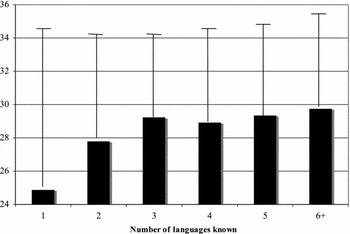
A one-way ANCOVA was conducted with the number of languages known by participants as independent variable and their level of TA as dependent variable, with age as a covariate. This indicated a small but significant effect of the number of languages: F(5,1984) = 8.7, p < .0001, η 2 = .021. Age was a significant covariate (F(1,1980) = 14.6, p < .0001, η 2 = .007), older participants scoring higher on TA. Participants knowing more languages scored higher on TA compared to those with fewer languages. A series of post-hoc pairwise comparisons with Bonferroni corrections showed significant differences between the monolinguals and all others groups (all p < .0001) with a smaller difference between the monolinguals and the bilinguals (p < .027). The bilinguals scored significantly lower than all other multilingual groups (p < .05, all cases) (see Figure 1 for the adjusted means and SDs). Speakers of three or more languages did not differ from one another. We note too that knowledge of more than one language decreased the dispersion of TA scores.
The effect of number of languages known on Tolerance of Ambiguity (means and SDs).

A one-way ANCOVA with age as a covariate showed that global self-perceived proficiency had a small but significant effect on TA (F(2,1978) = 6.0, p < .003, η 2 = .008). Age was a significant covariate (F(1,1978) = 15.1, p < .0001, η 2 = .008). Post-hoc pairwise comparisons, with Bonferroni correction, showed that for global self-perceived proficiency the TA scores of the “Low” group were significantly lower (p < .002) than those of the “High” group. No significant difference emerged between the Low and Medium group, nor between the Medium and the High groups.
A one-way ANCOVA with age as a covariate was performed to investigate the difference in TA between the 1597 participants who grew up monolingually after birth and the 422 participants who grew up with two or more languages from birth. No significant difference was found (F(2,1980) = .39, p = ns). Age was a significant covariate (F(1,1980) = 14.3, p < .0001, (η 2 = .007). A separate analysis revealed no significant difference in TA score between participants who had a bilingual upbringing compared to the 18 participants who were trilingual from birth.
A one-way ANCOVA with age as a covariate revealed that the 1421 participants who had experienced a stay abroad (i.e. a period of more than three months) scored significantly higher on TA than the 568 participants who had not lived abroad (Adjusted M = 29.2 compared to Adjusted M = 27.9 respectively (F(2,1980) = 11.0, p < .0001, η 2 = .011). Age was a significant covariate (F(1,1980) = 7.8, p < .005, η 2 = .004).
Next we focus on the 1421 participants who had lived abroad for more than three months. A one-way ANCOVA with age as a covariate was conducted to examine the effect of length of stay abroad on TA. Two groups were created: the “short stay” group who had stayed abroad between three months and one year (n = 345) (i.e. typically students in exchange programmes), and the “long stay” group who had stayed abroad for more than one and up to 55 years (n = 1078). The short stay group scored significantly lower on TA (Adjusted M = 28.5) compared to the long stay group (Adjusted M = 30.0) respectively (F(2,1410) = 5.5, p < .019, η 2 = .005). Age was not a significant covariate (F(1,1410) = 3.4, p = .064, η 2 = .002). Further correlation analysis showed that a longer period abroad (i.e. many years) was not linked to higher levels of TA within the long stay group.
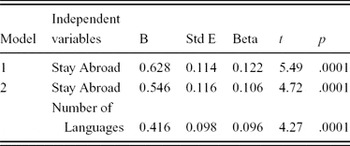
A Pearson Chi2 analysis on the whole database revealed that the group of participants who had stayed abroad had a large proportion of participants knowing many languages (Pearson-Chi2 = 84.2, df = 20, p < .0001). In order to find out how much unique variance in the TA scores is explained by the number of languages and the stay abroad, we carried out a stepwise regression analysis. For the stay abroad we distinguished four levels: from zero to three months abroad, between three months and one year, between one and 10 years, and over 10 years. The analysis reveals that the two independent variables contribute significantly to explaining the variance in TA scores (see Table 1).
Linear stepwise regression analysis for variables predicting Tolerance of Ambiguity.

Note: Model 1: r 2 = .014, F(1,1988) = 30.13, p < .0001; Model 2: r 2 = .024, F(2,1987) = 18.21, p < .0001.
As shown in Table 1, 2.4% of the variance of TA is explained by the model that included both independent predictors (stay abroad and number of languages). The inclusion of number of languages as an independent variable leads to a significant increase in the amount of variance explained in TA scores (r2 Change = .009, F Change (1,1987) = 18.2, p Change < .0001).
Discussion
The results show that multilingualism and aspects of individuals’ linguistic histories are linked to TA. Our first hypothesis was confirmed, participants knowing more languages scored significantly higher than those knowing fewer languages on TA, even though the effect size was small. The bilinguals occupied an intermediate position between the monolinguals and those with three or more languages. However, the scores of the trilinguals, quadrilinguals, pentalinguals and sextalinguals were no longer significantly different. This seems to suggest that once the threshold of three languages is reached, the effect of knowing additional languages no longer affects the level of TA. A similar pattern emerged in Dewaele and Stavans (in press) and Dewaele and van Oudenhoven (Reference Dewaele and Stavans2009), where the effect of knowing more languages on Openmindedness levelled off beyond knowledge and active use of respectively two and three languages. We interpret the effect on TA as an indication of multicompetence (Cook, Reference Cook and Macaro2010). The crucial aspect is that the presence of various languages in one mind has effects “that go beyond the actual knowledge of language itself” (Cook, Reference Cook and Cook2002, p. 7).
Our second, more fine-grained, hypothesis was also confirmed: a higher level of global proficiency in various languages was linked with higher TA scores. Similar effects for this corroborative variable were found on Openmindedness (Dewaele & Stavans, in press) and Cognitive Empathy (Dewaele & Li Wei, in press).
Our third hypothesis was rejected: participants who had been brought up bi- or trilingually did not score differently on TA compared to the majority who grew up monolingually, and no difference existed between those in bilingual or trilingual families. This suggests that the mere presence of two languages/cultures in one's environment is insufficient to boost TA. A child growing up in such a family is quickly aware of the two languages used between family members but they are both familiar. Further research is needed to see whether there might be variation according to the type of multilingual family and multilingual upbringing.
Our fourth hypothesis, concerning the effect of study abroad on TA was confirmed: those who had never stayed abroad scored significantly lower on TA compared to those who had stayed abroad for more than three months. Further analysis within the group who had stayed abroad revealed a significant positive effect of length of stay on TA up to the one-year mark, after which the effect fades. A regression analysis established that both the number of languages known and the stay abroad were significant independent predictors of TA. Here also the effect size was small. TA thus seems to be boosted by sudden massive exposure to unfamiliar languages and cultures (i.e. a “swim or sink” situation). We had no information about the age at which participants had found themselves abroad, which is a potentially important variable as individuals with different levels of cognitive maturity may react differently. The person arriving in a foreign country quickly realises that successful authentic communication in a foreign language requires a mental switch (Regan, Howard & Lemée, Reference Regan, Howard and Lemée2009). Bakalis and Joiner (Reference Bakalis and Joiner2004) found a similar effect of study abroad on Openness and TA among their Australian students. Those who had participated in a study abroad programme scored significantly higher on both dimensions.
Although a causal relationship between a high level of multilingualism and increased TA is very likely, it needs to be considered carefully. Schrauf (to appear) looked at the relationship between bilingual proficiency, and both psychological and social factors. He concluded that the causal pathway is in fact multidirectional, where proficiency is both a cause and an effect. Indeed, for our study one may argue that a higher level of TA strengthens an individual's curiosity and interest in foreign languages. Similarly, it could be argued that those participants who chose to live abroad might have scored higher on TA before their departure compared to those who did not live abroad. Indeed, Yashima (Reference Yashima2010) reported that participants who went abroad scored higher, before departure, on dimensions that reflect intercultural competence compared to control groups of peers who remained in the home institution. However, the fact that Yashima (Reference Yashima2010) found a significant increase in the scores of the volunteers on these dimensions at the end of the project offers further support for our hypothesis that TA increases as a consequence of intense multilingual interactions. Moreover, the fact that those who had been abroad for longer scored higher on TA than those who had been abroad for a short period suggests that the stay has a direct effect on TA. Although the effect seemed to stabilise past the first year abroad, it suggests that the continued exposure to a different language and cultural environment boosts TA. One possible explanation for the levelling off of the effect is that participants who had stayed abroad between three months and one year might have done so in educational exchanges, and as a consequence, could consider their period outside their home environment as an interesting parenthesis in their life, after which they were sure to reintegrate their familiar home environment. In other words, they might have felt more relaxed about not fitting into the host society since they never intended to develop roots there anyway. They could, to some degree, bury their head in the sand. On the other hand, those who had stayed for longer may have envisaged this new environment as a permanent home, and may therefore have strengthened their effort to value diverse others, to develop intercultural TA and to become bicultural. In the same vein, these people had to deal with unfamiliar situations, become aware of ambiguity in cross-cultural interactions and reflect on the differences between both cultures. In order to survive, they would have had to “stretch” themselves, manage conflicting perspectives and solve the paradox of “seemingly irreconcilable realities” (Herman et al., Reference Herman, Stevens, Bird, Mendenhall and Oddou2010, p. 63).
Conclusion
The present study shows that the effect of multilingualism extends beyond purely cognitive tasks. Our main finding is that the knowledge of multiple languages and the experience of having to survive in a foreign language and culture make individuals more tolerant of ambiguity. Although the effect of these independent variables is only modest, it establishes that a personality trait such as TA is linked to the knowledge of foreign languages and reflects sudden changes in the sociocultural and linguistic environment of individuals. We argue that the need to survive in a foreign environment forces people to become more attuned to differences and brings with it an awareness that their own values, beliefs and communicative practices are not necessarily shared by their interlocutors. We argue that the increased TA of multilinguals is a reflection of multicompetence (Cook, Reference Cook and Macaro2010), making them more tolerant individuals and therefore better citizens.
Appendix A. Background information

Appendix B. Adapted version of the Tolerance for Ambiguity questionnaire (Herman et al., Reference Herman, Stevens, Bird, Mendenhall and Oddou2010, p. 64)
1. I avoid situations where people don't share my values. [Reverse Coded]
2. I would like to live in a foreign country for a while.
3. I like to surround myself with things that are familiar to me. [Reverse Coded]
4. The sooner we all acquire similar values and ideals the better. [Reverse Coded]
5. I can be comfortable with nearly all kinds of people.
6. If given a choice, I would visit a foreign country rather than vacation at home.
7. A good teacher is one who makes you think about/consider your way of looking at things.
8. A good job is one where what is to be done and how it is to be done are always clear. [Reverse Coded]
9. A person who leads an even, regular life in which few surprises or unexpected happenings arise really has a lot to be grateful for. [Reverse Coded]
10. What we are used to is always preferable to what is unfamiliar. [Reverse Coded]
11. I like parties where I know most of the people more than ones where all or most of the people are complete strangers. [Reverse Coded]