Introduction
Famine is a catastrophic event in human societies, not only causing great suffering but also leading to major social disruptions. Due to the tragic nature of famine, the first thing that catches people's attention is ‘how many people died?’ Dying directly from starvation and malnutrition during the famine might not be the only consequences, however. According to Barker (Reference Lin and Yang1998, Reference Barker1992, Reference Barker2001), poor conditions experienced during the fetal period, especially malnutrition, may have serious negative consequences for an individual's health and longevity as adult. To be more specific, a baby's nutritional conditions before birth and during infancy could cause permanent changes influencing its susceptibility to various health problems later in life, including cardiovascular diseases, diabetes, hypertension, cerebrovascular disease and more. If Barker is correct, the serious consequences of the famine do not end with the famine itself; rather, the whole generation of famine survivors, especially those who were conceived or born during the famine, will face elevated risk for many kinds of illnesses and associated excess mortality during their entire lives.
Past research on famine provides mixed support for the fetal origins hypothesis. On the one hand, Kannisto et al. (Reference Kannisto, Christensen and Vaupel1997) show that the 1866–1869 Finnish famine increased the mortality rate of those born before and during the famine from birth to age 17, but did not affect adult mortality (after age 17). Stanner et al. (Reference Stanner, Bulmer, Andres, Lantseva, Borodina, Poteen and Yudkin1997) studied the Leningrad famine and report no difference in glucose intolerance, dyslipidaemia, hypertension or cerebrovascular disease in adulthood between those exposed and those not exposed to the famine. On the other hand, results from the Dutch hunger study show that exposure to the famine was associated not only with reduced birth weight and increased perinatal and infant mortality, but also with obesity later in life (Susser & Stein, Reference Susser and Stein1994; Ravelli et al., Reference Ravelli, Van Der Meulen, Michels, Osmond, Barker, Hales and Bleker1998). Recently, with the increasing availability of survey data in China, researchers have started to investigate the impact of the 1959–1961 famine from various perspectives. They have demonstrated that the famine increased the likelihood of stillbirth and miscarriage (Cai & Wang, Reference Cai and Wang2005), schizophrenia (St Clair et al., Reference St Clair, Xu, Wang, Yu, Fang and Zhang2005) and overweight and obesity at adulthood (Luo et al., Reference Luo, Mu and Zhang2006), and led to reduced adult height, labour supply and earning power (Chen & Zhou, Reference Chen and Zhou2007), providing some support for the fetal origins hypothesis.
Clearly, the fetal origins hypothesis has gone beyond its original formulation, which mainly focused on the effect of prenatal malnutrition on cardiovascular and cerebrovascular diseases; and has evolved into a comprehensive conceptual framework that is flexible and adaptable enough to explain not only a much broader range of health problems but also an increasing number of socioeconomic and demographic phenomena.
An alternative perspective on the relationship between famine and health and longevity comes from demographic insights regarding selection effects caused by differential mortality: famine may weed out ‘frail’ members of the population and leave the healthier and stronger ones; insofar as this is so, cohorts exposed to famine would be expected to have lower long-term mortality and morbidity than unexposed cohorts. Elo & Preston (Reference Elo and Preston1992, p. 195) mentioned this possibility but dismissed it on the ground that the probability that ‘genetic susceptibilities to death in childhood [are] positively correlated with genetic susceptibilities to death in adulthood’ is not high. Genetic susceptibility need not be the only factor at play, however. For example, the relationship between both infant and adult mortality/morbidity and socioeconomic status has been well established – higher socioeconomic status reduces both infant and adult mortality (Hobcraft et al., Reference Hobcraft, McDonald and Rutstein1984; Preston & Taubman, Reference Preston and Taubman1994; Gortmaker & Wise, Reference Gortmaker and Wise1997; Lleras-Muney, Reference Lleras-Muney2005). It would not be surprising to see that the excess mortality caused by famine also has a socioeconomic gradient. If this is the case, those exposed to famine will end up with a higher proportion of individuals with higher socioeconomic status, compared with pre- and post-famine cohorts, which in turn will result in lower average cohort mortality and morbidity afterwards.
The present research focuses on an important aspect of the 1959–1961 Chinese famine that has not yet been fully explored – the possible long-term mortality consequences of the famine – and directly tests the fetal origins hypothesis and selection effect hypothesis. Although the fetal origins hypothesis does not directly address the issue of mortality, mortality may be the best single indicator that can be used to test this hypothesis in a population-based study because the illnesses that are hypothesized to have fetal origins account for a significant portion of all deaths at adulthood (Kannisto et al., Reference Kannisto, Christensen and Vaupel1997). According to the Chinese Health Statistical Yearbook (Chinese Ministry of Health, 2004, 2005, 2006, 2007), the four diseases with fetal origins in Barker's formulation – diabetes, heart disease, hypertension and cerebrovascular disease – account for, from the youngest to the oldest age group, 5% to 50% of all deaths with a lifetime average of 40%.
If the fetal origins hypothesis correctly specifies the causal pathway that connects adult health status with fetal development, children conceived or born during the famine (the famine cohort) would inevitably have had higher mortality than children not conceived or born during the famine. By contrast, if the selection effect hypothesis holds, the exposed cohorts would have had a lower mortality than the unexposed cohort. The exposed group includes the cohorts born before the famine (who experienced famine as infants or young children) and the cohorts born during the famine (who experienced famine as fetuses or infants); while the unexposed group refers to cohorts born after the famine.
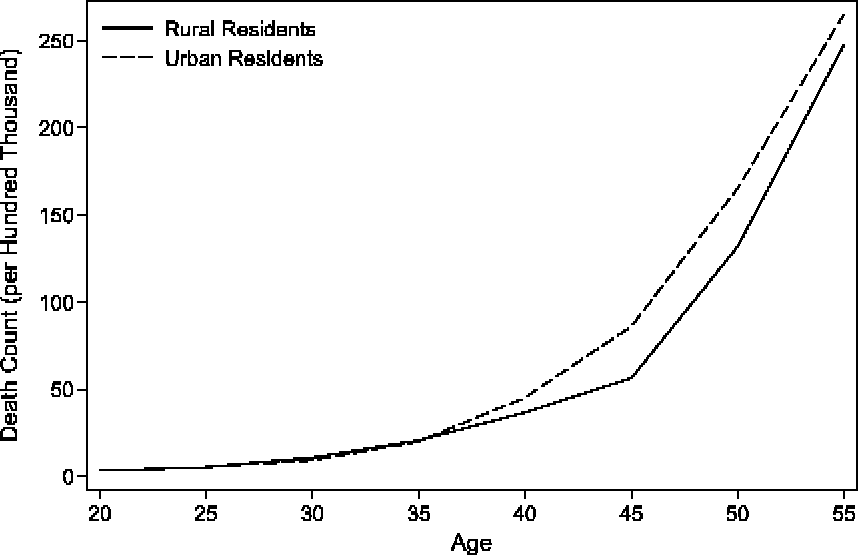
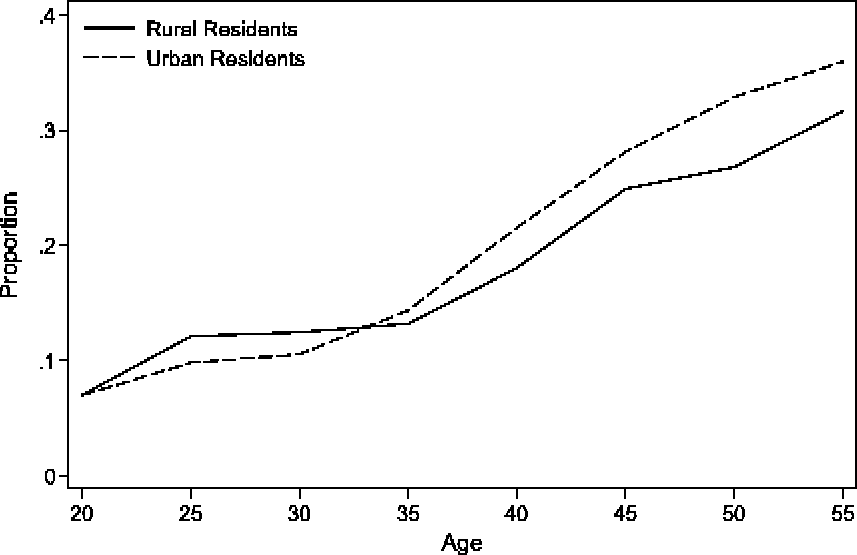
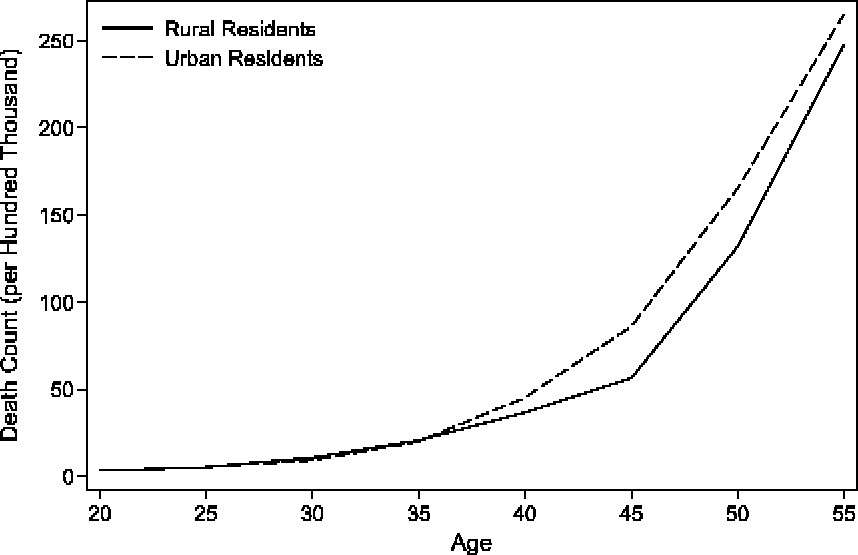
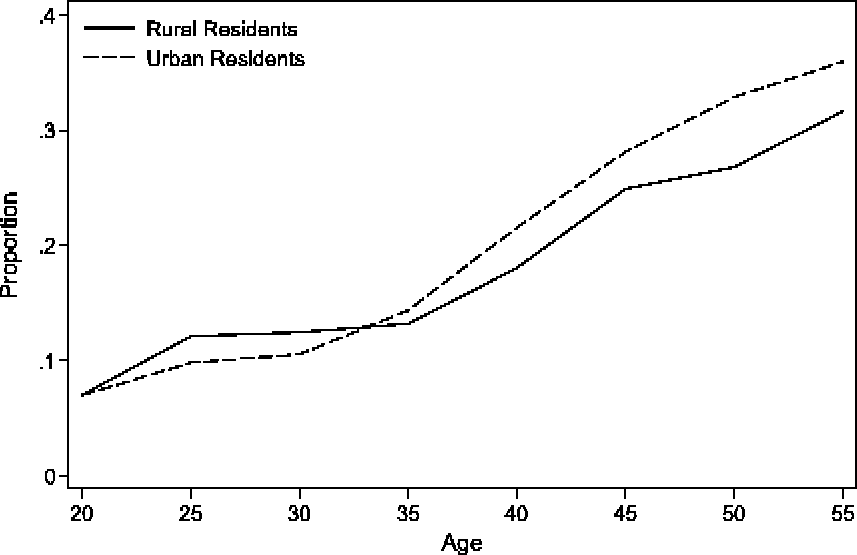
Results based on a sample of 343,973 Chinese children born between 1954 and 1967 selected from a large nationally representative sample survey show that, after controlling for the short-term mortality fluctuations, cohorts conceived or born during the famine do not suffer from elevated mortality up until their late 20s and early 30s. Supplemental analysis using aggregate population counts from Chinese Census reports shows similar patterns while extending the age coverage to the mid-40s and 50s. Calculated from the 2006 Health Statistical Yearbook, Fig. 1 shows the number of deaths by diabetes, heart disease, hypertension and cerebrovascular disease for each age group from 20 to 55, indicating a rapid rise at age 40–45. Also based on information in the 2006 Health Statistical Yearbook, Fig. 2 shows the proportion of deaths by diabetes, heart disease, hypertension and cerebrovascular disease in all deaths for each age group between 20 and 55. Proportion of deaths due to diseases that may be influenced by fetal programming jumps from around 10% in the 20s to around 20% in the 40s, and then to around 30% in the 50s. These results show that the two-step analytical strategy adopted in the present research, which combines individual-level data and aggregate census counts, captures sufficient number of deaths caused by diseases with fetal origins and the conclusions are highly relevant for the test of the fetal origins hypothesis.
Age-specific death count caused by diabetes, heart disease, hypertension and cerebrovascular disease, calculated using the 2006 Chinese Health Statistical Yearbook.
Age-specific proportion of deaths caused by diabetes, heart disease, hypertension and cerebrovascular disease in China, calculated using the 2006 Chinese Health Statistical Yearbook.
The rest of the paper begins with a brief description of the 1959–1961 Chinese Great Leap Forward Famine. Then the data, variables, statistical methodology and the main findings are introduced. The last section discusses the relevance of the new findings to the fetal origins hypothesis and the selection effect hypothesis, as well as potential shortcomings and possible next steps.
The ‘Great Leap Forward’ Famine and its long-term mortality consequences
It is widely accepted among China researchers that the three-year famine in 1959–1961 was triggered by a series of events, including several waves of accelerated agricultural collectivization, the nationwide establishment of the commune system, and especially the ‘Great Leap Forward’ movement begun in 1958 (Ashton et al., Reference Ashton, Hill, Piazza and Zeitz1984; Lin, Reference Lin1990; Lin & Yang, Reference Lin and Yang1998; Kung & Lin, Reference Kung and Lin2003). The goal of the Great Leap Forward was to accelerate the pace of industrialization and urbanization in China by mobilizing rural surplus labour to participate in labour-intensive non-agricultural productive activities, such as making iron and steel using backyard blast furnaces (Peng, Reference Peng1987). The results, however, turned out to be disastrous. Much of the iron and steel produced in backyards was useless, grain production declined partly because of a shortage of agricultural labour, and the rapidly expanding urban non-agricultural population resulting from the rural-to-urban migration exacerbated the food supply problem. Beginning in 1959, the second year of the Great Leap Forward movement, China experienced a severe famine affecting the whole country. Over 30 million people died from starvation or severe malnutrition and about 33 million births were either lost or postponed during the three-year period from 1959 to 1961 (Ashton et al., Reference Ashton, Hill, Piazza and Zeitz1984; Yao, Reference Yao1999), making this the largest famine in human history. The serious demographic consequences of the Great Famine put the Great Leap Forward to an end and sparkled policy debates among the highest leaders that eventually triggered the Cultural Revolution several years later (MacFarquhar, Reference MacFarquhar1974). Facing the serious socioeconomic consequences, the government had to send millions of unemployed peasant workers back to villages, and began to strictly implement the hukou system, an internal passport system designed to restrict rural-to-urban labour migration, on a national scale (Wu & Treiman, Reference Wu and Treiman2004). In a sense, the Great Leap Forward Famine is a watershed event in the early history of the PRC, marking the transition from a period of rapid recovery from war losses, economic prosperity and political stability to a period of economic stagnation and political turmoil.
Past research on the Great Leap Forward Famine focuses primarily on what happened during the famine: how many people died during that three-year period who otherwise would have lived (Ashton et al., Reference Ashton, Hill, Piazza and Zeitz1984; Peng, Reference Peng1987), how many miscarriages and stillbirths took place during that three-year period of time that otherwise would have been live births (Cai & Wang, Reference Cai and Wang2005), and who or what was responsible for this misfortune (Lin, Reference Lin1990; Lin & Yang, Reference Lin and Yang1998; Riskin, Reference Riskin1998; Lin & Yang, Reference Lin and Yang2000; Kung & Lin, Reference Kung and Lin2003). Only recently have researchers begun to expand their scope of observation from the three years between 1959 and 1961 to a much broader time period, from those who died during the famine to those who survived, and from the short-term consequences of the famine to the long-term consequences (St Clair et al., Reference St Clair, Xu, Wang, Yu, Fang and Zhang2005; Luo et al., Reference Luo, Mu and Zhang2006; Chen & Zhou, Reference Chen and Zhou2007).
The distinction between ‘short-term’ and ‘long-term’ effects is crucial. The biological mechanism of the short-term effect is straightforward: people are more likely to die if they do not have enough calories and nutrients. They face a higher mortality risk during the period of the famine because of malnutrition or even starvation; once the famine ends and food supply returns to normal, the elevated mortality risk should also drop to the usual level. All cohorts, young or old, are subject to the influence of the short-term effect. In this sense, the short-term effect of the famine can be characterized as ‘period effect’. Neither the fetal origins hypothesis nor the selection effect hypothesis is about period or short-term effects. Instead, they both predict that, among the surviving population, some cohorts will have higher than average mortality risk later in life because of the famine. They differ regarding the underlying mechanism through which the famine exerts its influence and in predictions about which particular cohort will have higher mortality. In the absence of secular mortality trends, while the fetal origins hypothesis emphasizes the importance of ‘biological programming’ or ‘biological imprints’ of prenatal malnutrition on fetuses and predicts that cohorts conceived or born during famine will have higher mortality, the selection effect hypothesis emphasizes the importance of differential (excess) mortality caused by the famine and predicts that the cohort born after the famine will have higher mortality relatively to cohorts born before and during the famine because the latter consists of famine survivors, who are generally stronger and healthier due to selection by the famine.
In order to test the two competing hypotheses regarding long-term mortality consequences of famine, short-term mortality fluctuations must be controlled for. Failure to do so creates biased estimates that lead to incorrect conclusions. Since the famine-born cohort has been exposed to the famine while the post-famine cohort has not, the famine cohort will definitely have higher overall mortality than the post-famine cohort, simply because of the excess deaths caused by malnutrition and starvation during the period of the famine. Only after the short-term mortality consequence of the famine has been effectively controlled for is it possible to evaluate the long-term mortality consequence of the famine.
To be more specific, the fetal origins hypothesis predicts that, in the absence of secular mortality trend and after controlling for short-term mortality fluctuations, the cohort conceived or born during the famine (1959–1962) has higher mortality than both cohorts born before and after the famine. Alternatively, the selection effect hypothesis predicts that, after controlling for short-term mortality fluctuations, both the cohorts born before and during the famine will have lower mortality than the cohort born after the famine.
Methods
Two sets of analyses were conducted in the present research. Using individual-level retrospective records of ever-married women's birth histories collected in 1988 and a multilevel generalized piecewise survival model with multiple clocks (cohort and period), the first set of analyses aims to assess patterns of cohort mortality differences between the famine cohort and the non-famine cohort, from birth to their mid 20s–30s. The second set of analyses uses aggregate cohort-specific population counts from the 1982 Census, the 1990 Census, the 1995 mini-Census (1% sample survey), the 2000 Census and the 2005 mini-Census (1% sample survey) to compare long-term relative mortality trends among the pre-famine, famine and post-famine cohorts. This second set of analyses extends the age range of the study population from birth to people in their mid-forties and fifties, when diseases known to be associated with fetal origins (diabetes, heart disease, hypertension and cerebrovascular disease) began to make significant mortality contribution, and helps to establish the robustness of the individual-level results.
The 1988 Two-Per-Thousand Fertility Survey
Data from the National Survey of Fertility and Contraception in China, also known as the Two-Per-Thousand Fertility Survey, is used to assess mortality consequences of the Great Famine in China. The survey was conducted in 1988 by the State Family Planning Commission. It covers all 29 provinces and a total of 2.1 million household members, making it the largest fertility survey in the world. The Two-Per-Thousand Survey administered three types of questionnaires, designed to collect information about communities, households and ever-married women. The ever-married women questionnaire collected detailed information on each woman's complete pregnancy/birth history, including the time the pregnancy ended, result of the pregnancy (live birth, stillbirth, miscarriage or abortion), and time of death of each live-born baby that did not survive to 1988, along with mother's characteristics such as education, place of residence and ethnicity.
The data structure is inherently multilevel in the sense that each woman may have multiple pregnancies/births. The data set contains information on 433,250 ever-married women with 1,478,206 pregnancies. The present analysis focuses on three cohorts: those born during 1954–1958, those born during 1959–1962 and those born during 1963–1967. The 1959–1962 birth cohort is the famine cohort (conceived or born during the famine); the other cohorts are adjacent and act as comparison groups. The analysis sample includes 122,352 women with 343,973 births.
It is worth noting that, due to the nature of the data, the chance of a newborn being included in the analysis depends partly on the mother's longevity. Since the primary respondent is the ever-married woman, she and her children are eligible for inclusion in the sample only if she was still alive in 1988. This may create sample selection bias. However, there is no compelling reason to believe that the influence of differential mortality of mothers is systematically different on mortality patterns of the pre-famine, famine and the post-famine cohorts.
The following variables are used in the present analysis:
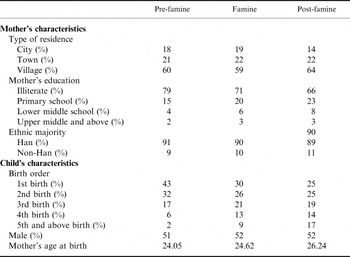
Birth cohort has three categories: the pre-famine cohort (1954–1958), the famine cohort (1959–1962) and the post-famine cohort (1963–1967). Although the famine was between 1959 and 1961 in most places, the cohort born in 1962 was mostly conceived in 1961 and is treated as part of the famine cohort. Differences between birth cohorts are at the centre of the fetal origins hypothesis as well as the selection effect hypothesis when using a non-experimental design. According to the fetal origins hypothesis, the mortality level of the post-famine cohort should be significantly lower than that of the famine cohort, controlling for short-term mortality fluctuations; according to the selection effect hypothesis, the post-famine cohort will have a higher mortality level than both the pre-famine and the famine cohort, controlling for short-term mortality fluctuation. About 22% of all cases (live births) belong to the pre-famine cohort, 23% belong to the famine cohort, and 55% belong to the post-famine cohort, indicating that the famine occurred during a period of rapid fertility increase; the trend was temporarily interrupted by the famine but resumed immediately after the famine was over.
Period and age are the two main time variables that structure the duration dependencies. They indicate when (at what age and during which year) a death occurred. Those who have survived to 1988 are considered to be censored and assigned values corresponding to the year 1988. Both variables are coded as continuous variables and enter the model as piecewise linear spline functions. Children born in 1954–1967 were followed until 1988, when they were 21–34 years old.
Mother's education has four categories: illiterate and semi-illiterate (66%), primary school graduate (23%), lower middle school graduate (8%), and upper middle school graduate and above (4%). Mother's education is the only socioeconomic status (SES) indicator used in the present analysis. Children of better-educated mothers are expected to have lower mortality, controlling for all else.
Type of residence has three categories. It indicates whether a child's mother lived in a city (16%), a town (22%) or a village (62%). People living in cities were better protected from the famine than those living in towns and villages, and those living in towns were better protected than those living in villages (Peng, Reference Peng1987). With the strict hukou system in place since the late 1950s, migration that crossed the urban–rural boundary was rather limited and did not become common until after the beginning of the economic reform in 1978; thus the present research treats mother's place of residence as equivalent to children's place of growing up.
The following control variables are also included: (1) ethnicity (1=Han, 0=other); (2) birth order (range=1–13, median=2); and (3) sex (1=male, 0=female). In China, members of ethnic minorities tend to live in remote rural areas and generally have a shorter life expectancy (Poston Jr & Shu, Reference Poston and Shu1987). Birth order has been shown to have a significant effect on mortality in other societies (Kaplan et al., Reference Kaplan, Mascie-Taylor and Boldsen1992; Preston et al., Reference Lin and Yang1998), and men are known to have higher mortality than women, in general.
Table 1 presents cohort-specific summary statistics of variables used in the analysis.
Descriptive statistics of selected variables from the Two-Per-Thousand Fertility Survey of China

No. mothers=122,352; no. children=371,105.
Census and micro-Census
A second data source used in the analysis is the published cohort-specific population counts of the three Censuses (1982, 1990 and 2000) and the two micro-Censuses (1995 and 2005) of China (Population Census Office under the State Council and Department of Population Statistics & Statistics NBO, 1985, 1993, 2001; National Population Sample Survey Office, 1997, Reference Peng2007). For each census year, the population counts of the pre-famine cohort (1954–1958), the famine cohort (1959–1962) and the post-famine cohort (1963–1967) are generated. Then within each census year, the ratio of the pre-famine cohort size to the famine cohort size and the ratio of the post-famine cohort size to the famine cohort size are calculated. Comparing the cross-temporal trend of these two ratios gives some ideas of the relative mortality of the three cohorts.
Statistical models
Mortality is modelled using a two-level piecewise Gompertz proportional hazard model:

where the log hazard of the j th woman's i th birth experiencing postnatal mortality lnhij(t) is modelled as a function of: (1) baseline duration dependencies T(t), (2) a vector of mother- or child-level covariates Z, (3) birth cohort C, and (4) a mother-specific random component δj. The baseline duration dependences are specified as a set of piecewise liner spline functions that are flexible enough to approximate complicated functional forms of any kind. More than one baseline duration dependency can be added to the model to represent effects of different ‘clocks’. Here two different baseline duration dependency specifications, age only (γ1T(a)) and age and period (γ1T(a)+γ2T(p)), are compared to evaluate the extent to which the estimated cohort difference in postnatal mortality is confounded by period mortality fluctuation. Although age and period are perfectly collinear with cohort, the linear spline functions T(a) and T(p) are not because they are non-linear transformations of age and periods; thus model identification is possible (Lillard, Reference Lillard1993; Wu, Reference Wu, Mortimer and Shanahan2003). The random component δj is assumed to follow a normal distribution with zero mean and constant variance σδ.
All the models discussed above are estimated using open source statistical software aML via the full information likelihood method (Lillard & Panis, Reference Lillard and Panis2003).
Results
In the first set of analyses, two multilevel generalized Gompertz survival models are compared to assess cohort differences in postnatal mortality. If the famine cohort (1959–1962) shows significantly higher mortality than both the pre-famine (1954–1958) and the post-famine (1963–1967) cohorts, this can be seen as evidence supporting the fetal origins hypothesis. On the other hand, if the post-famine cohort demonstrates significantly higher mortality than both the pre-famine cohort and the famine cohort, then the selection effect hypothesis gains support. It is worth noting that the above predictions are based on the assumption that there have been no secular mortality trends; things become more complicated in the presence of such trends, as will be shown.
At the time of interview, children of the selected primary respondents (ever-married women) in the 1988 Two-Per-Thousand Fertility Survey were between 21 and 34 years old. Past research (based on Finnish data) has shown that if a mortality difference between the famine cohort and the non-famine cohort exists, it most likely appears before age 17 (Kannisto et al., Reference Kannisto, Christensen and Vaupel1997). Given this, higher long-term mortality in cohorts conceived during the famine than in other cohorts even in the relatively young sample analysed here should be expected. However, the possibility that fetal origin effects on mortality occur at later ages cannot be ruled out. This is a limitation of the fertility survey data used in the present study. To address this possibility, a second set of analyses, based on aggregate cohort population counts, extends the age range of the selected cohorts to between 38 and 51.
Describing the overall trend of cohort mortality
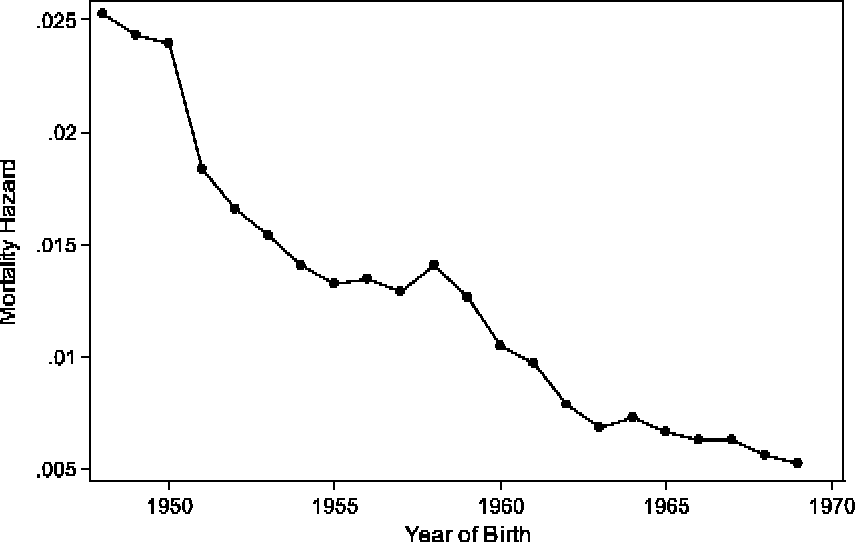
Figure 3 shows the cross-cohort trend in the child (below 18) mortality hazard in China, calculated from the 1988 National Survey of Fertility and Contraception. A secular trend of declining mortality is clear: the cohort mortality hazard declines from 0.025 in the 1948 birth cohort to 0.005 in the 1970 birth cohort. There are only a few exceptions to this secular long-term trend, among which the most noticeable one occurs between 1957 and 1958, where mortality hazard increases from 0.013 to 0.014. Does this suggest the presence of a long-term influence of the Great Famine on cohort mortality?
Overall trend in cohort mortality hazard (age≤18) in China, calculated using the 1988 National Survey of Fertility and Contraception in China. The very early cohorts (1941–1946) with small cohort size and the very late cohorts (1971–1988) were excluded to make sure the cohorts were comparable.
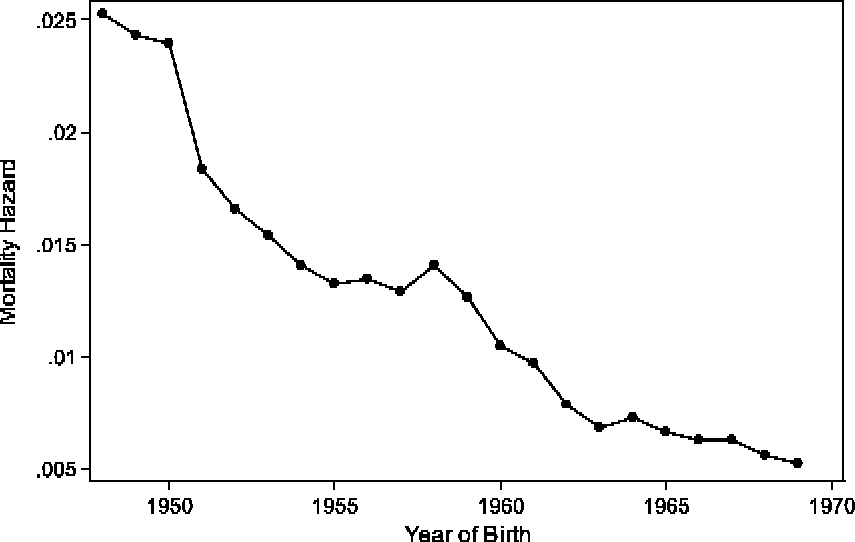
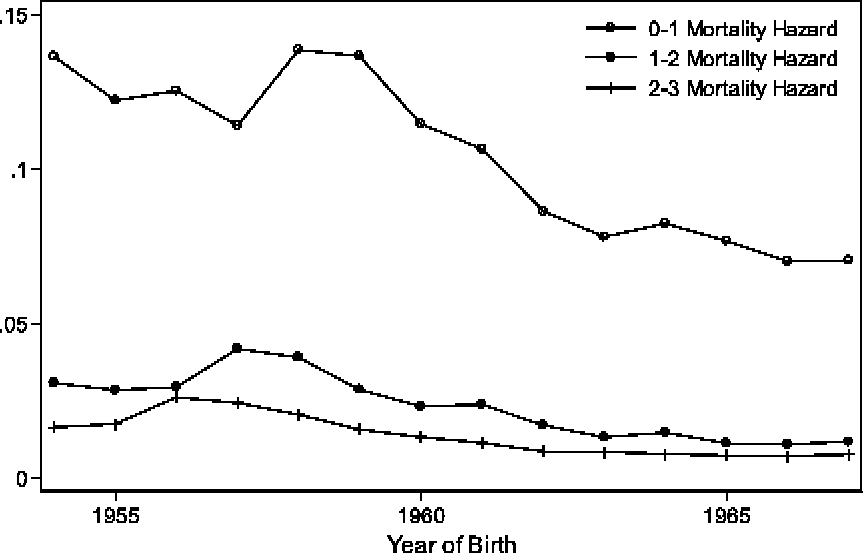
It is interesting to note that the sudden increase in mortality hazard occurred between the 1957 and the 1958 cohort, not between the 1958 cohort and the 1959 cohort, when the famine began to strike. The one-year gap between the increase in cohort mortality hazard and the beginning of the famine seems to suggest that the most dangerous risk factor for cohort mortality is not being conceived or born during the famine but being born right before the famine and being exposed as an infant.
To make this clear, Fig. 4 plots the mortality hazard between ages 0–1 years, ages 1–2 years and ages 2–3 years for a subset of cohorts. Mortality hazard of all three age groups have an irregular bell shape, first increasing then decreasing, with very flat tails. What is most interesting for the purpose of the present study is this: the 1958 cohort has the highest mortality hazard for the 0–1 age group, the 1957 cohort has the highest mortality for the 1–2 age group, and the 1956 cohort has the highest mortality hazard for the 2–3 age group. This does not seem likely to be mere coincidence because these cohorts all reach their peak mortality at the beginning of the Great Leap Forward Famine: 1959.
Single-year mortality hazard for individuals born between 1954 and 1967.
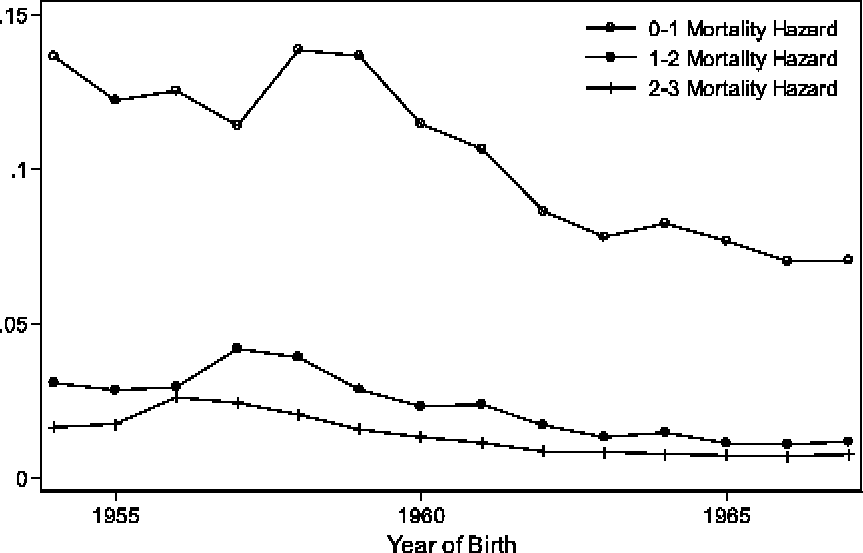
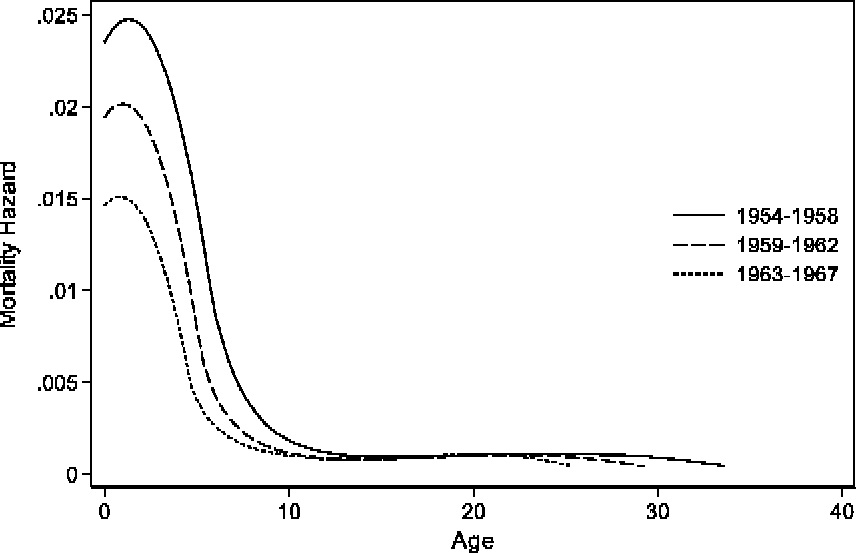
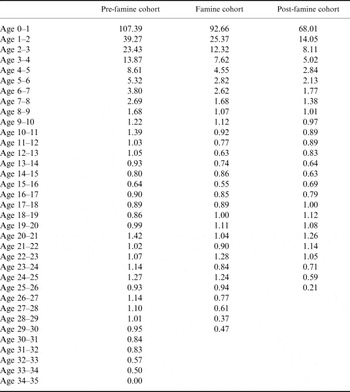
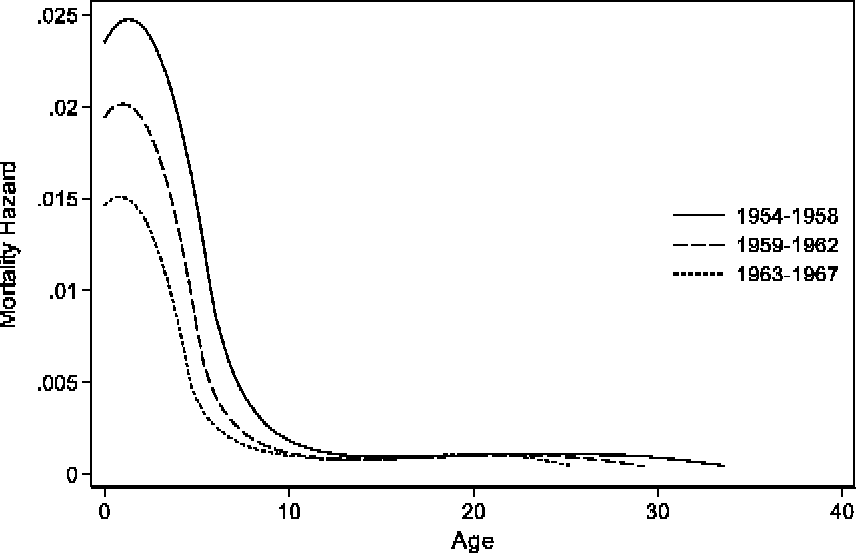
Figure 5 shows the smoothed empirical hazard function of postnatal mortality for the three selected birth cohorts. Clearly, cohort differences in mortality are more significant at younger ages than at older ages. There is virtually no cohort difference in mortality after age 15, which is consistent with the pattern observed for Finland by Kannisto et al. (Reference Kannisto, Christensen and Vaupel1997). Also, mortality is highest among the oldest cohort (the pre-famine cohort) and lowest among the youngest cohort (the post-famine cohort), leaving the famine cohort in the middle, showing a clear secular trend of decline in postnatal mortality from older cohorts to younger cohorts. Similar pattern can be seen from age-specific mortality rates in Appendix Table A1.
Cohort comparison of smoothed mortality hazard in China.
The empirical hazard functions plotted in Fig. 5 provide helpful information about the shape of the baseline hazard function and serve as the important first step; while age is certainly the most important time dimension that structures mortality, it may not be the only one. As indicated by Fig. 4, time period (beginning of the famine vs other) may also have played an important role in generating the observed mortality patterns, and needs to be accounted for appropriately; in addition, there may be other important factors that need to be controlled for. To partial out the influence of time period as well as other factors from the estimated cohort mortality difference, a series of multivariate analyses are carried out in the next section.
Postnatal mortality: are there long-term effects?
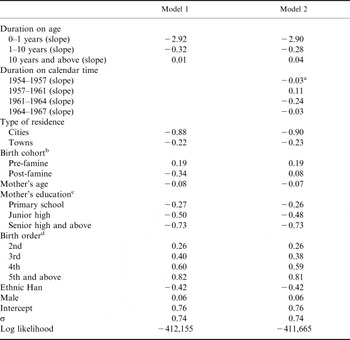
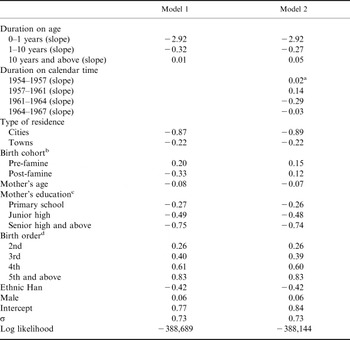
Table 2 reports results from two two-level piecewise Gompertz hazard models of postnatal mortality. Model 1 includes age splines as the only duration dependence (baseline hazard). The estimated cohort difference in the mortality rate is likely to be confounded by period mortality variation. Model 1 is treated as the baseline model against which a second model is compared. Model 2 includes both age and period in the baseline duration dependence in the form of linear spline functions. Contrasting Model 2 with Model 1 sheds some light on the extent to which the omission of period mortality variation biases the estimated cohort difference in mortality. A likelihood ratio test rejects the hypothesis that adding linear spline functions representing period effects does not change the model fit (p<0.001), making Model 2 the preferred model. The discussion begins with Model 1 and focuses on the comparison between Model 1 and Model 2.
Two-level generalized piecewise linear hazard model for postnatal mortality in China (log odds)

a p<0.05; all other coefficients reported in the table have significance level of p<0.001.
b The reference category is ‘famine cohort’.
c The reference category is ‘illiterate or semi-illiterate’.
d The reference category is ‘the 1st birth’.
As Model 1 shows, people growing up in cities have a lower risk of mortality than people growing up in villages (hazard ratio=0.41); people growing up in towns also have a lower risk of mortality than people growing up in villages but not as low as those growing up in cities (hazard ratio=0.80). Mother's age at childbirth also matters: a one-year increase in mother's age at childbirth decreases the hazard of children's mortality by 7%. Mother's education also decreases children's hazard of mortality significantly. Compared with illiteracy, primary school education reduces children's mortality hazard by 24%, junior high school education reduces the mortality hazard by 39%, and senior high school and above reduces children's mortality hazard by 52%. The mortality hazard increases with parity. Compared with the first-born, the second child's hazard of mortality increases by 30%, the third child's hazard increases by 49%, the fourth child's hazard increases by 83%, and the hazard for the fifth child or higher increases by 128%. Compared with ethnic minorities, the hazard of mortality is 34% lower for Han children. Compared with girls, boys’ hazard of mortality is 6% higher. The standard deviation of the random component is 0.74 (p<0.01), indicating significant variations in mother-level unobserved heterogeneity.
Some experimentation shows that a three-node (four-piece) linear spline approximates the baseline hazard function (age-dependence) reasonably well. Controlling for age-dependence, the covariates and mother-specific unobserved heterogeneity, the mortality hazard of the pre-famine cohort is 21% greater than that of the famine cohort, and the hazard of the famine cohort is 29% greater than that of the post-famine cohort, supporting the pattern revealed in Fig. 5. However, from Model 1, it is difficult to identify any long-term effect of the Great Leap Forward Famine on postnatal mortality: the fact that the pre-famine cohort has higher mortality than the famine cohort does not support the fetal origins hypothesis; the fact that the famine cohort has higher mortality than the post-famine cohort can hardly be attributed to the effect of fetal origins either, given the secular trend of mortality reduction revealed in Fig. 3.
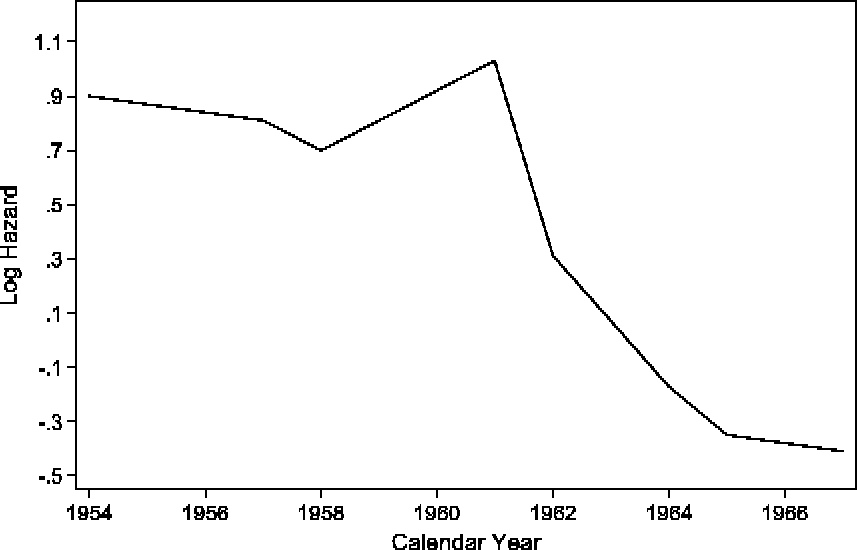
Predicted period pattern of mortality hazard in the 1950s and the 1960s (log hazard).
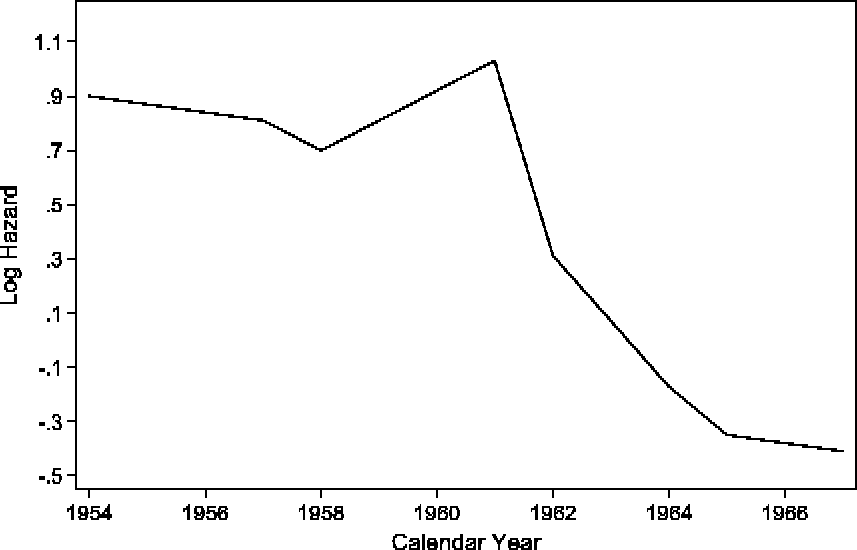
Adding period dependence into the baseline hazard function significantly improves the model fit, and changes the estimated model parameters. On the one hand, adding a four-node (five-piece) piecewise linear spline representing period mortality differences has little impact on the age dependence pattern; and it has little or no impact on the effects of mother's age, mother's education, place of residence, birth order, ethnicity or sex of the child. On the other hand, including period duration dependence dramatically changes the estimated cohort difference in the mortality hazard. Without including the period duration dependence, the post-famine cohort has a much lower mortality hazard than the famine cohort (hazard ratio=0.71); adding the period duration dependence completely reverses the relationship, now both the pre-famine (hazard ratio=1.20) and the post-famine cohorts (hazard ratio=1.09) have a higher mortality hazard than the famine cohort.
The above comparison shows that the ‘cohort effect’ estimated in Model 1 (as well as in Fig. 5) has been confounded by the presence of a strong ‘period effect’: the fact that the hazard of mortality is much higher than usual during the period of famine, as demonstrated in Fig. 4. Both the pre-famine cohort (as young children) and the famine cohort (as fetuses or infants) have been exposed to the famine, but the post-famine cohort has not. Without controlling for the mortality difference between the famine period (1959–1961) and non-famine period, the excessively high mortality in the pre-famine and the famine cohorts directly caused by malnutrition and starvation during the three-year period of famine would have been mistakenly counted as part of the long-term cohort difference in mortality, leading to biased results. In the present case, the bias is large enough to completely reverse the true pattern.
The predicted period duration dependence of postnatal mortality is displayed in Fig. 6. The log hazard of mortality starts high in 1954 but keeps declining gradually until 1958 when it starts to rise suddenly. The hazard reaches its peak in 1961, which is also the peak of the famine, and then begins to decline. The decline is most rapid between 1961 and 1962; it gradually slows down between 1962 and 1965, and even further after 1965. Presumably the trend of postnatal mortality between 1954 and 1967 would have been a smooth and reasonably linear curve if there had not been a famine between 1959 and 1961.
Including period duration dependence adjusts for period differences in cohort mortality, and yields a more accurate estimate of long-term cohort mortality differences. Model 2 suggests that while the Great Leap Forward Famine had a strong short-term influence on mortality (as depicted in Fig. 6), its influence ended when the famine did. The fact that the post-famine cohort has significantly higher mortality than the famine cohort, despite the strong secular trend of cross-cohort mortality reduction, strongly suggests that there is no long-term or lasting fetal origins effect of the famine on mortality, and the only long-term effect of the famine on mortality is due to selection. Note that these results pertain to people in their late 20s and early 30s. The selection effect might be expected to become even stronger as people age, which is what the census results show (see below). The fact that controlling for period differences does not change the estimated cohort difference in mortality between the pre-famine cohort and the famine cohort is not surprising because they both were exposed to the three-year famine period and hence both suffered from the excess mortality caused by malnutrition and starvation.
Since famine leads not only to excess fetal and infant mortality but also to reduced fertility (Ashton et al., Reference Ashton, Hill, Piazza and Zeitz1984; Peng, Reference Peng1987), it is necessary to rule out the possibility that the lower mortality of the famine cohort simply reflects differential fertility associated with famine. That is, an alternative to the claim that only the strongest fetuses survived the famine and thus were resistant to long-term consequences of fetal insult is that those conceived during the famine cohort were disproportionately from families relatively unaffected by the famine, and that this rather than differential survival explains their reduced mortality over the long term. To rule out this possibility, the same models were re-estimated using the subset of the famine cohort born in 1959. Since almost all members of this cohort were conceived before the beginning of the famine (that is, in 1958 and the first three months of 1959), their conception was not affected by the famine but their survival potentially was. That is, while influenced by differential mortality, they were not influenced by differential fertility. By contrast, the rest of the famine cohort was influenced by both differential fetal mortality and differential fertility. Comparing the new model against the main model in Table 2 thus provides a sensitivity test to assess the relative importance of the influence of differential fertility on long-term cohort mortality patterns. The fact that the new model yields a cohort mortality pattern highly consistent with the main model, as shown in Appendix Table A2, indicates that selection by differential fertility during the famine cannot account for the lower-than-average cohort mortality of the famine cohort, and the failure to identify the hypothesized fetal origin effects in both models makes an even stronger case against the fetal origin argument.
In summary, the fact that both the pre-famine cohort and the post-famine cohort have higher mortality than the famine cohort casts doubts on the fetal origins hypothesis. Also, the fact that the post-famine cohort has a higher mortality than the famine cohort suggests the effect of selection by differential mortality. In this particular case, the selection effect is strong enough to compensate for the very strong secular trend of mortality reduction, which drastically reduces the mortality level of younger cohorts. For cohorts that are not adjacent but are separated by several years, as in the case of the pre-famine cohort versus the post-famine cohort, the effect of the secular trend of mortality decline is much stronger and thus more difficult to offset. As a result, in this particular case, the secular trend wins out and produces the pattern that the pre-famine cohort has higher mortality than the post-famine cohort.
Evidence from census population counts
As noted above, because the oldest children in the 1988 fertility survey data were age 35, it could be that the survey sample was not old enough to reveal long-term consequences of adverse fetal origins on mortality. To assess this possibility, the present research compiled information on cohort population counts from published tabulations for three censuses and two micro-censuses (1% sample surveys) spanning the period from 1982 to 2005, when the oldest respondents in the main analysis were 51 years old.
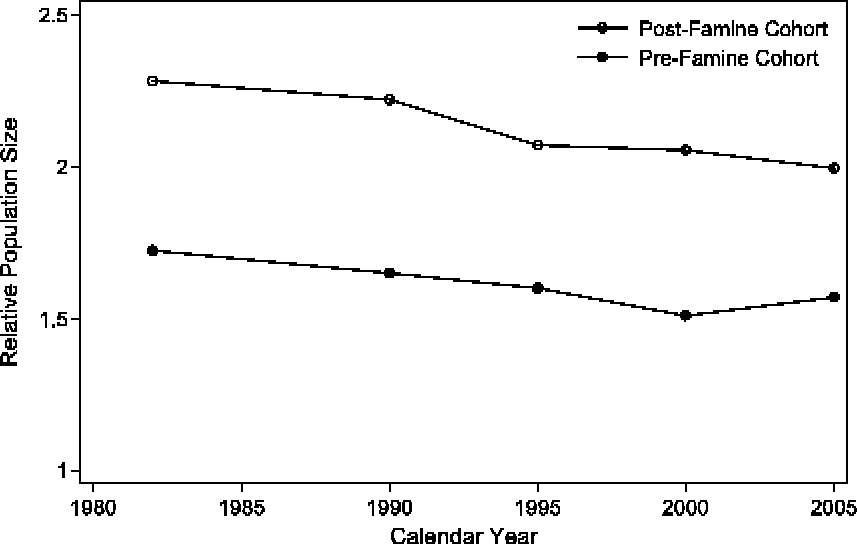
For each census/micro-census year, Fig. 7 shows the ratios between: (1) the population counts of the pre-famine cohort and the famine cohort, and (2) the population counts of the post-famine cohort and the famine cohort. If these three cohorts have roughly parallel mortality rates as they age, the two lines would be approximately parallel to the horizontal axis. According to the fetal origins hypothesis, both lines – the one for the pre-famine cohort and the one for the post-famine cohort – should show an upward trend: as the famine cohort dies faster, the proportion of the non-famine cohorts in the population should increase with time. According to the selection effect hypothesis, however, the post-famine cohort should show a downward trend since the excess mortality in the famine cohort selects for stronger individuals, whereas there is no such selection in the post-famine cohort. Under this hypothesis, there is no clear prediction regarding the relative mortality rates for the pre-famine and famine cohorts, both of which were subject to selection by the conditions prevailing during the famine.
Changes in relative cohort size of the pre-famine cohort, famine cohort and post-famine cohort, using the famine cohort as the baseline.
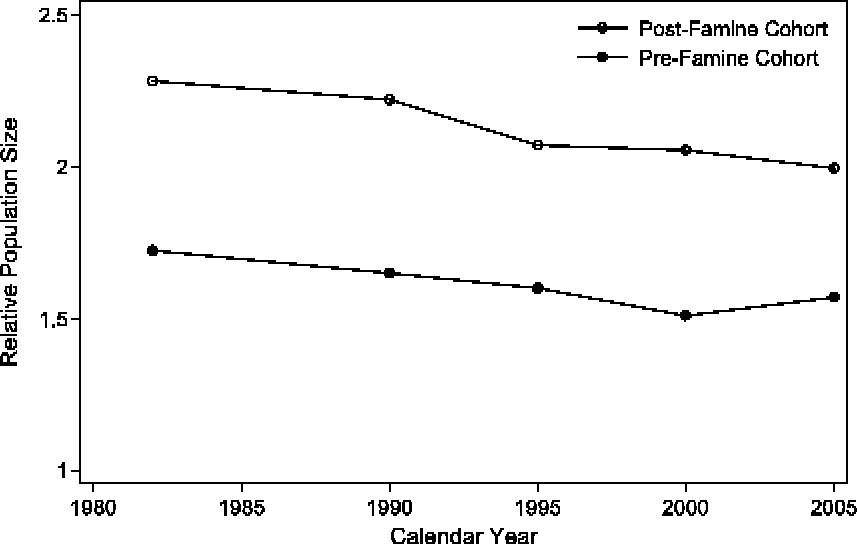
In Fig. 7, the two lines representing the pre-famine cohort and the post-famine cohort both show a gradual downward trend, indicating that over time the size of each of these cohorts was shrinking faster than for the famine cohort. This means that the famine cohort has a lower mortality rate than both the pre-famine and the post-famine cohorts, contrary to the expectations of the fetal origin hypothesis, but in agreement with the results reported in Table 2. The negative slope for the post-famine cohort indicates that the difference in mortality between the famine and the post-famine cohort increases with age, consistent with the selection hypothesis. One possible explanation for the negative slope for the pre-famine cohort is that the famine cohort is more highly selective than the pre-famine cohort with regard to the short-term excess mortality caused directly by the famine. When the famine started, individuals in the famine cohort were mostly infants, who were more vulnerable and less resistant to the adverse nutritional environment caused by the famine than individuals of the pre-famine cohort, who were mostly young children at that time. Also, the famine period had much higher stillbirth and miscarriage rates than both the pre- and post-famine periods (Cai & Wang, Reference Cai and Wang2005), which further increased the selectivity of the famine cohort compared with the pre- and post-famine cohorts.
Discussion
The Great Leap Forward Famine between 1959 and 1961 in China is unparalleled in modern human societies with regard to its duration and the magnitude of its consequences. The famine created a cohort of malnourished children who were different from both their older and younger siblings in many ways. Such a ‘natural experiment’ provides a rare opportunity to re-examine important scientific questions regarding early life conditions and adult mortality and morbidity. Using retrospective information from a large representative fertility survey conducted in 1988 in China and aggregate population counts from censuses and micro-censuses, the present research compared long-term mortality patterns of three cohorts of newborns. Multilevel survival models showed that, contradicting Barker's fetal origins hypothesis, there is no sign of long-term fetal origins effect on mortality, after controlling for short-term period mortality fluctuations. Similar findings have emerged from studies of famines in other countries (Kannisto et al., Reference Kannisto, Christensen and Vaupel1997; Stanner et al., Reference Stanner, Bulmer, Andres, Lantseva, Borodina, Poteen and Yudkin1997). Instead, the results support predictions made by the selection effect hypothesis that (in the absence of secular mortality trend) the post-famine cohort has the highest mortality.
The distinction between long-term and short-term effects is crucial, because they represent drastically different causal pathways. Famines generate excess mortality because of the harsh environments they create, especially with regard to food and nutrition. Once the famine ends and the food supply returns to normal, the elevated mortality rate also will return to normal. The fetal origins hypothesis predicts that, in addition to the short-term excess mortality generated by starvation and malnutrition during the period of the famine, exposure to famine as a fetus has independent long-term effects on mortality and morbidity, because of biological programming. These two different effects of the famine on mortality can be most conveniently conceptualized as a period effect and a cohort effect. This understanding is key to the present research.
Like Kannisto et al. (Reference Kannisto, Christensen and Vaupel1997), this study did not find independent long-term impacts of the famine on mortality, as are predicted by the fetal origins hypothesis. Two different processes seem to be in place in generating the observed cohort mortality pattern. The first is the secular trend in mortality reduction since the establishment of the socialist regime in 1949, mainly due to improvements in food supply, public health facilities and hygiene conditions (Kantha, Reference Kantha1990; Popkin et al., Reference Popkin, Ge, Zhai, Guo, Ma and Namvar1993; Banister & Hill, Reference Banister and Hill2004). Although the three-year famine temporarily interrupted this process, once the famine was over, the process resumed immediately. The second process explaining these findings is a selection effect caused by differential excess mortality during the three-year famine. Many ‘frail’ members of cohorts that experienced the famine died during that three-year period. Survivors of these cohorts are stronger and healthier and have longer life expectancies than cohorts that never experienced the famine. These two forces have opposite impacts on cohort mortality and work against each other in creating the observed cohort mortality patterns.
In contrast to the lack of evidence for biological programming, the present research found strong evidence for ‘social programming’ (Vagero & Illsley, Reference Vagero and Illsley1995): regardless of birth cohorts or time periods studied here, urban children have much lower mortality; mother's education significantly decreases children's mortality; and ethnic majority members have much lower mortality. None of these findings is new to social scientists, but putting them side by side with the estimated fetal origins effect makes the starkest comparison: social factors make a far larger contribution to postnatal mortality differentials than do biological factors.
The present research faces several limitations. As mentioned before, the data used in the present study includes only information on children of women who have survived to 1988, which constitutes only a subset of all women and a subset of all children. This is the problem shared by all retrospective studies and suggests caution in interpreting the results. However, there is no compelling reason to believe that differential mortality of mothers led to systematic differences in children's characteristics in the three different birth cohorts. In other words, children in the sample may have different mortality from children excluded from the sample, but as long as the same exclusion mechanism has been applied to all three cohorts, the exclusion will not bias the estimated cohort mortality difference shown here. The 1988 Two-Per-Thousand data cover a relatively short period of the life course (from birth to age 21–34). Even with the auxiliary analysis using aggregate census population counts, these analyses can only extend the age range to 38–51. The possibility that the mortality rate for the famine cohort rises after age 51 cannot be ruled out. However, results from analyses of the 1866–1868 Finnish famine show that the elevated mortality of the famine cohort appears before age 17, if it appears at all (Kannisto et al., Reference Kannisto, Christensen and Vaupel1997). This lends some confidence to the reported results. The ideal design, of course, would be to compare cohort mortality rates after most people in these cohorts decease. But this will take another 20–30 years, and there is no guarantee that better data will be available then to study the famine consequences other than more updated census population counts. Finally, the lack of cause-specific mortality data for individuals makes it impossible to pursue further in-depth analysis. These results cannot rule out the possibility that some cause-specific mortality rates do show patterns that agree with Barker's hypothesis. Better data are required to address this issue, and more in-depth research is needed.
Despite these limitations, the results presented here demonstrate the presence of a short-term effect of famine on postnatal mortality, caused directly by food deprivation and malnutrition. After the crisis was over, however, there seemed to be no lingering long-term effect of biological programming on postnatal mortality, as would have been predicted by the fetal origins hypothesis. It is thus reasonable to conclude that the only long-tem mortality consequence the famine produced, that the post-famine cohort has higher mortality than the famine cohort, was due to population selection. For the purpose of understanding cohort mortality differentials, socioeconomic indicators seem to be more efficient predictors than biological ones, even in extreme situations such as the Great Leap Forward Famine.
Acknowledgment
The author wishes to thank Don Treiman, Sarah Burgard, Feng Wang, Yong Cai and Peifeng Hu for their helpful comments.
Appendix
Age-specific mortality rate (per thousands) of selected cohorts from the Two-Per-Thousand Fertility Survey of China

Two-level generalized piecewise linear hazard model for postnatal mortality in China with the famine cohort restricted to those born in 1959 (N=326,536)

p values indicate the significance level of the differences between choice of public vs private sector providers between groups of women.
a p<0.05; all other coefficients reported in the table have significance level of p<0.001.
b The reference category is ‘famine cohort’.
c The reference category is ‘illiterate or semi-illiterate’.
d The reference category is ‘the 1st birth’.