In democracies, citizens are often called upon to accept the victory of the opposition candidate. This belief in the legitimacy of the winner, regardless of party, serves as the lifeblood of consolidated democracies. But what happens when the candidate or party that wins the most votes loses a democratic election? Such electoral inversions challenge the core democratic principle that all votes count equally. Two months ahead of the 2020 US presidential election, analysts put the probability of another electoral inversion at 14 per cent (The Economist 2020). Although this outcome did not take place, inversions in the 2000 and 2016 presidential elections in the United States underscore the importance of examining how voters judge such outcomes and determining whether inversions undermine perceptions of electoral legitimacy.
Inversions can take place when votes are tallied in sub-national districts such that the geographical distribution of votes, not just their total number, affects outcomes. Assembly elections in single-member districts (SMDs) are particularly prone to inversion. Parties that came in second in the popular vote won sole control of government in the UK in 1951 and 1974, in New Zealand in 1978 and 1981, in Canada in 2019, and in the United States in 2000 and 2016 (for further examples, see, for example, Christensen Reference Christensen2020).
Although such outcomes are thought to be consequential for democracy, research to date has typically focused on estimating the likelihood of inversions (for example, Geruso, Spears, and Talesara Reference Geruso, Spears and Talesara2019; Kaniovski and Zaigraev Reference Kaniovski and Zaigraev2018; Kikuchi Reference Kikuchi2016; May Reference May1948). We instead seek to understand the effects of such outcomes on the legitimacy of election results, which are difficult to measure with observational data. Our study is related to previous work interested in understanding political efficacy, vote satisfaction, and legitimacy among voters supporting the losing candidate (Anderson and Guillory Reference Anderson and Guillory1997; Craig et al. Reference Craig2006; Nadeau and Blais Reference Nadeau and Blais1993; Sances and Stewart Reference Sances and Stewart2015). We focus on a special case of such a loss, in which the voter supports a candidate who “should have won” in some sense. We conduct national survey experiments in the United States to assess the legitimacy of various potential outcomes of the 2020 presidential election. This design allows us to isolate the effects of inversions and popular vote margins from the tendency of supporters of a winning party or candidate to regard electoral outcomes as more legitimate (the “winner effect”). We also estimate the electoral winner effect based on an experimental design, complementing existing evidence of this phenomenon from observational studies.
Our results indicate that popular vote inversions reduce the legitimacy of winning candidates. This inversion penalty varies little by electoral margin within plausible bounds (a popular vote defeat of up to five percentage points) and is insensitive to whether the loser is from the respondent's own party or the opposing one. It is, however, party-specific: the inversion penalty we find is consistently observed among Democrats, the party whose presidential candidates were defeated in the two most recent US electoral inversions. By contrast, we find limited and inconsistent evidence that inversion reduces legitimacy among Republicans. These results suggest that inversion penalties may be concentrated among supporters of the parties most likely to suffer from them.
Theoretical Expectations
The principle that all votes should count equally is one of the bedrocks of democracy (Dahl Reference Dahl2008) and is embraced by an overwhelming majority of Americans (Carey et al. Reference Carey2019). Electoral inversions, which are made possible by rules like the Electoral College that effectively weigh votes from some areas more heavily than others, directly challenge this principle. Originally designed by the framers of the US Constitution to assuage smaller states and “refine” public sentiment, critics argue the Electoral College threatens to instead distort the national popular will by enabling presidential candidates who have not won the majority of the national popular vote to be elected to the nation's highest office.
Given Americans' support for the principle of votes counting equally, we expect inversions to diminish perceived legitimacy, which we define as citizens' recognition of an electoral outcome as rightful and worthy of deference regardless of whether their preferred candidate won:
Hypothesis 1: We expect the perceived legitimacy of an election result—that is, which candidate assumes office—to be lower when the Electoral College winner loses the popular vote than when the Electoral College and popular vote are won by the same candidate.Footnote 1
Second, supporters of winning candidates and parties report higher system support (Anderson and Guillory Reference Anderson and Guillory1997; Craig et al. Reference Craig2006; Nadeau and Blais Reference Nadeau and Blais1993) and confidence in the vote count (Sances and Stewart Reference Sances and Stewart2015) than do those who supported losing candidates and parties. We therefore also expect perceptions of electoral legitimacy to be shaped by partisan electoral fortunes:
Hypothesis 2: We expect the perceived legitimacy of election results to be greater when a co-partisan wins the Electoral College.
We also preregistered a research question asking whether the reduction in legitimacy after a popular vote inversion would be less pronounced among Republicans (compared to Democrats) because the Republican Party benefited from inversions in two recent presidential elections as well as in the US House of Representatives election in 2012 (Christensen Reference Christensen2020).
In addition, we consider how the popular vote margin might influence the strength of any inversion effect on legitimacy. Election observers and judges all explicitly weigh the scale of reported electoral irregularities against vote margins on the premise that wider victory margins confer increased legitimacy in competitive elections (see, for example, Organization of American States 2017; Vickery et al. Reference Vickery, Ennis, Ellena and Kaiser2018). Scholars who study elections in autocracies likewise posit that the legitimacy of the winner's claim to rule rises with the vote margin unless it becomes implausibly lopsided (Gehlbach and Simpser Reference Gehlbach and Simpser2015; Higashijima Reference Higashijima2015; Rundlett and Svolik Reference Rundlett and Svolik2016). Research on US elections reinforces these intuitions. In 2012, confidence in state-level vote counts was lower among supporters of both parties in states in which presidential vote margins were narrower (Sances and Stewart Reference Sances and Stewart2015).
These findings all suggest that the popular vote margin is related to the legitimacy of the winning candidate. We specifically consider the possibility that inversions damage legitimacy more as the popular vote advantage of the losing candidate increases. The violation of the all-votes-are-equal principle is more egregious, for instance, if an inversion winner loses the popular vote by 4 per cent rather than by 2 per cent. We therefore offer the following hypothesis:
Hypothesis 3: When the Electoral College winner and the popular vote winner are different, we expect that the perceived legitimacy of the Electoral College winner will decrease as the popular vote margin of the losing candidate increases.
We further expect “winner effects” to be greater in inversion elections. After the 2016 election, confidence in the US system increased among Trump voters compared to Clinton voters, a winner effect mirroring past elections in which there was no inversion (Levy Reference Levy2020; Sinclair, Smith, and Tucker Reference Sinclair, Smith and Tucker2018; Stewart Reference Stewart2019). However, given that US politics is highly partisan (Abramowitz and Webster Reference Abramowitz and Webster2016), we might expect voters to be more sensitive to inversion victories by the party they oppose than to inversions by the party they prefer. We therefore expect the following:
Hypothesis 4: We expect the difference in perceived legitimacy between a co-partisan Electoral College winner and opposition party Electoral College winner will be larger when the Electoral College winner loses the popular vote.
Finally, we are interested in how political awareness affects responses to inversions. We preregistered research questions asking whether a respondent's level of general political knowledge or the value the respondent places on democracy shape their sensitivity to inversions. We also sought to determine whether the salience of recent popular vote inversions would shape attitudes. In one set of experiments, we tested whether reminding participants of the 2016 inversion would affect their reactions to a potential 2020 inversion and their support for changing to a national popular vote system.
Methods
We conducted two between-subjects experiments asking Americans to rate the legitimacy of a potential 2020 electoral outcome. We employ a 2 × 4 factorial design in which the winning party and the popular vote margin are randomly varied but the Electoral College total is held fixed. Each respondent was shown only one scenario.
Our first experiment drew on a nationally representative sample of 3,395 respondents recruited March 23–30, 2020 from YouGov's online panel. In this experiment, we varied the party of the winning candidate (Democrat or Republican) as well as their popular vote margin (win by three percentage points [+3]; win by one percentage point [+1]; lose by one percentage point [−1]; and lose by three percentage points [−3]).
We conducted a second round of experiments that drew on a sample of 7,749 Democratic or Republican identifiers recruited from Lucid during May 12–22, 2020, using quotas to match population benchmarks. In this round, we replaced the scenario in which the winning candidate won the popular vote by three percentage points with one in which they lost by five percentage points (the possible popular vote outcomes were thus +1, −1, −3, and −5). From this second sample, we also collected additional information, such as attitudes on support for replacing the Electoral College with a national popular vote. Finally, the second sample also included an orthogonal manipulation in which respondents were randomly reminded with a 0.5 probability that the outcome of the 2016 experiment was an inversion (that is, that Donald Trump won the Electoral College but lost the popular vote).
The specific scenario presented to participants focused on potential outcomes in the 2020 election, the most proximate and salient case of a potential inversion for our participants.Footnote 2 After an introduction explaining that we were interested in how people judge the outcomes of presidential elections, respondents were randomly shown one of the following descriptions of a potential outcome of the election in which the popular vote margin and the party of the winning candidate was randomly varied:Footnote 3
Imagine the {Democratic/Republican} candidate wins the Electoral College and the presidency in 2020 {and wins the popular vote by three percentage points (YouGov only)/and wins the popular vote by one percentage point/but loses the popular vote by one percentage point/but loses the popular vote by three percentage points/but loses the popular vote by five percentage points (Lucid only)} compared to the {Republican/Democratic} candidate.
We measure the perceived legitimacy of this outcome by averaging responses to three questions we asked respondents immediately afterward in random order: “Would you consider the winning candidate to be the rightful winner of the election or not the rightful winner?”; “Would you view the winning candidate's presidency to be legitimate or not legitimate?”; and “Do you think the winning candidate's victory was fair or not fair?” The first was adapted from Craig et al. (Reference Craig2006) and the second and third resemble surveys conducted after the 2000 and 2016 elections (CNN 2000; Jones Reference Jones2016). Response options for each question were on a four-point Likert scale, with higher values indicate greater perceptions of election legitimacy. We use the mean value across the three items. Combining individual scales to reduce measurement error and increase scale reliability is an established technique that also helps to address concerns over wording of specific outcome measures. Cronbach's α for internal consistency are 0.93 and 0.89, respectively, for the YouGov and Lucid experiments, indicating that our scale is very reliable (for full question wording, the distribution of the component variables on four-point scales, and details on the reliability of the combined measure, see Online Appendix C in the Supplementary Materials).
Results
Inversion Penalties
Figure 1 shows mean values of the legitimacy index by vote margin conditions in our YouGov and Lucid experiments. Non-inversions are plotted to the left of the vertical dashed line and inversions to its right. Comparing inversion and non-inversion scenarios, we find that inversions reduce perceived legitimacy by about half a point on our four-point scale in the YouGov sample and a third of a point in the Lucid sample. Thus, if the Electoral College winner is described as losing rather than winning the popular vote, mean legitimacy decreases from 3.30–3.31 to 2.85–2.99, which represent declines of 0.48 (YouGov) and 0.38 (Lucid) standard deviations in our legitimacy index. However, in the experimental condition in which an inversion takes place, the legitimacy of the winner is not sensitive to the margin of victory—it does not matter whether the candidate loses the popular vote by three or five percentage points rather than by one percentage point.
Effect of electoral inversions on election legitimacy.
Notes: Means by condition with 95 per cent confidence intervals. “Legitimacy” is measured based on survey responses that scale together as a composite measure; higher values indicate greater perceptions of election legitimacy.

To confirm these results and to determine how they vary by partisanship, we analyze the data using ordinary least squares (OLS) regressions. We estimate the effect on perceived election legitimacy of both the popular vote margin and co-partisanship (that is, whether the candidate is from the party that the respondent favors or the one the respondent opposes). The models we estimate, which are reported in Table 1, include only partisans (respondents who self-identified as Democrats or Republicans, including leaners) and include controls for individual-level characteristics.Footnote 4 The reference category for popular vote margin is the condition in which the Electoral College winner also wins the popular vote by one percentage point.
Effects of winner vote margin on election legitimacy (relative to +1 percentage point)

Notes: OLS models with robust standard errors. The reference category for the popular vote margin coefficients is a popular vote victory of one percentage point. “Election legitimacy” is measured based on survey responses that scale together as a composite measure. All models control for political interest, race, college education, sex, and age group. Both models include only self-identified Democrats or Republicans, including leaners. For full results, including results with independents in the YouGov sample, see Online Supplementary Materials D. * p < 0.05; ** p < 0.01; *** p < 0.005 (two-sided).
Across both samples, inversions depress perceived legitimacy, but the margin by which the Electoral College winner loses (or wins) the popular vote does not measurably affect legitimacy in the ranges we evaluated (winning the popular vote by one or three percentage points, or losing it by one, three, or five percentage points). In our YouGov sample, for instance, inversions damage election legitimacy almost identically regardless of popular vote margin: −0.483 for a one-point inversion (SE = 0.047) and −0.506 (SE = 0.049) for a three-point inversion. Similarly, a candidate who loses the popular vote by three percentage points but wins the election is no less legitimate than one who loses the popular vote by one percentage point. Results from Lucid are similar. All inversion scenarios yield lower legitimacy but by similar amounts: −0.319 (SE = 0.026) when the popular vote margin is −1 percentage point; −0.333 (SE = 0.026) when it is −3 percentage points; and −0.342 (SE = 0.026) when it is −5 percentage points.
To confirm that these results are not an artifact of respondents moving between the “entirely legitimate” and “somewhat legitimate” categories, we estimate exploratory linear probability models for each disaggregated outcome measure in which the dependent variable is a binary measure of perceived legitimacy. Our results are consistent with those reported earlier. In our YouGov sample, inversion conditions cause a fourteen-percentage-point reduction in the proportion of people who answer that the winner is “legitimate,” a nineteen-point reduction in those saying that the winner is “rightful,” and a twenty-four-point reduction in those saying that the process is “fair.” Results are similar for our Lucid sample (eleven, fourteen and sixteen percentage points, respectively) (for further details, see Online Supplementary Materials E).
Our experimental design also enables us to compare directly the magnitude of the inversion effect we find with the winner effect previously documented in the literature. Respondents from both parties see winning candidates from their own party as more legitimate than winners from the opposing party. Supporting the winning candidate increases perceptions of legitimacy on our combined measure by 0.416 (SE = 0.034) in our YouGov sample and 0.247 (SE = 0.019) in our Lucid sample. These estimates are comparable in magnitude to the inversion penalties we observe earlier.
These results provide support for H1 and H2. Inversions reduce election legitimacy relative to outcomes where the popular vote winner becomes president. Voters whose favored party wins regard outcomes as more legitimate than do those who support the losing party. However, we do not find that larger vote margins magnify the effect of inversions as posited by H3.
Heterogeneous Effects by Party
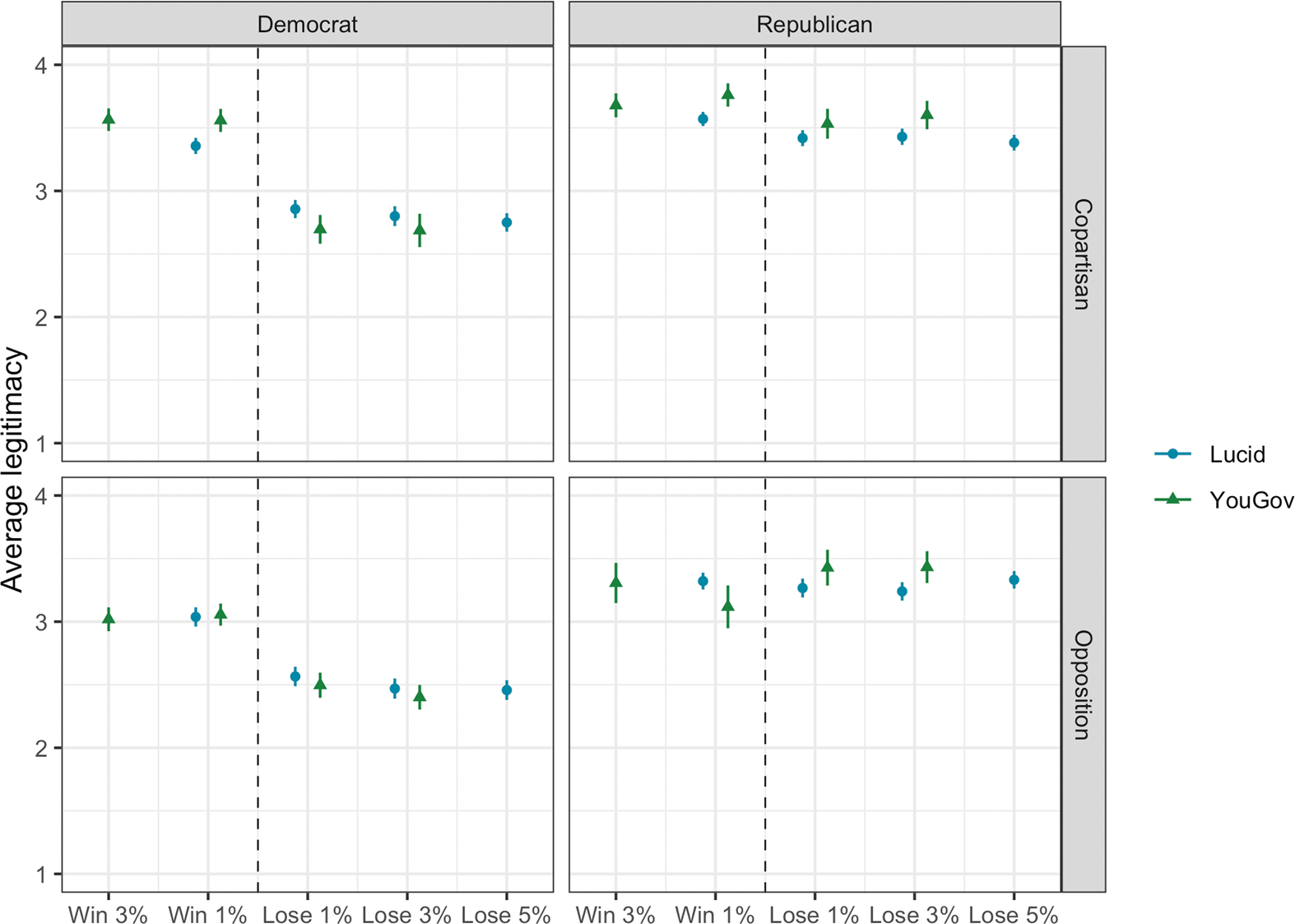
We next consider whether inversion effects on legitimacy vary by respondent partisanship. Figure 2 follows the format of Figure 1 but presents results separately for Democrats and Republicans, showing how each group evaluates the perceived legitimacy of a winning co-partisan or opposition candidate.
Effect of electoral inversions on election legitimacy by party.
Notes: Means by condition with 95 per cent confidence intervals. Left and right panes present separate means for Democratic and Republican identifiers (including leaners); the top and bottom panes present means of how respondents rated the legitimacy of a scenario in which a co-partisan or opposition party candidate win the election. “Legitimacy” is measured based on survey responses that scale together as a composite measure; higher values indicate greater perceptions of election legitimacy.

First, we find no evidence to support H4. Neither Democrats nor Republicans punish inversions more severely when an opposing candidate wins the presidency instead of a co-partisan.Footnote 5 However, we do observe substantial heterogeneity by party. Democrats clearly rate inversion winners as less legitimate, whereas perceived legitimacy is largely stable among Republicans when we compare non-inversion and inversion outcomes. These results are replicated across the two experiments.
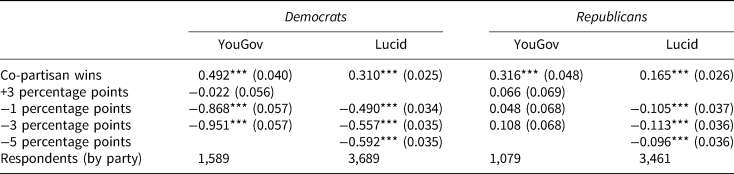
Table 2 summarizes how the average marginal effects of the popular vote margin and the party of the winning candidate vary between Democrats and Republicans (the underlying interaction model is reported in Table G1 in Online Supplementary Materials G). As expected, we find substantial co-partisan winner effects in both experiments and among supporters of both parties. In general, people view election outcomes as more legitimate when their preferred party prevails.
Average marginal effects on election legitimacy by party (relative to +1 percentage point)

Notes: Marginal effects on election legitimacy calculated from the models reported in columns 2 and 3 of Table G1 in Online Supplementary Materials G. “Legitimacy” is measured based on survey responses that scale together as a composite measure; higher values indicate greater perceptions of election legitimacy. These quantities are calculated by, first, taking first-order partial derivatives of the model specified in columns 2 and 3 of Table G1 with respect to the variables of interest (having a co-partisan winner or a given popular vote margin). We then use the resulting equations to estimate the average marginal effects of interest for Democrats and Republican, averaging over other terms in the model (that is, co-partisan winner for margins and vice versa). * p < 0.05; ** p < 0.01; *** p < 0.005 (two-sided).
Our focus here, however, is on understanding how the effects of inversions vary by party. We first consider the marginal effects of the popular vote margin among Democrats. Relative to the baseline of winning the popular vote by one percentage point, we find substantial inversion penalties when the winning candidate instead loses the popular vote. However, these generally do not vary by margin. Only in the five-point inversion condition in our Lucid experiment can we reject the null hypothesis that the size of the loser's popular vote victory has no effect on perceived legitimacy—perceived legitimacy declines by 0.103 as the size of the inversion increases from one percentage point to five, which is significant at p < 0.005 (see Table F1 in Online Supplementary Materials). Hence, we find very limited support for H3, which is only supported among Democrats in one condition in one sample.
The story among Republicans is strikingly different. In the YouGov experiment, there is no measurable inversion effect at all among Republicans. The Lucid experiment shows small inversion penalties among Republicans that are statistically significant, but the point estimates are about one-fifth as large of those observed among Democrats. Moreover, there is again little evidence of increasing legitimacy penalties as the inversion vote margin grows.Footnote 6
In sum, we find no evidence that partisans punish opposition party winners more severely. Instead, Democrats punish inversions consistently, while Republicans barely do so in one experiment and not at all in another. Finally, we find limited and inconclusive evidence that larger inversion vote margins damage legitimacy more than narrower margins (among only one party in just one sample).
Political Awareness
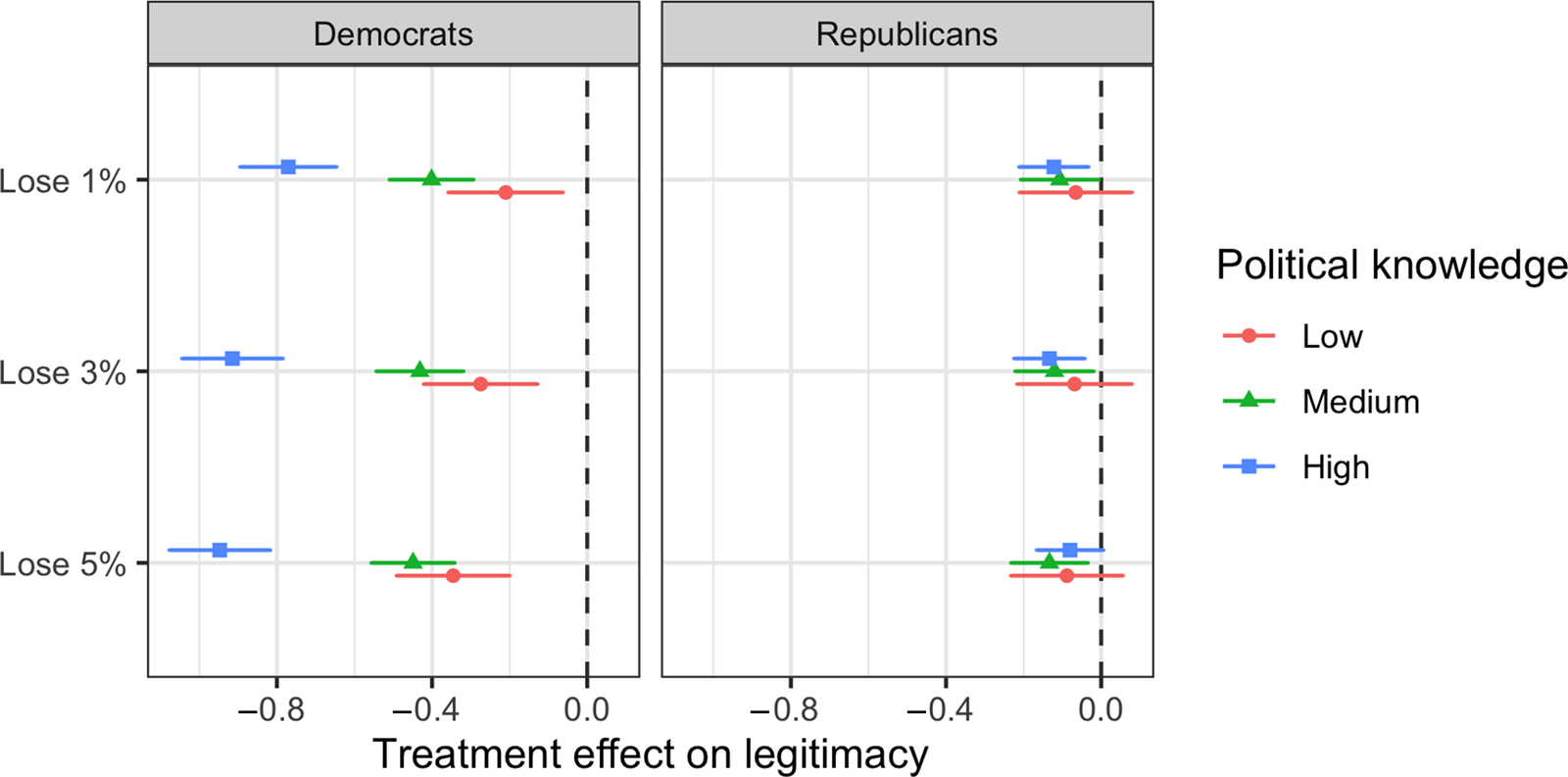
Do levels of political knowledge and reminders of the 2016 inversion influence respondents' sensitivity to inversions? We investigated these pre-registered questions in our Lucid experiment. Our results found greater sensitivity to inversions among more knowledgeable respondents, but only among Democrats, as illustrated in Figure 3. Inversions have modest negative effects on legitimacy among low-knowledge Democrats (−0.210 for a one-point inversion; −0.275 for a three-point inversion; and −0.346 for a five-point inversion). These effects are amplified (marginal effects of −0.561, −0.640, and −0.602, respectively) among their high-knowledge counterparts. As before, no such effects are observed among Republicans.Footnote 7
Effect of political knowledge by party.

Conclusion
Although scholars frequently study the likelihood of electoral inversions (when a party or candidate who gets the most votes does not win), prior studies have not closely examined the effects of inversions on citizens' perceptions of democratic legitimacy or compared inversion effects with the winner effect. Using survey experiments, we measure both winner and inversion effects in the context of the most salient sources of potential inversions—presidential elections in the United States, which are decided by the Electoral College. We also explored the impact of respondents' party preferences and level of political knowledge on their reactions to inversions.
In line with our expectations, inversions reduce democratic legitimacy overall. However, the effect in the US context is driven almost entirely by Democrats, who consistently punish inversions in both of our experiments. Republicans, by contrast, view presidents who win after losing the popular vote as similarly legitimate as those who win in non-inversion elections. Among Republicans, we found small inversion effects in one experiment and none at all in another.
Partisanship drives these inversion penalties in both expected and unexpected ways. Our participants rated presidential victors from their favored party as more legitimate regardless of whether they won the popular vote, but we find no evidence that partisan respondents punish inversions more severely when the winning candidate is from the party they disfavor. Instead, inversion penalties vary by respondents' party preferences. Democrats view presidents coming to office after an electoral inversion from either party as less legitimate, and Republicans are insensitive to inversion wins by candidates from either party. A similarly unexpected finding is that legitimacy judgments are not tightly bound to the magnitude of the inversion—it matters little, if at all, whether the victorious candidate lost the popular vote by a small or sizeable margin.
The partisan asymmetries we observe are consistent with other evidence showing that Republicans and Democrats have different democratic commitments, particularly with regard to the equality of votes across all citizens—the core democratic principle violated by electoral inversions. Bright Line Watch surveys conducted in March 2019 and in January/February 2021 show that Republican respondents assign lower values, on average, than do Democrats to the importance of living in a democracy and to the importance of the principle that all votes have equal impact on electoral outcomes (Bright Line Watch 2021a; Bright Line Watch 2021b).
These asymmetries might reflect not only differences in ideology between the parties, but also differences in personal experiences and in the cues that party elites offer to their voters. Most notably, Republicans have won both recent presidential elections in which there were inversions and are expected to enjoy an Electoral College advantage in the future.Footnote 8 Inversion penalties are stronger among more knowledgeable Democrat participants in our experiments; presumably, these individuals are more likely to know about these past outcomes and to have received elite cues about them. By contrast, we found weaker and less consistent inversion penalties among Republicans. Further research should explore when and why Democrats and Republicans differ in their views toward democracy, including especially cases in which core democratic principles are violated, such as inversions.
What, finally, are the comparative implications of these results? Frequent inversions are thought to lead to general public demand for reform. For example, following successive electoral inversions in the 1970s and 1980s, New Zealanders changed their electoral system through a majority vote in a popular referendum (Drutman Reference Drutman2020). Our results suggest that when barriers to electoral reform are higher and the vulnerability to inversion is borne by only one party, the effects may be limited to heightening sensitivity to the phenomenon in the disadvantaged group.
If lived experience drives responses to inversions, then the partisan asymmetries that we find are likely to persist. This continued asymmetry in both the causes and effects of inversions presents a formidable obstacle to any reform of the Electoral College.
Supplementary Material
Online appendices are available at: https://doi.org/10.1017/S000712342100048X
Data Availability Statement
Replication files for this article can be found at: https://doi.org/10.7910/DVN/YZZFTK
Financial Support
This research is supported by grants from the Hewlett Foundation (#2019-8638), Democracy Fund (#R-201802-02250), and by a gift from Wilhelm Merck.
Competing Interests
None