1. Introduction
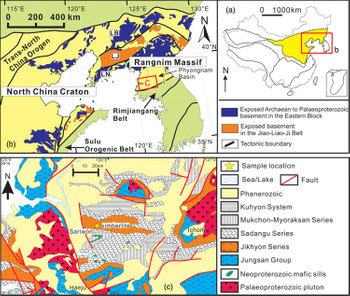
The Sino-Korean Craton is one of the most ancient in the world and consists primarily of the North China Craton (NCC) in China and the Rangnim Massif in North Korea (Fig. 1). Various studies have revealed that the Precambrian basement of the NCC is dominated by late Archaean (2.8–2.5 Ga) tonalite–trondhjemite–granodiorite (TTG) gneisses and supracrustal rocks, with minor amounts of early and middle Archaean components (Zhao & Zhai, Reference Zhao and Zhai2013). However, because of the difficulties in accessing rock outcrops and obtaining rock samples, the characteristics and tectonic affinity of the basement beneath the Rangnim Massif remain controversial. Based on a few early late Archaean and Proterozoic ages yielded by whole-rock Sm–Nd and Rb–Sr isochron methods, the crustal basement of the Rangnim Massif has been thought to be connected to the NCC and characterized by widely exposed Archaean rocks (Huang, Reference Huang1977; Paek et al. Reference Paek, Kang and Jon1996, p. 619; Qiao & Zhang, Reference Qiao and Zhang2002). This viewpoint has recently gained support from the high-precision U–Pb dating of zircons, which has yielded ages of 2.64–2.51 Ga for the granitoids that occur mainly along the eastern and southern margins of the Rangnim Massif (Zhao et al. Reference Zhao, Cao, Wilde, Sun, Choe and Li2006, Reference Zhao, Zhang, Yang, Han and Kim2016a; Zhang et al. Reference Zhang, Zhang, Zhai, Wu, Hou and Yuan2016). However, detrital zircons collected from sands in the major rivers that traverse North Korea indicate another scenario, given that their ages cluster dominantly around 1.9–1.8 Ga and there are fewer Archaean ages (Wu et al. Reference Wu, Yang, Wilde, Liu, Guo and Zhai2007b, Reference Wu, Li, Yang, Kim and Han2016). Similarly, most of the Precambrian plutonic rocks exposed in the Rangnim Massif have crystallization ages of 1.9–1.8 Ga (Peng et al. Reference Peng, Wang, Yang and Kim2016). Archaean rocks are limited in scale and are distributed only locally along the southern and eastern margins of the massif. These observations argue for a Palaeoproterozoic-dominated basement beneath the Rangnim Massif, with Archaean rocks being restricted to small isolated remnants within the Palaeoproterozoic terrane (Wu et al. Reference Wu, Li, Yang, Kim and Han2016).
(a) The location of the Sino-Korean Craton and (b) a regional geological map of Precambrian rocks in the eastern NCC and Rangnim Massif, modified after Zhao & Zhai (Reference Zhao and Zhai2013). LB – Liaobei Block; LN – Liaonan Block; LJ – Liao–Ji mobile belt. (c) Geological sketch map of Precambrian rocks in the Phyongnam Basin in the southern region of the Rangnim Massif. The location of the kimberlite samples is shown. The map is modified after Paek et al. (Reference Paek, Kang and Jon1996).

The arguments summarized above for different viewpoints are derived mainly from observations obtained from the shallow crustal layer, and they lack any consideration of the nature of the hidden crust that constitutes most of the basement. This lack of information about the true nature of the crustal components may result in biased or false conclusions (e.g. Zheng et al. Reference Zheng, Griffin, O’Reilly, Zhang, Pearson and Pan2006; Donatti-Filho et al. Reference Donatti-Filho, Oliveira and McNaughton2013). If we are to constrain the formation and evolution of the Rangnim Massif, further information on the deep structure of the basement is therefore required, especially for those regions where Archaean rocks are exposed.
Kimberlites are well known within Precambrian terranes and include the Kaapvaal Craton, the Siberian Craton and the NCC (e.g. Zheng et al. Reference Zheng, Griffin, O’Reilly, Zhao, Wu, Liu, Pearson, Zhang, Ma, Zhang, Yu, Su and Tang2009; Sparks, Reference Sparks2013; Sun et al. Reference Sun, Liu, Tappe, Kostrovitsky, Wu, Yakovlev, Yang and Yang2014). Kimberlites commonly form at great depths and are transported rapidly from the mantle to the Earth’s surface (Wyllie, Reference Wyllie1980; Mitchell, Reference Mitchell1986; Kelley & Wartho, Reference Kelley and Wartho2000). During their ascent, the kimberlitic magmas may interact with the lithosphere and capture mantle and/or crustal xenoliths or xenocrysts that provide information about the nature of cryptic components in the lithospheric mantle and crust during the time of the kimberlitic eruption (e.g. Rollinson, Reference Rollinson1997; Zheng et al. Reference Zheng, Griffin, O’Reilly, Yu, Zhang, Pearson and Zhang2007; Ashchepkov et al. Reference Ashchepkov, Rotman, Somov, Afanasiev, Downes, Logvinova, Nossyko, Shimupi, Palessky, Khmelnikova and Vladykin2012). Zircon xenocrysts are of special interest because they provide not only accurate U–Pb age data, but also information on whether the zircons crystallized from juvenile or recycled sources, as revealed by their Hf isotopes (Kinny & Maas, Reference Kinny, Maas, Hanchar and Hoskin2003; Kemp et al. Reference Kemp, Hawkesworth, Paterson and Kinny2006). The integration of U–Pb dating and Hf isotope data for xenocrystic zircons can therefore be used to characterize the vertical section of the lithosphere segment through which the kimberlitic magma passed, thus revealing its secular and variable evolution. In combination with data on the rocks exposed at the surface, the data from xenocrystic zircons could provide more comprehensive and reliable constraints on the nature and tectonic affinity of an otherwise little-known massif (e.g. Batumike et al. Reference Batumike, O’Reilly, Griffin and Belousova2007; Zheng et al. Reference Zheng, Griffin, O’Reilly, Zhao, Wu, Liu, Pearson, Zhang, Ma, Zhang, Yu, Su and Tang2009; Donatti-Filho et al. Reference Donatti-Filho, Oliveira and McNaughton2013; Kostrovitsky et al. Reference Kostrovitsky, Skuzovatov, Yakovlev, Sun, Nasdala and Wu2016).
Several Triassic kimberlite pipes and dykes are exposed within the Rangnim Massif (Fig. 1c; Yang et al. Reference Yang, O’Reilly, Walker, Griffin, Wu, Zhang and Pearson2010), and these hypabyssal rocks contain abundant zircon xenocrysts, thus providing a useful way of probing the deep lithospheric structure of the Rangnim Massif. In this paper, we explain how in situ U–Pb dating and Hf isotope analyses of zircon xenocrysts in the kimberlites of North Korea are able to reveal the age structure of the basement beneath the Rangnim Massif, constrain the crustal evolution of North Korea and provide further insights into the tectonic affinity of the Rangnim Massif.
2. Geological setting
North Korea consists of two major tectonic units: the Rangnim Massif and the Rimjingang Belt (Fig. 1b). The Rimjingang Belt, located on the southern side of North Korea, is characterized by high-pressure eclogites and gneisses, and it has been considered to be the eastern extension of the Dabie–Sulu ultra-high-pressure belt (Yin & Nie, Reference Yin and Nie1993; Ree et al. Reference Ree, Cho, Kwon and Nakamura1996; Kwon et al. Reference Kwon, Sajeev, Mitra, Park, Kim and Ryu2009), which resulted from the collision of the north and south China continents during Permian–Triassic time. The Rangnim Massif, the largest Precambrian unit of North Korea, is characterized by a basement that is composed mainly of the upper amphibolite- to granulite-facies Rangnim and Jungsan groups, and overlain by Mesoproterozoic to Phanerozoic sedimentary rocks (Paek et al. Reference Paek, Kang and Jon1996, p. 619). The Rangnim Group crops out in the northern part of the massif and flanks the margin of the south Phyongnam Basin, with the main rock types being gneisses, amphibolites, mafic granulites and calc-silicate rocks. The timing of deposition of the metasediments in the Rangnim Group has not been well constrained because of the lack of reliable geochronological data. Outcrops of the Jungsan Group are scattered widely in regions to the west of the Phyongnam Basin and along the western margin of the Rangnim Massif. The group consists of various schists that are characterized by the presence of garnet and sillimanite; the protoliths of these schists were deposited before c. 1.9 Ga and underwent strong metamorphic overprinting and anatexis during the period 1.9–1.8 Ga (Zhao et al. Reference Zhao, Cao, Wilde, Sun, Choe and Li2006, Reference Zhao, Zhang, Wu, Li, Yang, Kim and Chou2016b; Yang et al. Reference Yang, Peng, Jong, Park, Mun, Kim and Ku2016). Spatially and temporally associated with these so-called supracrustal rocks are voluminous granitoid plutons, including tonalitic–trondhjemitic–granodioritic gneisses and garnet–sillimanite-bearing S-type granites as well as massive porphyritic granites and syenites (Paek et al. Reference Paek, Kang and Jon1996, p. 619; Zhao et al. Reference Zhao, Cao, Wilde, Sun, Choe and Li2006; Wu et al. Reference Wu, Han, Yang, Wilde, Zhai and Park2007a; Peng et al. Reference Peng, Wang, Yang and Kim2016). Geochronological studies have shown that these igneous rocks were formed mainly at 1.9–1.8 Ga but with a small number of 2.6–2.5 Ga ages reported along the southern and eastern margins of the Rangnim Massif (Zhao et al. Reference Zhao, Cao, Wilde, Sun, Choe and Li2006, Reference Zhao, Zhang, Yang, Han and Kim2016a; Wu et al. Reference Wu, Yang, Wilde, Liu, Guo and Zhai2007b; Peng et al. Reference Peng, Wang, Yang and Kim2016; Zhang et al. Reference Zhang, Zhang, Zhai, Wu, Hou and Yuan2016). Mesozoic magmatic rocks are distributed widely within the Rangnim Massif and include Triassic (247–213 Ma) granites, syenites, dolerites and kimberlites, Jurassic (197–163 Ma) granites and Cretaceous (118–106 Ma) granites (Wu et al. Reference Wu, Han, Yang, Wilde, Zhai and Park2007a; Zhai et al. Reference Zhai, Zhang, Zhang, Wu, Peng, Li, Hou, Li and Zhao2016).
Most of the Mesoproterozoic–Phanerozoic sedimentary cover rocks are distributed in the Phyongnam Basin where they are deposited unconformably on the southern basement of the Rangnim Massif. The Phyongnam Basin contains a thick sequence of greenschist-facies metasedimentary rocks. The Sangwon System (Jikhyon, Sadangu, Mukchon and Myoraksan series) at the bottom of this sequence is distributed widely in the central part of the basin, and consists of a thick (c. 7000 m) succession of conglomerates, quartzites, phyllites, dolomites, limestones and marble. Hu et al. (Reference Hu, Zhai, Li, Li, Peng, Guo and Kusky2012) suggested that the age of deposition of the Sangwon metasediments is no older than 984 Ma. The Kuhyon System (Pirangdong and Rungri series) at the top of the sequence of metasediments in the Phyongnam Basin was deposited unconformably on the Sangwon System of rocks, and comprises conglomerates, phyllites, shales, dolomites and siltstones. A few mafic sills and dykes that have provided a baddeleyite Pb–Pb age of 899 ± 7 Ma were intruded into the rocks of the Sangwon System but were overlain by the sediments of the Kuhyon System (Peng et al. Reference Peng, Zhai, Li, Wu, Hou, Li, Li and Zhang2011), indicating that the Sangwon System was deposited at c. 900 Ma. The uppermost Phanerozoic strata belong mainly to the Hwagjiu System, which consists of Cambrian–Silurian terrigenous clastic rocks and carbonate rocks.
The kimberlites of North Korea are distributed within the Phyongnam Basin, where they appear as dykes and pipes that were intruded into the Jikhyon Series and the Precambrian basement (Fig. 1c). The rocks of the Jikhyon Series constitute the lowermost strata of the Sangwon System and unconformably overlie the Precambrian basement. They consist mainly of conglomerates, quartzites, chlorite schists and pelitic limestones, and contamination from these rocks may have altered the composition of the kimberlitic magma. Most of the kimberlites are porphyritic and have undergone high levels of surface alteration. The phenocrysts of olivine (pseudomorphs), phlogopite and pyroxene are set in a groundmass of mica, serpentine, ilmenite, pyroxene and carbonate. Mantle and/or crustal xenoliths, as well as xenocrysts and phenocrysts, are common in the kimberlites. Phlogopite phenocrysts from these rocks have yielded an Rb–Sr isochron age of 223 ± 7 Ma (Yang et al. Reference Yang, O’Reilly, Walker, Griffin, Wu, Zhang and Pearson2010), which represents the time of kimberlite crystallization. The mantle xenoliths captured by the kimberlites are mainly spinel peridotites, and garnet-bearing peridotites are absent. Previous research (Yang et al. Reference Yang, O’Reilly, Walker, Griffin, Wu, Zhang and Pearson2010) has indicated that these kimberlites have geochemical features similar to those of the Group II kimberlites of Smith (Reference Smith1983). The parental magmas of these kimberlites were formed by a small degree of partial melting of ancient lithospheric mantle at depths where garnet was stable (Yang et al. Reference Yang, O’Reilly, Walker, Griffin, Wu, Zhang and Pearson2010).
3. Analytical methods
The in situ U–Pb dating of the zircons was performed using laser ablation inductively coupled plasma mass spectrometry (LA-ICP-MS), whereas the Hf isotope analyses of the zircons were performed using LA multi-collector (MC) ICP-MS. All the analytical work was performed at the Institute of Geology and Geophysics, Chinese Academy of Sciences (IGGCAS).
3.a. Zircon LA-ICP-MS U–Pb dating and trace-element analyses
Fresh samples were crushed and the heavy mineral fractions, including zircon, were extracted using standard techniques. Zircon grains were handpicked under a binocular microscope, mounted in epoxy resin and polished until the grain centres were exposed. Cathodoluminescence (CL) images of the zircons were obtained with a LEO1450VP scanning electron microscope, and the images were used to characterize internal structures and to choose potential target sites for the U–Pb dating and Hf isotope analyses. The acceleration voltage during the CL imaging was 15 kV.
Laser ablation ICP-MS U–Pb analyses of the zircons were conducted using an Agilent 7500a ICP-MS instrument equipped with a 193 nm laser. The frequency for the analyses was 5 Hz, and the spot size for the laser was 32–44 μm. A total of 30–60 analyses per sample were performed for age determinations, with every 10 unknowns being bracketed by two standard zircons 91500 and one reference zircon GJ-1. Zircon 91500 was used as the external calibration standard, whereas zircon GJ-1 was treated as an unknown and used as an independent control on reproducibility and instrument stability. The standard silicate glass NIST 610 was used to optimize the instrument. Common Pb was not subtracted because of the large uncertainty in the determination of 204Pb, as noted elsewhere (Belousova et al. Reference Belousova, Griffin, Shee, Jackson and O’Reilly2001; Andersen, Reference Andersen2002; Jackson et al. Reference Jackson, Pearson, Griffin and Belousova2004). Raw count rates for 29Si, 204Pb, 206Pb, 207Pb, 208Pb, 232Th and 238U were collected for age determinations. Trace-element concentrations were calibrated using 29Si for internal calibration and NIST 610 as the calibration standard. 207Pb/206Pb and 206Pb/238U ratios were calculated using the GLITTER programme. As outlined in Ballard et al. (Reference Ballard, Palin, Williams, Campbell and Faunes2001), measured 207Pb/206Pb, 206Pb/238U and 208Pb/232Th ratios in zircon 91500 were averaged over the course of an analytical session and used to calculate correction factors. These correction factors were then applied to each sample to correct for both instrumental mass bias and depth-dependent elemental and isotopic fractionation. The age calculations and concordia plots were constructed using ISOPLOT (v. 3.0) (Ludwig, Reference Ludwig2003).
3.b. LA-MC-ICP-MS zircon Hf isotope analyses
Zircon Hf isotope analyses were conducted using a Neptune MC-ICP-MS instrument with an attached 193 nm excimer ArF laser ablation system. Lu–Hf isotope measurements were made on the same zircon grains that had been used for U–Pb dating. During Hf analyses, a laser repetition rate of 8 Hz and 15 J cm–2 was used, and the spot size was 60 μm. Raw count rates for 172Yb, 173Yb, 175Lu, 176(Hf + Yb + Lu), 177Hf, 178Hf, 179Hf, 180Hf and 182W were collected, and isobaric interference corrections for 176Lu and 176Yb on 176Hf were determined precisely. The analytical procedures and the corrections for interferences have been described by Wu et al. (Reference Wu, Yang, Xie, Yang and Xu2006). During the analyses, the 176Hf/177Hf ratios determined for the standard zircon Mud Tank were 0.282499 ± 5 (2σn, n = 34), similar to the commonly accepted 176Hf/177Hf ratio of 0.282507 ± 6 measured using the solution method (Woodhead et al. Reference Woodhead, Hergt, Shelley, Eggins and Kemp2004). The 176Hf/177Hf ratio determined for the standard zircon GJ-1 was 0.282008 ± 6 (2σn, n = 28), which is similar to the commonly accepted 176Hf/177Hf ratio of 0.282015 ± 19 (2σn, n = 25) (Elhlou et al. Reference Elhlou, Belousova, Griffin, Pearson and O’Reilly2006).
4. Results
4.a. U–Pb ages and trace elements
A total of 140 analyses were obtained on 138 zircon grains from six kimberlite samples (11NK11, 11NK12, 11NK13, 11NK14, T-1 and T-2). The U–Pb results and rare Earth element (REE) concentrations are listed in the online Supplementary Tables S1 and S2 (available at http://journals.cambridge.org/geo). CL images of representative zircons are shown in Figure 2a. Most zircon grains are euhedral to subhedral with sizes of 50–120 μm, and exhibit stubby prismatic or ellipsoidal morphologies. The majority of zircons display fine-scale oscillatory growth zoning (Fig. 2a), which is a typical characteristic of magmatic zircon (Corfu et al. Reference Corfu, Hanchar, Hoskin and Kinny2003). These zircons have variable Th (28–511 ppm) and U (91–905 ppm) contents with Th/U ratios (mostly 0.11–1.05) that are higher than the typical 0.1 of metamorphic zircons (Rubatto, Reference Rubatto2002) (online Supplementary Table S1). The chondrite-normalized REE diagram (Fig. 2b) shows that the zircons are characterized by enrichment in heavy REEs, depletion of light REEs and marked positive Ce and negative Eu anomalies (Fig. 2b and online Supplementary Table S2). These features suggest that most of the zircons analysed for this study were magmatic in origin (Hoskin & Black, Reference Hoskin and Black2000; Belousova et al. Reference Belousova, Griffin, O’Reilly and Fisher2002).
(a) Cathodoluminescence images of representative dated zircon xenocrysts from kimberlite samples of North Korea (the length of the scale bar is 100 μm). (b) Chondrite-normalized REE distribution diagram of the zircon xenocrysts from the North Korean kimberlites showing comparisons with the mantle zircons of Belousova et al. (Reference Belousova, Griffin and Pearson1998). The chondrite values are from Sun & McDonough (Reference Sun, McDonough, Saunders and Norry1989).

No reliable Archaean zircon ages were identified during our work (online Supplementary Table S1), and the oldest ages are Palaeoproterozoic (Fig. 3 and online Supplementary Table S1). Four analyses yielded the oldest 207Pb/206Pb ages, which range from 2402 ± 11 to 2442 ± 12 Ma, with a weighted mean 207Pb/206Pb age of 2419 ± 29 Ma (2σ, mean square weighted deviation (MSWD) = 2.3). Three concordant analyses gave ages of 1999 ± 15, 2151 ± 22 and 2246 ± 16 Ma. However, most of our 128 analyses gave ages of 1.9–1.8 Ga with a weighted mean 207Pb/206Pb age of 1879 ± 3 Ma (2σ, MSWD = 1.4) (Fig. 3). Two late Palaeoproterozoic–Mesoproterozoic zircons appear in our data, with one yielding a 207Pb/206Pb age of 1694 ± 51 Ma and the other a 207Pb/206Pb age of 1184 ± 18 Ma. The remaining three zircon grains are Phanerozoic and have a weighted mean 206Pb/238U age of 463 ± 8 Ma (2σ, MSWD = 0.1) (Fig. 3). A histogram for zircons of this study is shown in Figure 4a. Given that at least three grains are required to define an age population, the zircon ages show one prominent age peak at 1.8–1.9 Ga and two weak age peaks at c. 460 Ma and c. 2.4 Ga.
U–Pb concordia diagram for the zircon xenocrysts from our five kimberlite samples.

(a) Probability diagrams of U–Pb ages for zircon xenocrysts from the North Korean kimberlites, (b) detrital zircons from the Jikhyon Series, (c) Precambrian basement rocks within and around the Phyongnam Basin, and (d) detrital zircons from the Taedong River, North Korea. Data for the detrital zircons are from Wu et al. (Reference Wu, Yang, Wilde, Liu, Guo and Zhai2007b, Reference Wu, Li, Yang, Kim and Han2016), and data for the Precambrian basement rocks are from Peng et al. (Reference Peng, Wang, Yang and Kim2016).

4.b. Results of the zircon Hf isotope analyses
The measurements of Hf isotopes were made on the same zircon grains that had been used for U–Pb dating and mostly reoccupying the previous U–Pb analytical spots. The Hf data are listed in the online Supplementary Table S3 (available at http://journals.cambridge.org/geo).
The zircons we analysed for this study exhibit a wide range of 176Lu/177Hf ratios (0.0003–0.0018). Comparatively, the Precambrian zircon grains (c. 2.4–1.7 Ga) have less radiogenic 176Hf/177Hf ratios (0.280996–0.282092) than those with Phanerozoic ages (0.282389–0.282932), and they yield low ϵ Hf(t) values of –9.7 to +0.7, corresponding to the Hf model ages (T CDM) of 2.6–3.6 Ga (online Supplementary Table S3). In Figure 5, the data plot along the average continental crust evolution trend. The zircon with a Mesoproterozoic age has a weakly positive ϵ Hf(t) value (+1.5), corresponding to a Hf model age of 1.9 Ga. The Phanerozoic zircons (c. 460 Ma) display much higher ϵ Hf(t) values (–3.5 to +15.3) (online Supplementary Table S3) and plot close to the depleted mantle evolution line on Figure 5. The Hf model ages of these Phanerozoic zircons (T CDM = 1665–466 Ma) are similar or close to the zircon crystallization ages and are significantly different from those of the Precambrian zircons (online Supplementary Table S3).
Temporal variations in Hf values of the studied zircon xenocrysts. The black diamond shapes represent detrital zircons from North Korean rivers (Wu et al. Reference Wu, Yang, Wilde, Liu, Guo and Zhai2007b).

5. Discussion
5.a. The origin of zircon xenocrysts in the kimberlites
Because of the low silica contents of kimberlitic magmas and their relatively high alkali contents and high temperatures, it is difficult for kimberlitic magmas to crystallize primary phenocrysts of zircon (Krasnobayev, Reference Krasnobayev1980; Belousova et al. Reference Belousova, Griffin and Pearson1998; Griffin et al. Reference Griffin, O’Reilly, Ryan, Fei, Bertka and Mysen1999; Robles-Cruz et al. Reference Robles-Cruz, Escayola, Jackson, Galí, Pervov, Watangua, Gonçalves and Melgarejo2012; Donatti-Filho et al. Reference Donatti-Filho, Oliveira and McNaughton2013), and most zircons in kimberlites are captured from the mantle or crustal wall rocks during magma ascent (Krasnobayev, Reference Krasnobayev1980; Robles-Cruz et al. Reference Robles-Cruz, Escayola, Jackson, Galí, Pervov, Watangua, Gonçalves and Melgarejo2012; Donatti-Filho et al. Reference Donatti-Filho, Oliveira and McNaughton2013). In other words, the crystallization of these zircons is related to geological processes that took place prior to the kimberlitic magmatism (Allsopp et al. Reference Allsopp, Bristow, Smith, Brown, Gleadow, Kramers, Garvie and Ross1989; Valley et al. Reference Valley, Kinny, Schulze and Spicuzza1998; Griffin et al. Reference Griffin, Pearson, Belousova, Jackson, Van Achterbergh, O’Reilly and Shee2000; Belousova et al. Reference Belousova, Griffin, Shee, Jackson and O’Reilly2001; Zheng et al. Reference Zheng, Griffin, O’Reilly, Zhao, Wu, Liu, Pearson, Zhang, Ma, Zhang, Yu, Su and Tang2009). The zircons that we separated from the North Korean kimberlites show ages that range from c. 2.4 to 0.46 Ga (online Supplementary Table S1), which are significantly older than the age of formation of the host kimberlite (223 ± 7 Ma, Yang et al. Reference Yang, O’Reilly, Walker, Griffin, Wu, Zhang and Pearson2010), and these zircons therefore represent mantle or crustal xenocrysts captured by the host kimberlitic magma.
Inferences as to the sources of zircon xenocrysts in kimberlites can be made from their crystal morphology and trace-element contents (Kresten et al. Reference Kresten, Fels and Berggren1975; Krasnobayev, Reference Krasnobayev1980; Mitchell, Reference Mitchell1986; Belousova, Griffin & Pearson, Reference Belousova, Griffin and Pearson1998; Belousova et al. Reference Belousova, Griffin, O’Reilly and Fisher2002; Robles-Cruz et al. Reference Robles-Cruz, Escayola, Jackson, Galí, Pervov, Watangua, Gonçalves and Melgarejo2012; Donatti–Filho, Oliveira & McNaughton, Reference Donatti-Filho, Oliveira and McNaughton2013). Mantle zircons usually have a large grain size (typically several millimetres) and display either wide oscillatory zones or a homogeneous structure in CL images (Kresten et al. Reference Kresten, Fels and Berggren1975; Krasnobayev, Reference Krasnobayev1980; Belousova et al. Reference Belousova, Griffin and Pearson1998, Reference Belousova, Griffin, O’Reilly and Fisher2002; Sun et al. Reference Sun, Tappe, Kostrovitsky, Liu, Skuzovatov and Wu2018). Their uranium and thorium contents are low and rarely exceed 50–60 ppm for U and 10–15 ppm for Th (Belousova et al. Reference Belousova, Griffin and Pearson1998, Reference Belousova, Griffin, O’Reilly and Fisher2002). Mantle zircons have REE contents lower than 50 ppm and show weak or no Eu anomalies in chondrite-normalized REE patterns (Fig. 2b) (Belousova et al. Reference Belousova, Griffin and Pearson1998, Reference Belousova, Griffin, O’Reilly and Fisher2002). However, zircons in the Triassic kimberlites are characterized by narrow oscillatory zones and a grain size of < 150 μm. Most of these kimberlite zircons display markedly negative Eu anomalies, high Th (28–511 ppm) and U (91–915 ppm) abundances and high total REE contents (Figs 2b and 6a). These features suggest that the zircon xenocrysts from the North Korean kimberlites were derived from crustal rather than mantle rocks. Furthermore, the relatively high Y contents and high U/Yb values (Fig. 6b) indicate that these zircon xenocrysts probably had an origin in continental crust rather than being inherited from a recycled oceanic crust characterized by low U/Yb ratios (Grimes et al. Reference Grimes, John, Kelemen, Mazdab, Wooden, Cheadle, Hanghøj and Schwartz2007). The principal provenance for these zircons is therefore likely to have been the Rangnim Massif.
Diagrams of (a) Th v. U and (b) U/Yb v. Y (Grimes et al. Reference Grimes, John, Kelemen, Mazdab, Wooden, Cheadle, Hanghøj and Schwartz2007) showing the origins of the zircons. The data for mantle zircons in kimberlites are from Donatti-Filho et al. (Reference Donatti-Filho, Oliveira and McNaughton2013).

As has been pointed out previously, the host kimberlites were intruded into the rocks of the Jikhyon Series, and these sedimentary rocks may have provided a source for some of the zircon xenocrysts in the North Korean kimberlites (Parrish & Reichenbach, Reference Parrish and Reichenbach1991; Batumike et al. Reference Batumike, O’Reilly, Griffin and Belousova2007). However, detrital zircons in sedimentary rocks are in all cases characterized by some degree of rounding, and this characteristic was not observed in the subhedral–euhedral zircon grains that we analysed. More importantly, the in situ U–Pb dating of detrital zircons from the Jikhyon Series reveals two distinct age peaks at 1.6–1.4 and 1.2–1.0 Ga and a relatively weak age peak at 1.9–1.8 Ga (Fig. 4b) (Hu et al. Reference Hu, Zhai, Li, Li, Peng, Guo and Kusky2012; Li et al. Reference Li, Ni and Xu2016), and this age spectrum differs drastically from that of the zircon xenocrysts from the North Korean kimberlites. It therefore seems likely that these zircon xenocrysts were derived from the underlying crystalline basement rock and that the ages and Hf isotope characteristics of these xenocrysts should help us to establish the nature of the basement beneath the Rangnim Massif.
5.b. Zircon records of a Palaeoproterozoic basement
The kimberlites of North Korea are located in the Phyongnam Basin, which was developed on the southern side of the Rangnim Massif. Because of the widespread and thick Mesoproterozoic to Palaeozoic sedimentary cover rocks, the nature of the basement rocks beneath this region is not well constrained. Recently, Neoarchaean granitoid rocks with in situ zircon U–Pb ages of 2.64–2.52 Ga have been found along the southern and eastern margins of the basin (Zhao et al. Reference Zhao, Cao, Wilde, Sun, Choe and Li2006, Reference Zhao, Zhang, Yang, Han and Kim2016a), and these unique Archaean ages are consistent with the prior Archaean isochron dating results of Paek et al. (Reference Paek, Kang and Jon1996, p. 619), implying that more Archaean rocks may exist in the southern part of the Rangnim Massif. The zircon xenocrysts in the kimberlites offer a direct way of investigating the hidden basement of the basin, but the 138 zircon xenocrysts that we analysed revealed no concordant Archaean ages. The oldest age population, yielded by just four zircons, is a cluster at c. 2.4 Ga (online Supplementary Table S1 and Fig. 4a). These age data therefore suggest that Archaean basement rocks are of very limited extent or absent from beneath the Phyongnam Basin. The recently identified Archaean granitic rocks (Zhao et al. Reference Zhao, Zhang, Yang, Han and Kim2016a) might be restricted in scale and of limited extent at depth, and may represent remnants of Archaean material that survived the later thermal events (see Section 5.c. below).
The most prominent age population displayed by zircon xenocrysts from the North Korean kimberlites (Fig. 4a) is a cluster at 1.9–1.8 Ga. More than 90% (128 analyses) of the total data are within this range, and they gave a weighted average age of 1879 ± 3 Ma (online Supplementary Table S1). Considering the igneous origin of the xenocryst zircons and their derivation from crustal rocks, we suggest that a thick Palaeoproterozoic-dominant crustal component lies hidden at depth beneath the kimberlite region. This proposition is supported by the Palaeoproterozoic rocks that are widely exposed within and around the Phyongnam Basin (Fig. 4c). These rocks include massive porphyritic monzogranites, biotite granites, garnet–sillimanite granites and syenites with zircon U–Pb ages that range from 1908 ± 12 to 1854 ± 12 Ma (Zhao et al. Reference Zhao, Cao, Wilde, Sun, Choe and Li2006; Wu et al. Reference Wu, Han, Yang, Wilde, Zhai and Park2007a; Peng et al. Reference Peng, Wang, Yang and Kim2016), and their outcrops indicate that they exist in a much larger volume than the Archaean remnants. Furthermore, Wu et al. (Reference Wu, Yang, Wilde, Liu, Guo and Zhai2007b) examined detrital zircons collected from sands at the mouth of the Tedong River, which traverses the Phyongnam Basin, as a way of indirectly sampling the Rangnim Massif, and their age data also display a prominent age peak at 1.9–1.8 Ga (Fig. 4d).
In summary, the exposed basement rocks surrounding the Phyongnam Basin are predominantly of Palaeoproterozoic age, and their ages are consistent with the Palaeoproterozoic ages of the zircon xenocrysts that were derived from the hidden crustal components beneath the basin. The data therefore indicate that a widespread Palaeoproterozoic basement exists in the southern part of the Rangnim Massif.
The northern part of the Rangnim Massif has been considered to be a region with major outcrops of Precambrian basement rock (Paek et al. Reference Paek, Kang and Jon1996, p. 619). However, fieldtrips and rock sampling are not possible in this region. As an alternative strategy, Wu et al. (Reference Wu, Yang, Wilde, Liu, Guo and Zhai2007b) obtained samples from the major rivers that traverse the northern part of the Rangnim Massif, namely the Songchon and Chongchon rivers. The U–Pb ages of zircons collected from the mouths of these rivers feature a prominent age peak at 1.9–1.8 Ga, along with a few Archaean ages. Furthermore, among the few geochronological data reported for the rocks exposed in this region, no reliable dates for Archaean intrusions have been found (Zhao et al. Reference Zhao, Cao, Wilde, Sun, Choe and Li2006; Wu et al. Reference Wu, Han, Yang, Wilde, Zhai and Park2007a; Zhai et al. Reference Zhai, Guo, Peng and Hu2007a). Moreover, Archaean ages are also lacking in the adjacent region of China that was thought to be connected geologically with the Rangnim Massif of North Korea (Wang et al. Reference Wang, Ren, Lu, Kang, Chu and Yu2015). The majority of Precambrian rocks in the northern part of the Rangnim Massif are therefore probably of Palaeoproterozoic age, consistent with the southern part of the massif. We therefore suggest that, during Triassic time when the kimberlites were emplaced, the basement component of the Rangnim Massif was dominated by Palaeoproterozoic rocks. Although Archaean components are exposed locally at the surface, there is no evidence that they are widespread at depth.
The weak age population at 463 ± 8 Ma (Fig. 4a) has seldom been reported in North Korea, and it is significantly older than the c. 400 Ma metamorphic event recorded by the Neoproterozoic mafic dykes in the Phyongnam Basin (Peng et al. Reference Peng, Zhai, Li, Wu, Hou, Li, Li and Zhang2011), thus precluding any relationship with that event. In the adjacent eastern NCC, Ordovician diamondiferous kimberlites were emplaced at 480 ± 4 Ma (Li et al. Reference Li, Wu, Li, Qiu, Liu, Yang and Tang2011), and they represent the only known magmatism of Palaeozoic age within the craton. It is therefore possible that a similar magmatic event might also have occurred in North Korea, but slightly earlier than that in the NCC. However, the information on these events is very scarce, and further work is needed to ascertain the geological significance of these Palaeozoic zircons.
5.c. A Palaeoproterozoic crustal reworking event recorded by zircon xenocrysts
Although the Archaean materials are much more limited in scale than the Palaeoproterozoic rocks, their footprints can be traced widely in the Rangnim Massif. In addition to the exposed Archaean rocks mentioned above, inherited zircons of Archaean age have been found in North Korea in the Palaeoproterozoic granitic gneisses and in the sediments of modern rivers, and some of these zircons are as old as 3.2 Ga (Zhao et al. Reference Zhao, Cao, Wilde, Sun, Choe and Li2006; Wu et al. Reference Wu, Han, Yang, Wilde, Zhai and Park2007a, b; Zhai et al. Reference Zhai, Guo, Peng and Hu2007a). The question arises, therefore, as to whether the dominant Palaeoproterozoic basement rocks of the Rangnim Massif were derived from the reworking of those Archaean rocks or whether they simply represent a strong crustal growth event.
Zircon can provide information on the Hf isotope composition of the magma from which it crystallized (Cherniak et al. Reference Cherniak, Hanchar and Watson1997a, b; Kinny & Maas, Reference Kinny, Maas, Hanchar and Hoskin2003). Accordingly, Hf isotope data can be used to determine whether a zircon crystallized from a juvenile source or whether it was the result of ancient crustal recycling. Our Hf isotope analyses revealed that the zircons with Palaeoproterozoic ages have lowly radiogenic Hf isotopes with ϵ Hf(t) values of −9.7 to +0.7, and all these values are much lower than those of depleted mantle (Fig. 5), indicating that these zircons were not juvenile but derived from the recycling of more ancient crust. Statistical calculations indicate that these Palaeoproterozoic zircons have an average Hf model age of 2.86 ± 0.02 Ga (2σ) (Fig. 7a), identical to the Hf model age of 2.89 ± 0.03 Ga (2σ) given by Precambrian detrital zircons from the river sands of North Korea (Wu et al. Reference Wu, Yang, Wilde, Liu, Guo and Zhai2007b). These features indicate that much older crustal components existed in the Rangnim Massif before the Palaeoproterozoic Era.
Histograms showing the Hf model ages (a) of zircon xenocrysts from the North Korean kimberlites and (b) of detrital zircons from the Liaohe Group within the Liao–Ji Belt. Data for the Liaohe Group are from Luo et al. (Reference Luo, Sun, Zhao, Li, Ayers, Xia and Zhang2008).

A few Archaean zircons have been found in river sands collected from the mouths of North Korean rivers (Wu et al. Reference Wu, Yang, Wilde, Liu, Guo and Zhai2007b), although zircons of such ages are not present in our samples. Most of the Archaean zircons of Wu et al. (Reference Wu, Yang, Wilde, Liu, Guo and Zhai2007b) have ϵ Hf(t) values of −0.7 to +6.5, therefore falling between the evolutionary trend of depleted mantle and chondrite in Figure 5. These characteristics indicate that the protoliths of those Archaean zircons were juvenile during the Archaean Eon and that they possibly represent the initial crust of the Rangnim Massif. However, our work shows that those Archaean components have barely survived since the Triassic Period. Considering the wide distribution of 1.9–1.8 Ga basement rocks beneath the Rangnim Massif and their generation as a result of the re-melting of ancient crust, we suggest that a strong crustal reworking event occurred in the Rangnim Massif during the Palaeoproterozoic Era. Large volumes of crust- and mantle-derived magmatic rocks were generated repeatedly in the massif during this time, and those processes continuously digested the pre-existing basement, thus exhausting most of the supply of Archaean rock. Only scarce remnants of Archaean material survived to be sparsely distributed within the newly formed Palaeoproterozoic basement.
5.d. Implications for the tectonic affinity of the Rangnim Massif
It has been widely accepted that the basement of the Rangnim Massif is connected to that of the NCC (Cluzel et al. Reference Cluzel, Lee and Cadet1991; Yin & Nie, Reference Yin and Nie1993; Ernst & Liou, Reference Ernst and Liou1995; Chang, Reference Chang1996; Chang & Park, Reference Chang and Park2001; Kim et al. Reference Kim, Oh, Williams, Rubatto, Ryu, Rajesh, Kim, Guo and Zhai2006; Metcalfe, Reference Metcalfe2006; Oh, Reference Oh2006; Zhao et al. Reference Zhao, Cao, Wilde, Sun, Choe and Li2006; Wu et al. Reference Wu, Yang, Wilde, Liu, Guo and Zhai2007b; Zhai et al. Reference Zhai, Guo, Li, Chen, Peng, Li, Hou and Fan2007b, c; Oh et al. Reference Oh, Imayama, Lee, Yi, Yi and Lee2015), and that both terranes underwent similar geological evolutions during Phanerozoic time. However, the northeastern part of the NCC is composed of the Archaean Liaobei and Liaonan blocks and the intervening Palaeoproterozoic Liao–Ji mobile belt (Fig. 1b). These tectonic units record a distinctive Precambrian geological history (Zhao et al. Reference Zhao, Wilde, Cawood and Sun2001, Reference Zhao, Sun, Wilde and Li2005); the key to constraining the tectonic affinity of the Rangnim Massif therefore lies in making comparisons between the Rangnim Massif and these tectonic units. The Rangnim Massif was once thought to contain widespread areas of Archaean rock and was therefore treated as the eastern extension of the Archaean Liaonan Block (Bai, Reference Bai1993; Zhao et al. Reference Zhao, Wilde, Cawood and Lu1998, Reference Zhao, Sun, Wilde and Li2005; Zhao & Zhai, Reference Zhao and Zhai2013), with the Archaean Liaonan–Rangnim Massif representing one of the most ancient continental nuclei in the NCC. However, our work and that of others over the past 10 years has revealed that Archaean rocks are actually very scarce within the Rangnim Massif. This means that the massif differs significantly from the Liaonan Block, as the Liaonan Block has extensive exposure of late Archaean TTG rocks, and this in turn makes comparative studies of the Rangnim Massif and Liaonan Block difficult.
The Rangnim Massif is characterized by 1.9–1.8 Ga magmatic activity. This thermal event has also been well documented in the Liao–Ji mobile belt (Faure et al. Reference Faure, Lin, Monié and Bruguier2004; Luo et al. Reference Luo, Sun, Zhao, Li, Xu, Ye and Xia2004; Lu et al. Reference Lu, Wu, Guo, Wilde, Yang, Liu and Zhang2006; Li & Zhao, Reference Li and Zhao2007; Yang et al. Reference Yang, Wu, Xie and Liu2007). The belt consists of the supracrustal rocks of the Liaohe Group (and equivalent assemblages in Jilin Province) (LBGMR, 1989) and voluminous Palaeoproterozoic granitic rocks. The sediments of the Liaohe Group were deposited between the Archaean Liaobei and Liaonan blocks and were metamorphosed at 1.93 Ga (Luo et al. Reference Luo, Sun, Zhao, Li, Xu, Ye and Xia2004; Xie et al. Reference Xie, Yang, Wu, Yang and Wilde2011). The associated granitoids can be divided into 2.17–2.09 and 1.88–1.85 Ga granites (Lu et al. Reference Lu, Wu, Guo, Wilde, Yang, Liu and Zhang2006; Li & Zhao, Reference Li and Zhao2007; Yang et al. Reference Yang, Wu, Xie and Liu2007), and the younger of these granitic suites contains garnet- and cordierite-bearing porphyritic S-type granite, hornblende-bearing quartz diorite, porphyritic granodiorite and syenite. The granites are similar to the 1.9–1.8 Ga Ryonhwasan S-type granites, the Myohyangsan porphyritic granites and the Sakju syenites, all of which are present in the Rangnim Massif (Zhao et al. Reference Zhao, Sun, Wilde and Li2005; Wu et al. Reference Wu, Han, Yang, Wilde, Zhai and Park2007a; Zhai et al. Reference Zhai, Guo, Peng and Hu2007a; Kim et al. Reference Kim, Han, Zhao, Li and Kim2016; Peng et al. Reference Peng, Wang, Yang and Kim2016). In addition, detrital zircons from the Liaohe Group sediments have provenances dominated by the Palaeoproterozoic Liao–Ji granitoids along with small amounts of late Archaean basement rocks. The Liaohe Group zircons have an average Hf model age of 2.69 ± 0.03 Ga (Fig. 7b) (Luo et al. Reference Luo, Sun, Zhao, Li, Ayers, Xia and Zhang2008), and this is comparable to the model ages of our samples of zircon xenocrysts from the Rangnim Massif, thus indicating the coeval formation of continental crust in both areas. These observations suggest that the Rangnim Massif is more likely to be part of the Liao–Ji mobile belt (Peng et al. Reference Peng, Zhai, Li, Wu, Hou, Li, Li and Zhang2011, Reference Peng, Wang, Yang and Kim2016; Liu et al. Reference Liu, Liu, Wang, Liu and Cai2015; Wang et al. Reference Wang, Ren, Lu, Kang, Chu and Yu2015; Wu et al. Reference Wu, Li, Yang, Kim and Han2016) than of Archaean Liaonan Block. The Liao–Ji Belt is one of the Palaeoproterozoic orogens within the NCC and was previously considered to have been formed during the amalgamation of the Archaean Liaobei–Longgang Block and the Archaean Liaonan–Rangnim Block, thus marking the final stage in the formation of the NCC (Zhao et al. Reference Zhao, Wilde, Cawood and Sun2001, Reference Zhao, Sun, Wilde and Li2005). However, if the Rangnim Massif were part of the Liao–Ji Belt, then this would indicate the presence of a huge Palaeoproterozoic orogen in the eastern NCC. If this were the case, then a complete reappraisal of the Precambrian evolution of the eastern Sino-Korean Craton would be needed to understand the geodynamic evolution of this huge orogen and its role in the evolution of the NCC.
6. Conclusions
(1) Zircons in the North Korean Triassic kimberlites are xenocrysts that were captured from the deep crust during magma ascent.
(2) Most of the zircon xenocrysts are of igneous origin and crystallized at 1.9–1.8 Ga. Zircons of Archaean age were not found. The age spectrum for the zircons clearly indicates a Palaeoproterozoic provenance, which implies the presence of a Palaeoproterozoic basement beneath the Rangnim Massif.
(3) The Hf isotope data reveal that the Rangnim Massif once had an Archaean basement. During the Palaeoproterozoic Era, a strong crustal reworking event significantly modified the pre-existing Archaean crust of the Rangnim Massif and generated a basement that was dominated by Palaeoproterozoic materials.
(4) The Rangnim Massif shows a greater tectonic affinity with the Palaeoproterozoic Liao–Ji Belt of the NCC than with the Archaean Liaonan Block, and this poses significant problems for previous ideas on geological relationships in the Sino-Korean area. Our new data indicate the presence of a huge Palaeoproterozoic orogen in the eastern NCC, and the geological evolution of this area now requires a complete reappraisal.
Author ORCIDs
Yu-Sheng Zhu 0000-0002-1121-2506
Acknowledgements
We thank Yue-Heng Yang and Lie-Wen Xie for their help in determining the U–Pb ages and Hf isotope contents of the zircons. We also thank Peng Peng for discussions on the geology of kimberlites in North Korea. We are grateful to two anonymous reviewers for their thoughtful and constructive comments and to the editor for handling this paper. This study was supported by funds from the Ministry of Science and Technology of the People’s Republic of China (2016YFC0600109), the National Natural Science Foundation of China (41702059) and the China Postdoctoral Science Foundation.
Supplementary material
To view supplementary material for this article, please visit https://doi.org/10.1017/S0016756818000900.
Declaration of interest
None.