Introduction
Deficits in cognitive function in adults with major depressive disorder (MDD) are prevalent, pervasive, and highly relevant to patient-reported outcomes.Reference McIntyre, Cha and Soczynska 1 Cognitive function has been atomized into the domains of executive function, learning and memory, processing speed, as well as attention/concentration.Reference Millan, Agid and Brune 2 An overarching taxonomy has proposed the notion of cold and hot cognition to incorporate the influence of emotional valence on cognitive performance.Reference Roiser and Sahakian 3 In contradistinction to schizophrenia and bipolar disorder, there are relatively few studies that have broadly aimed to identify determinants of cognitive performance in well-characterized, clinical cohorts of individuals with MDD.Reference McIntyre, Cha and Soczynska 1
Anhedonia is defined as markedly diminished interests or pleasure in all, or almost all, activities most of the day, nearly every day for an extended period of time, as reported by patient or on observation.Reference Mitterschiffthaler, Kumari and Malhi 4 Anhedonia is a trans-nosological domain that is observed across neuropsychiatric disorders (eg, schizophrenic and Parkinson’s disease).Reference Pizzagalli 5 In addition to being a core criterion item for the diagnosis of a major depressive episode (MDE), convergent evidence indicates that MDD populations with anhedonia exhibit unique response characteristics.Reference Martinotti, Sepede and Gambi 6 Disturbances in pleasure, often referred to as an impairment in emotional valence, are hypothesized to be subserved by neural circuits/subcircuits relevant to affect generation/regulation and to general cognitive performance (eg, amygdala, insula, ventral striatum, ventral anterior cingulate cortex, ganglion, and prefrontal cortical regions).Reference Insel, Cuthbert and Garvey 7 , Reference Stein 8 An association between anhedonia and impaired cognitive performance is documented in adults with Parkinson’s disease.Reference Santangelo, Vitale and Trojano 9
The neurobiological substrates subserving anhedonia and general cognitive function are convergent, which suggests that both of the foregoing domains would be highly correlated in adults with MDD. The National Institute of Mental Health (NIMH) Research Domain Criteria (RDoC) matrix defines 5 interrelated, dissociable, and trans-diagnostic domains (and subdomains).Reference Insel, Cuthbert and Garvey 7 The overarching impetus behind the RDoC matrix is to refine mechanistic models that subserve psychopathology across the developmental trajectory. It is expected that a primary emphasis on neurobiological substrates bordering disorders will provide a more opportunistic platform for genuinely novel treatment discovery and development. A theme that emanates from the RDoC matrix, which is empirically supported by cognitive and emotional neuroscience, is the centrality of disturbances in cognitive function broadly defined in its critical role in regulating emotional processes and human function. Tacit to the theme inherent in the RDoC is the need to identify both convergent and discrete aspects of cognitive function. We are of the view that anhedonia is not only a ubiquitous clinical phenomenon in psychiatry, but in many individuals, it co-occurs alongside significant deficits in general cognitive function.
In this article, we sought to address, in a preliminary fashion, the foregoing clinical question by empirically determining the extent to which anhedonia is correlated with cognitive impairment in adults with MDD. We entered into this curiosity-driven analysis with an a priori assumption that the domains of anhedonia and general cognitive function would indeed be correlated, but would also be dissociable. Our intention was both clinical (ie, to instantiate overlapping and discrete aspects of anhedonia and cognition) as well as heuristic (ie, to what extent does RDoC-defined negative valence correlate with RDoC-defined general cognitive function?). The sample population for this analysis comprised a large, international, representative group of adults with well-characterized syndromal MDD.
Methods
A total of 369 individuals consented to be a part of the International Mood Disorders Collaborative Project (IMDCP) between January 2008 and July 2013. This analysis was confined to those individuals who met the criteria for MDD at enrollment and had satisfactory completion of the outcome measures pertinent to the analysis. The IMDCP is a multi-site, naturalistic, cross-sectional study of individuals presenting for evaluation and/or treatment in tertiary care specialized centers [ie, The Mood Disorders Psychopharmacology Unit (MDPU) located at the University Health Network (UHN), University of Toronto, and Cleveland Clinic Center for Mood Disorders Treatment and Research at Lutheran Hospital]. Both the MDPU and the Cleveland Clinic Center are academic specialty research programs providing clinical service to adults (18–87 years) with MDD or bipolar disorder (BD). The MDPU is exclusively an outpatient program, while the Cleveland Clinic Center for Mood Disorders Treatment and Research offers both outpatient and inpatient services.
Exclusion criteria for entry into the IMDCP are unwillingness or inability to comply with study assessment or provide informed consent. The MDPU research platforms at both centers were approved by the Research Ethics Board of the UHN, University of Toronto and the Institutional Review Board of the Cleveland Clinic Foundation at Lutheran Hospital, respectively.
Criteria for inclusion were a diagnosis of MDD as confirmed by the Mini-International Neuropsychiatric Interview for Diagnostic and Statistical Manual of Mental Disorders, 4th Edition, Text Revision (DSM-IV-TR) (MINI Plus 5.0), the completion of the Montgomery–Åsberg Depression Rating Scale (MADRS), the Adult ADHD Self-Report Scale (ASRS), and the Clinical Global Impression-Severity (CGI-S) scale.
The IMDCP did not include comprehensive (eg, Cambridge Neuropsychological Test Automated Battery; CANTAB) and/or brief (eg, Perceived Deficits Questionnaire; PDQ), standardized, self/objective measures of cognitive function. To proxy cognitive function in this clinical population, we used the ASRS, which has been validated and demonstrated to yield psychometrically sound results in European, Asian, and U.S. studies.Reference Kim, Lee and Joung 10 , Reference Kessler, Adler and Ames 11 The ASRS is an 18-item, self-report Likert scale used to rate symptom severity in 2 domains: inattention and hyperactivity/impulsivity. The inattention subscale was used to assess subjective cognitive symptoms over the past 6 months. Several items of the inattention subscale measure dimensions that are often impaired in adults with MDD (eg, executive function, memory, attention, and information processing speed). In previous studies, the ASRS was found to be moderately correlated with the Beck Depression Inventory (r=0.37),Reference Kim, Lee and Joung 10 negatively correlated with executive function as measured by the Stroop Color-Word Test (r=0.23) and the happiness subscale (r=0.34), but moderately correlated with a depression subscale (r=0.41) of the Combat Stress Assessment Instrument.Reference Hanson, Haub, Walker, Johnston, Goff and Dretsch 12
The IMDCP does not include a validated measure of anhedonia [eg, the Snaith-Hamilton Pleasure Scale (SHAPS)]. Instead we ascertained anhedonia with the MADRS Item 8 (ie, Inability to Feel). Illness severity was determined with the CGI-S ratings by the treating physician. We elected to determine illness severity with the CGI-S scale rather than MADRS in order to avoid co-linearity.
This analysis was confined to those individuals who met the criteria for MDD at enrollment and had satisfactory completion of the outcome measures pertinent to the analysis. We conducted a linear regression analysis with the ASRS inattention/hyperactivity total score as the dependent measure and MADRS anhedonia and CGI-S ratings as independent predictors.
All data were initially captured with paper versions of all scales and then either manually entered or scanned with automated capture software (TELEFORM Version 8) prior to statistical analysis. Statistical analysis was conducted using SPSS for Windows, Version 20 (Chicago, IL). The chi-square statistic was utilized for the comparison of prevalence rates as well as for comparison of other categorical factors (ie, demographic, presence of psychotic features, comorbidity) between groups.
Results
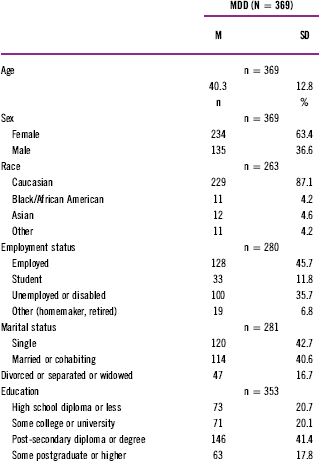
The analysis herein was limited to data from participants seeking treatment for MDD (N=369). Table 1 includes descriptive sociodemographic information related to the sample analyzed herein. The majority were female, Caucasian, single, and college-educated.
Demographic characteristics

Sample size varies due to missing data.
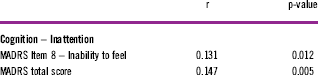
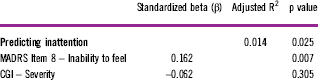
Results of the correlation and regression analyses are presented in Tables 2 and 3, respectively. The principal finding of our analysis is that self-rated cognitive impairment is significantly correlated with anhedonia (r=0.131, p=0.012). Moreover, total depression symptom severity as measured by the total MADRS score is also significantly correlated with self-rated measures of cognitive dysfunction (r=0.147, p=0.005). The association between anhedonia and self-rated cognitive dysfunction remained significant after adjusting for illness severity (ie, CGI-S; r=0.162, p=0.007).
. Correlations with cognitive function

. Anhedonia as a predictor of cognitive function

Discussion
The results of this preliminary analysis indicate that a significant correlation exists between anhedonia and self-rated cognitive function. In this analysis, the correlation between anhedonia and self-rated cognitive function is dissociable from a measure of overall illness severity.
Our data suggest that within our relatively large, heterogeneous group of adults with MDD, individuals with anhedonia are more likely to report deficits in measures of cognitive function. A separate line of evidence indicates that self-reported cognitive function in MDD is highly correlated with patient-reported quality of life and definitions of recovery, as well as functional improvement.Reference Lawrence, Roy, Harikrishnan, Yu and Dabbous 13
Mechanistically, there are several “units of analysis” that may provide a convergent explanation that subserves both anhedonia and cognitive dysfunction. A “unit of analysis” approach has been operationalized by the RDoC matrix as an integrated systems approach to conceptualize pathogenic substrates subserving psychopathology.Reference Insel, Cuthbert and Garvey 7
A non-mutually exclusive unit of analysis mechanistically relevant to both anhedonia and cognitive function may be proteins, nodal structures, and neural circuits critical to the immunoinflammatory homeostasis. For example, sickness behavior in preclinical models is purported to mimic phenotypic behavioral aspects of anhedonia (eg, reduced sucrose consumption).Reference Dantzer 14 Moreover, activation of the innate immunoinflammatory system in adults with MDD is highly associated with anhedonia measures as well as impaired cognitive performance.Reference Soczynska, Kennedy, Goldstein, Lachowski, Woldeyohannes and McIntyre 15 Neural circuits and subcircuits implicated in cognitive function overlap with reward circuitry implicated in anhedonia. The reciprocity and connectivity of circuits implicated in both anhedonia and cognitive impairment have been reported in MDD. Moreover, nodal structures/regions relevant to anhedonia and cognitive function have also been reported as abnormal in MDD (eg, ventral tegmental area, nucleus accumbens).Reference Gorwood 16 Unfortunately, immunoinflammatory and/or transomic data, including neuroimaging, were not available for the present analysis.
Our opinion regarding the clinical and conceptual translation of our finding is tempered by the methodological approach we have taken. Notwithstanding, we are of the view that anhedonia and cognitive function are co-linear. It is reasonable to assume that, in many cases, deficits in cognitive function in adults with MDD who are also anhedonic represents a pseudo-specific finding, perhaps secondary to lack of motivation and active engagement with cognitive function testing. Moreover, it may be the case that self-reported cognitive function, which is highly correlated with overall depressive symptom severity, may have a higher level of correlation with measures of anhedonia when compared to objective measures of cognitive function. A rival hypothesis would be that anhedonia and aspects of cognitive function share common neural chemistry, circuits, and networks. For example, central dopaminergic signaling may not only be central to measures of anhedonia and reward, but also may play a critical role in aspects of executive function. Importantly, the level of correlation between anhedonia and cognitive function is modest, which indicates that they are dissociable phenomena. The foregoing observation is aligned with the RDoC matrix insofar as the domain of a valence systems disturbance (eg, anhedonia) is discrete from the domain of general cognitive function, implicating convergent yet discrete underlying neural circuits.
The limitations of this analysis include, but are not limited to, factors relevant to any large observational, cross-sectional cohort (eg, lack of control for comorbidities, course of illness, treatment assignments), missing data, and the confinement of our analysis to cross-sectional assessment without longitudinal follow-up. Also, this analysis did not include an independently validated measure of anhedonia (eg, SHAPS), but instead utilized the MADRS Item-8 (ie, Inability to Feel) to proxy the domain of anhedonia. Similarly, we did not employ a comprehensive neuropsychological function battery as our cognitive measure; notwithstanding, the ASRS subjectively evaluates domains of cognitive function frequently reported to be abnormal in MDD. Moreover, there is no control group in this analysis, and the subjects represent individuals who are utilizing services at tertiary-based mood disorder centers, which may limit generalizability. Nonetheless, our cohort represents “real world” patients seeking care and is not stratified/preselected on the basis of any criteria.
We emphasize that our results are preliminary and provide clinical data supporting the testable hypothesis that anhedonia overlaps with, yet is dissociable from, general cognitive function. It has been reported that anhedonia in individuals with depressive symptoms may identify a subset who are at higher risk of exhibiting significant cognitive decline longitudinally.Reference Turner, Capuano, Wilson and Barnes 17 The next steps would be to carefully measure, with validated instruments, anhedonia (and its subdomains) as well as general cognitive function with a cascade downward “units of analysis” approach to parse convergent and discrete substrates.
Disclosures
Roger S. McIntyre has the following disclosures: NIMH, research, grants; CIHR, research, grants; NARS, research, grants; Bristol-Myers Squibb, advisor, honoraria; Eli Lilly, advisor/speaker, research, grant/honoraria; Lundbeck, advisor/speaker, research, grant/honoraria; Pfizer, advisor/speaker, research, grant/honoraria; Shire, advisor/speaker, research, grant/honoraria; Merck, advisor/speaker, research, grant/honoraria; Sunovion, advisor/speaker, research, grant/honoraria; Otsuka, advisor/speaker, honoraria; Forest, advisor/speaker, research, grant/honoraria; Takeda, advisor/speaker, honoraria; Janssen-Ortho, speaker/research, grant/honoraria; Astra-Zeneca, speaker/research, grant/honoraria; BMS, research, grant; CAN-BIND, research, grant. Hanna Woldeyohannes has nothing to disclose. Joanna Soczynska has the following disclosure: Eli Lilly Canada, fellowship, fellowship funding. Nadia Maruschak has nothing to disclose. Ida K. Wium-Andersen has nothing to disclose. Maj Vinberg has the following disclosures: Astra Zeneca, consultant, consulting fees; Lundbeck, consulting, consutling fees and research support. Danielle Cha has nothing to disclose. Yena Lee has nothing to disclose. Holly Xiao has nothing to disclose. Laura Ashley Gallaugher has nothing to disclose. Roman Dale has the following disclosure: Cleveland Clinic, employee, salary. Mohammad Alsuwaidan has nothing to disclose. Rodrigo B. Mansur has the following disclosure: Lundbeck, fellowship, salary. David J. Muzina has nothing to disclose. Andre Carvalho has nothing to disclose. Jeanette Jerrell has nothing to disclose. Sidney H. Kennedy has the following disclosures: Ontario Brain Institute, researcher, grant; CIHR, researcher, grant; Lundbeck, speaker/advisor/consultant, honorarium/grant; St. Judes Medical, researcher, grant; Bristol-Myers Squibb, speaker/advisor/consultant/researcher, honorarium; Clera, Inc., researcher, grant; Eli Lilly, honorarium; Lundbeck Institute, speaker/advisor/consultant, honorarium; Pfizer, speaker/advisor/consultant, honorarium; Servier, speaker/advisor/consultant, honorarium/grant; Forest, advisor/consultant, honorarium; Janssen, advisor/consultant, honorarium; Naurex, Inc., advisor/consultant, honorarium; AstraZeneca, advisor/consultant, honorarium.
The authors are entirely responsible for the scientific content of the paper. Funding for the International Mood Disorders Collaboration Project came in part from the Canadian Biomarker Integration Network in Depression, supported by the Ontario Brain Institute. In addition, funding was provided through an unrestricted grant from Pfizer Canada Inc.