Introduction
It is widely acknowledged that, compared with the general population, patients with schizophrenia suffer from higher rates of the metabolic syndrome and obesity-related illnesses such as type 2 diabetes mellitus, dyslipidaemia, hypertension and cardiovascular disease (Heiskanen et al. Reference Heiskanen, Niskanen, Lyytikainen, Saarinen and Hintikka2003). The development of the metabolic syndrome and other physical illnesses poses a serious health risk for these patients, and it is has been reported that up to 60% of the excess mortality rate in patients with schizophrenia is attributable to physical illnesses (Brown et al. Reference Brown, Inskip and Barraclough2000). The treatment of choice in schizophrenia is antipsychotic medications, and these drugs have been associated with weight gain and development of metabolic abnormalities (Allison et al. Reference Allison, Mentore, Heo, Chandler, Cappelleri, Infante and Weiden1999). However, antipsychotics are not the only cause of metabolic abnormalities described in psychosis. In fact, studies on drug-naive first-episode psychosis patients have also found impaired glucose tolerance and increased visceral fat (Ryan et al. Reference Ryan, Collins and Thakore2003, Reference Ryan, Flanagan, Kinsella, Keeling and Thakore2004). Interestingly, previous studies, by us and others have also reported elevated inflammatory markers in patients with chronic schizophrenia (Potvin et al. Reference Potvin, Stip, Sepehry, Gendron, Bah and Kouassi2008) and, more recently, in patients with first-episode psychosis (Sperner-Unterweger et al. Reference Sperner-Unterweger, Whitworth, Kemmler, Hilbe, Thaler, Weiss and Fleischhacker1999; Crespo-Facorro et al. Reference Crespo-Facorro, Carrasco-Marin, Perez-Iglesias, Pelayo-Teran, Fernandez-Prieto, Leyva-Cobian and Vazquez-Barquero2008; Fernandez-Egea et al. Reference Fernandez-Egea, Bernardo, Donner, Conget, Parellada, Justicia, Esmatjes, Garcia-Rizo and Kirkpatrick2009; Mondelli et al. Reference Mondelli, Cattaneo, Belvederi Murri, Di Forti, Handley, Hepgul, Miorelli, Navari, Papadopoulos, Aitchison, Morgan, Murray, Dazzan and Pariante2011). It is therefore possible that the increased inflammation contributes to the metabolic abnormalities seen in schizophrenia – but unfortunately the mechanisms underlying the increased inflammation and the increased risk of the metabolic syndrome in these patients are yet to be understood.
It has been suggested that repeated episodes of psychological stress can induce a chronic inflammatory process, which in turn may predispose to the development of metabolic abnormalities (Black, Reference Black2003). In particular, chronic psychosocial stress, including difficult care-giving and hostile marital relationships, has been associated with increased levels of the acute-phase protein, C-reactive protein (CRP) (Miller, Reference Miller2008). Likewise, childhood maltreatment has been associated with increased levels of CRP in adulthood, in a birth-cohort study of healthy individuals, independent of other co-occurring early-life risks, current stress or health problems (Danese et al. Reference Danese, Pariante, Caspi, Taylor and Poulton2007, Reference Danese, Moffitt, Harrington, Milne, Polanczyk, Pariante, Poulton and Caspi2009), although it was worse in those with concomitant adult psychopathology (Danese, Reference Danese2008). Indeed, high levels of stress in both childhood and adulthood have been consistently reported in patients with psychosis, and more recently at the time of the first psychotic episode (Fisher et al. Reference Fisher, Morgan, Dazzan, Craig, Morgan, Hutchinson, Jones, Doody, Pariante, McGuffin, Murray, Leff and Fearon2009, Reference Fisher, Jones, Fearon, Craig, Dazzan, Morgan, Hutchinson, Doody, McGuffin, Leff, Murray and Morgan2010; Aas et al. Reference Aas, Dazzan, Mondelli, Toulopoulou, Reichenberg, Di Forti, Fisher, Handley, Hepgul, Marques, Miorelli, Taylor, Russo, Wiffen, Papadopoulos, Aitchison, Morgan, Murray and Pariante2010; Mondelli et al. Reference Mondelli, Dazzan, Hepgul, Di Forti, Aas, D'Albenzio, Di Nicola, Fisher, Handley, Marques, Morgan, Navari, Taylor, Papadopoulos, Aitchison, Murray and Pariante2010a ). Furthermore, we have recently demonstrated that childhood trauma and recent life stressors predict lower brain-derived neurotrophic factor expression through an inflammation-mediated pathway in first-episode psychosis patients (Mondelli et al. Reference Mondelli, Cattaneo, Belvederi Murri, Di Forti, Handley, Hepgul, Miorelli, Navari, Papadopoulos, Aitchison, Morgan, Murray, Dazzan and Pariante2011). Therefore, there is evidence for both increased prevalence of psychosocial stress as well as increased inflammation in this population, but their possible contribution to the development of metabolic abnormalities has not been investigated.
As mentioned above, the immune response and metabolic regulation are highly integrated, and their proper functioning is interdependent. Indeed, obesity, insulin resistance, and type 2 diabetes have been shown to be closely associated with chronic inflammation, characterized by activation of inflammatory signalling pathways, and by abnormal cytokine production (Hotamisligil, Reference Hotamisligil2006). Interestingly, even a mild elevation in inflammation levels predicts increased risk of cardiovascular disease in apparently healthy individuals. In particular, high-sensitivity CRP (hsCRP) has been recently implemented as an adjunct to traditional risk factor screening for cardiovascular disease (Pearson et al. Reference Pearson, Mensah, Alexander, Anderson, Cannon, Criqui, Fadl, Fortmann, Hong, Myers, Rifai, Smith, Taubert, Tracy and Vinicor2003). Furthermore, a recent study in an obese population found body mass index (BMI) to be positively correlated with inflammatory makers and adipokines (Capuron et al. Reference Capuron, Poitou, Machaux-Tholliez, Frochot, Bouillot, Basdevant, Laye and Clement2010). It is possible that such mechanisms are also operating in psychosis. For example, one possible pathway may be that psychosocial stress leads to inflammation, which in turn causes metabolic abnormalities. It is also possible that psychosocial stressors can alter health-related behaviours, such as diet and exercise, which in turn may lead to increased obesity and finally to increased inflammation.
The aim of this study is to investigate the role of childhood maltreatment in metabolic and inflammatory abnormalities in first-episode psychosis patients. Given the evidence from previous studies, our proposed model is that the presence of psychosocial stress (childhood maltreatment) will be associated with increased inflammatory (CRP) and metabolic [BMI, lipid profiles, glycosylated haemoglobin (HbA1c)] markers. While this is a cross-sectional study that cannot unequivocally prove the direction of causality, we will also model, through analysis of covariance (ANCOVA), the relationship between inflammation and BMI, also taking into account potential confounders such as ethnicity and socio-economic status.
Method
Subjects
First-episode psychosis patients were recruited from in-patient and out-patient units of the South London and Maudsley NHS Foundation Trust (UK). We recruited subjects aged 18–65 years presenting for the first time to these services for a functional psychotic illness [psychotic codings from the following three sections of the International Classification of Diseases (ICD)-10; section F20–29, section F30–39 and section F10–19, excluding coding F1x.0 for acute intoxication] (WHO, 1992). Patients with organic psychosis, learning disabilities or requiring a translator were excluded. Controls were recruited from the same catchment areas as the patients, through local advertisement as well as from existing volunteer databases. Controls were screened using the Psychosis Screening Questionnaire (Bebbington & Nayani, Reference Bebbington and Nayani1995), and excluded if they met criteria for a present or past psychotic disorder. The study was approved by the local Ethical Committee, in accordance with the code of ethics of the World Medical Association, and written informed consent was obtained from all participants.
We recruited and assessed 95 patients with first-episode psychosis and 97 healthy controls. Of the patients, 63 received a Diagnostic and Statistical Manual of Mental Disorders, fourth edition (DSM-IV) diagnosis of schizophrenia-like disorder (including schizophrenia, schizophreniform disorder and schizo-affective disorder), 15 of affective psychoses (including major depression with psychotic symptoms and manic episode with psychotic symptoms), two of delusional disorder and 15 of psychotic disorder not otherwise specified. Duration of antipsychotic treatment ranged from 0 to 209 days with a mean duration of 37.0 (s.e.=4.6) days. This included treatment with olanzapine (n=34), riperidone (n=25), aripiprazole (n=13), haloperidol (n=4), quetiapine (n=3), amisulpiride (n=1) and sulpiride (n=1). A total of 14 patients were drug naive. Of the 95 patients, 44 were defined as having childhood maltreatment and 51 as not having childhood maltreatment (see below for definition and assessment of a history of childhood maltreatment). Patients who had experienced childhood maltreatment had a shorter duration of antipsychotic treatment compared with patients without childhood maltreatment [26.7 (s.e.=6.1) v. 46.3 (s.e.=6.5) days].
Inflammatory and metabolic markers were measured in a subset of patients for whom we were able to take blood samples. This contained 28 patients and 45 healthy controls. In this subset, 18 patients received a DSM-IV diagnosis of schizophrenia-like disorder, seven of affective psychoses and three of psychotic disorder not otherwise specified. Duration of anti-psychotic treatment in this subset of patients ranged from 0 to 171 days with a mean duration of 43.1 (s.e.=7.9) days. This included treatment with olanzapine (n=13), riperidone (n=6), haloperidol (n=2), aripiprazole (n=2) and sulpiride (n=1). A total of four patients were drug naive. Of the 28 patients, 10 were defined as having childhood maltreatment and 18 as not having childhood maltreatment (again, see below for definition and assessment of a history of childhood maltreatment). Also in this subset, patients who had experienced childhood maltreatment had a shorter duration of treatment compared with patients without childhood maltreatment [32.4 (s.e.=8.6)v. 49.1 (s.e.=11.2) days].
Questionnaires and clinical assessment
Sociodemographic data were collected using a modified version of the MRC Sociodemographic Schedule (Mallett et al. Reference Mallett, Leff, Bhugra, Pang and Zhao2002). Validation of clinical diagnosis was obtained using the Operational Criteria (OPCRIT) (McGuffin et al. Reference McGuffin, Farmer and Harvey1991), reviewing the case notes in the first month following the first contact with services. The presence or absence of symptoms was measured by the OPCRIT checklist using the strict OPCRIT definitions.
We collected information about stressful life events, in the previous 6 months, using the Brief Life Events questionnaire (Brugha & Cragg, Reference Brugha and Cragg1990). This assesses both the number and the emotional impact of life stressors involving moderate- or long-term threats, such as illness or injury, death of a close friend or relative, unemployment, financial loss and loss of important relationships. We also measured the perceived stress, in the previous month, using the Perceived Stress Scale (Cohen & Williamson, Reference Cohen, Williamson, Spacapan and Oskamp1988). This is a 10-item scale measuring the degree to which situations in one's life are appraised as stressful.
Finally, information about childhood maltreatment was collected, using a modified version of the Childhood Experience of Care and Abuse Questionnaire (Bifulco et al. Reference Bifulco, Bernazzani, Moran and Jacobs2005), including information about loss of parents, separation from parents for more than 6 months, and physical and sexual abuse before the age of 17 years. The physical and sexual abuse variables were used to create a composite variable which was a dichotomized variable with a score of 0 for absence of any childhood maltreatment and a score of 1 for presence of one or more childhood maltreatment variables (physical or sexual or both).
Inflammatory and metabolic markers
Weight was measured in subjects while wearing light clothing, to the nearest 0.1 kg, with an analogue floor scale. Height was measured without shoes, to the nearest 0.5 cm using a measuring tape. BMI was calculated as the individual's body weight (kg) divided by the square of their height (m2). The circumference of the waist was measured using a measuring tape at the narrowest part of the torso.
Blood samples were taken from the antecubital fossa using a BD safety-Lok™ blood collection set (Becton Dickinson, USA). The time of blood collection varied for each subject, and subjects were not fasted before collection. Samples were analysed at the biochemistry laboratory at King's College Hospital, blind to subjects' status. HbA1c was measured in plasma at the time of blood draw using the Primus Ultra 2 boronate affinity HPLC system. Total cholesterol, triglycerides and high-density lipoprotein-(HDL)-cholesterol were all measured in sera at the time of blood draw using the Bayer Advia 2400 automated system (Bayer HealthCare Diagnostics, Germany), via an enzymatic assay [intra-assay coefficient of variation (CV)=0.6, 0.55 and 1.33, respectively, inter-assay CV=1.23, 2.0 and 2.27, respectively]. Low-density lipoprotein (LDL)-cholesterol was then subsequently calculated using the Friedewald equation. hsCRP was analysed in sera using the Cormay hsCRP assay that employed an anti-CRP antibody sensitized to latex particles. The assay was analysed in batches on the Cobas Mira (intra-assay CV=2.96, inter-assay CV=3.85).
Data analyses
Data were analysed using the Statistical Package for Social Sciences, version 15.0 (SPSS, Inc., USA). Continuous variables are presented as mean values with their standard errors. We used χ2 tests to compare categorical variables between three groups: patients with childhood maltreatment, patients without childhood maltreatment and controls. Analyses of variance with post-hoc t tests were applied to test differences in inflammatory markers and metabolic parameters between the three groups, as well as ANCOVA to partial out effects of covariates and confounders, and model the relationship between inflammation and BMI. Finally, a t test was used to test differences in inflammatory and metabolic parameters between controls with and without childhood maltreatment.
Results
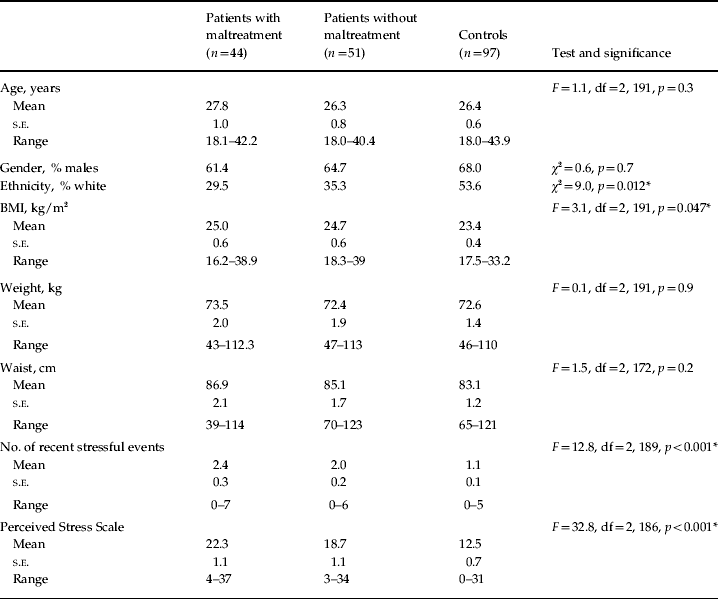
Sociodemographic, anthropometric and stress data of the large sample are shown in Table 1
Sociodemographic, anthropometric and stress data of first-episode psychosis patients with childhood maltreatment, without childhood maltreatment and healthy controls

df, Degrees of freedom; s.e., standard error; BMI, body mass index.
* p<0.05.
Anthropometric data: effect of childhood maltreatment
We tested the effects of childhood maltreatment on BMI by analysing the difference among three groups: patients with maltreatment, patients without maltreatment, and controls. There was a significant difference in BMI between the three groups (F 2,191=3.1, p=0.047) (Table 1). Post hoc tests revealed that BMI was higher in patients who had experienced childhood maltreatment when compared with controls (p=0.030). Patients who had not experienced any childhood maltreatment were not significantly different from the control group (p=0.07). Furthermore, there was a higher proportion of individuals with a BMI above a normal range (⩾23 kg/m2, in patients with childhood maltreatment when compared with those without maltreatment and controls (43.2% v. 37.2% v. 28.9%, respectively).
Interestingly, the effect of childhood maltreatment on BMI was specific to the patient group: there was no difference between controls with childhood maltreatment and controls without childhood maltreatment (n=26 and 71, respectively; data not shown; t 1,95=0.2, p=0.90).
Inflammatory markers: effect of childhood maltreatment
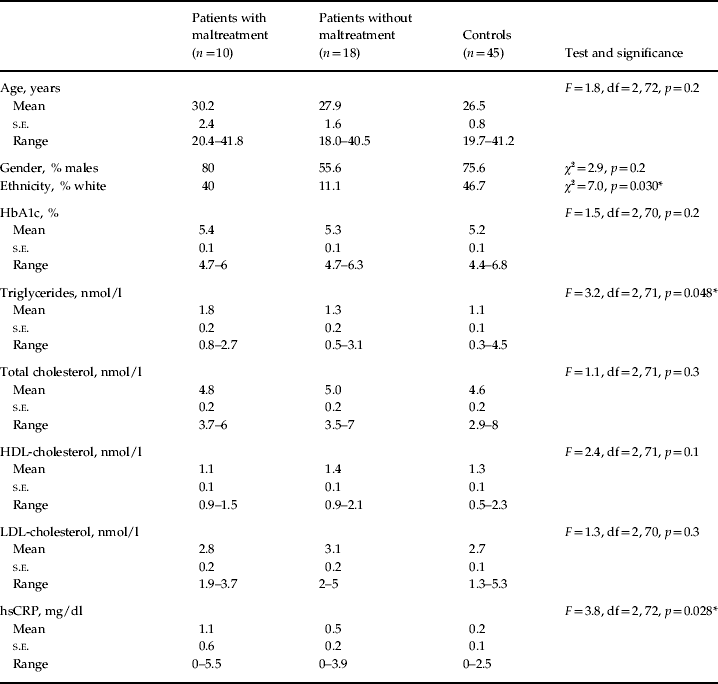
Sociodemographic, metabolic, inflammatory and stress data of this subset of subjects are shown in Table 2.
Sociodemographic, metabolic and inflammatory data of first-episode psychosis patients with childhood maltreatment, without childhood maltreatment and healthy controls from the subsample

df, Degrees of freedom; s.e., standard error; HbA1c, glycosylated haemoglobin; HDL, high-density lipoprotein; LDL, low-density lipoprotein, hsCRP, high-sensitivity C-reactive protein.
* p<0.05.
When looking at the effects of childhood maltreatment on inflammatory and metabolic markers, we again analysed the difference between three groups: patients with maltreatment, patients without maltreatment and controls. Levels of CRP and triglycerides were significantly different between the three groups (F 2,72=3.8, p=0.028 and F 2,71=3.2, p=0.048, respectively). Post hoc tests revealed that CRP was higher for patients who had experienced childhood maltreatment when compared with controls (p=0.009). Patients who had not experienced any childhood maltreatment were not significantly different from the control group (p=0.2). Furthermore, there was a higher proportion of individuals with a CRP level above a normal range (>1 mg/dl), in patients with childhood maltreatment when compared with both patients without maltreatment and controls (30% v. 22.2% v. 6.7%). Similarly, post hoc tests revealed that triglyceride levels were higher for patients who had experienced childhood maltreatment when compared with controls (p=0.015). Patients who had not experienced any childhood maltreatment were not significantly different from the control group (p=0.4).
Again, the effects of childhood maltreatment on CRP levels were specific to the patient group, as no differences were found between controls with childhood maltreatment and controls without childhood maltreatment (n=15 and 20, respectively; data not shown; t 1,43=–1.1, p=0.34). Furthermore, ANCOVA showed that even after controlling for the effect of BMI, the difference in CRP levels across the three groups remained significant (F 2,58=3.6, p=0.035).
Potential confounders
We investigated the possible effect of ethnicity and socio-economic status on our findings. Socio-economic status was determined by level of education, dichotomized into those who left school aged 16 years or younger without gaining any qualifications compared with others. After controlling the effects of both ethnicity and level of education in ANCOVA analyses, there was still a trend for a difference in BMI across the three groups (F 2,186=2.8, p=0.06) and a significant difference in CRP levels (F 2,67=3.3, p=0.42).
Discussion
To our knowledge, this is the first study examining the relationship between childhood maltreatment, CRP and metabolic abnormalities in first-episode psychosis patients. Our results indicate that first-episode psychosis patients with a history of childhood maltreatment show a higher BMI as well as higher levels of CRP when compared with healthy controls.
The increased BMI seen in patients with childhood maltreatment is in keeping with previous studies looking at the effect of childhood adversity on physical health in adulthood, in otherwise healthy individuals. Indeed, studies have shown that childhood adversity can contribute to the development of metabolic problems, as well as to poorer cardiovascular health in the general population (Lehman et al. Reference Lehman, Taylor, Kiefe and Seeman2005; Thomas et al. Reference Thomas, Hyppönen and Power2008; Danese et al. Reference Danese, Moffitt, Harrington, Milne, Polanczyk, Pariante, Poulton and Caspi2009). Moreover, self-reported abuse in childhood, including sexual, verbal and physical abuse, have been shown to be associated with higher adult BMI and adult obesity (Williamson et al. Reference Williamson, Thompson, Anda, Dietz and Felitti2002).
There may be several underlying mechanisms potentially driving the association between childhood adversity and higher BMI in our sample of first-episode psychosis patients. Our preferred model is that psychosocial stress, in the form of childhood maltreatment, leads to increased inflammation, as demonstrated by increased CRP levels, and this in turn leads to increased BMI. Indeed, CRP has been consistently associated with an increased risk of diabetes and other metabolic dysfunction (Bassuk et al. Reference Bassuk, Rifai and Ridker2004).
CRP has also been similarly linked to chronic psychosocial stress (Miller, Reference Miller2008). In particular, recent studies have shown an association between increased levels of CRP and childhood maltreatment. Work partly conducted in our own research group has demonstrated that maltreated children show a significant increase in CRP levels in adulthood, 20 years later (Danese et al. Reference Danese, Pariante, Caspi, Taylor and Poulton2007). In agreement with these findings, we observed the same association between childhood maltreatment and adulthood CRP in first-episode psychosis patients. Of note, we did not find an effect of childhood maltreatment on CRP or BMI in healthy controls. This is also consistent with our previous study, where the effects of childhood maltreatment on CRP were larger in the subgroup who were depressed in adulthood (Danese et al. Reference Danese, Moffitt, Pariante, Ambler, Poulton and Caspi2008). This suggests that the effect of childhood maltreatment on inflammation may be more evident in individuals who have other vulnerability factors, as shown by a predisposition to develop psychiatric disorders.
It is also possible that inflammatory processes are not the only mechanism linking childhood maltreatment and increased BMI. Other biological systems involved in the stress response may be overactivated, such as the hypothalamic–pituitary–adrenal (HPA) axis. Indeed, hyperactivity of the HPA axis can lead to increased cortisol secretion and this has consistently been demonstrated in first-episode psychosis patients (Aas et al. Reference Aas, Dazzan, Mondelli, Toulopoulou, Reichenberg, Di Forti, Fisher, Handley, Hepgul, Marques, Miorelli, Taylor, Russo, Wiffen, Papadopoulos, Aitchison, Morgan, Murray and Pariante2010; Mondelli et al. Reference Mondelli, Pariante, Navari, Aas, D'Albenzio, Di Forti, Handley, Hepgul, Marques, Taylor, Papadopoulos, Aitchison, Murray and Dazzan2010b ). In turn, this increased cortisol secretion can increase glucose levels and visceral fat deposition (Dinan, Reference Dinan2004). Moreover, stress and the HPA axis have been shown to dysregulate food intake and eating behaviour. Clinical evidence has shown that stress can increase the intake of highly calorific food (Dallman et al. Reference Dallman, Pecoraro and la Fleur2005) and precipitate binge eating (Freeman & Gil, Reference Freeman and Gil2004). Indeed, it has been described that adults who have experienced childhood maltreatment exhibit increased HPA axis activity in response to a psychosocial stress test (Heim et al. Reference Heim, Newport, Heit, Graham, Wilcox, Bonsall, Miller and Nemeroff2000). However, we believe that this particular pathway may not be operating in this sample. First, in our previous study in first-episode psychosis patients, childhood maltreatment was not associated with HPA axis hyperactivity (Mondelli et al. Reference Mondelli, Dazzan, Hepgul, Di Forti, Aas, D'Albenzio, Di Nicola, Fisher, Handley, Marques, Morgan, Navari, Taylor, Papadopoulos, Aitchison, Murray and Pariante2010a ). Second, as mentioned above, the increase in CRP was not accounted for by the increased BMI. As such, the role of the HPA axis as a possible mechanism for increases in BMI and the development of other metabolic abnormalities following childhood maltreatment in psychosis remains unclear.
If there is indeed a causal relationship between childhood maltreatment and increases in CRP and BMI, this could have significant public health implications. Information about experiences of childhood maltreatment may help to identify individuals with elevated inflammation levels and, thus, at greater risk of developing metabolic abnormalities. This could be used for raising awareness and targeting more vulnerable individuals for prevention and treatment strategies. As it is already well known that individuals with schizophrenia have a higher incidence of metabolic abnormalities, identifying more vulnerable individuals would improve quality of life and decrease poor physical health and mortality rates in these patients.
Some limitations to our study need to be acknowledged. First, the patients in this study were not all drug naive, and so it is not possible to completely rule out the effect of antipsychotic medications. However, patients who had childhood maltreatment actually had a shorter duration of treatment compared with those patients who had not experienced childhood maltreatment. This suggests that antipsychotic treatment is not driving the differences seen for BMI and CRP. Second, patients and controls were not matched for ethnicity. This could be of importance as a recent study demonstrated that CRP levels can vary with ancestry (Shah et al. Reference Shah, Newcombe, Smeeth, Addo, Casas, Whittaker, Miller, Tinworth, Jeffery, Strazzullo, Cappuccio and Hingorani2010). However, in our sample, although there was a significant difference for ethnicity between patients and controls, we did not find any significant differences for ethnicity between patients who had experienced childhood maltreatment compared with patients who had not. Furthermore, ANCOVA analyses showed that there was no significant effect of ethnicity on our outcome variables. Third, due to many patients being acutely unwell at the time of assessment, blood samples were not fasting. Finally, the sample size is relatively small and therefore this should be taken into consideration when interpreting the data presented.
In conclusion, our study shows a role of childhood maltreatment in the increased prevalence of high BMI and inflammatory abnormalities observed at the onset of psychosis, suggesting that more vulnerable individuals can be identified and targeted among patients with psychosis for preventative treatment strategies that promote better physical health. Future longitudinal studies would need to clarify if the increase in inflammatory markers may, at least in part, mediate the link between early-life stress and subsequent metabolic abnormalities in patients with psychosis.
Acknowledgements
This research has been supported by the South London and Maudsley NHS Foundation Trust and the Institute of Psychiatry NIHR (National Institute for Health Research) Biomedical Research Centre for Mental Health; a NARSAD (National Alliance for Research on Schizophrenia and Depression) Young Investigator Award, to V.M. (2007–2010); a grant from the University of London Central Research Fund to V.M.; a King's College London Translational Research Grant and a grant from the BIAL Foundation to P.D.; and grants from the British Academy, the UK Medical Research Council, and the Commission of European Communities 7th Framework Programme Collabo-rative Project Grant Agreement no. 22963 (Mood Inflame), to C.M.P.; and a grant from the Wellcome Trust (grant no. WT087417) to P.D., C.M., C.M.P. and R.M. We thank Roy Sherwood and Tracy Dew (King's College Hospital, UK) for conducting the biochemistry assays.
Declaration of Interest
None.