There is a growing consensus in the literature that children with significant congenital heart disease are at risk for elevated levels of behaviour difficulties and reduced levels of social and school competencies.Reference Bellinger and Newburger 1 Meta-analysis has suggested that risk increases across childhood and adolescence,Reference Karsdorp, Everaerd, Kindt and Mulder 2 and historical analyses have suggested that this risk has not reduced despite recent advances in surgical techniques, including neuroprotective strategies.Reference Bellinger and Newburger 1 , Reference Spijkerboer, Utens, Bogers, Helbing and Verhulst 3 Elevated levels of problems with anxiety, depression, attention, social cognition, and peer relationship have been noted and, increasingly, findings suggest that family factors – for example, parenting and coping skills, maternal mental health, and subjective worry – may be more important in determining these outcomes than disease and surgical factors.Reference McCusker, Doherty and Molloy 4 – Reference Goldberg, Janus, Washington, Simmons, MacLuskey and Fowler 7
However, contradictory findings cannot be ignored with respect to the presence or absence of behavioural difficulties in these children.Reference Karsdorp, Everaerd, Kindt and Mulder 2 , Reference McCusker, Doherty and Molloy 4 Indeed, there are some limitations in the literature to date, which may explain these differences and add caution to conclusions. Control groups have not been common, with most studies comparing outcomes with reference group norms. A few studies have used “healthy controls”,Reference Miatton, De Wolf, Francois, Thiery and Vingerhoets 8 which are not likely to match the non-specific effects of familial functioning where a chronic illness has been diagnosed and adaptations made therein. Thus, controlling for the specific effects of congenital heart disease in the child may be obscured.
A second limitation is an over-reliance on parental ratings of behaviour alone. Parents undoubtedly know their children best, and have the greatest overview of their behaviour across settings. However, studies have suggested that feelings of guilt, overprotection, anxiety, and stress may impact on parent ratings of their child's behaviour.Reference Bellinger, Newburger, Wypij, Kuban, duPlessis and Rappaport 6 Although there has been some consistency reported across the few studies, which have used additional teacher and child reports, differences have also been noted, with rates of disturbance generally being lower when compared with parental reports.Reference Bellinger, Newburger, Wypij, Kuban, duPlessis and Rappaport 6 , Reference Miatton, De Wolf, Francois, Thiery and Vingerhoets 8 , Reference Shillingford, Glanzman, Ittenbach, Clancy, Gaynor and Wernovsky 9
Third, when considering factors that predict behavioural outcomes for these children, most studies have been cross-sectional in design. This raises potential problems with inferring the direction of causality, especially when the predictor factors – for example, maternal mental health and family functioning – are arguably affected by the outcome factor, that is, the child's behaviour, as well as vice versa. Although prospective studies exist, such as the Boston circulatory arrest programme,Reference Bellinger, Newburger, Wypij, Kuban, duPlessis and Rappaport 6 these have typically focused on single diagnostic groups of children – for example, transposition of the great arteries. Further prospective studies are required.
The present study endeavoured to address some of these limitations. Although there is some suggestion that rates of behavioural disturbance may be higher in siblings of children with chronic illness,Reference Sharpe and Rossiter 10 such a group controls for many more family and context factors than healthy controls from other families, and a nearest-age sibling group was utilised in the present study.
Moreover, both parent and teacher reports were used for both children with congenital heart disease and their siblings. Finally, the current study is longitudinal in design and assesses the predictive significance of medical, surgical, child and family factors in the 1st year of life with behavioural outcomes at home and school at 7 years of age for children with the most common congenital heart conditions.
Additional sub-group comparisons were made with children in the congenital heart disease group. These parents had participated, either in an intervention or control group, in an early intervention trial, in the 1st year of the child's life. This had been designed to promote infant neurodevelopment and parental coping, and results of the trial were encouraging at the 6-month follow-up in relation to infant development, feeding, maternal mental health, and worry.Reference McCusker, Doherty and Molloy 11 Although attrition was high, we present sub-group analyses comparing 7-year outcomes for our original intervention and control families, as such intervention trials related to child and family adjustment are rare.Reference Bellinger and Newburger 1
Materials and methods
Participants
Baseline assessments involving the current sample were conducted between 2002 and 2004 on 70 infants and families recruited from a regional centre for paediatric cardiology in the United Kingdom. All infants had required surgery for correction or palliation of significant heart defects in the first months of life. Data were collected at this time on disease, surgical, child and family variables, as outlined below. These children and their families had participated in a controlled trial evaluating the impact of early psychological interventions on child development and family functioning, as noted above. However, as preliminary analyses suggested no differences between the retained groups who had or had not received the psychosocial intervention, on almost all current assessments at 7 years (see sub-group analyses below), these particular groupings were merged and all participants with congenital heart disease were assessed in comparison with their siblings, as described below.
Of the original 70 families, 40 responded to and accepted the invitation to participate in this current follow-up study. There were no differences between those retained and those lost at follow-up in terms of age, gender, deprivation scores, parental employment status, cyanotic status, surgical intervention, or syndrome status (all p-value's were >0.05). Furthermore, no differences were found in the original Intervention (22 cases) compared with the Control (18 cases) sub-groups in terms of gender, age, cyanosis, open heart surgery, palliative status, syndrome status, deprivation index, parental employment, and family composition (all p-value's were >0.05). Although all 40 children with congenital heart disease were included in the regression analyses examining prospective determinants of outcome, for analyses of differences in behavioural and social functioning in the children with congenital heart disease compared with the sibling group, the children with diagnosed developmental syndromes – Down syndrome – were excluded, that is, nine cases in total. This was undertaken because such syndromes often have specific behavioural phenotypes,Reference Harris 12 which we did not wish to confound the behavioural outcomes discerned and specific to congenital heart disease.
This resulted in a final sample of 31 for these comparisons, including 22 male patients and 9 female patients. Of these, nine had a corrected acyanotic condition, for example coarctation of the aorta, ventricular or atrial septal defects; nine had a corrected cyanotic condition, for example transposition of the great arteries and tetralogy of Fallot; and 13 had more complex cyanotic conditions, which were palliated only, for example hypoplastic right and left heart syndromes, double-inlet left ventricle. The current mean age of the sample was 7.7 years (standard deviation = 0.56), mean age at primary surgery was 2.3 months (standard deviation = 2.3), mean age at assessment of the family predictor factors outlined below was 2.8 months (standard deviation = 1.6), and mean age at baseline neurodevelopmental assessment was 8.6 months (standard deviation = 1.5).
The nearest-age sibling control group was recruited from the above sample where there was a healthy sibling, with no medical or psychiatric diagnoses or learning disability, who was under 18 years and still in full-time education. A total of 18 siblings were recruited (nine boys and nine girls) with a mean age = 9.6 years (standard deviation =1.8). The differences were not statistically significant between groups in gender distributions but were for age (T-score = 4.2; p = 0.001). However, age was not statistically associated with the key outcome measures described below, and thus was not used as a covariate. Teacher reports were received for 27 patients in the sample with congenital heart disease and 12 in the sibling sample.
Families who opted into this follow-up wave of the study attended the regional centre for current assessment. Following parental permission, teachers were contacted to provide evaluations of school functioning, as outlined below. Protocols for this follow-up study were approved by the Office for Research Ethics Committees in the United Kingdom and also by the research governance committee of the institution. Neurodevelopmental outcomes will be reported elsewhere, with the current paper focusing on the behavioural and competence factors outlined below.
Outcome measures
Parents completed the Child Behavior Checklist (CBCL/6–18)Reference Achenbach and Rescorla 13 for both their child with congenital heart disease and the nearest-age sibling, where applicable. A total problems score is computed by summing 113 Likert-scored items related to various behavioural, emotional, and social difficulties. This is converted to a standardised T-score with T > 63 considered to be clinically significant. Total problem scores and proportions in the clinically significant range were included in the current analyses. In addition, syndrome T-scores across eight sub-scales – anxious/depressed, withdrawn/depressed, somatic complaints, social problems, thought problems, attention problems, rule breaking behaviour and aggressive behavior – were computed in order to assess whether specific problems might be contributing to any total problems score differences between the children with congenital heart disease and the sibling group.
In addition, a total competence score represents the sum of three competence scales related to activities, social and school competencies. The authors note that a T-score <37 is considered clinically significant and both total T-scores (across the three sub-scale and total competence scale) and those in the clinically significant range for the total competence score were computed for comparison between the children with congenital heart disease and the siblings.
Teachers completed the Teacher Report Form (TRF/6–18)Reference Achenbach and Rescorla 13 of the same test battery. A total problem T-score is based on a similar Likert-scored checklist, with the same threshold for clinical significance (T > 63). Sub-scale T-scores were computed across the same eight syndromes as on the parent completed Child Behavior Checklist. Paralleling the total competence score on the parent completed scale, the Teacher Report Form Adaptive Functioning total score represents the sum of four sub-scale scores related to working hard, behaving appropriately, learning, and being happy. An additional academic performance competence sub-scale is also computed. Again, T-scores for the total Adaptive Functioning scale and each sub-scale were calculated, together with proportions in the clinically significant range of the total Adaptive Functioning scale (T < 37).
The Child Behavior Checklist scales have been the most extensively and consistently used scales to measure behavioural outcomes in children with congenital heart disease and other chronic illnesses. Although there are limitations – for example, the somatic complaints sub-scale may be less valid for what it is intended to measure in child physical health as opposed to child mental health populations – Reference Perrin, Stein and Drotar 14 this permits comparison of findings across studies, and psychometric properties have been very satisfactory.Reference Achenbach and Rescorla 13
In addition to the standardised scores outlined above, teachers of both the children with congenital heart disease and the siblings were asked to record the number of days absent across the previous school year, whether the child's participation in physical education was “did not participate/below average” or “average/above-average” in relation to other children in the same year group, whether or not the child was in receipt of any additional remedial input, and whether overall attainments were “below” class average or “average/above average”.
Predictor variables from infancy
Associations were examined in the congenital heart disease group between the above outcome measures at 7 years and disease/surgical, child and family factors measured during the 1st year of the child's life. These included cyanotic status, palliative status (corrected versus palliated defect(s) only), surgical status (open versus closed surgical procedure), length of time on cardiopulmonary bypass (hours), length of time (days) in paediatric intensive care, and total number of procedures undertaken. The children who had been diagnosed with a developmental syndrome in the 1st year of life – Down syndrome – were included in these analyses to examine the actual impact of this common co-morbid condition on outcomes in this sample. This also maximised power by increasing the sample again to the original 40 who had consented to participate in this follow-up study.
Child factors included gender, their Mental Development Index, and Psychomotor Development Index scores on the Bayley Scales of Infant Development-II,Reference Bayley 15 assessed at 8 months of age. These index scores (reference group mean = 100; standard deviation = 15) measure functions such as memory, habituation, communication, eye–hand coordination, and gross motor skills.
A number of family factors had also been assessed in the 1st year of the child's life. Maternal mental health was measured using the composite Global Severity Index scale (T-scores with reference group mean = 50 and standard deviation = 10) of the Brief Symptom Inventory.Reference Derogatis 16 Maternal worry about the child's current and future health status, which previous research has shown may vary independently of actual illness severity and affect behavioural adjustment independently,Reference De Maso, Campis, Wypij, Bertram, Lipshita and Freed 17 was assessed using the Maternal Worry scale.Reference De Vet and Ireys 18 Family functioning was assessed using the cohesion and conflict sub-scales of the Family Environment Scale.Reference Moos and Moos 19 Finally, family composition (lone versus two parents) was included together with a deprivation index score (Townsend et alReference Townsend, Phillimore and Beattie 20 ) based on post-code as a measure of socio-economic status.
Statistical analyses
The data satisfied assumptions for parametric analyses and these were undertaken utilising SPSS version 18. Comparisons were made between the children with congenital heart disease and their siblings, for the total problems and competence scores as assessed by both parents and teachers, using one way between subjects analysis of variance to yield indices of both statistical (F-test) and clinical (partial eta squared) significance. The proportion of children in the clinically significant range was also noted. Multivariate analysis of variance was used to assess the differences across the sub-scale behavioural and competence scales, with follow-up univariate tests utilised to assess specific sub-scale differences.
Given the relatively large number of predictor variables in relation to sample size, exploratory correlations were first used to assess the strength of the relationship between the predictor variables outlined above and parent and teacher total problems and competence scores in the congenital heart disease group only. Only factors with a correlation of at least 0.3 – a medium effect sizeReference Cohen 21 – were taken forward to four backward regression analyses to determine what disease/surgical, child and family factors in the 1st year of life predicted the optimum variance in outcomes at 7 years. A total of three–five predictor variables were identified by this method for each outcome measure, as noted below, with post hoc sample size calculations demonstrating sufficient sample size to have a power of 0.9 at p = 0.05.
Finally, analyses of covariance were used to compare the sub-group of children with congenital heart disease whose parents had participated in the original psychological intervention trial in the 1st year of life, with the control sub-group, in terms of behavioural outcomes, maternal mental health, and worry. For behavioural outcomes, sibling outcomes were used as a covariate to control for non-specific family factors. For maternal mental health and worry, baseline scores in infancy were utilised.
Results
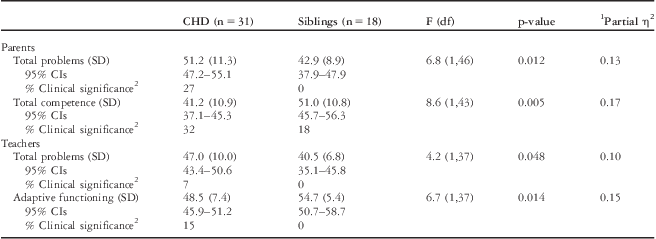
Table 1 summarises the mean total problems, competence, and adaptive functioning scores as rated by parents and teachers. Results suggested higher levels of behaviour problems and reduced levels of social and school competencies in the children with congenital heart disease compared with the sibling group, as rated by both parents and the independent raters, teachers. These differences were both statistically significant and three of the four partial eta squared indices suggested a large effect sizes (threshold = 0.13).Reference Cohen 21
Mean (standard deviation) Child Behavior Checklist problems and competence scores as rated by parents and teachers independently.

CHD = Congenital Heart Disease group
1Partial eta squared effect size: >0.08 = medium effect size; >0.13 = large effect size
2Percentage of cases in the clinically significant range
The magnitude of the difference between groups was generally less in the teacher analyses. This is most clearly illustrated by looking at the proportion of children who fell into the clinically significant range of the scales. Whereas, based on parent ratings, over a quarter of the children with congenital heart disease (27%) were in the clinically significant range for behaviour problems and almost a third (32%) for social competences, the figures were 7% and 15%, respectively, based on the teacher ratings. Although reduced in absolute terms, the pattern is the same regarding greater group differences in the competence domain than for behaviour problems. Correlations between parent and teacher problem and competence scores were 0.33 and 0.29, although these were reduced to 0.26 and 0.23 when performed for the children with congenital heart disease only. These are small–medium effect size associations only.
Table 2 summarises additional teacher-reported outcomes related to competencies and school attendance. Response rates to these items were lower than on the Child Behavior Checklist scales, possibly because of the requirement to quantify days absent across the previous school year from official records. Nevertheless, the pattern was clear. Children with congenital heart disease missed more days and a greater proportion of them participated less in physical education, required additional remedial input, and had lower attainments than their sibling counterparts. However, only the differences on the physical education variable reached statistical significance at the 0.05 threshold.
Days absent, PE participation, remedial input, and overall attainments at school.

CHD = Congenital Heart Disease Group; PE = physical education
1T-test statistic
2Chi-square statistic
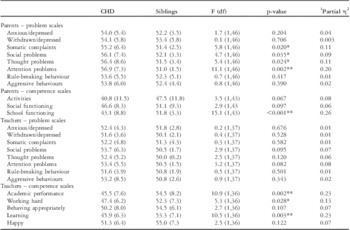
Table 3 presents the data that suggest that specific difficulties may be contributing to the above differences between children with congenital heart disease and their siblings. Examination of the competence sub-scales suggests that for both parents and teachers the statistically significant differences related to academic performance and capacity – see school functioning sub-scale on the parent scale and the academic performance, working hard, and learning sub-scales for the teachers. In contrast, the more personal competence sub-scales – for example, social functioning, behaving appropriately, and happy – were not statistically different across groups. The effect sizes (partial eta squared) of these statistically significant differences were all large (0.13–0.26). Although there was only a trend towards statistical significance on the activities competence scale of the parent scale (p = 0.067), this difference was of a medium effect size (partial eta squared = 0.08).
Mean (standard deviation) Child Behavior Checklist problem and competence sub-scale scores as rated by parents and teachers independently.

CHD = Congenital Heart Disease Group
1Partial eta squared effect size: >0.08 = medium effect size; >0.13 = large effect size
*Statistically significant at p < 0.05
**Statistically significant at p < 0.01
In terms of parent ratings of specific problem syndrome scales, if we exclude the somatic complaints for the reasons outlined above, statistically significant differences were found between the children with congenital heart disease and siblings on the social, thought, and attention problems syndrome scales, with medium–large associated effect sizes. Although differences did not reach statistical significance on any of the teacher rated sub-scales, it is striking that the magnitude of the differences found were greatest on these same specific sub-scales (partial eta squared effect sizes ranged from 0.06 to 0.08). Differences were small across both raters in relation to anxiety/depression, withdrawn, rule breaking, and aggression.
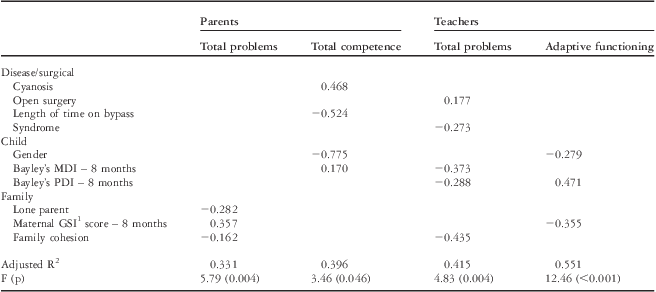
Exploratory correlation analyses were conducted, involving all 40 of the children with congenital heart disease only, to examine associations between the outcome and predictor variables outlined above. A Pearson's r > 0.3 (medium effect size threshold) was used to determine which variables were taken forward into the four regression models, with problem behaviour and competence outcomes, as rated by both parents and teachers, being the criterion variables. Those correlations that reached this threshold with one or more of the four outcomes were cyanosis, surgical status (open heart surgery), length of time on bypass, having a syndrome, gender, Bayley's Mental Development Index and Psychomotor Development Index scores, family composition (lone parent), maternal mental health (General Severity Index score from the Brief Symptom Index), and family cohesion from the Family Environment Scale, as described above. Table 4 summarises the results of the four backward regression models. Backward exclusion of variables was controlled by inspecting standardised beta values and excluding the variable with the lowest value until the adjusted R-squared was maximised, rather than relying on computer-generated de-selection procedures based on statistical significance alone.Reference Menard 22
Final regression models of disease/surgical, child and family factors and standardised betas associated with Child Behavior Checklist outcomes.

MDI = Mental Development Index; PDI = Psychomotor Development Index; GSI = General Severity Index
1GSI score on the Brief Symptom Inventory
Analyses of Child Behavior Checklist problem and competence outcomes, based on parental reports, suggested two main conclusions. First, the relative importance of family factors over disease and surgical factors in determining behavioural outcomes was confirmed by this prospective regression model. Only maternal mental health, family cohesion, and lone parent status were retained in the final regression model and accounted for 33.1% of the variance on behavioural outcomes. Second, however, child competence outcomes – activities, social and school functioning – appeared to be determined not by family factors but by cyanosis, length of time on bypass, gender – being male was associated with lower competence scores – and by neurodevelopmental functioning as measured in infancy, explaining 39.6% of the variance on competence outcomes 7 years later.
The pattern of results on teacher-reported outcomes was a little different. In terms of behaviour problems in the school setting, family cohesion had the highest beta value in the equation, which was consistent with the parent model. However, the neurodevelopmental status of the infant appeared especially important here with both of the Bayley index scores – mental and psychomotor development – contributing to the final regression model. Explanations for this are considered below. In addition, having open heart surgery was a risk factor. The negative beta value suggested that children with a co-morbid developmental syndrome were less likely to have behaviour difficulties at school. Thus, surgical, neurodevelopmental, and family factors all contributed to understanding behavioural outcomes in the school setting 7 years later, explaining 41.5% of the variance therein.
In terms of adaptive functioning – academic and personal competencies at school – as with the parent model, being male and having lower Bayley scores in infancy were risk factors for poorer outcomes. However, disease and surgical factors were not significantly involved in this final regression model but the mental health of the mother was significant here. These three factors – gender, Bayley's psychomotor index score, and maternal mental health – explained a highly significant 55.1% of the variance.
Finally, sub-group comparisons were conducted on the children with congenital heart disease who had been in the original early intervention and control groups 7 years previously. In all, three primary sub-group comparisons were made, which were particularly pertinent to the aims of the original trial. These included maternal mental health, maternal worry, and child behaviour outcomes as measured by the parent total problems score. No sub-group differences were found in terms of maternal worry at current assessment. Marginal means, using the maternal worry score in infancy as a covariate, were 9.16 (standard deviation = 7.5) in the Intervention and 10.44 (standard deviation = 8.6) in the Control sub-group (F statistic was 0.08; p = 0.779). Nor were differences observed in terms of maternal mental health. Marginal means on the General Severity Index scale, using same scores in infancy as a covariate, were 48.06 (standard deviation = 10.9) in the Intervention and 49.25 (standard deviation = 13.1) in the Control sub-group (F statistic was 0.349; p = 0.559).
Although no differences were found between sub-groups on simple T-test comparisons of Child Behavior Checklist problem scores (p > 0.05), when sibling scores were used as a covariate – to control for family factor influences non-specific to parenting a child with congenital heart disease, a statistically significant difference was observed. Marginal mean T-scores were 46.8 (standard deviation = 1.7) in the Intervention and 52.8 (standard deviation = 1.7) in the Control sub-group (F statistic was 5.98; p = 0.025). This was a promising finding and is discussed below.
Discussion
A fundamental finding of the present study was that parents discerned significantly higher levels of behavioural, social, and emotional difficulties, and reduced levels of personal and school competencies, in their children with congenital heart disease in comparison with a sibling control group. The sibling comparison group controls for family, parenting and environmental factors in a way that comparison to reference group norms, or healthy controls from other families cannot, and thus this suggests specific risk mediated by the congenital heart disease. Although of a lower magnitude, the same pattern of group differences was observed when teachers rated problems and competencies within the school setting. This is consistent with the recent reports of Shillingford et al,Reference Sharpe and Rossiter 10 and counters the criticism of such previous work with parents only, that their responses may be biased by their own adjustment issues and personal histories with chronic illness in their child. Findings suggest a consistency in the child's difficulties across contexts. Thus, although family factors are undoubtedly important, as discussed below, the expression of difficulties does not appear to be limited to the family context.
Analyses of specific behaviour and competence scales, as summarised in Table 3, highlight which specific difficulties these children face. As noted above, the pattern was consistent across both parents and teachers, although only the parent sub-scale analyses reached statistical significance across the behaviour syndrome scales. Consistent with the Bellinger longitudinal study involving children with tetralogy of Fallot,Reference Bellinger, Newburger, Wypij, Kuban, duPlessis and Rappaport 6 we found the greatest group differences within the attention – problems with inattention and hyperactivity – and social problems – peer relationships – sub-scales. We also found differences in thought problems – ritualistic behaviours, sleep disturbance, idiosyncratic thought patterns.
Those competencies that were reduced in comparison with siblings mainly related to school functioning and many of the related sub-scale differences were statistically significant on the teacher-rated scales also – academic performance, learning, and academic effort. These differences were consistent with teacher reports that the children with congenital heart disease missed twice as many days from school as their siblings, had reduced attainments, and 41% – as compared with 13% of siblings – were in receipt of remedial input. Finally, teacher reports suggested significantly reduced participation in physical education, consistent with parental ratings of physical activity functioning.
The longitudinal design of this study allowed us to examine prospective determinants, from the 1st year of the child's life, for outcomes 7 years later. The findings, based on parent responses and summarised in Table 4, suggested that disease/surgical, child, and family factors were all important but had differential relevance for specific outcomes. Thus, being male, having a cyanotic lesion, a longer time on cardiopulmonary bypass, and early evidence of reduced neurodevelopmental functioning were all risk factors for compromised social and school competencies in middle childhood – but not for behavioural and emotional difficulties. Rather, the latter appeared to be chiefly determined by family factors, with lone parent status and maternal mental health difficulties being risk factors and a cohesive family a protective factor for later childhood problems.
The prospective analyses, based on teacher responses, confirmed the importance of open heart surgery, being male, showing early neurodevelopmental signs, maternal mental health difficulties, and cohesive family functioning in the 1st year of life for later school outcomes. However, there was less of a differential impact of these predictor variables on problems and competencies. It is suggested that this is because behaviour difficulties in the school setting are more likely to be functionally related to neurodevelopmental, personal, and social competencies. School places much greater demands on these competencies than home, and behaviour difficulties can emerge where these are compromised. Thus, the two may be more intertwined in teachers’ experiences compared with those of parents.
Together, these findings add to the growing evidence based on the importance of family factors over disease and surgical variables in understanding adjustment in children with congenital heart disease.Reference McCusker, Doherty and Molloy 4 – Reference Goldberg, Janus, Washington, Simmons, MacLuskey and Fowler 7 However, the present findings extend and add caveats to this conclusion. Results of these prospective analyses highlight that disease, surgical, and neurodevelopmental factors are indeed relevant to understanding competence-related outcomes across both home and school, and indeed behavioural adjustment as perceived by teachers in school.
The original study with this sample had found benefits of psychological interventions on some aspects of infant neurodevelopment, feeding, maternal mental health, and worry.Reference McCusker, Doherty and Molloy 11 Current neurodevelopmental outcomes at 7 years will be reported elsewhere, but there were no differences between our two sub-groups at this 7-year follow-up. Moreover, in the current paper we have noted that statistically significant differences between sub-groups were not maintained on the maternal mental health and worry factors.
There are likely to be several reasons for these results. The marginal mean differences reported above were in favour of the Intervention group, but attrition in our sample will have compromised statistical power. However, perhaps more importantly, a relatively brief intervention (total duration ∼8 h) in infancy, although efficacious in the short term, may have required follow-up booster sessions to maintain its impact. This poses challenges for resources. However, one finding was encouraging that this may be worthwhile. The finding was that when sibling behaviour problem scores were included as a covariate, to control for non-specific family processes on such outcomes, statistically significant differences were indeed found between the original intervention and control sub-groups. It is important not to over-play the significance of this finding, given the wider absence of significant differences. Nevertheless, this particular finding is encouraging of the prospect that long-term benefits may indeed be accrued from psychological interventions to support families of children with congenital heart disease in infancy.
Conclusions from the present study must be tempered by an appreciation of limitations. As noted, attrition rates in a 7-year follow-up compromised statistical power – especially for our sub-group analyses. Second, our findings are reported from a single site sample. This could compromise generalisability of findings. However, given that this site has paediatric psychology input as routine, and has been involved in early intervention research of a psychological nature, it could be inferred that psychological mindedness in the centre actually renders any negative outcomes of a psychosocial nature conservative in estimation in relation to other centres. Third, we relied on maternal reports across most measures as paternal reports were too few for analysis. Just as we have included teacher reports as adjunct to complement maternal reports, and with interest in their own right, so too should future research specifically examine the outcomes for fathers and any variations in child reports thus accrued.
In sum, however, findings from the present study take forward our knowledge of outcomes for children with congenital heart disease. Confidence in the reliability of findings is boosted by the strengths of the present study, which include its prospective design, the inclusion of a sibling control group, and incorporation of both parent and teacher informants. Even in comparison with a control group of siblings, and consistently across parents and the independent respondents, teachers, a specific pattern of behaviour problems and competence limitations has been identified. Disease, surgical, child and family factors were all shown to have relevance in longitudinal terms, but differentially so for problems compared with competences.
Findings suggested that it may be possible to identify those children and families most at risk for more negative outcomes as early as infancy. Results have implications for preventive interventions. At least in middle childhood, these children are not particularly at risk for anxiety, depression, or conduct disturbances. Rather, their risk is related to school performance, peer relationships, and activity – perhaps underpinned by challenges posed by the disease and associated surgical interventions, but perhaps also by neurodevelopmental difficulties with attention, self-regulation, and thought. Competence-promoting interventions for children are indicated, rather than interventions to reduce maladaptive behaviours or emotions, although interventions to promote the mental health of mothers are also indicated given the relevance of the latter for behavioural outcomes.
We have previously reported on the encouraging findings, at 6-month follow-up, of such an intervention trial with this same sample in infancy.Reference McCusker, Doherty and Molloy 11 In this paper, we have reported on sub-group analyses relating to our original intervention and control groups, the question being does early intervention in the 1st year of life have longer-term benefits right through to middle childhood, 7 years later. Although limited in range, some encouraging findings were noted, but further development of such programmes to bolster the maintenance of early gains is indicated.
Acknowledgements
This work was originally supported by the National Lottery Charities Board/Community Fund of Great Britain (URN: MRB 217787); the current follow-up phase was supported by the Northern Ireland Children's Heartbeat Trust. After supporting the project proposals, neither body participated in study design, conduct, analysis, or dissemination.