Asylum and refugee policy has made headlines recently as the Trump administration attempted to “lock down” the southern border and enacted such policies as an overt ban on Muslim’s entering the United States and Matter of A-B- (2018), an opinion issued by outgoing attorney general Jeff Sessions, making asylum claims by women seeking gender-based asylum and families seeking protection from uncontrolled gang violence (among others) even more difficult.Footnote 1
Importantly, these efforts do not signal a fundamental change in policy but simply a change in the discourse around these policies. Race, gender, and sexuality have always been foundational to US nationalism, but they have often been—at least to some degree—buried just below the surface of our national policy discourse. This has been particularly true under the neoliberal logic of the last fifty years, in which assumptions of individual freedom and US national superiority have been used to position the United States as a beacon of liberty and progressiveness, especially when it comes to issues of sexuality (Puar Reference Puar2007).
In the midst of these changes to US asylum and refugee policy, sexual and gender minorities (as well as several other groups) have suffered tremendously. Many of these groups have drawn considerable media attention, including transgender and gay asylum seekers. Yet lost in much of this coverage—and, as we will argue, in asylum policy generally—is the plight of cisgender sexual minority women. Marginalized by both their gender and sexual orientation—and often by their race and/or religion—cisgender sexual minority women face significant and sometimes insurmountable obstacles to even make it to the United States to claim asylum and, subsequently, to make successful claims (Neilson Reference Neilson2005; National Center for Lesbian Rights 2006). For instance, women often find it harder to escape their countries of origin because their movements are more restricted than men’s, and they lack the financial and social resources that even poor men often possess (National Center for Lesbian Rights 2006). Indeed, data show that only 25 percent of those who lodged sexual orientation-based asylum claims between 2007 and 2017 were women (Fitzsimons Reference Fitzsimons2020). In this article, we focus on what happens in these rather rare instances when sexual minority women do make asylum claims based on their sexualities.
Given that law has generally been structured around white male perspectives based on white men’s experiences (Crenshaw Reference Crenshaw1991; MacKinnon Reference MacKinnon, Sarat and Kearns1995) and that the law has historically criminalized and otherwise excluded lesbian, gay, bisexual, transgender, and queer (LGBTQ) people from the realm of citizenship (Canaday Reference Canaday2009; Halperin and Hoppe Reference Halperin and Trevor2017), it is perhaps unsurprising that we show in this article that women fare less well than men when making sexuality-based asylum claims. We argue that these forces come together to efface sexual minority women’s asylum claims, both because of the way courts view their intersecting gender, sexual, and racial/ethnic/cultural identities and also because of the way these identities cumulatively shape sexual minority women’s sexualities and experiences of sexual violence. When women attempt to use laws that are structured around straight, white, Western male perspectives and experiences, their pathways are limited and sometimes nonexistent. Although the flexibility in this area of asylum law has allowed many types of new claims and recognized new sexual identities, these changes have mostly benefited those individuals assigned male at birth, and this surface malleability has ultimately worked to maintain law as a regulatory structure (Vogler Reference Vogler2016). Even with seemingly progressive changes in asylum law, the law itself has continued to uphold race, gender, and sexuality as durable social structures and does little to ameliorate inequalities along these axes of social difference.
In building this argument, we make several key contributions. First, this article represents the first comprehensive evaluation of sexual minority women’s asylum claims in the United States. Moreover, we compare these outcomes to those of sexual minority men to systematically and empirically demonstrate that sexual minority women are indeed less often successful in gaining asylum and that a significant reason for this result is courts’ differential treatment of private violence for men and women. We also contribute to a still underdeveloped body of socio-legal scholarship empirically examining intersectional legal claims. A handful of scholars have shown that our legal system generally fails to recognize discrimination claims that advance intersectional arguments about race and gender (Crenshaw Reference Crenshaw1989, 1991; Best et al. Reference Best, Lauren, Linda and Scott2011). Yet little scholarship has analyzed the intertwining of gender and sexuality (and how they function alongside race) in legal claims.
More broadly, we show that when rights are extended to new groups—such as the right for sexual minority women to claim asylum as queer women—they are not automatically actualized. Rather, such expansions of rights may paradoxically uphold the very structures of power they were meant to erode. This finding appears particularly true when rights originally structured around heterosexual, white, male experiences are extended to LGBTQ people, women, and people of color, and this is even more pronounced when these marginalized identities intersect, as in the case of the sexual minority women of color we study in this article. As we show, this seeming paradox occurs because courts fail to recognize how multiple social identities mutually structure individuals’ experiences, including their sexualities and experiences of persecution.
This finding is closely related to the asylum system’s continued inadequacy in recognizing gender-based persecution for cisgender women (Musalo Reference Musalo2010; McKinnon Reference McKinnon2016a). Yet asylum protections for sexual and gender minorities are in many ways more recognized and legally ensconced than those for cisgender women and have been mostly walled off from gender-based violence in asylum jurisprudence (McKinnon Reference McKinnon2016b; Vogler Reference Vogler2019). Thus, we might expect sexual minority women to fare better because their claims are brought under the more established jurisprudence of sexuality-based asylum. We show that this is not the case. Rather, adjudicators generally expect sexual minority women’s persecution claims to follow the same patterns as those of sexual minority men, on whose experiences this body of law has largely been built. They thus fail to recognize that sexual minority men’s and women’s sexual expressions—like those of straight men and women—as well as their experiences of persecution are quite different, and, as a result, they often reject women’s claims. Those sexual minority women who are successful are more likely to offer narratives that more closely resemble those of men, a finding that strongly suggests our asylum system continues to take men—and, especially, cisgender, heterosexual men—as the paradigmatic asylum subject.
RACE, GENDER, SEXUALITY, AND THE LAW
Law has historically been structured around male perspectives and male experiences (Crenshaw Reference Crenshaw1991; MacKinnon Reference MacKinnon, Sarat and Kearns1995). We can see this structure across time since the British colonized North America, and the colonists brought such legal constructs as “coverture,” which essentially made a woman her husband’s property. Women’s legal marginalization continued throughout the twentieth century as women fought for the recognition of sexual harassment and sexual violence as forms of gendered discrimination and violence. The first women to bring legal claims of sexual harassment as a form of gender discrimination were either blamed for “provoking” men simply by being in the workplace or told that it was a “private” matter that courts could not regulate (Baker Reference Baker2008), a startling sentiment that is similar to the one we show at work in women’s gender and sexuality-based asylum claims. Similarly, for most of US history, the law has allowed husbands to rape their wives and required women to resist sexual violence “to the utmost,” even when their lives were in danger, among other misogynistic declarations (Corrigan Reference Corrigan2013).
This marginalization becomes even more starkly evident when we look at cases involving women with multiply marginalized identities, such as Black women or LGBQ women. Women’s race and/or sexualities have been used to either silence or punish them. The Page Law, for instance, curtailed Chinese women’s entrance to the United States by labeling them prostitutes and vectors of disease (Luibheid Reference Luibheid2002).Footnote 2 Sexual minority and gender non-conforming women were likewise singled out for exclusion at the border and denied basic social rights throughout much of the twentieth century (Luibheid Reference Luibheid2002; Canaday Reference Canaday2009). Even into the twenty-first century, lesbians have been punished by courts with loss of child custody for the mere truth of their sexuality (Baumle and Compton Reference Baumle and Compton2015).
Kimberlé Crenshaw (Reference Crenshaw1989) coined the term “intersectionality” in the late 1980s to describe the failure of the US legal system to recognize the unique experiences of discrimination that Black women face. The theory was subsequently developed and elaborated by many feminist and critical race scholars (Crenshaw Reference Crenshaw1991; Roberts Reference Roberts1997; Collins Reference Collins2000 [1990]) and is now a distinct subfield in its own right (Cho, Crenshaw, and McCall Reference Cho, Kimberle and Leslie2013). But, at its core, intersectionality aims to understand the experiences of those who are multiply marginalized and how social institutions and actors treat those individuals and groups. Key to the theory is recognizing that multiple discrimination is not additive (for example, woman + Black) but, rather, that those who live at the intersection of multiple identities have experiences that are often unique to those people (McCall Reference McCall2005; Choo and Ferree Reference Choo and Myra2010). That is, we cannot understand the discrimination a Black woman faces by adding the experiences of white women and Black men together (Crenshaw Reference Crenshaw1991). Rather, Black women face stereotypes (for example, the jezebel; the welfare queen) and other forms of discrimination that are unique to them (Collins Reference Collins2000 [1990]). But these unique forms of marginalization are not exclusive to Black women or only to the intersection of race and gender.
Crenshaw (Reference Crenshaw1989) developed her first formulation of the concept, in part, through an analysis of Degraffenreid v. General Motors (1976), in which a court refused to recognize Black women as a cognizable group under antidiscrimination law.Footnote 3 Other cases have found that Black women are protected by Title VII, but they have continued to limit their claims. In Jefferies v. Harris County Community Action Association (1980), for instance, the Fifth Circuit declared that claims brought by Black women would be presented as either “race-plus” or “sex-plus,” meaning that claims had to state either race or sex as the primary axis of discrimination.Footnote 4 In Judge v. Marsh (1986), Jefferies was further interpreted as limiting such discrimination claims to two grounds only, ostensibly to prevent discrimination claims from becoming a “many-headed Hydra” that would render Title VII “beyond use and recognition” by protecting “subgroups … for every possible combination of race, color, sex, national origin and religion” (quoted in Atrey Reference Atrey2019, 12).Footnote 5 Thus, although there has been some nascent recognition of “multiple discrimination” in both the US and other legal systems, such claims are still generally parsed into their constituent parts rather than being considered together.
In an extensive analysis of US, Canadian, European, and international law, Shreya Atrey (Reference Atrey2019) found that single-axis discrimination is still the de facto (and often de jure) model for antidiscrimination law. Aisha Davis (Reference Davis2015) similarly shows that international human rights laws fail to recognize women’s intersectional claims or how intersecting identities make some groups of women more vulnerable than others. Rather, women who are racial or ethnic minorities are treated as variants of the category “woman” instead of recognizing how their race/ethnicity and gender come together to create unique vulnerabilities. Despite intersectionality’s thirty-plus year history in socio-legal and critical race studies and a rich theoretical conversation, there is still scant empirical work on how intersectionality operates within the law (see, for example, Caldwell Reference Caldwell1991; Roberts Reference Roberts1991; Goldberg Reference Goldberg2011; Cho, Crenshaw, and McCall Reference Cho, Kimberle and Leslie2013; MacKinnon Reference MacKinnon2013). Like Crenshaw’s groundbreaking analysis, most existing empirical studies of intersectionality in the law have been based on a relatively small number of unrepresentative cases (for example, Scales-Trent Reference Scales-Trent1989; Smith Reference Smith1991; Cunningham Reference Cunningham1998), and others have been in non-US contexts (for example, Vakulenko Reference Vakulenko2007; La Barbera and Lopez Reference La Barbera and Marta2019).
In perhaps the most extensive empirical investigation of intersectionality in the US legal system, Rachel Best and colleagues (Reference Best, Lauren, Linda and Scott2011) analyzed over one thousand equal employment opportunity cases and found that both demographic intersectionality (the claimant is multiply disadvantaged) and claim intersectionality (the claim actually puts forward an intersectional argument) make a claim unlikely to succeed. Indeed, those making intersectional claims are half as likely to win as those who allege a single basis of discrimination. However, even empirical studies tend to concentrate only on employment discrimination law and/or emphasize the intersection of sex/gender and race/ethnicity. While these are of course important matters, we should also expand the areas of law and the kinds of intersections we examine in order to more fully understand how law operates.
In this article, we consider how the intersection of race, gender, and sexuality contributes to the effacement of sexual minority women’s experiences in the US asylum system. We demonstrate how the law continues to uphold gender as a regulatory structure in raced and sexualized ways and how cultural notions of gender and gendered violence simultaneously structure law itself. Years ago, Barbara Risman (Reference Risman2004) contended that we must understand gender as a social structure that exists at different levels of society: individual, interactional, and institutional. To understand how gender is maintained as a social structure, we must understand how gendered processes unfold at all three levels and mutually constitute each other. This article primarily seeks to understand how one particular institution—the law—structures gender (and, conversely, how gender structures the law), while also offering some insight into how individual and interactional factors support these larger institutional processes.
IMMIGRATION AND MARGINALIZATION
Race, gender, and sexuality have long been central to US immigration and citizenship policy, and they continue to be today. Women’s abilities to migrate, for instance, have often been tied to those of men, and signs of gender non-conformity were taken to signal non-normative and “immoral” sexual proclivities (Canaday Reference Canaday2009). Ian Haney Lopéz (Reference Haney2006) has also shown how citizenship cases have served as primary mechanisms for articulating racial categories and determining what rights would accrue to them. These three axes of distinction have also frequently been conjoined in controlling women and their entry to the country, whether it has been through such policies as the Page Law or the more recent fears over “anchor babies” (Luibheid Reference Luibheid2013).
In more recent years, the conjoining of sexual rights and US nationalism has led to what queer studies scholar Jasbir Puar (Reference Puar2007) calls “homonationalism.” She argues that a homonationalist logic means that queer people are no longer a priori relegated to death and exclusion. Rather, certain sexual minorities who reinforce heteronormative institutions and US nationalism can be provisionally included in the polity. Such an understanding allows for the creation of US “sexual exceptionalism” or the idea that the United States is more accepting and safer for LGBTQ people than countries of the global South. Paramount to these constructs is what Puar terms the “ascendancy of whiteness.” As Puar explains, bio-power incorporates many ethnic bodies complicit with its ascendancy, but it does so through the careful management of difference: “[W]hat little acceptance liberal diversity proffers in the way of inclusion is highly mediated by huge realms of exclusion: the ethnic is usually straight, usually has access to material and cultural capital … and is in fact often male. These would be the tentative attributes that would distinguish a tolerable ethnic” (25).
One way that these racialized forces play out in sexual minority women’s asylum claims involves their sexual identity narratives and experiences. David Murray (Reference Murray2014a) contends that the staged model of identity development by which judges analyze the authenticity of sexuality is a white, middle-class, male perspective that forces asylum seekers to fit themselves into racialized, gendered, and classed categories (see also Berg and Millbank Reference Berg and Jenni2009; Berger Reference Berger2009). Stefan Vogler (Reference Vogler2016) shows that asylum law is fairly indeterminate and has allowed for a relatively wide range of sexual minority subjects to gain access to the United States. But this observation has largely been true of those assigned male at birth, including cisgender gay men and trans women. These two groups, in fact, have been considered under the same jurisprudence for several decades, which has essentially considered trans women to be variants of gay men (for example, effeminate gay men, gay men with female sexual identities, and so on).
Only recently was a distinct “transgender” category recognized by an appellate court (Vogler Reference Vogler2019). Nevertheless, the state’s history of cis-sexed, normatively gendered, and homonormative LGBTQ identity categorization reinforces harmful stereotypes that invalidate trans women’s gender identities and separates the gendered violence that trans and cis women both face, despite its shared misogynistic and homophobic roots. Sara McKinnon (Reference McKinnon2016b) contends that, by separating gender from gender identity and expression in asylum, the United States receives trans applicants as gendered claimants because their gendered claims do not also come with the threat of the reproductive body (as cisgender women’s do) that challenges the white capitalist structure of the state. Cisgender sexual minority women, despite their professed sexualities, nonetheless represent this reproductive threat.
US Asylum Law
US asylum law traces its roots to the Cold War when official federal policy reserved asylum for political dissidents fleeing communist countries or the Middle East. With the Refugee Act of 1980, US asylum policy was brought in line with international standards outlined in the 1951 United Nations Refugee Convention, which established five categories of asylum protection: race, religion, nationality, political opinion, and membership in a particular social group (PSG).Footnote 6 In order to successfully gain asylum, petitioners must prove two things: (1) that they belong to a legally defined protected social group and (2) that they have suffered persecution (or have a “well-founded” risk of future persecution) due, at least in part, to their membership in that group. In this regard, asylum claims are not dissimilar from discrimination claims where one must prove that they have suffered harm on account of a protected ground. Indeed, the tacit comparator in both bodies of law seems to be an “unmarked” (read: straight and white) man (Atrey Reference Atrey2019).
Sexuality-based asylum was first established in the landmark Matter of Toboso-Alfonso (1990) Board of Immigration Appeals (BIA) decision, which granted a gay man from Cuba protection by recognizing “homosexual men” as a PSG.Footnote 7 Attorney General Janet Reno declared the decision precedential in 1994, meaning that sexual minorities would no longer have to prove that they constituted a PSG on a case-by-case basis. The Ninth Circuit’s highly cited Hernandez-Montiel (2000) decision further solidified the ability of LGBTQ people to receive asylum in the United States and became the first case to establish that gender minorities could also be eligible under the same body of law.Footnote 8 Recently, with its decision in Avendano-Hernandez (2015), the Ninth Circuit appeared to begin creating a specifically transgender asylum jurisprudence, though most trans asylum claims still seem to be couched within the more firmly established body of sexual orientation-based law (Vogler Reference Vogler2019).Footnote 9
Gender-based asylum protections found their footing later and remain underdeveloped and unclear today (Musalo Reference Musalo2010; McKinnon Reference McKinnon2016a; Kallinosis Reference Kallinosis2017). Several barriers have contributed to difficulties for successful gender-based claims. For example, courts have been reluctant to find widespread cultural norms such as forced marriage or female genital mutilation (FGM) to be persecution. This has often been attributed to a “floodgates” fear, wherein state legal actors worry that such rulings would allow Black and brown women to flood into the United States. Finally, the perpetrators of gendered persecution are often private actors, such as family members or members of the claimant’s community, which disrupts the dominant paradigm of the state as the persecutory agent.
The BIA decision Matter of Kasinga (1995) was the first to establish that FGM could constitute grounds for asylum as gender-based persecution.Footnote 10 The Kasinga case was notable because it overcame the three most significant interpretive barriers to offering gender-based asylum, as outlined above. It recognized FGM as persecution even though it was a cultural practice, rendered women opposed to the practice as a legally cognizable PSG, and found non-state actors to be persecutory actors.
Only three years later, this progress was called into question with the BIA decision in Matter of R-A- (1999).Footnote 11 The case concerned Rody Alvarado, a Guatemalan woman who had married a former soldier at the age of sixteen and was almost immediately subjected to violent assaults at his hands. She complained to the police and a judge but was consistently rebuffed, being told that they would not interfere in a private domestic matter. Though the immigration judge who heard the case granted her asylum, the BIA reversed the decision, claiming that Alvarado had failed to establish that the harm she suffered was on account of membership in a particular social group or political opinion. The BIA majority stated that a social group must be “recognized and understood to be a societal faction” and that Alvarado had not established that.Footnote 12 This finding foreshadowed the BIA’s later decision that social groups must be “socially visible” (that is, visible to society at large) and “particular” (that is, not too large or diffuse).Footnote 13 Alvarado’s case was passed to a series of attorneys general before she was finally granted relief in 2009.
The Obama administration seemed to offer greater hope for gender-based asylum protections, but the Trump administration’s recent decision in Matter of A-B- has once again called into question whether domestic violence or other forms of gendered violence can be grounds for asylum and whether non-state actors can be persecutors.Footnote 14 The decision could have deleterious effects for both sexual orientation and gender-based asylum seekers who often suffer harm at the hands of non-state actors. This may be especially true for sexual minority women whose claims frequently contain elements of both gender-based and sexuality-based harms.
The Challenges of Sexuality-Based Asylum
Scholars have pointed to several challenges that those seeking asylum based on sexuality face. Most of their critiques focus on the problematic need to “prove” one’s sexual identity and the use of white, Western stereotypes and narrative tropes to accomplish this, though some also focus on the unique difficulties of proving persecution when many LGBTQ people claim harm by non-state actors. Stereotypes about gender nonconformity as a visual signifier of homosexuality as well as expectations about the claimant’s sexual behavior and lifestyle are common (and flawed) strategies that judges have used to evaluate claimants’ identities (Miller Reference Miller, Epps, Valens and Gonzalez2005; Randazzo Reference Randazzo, Luibheid and Cantu2005; Berger Reference Berger2009; Kimmel and Llewellyn Reference Kimmel and Cheryl2012). In one case, a woman from Jamaica was told by an immigration judge that he did not believe she was homosexual because “‘you don’t look like a lesbian’…. [Another woman’s] credibility as a lesbian was also questioned because she had not attended a Pride march and the immigration judge [told] her that ‘all lesbians go to Pride’” (quoted in Topel Reference Topel2016, 2372–73). In the Eighth Circuit case Shahinaj v. Gonzales (2007), an immigration judge had ruled that “[n]either [Shahinaj]’s dress, nor his mannerisms, nor his style of speech give any indication that he is a homosexual, nor is there any indication that he engaged in a pattern or practice of behavior in [sic] homosexuals in Albania, which gives expression to his claim at present.”Footnote 15 Notably, the Eighth Circuit vacated the decision due to the judge’s inappropriate use of stereotypes to discredit the claimant. The most comprehensive analysis of US LGBTQ asylum claims to date found that, each time the issue of stereotyping came before an appellate court, it was similarly struck down, though this was only true for gay male claimants, not lesbians, as we discuss further below (Vogler Reference Vogler2016). The fact that cases in which judges employ gendered stereotypes to assess claimants’ sexualities still end up before appellate courts suggests that stereotyping remains an issue.
The need for asylum seekers to present a linear “coming out” narrative has also been criticized by scholars and legal advocates, given that such an identity development trajectory is based on white, Western standards and less often captures the experiences of people of color and non-Western populations, especially those who may have been forced to be closeted for their own protection in their home countries (Marouf Reference Marouf2008; Hinger Reference Hinger2010; Southam Reference Southam2011). As Laurie Berg and Jenni Millbank (Reference Berg and Jenni2009) point out, the Western model of sexual identity development posits a linear path of identity development that begins with confusion/denial of one’s sexuality, followed by acceptance and eventual public acknowledgment when one arrives at their “final” endpoint in sexual identity development. But this trajectory does not fit many non-Western people and may not even be appropriate for many Westerners either, including women and racial/ethnic minorities (Murray Reference Murray2014b). Sara McKinnon (Reference McKinnon2016a), for instance, suggests this model is male-centric and that sexual minority women’s narratives are often different from this because they frequently resort to opposite-sex marriages out of force or convenience to survive in a patriarchal society. Women often become aware of their same-sex desire later in life than men, frequently after being in opposite-sex relationships and having children.
The issue of the “paradigmatic asylum seeker” being a man who is persecuted by state actors for his political activities may cause particular problems for sexual minority women (Neilson Reference Neilson2005; Lewis Reference Lewis2010). While sexual minority men are more likely to engage in public activities, such as attending gay bars or marching in Pride parades, and be punished by the police or military for doing so, sexual minority women are less likely to engage in these activities and, therefore, less likely to experience the kinds of public harm that men do. This finding stems from the patriarchal contexts of many asylum seekers’ home countries. For instance, in some cultures, women’s designated sphere is in the home and only the home, and it is unacceptable for women to leave the house without a male family member. Likewise, in many contexts, the primary agent of social control for women (and women’s sexuality) is the family (National Center for Lesbian Rights 2006). Thus, lesbians are more likely to suffer the kinds of gendered harms that heterosexual women do, such as domestic violence, forced marriage, and “honor” crimes. However, lesbians are also likely to be raped as a way to “cure” their lesbianism, often at the behest of their families (Neilson Reference Neilson2005; National Center for Lesbian Rights 2006). Other forms of persecution experienced by lesbians have included incarceration in psychiatric facilities and the removal of children from the mother’s custody merely for being a lesbian (National Center for Lesbian Rights 2006).
Because so much of sexual minority women’s persecutory experiences occur behind closed doors at the hands of private actors, and authorities often refuse to intervene, the National Center for Lesbian Rights (2006, 8–9) has concluded that “[t]he primary challenge facing a lesbian asylum applicant is proving her persecution or well-founded fear of persecution in a world that denies her visibility as a lesbian and the visibility of her abuse.” This “invisibility” often extends to formal written law in applicants’ home countries and to human rights reporting, making proving persecutory country conditions even more difficult. For example, anti-sodomy laws in many countries explicitly mention men but are silent on same-sex relations between women, leading some immigration authorities to conclude that such countries do not care about women’s same-sex sexualities (Berger Reference Berger2009). This view overlooks two important facts. First, judges often have wide latitude in interpreting anti-gay statutes and can still use them against sexual minority women. Second, countries with harsh anti-gay laws often also enact laws controlling women’s sexualities, such as those forbidding adultery by women and limiting women’s sexuality to marriage (National Center for Lesbian Rights 2006). Since women cannot marry each other, sexual contact between women is statutorily barred without being explicitly mentioned.
Human rights reports, on which most asylum applicants depend to prove harmful country conditions, have only recently begun to document human rights abuses against LGBTQ people, but this reporting is generally focused on gay men and sometimes trans women. Similarly, though such reports often consider the position of women, these sections rarely discuss lesbians (National Center for Lesbian Rights 2006). Such facts have led the former legal director of immigration equality, Victoria Neilson (Reference Neilson2005, 10), to conclude that “[i]t is vital to ensure that adjudicators realize that lesbian asylum cases do not fall exclusively under either category—sexual orientation or gender—but rather lie at the intersection of both categories.”
Even though most sexual minority women’s claims do not make explicitly intersectional arguments, their lived experience is inherently structured by both their gender and sexual identity and the intersection of the two. As a result of this fact, cisgender sexual minority women’s experiences often look different than cisgender sexual minority men’s or trans women’s (the other two social groups most heavily represented under the auspices of sexual orientation-based asylum). They more often resemble straight, cisgender women’s claims (Neilson Reference Neilson2005), but they often differ from those as well. Cisgender sexual minority women’s claims also tend to depart significantly from the paradigmatic asylee: the straight man who is persecuted by the state for his public political actions (National Center for Lesbian Rights 2006; McKinnon Reference McKinnon2016a). Before considering how these facts play out in sexual minority women’s asylum claims, we first turn to a discussion of our data and methods.
DATA AND METHODS
Data for this study primarily consisted of 199 federal appellate asylum decisions for sexual orientation-based asylum applicants from 1990 to 2019 obtained through the NexisUni and WestLaw legal databases. We found cases by searching for the keyword combinations “asylum and gay,” “asylum and lesbian,” “asylum and bisexual,” “asylum and homosexual,” and “asylum and sexual orientation.” This resulted in a final archive of 172 decisions regarding sexual minority men and twenty-seven regarding sexual minority women. Nineteen of the men’s decisions involved claimants who asserted a bisexual identity; no women put forward bisexual claims. We also analyzed the one precedential gay asylum case by the BIA, Matter of Toboso-Alfonso.Footnote 16
While the vast majority of asylum decisions are settled either in asylum offices or immigration courts, and appellate decisions represent a small subset of asylum claims that have been appealed at least twice, they are important to study because they set standards that affect all lower courts and highlight issues that cause difficulty and controversy at the immigration court level (Miller, Keith, and Holmes Reference Miller, Linda Camp and Jennifer2015). Additionally, public records are not available from asylum offices and immigration courts, nor are most BIA decisions publicly released. Thus, appellate decisions represent the best available data for understanding LGBTQ asylum outcomes in a systematic way and are also important for the legal precedents and guidelines they set (Vogler Reference Vogler2016). One of the authors of this article also conducted twenty-three interviews with legal actors involved in LGBTQ asylum issues and spent two years as a participant-observer with a large immigrant rights non-governmental organization. While the appellate decisions are the primary data we drew on for this study, these other data sources inform the analysis and help contextualize appellate decisions.
It is difficult to know the precise number of people who seek, or are granted, asylum based on sexual orientation in the United States because the government does not release these figures. However, a 2014 report by the LGBT Freedom and Asylum Network estimated that approximately 5 percent of all asylum claims in the United States are for sexuality-based persecution, and data obtained by NBC News through a Freedom of Information Act request found that there were 4,385 LGBTQ asylum claims between 2007 and 2017, suggesting the 5 percent figure is rather accurate (though claims have been increasing recently) (Fitzsimons Reference Fitzsimons2020).Footnote 17 For context, in 2014, approximately 20 percent of the 23,533 successful asylees—about 4,706 individuals—fell under the PSG classification, of which LGBTQ claims are a part.Footnote 18 We cannot know how many were unsuccessful or how many successful claims were for sexual minorities. But the overall grant rate for asylum in the United States averages about 50 percent, though it varies dramatically by jurisdiction and has been declining in recent years under the Trump administration (Ramji-Nogales, Schoenholtz, and Schrag Reference Ramji-Nogales, Andrew and Philip2009).
The underrepresentation of sexual minority women in our data—only 14 percent of total cases—presents a potential limitation to our analysis. However, this is not a large difference from the number of women who lodge LGBTQ claims in general. Data from 2007 to 2017 indicate that only 25 percent of those who had credible fear interviews on the basis of LGBTQ status were female.Footnote 19 We do not believe that this discrepancy indicates significantly higher success rates for women at lower court levels, though we cannot know for sure based on the available data. Rather, we hypothesize, based on our own research and the extant literature, that more women are dropping out of the appeals process and that this accounts for the lower percentage of female appellants. Either way, we do not believe the small discrepancy considerably affects our analysis or conclusions.
We coded cases both for basic factual information, including federal circuit, whether claimants had legal representation, gender, sexual orientation, country of origin, and so on, as well as key aspects of applicants’ identity narratives and persecution claims. The latter codes provided the primary data for this article. Our coding schema was as follows:
Information relevant to proving membership in a particular social group: claimant’s credibility evaluation, sexual identity narrative, discussions of gender expression and style, sexual activity and relationships, personal awareness of sexual identity, and how the court interpreted eligibility for membership in a particular social group based on sexual orientation.
Information relevant to persecution: perpetrator(s) (state or non-state actors or both), type and frequency of violence, type of harm experienced, response from the state, the public or private nature of events, country evidence used to evaluate likelihood of persecution, and the court’s interpretation of this persecution narrative.
We extensively discussed the criteria for each code, and then each author independently coded all twenty-seven decisions for sexual minority women and then compared outcomes. We attained a 90 percent or better rate of agreement for all codes. One of the authors then coded all remaining decisions, and the other author coded a 20 percent subset of those cases to ensure that we maintained a high level of inter-rater reliability. We again found a 90 percent or better agreement rate for all codes. For all disagreements, we discussed each author’s interpretation and came to a consensus regarding the best code. We offer quantitative overviews along with in-depth qualitative analyses in each section of our findings below. For the qualitative portion, we use key cases to illustrate broader trends that we identified through both our qualitative coding and quantitative analysis, which provide context for our quantitative findings.
FINDINGS
Victoria Neilson (Reference Neilson2005, 9), former legal director for immigration equality, the largest LGBTQ immigration advocacy organization in the United States, has declared that
[u]nlike FGM or domestic violence cases, the primary obstacle to grants of asylum encountered by lesbian applicants is not proving that they are members of a particular social group, but rather showing that the harm they have suffered or will suffer fits within accepted definitions of persecution. While lesbians are well positioned to borrow from precedent established in gay male cases to demonstrate that they are members of a particular social group, gay male cases often do not address the types of violence and abuse suffered by lesbians.
For example, one study of LGBTQ asylum claims in the United Kingdom, Australia, and Canada found that lesbians and gay men reported starkly divergent instances of sexual assault (Berg and Millbank Reference Berg and Jenni2009). In Canada, sexual assault constituted part of women’s claims 45 percent of the time, while, for men, that figure was 24 percent. In Australia, it was 37 percent for women compared to 7 percent for men. In the United Kingdom, reports of sexual assault for lesbians stood at 28 percent versus men’s 2 percent. Notably, while men’s rates of sexual assault varied considerably, women’s rates of sexual assault remained consistently and alarmingly high. Sexual minority women thus fall in an interstitial space where their claims resemble some aspects of sexual minority men’s and some aspects of straight, cisgender women’s asylum claims. Our results suggest that even though most of these women bring claims based on their sexual orientations, their gendered experiences tend to put them in the more precarious position of women seeking asylum based on persecution experienced by private actors (such as forced marriage, “curative” rape, and domestic/familial violence).
Consider the 2014 case of Biuma Malu, a gender nonconforming Congolese lesbian. At the age of eleven, Malu was sold to her uncle for a bride price and repeatedly raped and beaten. By the age of twelve, Malu had three abortions and a miscarriage and was subsequently raped by rebel soldiers. In 2000, she was sent to be circumcised and used the opportunity to escape to the United States. She married a man upon her arrival in the United States, but they separated two years later, and Malu eventually met her female partner and began identifying as a lesbian and dressing in men’s clothing. Her case clearly presents issues related to both gender-based and sexuality-based persecution. Nevertheless, her claim failed on all counts.Footnote 20
As Neilson (2009) and others would predict, Malu’s FGM, rape, and forced marriage claims were rejected for lack of a “socially visible” PSG. While an immigration officer found Malu to have credible fear of persecution and to have experienced past persecution, an immigration judge disagreed with both findings, concluding instead that “Congolese women viewed as property by virtue of their position as wives” is not a viable PSG because it is not socially visible and particular. Conversely, while the judge did believe Malu to be a lesbian, he determined that she lacked objective reasons for fearing future persecution in Congo because “no evidence established that state police perpetrated or condoned violence against lesbians.”Footnote 21 Furthermore, he disregarded Malu’s gender nonconformity as a factor that could put her at increased risk of harm, even though courts routinely consider this factor in relation to sexual minority men. Gender-based stereotypes have a long history in asylum determinations, and appellate courts have routinely vacated decisions in which judges deem male claimants to be “not feminine enough” or, conversely, have remanded decisions where judges did not take appropriate notice of a man’s gender presentation.Footnote 22 In Malu’s case, the National Center for Lesbian Rights filed an amicus brief discussing how Malu’s gender nonconformity put her at increased risk of persecution, but the judge rejected the argument because Malu did not explicitly bring it up herself (even though she did explain that she now wore men’s clothing). Malu’s case thus presents an almost ideal typical illustration of how sexual minority women’s claims are parsed into their constitutive parts for analysis and adjudication rather than considering the interlocked nature of gender and sexuality for sexual minority women’s lived experiences. How might Malu’s case have turned out differently if her sexuality, gender presentation, and gender-based abuse were considered cumulatively? Notably, courts have granted this opportunity to cisgender sexual minority men and trans women (those who were assigned male at birth) but, strikingly, not to cisgender and/or sexual minority women.
The landmark Hernandez-Montiel case offers the first example of a court considering a sexual minority man’s gender and sexuality simultaneously. Geovanni Hernandez-Montiel was a young Mexican man who, at times, dressed in women’s clothing.Footnote 23 Adjudicators at all levels appeared to believe that Hernandez-Montiel was gay and had suffered persecution. However, both the immigration judge and the BIA declared his PSG to be “homosexual male who dress as females” and further that “he was mistreated because of the way he dressed (as a male prostitute) and not because he is a homosexual.”Footnote 24 The Ninth Circuit disagreed with both of these decisions and instead determined that Hernandez-Montiel belonged to the PSG of “gay men with female sexual identities” and that “gay men with female sexual identities outwardly manifest their identities through characteristics traditionally associated with women, such as feminine dress, long hair and fingernails.”Footnote 25 Where the immigration judge and the BIA believed that Hernandez-Montiel should simply change the way he dressed to avoid persecution, the Ninth Circuit adjudged instead that his sexual identity and gender presentation were inextricably intertwined and must be considered together to properly decide the claim.
More recently, the Ninth Circuit made a similar move for transgender women in Avendano-Hernandez. The immigration judge refused to acknowledge Eden Avendano-Hernandez’s transgender identity and ruled that she would not experience persecution in Mexico because country conditions were improving for homosexuals. But, in an unprecedented move, the Ninth Circuit critiqued the judge for failing to properly acknowledge Avendano-Hernandez’s trans identity and, for the first time, ruled that transgender people should not be exclusively considered for asylum under sexual orientation-based jurisprudence, as was the usual method. The court rejected the contention that improved conditions for gays and lesbians automatically meant better conditions for trans and gender nonconforming people, writing: “Laws recognizing same-sex marriage may do little to protect a transgender woman like Avendano-Hernandez from discrimination, police harassment, and violent attacks in daily life.” The court then proceeded to state:
While the relationship between gender identity and sexual orientation is complex, and sometimes overlapping, the two identities are distinct. … Of course, transgender women and men may be subject to harassment precisely because of their association with homosexuality… Yet significant evidence suggests that transgender persons are often especially visible, and vulnerable, to harassment and persecution due to their often public nonconformance with normative gender roles.Footnote 26
Thus, the court ruled that gender and sexuality should be considered both separately and in tandem in adjudicating trans asylum claims and, moreover, that gender nonconformity may put trans people at particularly high risk. Such an analysis was strikingly absent from Malu, resulting in a judgment declaring her gender-based claim invalid for lack of a socially visible PSG and her sexuality-based claim a failure for lack of persecution.
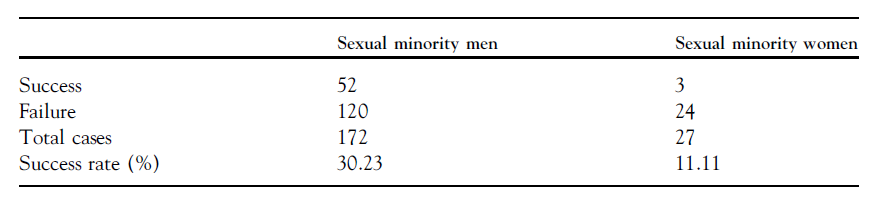
This latter result is unsurprising in light of our findings. Whereas scholars studying gender-based asylum have consistently argued that adjudicators rejecting applicants’ proffered PSG is the biggest roadblock for such claims, we found that a finding of no persecution (or no torture if it was a Convention against Torture claim) was the most common reason for a sexual orientation-based claim failing, regardless of gender.Footnote 27 However, the gendered discrepancies are startling. In terms of overall success rates in our archive of appellate cases, sexual minority men won their claims at nearly three times the rate of sexual minority women (see Table 1).
Overall success rate by gender

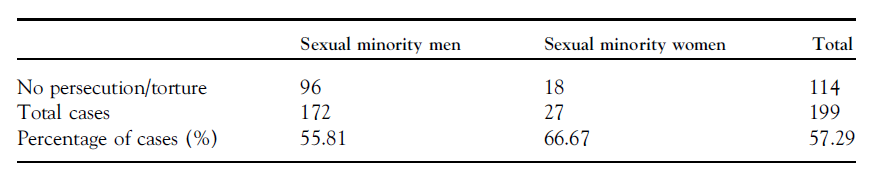
Similarly, when cases failed due to the court finding the claimant had not sufficiently proven persecution, women failed 66.67 percent of the time while men failed only 55.81 percent of the time (see Table 2). We discuss this pattern more thoroughly in the next section.
Finding of no persecution or torture was primary reason for case denial

The Gendered Nature of Violence against Sexual Minorities
The most significant part of an asylum claim is proving persecution. In sexual orientation claims, this involves submitting corroborating testimony and documentary evidence to prove that there was the infliction of violence by state actors or that the state cannot or will not protect the claimant; that there was serious physical or psychological harm beyond mere harassment and discrimination; and that sexual orientation was at least one central reason for which a perpetrator sought to harm the claimant. Proving all these factors is no easy task. As a result, 57.29 percent of denied cases in our data were denied due to an inability to prove persecution (or torture if it was a Convention against Torture claim). As presented in Table 2, however, there is a considerable gender gap in such determinations. We unpack the multiple reasons for this divergence below.
Failure to prove government involvement or acquiescence is a common reason for persecution failure. Only 22.22 percent of the sexual minority women and 23.84 percent of the sexual minority men in our data faced direct public, state-inflicted violence (see Table 3). Men’s percentage of state-inflicted violence increases to 26.8 percent if we exclude bisexual men, whose cases only involved private violence or fear of future persecution. Despite this relatively small quantitative difference between types of persecutory actors for sexual minority men and women in our archive, clear gender discrepancies persisted in the treatment of claims, including judges’ greater leniency with sexual minority men’s persecution narratives compared to sexual minority women’s.
Proportion of cases involving violence by public or private actors

Note: Percentages do not add to 100 percent because some cases did not state who persecutory actors were or only presented claims based on future fear and had experienced no past persecution.
In Tairou v. Whitaker (2018), Mocktar Tairou, a bisexual man, fled Benin after receiving death threats from relatives and villagers upon his cousin outing him to their community. After seeing pictures of Tairou and his same-sex lover hugging and kissing, a group of forty men harassed Tairou in his father’s backyard by pulling his ears and slapping him in the face for “bringing a bad name on their family,” while some directly threatened to kill him.Footnote 28 The death threats continued through several threatening phone calls and door knockings and a direct altercation inside of Tairou’s home where two of his cousins drew a knife on Tairou, threatening to kill him and harm his wife and children if he did not stop his same-sex relationship. Eventually, Tairou and his immediate family relocated to avoid these death threats, but, upon learning that two policemen showed up to his same-sex lover’s apartment to inform him that he had been turned in as a homosexual, Tairou fled Benin and came to the United States to seek asylum. Tairou did not face direct violence from state actors, and the State Department evidence discussed in his case regarding Benin indicated that “homosexual behavior was discouraged” but “neither prosecuted nor persecuted.” Regardless, the appellate court granted Tairou’s petition for review, deciding that he suffered “at least an implicit death threat when his cousin brandished a knife after the home invasion.”Footnote 29 Here, we can see the courts’ capacity to acknowledge the persecutory nature of anti-LGBTQ violence initiated by private actors in a country that is complacent to such violence, even if not its direct sponsor. Tairou’s case is just one example of how judges are willing to categorize private anti-LGBTQ violence as persecution in sexual minority men’s cases.
However, when sexual minority women present asylum cases involving private violence, they do not receive the same lenience from our legal system. In Mockeviciene v. United States A.G. (2007), Ingrida Mockeviciene, a lesbian woman from Lithuania, sought asylum in the United States after facing private sexual violence and six years of harassment from the police upon seeking protection. Her troubles began when she came out to her husband as a lesbian, after which he “beat and raped her while his friends held her down.”Footnote 30 She sought protection from the police, but instead of assisting her, they searched her mother’s apartment where Mockeviciene was staying to look for evidence of her homosexuality and threatened that they would “keep an eye on her.” The following year when Mockeviciene found a job at a cleaning company, the police outed her to her employer, causing her to lose her job. About three years later, an officer questioned her about her sexual orientation at her apartment, “expressed disgust at [her] lesbianism, and threatened to make her life a nightmare.” This action resulted in open hostility from her neighbors, causing her to be kicked out of her apartment and detained later that same year. Mockeviciene’s troubles did not stop even when she relocated. In fact, the police inspector in her new village arrested, physically and verbally abused, and threatened her with three years of imprisonment after directly informing her that his office was aware of her record as a “debauchee” and intentionally setting her up to be outed by sending her a fake invitation to join a gay and lesbian organization.Footnote 31 Mockeviciene faced a pattern of intentional violence from state and private actors, yet the appellate court declined her petition for review.
While the appellate decision critiqued the lower courts’ negative credibility determination as a result of Mockeviciene’s non-traditional sexual identity narrative, they primarily declined her petition for review because they did not believe she had met the standard for persecution stating: “[Her] description of the police’s treatment of her [did] not rise to the level of persecution … [and] she presented no evidence that her life or freedom were ever in danger on account of her social group.”Footnote 32 The court’s rejection of Mockeviciene’s consistent state violence, compared to their leniency toward Tairou’s private violence, paints a stark portrait of gender differences in the asylum system’s treatment of violence against sexual minority men and women.
Analyzing Mockeviciene’s case reveals a pattern of courts delegitimizing sexual minority women’s experiences with sexual violence. When evaluating Mockeviciene’s persecution narrative, the court entirely disregarded the rape her husband inflicted upon her, which was arguably one of the most aggravated instances of violence she faced. This treatment occurred despite her husband’s explicit intent to “cure” her lesbianism and the state’s clear unwillingness to protect her. Such an omission demonstrates the court’s ignorance to the political and systemic nature of sexual violence against sexual minority women as well as a tendency to mischaracterize male-female rape as a matter of private misconduct or heterosexual desire, instead of a criminal act motivated by hatred and the desire to dominate LGBTQ people and women.
We should note that Tairou and Mockeviciene were adjudicated eleven years apart, and the politics of sexuality in the United States and globally have changed dramatically in that time. However, as Shannon Minter, legal director for the National Center for Lesbian Rights, explains, “having asylum officers and immigration judges not recognize the types of persecution that lesbians were more likely to face at the hands of private actors, like forced marriage and being sexually assaulted because of your sexual orientation and that kind of thing. … I think that’s still actually a big problem and a big issue.”Footnote 33 Both our quantitative and qualitative findings presented below corroborate Minter’s assessment, suggesting that, even with advancements in sexual rights, sexual minority women’s experiences of persecution continue to be viewed as less severe than those of men.
We must also note, however, that this does not mean sexual minority women can never be successful. Indeed, the one lesbian asylum case that Stefan Vogler, one of the authors of this article, observed involving a woman from Mexico was successful. But, importantly for that case, the woman presented an almost ideal case. She realized her sexuality at an early age, was repeatedly raped by her husband and abused by family and neighbors, had a long-term relationship with another woman, and was harassed and beaten by the police. Moreover, she presented in a rather masculine manner. In other words, the narrative she presented closely resembled white, Western, male tropes of both persecution and identity development, which is not always the case for sexual minority women’s claims.
Sexual Violence in Persecution Narratives
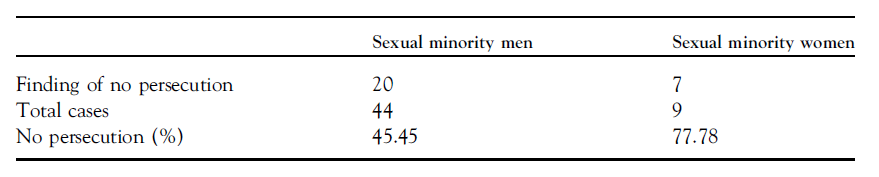
A significant cause of gendered discrepancies in asylum success rates is courts’ different treatment of sexual violence by gender. In our archives, 33.33 percent of sexual minority women faced sexual violence in comparison to 25.58 percent of sexual minority men (Table 4). Yet amongst those who faced sexual violence, the courts issued a negative persecution determination to 77.78 percent of sexual minority women and only 45.45 percent of sexual minority men (Table 5). These numbers demonstrate that, even while sexual minority women face higher rates of sexual violence than sexual minority men, courts do not consider sexual violence against sexual minority women to be as significant as that of sexual minority men. When sexual minority women bring forth narratives of sexual violence committed by men, courts often fail to see such violence as motivated (at least in part) by women’s queerness, and they sometimes even take these incidents as evidence of a woman’s heterosexuality. Indeed, sexual violence against men seems to bolster their claims to both persecution and membership in a PSG, whereas women’s success in sexuality-based asylum claims appears to depend more on forgetting that they are women at all.
Sexual assault as part of persecution claims

Persecution finding in cases of sexual assault

Note: Remands are counted as a finding of persecution for this table.
In Maldonado-Lopez v. Holder (2014), the parents of Yesenia Maldonado-Lopez of El Salvador forced her to marry a sixty-eight-year-old man at the age of fourteen to cure her from being a lesbian.Footnote 34 In the course of this forced marriage, Maldonado-Lopez’s husband drugged, raped, and impregnated her. However, the BIA decided that she did not face persecution because she “had two children” in the course of her “arranged marriage” and stayed married to her husband for thirteen years until his death.Footnote 35 The BIA categorized rape as a normal element of male-female relationships and failed to recognize the political motivations behind her perpetrator’s actions. Further, despite the clearly abusive power dynamics involved in her experiences, they undermined her sexuality because she had children with and stayed married to her persecutor and entirely disregarded the systemic inequalities that restricted her ability to make free choices as a woman. While men enjoy an independent relationship vis-à-vis the state, women’s primary legal status is attached to their families. Therefore, while a man could receive state protection for private violence, a woman may be beaten or killed by a family member for her sexual orientation and not be entitled to any state protection (Wilets Reference Wilets1997, 994). While the appellate court granted review after persistent advocacy from civil rights organizations, the lower court’s dismissive interpretation of Maldonado-Lopez’s persecution demonstrates how blindness to the convergence of gender and sexuality-based factors invalidates sexual minority women’s experiences of sexual violence and normalizes gender-based violence as a basic element of heterosexual relations.
Courts are skeptical even when the perpetrators of sexual minority women’s sexual violence are state actors. In Densmaa v. A.G. of the United States (2008), a Mongolian lesbian, Tsogzolmaa Densmaa, and her partner, Chimgee, were arrested and imprisoned under false prostitution charges. The police called Densmaa a “lesbian pervert” and threatened to commit her to a psychiatric hospital.Footnote 36 Both women were also raped and beaten in custody, allegedly causing Chimgee to die. While Densmaa’s asylum case failed primarily due to an adverse credibility determination as a result of internal inconsistencies regarding the day of the police rape, the crime the police charged her with, and whether the police questioned her about her sexual orientation, the appellate court’s decision regarding the violence she faced is notable. In determining whether Densmaa had a well-founded fear of future persecution, the appellate court solely evaluated country evidence for persecution against gays and lesbians in Mongolia, failing to weigh how Chimgee’s death, which resulted from severe police assault in the form of beatings and rape, may have impacted Densmaa’s fear of persecution. This omission communicates that the courts are less likely to view male-female rape as an alarming indicator of persecution, even when committed by state actors.
In contrast to the invalidation of sexual minority women’s experiences, sexual violence in sexual minority men’s cases is easily interpreted as serious evidence of persecution. In Walker v. Lynch (2016), Gavin Walker testified that he fled Jamaica because he felt scared of his uncle and cousin who threatened to kill him if he told anyone that his uncle had raped him during his childhood.Footnote 37 The immigration court and the BIA denied his asylum claim, reasoning that he had failed to prove government acquiescence in the violence he faced. Yet, despite no direct mentions of sexual orientation being a motivator for the rape and death threats, the appellate court remanded his case. Similarly, in Gonzalez-Ortega v. Lynch (2016), Sergio Gonzalez-Ortega, a gay man from Mexico, came to the United States after he suffered repeated rape from his brother and cousin. While the BIA doubted whether the violence he faced was motivated by his sexual orientation, the appellate court remanded the decision and determined that his cousin clearly targeted him because “his closeted homosexuality made him vulnerable.”Footnote 38 These examples demonstrate how in the eyes of the court, male-male rape is immediately recognized as an act intended to humiliate and disempower men who defy traditional masculinity and heteronormativity, even when the perpetrators are family members. The court’s different treatment of sexual violence in sexual minority men and women’s cases demonstrates the unjust impact of the legal system’s blindness to the intersection of gender and sexuality and explains, in part, why sexual minority women’s asylum claims fail at significantly higher rates than men’s.
Gender Variations in Proving Sexuality
Another central issue in any asylum claim is proving that one belongs to a protected social group. For LGBTQ people, this means, in effect, that they must prove their sexualities to the court. Here again, we found gender discrepancies, with sexual minority women facing more difficulties and lower success rates in proving their sexual orientations and thus their valid membership in a particular social group. Courts found sexual minority women not credible in regard to their sexualities in 14.8 percent of claims, while they found men’s sexualities not credible only 11.1 percent of the time. If we separate bisexual men’s cases, which face a disproportionate amount of scrutiny for various reasons (Rehaag Reference Rehaag2009; Sin Reference Sin2015), we find only a 7.84 percent failure rate in proving sexual orientation for gay men, compared to a 14.81 percent failure rate for sexual minority women (Table 6).Footnote 39 These findings mean that sexual minority women face nearly double the amount of adverse credibility findings regarding sexual orientation in comparison to gay men.
Adverse credibility decisions regarding sexuality

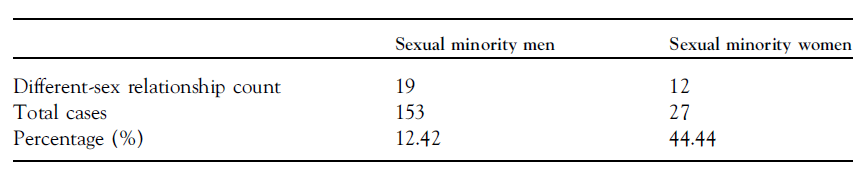
Sexual minority women face lower credibility rates, in part, because they have higher rates of different-sex relationships than sexual minority men. Of the sexual minority women in our sample, 44.44 percent mentioned at least one instance of different-sex relationships, whereas only 12.42 percent of gay men and 16.86 percent of all sexual minority men did so (Table 7). As previously discussed, sexual minority women commonly face persecution manifested as private sexual violence. Therefore, engaging in different-sex relationships is not always a matter of choice for women. Rather, many enter relationships with men due to force and/or social and familial pressures. In Lyashchynska v. United States AG (2012), Olha Lyashchynska, a lesbian asylum seeker from Ukraine testified about two different-sex relationships. In the first one, the man she was dating and his friends gang raped her to teach her “how to be a real woman” and, in the second one, she claimed having only married him because the guy “was like really nice to her.”Footnote 40 Lyashchynska’s description of her relationships with men communicate abusive power dynamics and convenience, not desire or attraction toward men. Furthermore, her testimony included evidence of a same-sex relationship and participation in a gay social club, which subjected her to a violent attack by skinheads who physically assaulted club members, including her and her girlfriend, and called them “filthy gays and lesbians.”Footnote 41 Regardless, her participation in different-sex relationships led the judge to question whether she was truly a lesbian.
Number of claimants with different-sex relationship

In Michulena v. Attorney General of the United States (2010), the courts scrutinized the petitioner’s averred lesbian sexual orientation because she had married two different men, a matter the immigration judge deemed “so fundamentally inconsistent with her claimed social group membership that it shatter[ed] her credibility before the court.” Similar to Lyashchynska, Michulena married her Latvian husband because he raped and impregnated her, and when asked about her second marriage to a man in the United States, she responded that she wanted to “live a normal life and have children.”Footnote 42 The courts’ failure to acknowledge the sometimes persecutory and desireless nature of sexual minority women’s different-sex relationships demonstrates their ignorance to sexual minority women’s experiences as women.
Another possible explanation for low credibility rates for sexual minority women’s sexualities is their trajectories of sexual awareness, which often differ substantially from men’s. Scholarship demonstrates that it is common for sexual minority women to realize their homosexual desire much later in life than gay men, often after being in relationships with men and having children (McKinnon Reference McKinnon2016a, 113) and that many women experience considerable fluidity and change in their sexual desires and identifications over the course of their life (Diamond Reference Diamond2008). As Heather McClure, anthropologist and founder of one of the first LGBTQ immigration advocacy organizations, stated of her fieldwork with LGBTQ Guatemalans, “there was a lot of same-sex desire, but there was a lot of variability in terms of whether people self-identified as gay. So desire and identity are not necessarily the same thing.”Footnote 43 However, when measured against the US asylum system’s white, Western, male-centered, and immutable notions of sexual identity, sexual minority women’s sexual malleability casts doubt on their credibility. This is demonstrated in one instance by Michulena, where the court categorizes her as a lesbian, but a footnote states: “Michulena suggested that she was bisexual but that ‘I think I’m more of a lesbian.’” This statement demonstrates how her struggle to fit into Western sexual identity categories negatively affected her chance at asylum relief.Footnote 44
In Mockeviciene v. United States Attorney General (2007), Ingrida Mockeviciene was married to a man with whom she had a daughter, she did not have a same-sex partner during the four years she lived in the United States, and she defined being lesbian as “a woman who wants to be around other women and … it does not necessarily involve sexual relationships.”Footnote 45 Upon evaluating her case, the immigration judge made an adverse credibility determination regarding her sexuality and labeled her as “at best a non-practicing lesbian,” a finding that the appellate court did not reverse. This was despite the previously discussed consistent and intentional violence that state actors inflicted upon her for believing she was a lesbian, her daughter corroborating her sexuality, and her own clarification that, through her prior statement, she meant to communicate that being a lesbian “doesn’t have to be a sexual affair” but that, for herself, she only wants to have sex with women and “cannot have it with a man.” Mockeviciene’s case demonstrates how sexual minority women’s sexualities do not fit with white, Western, and male-centered sexual immutability standards and, therefore, are more often deemed not credible. It is also important to note that part of why the immigration judge discredited Mockeviciene’s sexuality was because she had “not joined any groups while being here in the United States for four years that involve[d] lesbian activities.”Footnote 46 This analysis highlights the social visibility requirement for proving sexuality, a standard that fully disregards the limitations sexual minority women face from publicly expressing their sexual orientations due to patriarchal gendered constraints that proclaim men as the dominant subject of public affairs, even in highly industrialized countries such as the United States.
Sexual minority men with non-normative sexualities also face challenges in proving particular social group membership. In fact, bisexual men faced a 36.84 percent failure rate in proving their sexualities, the highest of any group (though, notably, there were no self-identified bisexual women in our data). However, we found that, in the presence of strikingly similar experiences, courts offer sexual minority men more lenience. Take Pozos v. Gonzales (2005) for instance.Footnote 47 In his asylum case, Miguel Pozos testified that he faced persecution in the form of rape and beatings as a result of his perceived homosexuality in Mexico. Pozos’s case presented a fluid sexuality narrative similar to Mockeviciene. He did not identify himself as homosexual, mentioned sexual fantasies involving both men and women, and testified that he had no sexual relationships since coming to the United States. Indeed, both Pozos and an evaluating social worker averred that they did not know what Pozos’s sexuality was and that he had “eschewed sexual relations with either gender.” While the immigration judge determined that Pozos was not a homosexual and thus ineligible for asylum, the appellate court reversed this finding and deemed him eligible for particular social group membership as an imputed homosexual. Its reasoning was that it was still possible for him to face anti-gay persecution despite “not engaging in open displays of affection with other men [and] not frequenting gay establishments.”Footnote 48 The striking contrast between the courts’ evaluation of Mockeviciene and Pozos’s sexuality narratives highlights that sexual minority women’s sexualities are held to stricter standards than sexual minority men’s.
Adding to sexual minority women’s difficulties, within the realm of patriarchal gender norms, women’s outward expression of gender nonconformity is not weighed as heavily as that of sexual minority men as evidence of one’s sexual orientation. In the United States, female-bodied people can encompass a wider range of gender expressions and sexual behaviors without the same level of stigma and without being immediately viewed as gay (Rupp and Taylor Reference Rupp and Verta2010; Kazyak Reference Kazyak2012; Mize and Manago Reference Mize and Bianca2018). US courts often enforce this standard by refusing to acknowledge how understandings of gender and sexuality vary across cultural contexts. For instance, in Burog-Perez v. INS (2004), despite Belinda Burog-Perez insisting that her “appearance as a lesbian” made her subject to economic and other forms of persecution in the Philippines, the judge never considered how her style might make her socially visible as lesbian and increase her risk of persecution and thus denied her case.Footnote 49 Similarly, in Maldonado-Lopez, the courts ignored Yesenia Maldonado-Lopez’s claim that her “masculine appearance and mannerisms” motivated her parents to force her to marry a sixty-eight-year-old man when she was fourteen and that, despite this forced sexual relationship, she continued to feel ostracized from her community, who talked about lesbians in pejorative terms and repeatedly murdered sexual minorities.Footnote 50
In contrast, courts immediately accept defiance of masculinity as strong evidence of a queer sexual orientation in men’s asylum cases. In Grijalva v. Gonzales (2007), Jose Antonio Grijalva of Guatemala sought asylum because his career choice of selling fruits and vegetables, which was seen as “doing women’s work” in his country, as well as his long hair and use of makeup and skin creams made him subject to attacks from guerrillas and soldiers. The US courts categorized him in the group of “obviously effeminate homosexual men,” emphasizing his gender nonconformity as evidence of his sexuality.Footnote 51 Even when they do not identify as a sexual minority, men who defy norms of masculinity enjoy significant lenience in sexual orientation claims. In Velasquez-Banegas v. Lynch (2017), the Seventh Circuit granted Rigoberto Velasquez-Banegas of Honduras asylum based on imputed homosexuality because it concluded that Hondurans would assume his HIV-positive status also meant he was gay. In addition, the court decided that Velasquez-Banegas was more likely to be perceived as homosexual because “though now in his late forties, he has never married,” and he also did not fit the profile of “heterosexual men who have such huge sexual appetites that they are unwilling to tie themselves to one woman.”Footnote 52 The alarming contrast between the courts’ treatment of gender nonconformity in men and women demonstrates the asylum system’s tendency to evaluate sexual orientation eligibility through a male-centric lens.
As demonstrated above, US sexual orientation asylum law presents many gendered double standards. It provides flexibility for nonnormative sexual minority men asylum seekers but delegitimizes the violence and sexual fluidity sexual minority women experience. Considering such blindness to the intersection of gender and sexuality, sexual minority women’s significantly lower asylum success rates come as no surprise.
CONCLUSION
In this article, we have argued that cisgender sexual minority women are marginalized within, and excluded from, the US asylum claiming process because their claims lie at the intersection of the raced, gendered, and sexual oppression that shapes their everyday lives in ways that are often incomprehensible to a legal system premised on single-axis discrimination frameworks. Specifically, we have demonstrated that cisgender sexual minority women’s sexualities and persecution narratives are deemed less credible than cisgender sexual minority men’s and, even more pointedly, that women’s experiences of private persecution and sexual violence are treated differently than men’s. Courts fail to recognize the constraints that sexual minority women face coming to terms with and expressing their sexualities in patriarchal, heterosexist contexts that often limit women to the domestic sphere, subject them to strict control by male family members, and frequently coerce them into compulsory heterosexuality. Moreover, even women in more sexually open cultures evince different trajectories of sexual orientation development and expression than men (Diamond Reference Diamond2008). Nevertheless, different-sex relationships are frequently taken as evidence of heterosexuality for women—or, at the very least, cast considerable doubt on any professed queerness—but often not for men. Lack of racial, ethnic, and cultural understanding also surfaces in courts’ general inability to comprehend identities and narratives that do not fit typical white, Western, male experiences that are linear and teleological.
Presenting successful narratives of persecution is likewise significantly more difficult for cis women than for cis men. Multiple factors account for this divergence. First, women are more likely to experience persecution by non-state actors. However, this difference was relatively small in our sample (approximately a 1.5 percent difference that rises to about 4.5 percent if we exclude bisexual men), so this discrepancy alone does not account for an overall men’s success rate that is nearly three times higher than women’s. Rather, our qualitative analysis reveals that this relatively small quantitative difference is magnified by the disparate treatment of sexual minority men’s and women’s claims, wherein private violence directed at men is taken more seriously than private violence against women. This difference was especially pronounced when it came to sexual assault, a common event in both sexual minority men’s and women’s persecution narratives. Even though women reported sexual assault more often than men, women were successful in such claims less than half as often as men. We suggest that this finding stems in large part from US cultural beliefs about sexual assault wherein sexual violence against women is normalized as a routine aspect of heterosexual relations, while the rape of men is seen as highly abhorrent and harmful (Freedman Reference Freedman1987; Small Reference Small2019).
In addition to its direct implications for asylum policy, our article contributes to the still underdeveloped empirical literature on intersectionality in legal claims and the particularly understudied intersection of gender and sexuality. Echoing extant scholarship on how multiple-axis discrimination claims are adjudicated, we have found that cisgender sexual minority women’s claims fail at significantly higher rates than cisgender sexual minority men’s because adjudicators fail to account for the ways in which gender and sexuality simultaneously and inextricably shape sexual minority women’s lived experiences in ways that are different from men’s. Sexual minority men’s claims have served as the foundation for jurisprudence in this area of law, much as men’s experiences in general have shaped law writ large (MacKinnon Reference MacKinnon, Sarat and Kearns1995). Scholars who study gender-based asylum have made similar arguments about the law’s failure to recognize single-axis gender-based asylum claims as well (Neilson Reference Neilson2005; McKinnon Reference McKinnon2016a), lending further weight to our contention that adjudicators in all areas of law—and lawmakers themselves—must stop universalizing straight, white, male experiences as the baseline for legal claims.
It is unsurprising that asylum criteria continue to be centered around Western, straight, white, male standards given that asylum law was created with male political dissidents in mind during the Cold War. As Puar’s (Reference Puar2007) homonationalist framework also suggests, even though some queer people have been tentatively admitted to the polity, they are usually white, middle-class, and male. Indeed, the United States’s desire to position itself as a beacon of sexual freedom has benefited some sexual minority asylum seekers, but these have mostly been men (Vogler Reference Vogler2016). As we demonstrated above, the sexual minority women most likely to be successful in their asylum claims are those who present the most typically white, male, and Western narratives.
Our current political moment has also witnessed the rise of overt white supremacy, nationalism, homophobia, and sexism at the highest levels of political office—forces that have always shaped US immigration policy but that are more evident today than any time in the last half-century. The link between immigration, race, and fear of Black and brown reproduction has thus reemerged stronger than ever in national discourse. Anti-immigration tropes like the “anchor baby” that an immigrant woman uses to gain herself access to the United States animate these conjoined race, gender, and sexual fears (Luibheid Reference Luibheid2013). As Sara McKinnon (Reference McKinnon2016b) has further asserted, part of the walling-off protections for cisgender women from those assigned male at birth (that is, gay men and trans women) involves fear of immigrant women’s reproductivity and the “browning” of the United States, and this finding is closely connected to the “floodgates” argument around gender-based asylum discussed above (Lobo Reference Lobo2012). Given these resurgent nationalist forces, it unfortunately comes as little surprise that recent reporting has revealed the forced sterilization of migrant women in US custody (Manian Reference Manian2020), something with which the United States has a long and dark history (Lopez Reference Lopez2008).
As others have long argued, both in relation to asylum and law more broadly, more intersectional approaches to claims of discrimination and violence would go far in opening courtroom doors to those who are multiply marginalized and cannot articulate their experiences without recourse to intersectionality. For migrant women, their races, genders, sexualities, religions, cultures, and much more inextricably shape their lives and identities. As we have shown, sexual minority women seeking asylum cannot describe their lives without articulating them in terms of the interlocked nature of gender, sexuality, and race. Courts must move away from both single-axis and “race-plus” or “gender-plus” models of discrimination. Without such a move, the law will only continue to uphold race, gender, and sexuality as regulatory structures. In fact, in many ways, our findings suggest that gender often becomes a “master status” that effaces sexual minority women’s sexualities and races and that the best way for a sexual minority woman to win her claim is to present it as if she were not a woman at all—that is, to present it as closely to that of a cisgender, white, gay man.
Debates about the legal rights of transgender people in various areas also evince the need to consider how gender and sexuality interact to structure our legal and cultural responses to a range of issues. Trans studies scholar Tey Meadow (Reference Meadow2010) has shown, for instance, that historically when trans people have sought to change the gender on their birth certificates or otherwise be legally recognized as their proper gender, courts have been especially concerned with genitals and the reproductive capacity of the body in question. In other words, compulsory heterosexuality has strongly structured jurisprudence around the recognition of trans people. Recent skirmishes over bathrooms and the right of trans people to participate in organized sports also reveal the intertwining of gender and sexuality in the public and legal imaginary. Laurel Westbrook and Kristen Schilt (Reference Westbrook and Kristen2014) contend that such debates are animated by “penis panics” or the perceived threat that a penis presents in “single-sex” settings for women, such as locker rooms and bathrooms. The implication is that trans women (who may have penises) present a sexual threat to cisgender women. Even though there is no evidence for such claims, this argument has been used to justify the exclusion of trans women and intersex people from sports and the denial of trans people’s right to use public bathrooms.
While law clearly continues to structure race, gender, and sexuality, including determining what they are and what rights accrue to them, race, gender, and sexuality as social structures in their own right also work to shape law. By incorporating white, Western, male standards as the basis for adjudicating asylum claims (and beyond), the law tacitly absorbs principles of white, Western supremacy and patriarchy into its very workings. Considering this iterative relationship allows us to recognize how cultural, individual, and interactional changes around race, gender, and sexuality may eventually reverberate through the legal system and, conversely, how law may act back on our culture to create changes in how we understand these social distinctions. However, for this “loop” to create positive change for marginalized people, the law must be open to adjudicating claims as they happen in the world, not as courts wish them to happen.