In terms of its political culture, the German Democratic Republic (GDR) “was a place where history really mattered.”Footnote 1 Confronted by the threefold problem of an arbitrary geographical boundary, historical origins in military occupation, and, above all, a direct Western competitor, the leaders of the GDR were forced permanently to negotiate a unique legitimation “dilemma,” reinforced especially in the state's formative twelve years by the flood of emigration to the West.Footnote 2 As one means of asserting the right of its state to exist, the ruling Socialist Unity Party (SED) looked to history. Lacking distinct indigenous traditions to which to attach itself, the party sought to coopt progressive strands of German history into its “historical myth,” helping the SED to define its state in strict opposition to the “imperialist” Federal Republic in the West and presenting it as the inevitable culmination of the long, progressive struggle of Germany's workers and peasants.Footnote 3
To that end, party propaganda represented the land reform program begun in the 1940s as a culmination of the agrarian reforms of the early nineteenth century, whereas the Nationale Volksarmee, founded in 1956, portrayed itself as the heir to the voluntarist liberation armies that had fought Napoleon and that would, in the future, fulfill their mission of a unified Germany. Drawing upon the perceived humanistic and progressive qualities of historic German icons, the SED also constructed a canon of cultural and political forbearers. Johann Wolfgang von Goethe, Johann Sebastian Bach, Ludwig van Beethoven, Friedrich Schiller, and George Frideric Handel were accordingly feted as “symbols of unity,” “solidarity,” or “peace,” while the “progressive generals” August Neidhardt von Gneisenau, Gerhard von Scharnhorst, and Carl von Clausewitz were invoked as emblems of “national independence”—patriotic archetypes in the fight against the “warmongering rulers in Washington and their servants … in Bonn.”Footnote 4 In Jon Berndt Olsen's phrasing, this was a “tailored” history, selected, crafted, and manipulated according to circumstance in order to reinforce the SED's claim to power.Footnote 5 As a result, a vast range of individuals, events, and traditions from German history came to assume political significance over time.
One particularly prominent example invoked by contemporary observers was that of Prussia.Footnote 6 Scholars have spoken of a “Prussia wave” beginning in the late 1970s, personified by Ingrid Mittenzwei's 1979 “revisionist” biography of Frederick the Great, the restoration in 1980 of Christian Daniel Rauch's equestrian statue of that same monarch to its original site in central Berlin, and the success of the historical television drama Sachsens Glanz und Preußens Gloria (Saxony's Splendor and Prussia's Glory) in the mid-1980s.Footnote 7 If this was the Renaissance of Prussia in the GDR, then, by extension, the preceding three decades had been its Dark Ages, in which perceptions of the Prussian state were limited to its portrayal as a bastion of reaction and an incubator of fascism. According to this view, the intellectual parameters of Prussian history in this era were defined by the so-called misere theory, according to which German history had been characterized by the “political and social backwardness” of the Prussian state, which had inhibited Germany's capacity to unify and to progress.Footnote 8 It is a common assumption that this demonization of Prussia extended into all spheres of East German politics and culture, emblematized academically by Alexander Abusch's 1946 book Irrweg einer Nation and by a theoretical focus on the works of the German socialist historian Franz Mehring (1846–1919), rhetorically by the incantations at the high political level of West German “militarism” and Junkertum, and symbolically by the destruction of the city palaces of Berlin and Potsdam in 1950 and 1959, respectively.Footnote 9
With a specific focus on Prussian representative architecture, it is the aim of this article to demonstrate that the idea of a fundamental Prussian myth within the Manichean historical mythology of the early GDR should not be the sole measure by which we interpret specific instances of its historical management practices. Instead, we should broaden our scope to consider the ways in which discussions about the past and its physical traces proceeded in inherent union with reflections about a future socialist Germany. While the socialist-realist cultural paradigm of the Stalinist era emphasized aesthetic continuities and traditions in order to mobilize “popular adherence to certain systems of values and power,” the problem of how best to balance past, present, and future within socialist culture was not confined to this immediate postwar period alone.Footnote 10 Throughout the entire time frame covered by this article, the issue generated considerable division in the GDR and even within the SED itself, with the complexities arising from ideological inconsistencies and reversals further compounded by competition for authority among key administrative institutions.
A growing body of literature on the history of socialist space has developed a sophisticated understanding of how “structures of power, domination, and the transmission of ideology” were disseminated, understood, and negotiated in everyday life behind the Iron Curtain.Footnote 11 As Graeme Gill notes, the power that regimes possess to change both the “material (regions, buildings, streets, squares) and the non-material (names by which the material factors are known) elements” of an urban space is fundamentally “a power to help shape individuals’ conceptions of themselves.”Footnote 12 In the Eastern Bloc, the “drive of the rulers into public space” was characterized first and foremost by symbolic assertions of the prevailing political order.Footnote 13 The reshaping of the urban and architectural fabric of a city enabled the ossification of a particular political language, which was instilled in the social and cultural universe of the population. It sought to make people conform to the ideocratic parameters of the regime by casting a permanent reminder that the world they lived in was one defined by a particular set of values.
Rudy Koshar sets this phenomenon within the broader patterns of modernity. In his view, historic preservation became a vital instrument in the nineteenth-century attempts of nation-states to “create a cultural authority” anchored in a collective past rendered increasingly unknowable by the acceleration of time.Footnote 14 This process perceptibly intensified in the twentieth century, and was visible also in the fledgling Soviet Union. From the most formative years of the Bolshevik republic, Soviet-style regimes valued the conservation even of imperial heritage. The reasons for this were twofold. First, such heritage stood as testament to the powers of human achievement: under Soviet custody, it had supposedly been transferred to ownership by the people.Footnote 15 Second, the symbolism of the Bolsheviks after the revolution was increasingly marked by appeals to Russian history.Footnote 16 Socialist realism was one attempt to infuse traditional cultural forms with the forward-looking dynamic demanded by revolutionary politics, and indeed was central to the cultural model that the Soviets exported westward after 1945, reigning as the official paradigm until Joseph Stalin's death in 1953.Footnote 17 But in East Germany in particular, as authors including Martin Sabrow and Brian Campbell have demonstrated, conservation and urban renewal continued to stand in uneasy tension with one another.Footnote 18
To craft a socialist identity through the manipulation of space, not even a self-professed revolutionary regime could avoid the need to deal with the symbolic urban landscape it had inherited. Architectural historians have employed the term razing (Schleifung) to describe acts of demolition conducted with an express purpose to rid an urban environment of a particular symbolism or political identity.Footnote 19 When it is thought that a previous political order is morally incompatible with the new, and that a distinct break is needed between it and its successor, then razing may assist in laying the groundwork for the latter's moral legitimation. If the SED's attempts to anchor the legitimacy of its state within a historically defined antifascist or socialist identity were to acquire any semblance of permanence, then urban space provided a valuable stage for this to be acted out.
The Prussian Architectural Legacy in East Berlin
Between 1949 and 1961, East Berlin and Potsdam each experienced a series of physical demolitions of Prussian power symbols. In the East German capital, Rauch's celebrated equestrian statue of Frederick the Great was removed from its prominent site on the city's historic central boulevard Unter den Linden and subsequently lay in ignominious obscurity in Sanssouci Park for over three decades. The baroque city palace, also in Berlin, met its end by party decree in 1950, while statues of various Prussian military heroes and monarchs disappeared overnight from their pedestals. Debates raged about such structures as the New Guardhouse (Neue Wache) and the Royal Arsenal (Zeughaus), with political figures variously advocating demolition, conservation, or reappropriation. Potsdam was equally despoiled, most notably losing its own city palace in 1959. But amid these razings transpired a number of alternatives: either full restorations, which were designed to celebrate the site's cultural and historic value, or reappropriations, which were intended to propagate the victory of the workers and peasants over reactionary Prussian militarism. Annihilation was far from a default response.
Even after 1945, Berlin's associations with Nazism did not diminish the city's significance as a symbol of Prussian royal power. Cautioning against its selection as a future German capital, the Rheinlander Konrad Adenauer argued: “We in the West reject much of what is commonly called the Prussian Spirit. … Whoever makes Berlin the new capital creates a new Prussia in spirit.”Footnote 20 In October 1945, Communist city council (Magistrat) deputies Karl Maron and Arthur Pieck expressed their desire to strip Berlin fully of its “militaristic past,” while the Social Democratic representative Josef Orlopp advocated the immediate removal of “all public buildings … portraits, and emblems”—regardless of artistic merit—“that recall the Hohenzollerns and all other earlier ruling houses, the military caste, or National Socialism.”Footnote 21 Such sentiments were echoed in the Soviet Zone press with regard to Berlin street names.Footnote 22 The Berliner Zeitung grumbled in September 1945 that the former capital was flooded with recollections of “‘sabre-rattling militarism’ and ‘imperialistic Prussianism.’”Footnote 23
That such a great emphasis was placed on matters of toponymy despite the many other, ostensibly more urgent, responsibilities facing postwar authorities points again to the seriousness with which the symbolic components of political reeducation were treated. (As the British government remarked in 1944, “the Nazis have shown that it is unwise to underestimate the power of symbolism, particularly in Germany.”Footnote 24 ) These discussions extended also to architectural matters. In deliberating the fate of the city palace, Pieck argued that “[n]obody today has an interest in concoctions that are only expressions of Hohenzollern imperialism”—a view echoed by fellow councilor Edmund Noortwyck, who felt it was not “the task of the Magistrat to conserve the memory of the time of the Hohenzollerns.”Footnote 25 In this context, scholars have tended to cite the 1950 removal of Rauch's equestrian statue and the subsequent demolition of the Berlin city palace as the postwar era's most conspicuous instances of anti-Prussian razing.Footnote 26
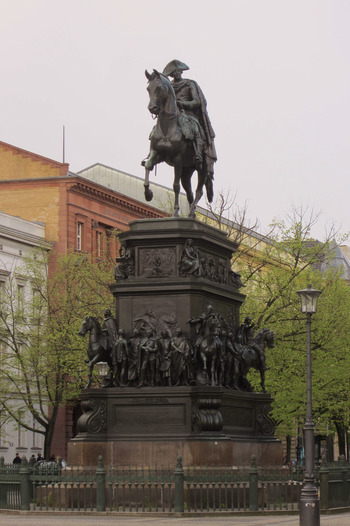
Walled-up in the final years of the war to escape bomb damage, Rauch's famed figure on Unter den Linden, dedicated in 1851, remained enclosed until mid-1950, when it was dismantled and removed to a distant corner of Sanssouci. Throughout the interim period, however, the fate of the statue had remained unclear. Plans appear to have changed considerably during the immediate postwar period, when the statue proved to be an object of some controversy. In an advisory report composed in February 1946, the Berlin Magistrat distinguished strictly between monuments according to the eras in which they were produced. Objects from the National Socialist period were simply to be demolished; those from the Wilhelmine and pre-Wilhelmine eras were, with a handful of important exceptions, also to be removed as expressions of an “arrogant dynastic self-importance”; monuments that reflected “a certain epoch artistically,” such as the baroque or neoclassical, could be retained as the artistic property of the people.Footnote 27 Despite being a product of the latter period, Rauch's representation of the Prussian king (still referred to in the report with the epithet “the Great”) became something of an exception to this order (Fig. 1).
Christian Daniel Rauch's equestrian statue of Frederick the Great on Unter den Linden, dedicated in 1851. Source: Photograph by author.

While some political figures stressed the important place the statue occupied “in the hearts” of Berliners, for whom “it is a piece of old-Berlin life,” others demanded its destruction by noting that it “rode against the East.”Footnote 28 The latter view, at least according to Karl Brammer of the Christian Democratic Union (CDU), contradicted that of the Soviets who, here as in many other instances, took a more considered approach to conservation.Footnote 29 In many ways, the tension surrounding the fate of Rauch's sculpture reflected the ambivalence surrounding the legacy of Friedrich II in the Soviet Occupation Zone more generally. In determining how the Prussian king was to be taught to schoolchildren, for instance, the 1946 guidelines of the Central Administration for People's Education (Deutsche Zentralverwaltung für Volksbildung) advised that, “against the abundant legends, the personality of Friedrich II is to be depicted objectively with an eye to its assets and deficiencies.”Footnote 30 With the ideological battle lines of the Cold War still not fully formed, the reductive historical depiction of Friedrich II as a mere instrument of the reactionary Junker class pursuing a categorically antinational policy remained undeveloped.Footnote 31
The Magistrat resolved in May 1946 to transfer the statue to Charlottenburg in the British sector, but no action was taken. This was presumably because of the intensification of Cold War tensions within the Magistrat itself, which culminated in its split in late 1948. Discussions about the statue's fate continued throughout the immediate postwar years. Even following the establishment of the GDR in October 1949, the newspaper Neue Zeit could still report that “it will probably remain in place”—whereas the Berliner Zeitung wrote that the statue's preservation might be accompanied by a school educational program to enlighten students about “such historical figures” as Friedrich.Footnote 32 It was decided by February 1950 that it would remain preserved as an “artwork” and re-erected for this purpose in Sanssouci.Footnote 33 According to the later testimony of Hans Bentzien, GDR Minister of Culture from 1961 to 1966, East Berlin mayor Friedrich Ebert had called for its removal in 1949. An initial plan to transfer the statue to Potsdam was resolved by the Magistrat in May 1950, upon which “Ebert sent [it] to his counterpart Dr. [Karl] Steinhoff, Minister-President of Brandenburg, and had it brought to Potsdam in 1951.” Steinhoff, however, “rejected the ‘gift.’”Footnote 34 It was only then that it was decided to relocate the statue to Sanssouci, where it remained dismantled, enclosed, and concealed for a decade. After much deliberation, in which artistic value was balanced against political symbolism, it was eventually re-erected in Sanssouci's Hippodrome in 1962, a site deliberately selected to “make the artwork effectively visible without glorifying” the king's image.Footnote 35
The ultimate decision to preserve the statue—as well as the spectrum of opinions voiced on the issue—underline the competing impulses within East German historical management practices at the time. Indeed, they suggest that the reason for the statue's removal was not primarily the complete erasure of Friedrich II from the GDR's historical imagination, but only from such a prominent symbolic position as on Unter den Linden, a site soon to become central in the socialist reconstruction of the East German capital (discussed later). A monarch, especially one renowned for his conquests in the East, clearly could not inhabit a site of such symbolic importance. This was fundamentally less a question of conquering the past than one of dominating symbolic space.
No space in Berlin possessed such symbolic value as the site of the city palace, however. This had long been significant for many Berliners as the “heart” of the city—a historic center of royal, cultural, and civil power, around which the life of Berlin had formed.Footnote 36 Even after the demise of the Hohenzollerns, it assumed a public role as backdrop to the political rallies of the Weimar Republic. For the new Communist regime, the Schlossplatz and the Lustgarten thus had the dual advantage of being both central and politically meaningful: it was there that the great demonstrations of the SPD and KPD had taken place in the 1920s and early 1930s, and there also that Adolf Hitler had led his triumphalist Berlin rallies. After the National Socialists’ first demonstration there in March 1932, Joseph Goebbels boasted that the party had “conquered this historic meeting place for the first time.”Footnote 37 In a report from July 1950, the East German Ministry for Reconstruction (Ministerium für Aufbau) affirmed that “the historical space for demonstrations in Berlin is the Lustgarten.”Footnote 38 Yet, the area had proven too small in the postwar period for the scale of state parades demanded by the “new political style.”Footnote 39 There was therefore a deeper symbolic history behind the SED Politburo resolution to demolish the Stadtschloss in 1950 to make way for a vast parade ground. At least in part, the decision was based on the reasoning that the site enjoyed “particular political traditions and a favorable location” for demonstrations: symbolically, it was an ideal site for the confluence of progressive tradition and democratic power.Footnote 40
Dating back to the fifteenth century, but given its lasting baroque structure by the court architects Andreas Schlüter and Johann Eosander von Göthe in the early eighteenth century, the Berlin Stadtschloss has been extolled as “the greatest baroque structure north of the Alps.”Footnote 41 It suffered substantial bombing and fire damage during the war, but nevertheless remained in use as an exhibition space until 1948. Following the establishment of the GDR, however, a more centralized, ideologically driven notion of urban planning began to generate new ideas for the historic center of Berlin. In mid-1950, following a trip by a high-level East German delegation to the Soviet Union, the state adopted its Sixteen Principles of Urbanism, which emphasized the political significance of city centers and state capitals.Footnote 42 Above all, the construction of mass parade grounds would exemplify the politicization of central urban space.Footnote 43 As sites of mass ceremonial affirmation of the regime's “ideocratic” legitimacy, squares and parade grounds assumed a particular importance within the “culture-planning” practices of the young state.Footnote 44 The sixth of the Sixteen Principles affirmed that “the middle of the city is the political center point for the life of its population,” and that “the political demonstrations, the parades and the people's celebrations” would take place in its spaces.Footnote 45 Deprived of their original revolutionary purpose, parades in the Eastern Bloc were “orchestrated mass celebrations” of the status quo, expressing as much the tremendous power of the socialist state as the ostensible unity of its workers.Footnote 46 In many ways the apotheosis of socialist mass society, the parade was a constructed locus of self-legitimation, ritual, and mythmaking.Footnote 47 The city palace was clearly under threat, then, by virtue of its physical centrality to Berlin's historical development. Debate nevertheless continued within the Magistrat and the Ministry for Reconstruction throughout 1950 about the building's fate, until SED General Secretary Walter Ulbricht announced at the SED Party Conference in July that Berlin's central parade ground would cut through Unter den Linden, including the “area of the present palace ruin.”Footnote 48 This announcement effectively condemned the Stadtschloss to history.
Many historians have since cited the act of demolition as a distinctly anti-Prussian measure: “an instructive example of the rigorous kind of handling of the Prussian past in the early years of the GDR.”Footnote 49 Yet, there is good reason to suppose that a degree of opportunism accompanied these ostensibly anti-Prussian sentiments. One thinks, for instance, of a revelation by Neues Deutschland editor and later State Secretary for Higher Education Wilhelm Girnus, who purportedly told the art historian Richard Hamann and the journalist Helmut Räther in 1951: “We had the choice: palace or [the adjacent Wilhelmine] cathedral. If we had torn down the cathedral, for years this would have been grist to the mill for the West, and they would have spoken of ‘an assault on the church [Kirchenstürmerei].’ So the palace was preferred. We could handle the art historians!”Footnote 50 It is clear that planning authorities had, in fact, considered this option: throughout the middle months of 1950, proposals from the Ministry of Reconstruction weighed the prospect of a demolished cathedral alongside that of a razed Schloss.Footnote 51 Support for the claim that the regime preferred to avoid needlessly antagonizing the church in the tentative early days of the regime comes also from a May 1951 meeting between East German President Wilhelm Pieck and some East German sculptors about the construction of a Karl Marx-Friedrich Engels monument in central Berlin. Here Pieck explicitly rejected a proposal to tear down the cathedral in order to maintain a good relationship with the church.Footnote 52 Regardless of how unsympathetic Girnus's disclosure reveals the regime to have been with respect to matters of cultural heritage, the important point here was the posing of a legitimate option: palace or cathedral. It suggests that the fate of the palace was not predetermined by ideological considerations, but rather that such concerns only arose once the future of the site had already come into question.
It is exceedingly improbable, of course, that the symbolic import of a razed palace did not at some stage flicker through the minds of the responsible party officials.Footnote 53 The SED leaders were certainly not admirers of the Hohenzollerns, the “despots who [had] Prussified Germany,” the puppets of the hated Prussian nobility, and the inhibiters of national unity.Footnote 54 Such an attitude, translated into the destruction of tainted stone, was not beyond the cold and inscrutable Ulbricht. Variously described as suffering from “a deep-seated anti-Hohenzollern affect” and a “regional Saxon vengefulness against Prussia,” the General Secretary was known to take a keen interest in architectural matters.Footnote 55 Few political figures were quite as emphatic about the imposition of new urban planning regimes as he was, and a particular source of frustration for Ulbricht were conservators who persistently delayed the imposition of his urban visions. In a 1967 meeting, for instance, he complained that “the people from monument conservation and the Ministry for Culture must also comply with economic budgeting. It won't work if we preserve these old palaces and invest millions, but have absolutely no use for them.”Footnote 56 For Ulbricht, then, any notions of inherent artistic or historical value could play no role in questions of conservation. The only meaningful factor was the capacity of a structure to be incorporated symbolically and spatially into a new city plan.
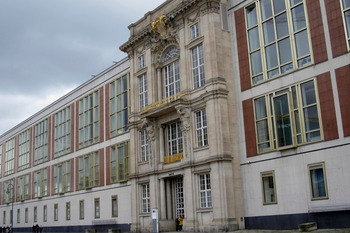
Ulbricht and the attitudes he expressed were clearly a major obstacle for preservationists in the GDR. A particular problem for them was that he seemingly wielded his powers in this domain indiscriminately. On the one hand, he toyed privately with the idea of restoring parts of the Stadtschloss elsewhere in Berlin; on the other, and ostensibly without good reason, he called personally for the destruction of Karl Friedrich Schinkel's Bauakdemie in 1956 (discussed later).Footnote 57 In discussion with Deutsche Bauakademie President Kurt Liebknecht in September 1950, only days before the first detonations on the palace walls, he affirmed that, while “the Schloss will be demolished,” the Zeughaus—the former Prussian arsenal situated just yards away from the Stadtschloss—“will be preserved in its current form” (also discussed later).Footnote 58 Ulbricht's foremost preoccupation was the transformation of old cities into new ones. For him, as Simon Ward has argued, the Stadtschloss appeared “obsolescent” in the new planning regime, redolent of an outdated urban scheme that now had no role to play.Footnote 59 Even if the building was of great artistic or historic value, it could not belong in the new socialist city if it lacked meaning for the present political purpose of the site. Over a decade later, the SED gave expression to this standpoint in a very basic way by restoring the palace's fourth portal, from which Karl Liebknecht (Kurt's uncle) had proclaimed the Free Socialist Republic during the revolution of November 1918, and by incorporating it into the State Council Building (Staatsratsgebäude), completed in 1964 at the southern end of Marx-Engels-Platz (Fig. 2).
Portal IV of the former Stadtschloss, reconstructed and incorporated into the northern facade of the State Council Building in 1964. Source: Photograph by author.

More important was what Ward terms the “ideological content” designed to fill the resulting void.Footnote 60 Here again one sees the historically rooted and transcendent political value of the site itself outweighing the inherent value of its temporary inhabitants. That the East German regime wanted the Schlossplatz to remain a site of power is suggested by some of the unrealized plans from the time. Most of these plans foresaw the construction, on the other side of the Spree to the square's eastern side, of a representative building that would outline the backdrop to the parades. One, developed by architect Richard Paulick, was clearly modeled on the Stalinist Moscow “wedding-cake” skyscraper design.Footnote 61 From 1976, of course, the Palast der Republik—the seat of the GDR's People's Chamber (Volkskammer) and a location of various cultural activities—would occupy much of the site of the former Stadtschloss, reaffirming for the remainder of the GDR's existence the square's significance as a site of public meeting and political power. This structure's distinctive bronzed glass and concrete design anchored it firmly in the fashions of the 1970s, but its purpose as the GDR's social, cultural, and political nucleus was a direct expression of the site's deeper historical meaning—a meaning that was equally apparent to planners in 1950.
Ulbricht's militant stance represented only the radical wing of what was, in reality, a broad spectrum of urban and architectural ambitions in the GDR. But variations along this line also developed chronologically, and, in this sense, attitudes toward Prussian architecture are more helpfully explained in terms of the distinct stages of the SED's historical self-conception than the whims of any individual or group. The year 1950 preceded the party's formalization of what East Germany's progressive, national culture should look like. Previously, there had been much talk about a “progressive democratic culture of the German people.”Footnote 62 But it was only in 1951 that discussion turned to the architects and eras upon which the new “German architecture,” portended in the previous year's Sixteen Principles, would be styled.Footnote 63 Berlin was, to be sure, to be planned according to the “historically evolved structure of the city,” but the lack of specificity this entailed ensured that nothing could be discounted in practice.Footnote 64 Planners active in East Berlin thus lacked cultural guidelines that would allow them to orient their treatment of the city's historical character. As an expression of these cultural-historical inconsistencies, schoolchildren continued to be taught that Andreas Schlüter was “Berlin's most significant architect” well after his masterpiece had been obliterated; in fact, Claus Back's biographical novel Andreas Schlüter, first published in 1957, was sufficiently popular to be reissued five times before 1969.Footnote 65
In their protests against the demolition of the Berlin Stadtschloss, a number of prominent German and international art historians emphasized the palace's rightful standing within the German cultural canon, exalting it as “one of the most significant creations of German architecture” and “an achievement of the German people.”Footnote 66 The SED's paeans to German culture certainly seemed hypocritical in light of the destruction, and at least one worker involved in the demolition requested a transfer to another site, claiming that he could not carry out his duties “as a good German.”Footnote 67 The protests were sent to the highest echelons of the SED, usually drawing unhelpful, evasive responses.Footnote 68 The inability of the party leadership to respond effectively to them was perhaps the most telling indicator of their cogency. The protests chiefly sought to defend the palace on two grounds: the artistic value of the structure and, employing Soviet Russia as a powerful counterexample, the lack of precedent for willful destruction. Given the ideological climate in which the protests were composed—a time when the appropriation of German culture was deemed a task of fundamental importance in view of a future national unification—these approaches represented a clear legitimizing technique designed to align with, not refute, official rhetoric.
Many protesters pointed to the case of the Moscow Kremlin, whose restoration, art historian Richard Hamann pointed out, East German newspapers celebrated “at the same time” that they coolly reported the destruction of the Stadtschloss.Footnote 69 For their part, the Soviets appear to have had little influence on the ultimate decision to demolish the palace and, as we saw with regard to Rauch's equestrian statue, fell into regular conflict with the SED on matters of preservation. When, for example, members of the Potsdam regional party leadership presented the Soviet Military Administration (SMAD) with their plans to demolish the Potsdam City Palace in 1949 (discussed later), they were met with incredulity. “Why do you want to demolish it?” came the response, “do you have a reason for this?”Footnote 70 First Lieutenant Jewgeni Lutschuweit, the Red Army's “Savior of Sanssouci,” whose efforts in April 1945 had ensured that Potsdam's most renowned cultural artifact remained unscathed by war damage, would continue to advocate the preservation of Prussian architectural heritage until his death in 1966.Footnote 71 After demolition work on the Berlin Schloss was already underway, representatives from the Soviet Control Commission (SKK) criticized the excessive focus of central Berlin planners on technical questions relating to the creation of the demonstration space at the Lustgarten, arguing that more energy should be directed toward the “representational” architectural restructuring of Unter den Linden.Footnote 72 The demolition of the city palace was clearly a decision made in Berlin.
Officials made some effort to refute the protesters’ criticisms, with the monument conservator and art historian Gerhard Strauss assigned to record and preserve for posterity key segments of this “most significant architectural monument [Baudenkmal] to German baroque art,” on the spurious basis that the “most artistically valuable” sections of the palace would be reconstructed elsewhere.Footnote 73 That this did not take place is evidence of the lack of sincerity with which the SED often treated German cultural heritage. Strauss was later recommended by the Culture Ministry for a Goethe Prize for his efforts, but he seems also to have had “private doubts” about the whole affair.Footnote 74 These may have derived from a professional standpoint: in the following months he, along with several other SED-aligned art historians who had participated in the demolition work, found themselves ostracized by their respective academic communities. In the most dramatic instance, Hamann withdrew his offer to supervise Strauss's Habilitation.Footnote 75 Reflecting on the reasons for his professional exclusion, Strauss reasoned that “the bourgeois influence in the area of art research has, in the course of the past two years, not diminished, but decisively increased.”Footnote 76 Conservation was clearly a fiercely contested political battlefield.
The manner in which the SED handled the protests demonstrates that it clearly recognized the extent to which acts of razing could be politically sensitive. Demolition work was conducted swiftly and clandestinely. “The sooner the ruin disappears from the heart of Berlin,” Otto Grotewohl told Strauss's team, “the sooner the people will be happy.”Footnote 77 But on those occasions where a public defense was advanced, the malleability of the party's defensive rhetoric suggests that it did not intend such acts to serve any explicitly didactic purpose: in other words, they were not designed to reflect a misere Geschichtsbild. Indeed, what was most striking was that the party conspicuously avoided all mention of Prussia or the Hohenzollerns in its (limited) propaganda campaign to defend the demolition. In his rationalization of the act, Strauss initially couched the structure's history in terms of “the representational need of self-centralizing Prussian absolutism,” with its demolition a “symbol of that feudal and imperial power's complete decline.”Footnote 78 For him, the interminable Berlin cycle of construction and demolition was a process of competing symbolisms, the manipulation of which was the basic prerogative of the city's ruling power. But it soon became clear that this was an unsustainable argument. A few days later, in a communication concerning the manner in which the public would be informed of the demolition, Strauss insisted that “a simple interpretation of the Schloss structure as reactionary architecture … [is] to be avoided.”Footnote 79 East Berlin mayor Friedrich Ebert's public justification for the demolition also contained no reference to Prussia or to the Hohenzollerns, but centered instead on the claim that the Stadtschloss was now “a ruin no longer capable of being reconstructed.”Footnote 80 The creation of the new was the dominant message.
Historical symbolism thus only rarely played a role in the public discussions about the palace. Seen from the perspective of the regime, the reformulation of urban space into a locus of experienced and ritualized political meaning was a process of greater symbolic importance than that of demolition. Positioning demonstration grounds in city centers, much like defining a city's odonymic character, advertised the values the socialist regime wished to instill in its population. With regard to the demolition of the palace, the “ideological virtue” lay in constructing the new, not erasing the old; the “Prussianness” of the building was only a secondary consideration.Footnote 81 Obliterating the Hohenzollern Stadtschloss was not the opening salvo, then, of a concerted attack on the historical character of central Berlin.
There is abundant evidence suggesting that the SED did not envision a comprehensive assault on the representative architecture of previous regimes. In 1952, the party resolved to house the Museum for German History in the Zeughaus in central Berlin.Footnote 82 Few buildings cast such a complex historical shadow as this one. As one of the city's primary “symbolic sites of Prusso-German militarism,” it was even said to have “helped ideologically prepare” the last war.Footnote 83 It was no surprise that much talk about the Zeughaus centered in the immediate postwar years on the possibility of its demolition. But an altogether different route was instead taken.
Party authorities had initially considered both the Zeughaus and the Alte Kommandatur (Old Commandant's House), which was located directly opposite, as potential sites for a “House of German Culture.”Footnote 84 But once the decision was made in favor of keeping the Zeughaus, there were no moves to demilitarize its external appearance. The reason for this appears to have been an explicit desire on the part of the SED to claim a symbolic victory over militarism through architectural reappropriation.Footnote 85 While opening an exhibition during the official “Karl Marx Year” of 1953, Politburo member Fred Oelszner proclaimed, “Today we open the Karl Marx exhibition in this former Zeughaus: may it serve as an outward symbol that Marxism has conquered the Hohenzollern legend.”Footnote 86 Such public displays of “grave dancing” were not restricted to political rhetoric. In 1957, the catalogue for an exhibition titled “Arms and Weapons in History” included the following statement: “In the German Democratic Republic, imperialism and militarism have been cleared away. … It is symbolic of this social revolution that the site of the present Museum for German History emerged on the site of the old Arsenal.”Footnote 87 The reappropriation of the Zeughaus was therefore a representational act of historical mastery, with the symbolism of the building itself incorporated into the historical experience the museum offered.Footnote 88 The museum's construction, two historians proclaimed in 1960, was “symbolic for the new conditions in the GDR. The old Zeughaus—the arsenal and later the Hall of Fame of Prusso-German militarism—exists no longer.”Footnote 89 Old form was thus suffused with new content. This was a distinct form of annihilation: a creative and emphatic statement of reappropriation that nevertheless permitted no misinterpretation.
If the reappropriation of the Royal Arsenal was intended to symbolize the overcoming of Prussian militarism, then the restoration of Karl Friedrich Schinkel's adjacent New Guardhouse (Neue Wache) was carried out with the express purpose of attaching GDR identity to Prussian history. Dating from the post-Napoleonic era, the Neue Wache had served both as a guardhouse for the Stadtschloss guards and as a memorial to the Wars of Liberation.Footnote 90 In the late 1940s, leaders of the Free German Youth (FDJ), supported by figures in the East Berlin Magistrat, had advocated the structure's demolition.Footnote 91 Yet, in 1950, the Magistrat decided in favor of its restoration as a “memorial for the victims of imperialist wars.”Footnote 92 Its purpose changed again, however, this time in keeping with the SED's attempts to endow its “antifascist” struggle with deeper progressive roots. Refashioned in 1960 as a monument to the “victims of fascism and militarism,” the Neue Wache now came to symbolize a direct historical continuity between the liberation heroes for whom it was originally constructed and the antifascist fighters of the present day.Footnote 93
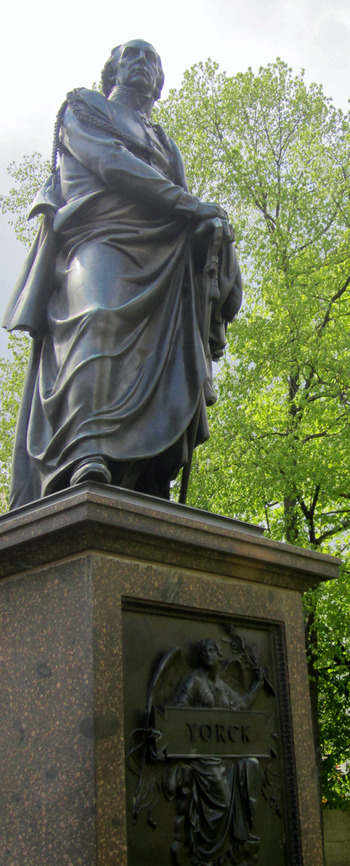
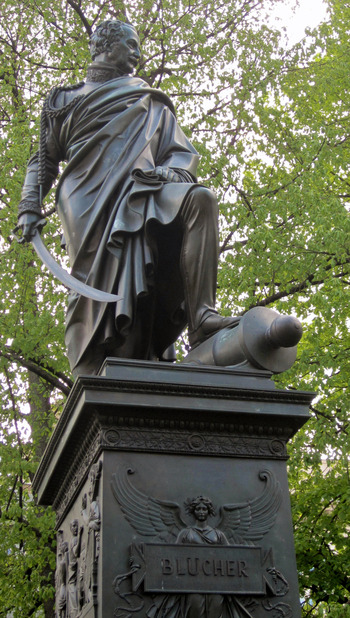
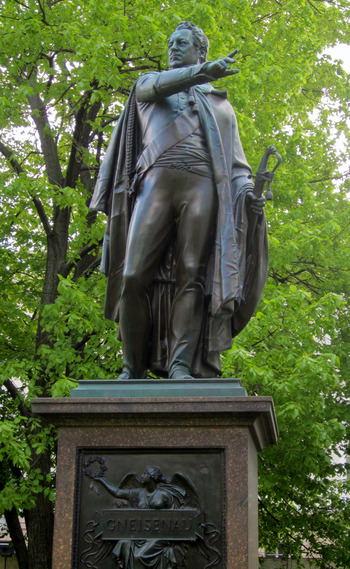
In this way, the symbolic manipulation of the Neue Wache reflected broader patterns in the GDR's Geschichtspolitik. In particular, its timeline mirrors that of the commemorative practices relating to the Prussian generals who had fought against Napoleon. In the years following the Wars of Liberation, Christian Daniel Rauch's statues of Gerhard von Scharnhorst and Friedrich Wilhelm Bülow von Dennewitz were erected outside or near the New Guardhouse and Frederick the Great's nearby cultural forum (the Forum Fredericianum).Footnote 94 These were removed in 1950 in an act that went unremarked in the GDR press.Footnote 95 Removed also were neighboring statues of Ludwig Yorck von Wartenburg, August Neidhardt von Gneisenau, and Gebhard Leberecht von Blücher; at the end of May 1951, streets bearing reference to the latter three were renamed as well.Footnote 96 It was announced in 1961, however, that the statues would be re-erected near their original sites (Figs. 3, 4, 5).Footnote 97
Christian Daniel Rauch's statue of Ludwig Yorck von Wartenburg (1855) in the Prinzessinnengarten, Unter den Linden. Source: Photograph by author.

Christian Daniel Rauch's statue of Gebhard Leberecht von Blücher (1826) in the Prinzessinnengarten, Unter den Linden. Source: Photograph by author.

Christian Daniel Rauch's statue of August Neidhardt von Gneisenau (1855) in the Prinzessinnengarten, Unter den Linden. Source: Photograph by author.

Historical reappropriation was, in fact, the most common approach the SED adopted with regard to questions of Prussian architecture. The Haus der Abgeordneten (House of Representatives) building, which had been the middle chamber of the Prussian parliament during the imperial era, was restored by the Soviets and used in the GDR as the seat of the Council of Ministers (Ministerrat); communications within the Ministry for Reconstruction referred to Pankow, the northern district in which the SED elite was housed, as the “former little military town,” presumably in reference to the popularity of the baroque Schloss Schönhausen, the birthplace of Otto von Bismarck, among eighteenth-century Prussian monarchs.Footnote 98 The Schönhausen palace itself was indeed utilized as the official residence of President Wilhelm Pieck until his death in 1960. In 1956, it had been announced that the Brandenburg Gate—the most famous of all Prussian structures—would be restored as a “gate of peace.”Footnote 99 With its adorning Quadriga stripped of its Prussian eagle and iron cross, the gate served until 1961 as a popular national symbol that was commemorated on a postage stamp in 1958.Footnote 100 Its restoration was promoted as a rekindling of the symbol's “original purpose.”Footnote 101 As deputy mayor Waldemar Schmidt explained, “the trophies that the charioteer bore were originally emblems of peace. The Prussian-Junker reaction and the later German imperialism cared little for the thoughts of [its designers]. The Brandenburg Gate often became … a hotbed for militarists and chauvinists.”Footnote 102
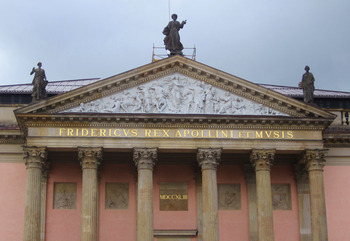
The party's leaders hereby portrayed the regime as a guarantor of Prussian cultural heritage that the Hohenzollern state never had been. As part of its post-1952 attempts to tap into German national traditions, the SED exalted certain cultural artifacts, which included many that had served the Prussian state, as well as distinctly royal structures. A 1955 postage stamp series commemorating “historical buildings of the GDR” included the State Opera in Berlin, alongside the likes of the Dresden Zwinger and the Magdeburg cathedral.Footnote 103 The State Opera was an interesting case. Its restoration was indicative, as Neues Deutschland wrote, of “what resources the GDR is prepared to invest when it comes to reconstructing that which is historically valuable.”Footnote 104 Indeed, its reconstruction was never in question. But according to Kurt Liebknecht, some doubts emerged about the inscription on the structure's pediment: Fridericus Rex Appollini et Musis (King Frederick, to Apollo and the Muses). “We were of the opinion,” he later reflected, “that [Hans Georg Wenzeslaus von] Knobelsdorff's masterwork had been abused by this obeisance to the Prussian absolutism of Friedrich II” (Fig. 6).Footnote 105
Pediment of Staatsoper, Unter den Linden. The inscription reappeared in 1986. Source: Photograph by author.

This is not to say that the Stadtschloss, in being demolished, was the exception to a general program of preservation. Yet, ostensibly similar razings usually derived from case-specific rationales, blunting any notion of an anti-Prussian iconoclastic hysteria. For instance, the fate of Schloss Schönhausen seems to have been determined, above all, by its dilapidated condition: it had been used as a retirement home for some time after 1945, before falling into a state of disrepair.Footnote 106 Some contemporary observers saw this as yet another manifestation of anti-Prussian razing.Footnote 107 But, when it fell in 1958, conservators offered little resistance.Footnote 108
The one other supposed instance of anti-Prussian razing in East Berlin—that of Schinkel's Bauakademie—also emphatically demonstrates the essential power of urban planning regimes in determining a building's fate. One of Schinkel's final masterpieces, the Bauakademie's frugal, red-brick, industrial design ensured that it stood as anything but a symbol of Prussian royal power. (Indeed, Kaiser Wilhelm II was alleged to have demanded, “the red box must go!”Footnote 109 ) To the contrary, its “radical” and “forward-thinking” design aligned ideally with the progressive focus of the SED's reigning cultural policy in the early 1950s.Footnote 110 At the founding of the Deutsche Bauakademie in December 1951, Ulbricht even proclaimed, “may the reconstruction of the destroyed Schinkel building … symbolize both the high esteem in which we hold the achievements of the masters of German architecture and the strength of our will to advance our architecture creatively even further.”Footnote 111
Despite having been burned out completely during the war, the outer walls of the Bauakademie remained more or less preserved, and early plans foresaw the building as a seat for the Ministry for Reconstruction.Footnote 112 In the early 1950s, the ministry, alongside the Deutsche Bauakademie itself, invested heavily in the building's upkeep, and, in 1951, “the great heritage of Schinkel,” including the Bauakademie, was commemorated in connection with the master architect's 170th birthday.Footnote 113 Indeed, the neoclassical character of East German socialist realist architecture owed more to Schinkel than to any other architect.Footnote 114 But the situation began to change in late 1954.Footnote 115 Renovation work stopped temporarily that year owing to a lack of funds, yet political attitudes changed as well.Footnote 116 In a private conversation with the architects Liebknecht and Edmund Collein in 1956, Ulbricht intimated that it would likely be necessary to demolish the building “for the future arrangement of the west side of the Marx-Engels-Platz.”Footnote 117 Liebknecht petitioned the (now) First Secretary on the matter, arguing that “neither the people of Berlin nor the experts would fathom a demolition.” Referring to a previous conversation with Hermann Henselmann, the head architect of East Berlin, Liebknecht argued furthermore that future plans for the Marx-Engels-Platz could readily incorporate the structure without any disruption to the harmony of the site.Footnote 118 Yet, Ulbricht's formulaic reply stated simply that the means would not be available “for the coming years.”Footnote 119 In March 1960, the Section for Fine Arts at the Ministry for Culture again advocated the building's integration into the “new ensemble,” arguing that it represented “the needs and ideas of the humanistically educated bourgeoisie—the progressive stratum of the early nineteenth century.”Footnote 120 But the petition was in vain: the building was demolished in 1962, and on its site was built the new Foreign Ministry.
In contrast to Simone Hain's claim that the Bauakademie was demolished primarily at the personal whim of Paul Verner, who, as First Secretary of the SED's Berlin district, bore a “personal aversion … to Prussian barracks buildings,” Jörg Kirchner argues that the Bauakademie was ultimately demolished as a result of a “fundamental ideological shift” in GDR cultural policy more broadly.Footnote 121 With the demise of a focus on “national architectures” across the Eastern Bloc following Stalin's death in 1953, Schinkel and his brand of Prussian neoclassicism fell from political favor.Footnote 122 It was not that the symbolism and pedigree of his building suddenly became odious, but rather that, in a transformed ideological climate, it also became “obsolescent.” Like the Stadtschloss, Schinkel's Bauakademie was a work of profound historical and artistic importance, but, as demonstrated by the change in official attitudes during the 1950s, this counted for little if it lacked cultural and political relevance. In political conditions where history possessed value only insofar as it conferred meaning upon the present, “heritage value” was not in itself sufficient to rescue a structure threatened by the wrecking ball.
The Prussian Architectural Legacy in Potsdam
If Berlin was associated in most minds with Prussian royal power, then Prussian militarism was synonymous with Potsdam. The residence city of Frederick the Great, famed for its parade plazas, gardens, and handsome baroque, rococo, and neoclassical architectural medleys, had lent its name to the “Spirit of Potsdam”: the militaristic character that had so typified the Prussian state. It, too, was subject to an intense bombardment by the Royal Air Force (RAF) in 1945. The attack on the evening of April 14 destroyed or extensively damaged some 80 percent of the city's dwellings and 45 percent of the historical inner city.Footnote 123 In an act long celebrated in GDR propaganda, the Red Army immediately set about restoring Frederick the Great's renowned Sanssouci palace and garden complex. “Sanssouci is a national shrine,” wrote Neue Zeit in March 1951, proudly declaring, “everything that recalls Friedrich II was protected by the [Soviet] Occupation Authority.”Footnote 124 A 1953 history textbook later informed students that “Friedrich II deployed money, material, and labor in Sanssouci without consideration for the plight of the people. Thus arose there a particularly beautiful area that today finally belongs to the people.”Footnote 125 Within the Sanssouci palace, there was even a room dedicated to honor the “Savior of Sanssouci,” Jewgeni Lutschuweit.
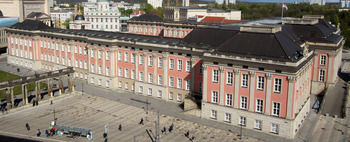
As in Berlin, the postwar political authorities were attuned to Potsdam's symbolic importance. Talk of demolishing key structures as “refuge[s] of Prussian militarism” was commonplace in 1946.Footnote 126 Attention naturally turned to the ruins of the city palace. Erected in 1662, but rebuilt by the legendary baroque architect Hans Georg Wenzeslaus von Knobelsdorff in the mid-eighteenth century, the palace of Potsdam, like the palace of Berlin, developed into the central structure of the city's urban constitution (Fig. 7).Footnote 127 Its fate accordingly hinged upon the urban scheme the city's new leaders would impart to it. For reasons that will be discussed later, the development of such a scheme was delayed in Potsdam's case, however, and the future of its Stadtschloss was ultimately determined by a very different phase of the GDR's urban fashions from the one that sealed the fate of its counterpart in Berlin.
Reconstructed Stadtschloss in Potsdam. Source: Photograph by author.

A submission by Schloss opponents to a January 1949 meeting of regional administrators reflected the anti-Prussian language characteristic of the immediate postwar years. Directly attacking the symbolism of the structure, the submission recommended demolishing the Stadtschloss on January 30—sixteen years to the day since Hitler's ascension to the chancellorship.Footnote 128 That same month, Peter Scheib, a representative of the SED's “Operation Group” in the Brandenburg government, published an open letter to SED Potsdam mayor Walter Paul in the Märkische Volksstimme, the party's regional organ. Scheib's letter laid bare the imperative of erasing from Potsdam's urban fabric all damaged Hohenzollern relics.Footnote 129 Yet, when Paul penned a response to the same newspaper defending the Schloss's preservation, he unwittingly exposed a deep schism between the region's leading party figures. Analyzing the situation, the Brandenburg Party Control Committee noted that the prospect of demolition had “incited a public struggle” within the SED itself.Footnote 130
Paul's argument itself was not particularly controversial. Potsdam, he wrote, “possessed, like all other cities in Europe, architectural works of art that ought to remain preserved because of their artistic value and not because of their former occupants.”Footnote 131 The problem was that, within the SED, it was Scheib's view that represented the “majority of our party.”Footnote 132 As such, the Volksstimme refused to publish Paul's letter because of fears that he “would compromise himself” and “present our party in an unfavorable light.”Footnote 133 Gerhard Strauss, then working for the Central Administration for People's Education (Deutsche Verwaltung für Volksbildung, or DVV), was obliged to intervene.Footnote 134 In a hastily composed letter to Scheib, Strauss cautioned against recklessness in such sensitive cultural matters. While acknowledging that a full reconstruction was out of the question “for ideological and … economic reasons,” Strauss affirmed that “today it still cannot be decided whether, in the context of the overall planning of Potsdam, the Stadtschloss must fall or, preferably, be preserved.”Footnote 135 In other words, no decision could be reached without due weight accorded to longer-term considerations: “when one asks … whether the destruction of the Stadtschloss is necessary,” he continued, “then one must count on the fact that the next generation will perhaps understand our action, but not endorse it, and I believe that that, too, must today be taken into account.”Footnote 136
The risk of exposing party division was thus exacerbated by a distinct lack of clarity more generally with regard to Potsdam's reconstruction. Suggestions for the Schloss's preservation included transforming the structure into a house of art or a college, or incorporating it into a new congress hall.Footnote 137 But the discussion was eventually terminated because neither advocates nor opponents of demolition could articulate a longer-term vision for the site in the absence of a more encompassing planning rationale for central Potsdam.Footnote 138 Regardless of the ideological zeal of local party figures, such a plan remained the necessary precondition for any demolition. As Strauss put it in a decisive meeting in May 1949, “no urgent necessity for a demolition currently exists.”Footnote 139 Brandenburg Minister of People's Education Fritz Rücker concurred, concluding that “in the absence of any urgent need for a demolition, the Stadtschloss should remain preserved as a cultural-historical substance [kulturhistorische Substanz].”Footnote 140 Most significant, however, the Soviet Military Administration terminated the discussions in 1949 because, as later recalled by Erich Reimer of the district party leadership (Bezirksleitung), “through it we [would] unnecessarily divert energies away from the main task, the commencement of the two-year plan”.Footnote 141 With the DVV and Soviets opposed to an immediate demolition, and with no encompassing urban plan within which a demolition would make sense, all moves in this direction were put on hold indefinitely, until the decision to demolish the palace was eventually reached in 1959.
In the eyes of the Schloss's most fervent opponents, the need to develop a comprehensive plan merely encouraged the attitudes of the conservators. For the opponents, the conservators were not, as they themselves claimed, acting on behalf of the party's own guidelines and strictures on cultural preservation—they were reactionary figures, determined to prevent the construction of a new Potsdam. It is true that most conservators in the GDR, whether aligned with the SED or not, saw no need to demolish the Potsdam Stadtschloss. But the attitude expressed against them by some party leaders approached a level of paranoia. In October 1957, for instance, Collein, in his capacity as construction advisor to the Council of Ministers, wrote to the district (Bezirk) council chairman Herbert Rutschke to suggest a temporary suspension of work on the Lange Brücke and other areas around the Stadtschloss.Footnote 142 A clearly infuriated Rutschke quickly called a meeting of local party leaders, where it was argued that Collein's advice had been “influenced by people who consider, from a misunderstood notion of monument conservation, the preservation of ruins in the city center to be more important … than finding a sensible solution” to the city's planning needs.Footnote 143 The chief target was a certain Czechowsky, the former head architect for city and town planning at the Bezirk council, who had very recently fled to the West. Czechowsky had indeed been one of the most vocal critics of a new traffic plan for Potsdam, but, because of his opposition, he was now vilified as “one of the most zealous representatives of reactionary city planning.”Footnote 144
According to Erich Reimer, the Schloss had only survived the year 1949 on the basis of reports authored and influenced by conservators and politicians hostile to the party, in a process that was now being repeated ten years later.Footnote 145 Like many of his comrades, Reimer was palpably frustrated at “how little [Potsdam] had progressed” in planning matters over the intervening decade.Footnote 146 By the time plans for a new Potsdam finally began to take shape, other local SED authorities protested that, in terms of urban development, “there probably is not a Bezirk capital in the whole republic that has been as neglected as Potsdam.”Footnote 147
The interim ten years witnessed a number of profound changes in urban planning practice in East Germany, each of which had a clear impact on efforts toward demolishing the Potsdam Stadtschloss. In questions of destruction, the establishment of the GDR in October 1949 portended a distinct shift in rhetoric, first to one of uncertainty, and then, in the context of the new “national historiography” that began in 1952, to one of explicit caution. In 1950, with the adoption of the Sixteen Principles of Urbanism, Potsdam was considered only a secondary reconstruction priority.Footnote 148 All talk of an urban reformulation of the city's historic center was postponed, leaving the question of the palace's demolition lingering for nearly a decade. A state of ambiguity prevailed during this period. Throughout the 1950s, East German newspapers still carried stories proclaiming the preservation of the palace in a yet-to-be-determined capacity.Footnote 149 An advisory council for questions of construction suggested to the GDR Council of Ministers in November 1956 that the Stadtschloss be preserved as a ruin—a suggestion in turn correlating with proposals put forward in a new “city composition plan”—while SED members of the Cultural Association of the GDR (Kulturbund der DDR) continued to advocate privately the preservation of the structure as a museum.Footnote 150 In September 1958, Erich Wendt of the Ministry for Culture, writing on behalf of Minister Alexander Abusch, reaffirmed to the Bezirk leadership his ministry's support for reconstruction, emphasizing the SED's commitment at its Fifth Party Conference in July of that year to the “cultivation of our cultural heritage.”Footnote 151 Abusch himself, who had gone to some effort to familiarize himself with details of conservation practices in the Soviet Union, cautioned against any rash actions.Footnote 152 Even in March 1959, at the final Bezirksleitung meeting before the final demolition plans were submitted to the Politburo, representatives from the Ministry of Culture and the Ministry of Reconstruction continued to stress their support for a restoration.Footnote 153
The Bezirksleitung remained steadfast, however. First Secretary Kurt Seibt concluded the March 1959 meeting by falsely conciliating those present who opposed demolition: “We will say to the Politburo candidly that there are other views about the reconstruction of the palace.”Footnote 154 Yet, his words were intentionally misleading, designed to neutralize possible threats from pro-Schloss advocates in Berlin. The Potsdam Bezirk leadership was the true driving force behind the plans, but often found itself in opposition to senior figures in both the civil and party administrations. Perhaps fearing an overruling from above, as in 1949, the Potsdam party leadership thus kept its plans concealed until the last possible minute. Liebknecht discovered the details of the Bezirk's final plans only “on the way to Potsdam” for a decisive meeting in January 1959.Footnote 155 Aware that demolition work could not begin before confirmation by the Politburo, the Bezirk leadership sought to ensure that “no official opinion about it will be disclosed to the public” before such confirmation was received.Footnote 156
Likely owing to lessons learned from the Berlin experience nine years earlier, there was a widespread recognition that demolition could create an acutely damaging public impression. In a discussion convened in November 1958 with the express purpose of developing “a common standpoint on some controversial questions” regarding Potsdam's reconstruction, leading figures from the Ministry of Culture considered the demolition's implications for “foreign and all-German questions.” They concluded that such issues required a “carefully thought-out decision and argumentation.”Footnote 157 For his part, Liebknecht cautioned against any plan for Potsdam that sought a comprehensive imposition of the modern, given that “wide circles not only in Germany, but also overseas,” took a keen interest in Potsdam's historical significance. It was important, he reasoned, “not to acquire the reputation of being cultural barbarians.”Footnote 158 But this appeal was also in vain. As soon as the decision became public knowledge, petitions and protests flooded in from all over Germany. A West German push to present the issue to “an international forum in the presence of UNESCO representatives” was “prevented only by chance.”Footnote 159
It was clear also that the demolition defied the wishes of many Potsdam residents. This was made evident at an exhibition held during April and May 1951, titled “Potsdam Plans Its Reconstruction,” at which a series of plans developed by the Ministry for Reconstruction was presented to the public. The plans, which reflected the deep ambiguity that characterized the SED's attitudes toward historical architecture in these years, demonstrated that the fate of Potsdam's Prussian architectural heritage remained undetermined: some plans, for instance, retained the Stadtschloss in its entirety; others did not.Footnote 160 But the exhibition also issued a questionnaire to visitors, inviting them to adjudicate on their preferred proposal and offering prize rewards for the top suggestions. An overwhelming number of the 103 respondents favored a plan containing both a preserved city palace and a demonstration space west of the Nikolaikirche.Footnote 161
The survey also contained space for written answers to questions such as “how do you feel about the preservation of architectural monuments, for instance, the Stadtschloss, the Town Hall, etc.?” or “on which architectural monuments do you place no value and on what basis?”Footnote 162 The preservation of the Stadtschloss was favored—either explicitly or as indicated by the respondents’ preferred proposal—by seventy-eight participants, with only twenty-four supporting its demolition.Footnote 163 Some advocates of demolition advanced a distinctly anti-Prussian argument, questioning the use of “a rebuilt Hohenzollern palace” when what was really needed was “a beautiful new building that … is a cultural monument of our time.” Or, as another wrote, “The Stadtschloss recalls the military era too much.”Footnote 164 Describing the Stadtschloss and Garnisonkirche as “recollection[s] of a bad tradition,” others argued that their demolitions were necessary to “do away with the Prussian past.”Footnote 165 Yet, many more respondents were indignant at the very suggestion of demolition. “The preservation of all architectural monuments,” wrote one, “is unconditionally important!”Footnote 166 These sentiments did not derive, of course, simply from the unreflected “reactionary” attitudes of their authors, as party leaders were wont to claim. Given that other, less explicitly “Prussian” structures generated comparable levels of support, the responses did not indicate any particular affinity for Prussian relics specifically, but rather a much more general sympathy toward works of historical and cultural value.Footnote 167
Admittedly, this represented only a tiny sample. But the responses provide some of the best available insights into the meaning of the Prussian architectural legacy to GDR citizens at the time. That public opinions were entreated in the first place indeed indicates a markedly different approach to cultural heritage from that evident in Berlin during 1950, when individuals within the Ministry for Construction (Ministerium für Bauwesen) had claimed that “the population of Berlin has no special relationship with the Schloss and thus has, as a whole, hardly discussed the demolition.”Footnote 168 The Potsdam SED district leaders’ meeting of November 18, 1958, from which emerged the draft resolution submitted to the Central Committee for the Stadtschloss's demolition, dedicated much attention to public attitudes. An attendee from the Ministry for Construction remarked that support for reconstructing the palace was “so widespread” that it would be necessary to establish in the public's mind the inevitability of the palace's demise “without initiating a discussion.” This would entail demonstrating, above all, the value of the “socialist center” that would replace it.Footnote 169 Indeed, there was a pervasive optimism within the local SED that the realization of the new plans would enjoy the “agreement of the population” and foster trust between it and the party.Footnote 170 Alongside the recognition that this decision would be deeply unpopular persisted a quixotic confidence that the people of Potsdam would ultimately come to embrace the new, if only they were given the chance to see it.Footnote 171
How, then, was the new Potsdam to appear? The city would not fall back on its prewar urban scheme; this much was certain. But it nevertheless took until 1957 for agreement on the imposition of a “socialist center” in Potsdam to be reached.Footnote 172 The contours of the new approach found expression in the slogan “better, cheaper, and faster,” formalized into a comprehensive program at the Fifth Party Conference of the SED in 1958.Footnote 173 This marked a break with the monumentalism of the Stalin era and heralded a functional age in East German planning, in which industrial and material needs were given immediate priority. The emphasis was now on “wide streets, large squares, broad green spaces, harmonious architectural ensembles, opportunities for social, cultural and sporting activity, as well as for recreation, architectural apexes at the social centers [and] dominant structures that demonstrate the power of the socialist social order.”Footnote 174 These ambitions manifested themselves differently in various cities, but one common factor was immediately apparent: preservation and heritage would now play a diminished role.
The development of a total conception was significant because, as in Berlin in 1950, the Politburo's decision to demolish the Schloss concerned, in fact, only one section of a much broader resolution on urban reconstruction.Footnote 175 As such, it was also the basis on which the Bezirk leadership offered its public defense of demolition. Despite “scrupulous and exhaustive” efforts, it argued, it had proved impossible to “integrate the remains of the former Stadtschloss into the reconstruction,” a result of the “high degree of destruction.” Furthermore, a “reconstruction of the Stadtschloss would consume great resources without adding anything essential for the cultural life of the people.”Footnote 176 These arguments were patently bogus: assessments conducted during the previous decade had determined that between 75 and 83 percent of the external structure was preserved and reusable.Footnote 177 These evaluations exposed, in turn, the hollowness of Seibt's justificatory claim that if “the Statdtschloss had been intact, if 80 percent were now still standing, then we would have rebuilt it.”Footnote 178
The Potsdam SED sought also to claim a democratic mandate for the demolition, maintaining that “the population of Potsdam,” despite its admiration of “the generous maintenance of the existing historical cultural monuments” hitherto exercised by the state, rejected a reconstruction in the belief that the money would be better spent on “housing and cultural facilities.”Footnote 179 In a critical meeting of the Bezirk leadership in January 1959, the secretary for People's Education and Culture questioned whether “agonizing over an eyesore for fifteen years” could be justified “before the eyes of the international world … while the workers are not given that to which they are entitled?” Seibt concluded the meeting on a similar tone: “We are not iconoclasts … We do not want to tear it down because we do not like it … Why should we reconstruct something that costs us so much money? I cannot justify it to the workers. But we will have to justify it.”Footnote 180
Frustratingly for the SED, however, several people contested the manner in which the local party authorities had arrogated to themselves such a mandate. Among these were the architects and engineers from the C Brigade of the state-owned “Construction Project Planning Potsdam” (VEB Hochbauprojektierung Potsdam), who, in late 1959, delivered a protest telegram to the district council, to President Pieck, and to Liebknecht.Footnote 181 District council chairman Herbert Rutschke met with the renegades for a “discussion” (Aussprache) on November 19. Yet, while the crux of the matter was the demolition itself, the discussion came to center on democratic rights and the sense of exclusion rampant among architects and conservators. “Why do you reject all discussion about various problems?” one asked Rutschke. “We feel we have been bypassed.”Footnote 182 Rutschke unhelpfully responded with a lecture about the principles of democratic centralism. Expressing a frustration with conservators reminiscent of that of Ulbricht himself, the chairman complained that, contrary to claims of supposed marginalization, the enduring discussions about the fate of the Stadtschloss had, in fact, impeded the construction of Potsdam's “new center.”Footnote 183
Despite the palpable determination of anti-Schloss voices in the Potsdam region, demolition was nevertheless reached only via a tortuous path. Any scholarly explanation for the demolition resting only on the premise of an explicit and unchanging ideological intent on the part of the party is therefore clearly insufficient. Following the intervention of the DVV and the SMAD in 1949, the next set of hurdles came in 1952. This was a critical year in the view of conservator Friedrich Mielke, who later fled the GDR in 1958. The abolition of the federal states (Länder) and the subsequent formation of administrative districts (Bezirke) had demanded a new hierarchy of urban symbolism. Yet, the question of what a “socialist district capital must look like,” Friedrich Mielke claims, remained unresolved, with the search for a specific answer lasting another several years.Footnote 184
But the year 1952 was not only significant for the administrative changes it witnessed. It was also important at the level of Geschichtspolitik, for 1952 was also the year in which the GDR officially turned to its “national historiography,” translated into architectural practice through the “Decree on the Preservation and Conservation of National Cultural Monuments.”Footnote 185 Schoolbook histories acclaimed Knobelsdorff as a cultural icon of his era, with his work on the Potsdam Stadtschloss warranting special praise.Footnote 186 Here again, the uneasy coexistence within the regime's rhetoric of “positive” and “negative” strands of German history was evident. Neues Deutschland counseled its readers not to allow any “uncertainty” about the royal symbolism of Prussian structures to detract from their “beauty,” while Arno Rattay's history of Potsdam in the Berliner Zeitung affirmed that the “end of the Prussian spirit of servility” heralded by 1945 did not signify “the end of a city within whose walls the brilliant creative mastery of great German architects” was ever-present.Footnote 187 This state-sponsored emphasis on German artistic achievement played a key role in prolonging the discussions about Prussian architecture in the new Potsdam.
The indulgence in national culture ended in the late 1950s, however, with the importation of a new planning regime unveiled by Nikita Khrushchev in the Soviet Union. This phase was less concerned with the selective restoration of cultural heritage than with the “new”—i.e., with that which could be identified as “progressive” and “socialist.”Footnote 188 Gone were the monumentality and “historicity” of socialist realism, replaced by the blander (and more economical) modernist creations and Plattenbauten characteristic of the post-Stalin era. Conservators vainly continued to point to the validity of the 1952 decree.Footnote 189 Within this new scheme, Christina Emmerich-Focke argues, there could be no chance of Potsdam becoming a “Prussian Museum.”Footnote 190 As the Potsdam Council put it with regard to the Stadtschloss, such emblems of “reactionary Prussianism” had no place “under the new conditions of socialist development.”Footnote 191 The “new” would need to replace the old if a legitimately “socialist city center” were to emerge.Footnote 192 The era of reappropriation was over.
It is possible here to trace a distinct change in the language of propaganda from that concerning the Berlin Stadtschloss's demolition in 1950. Following the demolition resolution in November 1959, Neues Deutschland wrote of the wanton destruction wreaked by “American aerial bombardments,” and reminded its readers not only that “the spirit of Prusso-German militarism [had] ruled in Potsdam, but also that humanistic artists had produced buildings of … immortal beauty.”Footnote 193 To this category belonged the city palace, the destruction of which was reported as “a painful loss” occasioned by damage suffered during the war.Footnote 194 Ten years had obviously taught the regime a great deal: when the order was given to demolish the Berlin Stadtschloss in 1950, there had been no such lamentations in the GDR press. The obvious inference here is that the SED had become progressively less confident in its capacity to construct an urban identity without in some way—however unfaithfully—engaging its citizens. We have already seen how party figures clung to the hope that the benefits of the new Potsdam would ultimately outweigh any emotional attachment to the Stadtschloss, with the Bezirk leadership justifying the decision in their Politburo submission by referring to the wishes of the population.Footnote 195 Manipulative and dishonest though these proclamations may have been, they do at least convey the realization that the clandestine removal of architectural heritage was no longer a feasible cultural-political strategy.
Conclusions
The picture that emerges from these case studies is a considerably more complex one than that offered by a crude, “anti-Prussian” ideological reading. Within the Soviet-inspired cultural contours of East Germany, the treatment of memory sites considered in any way Prussian varied substantially over time. This ranged from outright rhetorical attacks in 1945–1946, to an emphasis upon their national cultural significance from 1952 onward, followed by a perception of incongruence in the face of the “new” from the late 1950s. During each of these stages, of course, differing opinions and much inconsistency arose. But the historical management of Prussian artifacts in Berlin and Potsdam did, in general, follow the parameters of the SED's approach to German history more generally. In urban spaces, consequently, the explanatory framework of razing cannot alone suffice, for, as of 1949, the importance of constructing an ideologically driven identity in a Cold War climate, with an attendant canon of cultural and artistic icons, completely altered the political attitudes underlying architectural and urban policy. In short, one must bear in mind that the substance of the SED's “historical consciousness” remained fluid in these early years and was particularly susceptible to changes in the wider political world.
It is also significant that the Prussianness of these structures was less detrimental to their fates than might be assumed from much commentary on the GDR's early Preußenbild. When it concerned the fate of historic buildings, all symbols of previous power regimes lacking an explicit purpose in the new regime were at some risk. Indeed, on the part of many conservators, there did not seem to be a sense that demolitions were in any way targeted. Conservators in Dresden, for instance, feared in 1958 “that similar plans exist for the destruction of the Dresden Schloss as for the Stadtschloss of Potsdam.”Footnote 196 The city's SED mayor, Walter Weidauer, displayed a notorious indifference to Dresden's cultural heritage, and during the late 1950s followed Ulbricht steadfastly in the pursuit of a full socialist reconstruction.Footnote 197 The parallel is important because Saxon history was never comparable to Prussia as a source of controversy in the GDR during this time. Madeleine Brook, for example, draws an intriguing contrast between popular representations of Frederick the Great and August the Strong, arguing that the Saxon elector was a figure of some ambiguity during the 1950s, portrayed popularly in both positive and negative lights.Footnote 198
Even more zealous than their comrades in Dresden were the local authorities in Mecklenburg. As Brian Campbell has remarked, this region was especially vulnerable to “the worst vulgar Marxism” and bred a philistine approach to conservation that manifested itself in the demolition of such structures as St. Jacob's Church in Rostock, St. Mary's Church in Wismar, and the Putbus Palace on Rügen in the late 1950s and early 1960s.Footnote 199 The latter case is of particular interest. A former noble home, the palace fell into a state of disrepair after World War II. Yet, the path toward its eventual demolition was obscure. In the view of the author of a critical contemporary report, the impulse to demolish derived above all from a “justified hatred of the class enemy.”Footnote 200 The patent falsity of the Bezirk's rationalizations made this clear: Max Kotzian, the Rostock Bezirk deputy chairman, had pushed for demolition by arguing that the structure had succumbed to “wall cancer”—a condition, the report noted, that did not exist within professional discourses.Footnote 201 As Campbell concludes, “it is clear that the palace's demolition had less to do with costs or usefulness; rather it was an attempt by Rostock regional officials to do away with the island's imperial history.”Footnote 202 A similar story unfolded in the Erfurt Bezirk with regard to Schinkel's theater in Gotha, demolished at the behest of the Bezirk leadership in 1958 despite strong criticisms about the process from representatives of the state Ministries for Culture and Construction.Footnote 203 The differences in approach among regions demonstrate that attitudes toward heritage often had less to do with ideological impulses radiating from Berlin than with the initiatives of local party authorities and the conservators who routinely opposed them. We have seen how the impetus for the demolition of the Potsdam Stadtschloss derived from the local party branch, often in opposition to voices in the capital. This was a typical pattern throughout the era.Footnote 204
It is thus possible to draw three conclusions on the subject of the urban Prussian legacy in the early years of the GDR. First, the desire to demolish Prussian sites based solely on their symbolism was greater—and certainly more public—in the immediate postwar months than at any later stage. Second, the SED would not, as a rule, demolish structures that had already been restored under the Soviet Military Occupation authorities. And third, acts of demolition cannot directly be traced to any distinct “Prussia policy” on the part of the SED. Prussian residues in urban spaces were not only odious symbols demanding obliteration but symbolic opportunities for demonstrating the cultural outlook of the new regime and the historical narrative into which it placed itself. These debates did not concern Prussia itself, but rather reflected the tenuous reciprocity of old and new in generating legitimacy for the SED through its political culture.