INTRODUCTION
Thrips tabaci Lindeman (Thysanoptera: Thripidae), the onion thrips, is a cosmopolitan pest species causing severe losses in many protected as well as in field crops such as onion, leek, cotton, cabbage and various ornamentals (Jenser & Szénási Reference Jenser and Szénási2004). Adults and immature stages of this polyphagous thrips species both feed on plant tissue by penetrating plant cells and sucking out the cell sap. Damaged areas of plant tissue develop into desiccated and discoloured spots (Kahrer & Gross Reference Kahrer and Gross2002).
The conventional view in Pisum sativum L. crops is that the onion thrips is not a pest problem, although it was recently found to be one of the most abundant thrips species in edible pea cultivars for the production of fresh (green) seeds in Europe (Wnuk & Pobożniak Reference Wnuk and Pobożniak2003; Pobożniak Reference Pobożniak2011). Feeding damage of T. tabaci on pea was previously described by von Oettingen (Reference Von Oettingen1951), and Pobożniak (Reference Pobożniak2011) observed onion thrips feeding on pea leaves as well as on flowers and young pea pods resulting in white and brown spots on the pea pods. Pobożniak (Reference Pobożniak2011) investigated the species composition of Thysanoptera on food legume crops in the field and significant differences in numbers of T. tabaci larvae and adults on different pea cultivars were recorded. The reasons were suggested to be differences in the maturity group, i.e. in the length of the growing season between the pea cultivars (Wnuk & Pobożniak Reference Wnuk and Pobożniak2003), or biochemical or morphological differences (Brodbeck et al. Reference Brodbeck, Stavisky, Funderburk, Andersen and Olson2001; Riefler & Koschier Reference Riefler and Koschier2009). Whether feeding preferences of thrips are determined by nutritional factors, i.e. primary metabolites such as nitrogen (N) and carbohydrates, or by secondary compounds in their host plants is not yet entirely known (Ananthakrishnan & Gopichandran Reference Ananthakrishnan and Gopichandran1993; Mollema & Cole Reference Mollema and Cole1996; Brodbeck et al. Reference Brodbeck, Stavisky, Funderburk, Andersen and Olson2001; Scott Brown et al. Reference Scott Brown, Simmonds and Blaney2002; Žnidarčič et al. Reference Žnidarčič, Vidrih, Germ, Ban and Trdan2007). While the results of several fertilization experiments examining the influence of the N content in different host plants of T. tabaci differ (Wiedenfeld et al. Reference Wiedenfeld, Scully, Miller, Edelson and Wang1990; den Belder & Elderson Reference Den Belder and Elderson1999; Westerveld et al. Reference Westerveld, Mckeown, Mcdonald and Scot-Dupree2001; Martin & Workman Reference Martin and Workman2006; Malik et al. Reference Malik, Nawaz, Ellington, Sanderson and El-Heneidy2009), Žnidarčič et al. (Reference Žnidarčič, Vidrih, Germ, Ban and Trdan2007) demonstrated that the sucrose content in cabbage (Brassica oleracea L.) is positively correlated with onion thrips infestation. However, the factors that determine the attractiveness and suitability of pea as a host for feeding and reproduction of T. tabaci have not been investigated to date.
The current trend of growing legume crops such as peas, particularly in organic farming systems, might favour T. tabaci populations. However, to accurately assess onion thrips densities in pea crops, information on their daily activity patterns is needed: numbers of thrips caught in the field might vary depending on the time of day that samples are taken. This knowledge provides a basis for monitoring thrips infestation in pea and may help prevent T. tabaci becoming a pest problem in the future. Therefore, the objective of the present study was: (i) to compare the abundance of T. tabaci on different pea cultivars at different sampling times during the day and throughout the season in the field, (ii) to look for differences in N and sugar contents of the pea cultivars, and (iii) to prove thrips feeding and oviposition activity on pea cultivars in the laboratory.
MATERIALS AND METHODS
Field experiments
Study site and experimental plots
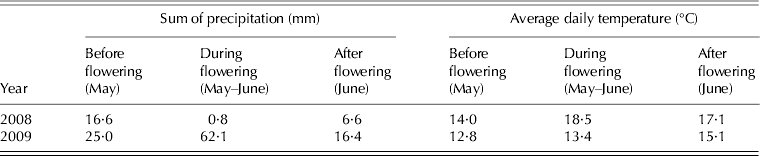
In 2008, 2009 and 2010 field experiments were conducted at the Experimental Station of the Faculty of Horticulture, Agricultural University in Cracow, located in Mydlniki (near Cracow, southern Poland; 50°04′N, 19°51′E, 207 m a.s.l.) on a typical brown soil with pH 6·5 and organic carbon content of 18 g/kg. Two cultivars of pea (P. sativum) were grown: the very early cultivar Pionier and the early cultivar Cud Kelwedonu. The trial was arranged in a completely randomized design with four replications for each of the two pea cultivars. The plot size was 16 m2 (4×4 m), and plots were separated by 1 m wide paths. Seeds were sown in rows, 0·3 m apart, on 30 March 2008, 3 April 2009 and 9 April 2010. In the spring of each trial year, the field was fertilized according to recommendations for food legumes (70 kg P2O5 and 100 kg K2O in autumn and 35 kg N in spring). No chemical treatments were applied, and weeds were removed mechanically and manually. Previously, various vegetable crops had been grown on this field, of which some (onion, leek, cabbage and herbs) are important hosts for T. tabaci (Jenser & Szénási Reference Jenser and Szénási2004). The phenological growth stages of the pea cultivars in all seasons were recorded at each sampling date and were classified according to Feller et al. (Reference Feller, Bleiholder, Buhr, Hack, Hess, Klose, Meier, Strauss, Van Den Boom and Weber1995) and Weber & Bleiholder (Reference Weber and Bleiholder1990) as shown in Table 1. Data from the meteorological station located at the trial site are presented in Table 2. The air temperature and rainfall during the three thrips sampling periods throughout the season, i.e. before (May), during (May–June), and after flowering of the peas (June), were recorded using a HOBO water temperature Pro data logger (Onset Computer Corp., Bourne, USA) at hourly intervals during the day.
Phenology of the pea cultivars Pionier and Cud Kelwedonu grown in Mydlniki (Krakow region, Poland) in the seasons 2008 and 2009 L – development of main shoot and leaves (BBCH 35–39); I – inflorescence emergence (BBCH 50–59); F – flowering (BBCH 60–69); P – development of pods (BBCH 70–75).

Rainfall and average daily temperature at the experimental site (Mydlniki, Krakow region, Poland) during each sampling period (before, during and after flowering of pea plants) in the seasons 2008 and 2009

Thrips sampling
The sampling period in all seasons started in May and lasted until the 3rd week of July. Thrips were caught using a standard entomological sweep net. A single sample consisted of 25 sweeps within each plot, and the resulting catch was stored in a plastic bag. Samples were taken at three sampling times during the day (10·00, 12·30 and 15·00 h) from each plot. During each of the three sampling periods throughout the season, each plot was sampled three times at intervals of 3–9 days. In the laboratory, T. tabaci adults and larvae were extracted and kept in a conservation fluid (60% alcohol with glycerol). Adult individuals of T. tabaci were determined to species level according to zur Strassen (Reference Zur Strassen2003) using a microscopic technique (Zawirska Reference Zawirska, Kozłowski and Boczek1994).
Chemical analysis of plant material
Leaf samples of both pea cultivars were collected randomly from the respective plots on 13 May 2009 and 22 May 2010 during the development of the main shoots and leaves (BBCH 35–39; Meier Reference Meier2001). From each leaf sample, 0·5 g fresh material was weighed and homogenized with 90% ethanol in a porcelain mortar, then poured into a measuring flask and the mortar was washed with ethanol several times to fill the flask to a final volume of 25 ml. The flask contents were poured into plastic test-tubes and kept in the refrigerator at −25 °C. Using these ethanol extracts, the total N content of the leaf samples was analysed with the Kjeldahl method described by Persson et al. (Reference Persson, Wennerholm and O'Halloran2008), the content of the total sugars was determined using the anthrone test (Samotus et al. Reference Samotus, Tuz and Doerre1993), and the reducing sugars in the pea leaves of each cultivar was determined using the hexacyanoferrate method described by Nath & Singh (Reference Nath and Singh1965). All analyses were performed three times for each of the extracts.
Laboratory bioassays
Test insects and plants
A thelythokous strain of T. tabaci was reared in the laboratory on sugar pea pods (P. sativum L.) in 0·5 litre glass jars covered with a fine mesh to ensure ventilation. Fresh sugar pea pods (different cultivars) grown in organic farming systems were purchased regularly and added to the thrips culture three times a week. The thrips were reared in an air-conditioned room at 23±1 °C and 30±5% relative humidity with a photoperiod of 16:8 h light:dark (adapted from Loomans & Murai Reference Loomans, Murai and Lewis1997).
Pea (P. sativum cultivars Pionier and Cud Kelwedonu) plants were grown using a standard substrate in a plant growing room. All plants were watered regularly, with tap water only. In all bioassays leaves from plants of the respective pea cultivar (plant age 3–4 weeks) were punched using a cork borer to obtain leaf discs (1·1 cm diameter). All bioassays were conducted in a growth chamber at 24±1 °C and 35±5% relative humidity with a photoperiod of 16:8 h light:dark.
Settling preference
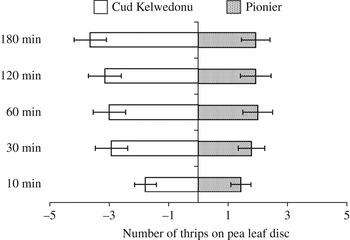
For this choice test, pea leaf discs from either pea cultivar were placed across from each other (distance between discs c. 4 cm) in a glass Petri dish (9 cm diameter) on a thin layer of 1% water agar (Fluka Analytical, Sigma Aldrich, Vienna, Austria). Filter paper squares (0·5×0·5 cm2) were placed in the centre between the two leaf discs as neutral starting points. Ten T. tabaci females of unknown age were randomly collected from the rearing jars and released on the starting point. Each bioassay unit was covered with a thin plastic film (Carl Roth, Karlsruhe, Germany), which was perforated (1 hole per cm2 on average) by means of insect pins (0·4 mm diameter) to ensure ventilation. All units were completely randomized under an artificial light source (900 lux light intensity) at 23±1 °C. The number of thrips on either leaf disc was counted after 10, 30, 60, 120 and 180 min. Thrips elsewhere in the Petri dish were not taken into account. The experiment was replicated 14 times, i.e. preferences of 14×10 female thrips for either pea cultivar were recorded.
Feeding and oviposition
Thrips pupae were collected randomly from the rearing jars and transferred to single sugar pea pods in Petri dishes (9 cm diameter). They were checked daily for adult emergence and emerged females were transferred to fresh pea pods. These females of known age were used 48 h post-emergence in the bioassays. In dual-choice assays on feeding and oviposition preference leaf discs from either pea cultivar (Pionier and Cud Kelwedonu) were placed side by side in glass Petri dish bottoms (9 cm diameter). For the assessment of the feeding and oviposition rate pea leaf discs were placed singly (no-choice situation) in small glass Petri dish bottoms (6 cm diameter). In both experimental series, the leaf discs were placed on a thin film of 1% water agar on the Petri dish bottoms and the bioassay units were covered with perforated plastic film as described above. After 24 h the thrips were removed and the feeding damage on the pea leaf discs was determined using a transparent counting grid (1×1 mm) and a stereo microscope. Subsequently the number of eggs on each leaf disc was counted using a transmission light microscope.
Statistical analysis
For the field data one-way ANOVAs were performed to test for differences between the numbers of T. tabaci adults and larvae per plot of each cultivar in each sampling period during the season and at each sampling time during the day. Likewise the N and sugar content of leaves from the two cultivars were compared using one-way ANOVAs. Data on settling, feeding and egg-laying preferences of thrips adults for either pea cultivar obtained in the choice bioassays in the laboratory were analysed using paired t tests. The feeding and oviposition rate on leaf discs of either pea cultivar was compared with an unpaired t test. Prior to the respective statistical analysis all data were tested for normality (Kolmogorov–Smirnov) and homogeneity of variance (Levene). All statistical analyses were performed using the software PASW Statistics 18.0 and Genstat 15 (VSN International, Hemel Hempstead, UK).
RESULTS
Field experiments
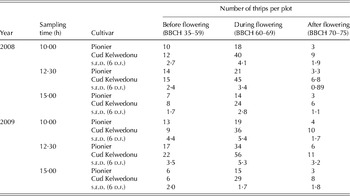
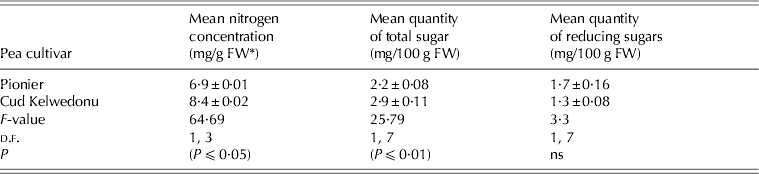
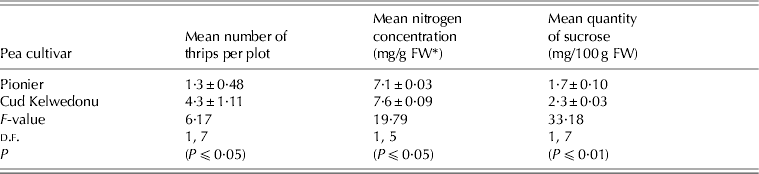
In 2008 and 2009, the sampling time during the day affected the number of T. tabaci individuals caught before the flowering period of the pea plants (P⩽0·001) and during flowering (P⩽0·001), whereas after flowering similar numbers of thrips were caught at 10·00, 12·30 and 15·00 h (F 2, 47=1·38), independently of pea cultivar and trial year (Table 3). Before flowering of the peas during the development of the main shoots and leaves, the mean number of thrips in each plot was similar on both cultivars. In both years during the flowering period and the phase of pod development, significantly (P levels of ⩽0·05, P⩽0·01 and P⩽0·001) more thrips adults and larvae were found on cvar Cud Kelwedonu than on Pionier. Chemical analysis of the leaf samples taken in the middle of the development of the main shoots and leaves (BBCH 35–39) in May 2009 showed that leaves from Cud Kelwedonu had a significantly higher N (P⩽0·05) and total sugar content (P⩽0·01) than leaves from Pionier (Table 4). With a difference of 0·4 mg/100 g fresh weight the mean quantity of reducing sugars was similar in the leaves of both cultivars. On 22 May 2010 at 12·30 h, significantly more thrips (P⩽0·05) were caught in Cud Kelwedonu plots and the chemical analyses of the leaf samples taken on the same day showed significantly higher nitrogen (P⩽0·05) and sucrose (P⩽0·01) contents in Cud Kelwedonu leaves (Table 5).
Mean Thrips tabaci abundance (±s.e.) in plots of the pea cultivars Pionier and Cud Kelwedonu in Mydlniki (Krakow region, Poland) at three sampling times (10·00, 12·30, 15·00 h) per sampling date during each sampling period (before, during and after flowering of pea plants) in 2008 and 2009

Mean sugar and nitrogen composition of leaves (±s.e.) from the pea cultivars Pionier and Cud Kelwedonu on 13 May 2009 (BBCH 35–39)

* FW=Fresh weight.
Mean Thrips tabaci abundance (±s.e.) in plots of the pea cultivars Pionier and Cud Kelwedonu and sugar and nitrogen composition of leaves of either cultivar on May 22nd, 2010 (BBCH 35–39)

* FW=Fresh weight.
Laboratory bioassays
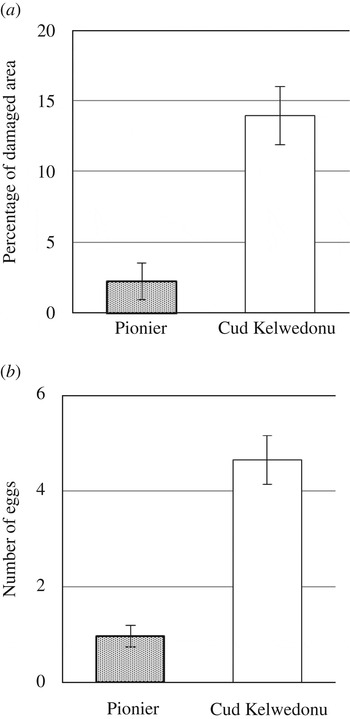
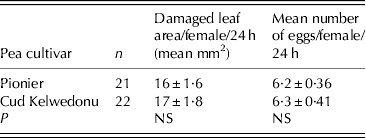
Although the differences are not statistically significant, when they had a choice, more T. tabaci females settled on leaf discs of cvar Cud Kelwedonu compared to discs from Pionier over a 3-h observational period (Fig. 1). In a dual choice situation, the feeding and oviposition preference of thrips females for leaf discs of the pea cvars Pionier or Cud Kelwedonu over a 24-h period was determined (Fig. 2). The thrips caused significantly more feeding damage (P⩽0·01) and laid significantly more eggs (P⩽0·001) on leaf discs from cvar Cud Kelwedonu than Pionier. Bioassays on the feeding and oviposition rate of thrips showed that when thrips had no choice their feeding and egg-laying activity was similar on leaf discs of both cultivars (Table 6).
Mean number of T. tabaci females (±s.e.) settled on leaf discs from the pea cultivars Cud Kelwedonu or Pionier 10 min, 30 min, 1, 2 and 3 h after their release.

Feeding and oviposition preference of T. tabaci females (±s.e.) for different pea cultivars. (a) Feeding damage (mean percentage of damaged area) and (b) number of eggs/female/24 h on leaf discs of the pea cultivars Pionier or Cud Kelwedonu.

Feeding and oviposition rate (±s.e.) of T. tabaci females on leaf discs from the pea cultivars Pionier and Cud Kelwedonu within a 24-h period (d.f.=41)

DISCUSSION
Several Thysanopteran species show a pattern of periodic activity during the day, for instance Frankliniella occidentalis (Pergande). Knowledge on their activity patterns is not only crucial to accurately estimate density and distribution patterns of thrips in a crop, but also for optimized timing of insecticide applications or the release of beneficial arthropods (Mateus et al. Reference Mateus, Araujo and Mexia1996; Whittaker & Kirk Reference Whittaker and Kirk2004; Trdan et al. Reference Trdan, Valič and Žnidarčič2007; Liang et al. Reference Liang, Lei, Wen and Zhu2010). Mo et al. (Reference Mo, Munro, Boulton and Stevens2008) investigated diurnal variations in the distribution of T. tabaci adults and larvae between basal upper and lower parts of onion leaves in the field, but found no clear activity patterns for the thrips. In contrast, relating the location of T. tabaci on salad onion plants to the time of day, Burnstone & Collier (Reference Burnstone and Collier2009) observed a regular migration of thrips adults from the basal halves of the onion leaves to the apical halves: in the early afternoon a significantly higher proportion of thrips adults occupied the apical plant parts than at any other time of the day. This is in accordance with the results of the present field study: before and during flowering of the pea plants in 2008 and 2009, more onion thrips were caught at 12·30 h than at the earlier (10·00 h) and later (15·00 h) sampling time during the day, which indicates a peak activity of the thrips around noon. Laboratory experiments on the influence of light intensity and/or temperature on the activity patterns of T. tabaci could support and refine these observations in the field.
Weather conditions, particularly temperature and rainfall, have been demonstrated to affect the population dynamics of T. tabaci in different crops, for instance in onions or cotton. Population increase has been positively correlated with temperature and heavy rainfall has been shown to reduce thrips populations significantly (Liu Reference Liu2004; Selvaraj & Adiroubane Reference Selvaraj and Adiroubane2012). In the present field experiments, no clear influence of temperature or rain on T. tabaci abundance in pea was determined. In 2008, only light rains, i.e. rates of fall from trace to 2·5 mm/h at the most, occurred throughout the experimental period from mid-May until late June, while in 2009 frequent moderate rains and associated lower temperatures were measured, particularly during flowering (end of May to early June). However, numbers of onion thrips caught in the experimental plots within comparable sampling periods were similar in both years.
The polyphagous thrips species T. tabaci can be found in flowers as well as on the leaves of a wide range of host plants (Moritz Reference Moritz2006; Diaz-Montano et al. Reference Diaz-Montano, Fuchs, Nault, Fail and Shelton2011). A number of secondary plant volatiles that commonly occur in floral scents have been proved to act as olfactory attractants to T. tabaci (reviewed by Koschier Reference Koschier2008). In the present field experiments in 2008 and 2009, a similar number of T. tabaci adults and larvae were found on both cultivars before flowering. The inflorescences of the very early Pionier cultivar emerged 5–6 days earlier than those of the early cultivar Cud Kelwedonu, but pea flower buds and flowers might not have attracted the thrips: during flowering significantly less T. tabaci adults and larvae were found on Pionier plants. In May 2010 the difference was even more significant, with even more thrips occurring on Cud Kelwedonu than on Pionier. In a previous field study, the cultivar Pionier was also found to be significantly less infested by T. tabaci compared with the Cud Kelwedonu cultivar (Pobożniak Reference Pobożniak2011). Olfactometer experiments using non-flowering pea plants of either pea cultivar could show whether volatiles in the green leaves of the Cud Kelwedonu plants act as olfactory attractants to the onion thrips. However, in a Y-tube olfactometer walking onion thrips adults did not respond positively to the odour of 10-week-old onion plants (Diaz-Montano et al. Reference Diaz-Montano, Fail, Deutschlander, Nault and Shelton2012). Although the choice of bioassays conducted in the laboratory in the present study are not suitable for distinguishing between olfactory and gustatory responses of insects, the present results do confirm the preference of T. tabaci for leaves of the cultivar Cud Kelwedonu observed in the field. Thrips tended to settle, showed a significantly higher feeding activity and laid significantly more eggs on the leaves of the Cud Kelwedonu cultivar. When they had no choice, no differences in oviposition or feeding activity were found on leaves of the two pea cultivars. No-choice bioassays over an experimental period of >24 h using whole potted pea plants might have revealed such effects that might be caused by biochemical differences between the pea cultivars.
Primary metabolites such as N, sugar and carbohydrates stimulate feeding and influence life history parameters of thrips (Ananthakrishnan Reference Ananthakrishnan1993; Ananthakrishnan & Gopichandran Reference Ananthakrishnan and Gopichandran1993; Scott Brown et al. Reference Scott Brown, Simmonds and Blaney2002). Cud Kelwedonu leaves taken from field-grown pea plants in 2009 contained significantly higher proportions of N and higher total sugar levels compared to the leaves of the Pionier cultivar. Since the sucrose content of plant material can be estimated from the difference in total sugars and reducing sugars, the sucrose content was also almost 3-fold higher in the Cud Kelwedonu leaves, and this result was confirmed in 2010. The importance of N contents in plant tissues for T. tabaci feeding and egg laying has been investigated in several fertilization experiments, though the results do not provide a clear picture. Positive correlations between N fertilization and T. tabaci infestation level have been found in onion (Allium cepa L.) (Martin & Workman Reference Martin and Workman2006; Malik et al. Reference Malik, Nawaz, Ellington, Sanderson and El-Heneidy2009), but Wiedenfeld et al. (Reference Wiedenfeld, Scully, Miller, Edelson and Wang1990) and Westerveld et al. (Reference Westerveld, Mckeown, Mcdonald and Scot-Dupree2001) found no correlation between these parameters. Higher N contents in shafts and leaves of leek (Allium porrum L.) also showed no correlation with higher onion thrips numbers on plants (den Belder & Elderson Reference Den Belder and Elderson1999). Similarly, in Impatiens wallerana Hook.f., N application rate did not affect F. occidentalis population levels (Chen et al. Reference Chen, Williams, Harbaugh and Bell2004). In contrast, in chrysanthemums (Dendranthema grandiflora Tzvelev), pepper (Capiscum annuum L.), tomato (Solanum lycopersicum L.) and cut roses (Rosa hybrida L.), a positive correlation between fertilization, i.e. leaf N content and the F. occidentalis population was determined (Schuch et al. Reference Schuch, Redak and Bethke1998; Chau et al. Reference Chau, Heinz and Davies2005; Davies et al. Reference Davies, He, Chau, Spiers and Heinz2005; Baez et al. Reference Baez, Reitz, Funderburk and Olson2011; Chow et al. Reference Chow, Chau and Heinz2012). Moreover, higher fertilization rates in tomato resulted in increased flower N contents and higher F. occidentalis populations (Brodbeck et al. Reference Brodbeck, Stavisky, Funderburk, Andersen and Olson2001). Protein contents influenced the suitability of plants as hosts for F. occidentalis and Heliothrips haemorrhoidalis (Bouché) more than the levels of carbohydrates, though it is not clear whether the thrips were responding to the proportion of protein, carbohydrate, or both (Scott Brown et al. Reference Scott Brown, Simmonds and Blaney2002). In field-grown cabbage (B. oleracea L.), onion thrips infestation was positively correlated with the sucrose amount in the leaves (Žnidračič et al. Reference Žnidarčič, Vidrih, Germ, Ban and Trdan2007). The results of the present study add evidence that higher leaf N and sucrose contents in the leaves promote the population growth of the onion thrips in pea. Based on these findings, further investigations could reveal any links between primary and secondary metabolites and the host selection of T. tabaci.
The present study adds evidence that T. tabaci shows a peak activity pattern at around noon in the field. This knowledge on abundance, host preferences and host use of T. tabaci may contribute to optimize cultivar selection, monitoring and timing of possible control measures in pea crops in the future.
The authors would like to thank Mag. Stefan Peneder for his assistance in the laboratory and Dr Heinrich Grausgruber for the help with the statistical analyses. This study was supported by the grant N N310 142135 from State Committee for Scientific Research in Poland.