1. Introduction
Biological species is arguably one of the most controversial topics in the philosophy of evolutionary biology, with much ink spilled over the “correct” concept of species and their ontological status. Species were traditionally taken to be classes or types instantiated by individual organisms. After the advent of evolutionary theory, the typological view was largely replaced by the nominalist view that identifies a species with a concrete historical entity—a chunk of biological lineage—of which individual organisms are mereological bits (Ghiselin Reference Ghiselin1974; Hull Reference Hull1976). Although nominalism has become a de facto standard in the philosophy of biology in the last century, some have complained about its lack of explanatory power and called for a revival of a type or natural-kind-based concept of biological species (Boyd Reference Boyd and A1999).
To this debate between nominalists and typologists, this article introduces yet another thesis according to which species are models of a scientific theory, that is, set-theoretic entities that make assertions or inferences of a given theory true or false. This implies that biological species are mathematical, rather than biological or even tangible, entities. To flesh out this claim, section 2 of this article characterizes various (e.g., phenetic, cladistic, biological) species concepts in terms of formal models and determines the type of inferences licensed by each model. This will explicate logical connections among different species concepts and provide a platform to evaluate them as a problem of model selection. The philosophical implications of the model-theoretic rendering are expounded in section 3. Identifying species with models entails that the organism-species relationship is not instantial or mereological but rather representational; that is, a species as a model represents individual organisms. This opens the possibility of applying general philosophical discussions on scientific representation and realism to the vexed questions concerning the epistemic and ontological status of biological species. Through these arguments, this article situates the species problem within the broader contexts of model selection, scientific representation, and scientific realism, presenting it as a special case of the generic questions concerned with how science investigates the world.
2. Species as Models
This section fleshes out the main thesis of the article by characterizing various species concepts in terms of the corresponding set-theoretic models. The central idea is that species concepts specify theories that underpin biological inferences and descriptions, and species are models that satisfy such theories.
2.1. Typological Species Concepts
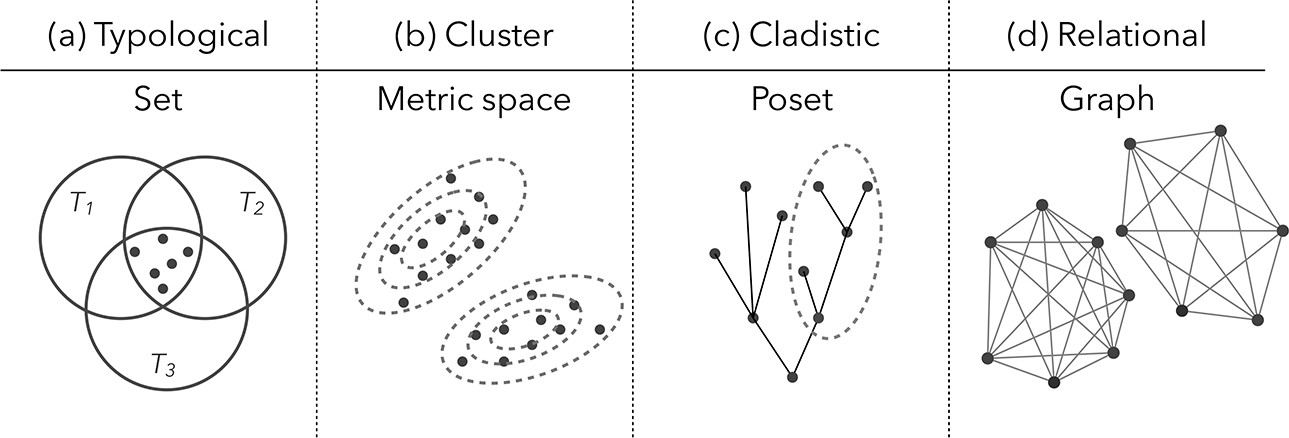
The traditional typological view defines a species by its essence, or necessary and sufficient conditions or traits. This finds straightforward expression as a biconditional form  . A model that satisfies such logical formulas is a set, where the species S corresponds to the intersection ∩iTi of trait sets (see fig. 1a).
Models of various species concepts, with corresponding formal setups. Dots/nodes represent individual organisms.

The biconditionals, if true, enable one to identify a species from some of its “essential” traits and infer back the rest of its traits, just as did the great French zoologist George Cuvier, who took pride in his ability to reconstruct the whole body of an extinct animal from a single piece of bone. As is well known, however, such inferences have very restricted validity, because a definite set of phenotypic or genetic characteristics that exclusively defines a given species is hard to come by. Evolution implies “fuzzy” species boundaries, which undermine the simple biconditional definition. The typological species concept has thus been criticized for its poor expressive power: a simple algebra of trait sets cannot capture the nuanced reality of biological species.
2.2. Cluster Species Concepts
The cluster species concepts avoid this difficulty by defining a species as a group or cluster of similar organisms that do not necessarily share a common set of traits. The question, then, is how to define similarity. Its earliest variant, the phenetic species concept, represents organisms (called operational taxonomic units, or OTUs) in a multidimensional space, each axis of which defines a recorded trait (Sokal and Sneath Reference Sokal and Sneath1963). Phenotypic similarity between two organisms is then measured by their Euclidean distance, and a chunk or cluster of organisms in this Euclidean space is identified as a species (fig. 1b). The choice of Euclidean distance is not obligatory. One could, for example, measure the angle between two point vectors/OTUs in the normalized phenotypic space and calculate the cosine similarity, which is equivalent to correlation. A species is then identified as a correlated cluster characterized by some probability distribution over traits (Boyd Reference Boyd and A1999).
The phenotypic space equipped with a metric or probability measure is certainly a much richer machinery than overlapping sets. The sophisticated theoretical background allows for more nuanced expressions and inferences, such as the quantification of phenotypic or genetic similarities and trait-species inferences in the absence of necessary or sufficient criteria. However, whether and to what extent such clustering and inference capture the objective species boundaries is disputed, for calculated similarities crucially depend on a set of characters taken into account as well as the assumed metric. Also note that the cluster concepts, like the typological concept, are purely static and lack a means to express evolutionary history, which some take to be the defining feature of biological species.
2.3. Cladistic Species Concepts
Cladistic species concepts focus on evolutionary history and define species solely in terms of phylogenetic relationships, as a “branch” or monophyletic group in the evolutionary tree (Hennig Reference Hennig1966; see fig. 1c). Since an ancestral relationship is antisymmetric and transitive, phylogeny forms a strict partially ordered set, or poset (Ω, ≺), over a set of organisms Ω, where  means “ωi is an ancestor of ωj.” A cladistic species is then defined as all the descendants of some founder organism(s) ωf; that is, {
 }.
The primary advantage of the cladistic concepts is that a monophyletic group, and thus species, can be objectively determined upon the reconstruction of an evolutionary lineage, and for this reason it has been most popular among biologists and philosophers alike. It is not, however, without its flaws. On one hand, the above definition does not specify how big a monophyletic branch must be to qualify as a species, so that monophyly by itself does not provide a sufficient condition of species (Velasco Reference Velasco2008). On the other hand, the requirement is too strong especially when applied to higher taxa, for the monophyletic definition of “reptiles” would inevitably include birds as well as lizards, snakes, and crocodiles, conflicting with a common intuition. That is, the cladistic species concepts make paraphyletic groups like reptilia meaningless, which strikes some as too restrictive.
2.4. Relational Species Concepts
Another popular approach is to define a species as a group of individuals that have a certain relationship to each other. The biological species concept, for instance, defines species as groups of interbreeding populations that are reproductively isolated from other such groups (Mayr Reference Mayr1942), so that the required relationship here is mutual crossability. Other variants focus on reproductive competition (Ghiselin Reference Ghiselin1974) or organisms’ capacity to recognize each other as a possible mate (Paterson Reference Paterson and Vrba1985). All these proposals characterize species in terms of mutual relationships (interbreeding, competition, recognition, etc.). By representing such relationships with edges between nodes/organisms, a relational species can be defined as an isolated complete subgraph or clique in an undirected graph, that is, a group of nodes in which every two distinct nodes are connected but none is connected to the outside (fig. 1d). Relational species thus find their model in graph theory, where edges represent the relation in question.
A common criticism of relational species concepts is that the focal relationship, such as crossability, is often nontransitive and thus fails to induce isolated cliques, as in the case of ring species. Moreover, the biological species concept implies that every asexually reproducing organism forms a distinct species (for any singleton node is complete). These issues suggest that the real biological network is so “messy” that just a single relationship cannot divide it into distinct cliques in a nontrivial way.
2.5. “Combo” Solutions
The model-theoretic rendering above explicates what each species concept can and cannot meaningfully say about the biological world. Given that most of the criticisms we have seen concern the “cannot say” part, one way to deal with these difficulties is to combine different theories to form more complex definitions of species.
For instance, one may combine the cluster and cladistic species concepts and define a species as a lineage that shares the same or similar phenotypic distribution

where  assigns distribution parameters to each organism
 .Footnote 1 On this definition one may meaningfully define paraphyletic species or taxa and distinguish birds from reptiles on the basis of the difference in their phenotypic or genetic profiles. It can also account for anagenesis (speciation without branching) and continuity of species between a cladogenesis (splitting event) as the change or stasis of the distribution.
By replacing θ in (1) with a different function that maps organisms to their niche, one obtains the ecological species concept, which defines a species as “a lineage … which occupies an adaptive zone minimally different from that of any other lineage in its range” (Van Valen Reference Van Valen1976, 233).
Yet another combination is that of the cladistic and biological species concepts, which would define a species as a maximum monophyletic lineage that can mutually interbreed, so that

where ~ stands for crossability.Footnote 2 This makes up for the lack of a sufficient condition in the cladistic species concept and accords well with the so-called evolutionary species concept that emphasizes the unique “evolutionary tendencies and historical fate” of each species (Wiley Reference Wiley1978, 17).
2.6. The Scientific Species Problem as a Problem of Theory Choice
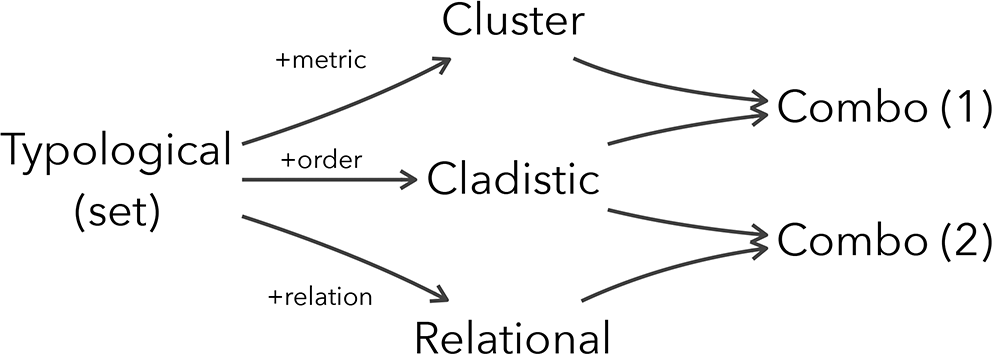
The above discussion shows that (i) major species concepts can be defined as models of semiformal theories and that (ii) more complex concepts can be formed by combining basic ones. The model-theoretic approach characterizes each species concept with the formal apparatus it assumes, which in turn determines its expressive power or what can meaningfully be stated about organisms or their history. In general, a richer theoretical apparatus allows for more nuanced expressions, which makes it less liable to counterexamples. This is illustrated in the progression from the typological to cluster and then to cluster-cladistic concepts (combo 1), where in each step the species concept acquires the ability to deal with fuzzy boundaries and evolutionary history, respectively (fig. 2).
Logical dependency among different species concepts.

The catch, however, is that a richer concept tends to have a greater degree of freedom and requires more data in actual application. While only phylogenetic information suffices to demarcate cladistic species, the cluster-cladistic concept also requires phenotypic or ecological information, which in many cases may not be available. A stronger semantic power thus comes with a higher epistemic cost and makes a species concept less operational.
In this respect, the competition among various species concepts resembles the problem of model selection, where different models are evaluated on the basis of their explanatory or descriptive power versus parsimony or operationality (Sober Reference Sober2008). Indeed, most disputes among advocates of different species concepts arise from their differential emphasis on what aspects of the biological world a respectable species concept need (not) take into account (Ereshefsky Reference Ereshefsky2001), but the difficulty has been that these emphases are often implicit and incommensurable. Although the model-theoretic perspective does not arbitrate the debates, it points to a common formal framework that makes explicit the explanatory power and operationality of species concepts and facilitates evaluation of their respective advantages.
3. Philosophical Implications
3.1. Species Are Models
Upon the model-theoretic reconstruction of various species concepts, I now elaborate the philosophical thesis that species taxa should be construed as models (i.e., set-theoretic entities). To proceed, let me first begin with an analogy from physics. Classical mechanics is a theory about Newtonian particles, which are customarily defined as volumeless points in a three-dimensional Euclidean space. Newton’s celebrated laws like  describe the temporal evolution of a system composed of such “particles.” This system is to be distinguished from any actual physical systems, say the solar system; for one thing, no concrete bodies are volumeless, nor do they exactly satisfy Newton’s laws of motion. Newton’s theory, or any other physical theory for that matter, is a description of abstract idealized models and not of actual phenomena (Cartwright Reference Cartwright1983). That is, models of classical mechanics—which make its laws and statements true—are not concrete, physical entities but rather abstract mathematical objects that can be constructed within set theory (McKinsey, Suppes, and Sugar Reference McKinsey, Suppes and Sugar1953).
That a scientific theory relates to actual phenomena only through its models is the main tenet of the so-called semantic or model-based view of scientific theories (e.g., van Fraassen Reference van Fraassen1980; Suppe Reference Suppe1989).Footnote 3 Traditional logical positivists who assume that a scientific theory directly describes observed data have faced the tremendous task of reducing theoretical concepts that seemingly lack direct empirical content to observational vocabulary by way of bridge laws or partial interpretations. To avoid this difficulty, proponents of the model-based view take a model, rather than observation, as the primary descriptive target of a scientific theory. In this view, a theory specifies an abstract model that idealizes and extracts just salient factors and only indirectly relates to actual phenomena.
I submit that the species problem is a variant of the positivist conundrum. Species is a highly theoretical concept, and various proposals of “species concepts” in the past can be understood as attempts to build bridge laws for reducing it to a set of observational or operational criteria. To date, more than a dozen different concepts have been proposed, but not one of these escapes criticism for having limitations or because of counterexamples found in the rich and heterogeneous biological world.Footnote 4 Such discontentments stem from the assumption that a species concept must be a faithful description of actual biological features or phenomena. But is this assumption reasonable? The model-based view has been quite popular among philosophers of biology (e.g., Beatty Reference Beatty, Asquith and Giere1981; Lloyd Reference Lloyd1988). If we adopt this view and construe evolutionary theory as describing models, then species too must be defined accordingly, that is, as (a part of) abstract models that satisfy descriptions or inferences of the corresponding theory.
What, then, are theories about species? Without claiming to be exhaustive, this article adopts Suppes’s (Reference Suppes2002) proposal of defining a scientific theory in terms of a set-theoretical predicate. The foremost advantage of this approach is that it enables one to easily harness a theory with the mathematical apparatus necessary for sophisticated reasoning. As discussed above, contemporary studies on species rely heavily on quantitative methods to calculate similarity or reconstruct a phylogenetic tree from phenotypic or genetic data. Given that such mathematical reasoning requires matching formal models of calculus or probability theory, the straightforward way to define a species is to build it on these mathematical backgrounds. Section 2 is a broad-brush sketch applying this Suppesian program to various species concepts. If this attempt turns out to be successful, biological species are to be understood as parts of set-theoretic structures, just like Newtonian particles. That is, they are mathematical and abstract constructs, rather than physical or biological entities.Footnote 5
Another advantage of the set-theoretic exposition is that it makes implicit assumptions of a species concept explicit and suggests a way to deal with counterexamples. Take, for example, the problem of ring species for the biological species concept, which arises from a conflict between the theoretical presumption that each biological species must be isolated and the biological fact that crossability is not always transitive. One possible response then is to weaken the former assumption and redefine a species just as a (not necessarily isolated) clique in the reproductive network. Clarification of theoretical assumptions helps us to assess other species concepts as well. For example, the phenetic species concept is often claimed to be “theory free” in that it does not depend on any evolutionary hypothesis. But as we have seen in section 2.2, the calculation of phenotypic similarity presupposes a phenotypic space equipped with a particular metric, which is a fairly strong theoretical assumption. Likewise, although cladists often emphasize the simplicity and purity of their monophyletic species definition that stands solely on the phylogenetic relationships, in order to make use of likelihood methods to infer such relationships, as is common in practice, a simple poset is not enough: one also needs to assume some genetic or phenotypic distribution. This means that the theoretical background needed for phylogenetic inferences does not differ from that of the combo (1) defined in section 2.5, and accordingly cladists have no a priori justification to rule out non-monophyletic taxa as meaningless.
The final, but not least, merit of the set-theoretic approach is its flexibility: it allows for a construction of a new species concept by combining existing ones (sec. 2.5) or adding new theoretical assumptions. For instance, it is common in experimental biology to characterize a species by shared developmental or causal mechanisms; developmental biologists often talk about “the development of the chicken,” and medical doctors assume intraspecific causal homogeneity when they prescribe a clinically tested drug for their patient. Such a “causal species” may be defined by isomorphic causal models, which combine a probabilistic distribution and a causal graph over variables. Hence, the discussion in section 2 covers just a few samples that can be constructed within this general framework. This does not of course mean that every possible species concept can and should be formalized, but it does suggest the potential of the set-theoretic approach to accommodate the use of existing species concepts and to develop novel ones.
3.2. The Relationship between Species and Organisms
Identifying species with theoretical models sheds new light on some vexed philosophical issues, one of which concerns how individual organisms are related to species taxa. Philosophers have long debated whether the organism-species relationship is instantial (organisms are particular instances of a species qua type), one of membership (they are members of a species qua set; Kitcher Reference Kitcher1984), or mereological (they are parts of a species qua genealogical entity; Ghiselin Reference Ghiselin1997). The model-theoretic approach suggests an alternative account, according to which a species represents (a group of) individual organisms. Just as the Rutherford-Bohr model represents the microscopic structure of atoms, the models proposed in section 2 represent biological populations: for example, nodes and edges consisting of the biological species model in figure 1d respectively represent organisms and their crossability. Representation captures the intuitive notion that a model and its target phenomenon share salient static or dynamic features up to a certain precision. Having said that, it must be admitted that the criteria and nature of scientific representation are still debated and remain open questions (Frigg and Nguyen Reference Frigg, Nguyen and Zalta2016). Hence, calling the species-organism relationship representational may not demystify it, but it does imply that the problem is not endemic to evolutionary theory; it is rather a version of the broader philosophical issue as to how the use of scientific models help us understand the world. This means that the arsenal of this rich philosophical literature can and should be consulted to elucidate the nature of the species-organism relationship. Another more immediate implication is that the membership and mereological accounts must be both abandoned, for whatever the relationship between a model and phenomena turns out to be, the latter must certainly not be a member or part of the former.
Neither is representation identity or instantiation. Ideal gas is not identical to any actual gas, but it only approximates the thermodynamic characteristics of some. Hence, strictly speaking it has no instantiation, but this does not detract its epistemic validity. Likewise species concepts, as specifications of ideal models, need not directly apply to actual populations. No wild population big enough to qualify as a species would strictly satisfy the requirement of the biological species concept, because mating chance is often frustrated by physiological, geographical, and other contingencies. In the same vein, a phenetic or genetic cluster is expected to have outliers when applied to a real population. However, the presence of such exceptions should not immediately invalidate the corresponding species concepts, because the value of a species concept consists less in its universal validity than in its epistemic serviceability for inferences and explanations of evolutionary or biological phenomena. The two desiderata often conflict; Cartwright (Reference Cartwright1983) even argues that explanatory theories necessarily distort the reality by idealizing the situation and extracting only relevant features, so that they are “lies” by design. Cartwright’s examples are from physics and economics, but her idea also applies to the current context. The primary function of a species concept is to explain biological phenomena rather than to save them, so that a few discrepancies should not be taken as its falsification.
The conflict between exceptionlessness versus explanatory or semantic power also underlies the debate over species realism. Those who claim that a species is nothing but a totality of individual organisms have sustained their nominalist view by criticizing the realist interpretation of species-as-class for its commitment to the typological thinking and failure to deal with the evident heterogeneity of biological populations (e.g., Ghiselin Reference Ghiselin1997). In contrast, those who attach weight to the role of species concepts in induction and explanation have upheld a realist position and treated species as natural kinds (Boyd Reference Boyd and A1999). The current thesis suggests a way to acknowledge the explanatory role of the species concept without committing to Platonic ideas. As we have seen in section 2, species as models license inferences practiced in biological sciences. The cluster and typological species/models underpin an expectation that physiological or genetic features found in, say, laboratory animals would also be shared by other individuals of the same species, while the evolutionary species concept explains the reason for such intraspecific similarities. Such inferences no more presuppose the existence of a model as an independent, real entity than do explanations based on, say, an ideal gas. Indeed, explanatory models may be fictional, as in the case of the Ising model in statistical mechanics.
This does not of course mean that models must be fictions or that species do not exist. Recent advocates of scientific realism argue that successful scientific models capture some, especially structural, aspect of reality (Ladyman Reference Ladyman and Zalta2016). Given its affinity to the model-based view of scientific theories, species realists may well apply this line of reasoning to the current context, taking the set-theoretic structures as discussed in section 2 as representing real and essential features of biological species. Whether and to what extent such an argument carries over, however, remain to be examined by a further study.
4. Conclusion
The philosophical debates over biological species have been based on the assumption that species concepts are to describe actual biological phenomena and should be evaluated solely in terms of their verisimilitude. The current article challenged this assumption and argued that the primary referent of a species concept is a (set-theoretic) model that licenses a certain set of biological inferences. The model-theoretic formulation articulates the explanatory or semantic power as well as theoretical assumptions of each species concept and illuminates logical relationships among them. Once species are specified as models, the long-standing competition among different species concepts reduces to a common problem of model selection, where the relative merits and demerits of each concept are evaluated in terms of their explanatory power as well as descriptive accuracy.
On the philosophical side, the shift in the ontological status of species means that the organism-species relationship is not that of instantiation, membership, or mereology but rather representation. This puts biological species on equal footing with other scientific concepts like atoms or ideal gases and connects the vexed issues concerning the ontological as well as epistemic status of species to the broader problems related to how scientific models represent and explain the world. In this way, the model-theoretic approach redescribes the species problem as a variant of general scientific and philosophical issues of model selection, scientific representation, and realism, thereby opening up the possibility of applying the rich literature on these topics to elucidate the nature of biological species.