Introduction
The persistent disparity in wealth among nations has long been a central question in political science and development studies. Institutions – formal and informal rules, norms and governance systems – are widely recognised as fundamental determinants of economic performance, shaping national trajectories (Acemoglu et al., Reference Acemoglu, Johnson and Robinson2001; North, Reference North1990; Acemoglu and Robinson Reference Acemoglu and Robinson2012). Inclusive institutions promote economic growth by securing property rights, enforcing contracts and ensuring a stable environment for investment and innovation (Acemoglu and Robinson Reference Acemoglu and Robinson2012). They also build trust between economic actors, fostering a stable economy. Inclusive institutions promote social inclusion and reduce inequality. In contrast, extractive institutions concentrate power and wealth among a few, thereby restricting economic opportunities. They are conducive to corruption and inefficiency and are likely to hinder growth, thus impeding long-term development. In Why Nations Fail, Acemoglu and Robinson (Reference Acemoglu and Robinson2012) argues that national prosperity is based on institutional quality, whether inclusive or extractive. They believe that the colonial legacy played a fundamental role in shaping these institutions. Colonial powers established extractive institutions to serve their own interests, and these structures often persisted after independence, shaping governance and perpetuating inequality. Rooted in extractive systems designed to serve colonial interests, this legacy remains a significant factor in African state dysfunction, with direct and lingering effects continuing to shape development outcomes (Mormul, Reference Mormul2018).
According to institutional theory, one might initially expect that Guinea-Bissau and Cabo Verde, two nations with a shared Portuguese colonial rule, would follow similar development paths. While both were members of the Portuguese Empire and subject to extractive colonial economics, a closer examination reveals that their colonial experiences diverged in critical ways, particularly in education, legal status and administrative roles – factors that would shape their post-independence trajectories. This nuanced understanding challenges the simplistic notion that a shared colonial power guarantees similar institutional outcomes. Despite Guinea-Bissau’s rich endowment of natural resources, its post-independence trajectory has veered sharply away from that of Cabo Verde. This divergence highlights that it is not the colonial legacy alone, but rather how specific colonial-era disparities interact with post-independence governance and elite choices that determine a country’s development path.
In this study, I explore the key factors behind this divergence. The case of Cabo Verde offers valuable insight into how a country can be removed from extractive institutions and embrace effective governance, thus fostering long-term development. However, Guinea-Bissau remains hampered by weak and extractive institutions and persistent inefficiencies that prevent meaningful progress. By analysing these two contrasting experiences, we can draw valuable lessons for other nations facing similar historical challenges. This study underscores that colonial heritage is not an unchangeable fate; instead, strategic governance choices, strong leadership and institutional reforms can set countries on a path to sustainable development. This paper offers valuable lessons for policymakers seeking to overcome the cycles of underdevelopment and create opportunities for long-term growth.
Beyond the institutional view, the literature commonly distinguishes two primary explanatory approaches: structural and actor-centric. The structural approach considers macrolevel factors, such as geography, natural resource endowment, urbanisation, industrialisation and education, to be positively related to economic growth. For example, geography influences agricultural productivity, trade opportunities and access to critical resources, with tropical regions often facing development challenges due to diseases such as malaria (Frankel & Romer, Reference Frankel and Romer1999; Sachs, Reference Sachs2001). The actor-centric approach focuses on the role of key actors, particularly elite decision-makers, in shaping policies and institutions. This part of the literature argues that development outcomes are not determined by structural factors alone but by the choices made by key actors, that is, political elites. They shape policies through strategic choices, bargaining power and political actions that promote or hinder growth (O’Donnell et al., Reference O’Donnell, Schmitter and Whitehead1986). For example, Dercon (Reference Dercon2022) highlights in Gambling on Development that elites often take calculated risks and make strategic choices that promote growth and stability.
For structural theory advocates, Guinea-Bissau should be wealthier than Cabo Verde because of its better geography and natural resources. However, this is not the case. Guinea-Bissau’s challenges are deeply rooted in the perspectives of its citizens, who view the weakening of the state and ineffective institutions as the core of the country’s problems. Reports such as the 2010 Interpeace study (di Paz, Reference di Paz2010)Footnote 1 and the 2018 DEMOS survey (Carter, Reference Carter2018)Footnote 2 highlight widespread concerns about poor governance, corruption and the failure of state services, with citizens perceiving that the government primarily serves the interests of a few elites rather than the broader population. The contrast with Cabo Verde is striking in this regard. Afrobarometer Round 7 (2017) shows that even as trust in elective institutions declined modestly, courts retained the confidence of 55% of Cabo Verdeans and the electoral commission 43% (Furtado & Semedo, Reference Furtado and Semedo2018). More tellingly, large majorities dissatisfied with government performance on unemployment and corruption expressed that dissatisfaction as democratic demands rather than state rejection – a posture that presupposes a functioning framework worth engaging with. Guinea-Bissau, by contrast, exhibits the opposite dynamic, where elite capture and institutional decay have eroded the very foundations of public trust, reinforcing the cycle of fragility that structural factors alone cannot explain. The case of Guinea-Bissau and Cabo Verde offers a natural experiment, showing how different institutional dynamics and governance structures can lead to divergent economic outcomes. This comparison provides a unique opportunity to explore how institutional quality, elite bargaining and strategic decisions shape development outcomes.
This paper makes four key contributions. First, it goes beyond structural factors, such as geography and resources, to emphasise governance and institutional quality in long-term development. Second, it offers a comprehensive analysis by integrating institutional theory and actor-centric approaches to highlight how elite decisions and governance structures shape economic outcomes. This framework explains how institutional dynamics and elite actions contribute to economic divergence, offering fresh insights into the relationship between governance, institutions and development in post-colonial contexts. Third, most comparative studies have focused on countries with different colonial backgrounds (e.g. Anglophone vs. Francophone), this paper fills a gap by comparing two Portuguese-speaking countries, highlighting how even countries with similar geographies and colonial histories can experience significantly divergent developmental paths. Finally, this document offers important policy implications for breaking underdevelopment cycles and fostering long-term growth opportunities.
The remainder of this paper is organised as follows. In Section Standard of living in Guinea-Bissau and Cabo Verde, we explore the divergence in the standard of living between Guinea-Bissau and Cabo Verde. Then, we examine the underlying causes of this divergence in Section Beyond geography and colonial legacy: rethinking developmental divergence. Section Governance, macroeconomic and political stability analyses the disparities in governance and the quality of institutions, while Section Elite bargaining and institutional divergence investigates the role of elites in shaping these disparities. Section Beyond Guinea-Bissau and Cabo Verde: broader implications for development policies discusses the broader implications for development policies and concludes in Section Conclusion.
Standard of living in Guinea-Bissau and Cabo Verde
Guinea-Bissau won independence from Portugal in 1974 and Cabo Verde in 1975. At the time they became sovereign nations, both countries inherited almost identical institutional characteristics from the Portuguese colonies. Beyond deep cultural and historical ties, they also pursued a common vision of political unity driven by interconnected elites. They initially faced similar economic challenges typical of post-colonial African states, including low GDP per capita and a lack of economic diversification. Both were governed by the same political party until a 1980 coup in Guinea-Bissau ended their political union. However, as shown in Figure 1, their economic trajectories have since diverged significantly. The figure illustrates the natural logarithm of an index of real GDP per capita (measured in PPP 2017 US dollars) for Guinea-Bissau and Cabo Verde from 1970 to 2020. The index was set to one in 1980, making its natural logarithm zero at that point, providing a clear visual of their economic divergence over time.
Living standards in Guinea-Bissau and Cabo Verde after their political separation.
Source: Penn World Table version 10.01 (Feenstra et al., Reference Feenstra, Inklaar and Timmer2015), author’s calculation.

Before 1980, Guinea-Bissau had a higher real GDP per capita than Cabo Verde, reflecting relatively better living standards. However, while Guinea-Bissau initially had an economic advantage, it also faced greater instability, whereas Cabo Verde followed a steadier, albeit slower, growth path. Cabo Verde showed consistent growth in living standards, whereas Guinea-Bissau stagnated.
One striking feature of Figure 1 is the divergence in the standard of living between the two countries since 1980. Cabo Verde and Guinea-Bissau are unique in Africa because they were separate independent countries ruled by the same party until 1980. After independence, both countries pursued a common project under the PAIGC until a 1980 military coup ousted President Luis Cabral, led by Joao Bernardo Vieira (Chabal, Reference Chabal1983; Munslow, Reference Munslow1981). The plans for unification with Cabo Verde were abandoned, and the two countries followed separate paths. Since then, the development trajectories of the two countries could hardly have been more different. The overthrow was the first of many political coups that undermined the country’s stability over the next four decades. Of course, the early 1980s global economic recession led both countries to neoliberalism, but the central point is that the GDP per capita in Guinea-Bissau stagnated and even declined while it consistently increased in Cabo Verde. In 2007, Cabo Verde was reclassified as no longer a Least Developed Country (LDC), whereas Guinea-Bissau remained one of the poorest countries in the world. Between 1980 and 2007, real GDP per capita increased by an average of 4.7% per year in Cabo Verde, while it declined by an average of 0.5% per year in Guinea-Bissau.Footnote 3
Turning from growth rates to levels highlights the long-term impact of these differences in growth. After independence, Guinea-Bissau had a higher standard of living than Cabo Verde. In 1975, Guinea-Bissau had a real GDP per capita (US PPP$2017) of $1,667.1, which is approximately 1.18 times Cabo Verde’s ($1,407.6). In 1979, the gap widened to a ratio of 1.21, with Guinea-Bissau at $1,811.08 and Cabo Verde at $1,579.64. This gap was then reduced, and in 1980, they had almost similar real GDP per capita, Guinea-Bissau at $1, 678.6 and Cabo Verde at $1, 576. However, during the following decades, their economic trajectories diverged significantly. In 2007, Cabo Verde’s real GDP per capita increased to $5622, while that of Guinea-Bissau declined to $1468.7, making Cabo Verde nearly four times wealthier. This gap persisted, although Guinea-Bissau saw moderate improvements. In 2019, Cabo Verde achieved a real GDP per capita of $7189.1, while Guinea-Bissau remained at $1698.6.
This gap is also observed in other development indicators. For example, looking at the Human Development Index (HDI) of the United Nations Development Program (UNDP), Cabo Verde had an HDI of 0.569 in 2010, placing it in the category of ‘Medium human development’, while Guinea-Bissau, at 0.443, remained in ‘Low Human Development’ (UNDP, 2024). Despite some progress, the gap has endured. By 2021, Guinea-Bissau’s HDI had risen to 0.483, but Cabo Verde’s HDI had reached 0.662, underscoring ongoing challenges in governance, institutional capacity and overall development.
Beyond geography and colonial legacy: rethinking developmental divergence
Geographical myths and limits of environmental determinism. Guinea-Bissau, which covers 36,125 km2, consists of a continental area and around 80 islands, including the scenic Bijagós Archipelago, known for its biodiversity and tourism appeal. It benefits from rich natural resources, including abundant rainfall, fertile soils, extensive fish stocks, vast forests, mineral deposits (bauxite, phosphates, diamonds and gold) and promising offshore oil reserves (Mendy & Lobban, Reference Mendy and Lobban2013; SEA, 2015; World Bank, 2019).
In contrast, Cabo Verde, an archipelago of 10 islands covering 4,033 km2, is particularly poor in natural resources. Its rugged terrain complicates internal circulation, while its fragmented geography and Sahelian climate expose it to chronic droughts, soil erosion, deforestation and water scarcity – making it highly dependent on food imports and international aid (AfDB, 2012; Duarte et al., Reference Duarte, Romeiras, Gillespie and Clague2009; Lobban et al., Reference Lobban, Woronoff and Saucier2007). Yet this very scarcity created a ‘survival imperative’ that fostered political unity and institutional innovation among its elites (Chabal, Reference Chabal1983; Foy, Reference Foy1988; Lobban, Reference Lobban1995; Meyns, Reference Meyns2002) – a factor consistently overlooked by structural determinism.
The geographical hypothesis that natural endowments drive economic performance remains among the most cited explanations for development disparities (Sachs & Malaney, Reference Sachs and Malaney2002; Sachs, Reference Sachs2001). Proponents argue that tropical regions face inherent growth barriers, while temperate zones enjoy conditions conducive to prosperity. The divergence between Guinea-Bissau and Cabo Verde directly challenges this narrative. Although Cabo Verde and Guinea-Bissau differ substantially in their climatic and geographical conditions, they share several important historical and structural characteristics, including a Portuguese colonial heritage, tropical location, and access to the Atlantic Ocean—conditions that, in principle, provide a meaningful basis for comparison. Both countries have historically faced malaria, although Cabo Verde was officially certified malaria-free by the World Health Organization in 2024 (WHO, 2024). Despite Guinea-Bissau’s considerably richer natural endowment, Cabo Verde has achieved far greater economic and institutional success. Paradoxically, Guinea-Bissau’s abundance may have enabled predatory elite behaviour and rent-seeking (Forrest, Reference Forrest1992; Galli & Jones, Reference Galli and Jones1987), while Cabo Verde’s scarcity fostered cooperative state-building and innovation (Foy, Reference Foy1988; Meyns, Reference Meyns2002) – a dynamic that deterministic frameworks, focused narrowly on resource endowments, consistently fail to capture (Evans, Reference Evans1995; Leftwich, Reference Leftwich1995).
Some might argue that Cabo Verde’s success stems from its small size, which ostensibly simplifies governance and economic management. Yet smallness is not inherently advantageous. São Tomé and Príncipe – another small former Portuguese colony of approximately 1,001 km2 – illustrates this clearly. Despite its size, the country has struggled with economic dependence on cocoa, geographic isolation and political instability. If smallness alone guaranteed easier governance, São Tomé and Príncipe would have followed Cabo Verde’s trajectory.
Colonial legacy and institutional development: divergence within shared history. Guinea-Bissau and Cabo Verde shared a long colonial history under the Portuguese Empire, administered jointly until 1879. Both countries served as key hubs in the transatlantic slave trade and were subjected to similar extractive economic systems (Mendy & Lobban, Reference Mendy and Lobban2013; Mormul, Reference Mormul2018). However, beneath this shared framework, their colonial experiences diverged in ways that created lasting human capital and institutional disparities that would connect and ultimately divide their post-independence trajectories.
A critical distinction lies in the legal status of their populations. From the early 20th century, Cabo Verdeans were classified as assimilados (assimilated), granting them Portuguese citizenship, access to civil rights and public goods like education (Lobban, Reference Lobban1995; Owolabi, Reference Owolabi2023). Yet while Portuguese colonial rhetoric championed a ‘civilizing mission’ of assimilation across its empire, the reality in Guinea-Bissau was one of systematic exclusion and entrenched racial hierarchy (Mendy, Reference Mendy2003). The assimilado status, theoretically open to any African who met stringent linguistic, economic and moral criteria, was deliberately designed to be unattainable for the vast majority of the population. Until the formal abolition of the Indigenato (Native Statute) in 1961, over 99% of Guinea-Bissau’s population was classified as indígenas (natives): the 1950 census recorded only 1,478 assimilados out of a total population of 502,457 (Chabal, Reference Chabal1983; Galli & Jones, Reference Galli and Jones1987). This classification denied them Portuguese citizenship and subjected them to a separate and discriminatory legal code that enforced compulsory labour obligations and restricted freedom of movement (Galli & Jones, Reference Galli and Jones1987; Havik, Reference Havik2006). The gap between assimilationist discourse and colonial practice was not incidental but structural, a deliberate instrument of labour extraction and social control (Havik, Reference Havik2006; Mendy, Reference Mendy2003).
Legal apartheid translated into stark educational inequalities. Portugal invested minimally in education, but such investment was even more negligible in Guinea-Bissau. By independence, Guinea-Bissau’s literacy rate was below 10%, while Cabo Verde’s approached 30% (Meyns, Reference Meyns2002). This educational advantage allowed Cabo Verdeans to dominate the colonial civil service; by the early 20th century, they comprised more than 75% of the administration in Portuguese Guinea (Mendy & Lobban, Reference Mendy and Lobban2013).
Paradoxically, these disparities fostered an interconnected elite. The administrative unit known as Guiné e Cabo Verde facilitated significant interactions between the two groups. Cabo Verdeans, as clerks, teachers and mid-level administrators in Guinea-Bissau, formed a bilingual, bicultural elite that navigated both territories (Brooks, Reference Brooks1987; Meyns, Reference Meyns2002). Furthermore, future leaders from both territories often studied in the same institutions in Portugal or Cabo Verde, where they were exposed to Pan-Africanist and nationalist ideologies, reinforcing a shared vision of self-determination (Chabal, Reference Chabal1983; Davidson, Reference Davidson1981; Stoleroff, Reference Stoleroff2013).
This integrated, educated elite provided the backbone of the liberation movement. The PAIGC, founded by Amílcar Cabral (born in Guinea-Bissau to Cabo Verdean parents), embodied this network. The party’s vision, anchored in socialist and anti-colonial principles, advocated for national liberation, social justice and the eventual political unification of the two territories (Chabal, Reference Chabal1983).
After 11 years of armed struggle, which began in early 1963, Guinea-Bissau gained independence in 1974. Portugal and the PAIGC signed the agreement establishing a transitional government in December 1974, and Cabo Verde became independent on 5 July 1975. (Forrest, Reference Forrest1992; Galli & Jones, Reference Galli and Jones1987).
After gaining independence, Guinea-Bissau and Cabo Verde initially maintained political unity under the PAIGC. Luís Cabral, brother of Amílcar Cabral and cofounder of the PAIGC, became the first president of Guinea-Bissau, while Aristides Pereira, the PAIGC secretary-general, and Pedro Pires, a former military commander, became the first president and prime minister of Cabo Verde, respectively. Their political unity was short-lived and ended in 1980 after a military coup (Chabal, Reference Chabal1983; Forrest, Reference Forrest1992). Guinea-Bissau remained under PAIGC rule, while the party’s Cabo Verde branch split to form the African Party for the Independence of Cabo Verde (PAICV). From there, their development paths diverged.
Thus, the colonial legacy was dual-edged: it not only created a shared project among a connected elite but also planted the seeds of future conflict. Cabo Verde entered independence with a significant human capital advantage, a cadre of educated, administratively experienced elites. However, the overrepresentation of these Cabo Verdean elites in the leadership of the PAIGC and the early government of Guinea-Bissau fuelled resentment. Many Bissau-Guineans, particularly military veterans from rural backgrounds, felt marginalised, perceiving that independence had merely replaced Portuguese rulers with a Cabo Verdean-led administration (Forrest, Reference Forrest1992). This tension, rooted in colonial-era disparities, culminated in the 1980 coup that ended the political union.
In summary, while both nations shared the broad contours of Portuguese extractive rule, their colonial experiences were critically different. Cabo Verde’s relative privilege in education and legal status provided a foundational advantage for state-building while simultaneously creating a structural rift that contributed to the dissolution of the unified project. This nuanced understanding moves beyond a simplistic ‘shared colonial history’ to explain the profound ambivalence – both connection and contestation – that characterised the Guinea-Bissau/Cabo Verde relationship from the outset.
Sociocultural factors and informal institutions. Beyond formal institutions, sociocultural dynamics and informal rules have critically shaped the divergent trajectories of Guinea-Bissau and Cabo Verde. These factors help explain the differences in political cohesion, elite behaviour and state–society relations.
Guinea-Bissau’s ethnic and religious diversity has sometimes intersected with patronage networks and localised political loyalties, although fragmentation alone does not explain the country’s institutional instability (Embaló, Reference Embaló2012; Chabal and Green Reference Chabal and Green2016). This has encouraged a view of the state as a resource to be captured, reinforcing ‘big man’ politics and chronic instability (Forrest, Reference Forrest2003).
In contrast, Cabo Verde’s Creole (mestiço) majority, Catholic predominance and linguistic unity have facilitated a stronger national identity and reduced ethnic or religious polarisation (Amado, Reference Amado2023). While island-based identities exist, they have not produced the deep societal cleavages seen in Guinea-Bissau, enabling more programmatic rather than clientelist political competition.
Cabo Verde has one of the world’s largest diasporas relative to its resident population – estimated at twice the size of the resident population – with significant communities in Portugal, the United States and across Europe (Carling, Reference Carling2004; Resende-Santos, Reference Resende-Santos2016). This diaspora provides substantial financial remittances – consistently exceeding 10% of GDP – as well as social and political remittances that reinforce democratic norms and transnational networks that facilitate investment and diplomacy (AfDB, 2012; Baker, Reference Baker2006). Guinea-Bissau’s diaspora is proportionally smaller, less organised and less integrated into national development, limiting external stability and innovation.
In Guinea-Bissau, informal patronage networks frequently override formal institutions. Access to state resources, from aid to cashew licences, is exchanged for political loyalty, while the military operates as a parallel power centre with its own economic interests, including alleged involvement in drug trafficking (Embaló, Reference Embaló2012; Shaw, Reference Shaw2015). This ‘shadow governance’ undermines accountability and institutional reform. Cabo Verde has cultivated strong informal norms of elite restraint and procedural integrity. The peaceful transition to multiparty democracy in 1990 was anchored in an elite consensus to respect electoral outcomes and maintain civilian control over the military (Meyns, Reference Meyns2002). These unwritten rules have complemented formal institutions to create a stable and predictable governance environment.
Sociocultural and informal factors are not merely background conditions; they interact dynamically with formal institutions. In Cabo Verde, social homogeneity, an active diaspora and norms of elite restraint reinforce inclusive institution-building. In Guinea-Bissau, ethnic fragmentation, a weaker diaspora and predatory informal institutions consistently undermine efforts to build and democratise the state. A complete understanding of their divergence must account for how formal institutions are embedded in – and shaped by – these deeper social and informal contexts.
Governance, macroeconomic and political stability
Economic growth and development trajectories. Figure 2 displays the economic performance of Guinea-Bissau and Cabo Verde since independence. It shows contrasting economic growth patterns, particularly after their separation in 1980. Guinea-Bissau is characterised by frequent high fluctuations in GDP growth and stagnation in real GDP per capita. Periods of brief growth were often followed by sharp declines, reflecting repeated crises and a general lack of sustained economic progress (Figure 2(a)). In contrast, Cabo Verde has enjoyed steady growth, with a consistently rising real GDP per capita (2(b)). Although Guinea-Bissau’s economy has been unstable and erratic, Cabo Verde has experienced clear phases of expansion, which have accelerated notably since the early 2000s. These contrasting patterns underscore the divergence in economic performance between the two countries over time.
Growth and gross domestic product per capita.
Source: Penn World Table version 10.01 (Feenstra et al., Reference Feenstra, Inklaar and Timmer2015), author’s calculation.

Between 1974 and 1981, Guinea-Bissau’s growth was highly volatile, with sharp swings from 5.4% in 1974 to −20.5% in 1977, rebounding to 16.2% in 1978 (Figure 2(a)). This instability reflects political turmoil, inconsistent policies and structural weaknesses. After independence, the PAIGC leadership attached great political importance to economic output and material improvement (Rudebeck, Reference Rudebeck1974). The government, according to the PAIGC guidelines, prioritised agriculture and emphasised the need to diversify agricultural production in liberated areas to meet the population’s food needs, as 86% of the population is subsistence farmers. The strategy involved nationalising land, forming agricultural cooperatives, distributing rice seeds and rehabilitating plantations (Chilcote, Reference Chilcote1977; Stoleroff, Reference Stoleroff2013). International aid was directed at rural projects, and the economy was decentralised with local control through ‘People’s Stores’ (Washington, Reference Washington1980). To boost production, the government raised peanut prices by 420% and encouraged crop diversification through educational campaigns, despite resistance from urban elites who favoured more urban-focused policies (Goulet et al., Reference Goulet1978; Stoleroff, Reference Stoleroff2013). However, the agricultural policies of the government failed due to unfavourable exchange rates for farmers and a lack of relevant goods in rural areas, which remained largely concentrated in Bissau (Galli & Jones, Reference Galli and Jones1987; Lopes, Reference Lopes2019). In addition, infrastructure development, which is essential for boosting rice production, has been neglected outside the capital, with most public resources and investments concentrated in Bissau. This centralisation has led to a growing detachment from the rural population, as the government prioritised the demands of the urban elite over those of the agricultural masses (Stoleroff, Reference Stoleroff2013). The following period, 1981 to 1997, saw a stagnation phase during which GDP growth per capita ranged from −1% to 5%, reflecting the country’s limited capacity to foster sustained economic development. The 1998 civil war marked a sharp decline in Guinea-Bissau’s economic performance, with a dramatic 16.01% drop in GDP per capita. The instability caused by the war further hindered growth, leading to long-term stagnation and economic decline.
In contrast, after its separation from Guinea-Bissau in 1980, Cabo Verde embarked on a path of economic stabilisation (Figure 2 (b)). Cabo Verde’s economic progress unfolded in three key phases, reflecting its transformation into a stable middle-income country (AfDB, 2012). The 1980s saw modest but steady growth, driven by early investments in education, infrastructure and public administration. Political stability and foreign aid also played a crucial role in strengthening resilience. The 1990s marked a turning point as the country embraced market-oriented reforms, diversified into tourism and services, and attracted foreign direct investment (FDI), accelerating GDP per capita growth to around 5–6% by the late 1990s. From 2000 onwards, Cabo Verde has experienced significant expansion. Tourism has become an essential driving force, supported by strategic public investment and international partnerships. Political stability, strong macroeconomic policies and good governance have allowed Cabo Verde to sustain its development. The country graduated from the Least Developed Country (LDC) category in 2007 to achieve middle-income status. By 2019, its GDP per capita had more than doubled. Cabo Verde has established itself as one of Africa’s economic success stories.
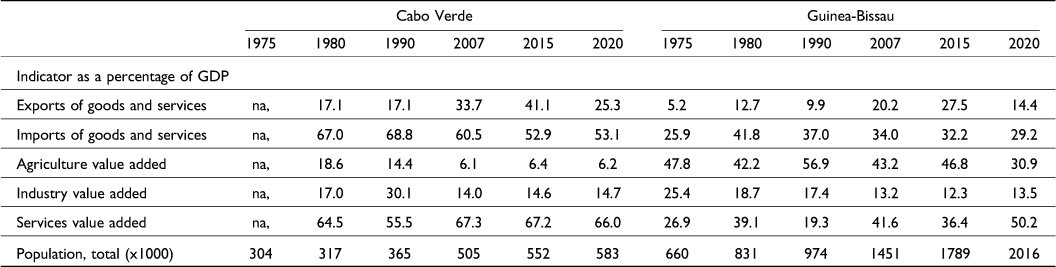
Examining structural transformation provides further insight into the divergence between the two countries. As shown in Table 1, the economic structures of both countries were similar at their separation. Agriculture played a key role alongside modest contributions from industry and services. However, their trajectories diverged significantly over time. Cabo Verde has transitioned into a service-based economy. In 2007, when Cabo Verde graduated from the LDC, services represented 67.3% of GDP, driven by tourism, foreign investment and the development of human capital (AfDB, 2012). The country also increased its export share, signalling deeper integration into global markets. In contrast, Guinea-Bissau remained heavily dependent on agriculture, mainly cashew, which expanded from 42.2% of GDP in 1980 to 56.9% in 1990 before returning to 43.2% in 2007 at the expense of the industrial sector. Although exports grew modestly, the economy failed to diversify, as policies prioritised short-term rent-seeking over long-term growth.
The Cabo Verde and Guinea-Bissau economies’ structures

Table 1. Long description
The table compares economic indicators as a percentage of GDP for Cabo Verde and Guinea-Bissau from 1975 to 2020. It has 7 rows and 14 columns. The columns are labeled with years: 1975, 1980, 1990, 2007, 2015, and 2020 for both countries. The rows are labeled with indicators: Exports of goods and services, Imports of goods and services, Agriculture value added, Industry value added, Services value added, and Population, total (x1000). Row 1: Exports of goods and services, 1975: na, 17.1, 17.1, 33.7, 41.1, 25.3, 5.2, 12.7, 9.9, 20.2, 27.5, 14.4. Row 2: Imports of goods and services, 1975: na, 67.0, 68.8, 60.5, 52.9, 53.1, 25.9, 41.8, 37.0, 34.0, 32.2, 29.2. Row 3: Agriculture value added, 1975: na, 18.6, 14.4, 6.1, 6.4, 6.2, 47.8, 42.2, 56.9, 43.2, 46.8, 30.9. Row 4: Industry value added, 1975: na, 17.0, 30.1, 14.0, 14.6, 14.7, 25.4, 18.7, 17.4, 13.2, 12.3, 13.5. Row 5: Services value added, 1975: na, 64.5, 55.5, 67.3, 67.2, 66.0, 26.9, 39.1, 19.3, 41.6, 36.4, 50.2. Row 6: Population, total (x1000), 1975: 304, 317, 365, 505, 552, 583, 660, 831, 974, 1451, 1789, 2016.
Source: World Development Indicators (WDI) 2024, World Bank.
Political stability, governance and institutional performance. Political stability is another key factor in the divergence between countries. Cabo Verde has established itself as a beacon of democracy in Africa, marked by peaceful power transitions and robust institutional frameworks (AfDB, 2012; Baker, Reference Baker2006; Meyns, Reference Meyns2002). The relatively peaceful transition of Cabo Verde to independence and its more educated civil service laid the foundation for greater political stability and institutional development (Lobban et al., Reference Lobban, Woronoff and Saucier2007). In contrast, Guinea-Bissau has endured a turbulent political landscape characterised by coups and systemic corruption. Guinea-Bissau, which suffered the full force of the liberation struggle, inherited a weakened state apparatus, leading to permanent political instability and deep-rooted internal divisions.
Guinea-Bissau’s political history since independence has been marked by chronic instability: a military coup in 1980 ended the union with Cabo Verde; a civil war from 1998 to 1999; the assassination of President João Bernardo Vieira in 2009; another military coup in 2012; and a transition to civilian rule in 2014, followed by continued political instability (Marshall & Marshall, Reference Marshall and Marshall2022; Stoleroff, Reference Stoleroff2013). This pattern continued with a further military coup in November 2025 (Reuters, 2025). These events are not random crises but a pattern of institutional failure where formal democratic processes are repeatedly subverted by military intervention and elite bargaining (Embaló, Reference Embaló2012; Jaló, Reference Jaló2023).
The peaceful transition of Cabo Verde to multiparty democracy in 1990 strengthened the country’s political institutions (AfDB, 2012; Meyns, Reference Meyns2002). The country ranks high on the political stability and governance indices, reflecting its commitment to democratic principles. In contrast, the Bissau-Guinean political environment has been marred by instability due to multiple coups. Since independence, the country has witnessed four successful coups, six attempted coups, five plotted coups and five alleged coups, highlighting its political volatility (Marshall & Marshall, Reference Marshall and Marshall2022; Stoleroff, Reference Stoleroff2013).
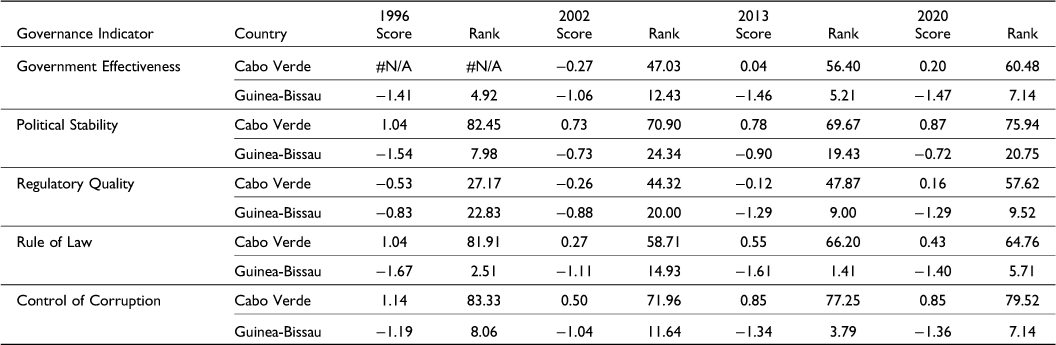
As illustrated by their performance on the World Bank World Governance Indicators (WGI) (Table 2). Cabo Verde outperformed Guinea-Bissau in key governance metrics, especially in terms of political stability and corruption control. Since the late 1990s, Cabo Verde has maintained a percentile rank between 70.90 and 82.45 for political stability, reflecting a relatively stable political environment. In contrast, Guinea-Bissau has struggled with persistent political instability, ranking from 7.98 in 1996 to 20.75 in 2020. This disparity is significant because political stability is the foundation of development, and the stability of Cabo Verde fosters an environment conducive to investment and growth.
World Bank governance indicators for Cabo Verde and Guinea-Bissau

Table 2. Long description
The table compares five governance indicators for Cabo Verde and Guinea-Bissau from 1996 to 2020: Government Effectiveness, Political Stability, Regulatory Quality, Rule of Law, and Control of Corruption. Cabo Verde consistently achieves positive scores and higher percentile ranks across most areas, reaching a peak rank of 79.52 in corruption control by 2020. Conversely, Guinea-Bissau registers negative scores and significantly lower ranks across all categories throughout the entire period.
Source: World Governance Indicator WGI 2023, World Bank.
Note: Score (−2.5 to 2.5) Rank is (0–100).
Cabo Verde has consistently demonstrated progress in controlling corruption, ranking at or near the 75th percentile or higher, with a peak of 83.33 in 1996 and maintaining a strong position at 79.52 in 2020. In contrast, Guinea-Bissau has struggled with widespread corruption, ranking at or below the 10th percentile, dropping from 8.06 in 1996 to 7.14 in 2020 (Table 2). This divergence reflects Cabo Verde’s ability to build public trust and improve governance through state reforms that modernise financial management and service delivery (AfDB, 2012). Similarly, Cabo Verde’s regulatory quality and rule-of-law scores show consistent improvement. In contrast, Guinea-Bissau has seen regulatory quality decline from 22.83 to 9.52 over the same period, while the rule of law has stagnated near the bottom, hovering between 2.51 and 5.71. These contrasting governance profiles highlight how Cabo Verde’s stronger institutions have fostered stability and development, while Guinea-Bissau’s weak governance continues to hinder its progress and economic potential.
These contrasting governance performances are further reinforced across the most widely used governance indicators, such as Polity5 dataset (Coppedge et al., Reference Coppedge, Gerring, Knutsen, Lindberg, Teorell, Marquardt and Wilson2024; Marshall et al., Reference Marshall, Gurr and Jaggers2021). For example, Cabo Verde consistently scores higher in democratic quality and institutional performance, reflecting its adherence to democratic principles and effective governance, while Guinea-Bissau remains at the lower end of the spectrum, characterised by weak democratic practices, political instability and governance deficits. These disparities are also evident in the Mo Ibrahim Index of African Governance (IIAG), where Cabo Verde ranks among the top performers in Africa, showing strong scores in safety, rule of law, participation and human development. Guinea-Bissau ranks near the bottom, reflecting chronic failures in governance, institutional capacity and service delivery. This consistent pattern across various governance measures underscores the centrality of robust institutions, accountability and effective governance in Cabo Verde to its development, while Guinea-Bissau’s governance weaknesses continue to hinder its progress and exacerbate its socio-economic challenges.
Guinea-Bissau’s history of governance dysfunction was exemplified by its severe fiscal mismanagement, highlighted by institutions such as the International Monetary Fund (IMF). The IMF acknowledged significant challenges in programme implementation during 2000 and 2001, driven by a weak fiscal stance amid political instability and increased military activities near the border areas (IMF, Reference IMF2015). This environment severely limited the authorities’ capacity to control the budgetary process. The extent of fiscal mismanagement is illustrated by unauthorised expenditures in 2000, which amounted to nearly 8% of GDP – a significant result that indicates systemic failures in budget oversight. Furthermore, the accumulation of new domestic arrears equivalent to about 6% of GDP further emphasised the government’s inability to manage its finances effectively. This period not only underscored the state’s fiscal vulnerabilities but also highlighted broader governance issues.
Foreign aid, state capacity and dependency. Following their independence, both Cabo Verde and Guinea-Bissau began to benefit from development finance. Concessional Official Development Assistance (ODA) supported several early public investments, beginning with infrastructure. In the years following its independence, Guinea-Bissau benefited more from concessional ODA than Cabo Verde.Footnote 4 . Both countries initially received substantial aid, but their ODA trajectories significantly diverged post-1980 (Figure 3). Between 1975 and 1979, Guinea-Bissau’s ODA increased from $20.7 million to $52.5 million, reflecting strong international support, while Cabo Verde’s aid increased from $8.7 million to $32.5 million, indicating more modest initial assistance. Svedberg et al. (Reference Svedberg, Olofsgård and Ekman1994) further emphasised that Guinea-Bissau had a higher level of ODA per capita compared to other countries, such as Gambia, Haiti, Bangladesh and Guinea. After the separation in 1980, Cabo Verde experienced a relatively consistent increase in ODA receipts, with a steady rise in aid over the years. However, Guinea-Bissau’s ODA volume was more volatile, fluctuating significantly over time, and remained relatively stagnant after the 2000s, showing limited growth in international aid, while Cabo Verde experienced a significant increase that surpassed that of Guinea-Bissau.
Evolution of net ODA received (Millions of US dollars).
Source: World Development Indicators (WDI).

Examining aid in terms of Gross National Income (GNI) and per capita provides more information on a country’s aid dependency and whether the aid is being used effectively. As depicted in Figure 3b, both countries initially depended heavily on foreign assistance until the mid-1980s, increasing ODA as a percentage of GNI. Thereafter, Cabo Verde followed a downward trend, while Guinea-Bissau remained almost stable. This decline in the Cabo Verde ODA to GNI ratio, along with an upward trend in ODA per capita, reflects successful economic diversification and GDP expansion. The government’s high dependence on aid was a key factor in the government’s decision to promote further economic diversification, particularly in tourism. The economic policies of Cabo Verde, focusing on sectors such as tourism and improved governance, contributed to this transformation (AfDB, 2012). The high ODA per capita, especially in the 1980s, demonstrated the successful allocation of resources and improvements in economic policy. According to Devarajan et al. (Reference Devarajan, Dollar and Holmgren2001), Cabo Verde was one of the largest recipients of ODA per capita in the world during this period, reflecting how the country’s stable governance allowed it to use aid effectively, improve development outcomes and promote long-term growth.
In Guinea-Bissau, the ratio of ODA to GNI fluctuated around a stagnant trend, driven primarily by the volatility of the country’s ODA flows, which are closely related to the civil war 1998–1999 triggered by an attempted coup and the subsequent instability period. Periods of increased aid following these crises were aligned with international efforts, including support from the United Nations, the World Bank and other bilateral donors, to stabilise the country and foster economic recovery. These fluctuations also highlight Guinea-Bissau’s dependence on external aid, given its small tax base, making it crucial for the government to maintain strong relationships with donors to stay in power (Kovsted & Tarp, Reference Kovsted and Tarp1999). The stagnation in both the ODA to GNI ratio and the ODA per capita underscores the limited economic diversification and highlights the challenge of translating foreign aid into tangible development outcomes.
Elite bargaining and institutional divergence
Elites, political power and political (in)Stability. Since independence, elite bargaining for power have dominated the political arena in Guinea-Bissau. A small military elite, primarily former independence leaders, has historically maintained control over the political system, although this dynamic has evolved since the 2012 coup and subsequent transitional arrangement (Embaló, Reference Embaló2012; Ferreira, Reference Ferreira2004; Forrest, Reference Forrest1992, Reference Forrest2003). These elites consolidated state power, establishing an autocratic system with minimal oversight. The armed forces assumed control over state affairs, becoming a key driver of the country’s chronic instability (Embaló, Reference Embaló2012; Forrest, Reference Forrest, Green and Chabal2016). Rooted in the liberation struggle, the deep influence of the military, particularly veterans and top commanders, has dominated the civilian government, shaping the political landscape of Guinea-Bissau (Herbert, Reference Herbert2003; Stoleroff, Reference Stoleroff2013). This dynamic reflects what Koudawo (Reference Koudawo2001) describes as a ‘command logic’ – a direct legacy of the armed independence struggle that militarised the state and entrenched the armed forces as the dominant political institution, systematically undermining civilian authority and constitutional order. This interpretation is further nuanced in Chabal and Green (Reference Chabal and Green2016), whose contributors argue that the politicised armed forces, while destabilising formal institutions, may paradoxically have prevented outright civil war by functioning as an informal conflict-management mechanism among competing elites.
In contrast, Cabo Verde distanced its military from politics and encouraged stronger political institutions. This civilianisation process involved former military leaders formally severing institutional ties with the armed forces while retaining only symbolic markers of their past roles – a crucial difference from Guinea-Bissau, where the military remained an active political actor. Cabo Verde’s trajectory aligns with Koudawo’s contrasting notion of an ‘administrative logic’, whereby the peaceful transition to independence preserved pre-existing civilian structures, fostering institutional continuity and a culture of governance grounded in the rule of law (Koudawo, Reference Koudawo2001).
The politicisation of Guinea-Bissau’s armed forces has entrenched military control, with elites co-opting civilian politicians into patronage networks linked to economic interests, including drug trafficking (Embaló, Reference Embaló2012; Stoleroff, Reference Stoleroff2013). Chabal and Green (Reference Chabal and Green2016) caution against reducing Guinea-Bissau’s crisis solely to the narco-state label, arguing that the evidential basis for this framing remains thin and that it risks obscuring the deeper structural dynamics of elite capture and post-colonial state fragility. This politicisation has nonetheless strengthened military control, weakened civilian authority and fuelled persistent instability. Persistent instability has undermined governance and led to frequent government changes and state fragility (Ture, Reference Ture2017). The country had 11 presidents and 23 governments between 1994 and 2021, with an average tenure of 2.4 years per president and 1.1 years per government (Jaló, Reference Jaló2023). Political instability peaked under President José Mário Vaz (2014–2020), who replaced five governments in one year, further weakening institutions and policy continuity. Despite attempts at a democratic transition, persistent deadlock and changes in leadership have left the state vulnerable to stagnation and a weak rule of law.
Unlike Guinea-Bissau, where elite bargaining led to instability and military dominance, Cabo Verde built a stable civilian-led government that kept the military out of politics. Its educated elites focused on strengthening democratic institutions and promoting accountability and transparency. After the coup in Guinea-Bissau in 1980 and the formation of the PAICV, the idea of unity between the two countries faded from Cabo Verdean politics. The PAICV introduced reforms that integrated a younger post-liberation generation into its leadership while implementing measures to expand political participation, all within the framework of the one-party system (Meyns, Reference Meyns2002). The country adopted a multiparty system in 1990, ensuring peaceful power transitions. These reforms have strengthened public trust in democracy, reinforcing press freedom and an independent judiciary (AfDB, 2012; Baker, Reference Baker2006, Reference Baker2009; Meyns, Reference Meyns2002).
The Cabo Verdean elites prioritised good governance, introducing anticorruption measures and reforms that promoted stability and economic growth. Strategic investments in infrastructure, technology, education and health improved public services, reduced inequality, contributed to social cohesion and created a strong economic foundation that supports political stability (AfDB, 2012). Unlike Guinea-Bissau, where elite competition has led to persistent political crises, Cabo Verde’s commitment to dialog, compromise and strategic planning has ensured long-term stability and resilience (AfDB, 2012; Meyns, Reference Meyns2002). These governance choices have allowed Cabo Verde to attract foreign investment, diversify its economy and build a solid foundation for sustainable development, further underscoring the divergence between the two nations.
Elite capture, rent-seeking and economic development. Elite behaviour is central to understanding the divergent paths of Guinea-Bissau and Cabo Verde. In Guinea-Bissau, elite capture has fuelled rent-seeking, with political and military leaders prioritising personal gain over long-term growth. Instead of investing in development, they exploit foreign aid, natural resources and even illicit activities such as drug trafficking to maintain power (Embaló, Reference Embaló2012; Shaw & Reitano, Reference Shaw and Reitano2013). Chabal and Green (Reference Chabal and Green2016) situate this within a broader pattern of elite capture, showing how military and political actors have instrumentalised the narco-state label to consolidate patronage networks, with drug trafficking revenues reinforcing rather than disrupting existing elite hierarchies. The government’s dependence on external aid, without effective integration into the economy, has created a system where funds support elite networks rather than promote structural transformation (Kovsted & Tarp, Reference Kovsted and Tarp1999; Svedberg et al., Reference Svedberg, Olofsgård and Ekman1994). In contrast, the Cabo Verde elites have strategically leveraged foreign aid, economic liberalisation and institutional reforms to drive sustainable growth, ensuring that governance structures remain accountable and transparent (AfDB, 2012).
In Guinea-Bissau, rent-seeking behaviour is particularly evident in the dominance of cashew exports, which account for more than 90% of total export earnings (Kyle, Reference Kyle2009). Although the sector can drive industrialisation, elites have instead imposed excessive taxes and fees, prioritising revenue extraction over value-added processing (Cont & Porto, Reference Cont and Porto2014). The failure of initiatives such as the Fund to Promote the Industrialization of Agricultural Products (FUNPI) illustrates how short-term elite interests have undermined economic diversification (S. Kyle, Reference Kyle2015). High transaction costs, bureaucratic inefficiencies and opaque export regulations have further hampered the development of the private sector, strengthening Guinea-Bissau’s dependence on primary commodity exports (IMF, Reference IMF2017). In contrast, the Cabo Verdean elites pursued economic diversification through tourism, services and foreign investment, reducing dependence on any single sector and allowing sustained economic expansion (AfDB, 2012; Baker, Reference Baker2009).
The role of military and political alliances further distinguishes elite behaviour in both countries. In Guinea-Bissau, the military remains deeply embedded in economic and political networks, with top officials engaging in drug trafficking and rent-seeking activities (Shaw, Reference Shaw2015). The lack of civilian control over the military has allowed persistent political instability, coups and governance failures (Embalo, Reference Embalo2015). In contrast, the Cabo Verdean elites successfully established civilian oversight of the military, ensuring that the security forces remain separate from political and economic affairs (Meyns, Reference Meyns2002). This separation has contributed to the country’s long-term stability, fostering a governance environment where institutions, rather than military factions, drive economic decision-making.
The legacy of rent distribution and neopatrimonial networks further underscores the stark contrast between the two countries. In Guinea-Bissau, elite bargaining revolves around controlling state resources, fostering a patronage system that prioritises political loyalty over economic efficiency (Mendes de Carvalho, Reference Mendes de Carvalho2009). The distribution of rents was strategically designed to benefit the core political elites of the one-party state, particularly the military and the petit bourgeoisie.Footnote 5 Economic liberalisation and foreign aid further reinforced elite capture, allowing a small group of politically connected asset holders, including the petit bourgeoisie and high-ranking officials, to monopolise resources (Galli, Reference Galli1990). These elites claimed thousands of acres of land and secured 60% of all medium- and long-term agricultural credit but failed to channel these resources into productive investments. Instead, they diverted international grants and agricultural credit into rent-seeking and unproductive ventures, reducing agricultural productivity and deepening structural inequalities and economic inefficiencies.
In contrast, Cabo Verde’s leadership took greater ownership of reforms, ensuring that aid and economic policies aligned with national priorities (Baker, Reference Baker2006). The country’s transition to multiparty democracy in 1990, although driven by elites, fostered public trust through inclusive policymaking and institutional transparency, reinforcing economic stability and long-term development (AfDB, 2012). While Cabo Verdean elites built a governance framework that promoted sustainable development, Guinea-Bissau’s elites prioritised rent-seeking and state capture. Cabo Verde’s commitment to economic diversification, transparency and institutional resilience is in stark contrast to the dependence of Guinea-Bissau on extractive economic practices and elite-driven political instability. These divergent paths highlight the decisive role of elite incentives and governance choices in shaping long-term development trajectories.
Beyond Guinea-Bissau and Cabo Verde: broader implications for development policies
The divergence between Guinea-Bissau and Cabo Verde illustrates that development trajectories are not solely determined by geography, colonial legacy or resource endowments. Rather, governance quality, institutional effectiveness and elite strategies play a decisive role in shaping economic outcomes.
Similar contrasts can be observed in other cases where nations with comparable structural characteristics have followed divergent paths due to differences in governance and elite behaviour. For example, Ghana and Cameroon share structural similarities, natural resources, coastal access, ethnolinguistic diversity and colonial legacies, but they have diverged in governance quality and development outcomes. Ghana has demonstrated stronger institutional resilience and democratic continuity, enabling consistent economic progress (Aryeetey et al., Reference Aryeetey, Harrigan and Nissanke2000). In contrast, Cameroon has struggled with elite capture, centralised power and corruption, which have slowed economic diversification and improvements in livelihoods (Fonchingong & Gemandze, Reference Fonchingong and Gemandze2009). This divergence echoes the Guinea-Bissau/Cabo Verde dynamic, where similar initial conditions lead to different outcomes based on governance choices and elite accountability.
Similarly, Mauritius and Madagascar share similar island geographies, colonial histories and natural resources; however, their trajectories have sharply diverged. Mauritius leveraged sound governance and social cohesion to build a stable, diversified economy (Brautigam, Reference Brautigam and Joseph1999). Despite its wealth in resources, Madagascar remains trapped in cycles of political instability, elite predation and economic stagnation (Razafindrakoto et al., Reference Razafindrakoto, Roubaud and Wachsberger2020). Like Guinea-Bissau, Madagascar’s challenges stem from weak institutions and elite capture; similarly, Cabo Verde and Mauritius demonstrate how governance can overcome structural constraints.
These cases reinforce the central argument that governance and elite choices mediate the impact of structural factors on development outcomes. Even in difficult contexts, governance interventions matter; elite bargains that prioritise national development are critical; and institutional resilience can be built through consistent reform. For Guinea-Bissau, Cabo Verde’s experience suggests that reforms in civilian–military relations, anticorruption and elite accountability are essential. Ghana and Mauritius offer models of how governance improvements can mitigate structural disadvantages. Across contexts, institutions and elite choices ultimately determine whether nations flourish or falter.
Conclusion
The persistence of disparities in wealth between nations remains a central issue in development practice. This study examines the economic divergence between Guinea-Bissau and Cabo Verde – two former Portuguese colonies that shared a colonial legacy and political unity before their separation in 1980. The comparison of both experiences highlighted how elite behaviour profoundly influenced long-term political and development trajectories. These findings align with the broader literature on development, emphasising that structural factors such as geography and resource endowments alone cannot fully explain economic divergence. Strategic investments in institutions, human capital and economic diversification can create an environment conducive to sustainable growth, whereas elite capture produces harmful effects such as political instability and rent-seeking. Addressing these governance challenges requires institutional reforms that promote transparency, accountability and a more inclusive political and economic system that reduces elite dominance and enhances public trust.
The contrasting experiences of Guinea-Bissau and Cabo Verde offer valuable lessons for other developing countries, particularly in sub-Saharan Africa, where elite bargaining and governance challenges continue to shape development outcomes. Strengthening governance frameworks, fostering inclusive economic policies and improving institutional resilience are essential steps towards sustainable development. Political stability, sound economic planning and effective leadership are critical for ensuring that economic progress is sustained over time.
The tale of Cabo Verde and Guinea-Bissau is ultimately a powerful illustration of the primacy of institutions and governance in post-colonial development. Their divergent trajectories demonstrate that neither colonial legacies nor natural resource endowments are destiny – the critical difference lay in the institutional choices made in the aftermath of independence. Guinea-Bissau’s path was defined by a militarised state, weak institutions and elite predation, producing a vicious cycle of instability and underdevelopment. Cabo Verde, in contrast, built a foundation of civilian rule, administrative capacity and democratic consolidation, which enabled it to overcome its geographical and resource constraints and emerge as one of Africa’s most stable and well-governed states. This comparison thus challenges structural determinism at its core: what ultimately separates these two nations is not what they inherited, but what their elites chose to build.
For academic research, this comparison offers invaluable insights into the complex interplay of history, institutions and elite behaviour in shaping the multifaceted nature of democracy and development in post-colonial Africa. It calls for greater scholarly attention to the agency of political elites as a primary explanatory variable – one that operates independently of, and sometimes against, structural conditions.
This study has limitations that future research could address. Although we examined sociocultural factors and informal institutions, further research could deepen our understanding of how these elements interact with formal institutions over time. Relying on certain datasets may not fully capture recent governance dynamics, particularly in Guinea-Bissau’s volatile political context. Future research could also systematically explore the role of external actors – including regional organisations, former colonial powers and emerging partners – in shaping elite behaviour and institutional development in both countries.
Competing interests
The author declares that there are none.