Introduction
Within the Lecanoromycetes O. E. Erikss. & Winka, the subclass Ostropomycetidae Reeb et al. has a high diversity of ascomata, thallus forms, symbiont preferences and ecological habits. Relationships among orders inside Ostropomycetidae have been difficult to resolve (e.g. Baloch et al. Reference Baloch, Lücking, Lumbsch and Wedin2010; Resl et al. Reference Resl, Schneider, Westberg, Printzen, Palice, Thor, Fryday, Mayrhofer and Spribille2015). Phylogenetic revision of the Lecanoromycetes (Miadlikowska et al. Reference Miadlikowska, Kauff, Högnabba, Oliver, Molnár, Fraker, Gaya, Hafellner, Hofstetter and Gueidan2014) placed the Arctomiales S. Stenroos, Miądl. & Lutzoni as a sister group to the Ostropales Nannf. with weak support, as part of a relatively well-supported clade which also contains Trapeliales B. P. Hodk. & Lendemer. Resl et al. (Reference Resl, Schneider, Westberg, Printzen, Palice, Thor, Fryday, Mayrhofer and Spribille2015) performed a series of topological hypothesis testing and rejected the sister group relationship of Arctomiales and Ostropales. Instead, the authors recognized Arctomiaceae as part of the order Baeomycetales Lumbsch, Huhndorf & Lutzoni based on its sister relationship to Xylographaceae Tuck. and Trapeliaceae M. Choisy ex Hertel. within a large clade that includes Baeomycetaceae Dumort. and Hymeneliaceae Körb. A recent revision of the orders and families within the Lecanoromycetes, based on a temporal banding approach (Kraichak et al. Reference Kraichak, Huang, Nelsen, Leavitt and Lumbsch2018), confirmed this topology and reduced the Arctomiales into synonymy with Baeomycetales.
Arctomiaceae is the only family of the Ostropomycetidae to associate with cyanobacteria of the order Nostocales T. Cavalier-Smith as their main photobionts (Miadlikowska et al. Reference Miadlikowska, Kauff, Högnabba, Oliver, Molnár, Fraker, Gaya, Hafellner, Hofstetter and Gueidan2014). Morphology-based revisions classified most lichens with jelly-like, homoiomerous thalli in the family Collemataceae Zenker, until Wedin et al. (Reference Wedin, Wiklund, Jørgensen and Ekman2009) showed that fungi forming such thalli represent a much broader phylogenetic diversity. Furthermore, it has been shown that the identity of the cyanobiont is likely to influence the thallus structure. For example, Magain & Sérusiaux (Reference Magain and Sérusiaux2014) demonstrated that in the genus Fuscopannaria P. M. Jørg., thalli of the Kroswia morphotype involve cyanobionts from a unique clade of Nostoc Vaucher ex Bornet & Flahault, which is phylogenetically distant from other Fuscopannaria photobionts. Recently, several species classified elsewhere have been transferred to Arctomiaceae based on molecular evidence, for example Moelleropsis humida (Kullh.) Coppins & P. M. Jørg. (currently Gregorella humida (Kullh.) Lumbsch; Lumbsch et al. Reference Lumbsch, del Prado and Kantvilas2005), Collema fasciculare (L.) F. H. Wigg (currently Arctomia fascicularis (L.) Otálora & Wedin; Otálora & Wedin Reference Otálora and Wedin2013) and Massalongia intricata Øvstedal (currently Steinera intricata (Øvstedal) Ertz; Ertz et al. Reference Ertz, Poulsen, Charrier and Søchting2017). Spribille & Muggia (Reference Spribille and Muggia2013) also discussed the possibility of two other Steinera species, S. polymorpha P. James & Henssen and S. sorediata P. James & Henssen, belonging in Arctomiaceae.
Otálora & Wedin (Reference Otálora and Wedin2013) recognized Collema fasciculare as a member of Arctomiaceae under the name of Arctomia fascicularis, despite the anatomical differences in comparison to other species of the genus but in the absence of convincing phylogenetic evidence for the recognition of a new genus. Later on, Jørgensen (Reference Jørgensen2014) proposed to resurrect the name Gabura Adans. to accommodate Collema fasciculare as Gabura fascicularis (L.) P. M. Jørg (spelt as ‘fasciculare’). Currently, the family Arctomiaceae contains five accepted genera: Arctomia Th. Fr., Gabura, Gregorella Lumbsch, Steinera Zahlbr. and Wawea Henssen & Kantvilas. Jørgensen & Palice (Reference Jørgensen and Palice2016) suggested that the morphology of Leptogium insigne P. M. Jørg. & Tønsberg resembled that of Gabura fascicularis, and that this species might also be a member of the genus Gabura. However, the formal transfer was never completed due to lack of molecular evidence. Leptogium insigne was later transferred to the genus Arctomia as A. insignis P. M. Jørg. & Tønsberg (Ertz et al. Reference Ertz, Poulsen, Charrier and Søchting2017). The geographical distribution of A. insignis remains unclear because the species is often confused with the morphologically similar but unrelated Leptogium brebissonii Mont., which has been reported from Australia, Brazil, France, Montenegro, Portugal and Tenerife. In contrast, A. insignis is found on the west coast of North America, including Alaska, British Columbia, California, Oregon (the type locality) and Washington, where L. brebissonii is thought not to occur (Carlberg Reference Carlberg2012). Another new species, A. borbonica, morphologically resembling A. insignis, was described from Reunion Island by Magain & Sérusiaux (Reference Magain and Sérusiaux2012). Later, despite the absence of genetic evidence, this species was synonymized with A. insignis (as Leptogium insigne) by Jørgensen & Palice (Reference Jørgensen and Palice2016).
Since many recent studies revealed numerous cases of similar morphotypes representing assemblages of distinct, genetically isolated lineages (e.g. Lücking et al. Reference Lücking, Dal-Forno, Sikaroodi, Gillevet, Bungartz, Moncada, Yánez-Ayabaca, Chaves, Coca and Lawrey2014, Reference Lücking, Moncada, McCune, Farkas, Goffinet, Parker, Chaves, Lőkös, Nelson and Spribille2017; Magain et al. Reference Magain, Miadlikowska, Goffinet, Sérusiaux and Lutzoni2017) and because cosmopolitan species seem to be the exception rather than the rule for lichen-forming fungi (e.g. Moncada et al. Reference Moncada, Lücking and Suárez2014; Lücking et al. Reference Lücking, Moncada, McCune, Farkas, Goffinet, Parker, Chaves, Lőkös, Nelson and Spribille2017; Magain et al. Reference Magain, Miadlikowska, Goffinet, Sérusiaux and Lutzoni2017), the aims of this project were to 1) reconstruct a multilocus phylogeny for the family Arctomiaceae; 2) re-evaluate the circumscriptions of genera using monophyly as the grouping criterion; 3) assess the taxonomic validity of A. borbonica and A. insignis. We present a four-locus phylogeny of the family Arctomiaceae, with a focus on the genus Gabura. We assessed the generic affinity of Arctomia insignis based on expanded taxon sampling. We also tested whether A. borbonica represents a distinct lineage sister to A. insignis. In addition, we assessed the phylogenetic placement of recently acquired putative specimens of A. insignis, and other members of Arctomiaceae, in the context of the most comprehensive taxon sampling of the family to date.
Material and Methods
Taxon sampling and DNA sequence acquisition
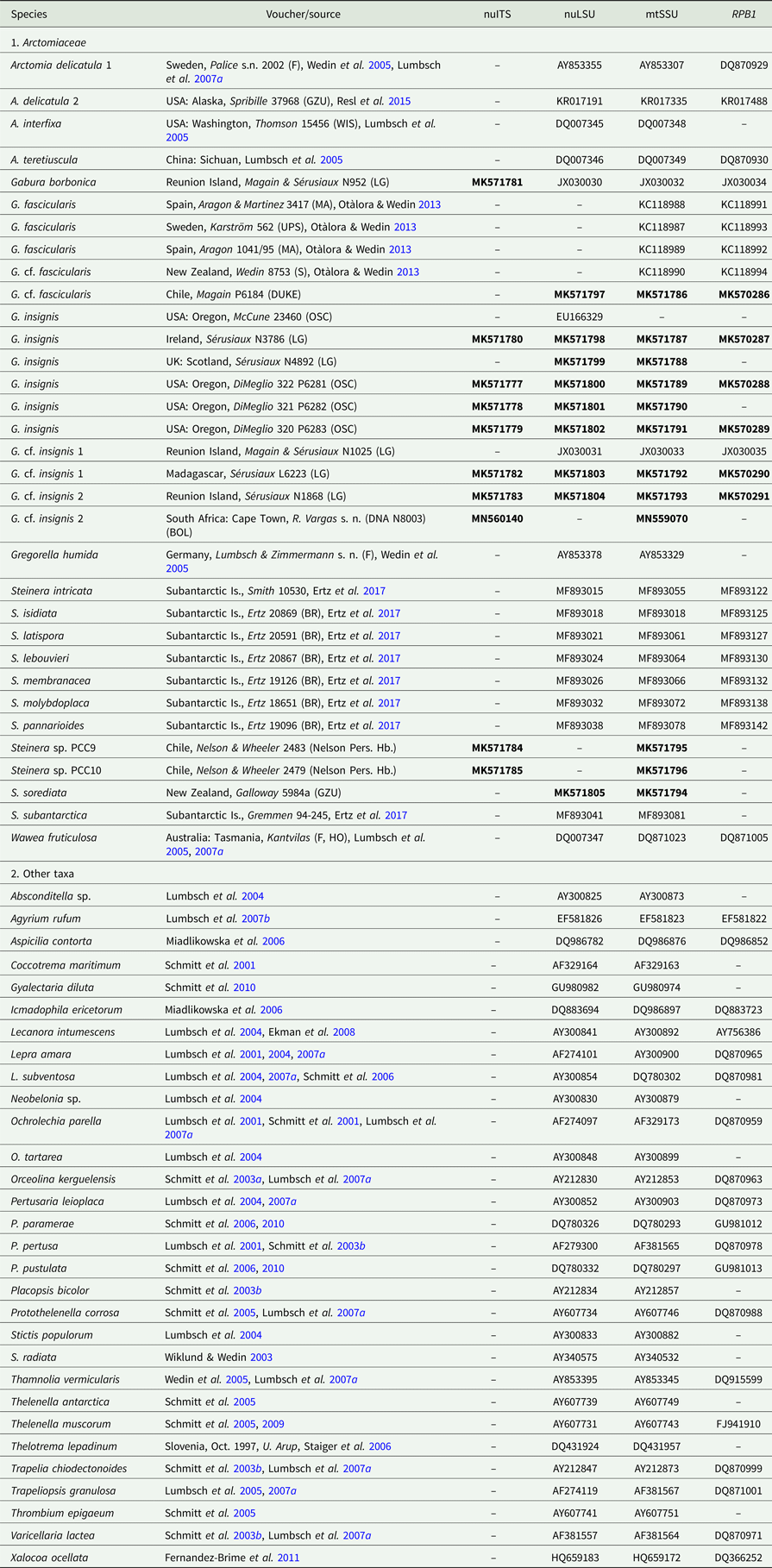
We collected eight specimens morphologically identified as Arctomia insignis or A. borbonica from the USA (Oregon), Ireland, Scotland, Madagascar, Reunion Island and South Africa, as well as one specimen identified as G. fascicularis from Chile. For each of the nine specimens, we sequenced four loci of the mycobiont DNA: the entire ITS regions (internal transcribed spacer 1, 5.8S ribosomal RNA gene and internal transcribed spacer 2; ITS), the nuclear large subunit ribosomal RNA gene (nuLSU), the mitochondrial small subunit ribosomal RNA gene (mtSSU), and the protein-coding RNA polymerase II largest subunit (RPB1), following protocols described in Magain & Sérusiaux (Reference Magain and Sérusiaux2012, Reference Magain and Sérusiaux2015). We also sequenced ITS of the type material of A. borbonica (N952), mtSSU and nuLSU for a specimen of Steinera sorediata from the type locality, and ITS and mtSSU for two unidentified collections of Steinera from Chile. We generated 10 new ITS sequences, nine nuLSU, 12 mtSSU and six RPB1, giving a total of 37 new sequences (Table 1). We downloaded sequences from GenBank representing the diversity of Baeomycetales and selected orders from Ostropomycetidae (Kraichak et al. Reference Kraichak, Huang, Nelsen, Leavitt and Lumbsch2018) and added sequences of Lecanora intumescens (Lecanorales Nannf.) to root the tree.
Specimens of Ostropomycetidae used in the 3- and 4-locus datasets for phylogenetic and species discovery analyses. Voucher information (for Arctomiaceae) is provided and/or details of the source of the previously published sequences and GenBank reference numbers for each locus. Newly generated sequences are in bold. Details of the outgroup Lecanora intumescens (Lecanorales) are also provided.
We assembled single-locus datasets using Mesquite v. 3.1.1 (Maddison & Maddison Reference Maddison and Maddison2016). Sequences were aligned using MAFFT v. 7.305b with default settings (Katoh et al. Reference Katoh, Misawa, Kuma and Miyata2002). Substitutions and indels between sequences of the A. insignis/A. borbonica group were counted after alignment. After manual exclusion of ambiguously aligned characters, we combined them into two datasets: a three-locus dataset of 63 specimens containing nuLSU (903 characters), mtSSU (605 characters) and RPB1 (654 characters); a four-locus dataset containing, in addition to the three loci, the ITS sequences (653 characters) of eight representatives of the A. insignis/A. borbonica group (Table 1). We also assembled a two-locus dataset (ITS and mtSSU with 486 and 790 characters, respectively) for the sequences from the three Steinera specimens along with all the sequences for ITS and mtSSU available in GenBank for this genus.
Phylogenetic and species discovery analyses
We delimited six subsets for the three-locus dataset (nuLSU, mtSSU, RPB1 1st, 2nd and 3rd codon positions, and the intron of RPB1) and seven subsets for the four-locus dataset (addition of ITS to the six subsets) and ran PartitionFinder2 v. 2.1.1 (Lanfear et al. Reference Lanfear, Frandsen, Wright, Senfeld and Calcott2016), searching all models with the greedy algorithm and BIC as the model selection criterion to determine the best partitioning of the data. For the four-locus dataset, four subsets were delimited: the first was composed of ITS and the intron of RPB1 (GTR + G), the second of mtSSU (GTR + I+G), the third of nuLSU and RPB1 1st and 2nd codon positions (GTR + I+G), and the fourth of RPB1 3rd codon positions (GTR + I+G). The same four subsets were delimited in the three-locus dataset, except that ITS was not included.
We ran RAxML v. 8.2.9 (Stamatakis Reference Stamatakis2006) on the two datasets using the best partition schemes with the GTRGAMMA model, performing 1000 bootstrap pseudoreplicates and searching for the best maximum likelihood (ML) tree simultaneously. RAxML analysis with similar settings was completed on the two-locus Steinera dataset, which was partitioned according to the loci. In addition, we performed a MrBayes v. 3.2.6 analysis (Ronquist & Huelsenbeck Reference Ronquist and Huelsenbeck2003) as implemented on the CIPRES portal (Miller et al. Reference Miller, Pfeiffer and Schwartz2010), using the same partition scheme and the best models of nucleotide substitutions as determined by PartitionFinder2. We conducted two runs of four chains for 50 million generations, sampling every 1000th generation, and discarding the first 10 000 trees (20%) as burn-in.
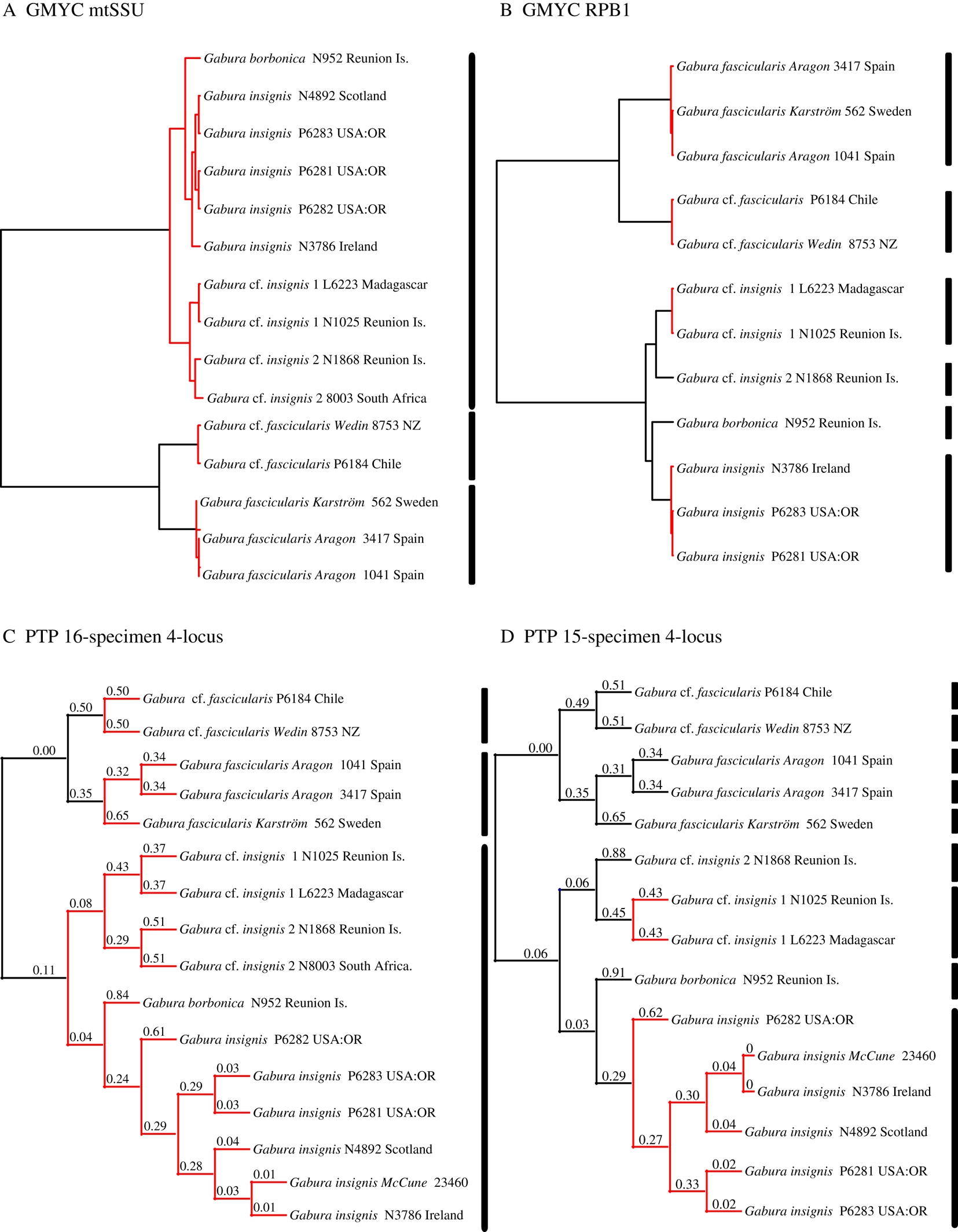
We further generated single-locus chronograms for the Gabura clade for the mtSSU (16 taxa, 763 characters) and RPB1 (12 taxa, 653 characters) because they were the two loci with the lowest quantity of missing data. We determined the best substitution models using MrModeltest2 v. 2.3 (Nylander Reference Nylander2008) for the mtSSU (substitution model GTR), the RPB1 1st and 2nd codon positions (GTR), RPB1 3rd codon position (K80), and for the non-coding regions (JC). We ran BEAST v. 1.8.4 (Drummond & Rambaut Reference Drummond and Rambaut2007) for 50 million generations, sampling every 1000th generation, with default priors. The RPB1 dataset was partitioned into three subsets (1st and 2nd codon positions together, 3rd codon positions, and non-coding regions) and the analysis was run with unlinked substitution models. We removed 10% of the trees as burn-in and generated a maximum clade credibility tree. These trees were used for GMYC (General Mixed Yule Coalescent model, Pons et al. Reference Pons, Barraclough, Gomez-Zurita, Cardoso, Duran, Hazell, Kamoun, Sumlin and Vogler2006) species discovery analyses using R (R Core Team 2016) package splits v. 1.0 (Ezard et al. Reference Ezard, Fujisawa and Barraclough2009). We also ran the PTP (Poisson Tree Process, Zhang et al. Reference Zhang, Kapli, Pavlidis and Stamatakis2013) species discovery method as implemented on the portal https://species.h-its.org (last accessed 27 September 2019) on the four-locus phylogram of the Gabura group, using default parameters. Additional GMYC and PTP tests were performed on phylogenetic trees after pruning selected taxa, to test the sensitivity of the analyses.
Results and Discussion
The topologies of the ML trees resulting from the three- and four-locus datasets match, including branch lengths and bootstrap support (four-locus tree is shown; Fig. 1). Overall, the majority of branches in the phylogenetic tree of the Ostropomycetidae are highly supported, except for deep relationships including the placement of the family Arctomiaceae in relation to the remaining orders and the relationships among them (although PP support is usually high, bootstrap values are below 70%) (Fig. 1). Contrary to Kraichak et al. (Reference Kraichak, Huang, Nelsen, Leavitt and Lumbsch2018), the order Trapeliales is nested in Ostropales, with Protothelenella corrosa (Körb.) H. Mayrhofer & Poelt and Thrombium epigaeum (Pers.) Wallr. (Protothelenellaceae) placed outside of the clade containing Ostropales and Trapeliales. Our topology does not support the inclusion of Arctomiales and Trapeliales in Baeomycetales. However, our sampling for the latter order does not include all families (Kraichak et al. Reference Kraichak, Huang, Nelsen, Leavitt and Lumbsch2018). Our topology is not in conflict with the phylogeny presented in Otálora & Wedin (Reference Otálora and Wedin2013), where phylogenetic relationships inside the family Arctomiaceae were mostly unresolved due to low bootstrap support.
Phylogenetic tree (best ML tree) of taxa in the Ostropomycetidae resulting from the RAxML analysis on a four-locus dataset (ITS, nuLSU, mtSSU, RPB1) for a total of 2815 characters and 63 specimens. ML bootstrap values and Bayesian posterior probabilities are shown above or below branches, before and after the slash, respectively. Thick black branches received ML bootstrap support value ≥ 70, while thick grey branches received Bayesian posterior probability ≥ 0.95 but MS bootstrap support value <70. The grey box highlights the family Arctomiaceae. Lecanora intumescens is used to root the tree.

We recovered a monophyletic family Arctomiaceae with similar internal relationships as reported in Magain & Sérusiaux (Reference Magain and Sérusiaux2012) and Ertz et al. (Reference Ertz, Poulsen, Charrier and Søchting2017). Arctomia interfixa (Nyl.) Vain. appears as the first-diverging lineage in the family, and clearly does not belong to Arctomia s. str., as already reported in other studies (Magain & Sérusiaux Reference Magain and Sérusiaux2012; Otàlora & Wedin Reference Otálora and Wedin2013). The two monotypic genera Gregorella and Wawea are resolved outside of the clade comprising the remaining genera in the family (Arctomia, Gabura and Steinera).
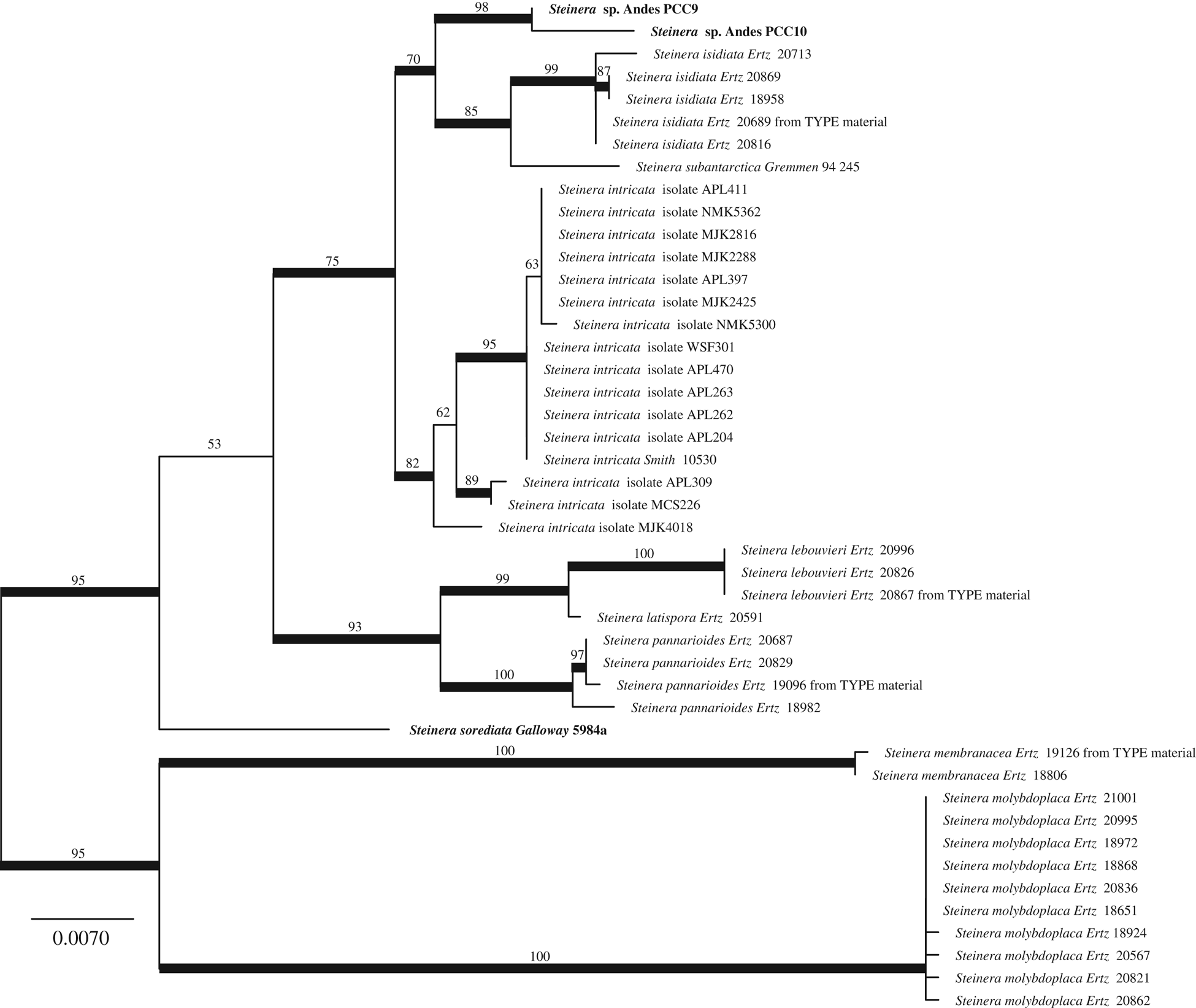
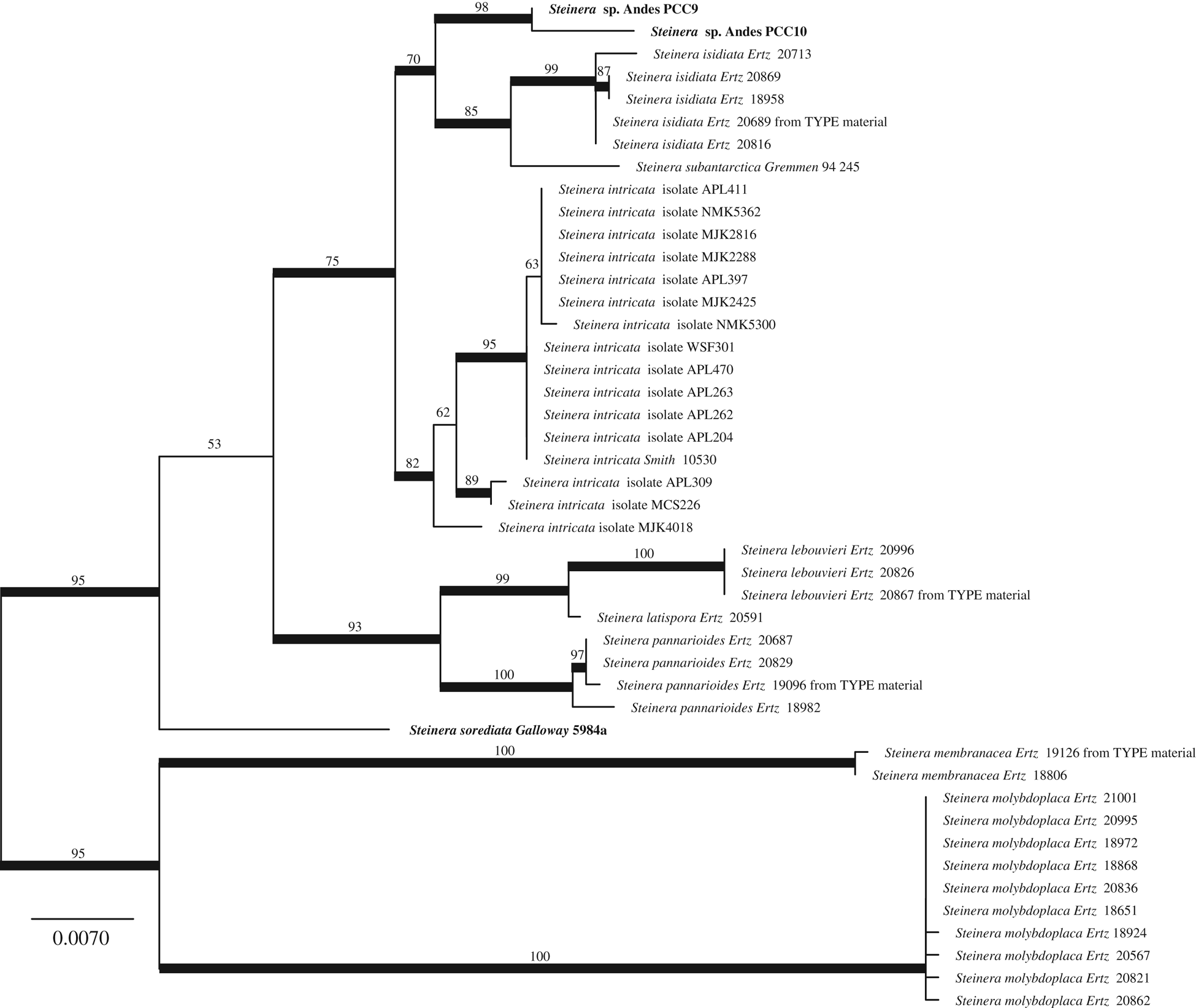
Within the genus Steinera, S. membranacea Ertz & R. S. Poulsen and S. molybdoplaca (Nyl.) Zahlbr. form a sister clade to the remaining species of the genus followed by S. sorediata. Two unidentified specimens from Chile (PCC9 and PCC10) cluster with S. intricata (Øvstedal) Ertz and S. isidiata Ertz & R. S. Poulsen. The two-locus analysis focusing on Steinera suggests that the newly added collections represent a new species, sister to a clade composed of S. isidiata and S. subantarctica (Øvstedal) Ertz (Fig. 2).
Phylogenetic tree of Steinera species resulting from the RAxML analysis on a two-locus dataset (ITS, mtSSU) for a total of 45 taxa and 1276 characters. ML bootstrap values are shown above branches. Thick black branches received ML bootstrap support value ≥ 70. Newly sequenced specimens are shown in bold. The tree was rooted according to Fig. 1.
The genus Steinera is sister to a clade composed of Arctomia s. str. (A. delicatula Th. Fr., the type species of the genus, and A. teretiuscula P. M. Jørg.) and representatives of the genus Gabura (Fig. 1), including a sister relationship of Gabura fascicularis with representatives of the G. insignis/G. borbonica group (formal combinations which have been introduced in this study to accommodate Arctomia insignis/A. borbonica). As currently delimited, and with the exclusion of the isolated species A. interfixa, the genus Arctomia is characterized by crustose-squamulose, semi-gelatinous thalli and biatorine apothecia (Henssen Reference Henssen1969; Jørgensen Reference Jørgensen2003; Otalóra & Wedin Reference Otálora and Wedin2013). Other characters referred to by Jørgensen (Reference Jørgensen, Jørgensen, Tønsberg and Vitikainen2007), such as the absence of amyloid structures in the ascus apex and fusiform, multiseptate ascospores, are no longer autopomorphic within the family because they are also present in the Collema fascicularis group (Otalóra & Wedin Reference Otálora and Wedin2013).
Gabura fascicularis is split into two well-supported and geographically distant groups: one with European specimens (from Spain and Sweden) and the second with specimens from Chile and New Zealand (Fig. 1). The G. insignis group is composed of four well-supported clades including G. insignis s. str., containing a sequence from the type material (McCune 23460) from Oregon, together with other specimens from Oregon, Scotland and Ireland (Fig. 1). The origin of the type material was erroneously reported as ‘Washington, Lane Co., near mouth of Gwynn Creek on Pacific Ocean’ (Jørgensen & Tønsberg Reference Jørgensen and Tønsberg2010) although it comes from Lane County in Oregon. The second clade is represented by the type specimen of G. borbonica (N952) and is sister to G. insignis s. str. (Fig. 1). A specimen from Reunion Island previously identified as Arctomia borbonica (N1025, Magain & Sérusiaux Reference Magain and Sérusiaux2012) and one specimen from Madagascar (L6223) were placed in a separate lineage, whereas another specimen from Reunion Island (N1868) together with a single collection from South Africa (N8003) is part of another separate clade, representing early divergence events within the G. borbonica/G. insignis species complex (but with relatively low support; BS = 69, PP = 0.61) (Fig. 1). These four distinct lineages revealed within the G. insignis group probably represent separate species. GMYC species discovery analyses of RPB1, as well as PTP analysis of the four-locus dataset (15 specimens), suggest the presence of four species in this species complex, whereas GMYC analysis of mtSSU and PTP analysis of the 16-specimen dataset (but with PP = 0.11, Fig. 3C) suggest that they all belong to the same single species (Fig. 3). These analyses are sensitive to sampling, as removal of a single taxon from the mtSSU (data not shown) or from the combined PTP analyses (Fig. 3C & D) resulted in the recognition of several species in the group. In this case, species delimitation results are inconclusive and need to be interpreted with caution.
Species discovery results for the genus Gabura based on GMYC analyses on the chronograms of mtSSU (A) and RPB1 (B), and PTP analyses on the four-locus phylogram with 16 specimens (C) or 15 specimens (D). Red branches represent intraspecific branching events, and black branches interspecific branching events. Vertical bars to the right of the trees summarize the best ML species delimitations.
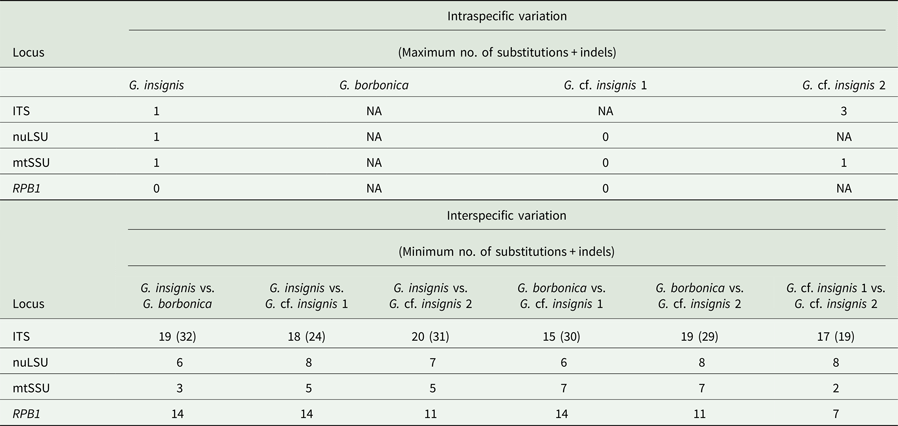
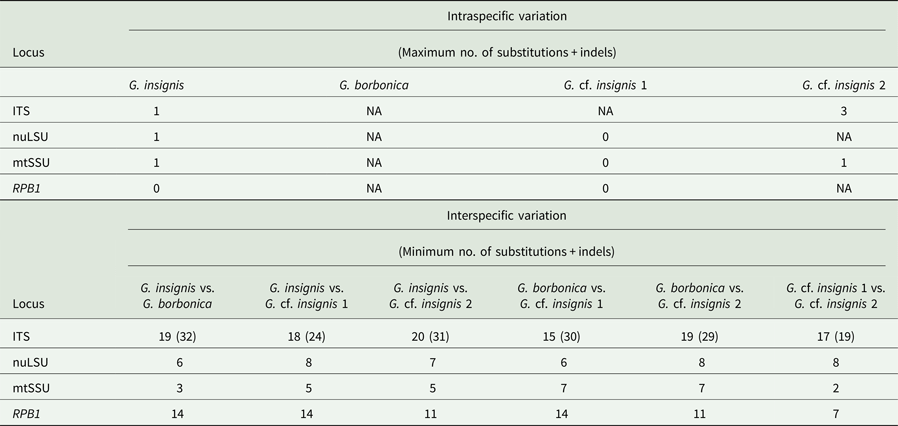
The four lineages of the G. insignis/G. borbonica complex form a monophyletic clade and could represent a single species corresponding to a broadly defined and widely distributed G. insignis, as suggested earlier by Jørgensen & Palice (Reference Jørgensen and Palice2016) (Fig. 1). However, several lines of evidence suggest that each lineage represents a distinct species. First, there is almost no genetic differentiation among specimens of G. insignis from Oregon, Ireland and Scotland, suggesting that this species has low intraspecific genetic variation (Table 2). Furthermore, if the four lineages reflect a biogeographical structure within a species, we would expect to see all populations from Reunion Island clustered together. Instead, G. borbonica shares a most recent common ancestor with European and North American representatives of G. insignis, while specimens from other lineages of G. cf. insignis from Madagascar, Reunion Island and South Africa form the most early-diverging lineage in this clade (Fig. 1). Branch lengths between these four lineages are similar to the branch lengths between species in the closely related genus Steinera (Fig. 1), suggesting a similar level of genetic differentiation between these specific-level lineages. Furthermore, a large difference between intraspecific and interspecific variation in all loci suggests the presence of a barcoding gap (Table 2) between these four putative species (with the exception of the mtSSU sequences of G. cf. insignis 1 and G. cf. insignis 2, which are more similar). As mentioned, G. fascicularis also seems to be composed of two lineages (Fig. 1), probably representing distinct species with a similar strong biogeographical pattern: one clade in Europe (Spain and Sweden) and the other in the Southern Hemisphere (Chile and New Zealand). We also noticed subtle morphological differences in the examined collections although, as clearly demonstrated by the original description of Leptogium insigne (Jørgensen & Tønsberg Reference Jørgensen and Tønsberg2010), considerable variation had already been observed. The monophyletic group of G. fascicularis, G. borbonica, G. insignis and other accessions here referred to as G. cf. insignis 1 and 2 is morphologically heterogeneous. Gabura fascicularis has a subfoliose thallus with numerous erect lobules, abundant and crowded apothecia with very thick rugose thalline margins, and vermiform, twisted ascospores, 10–15-septate, 50–95 × 5–6 μm, whereas all G. borbonica, G. insignis and G. cf. insignis 1 and 2 accessions develop subfoliose to granular thalli, often very crumpled, usually with indistinct lobes and produce granular, yellowish to brownish soralia, but never apothecia. Therefore, all the characters of apothecium development and structure, ascus apex and ascospores identified by Otalóra & Wedin (Reference Otálora and Wedin2013) to demonstrate the phylogenetic affiliation of the Collema fasciculare group with the Arctomiaceae, are not applicable to the G. insignis/G. borbonica complex. Despite these morphological differences, we refrain from describing a new genus to accommodate these taxa because their sister relationship with G. fascicularis is strongly supported and our sampling did not include many poorly explored territories. Species potentially related to G. fascicularis (Collema leptosporum, C. papuanorum and C. uviforme; see Degelius Reference Degelius1974) share a similar morphology. Interestingly, G. borbonica is the most morphologically distinct taxon within the G. insignis group, and easily distinguished from its sister species, G. insignis (see Taxonomic Treatment).
Comparison of intraspecific variation (the maximum number of substitutions/indels between two sequences of the same species) and interspecific variation (the minimum number of substitutions between two sequences of two distinct species) in four loci of lineages of the Gabura insignis clade. Indels were treated as a fifth character state, except in ITS where they were very frequent. For ITS, the number including indels is indicated in parentheses. NA (not applicable) is indicated when only one sequence was available for a given species.
The current sampling suggests a complex pattern of genetic diversity within G. insignis, regardless of the ultimate delimitation of this species. Three distinct phylogenetic lineages occurring in the Indian Ocean are present on Reunion Island. The genetic diversity found in this island alone is higher than the diversity between collections from Europe and North America. The only lineage that has been sampled outside of the Mascarenes and Africa (i.e. in Europe and the Pacific Northwest of North America), G. insignis s. str., is one of the most recently diverged lineages within the G. insignis clade. If we were to assume that our sampling reflects the global population structure of the taxon, most of its genetic diversity was detected in the Indian Ocean, suggesting that this is the most probable origin and diversification centre for this group. Under this scenario, a single dispersal event might have led to the spread of the group to Europe and the Pacific Northwest of North America. However, the recent discovery of G. insignis in the British Isles, one of the best-explored areas in the world, underlines the deficiencies in our estimation of lichen distribution ranges. It is unclear whether the specimen from Ecuador reported by Jørgensen & Palice (Reference Jørgensen and Palice2016) belongs to G. insignis, G. borbonica, one of the two unnamed early diverging lineages, or if it represents a new distinct lineage.
We refrain from describing new species for the two early diverging lineages in the G. insignis group because they are each represented only by two relatively small, and morphologically cryptic specimens. A lack of obvious diagnostic characters is the reason why these lichens might be overlooked and thus their distributions should be much broader than currently known.
Transferring Arctomia insignis and A. borbonica to the genus Gabura solves the problem of morphological and anatomical heterogeneity in the genus Arctomia (following Henssen (Reference Henssen1969)) raised by Jørgensen & Palice (Reference Jørgensen and Palice2016). As recircumscribed, the monophyletic Arctomia s. str. currently encompasses two species, A. delicatula and A. teretiuscula. All species of the Collema fasciculare group transferred to Arctomia by Otálora & Wedin (Reference Otálora and Wedin2013) probably represent Gabura, but DNA evidence is required before applying any taxonomic changes to this complex group. The two subantarctic species, Arctomia latispora Øvstedal and A. subantarctica Øvstedal (Øvstedal & Gremmen Reference Øvstedal and Gremmen2001, Reference Øvstedal and Gremmen2006), were transferred to the genus Steinera (Ertz et al. Reference Ertz, Poulsen, Charrier and Søchting2017). Based on the reconstructed phylogeny (Fig. 1), Arctomia interfixa does not belong to Arctomia s. str. and a new genus should be erected to accommodate this species.
Taxonomic Treatment
Gabura borbonica (Magain & Sérusiaux) Magain & Sérusiaux comb. nov.
MycoBank No.: MB 883418
Basionym: Arctomia borbonica Magain & Sérus., Mycokeys 4, 16 (2012); type: Reunion, Forêt de Bébour, track starting at gîte de Bélouve toward Piton des Neiges, 21°4′49″S, 55°31′24″E, 1850 m, 9 November 2009, N. Magain & E. Sérusiaux s. n. (holotype LG).
Gabura borbonica and G. cf. insignis 1. A–C, type of G. borbonica. Conspicuous dark lobes (almost black) with a thick brownish blue soredioid margin are typical for this species. The white thallus in B is Leioderma erythrocarpum (Delise ex Nyl.) D.J. Galloway & P.M. Jørg. D & E, G. cf. insignis 1, from Reunion Island (DNA 1025). Lamellate thallus with proliferation of verruciform masses (D) that become aggregated and erect (lobes) with dark bluish to brownish soredioid margins. Scales: A = 1 cm; B–E = 2 mm.
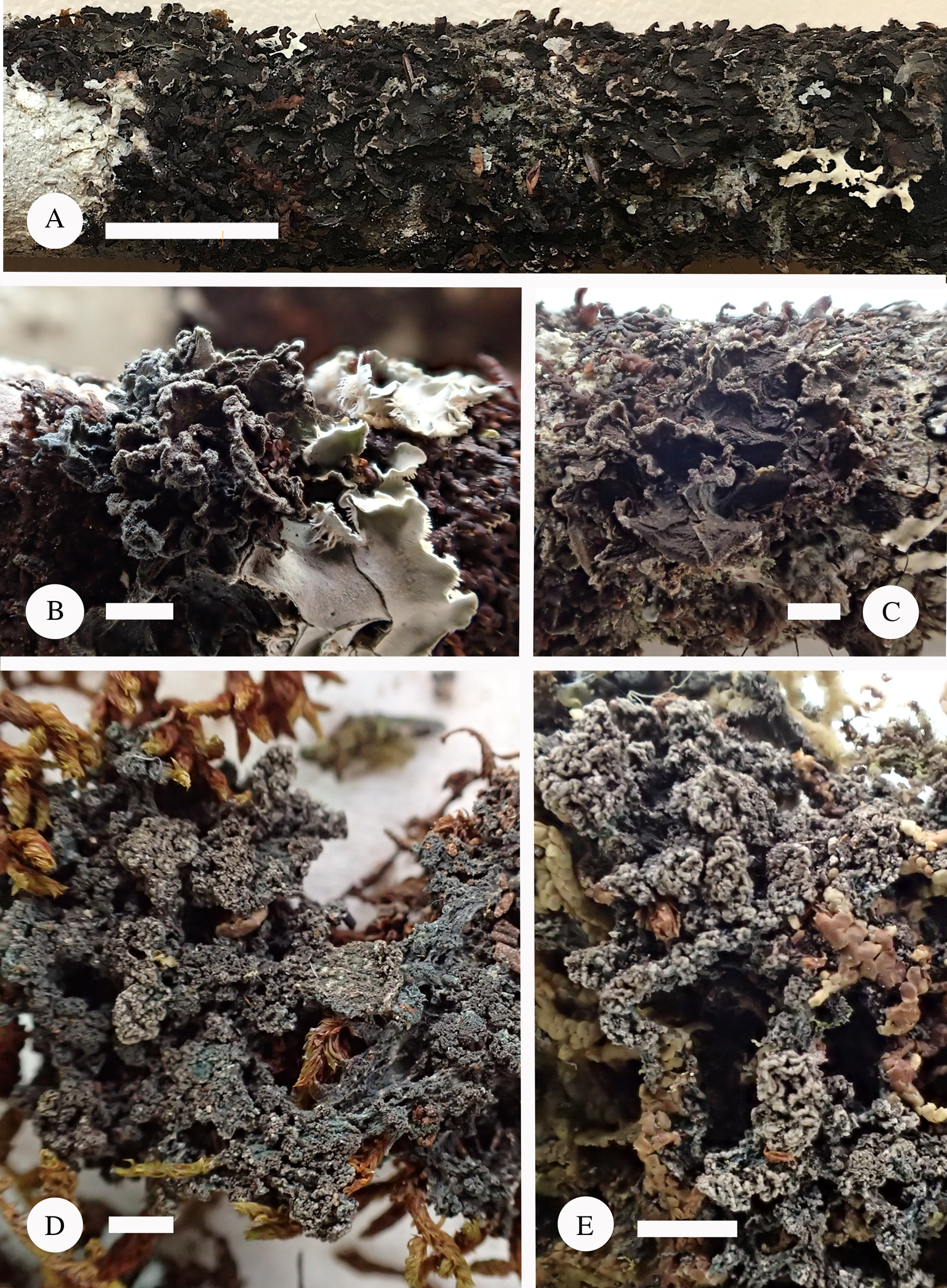
Thallus up to 1 cm across, with distinct c. 1.5–2 mm large lobes, brownish black when dry, with a well-developed linear soredioid margin which may become bluish; lobes with strongly developed wrinkles, somewhat scrobiculate, with extremities erect and corrugated.
Gabura insignis (P. M. Jørg. & Tønsberg) Magain & Sérusiaux comb. nov.
MycoBank No.: MB 883419
Basionym: Leptogium insigne P. M. Jørg. & Tønsberg, Biblioth. Lichenol. 104, 242 (2010); type: USA, Oregon [incorrectly reported as Washington in protologue], Lane Co., near mouth of Gwynn Creek on Pacific Ocean, 44°17′N, 124°06′W, 10 m, on leaning Alnus trunk in forest, 23 February 1996, B. McCune 23460 (holotype OSC (seen by TS), isotype BG, not seen).
Synonym: Arctomia insignis (P. M. Jørg. & Tønsberg) Ertz (as ‘insigna’), in Ertz et al., Phytotaxa 324(3), 231 (2017).
Gabura insignis (A–F) and Steinera sp. (G & H). A, collection of G. insignis from USA (Oregon; DNA 6282). B, collection from Ireland (DNA 3786); circled area enlarged in E. C, collection from UK (Scotland; DNA 4892); circled area enlarged in F. D, collection from USA (Oregon; DNA 6281); white thallus is a fragment of Peltigera. E, collection from Ireland (DNA 3786); dark brownish lobes with yellowish punctiform soredioid masses are typical of this specimen but can be absent in other accessions of G. insignis. F, collection from UK (Scotland; DNA 4892). G & H, Steinera sp. (Tim Wheeler & Peter Nelson 2507); G, thallus and H, ascospores. Scales: A–C = 1 cm; D = 2 mm; E & F = 1 mm; H = 10 μm.
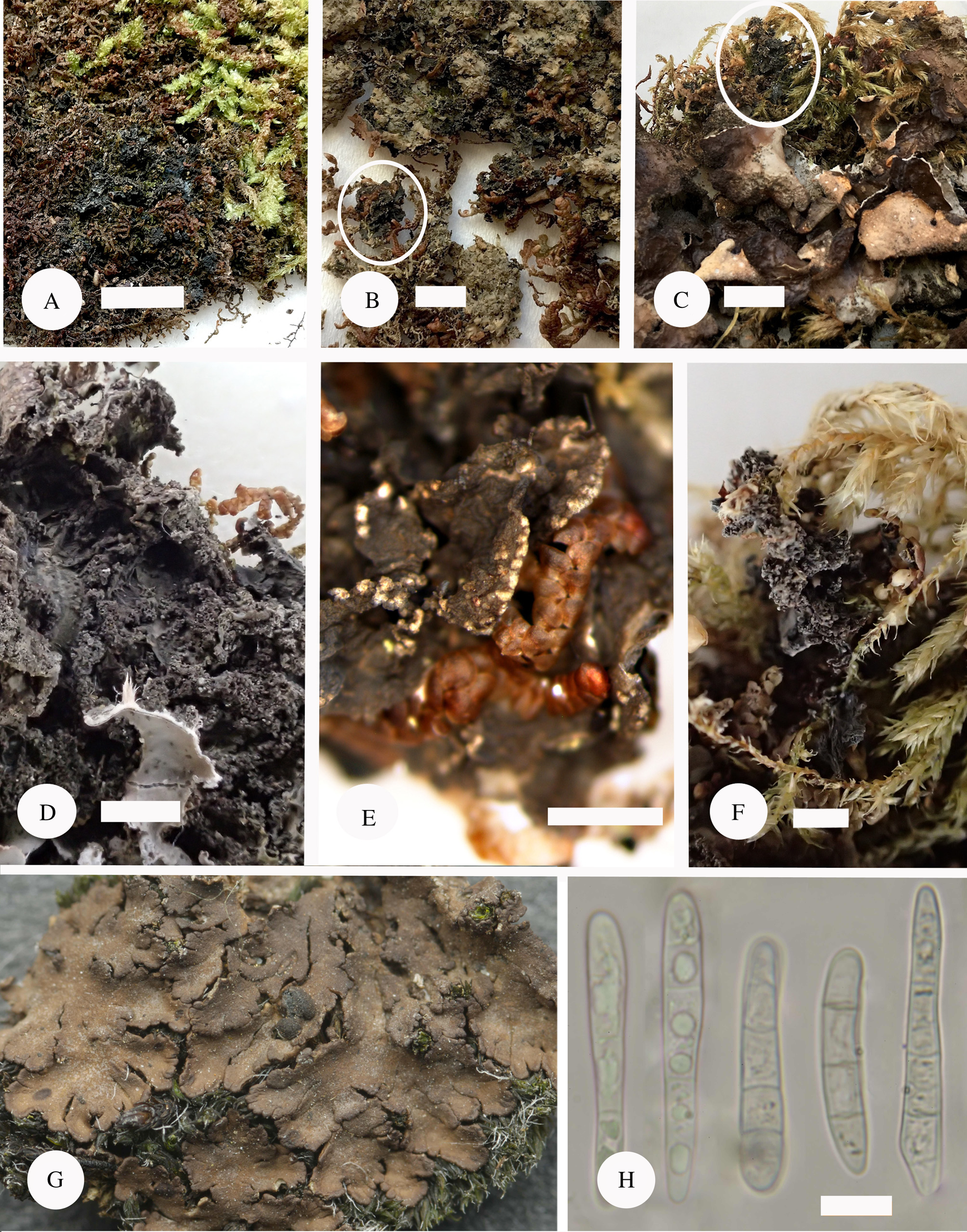
Short description for the European collections (Ireland and Scotland): thallus with distinct and erect lobes, c. 1.0–1.2 mm across, dark brown, without any bluish tinge, sometimes with punctiform and rarely linear soralia which are yellowish to dark brown, never bluish and not forming a linear soredioid margin; main lobes flat but can be overgrown by erect lobes and soredioid masses in some parts of the thallus.
Notes
In Europe, Gabura insignis is difficult to see in the field as thalli are minute (c. 2–5 mm across) and never abundant, unlike in western North America. It could be mistaken for a poorly developed Leptogium brebissonii, but it has not been found in the collections filed under that name in E (B. J. Coppins, personal communication) or in LG. Interestingly, it was not found in our large collections of Peltigerales from Macaronesia (Canary Islands, Madeira and the Azores). This unexpected discovery demonstrates that our understanding of lichen biodiversity is still incomplete, and more fieldwork is necessary even in well-researched territories such as the British Isles.
Specimens examined
Ireland:Kerry: S of Killarney, near the Muckross Lake, trees in parkland conditions, 52°01′05″N, 09°30′15″W (coordinates centred on Muckross Castle), alt. 30 m, ii 2014, E. Sérusiaux s. n. (LG DNA 3786).—Great Britain:Scotland: V.C. 104, Isle of Skye, Dunvegan Park, park with various trees, incl. exotic species, 57°26.49′N, 06°35.17′W, alt. 20 m, vi 2015, E. Sérusiaux s. n. (LG DNA 4892).
Gabura cf. insignis 1
Flat and very thin thallus blade up to 2–3 cm long, conspicuous, with bloated lobes and soredidoid masses; at first dark bluish green becoming dark brown; soredioid masses occurring on small aggregated and wrinkled lobes, starting as punctiform on lobe margins and becoming more developed over the erect parts of lobes.
Specimens examined
Madagascar: Prov. Diego Suarez, Antsiranana, Joffreville, Parc National de la Montagne d'Ambre, 12°31′37.5″S, 49°10′18.8″E, 1068 m, x 2014, E. Sérusiaux s. n. (LG DNA 6223).—Reunion: au-dessus de la Réserve de Mare Longue, près du gîte B. Brice, 21°20′23″S, 55°41′55″E, alt. 650 m, 10 xi 2009, N. Magain & E. Sérusiaux s. n. (LG DNA 1025).
Gabura cf. insignis 2
Gabura cf. insignis 2 from South Africa (DNA 8003). A, thallus rather similar to G. cf. insignis 1, with flat dark brown lobes. B, Lobes mainly hidden by the exuberant development of soredioid masses, forming soredioid margins and rarely well-delimited soralia. Scales: A & B = 2 mm.

Thallus up to 1 cm across, with rather flat dark brown lobes, almost hidden by the exuberant (compared to the other species) development of soredioid masses present on the margins and over the wrinkles of lobes, forming soredioid margins, and rarely well-delimited soralia.
Specimens examined
Reunion: Réserve naturelle de la Roche Ecrite, piste vers le sommet, 20°58′6″S, 55°26′26″E, alt. 1500 m, 4 xi 2009, N. Magain & E. Sérusiaux s. n. (LG DNA 1868).—South Africa:Western Cape: Cape Town, trail to Table Mountain from Kirstenbosch National Botanical Garden, 33.988°S, 18.424°E, 6 vi 2019, R. Vargas (BOL, DUKE DNA NM8003).
Steinera sorediata
Specimen examined
New Zealand:South Island: Otago, Mt Cargill (type locality), boulders below summit, 2009, D. Galloway 5984a (GZU).
Data Accessibility
Alignments have been deposited in TreeBase and can be accessed at http://purl.org/phylo/treebase/phylows/study/TB2:S25138
Acknowledgements
Field studies in several parts of the world were made possible with the help and advice of local authorities and colleagues, and we would like to mention in particular Rogerlala Andriamiandrisoa, Maarten Brand, Damien Ertz, Eberhard Fischer, Bernard Goffinet, Dorothee Killmann, Tahina Razafindrahaja, and Pieter van den Boom for our field trips in Africa (Congo RDC, Madagascar, Rwanda and Reunion Island). We thank the GoLife team, including the local collaborator Terry Henderson, for assistance during the trip in South Africa, and Reinaldo Vargas for collecting the specimen. We also benefited from the help of the Missouri Botanical Garden offices at Antananarivo (in particular Faranirina Lantoarisoa) and Claudine Ah-Peng for the preparation of field trips to the Amber Mountain and Marojejy National Parks. In addition, the support of the Parc Botanique et Zoologique de Tzimbazaza at Antananarivo and of the Ministère de l'Environnement, de l'Ecologie et des Forêts in Madagascar (i.e. the Madagascar National Parks Services) has been crucial to the success of our field trips. Fieldwork in the Mascarenes was made possible with the help and advice from the Parc National de La Réunion, especially through the courtesy of Benoît Lequette, Claudine Ah-Peng and Dominique Strasberg of the University of La Réunion in Saint-Denis. We further thank Laurent Gohy for technical assistance in the molecular laboratory and herbarium at the University of Liège, and Antoine Simon for assistance with photographs. Collections in South Africa were made possible thanks to the NSF GoLife project DEB-1541548 to JM. TS was supported by the National Science and Engineering Research Council of Canada (NSERC) grant RGPIN-2019-04892. Finally, we thank the referees for their critical and helpful comments and suggestions.