Debates over whether to require voters to provide proof of identity at the polls, and just how that can be accomplished, are taking place in legislative chambers and courtrooms across the nation. At the heart of these debates is the balancing act of ballot security versus access to voting. Opponents of voter-identification requirements argue that they place a disproportionate burden on ethnic and racial minorities, the poor, the less educated, the very young, and the very old. Supporters of identification requirements argue the standards are no higher than those required for boarding a plane or cashing a check, and the requirements are needed to prevent voter fraud.
Empirical research to date has provided varying answers to the question of whether identification requirements reduce turnout. When looking at data on the aggregate level, it appears that voter identification has little or no effect on turnout rates (Vercellotti and Andersen Reference Vercellotti and Andersen2006; Alvarez, Bailey, and Katz Reference Alvarez, Bailey and Katz2008). When examining turnout on the individual level however, differential effects do appear in the likelihood of voting, though researchers disagree on what those effects are. Vercellotti and Andersen (Reference Vercellotti and Andersen2006) found that non-photo-identification requirements lowered turnout among African American and Hispanic voters in 2004, while Alvarez, Bailey, and Katz (Reference Alvarez, Bailey and Katz2008) found no evidence of disproportionate effects on nonwhite voters when examining voter turnout in the 2000, 2002, 2004, and 2006 elections. Alvarez, Bailey, and Katz, however, did find a slight negative effect of identification requirements on turnout among voters from lower socioeconomic backgrounds.
Part of the concern surrounding tighter voter-identification requirements is that voters will be unprepared to provide the necessary identification at the polling place. Not all citizens carry their identification with them at all times, and not all citizens have access to all types of identification. Several states require voters to provide a form of identification that displays their full name and the address at which they are registered in order to verify their identity. Anyone holding a current valid driver's license meets this requirement, but for those who do not, compliance requires prior knowledge and preparation. Typically this involves bringing a utility bill or some other form of verification, necessitating that voters are aware of the forms of identification that will suffice, and are then able to obtain a document meeting those rules.
The most stringent form of identity verification at the polls—government-issued photo identification bearing the voter's full name and address—is potentially problematic as well. Not all citizens can meet that standard (Barreto, Nuño, and Sanchez Reference Barreto, Nuño and Sanchez2008). Additionally, the distribution of government-issued photo identification is not uniform across the electorate, leaving some groups less likely to possess them, especially non-whites, the less educated, poor residents, and both the young and elderly (Barreto, Nuño, and Sanchez Reference Barreto, Nuño and Sanchez2007; Reference Barreto, Nuño and Sanchez2008).
Variation in residential mobility also makes it harder for some groups to provide a current photo or non-photo identification, such as a utility bill or bank statement. The March 2000 Current Population Survey found that 16% of survey respondents said they had moved in the previous year. But the percentages varied by race and ethnicity (14% for white respondents, 19% for African Americans, 21% for Hispanics, and 20% for Asians and Pacific Islanders). Mobility also was higher among younger age groups (35% for those ages 20 to 24 and 32% for those ages 25 to 29), and among the poor (28% for respondents living below the poverty level, compared to 14% for those at 150% of the poverty level or higher) (Schachter Reference Schachter2001).
Across all forms of identification laws, then, there could be segments of the electorate unable to meet the standard. This would be true for any election, but the effect on turnout may be greatest when requirements are new and even those who have the required identification, or could obtain it, are unaware of the new rules. Rules that have been in place for one or more election cycles may condition voters to bring the necessary identification, raising the possibility that, at least for some voters, there may be a learning curve regarding voter-identification requirements.
DATA AND METHODS
We seek to explore the possibility of a learning curve by examining turnout in states with new identification requirements in the 2004 presidential election. While examining only one election does not adequately address issues of causality in voter turnout, we offer this research as a starting point for exploring whether voters learn by experience when it comes to identification requirements.
We test our hypotheses using data from the November 2004 Current Population Survey. Classification of voter-identification requirements comes from a review of state statutes that were in effect at the time of the November 2004 election, as well as newspaper articles and voter guides printed at the time of the election.Footnote 1 Controlling for demographic factors and contextual predictors of voter turnout, we examine whether the varying identification requirements affect turnout. We also focus on the potential variation in effect by race, ethnicity, age, and socioeconomic status, which are among the most intense points of disagreement in the current debate over voter-identification requirements.
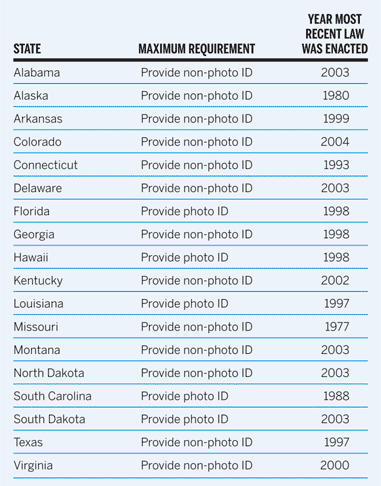
We focused on photo and non-photo identification requirements that were in place in 18 states in 2004. The states, their requirements, and the enactment dates are listed in Table 1. We concluded that seven states required non-photo or photo identification for the first time in a presidential election in 2004, and that 11 states had had those requirements in place for at least one prior presidential election. We coded the 50 states and the District of Columbia into one of three categories: states that required photo or non-photo identification for the first time in 2004, states that had those requirements in place in 2004 and also in previous presidential elections, and states that required something less than identification, such as stating or signing one's name or matching one's signature to a signature in a voting book.
Maximum Voter-Identification Requirements in 2004

Sources: Newspaper articles, state voter guides, and Eagleton Institute of Politics and Moritz College of Law (2006).
The dependent variable in these analyses is whether a survey respondent reported voting in the November 2004 election. We used as predictors dummy variables for states with new photo and non-photo identification requirements in 2004, and states that had those requirements in previous presidential elections.Footnote 2 The remaining states served as the referent category. The models also included other state-level contextual factors that might have influenced turnout in 2004: whether the state was considered a battleground state in the presidential election, and whether there was a closely contested gubernatorial and/or U.S. Senate race in the state (see Alvarez and Ansolabehere Reference Alvarez and Ansolabehere2002 and Alvarez, Nagler, and Wilson Reference Alvarez, Nagler and Wilson2004 for similar approaches). We also controlled for states that permitted Election Day registration, and added a dummy variable for the South to control for differences in turnout for that region.
At the individual level, we controlled for gender, household income, race/ethnicity, age, and education. We created dummy variables to represent whether a voter was black/non-Hispanic, Hispanic, or Asian (with white/non-Hispanic/other voters as the omitted category for reference purposes). In light of previous research on the curvilinear relationship between age and the probability of voting, with the probability increasing with age, then declining for the elderly, we included dummy variables to those ages 18 to 24, 25 to 44, and age 65 and up, with voters ages 45 to 64 serving as the referent category.
We controlled for whether an individual was employed (see Mitchell and Wlezien Reference Mitchell and Wlezien1995), as well as marital status and residential mobility, all of which have emerged as significant predictors of turnout (Alvarez and Ansolabehere Reference Alvarez and Ansolabehere2002; Alvarez, Nagler, and Wilson Reference Alvarez, Nagler and Wilson2004; Wolfinger and Rosenstone Reference Wolfinger and Rosenstone1980). We measured residential mobility by coding for whether the respondent had moved to a new address in the six months prior to the interview.
RESULTS
We examined the effects of the new requirements in a general probit model, and then ran models in which we interacted the dummy variables for new and existing requirements with variables that have drawn theoretical and empirical attention in the voter-identification literature: race/ethnicity, age, education, income, and residential mobility. We hypothesized that while new and existing identification requirements could affect turnout among groups along these dimensions, we expected that the greatest effect would occur in states in which the requirements were in place for the first time in a presidential election in 2004.
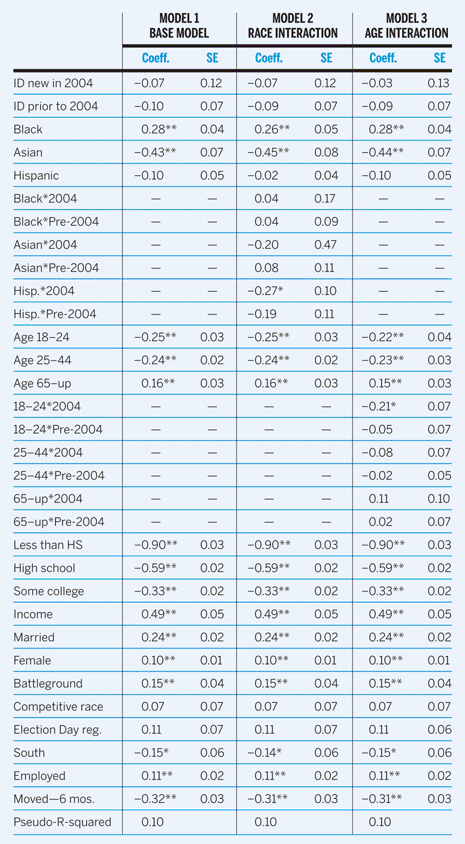
As others have found, the identification requirements did not have a general effect on turnout when taking into account the entire sample of voters. This was true for requirements that had been in place in prior presidential elections, as well as requirements that were new in 2004. Model 1 in Table 2 shows that race, age, socioeconomic factors, and contextual variables all have significant effects on whether a respondent reported voting in the 2004 election. But there was no relationship between turnout and identification requirements.
Probit Models of Voter Turnout in 2004

N = 51,124 registered voters, Current Population Survey, Nov. 2004
p < .05* p < .01** (two-tailed tests)
Models were estimated with robust standard errors to correct for correlated error terms within each state.
Previous research suggests, however, that there may be variation among specific groups. We interacted the dummy variables for identification requirements in separate models with race/ethnicity, age, education, income, and residential mobility. The interaction between identification requirements and group variables were significant along two dimensions: race/ethnicity and age. Model 2 shows that the interaction between the Hispanic dummy variable and the dummy variable for states that had new identification requirements in 2004 was statistically significant, and the coefficient traveled in the expected negative direction. The interaction for Hispanic voters in states that had identification requirements in previous elections as well as in 2004 was not significant. None of the interactions for black and Asian voters and identification requirements were significant.
The interaction involving Hispanic voters in states with new requirements, and the lack of a significant interaction involving Hispanics in states with previously existing requirements, offers possible evidence of a learning curve for dealing with voter-identification requirements. Quantifying such a learning curve is difficult using probit coefficients, so we calculated the predicted probability that a Hispanic voter would report having voted in a state with new requirements compared to a Hispanic voter in a state with existing requirements. The difference in probability was slight—Hispanics in the new-requirement states were 2% less likely to say they voted compared to Hispanics in states with existing requirements.
The interactions involving age categories also provided an interesting result, but one less suggestive of a learning curve. In Model 3, the interaction between new requirements and age for voters 18 to 24 was statistically significant and the coefficient was negative, as we expected. Undermining the evidence for a learning curve in this age group, however, was the fact that the dummy variable for age 18 to 24 also was significant and traveled in a negative direction. One would interpret that result as indicating that voters ages 18 to 24 in states other than those with identification requirements also were less likely to say they voted. The results for voters ages 18 to 24 in Model 3 appear to be driven more by age than by voting requirements.
DISCUSSION AND CONCLUSION
Logically, requiring stricter forms of identification has the potential to reduce turnout, at least initially. There will be legitimate voters who are unaware of the new law and fail to bring the newly required identification, as well as those who may be aware yet fail to obtain the necessary documentation. There will also be those who might otherwise seek to vote fraudulently but are barred from the ballot by the new law, further decreasing turnout. Under a well-tailored law the hope is that the maximum number of legitimate and the minimum number of fraudulent voters are allowed access to the polls, and that over time the rate at which people are caught unaware declines.
The presence of a learning curve for voter-identification requirements could have a significant influence on the debate over voter-identification laws. If those laws do bar specific groups from voting, then a learning curve would suggest it is possible to mitigate the effects with education and preparation, alleviating the disenfranchising impact among those who are able to obtain the necessary identification. Opponents of voter-identification laws, having struggled unsuccessfully to defeat those laws in state legislatures or to have courts declare them invalid, would have another way to overcome what they perceive as an unjust cost associated with casting a ballot.
The evidence for a possible learning curve presented here is modest, and applies to only one group of voters—Hispanics. But that group has been among those at the heart of the debate over voter-identification laws. If indeed it is possible to reduce the effects of voter-identification requirements through education about the requirements, even a small increase in turnout would be worthwhile. Further quantification of a learning curve also could generate a more nuanced accounting of the effects of voter-identification laws by distinguishing between citizens who would vote if they knew the rules and how to comply with them, versus voters who have to opt out because they are simply unable to provide the required identification.
Absent a clear understanding of the ratios between those able to overcome temporary disenfranchisement via a learning curve and those more permanently barred through sheer lack of identification, the precise impact of new voter-identification laws on turnout will remain unclear. The test we present here is preliminary given that we examine only one election. To confirm that a learning curve is at work, it is important to explore the possible effects of new laws over multiple election cycles. But the logic is intuitive, and the potential normative benefit is great if indeed further evidence emerges for a learning curve in this area. ■