Introduction
This is our fourth contribution to the lichenicolous biota of Bolivia (Flakus & Kukwa Reference Flakus and Kukwa2012a , Reference Flakus and Kukwa b ; Kukwa et al. Reference Kukwa, Etayo and Flakus2012), within an inventory aimed at improving our knowledge of the diversity of lichens and allied fungi in the country (see e.g. Flakus & Wilk Reference Flakus and Wilk2006; Flakus Reference Flakus2009, Reference Flakus2012; Knudsen & Flakus Reference Knudsen and Flakus2009; Flakus et al. Reference Flakus, Rodriguez Saavedra and Kukwa2012). In this paper we describe a further new species of Niesslia Auersw. Twelve lichenicolous species in the genus are currently known (Lawrey & Diederich Reference Lawrey and Diederich2012), most of them parasitizing members of Peltigerales. An identification key to these was provided by Etayo & Sancho (Reference Etayo and Sancho2008). The new species belongs to a group of taxa with ascospores breaking within the asci. So far three lichenicolous species with this character are known, all described from the Neotropics: N. globospora Etayo, N. schizospora Etayo (as schyzospora) and N. tetraedrispora Etayo (as tetrahedrospora) (Etayo Reference Etayo2002).
Material and Methods
The morphology and anatomy were examined using Nikon SMZ800 and Nikon Eclipse 80i (DIC) microscopes. Photographs were taken with Nikon Digital Sight DS-Fi1 equipment. Squash and sectioned preparations were studied on material mounted in water, 10% KOH solution (K), and in Lugol's iodine solution without (I) or with pre-treatment with KOH (K/I). All measurements were made on material mounted in water.
The New Species
Niesslia echinoides Etayo, Flakus & Kukwa sp. nov.
MycoBank No: MB 800218
Species similar to N. schizospora, but differs in larger and more setose ascomata, usually simple setae, as well as larger and wider ascospores (13–15×3·0–3·5 µm) and a different host.
Type: Bolivia, Dept. La Paz, Prov. Nor Yungas, PNANMI Cotapata, 30 min by foot of Unduavi by Sillu Tincara pre-Columbian route, 16°17′38″S, 67°53′33″W, 3437 m alt., Yungas montane cloud forest, on thallus of epiphytic Erioderma barbellatum, 23 December 2009, A. Flakus 16349 & P. Rodriguez Flakus (KRAM—holotype; LPB, hb. Etayo—isotypes).
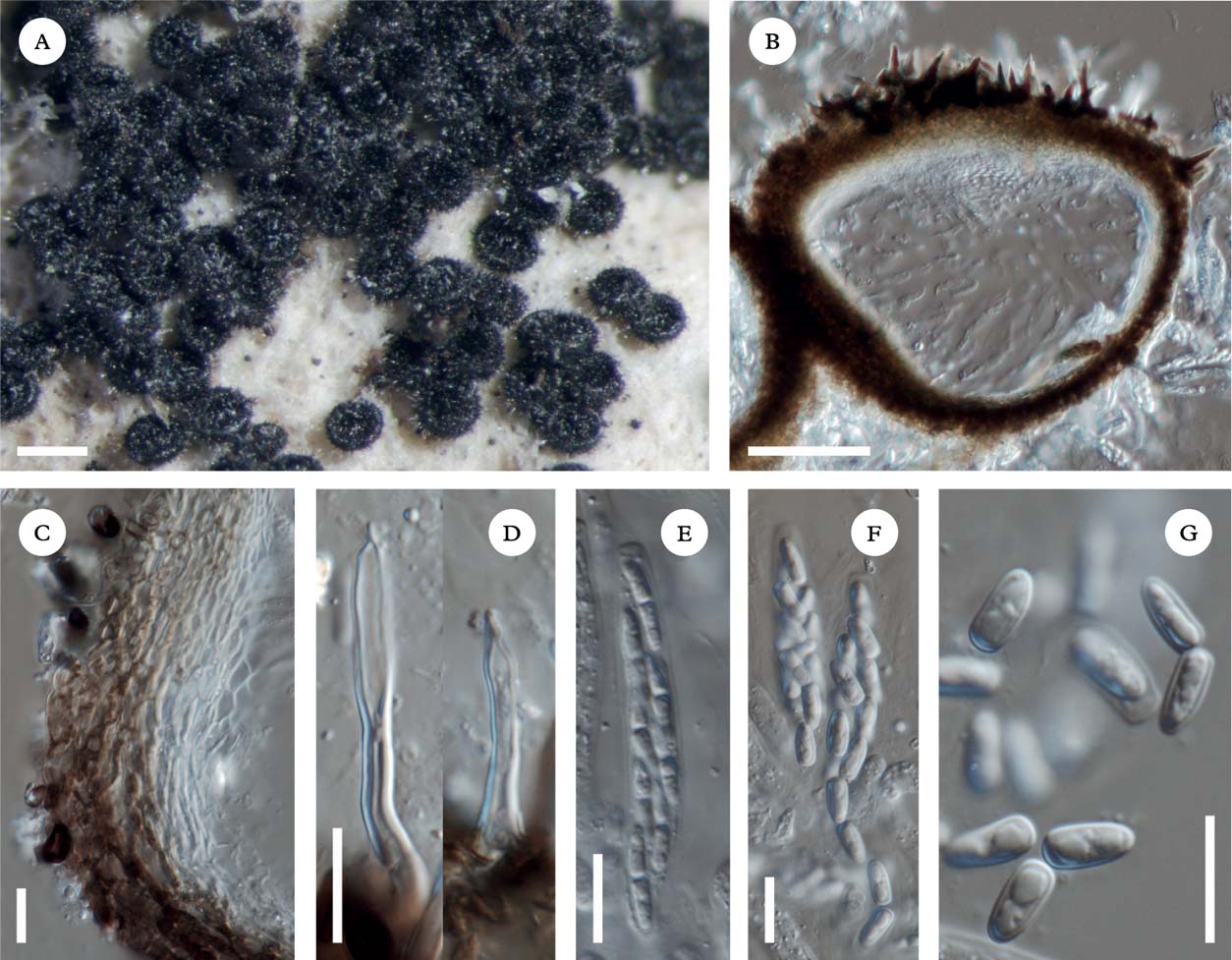
Niesslia echinoides (holotype). A, habit of the fungus on the lower surface of the host thallus; B, section through perithecium covered by dark brown setae; C, exciple composed of several rows of cells with dark brown external part and hyaline inner part; D, hyaline setae; E, ascus with entire, 1-septate ascospores; F, asci with broken ascospores; G, mature part spores without perispore, outside of an ascus. Scales: A=200 µm; B=50 µm; C–G=10 µm. In colour online.
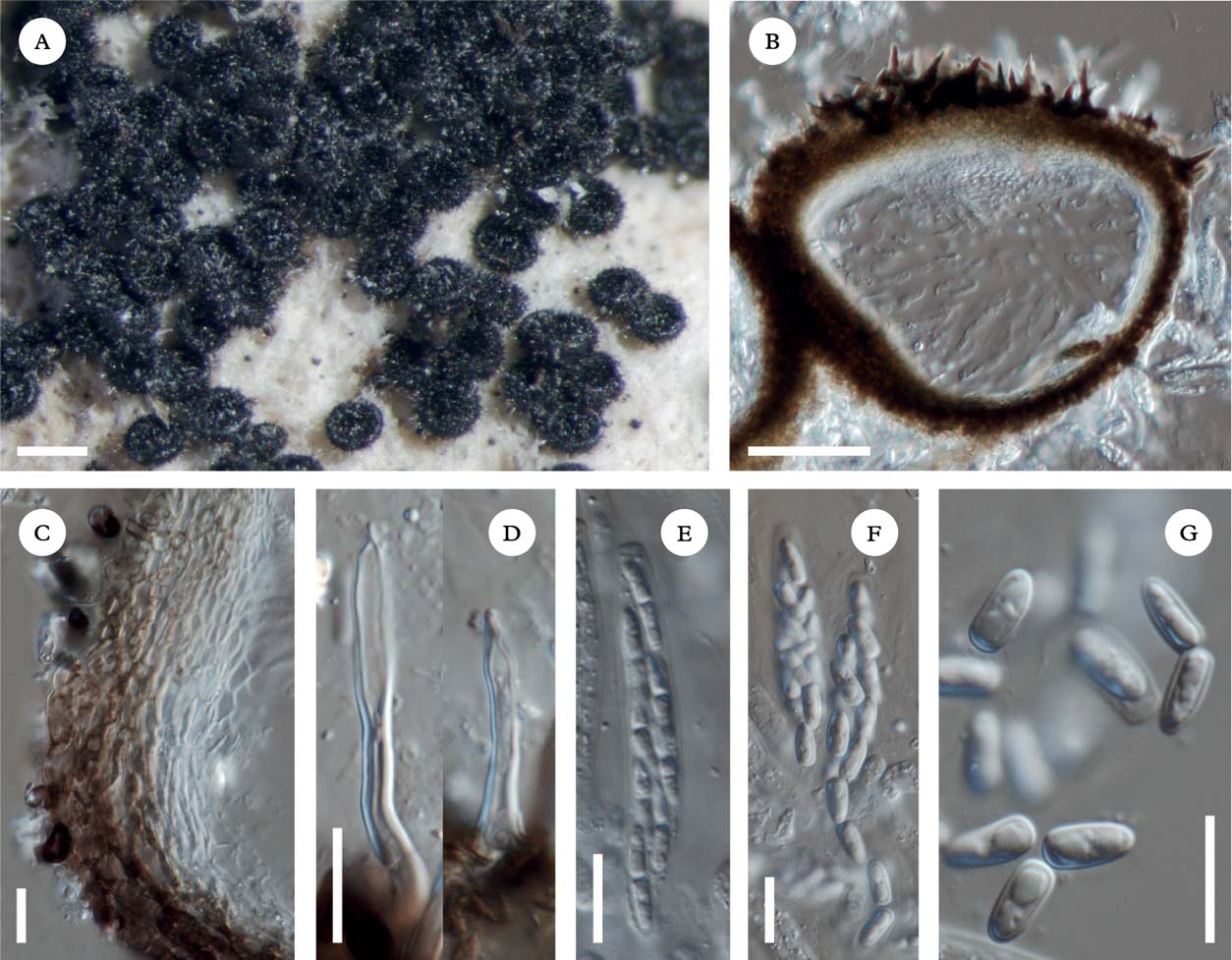
Ascomata mainly situated on the lower surface of the host thallus, usually visibly aggregated, black, subspherical, usually flattened when dry, with a central ostiole, sessile, richly and uniformly setose, 120–170(–190) µm diam. Exciple dark brown, of several rows of angular cells, internal layer of more elongate and thinner hyaline cells, 10–15 µm wide, but in upper part up to 30 µm; external layer in surface view of textura epidermoidea, composed of 1·2–3·0 µm wide, thin-walled and usually branched cells. Setae acute, with a wide base, simple or rarely furcate (forming short teeth-like outgrowths), of two types: dark brown, 10–24 µm long, basally 3–6 µm wide, and hyaline, 10–35 µm long, basally 2–5 µm wide, sometimes twisted. Periphyses formed around the ostiole, hyaline, 10–12×1–2 µm wide, thin-walled. Paraphyses not observed in mature perithecia. Asci clavate, with a short foot at the base and a truncate apex of the ascus, unitunicate, 8-spored, I−, KI− (but epiplasm orange), 47–57×7–8 µm. Ascospores biseriate in asci, elongate ellipsoid to fusiform, smooth, without perispore, with obtuse ends, hyaline, 1-septate, 13–15×3·0–3·5 µm, breaking within the asci into two semi-spores 6–9×3·0–3·5 µm, often with two guttules in each cell.
Etymology
The new species is named after its abundantly setose and flattened perithecia when dry, reminiscent of sea urchins (e.g. Echinus esculentus Linnaeus, 1758).
Discussion
Niesslia echinoides can easily be separated from almost all lichenicolous members of the genus by its ascospores breaking into halves within the asci; it shares this character with only three species. Niesslia schizospora is the most similar taxon of this group, but it can readily be distinguished by shorter and narrower ascospores (5–8×1·5–2·0 µm). Furthermore, the species has comparatively smaller ascoma (100–130 µm diam.) with sparse, distinctly branched and short setae (Etayo Reference Etayo2002). Both species differ also in the host preference: N. echinoides grows on Erioderma barbellatum, whereas N. schizospora grows on unidentified Hypotrachyna species (host of the holotype), although we have found similar specimens from Ecuador on other host genera like Dichosporidium sp. and Lobariella crenulata, which will be commented on in a future work.
Externally, Niesslia echinoides could also be confused with N. globospora, a species described from Dictyonema glabratum (Etayo Reference Etayo2002). In N. globospora, asci are always 4-spored, and ascospores are ornamented and composed of two easily separating and almost spherical cells measuring 3–4 µm diam.; this gives the illusion of eight subspherical spores in the ascus and it was originally interpreted as such (Etayo Reference Etayo2002). Also setae are comparatively less numerous and much longer (32–65 µm) in N. globospora. Material similar to N. globospora, but parasitizing unidentified Erioderma species, was also found in Colombian Páramo (Etayo 16683). It was characterized by smooth-walled ascospores breaking into larger cells (5–6×4–5 µm) and scarce, long and straight setae, 75–100×6–8 µm (Etayo Reference Etayo2002); this may represent a yet undescribed species.
A further species, N. tetraedrispora has 8-spored asci like N. echinoides, but the ascospores easily break within them into 16 tetrahedral and wider (4–5 µm) cells (Etayo Reference Etayo2002).
Host
The new species lives mainly on the lower surface (less frequently also on the upper surface) of the epiphytic Erioderma barbellatum, without visible damage to the host thallus.
Distribution and habitat
The species is known only from the type locality, where it was found in Yungas montane cloud forest.
We are greatly indebted to Rosa I. Meneses Q., Director of the Herbario Nacional de Bolivia, Instituto de Ecología, Universidad Mayor de San Andrés, La Paz, for generous cooperation, and to reviewers Paul Diederich (Luxemburg) and Mikhail P. Zhurbenko (St. Petersburg) for valuable and constructive comments on the manuscript. We also thank Pamela Rodriguez Flakus (Frankfurt) for valuable help during fieldwork. This research received support from the National Centre for Research and Development (NCBiR) in Poland under the LIDER Programme for the years 2010–2013 (no. 92/L–1/09).