Introduction
It is estimated that between 8% and 54% of elderly Taiwanese women suffer from poor sleep quality (Su et al., Reference Su, Huang and Chou2004; Tsai et al., Reference Tsai, Chen, Wang, Liu, Wu and Lin2000), constituting an important health problem (Blay et al., Reference Blay, Andreoli and Gastal2008; Yao et al., Reference Yao, Yu, Cheng and Chen2008). Alcohol use is one of the well-known risk factors for poor sleep quality (Park et al., Reference Park, Kim and Jhun2008). Alcohol use has been a major public health issue in Taiwanese aboriginal communities (Yen et al., Reference Yen2006).
The Taiwanese indigenous aborigines are an Austronesian people, with linguistic and genetic links to other Austronesian ethnic groups, such as peoples of the Philippines, Malaysia and Indonesia. They may have been living on the islands for approximately 8000 years before the major Han Chinese immigration which began in the seventeenth century. Currently, the 14 ethnic groups of the Taiwanese aboriginal people make up about 2% of the total Taiwan population. In turn, the six main ethnic groups – the Amis, Paiwan, Atayal, Bunun, Rukai and Puyuma – make up nearly 90% of the total aboriginal population. Over half of all Taiwanese aborigines live in the mountains (Council of Indigenous Peoples, 2008). As a minority group they are marginalized in the political, economic, cultural, and even health domains in Taiwan. In recent years they have faced a new cultural discontinuity and oppression (Ko et al., Reference Ko, Liu and Hsieh1994), with a high prevalence of substance abuse (Ko et al., Reference Ko, Liu and Hsieh1994), low socioeconomic status (Ko et al., Reference Ko, Liu and Hsieh1994; Ralph-Campbell et al., Reference Ralph-Campbell, Pohar, Guirguis and Toth2006), and poor general health (Jean-Louis et al., Reference Jean-Louis2001). The prevalence of women with alcohol problems has increased significantly (Cameron et al., Reference Cameron, Morris and Forrest2006). Owing to differences in metabolism, women of all ages are at a higher risk than men for negative physical, medical, social, and psychological consequences associated with at-risk and higher levels of alcohol consumption (Epstein et al., Reference Epstein, Fischer-Elber and Al-Otaiba2007).
Thus far, little is known regarding the prevalence of poor sleep quality and alcohol use problems within minority elderly communities. We conducted an epidemiological study to evaluate the prevalence of these two health problems. The purposes of this study are to identify a one-month prevalence of poor sleep quality and alcohol use problems, and to investigate the association between sleep quality (and its components) and alcohol use problems among elderly aboriginal women in Taiwan.
Methods
Design and sample
This study was part of an epidemiological study focusing specifically on 25,163 elderly aboriginal women from six major ethnic groups, including the Amis, Paiwan, Atayal, Bunun, Rukai, and Puyuma, in Taiwan (Council of Indigenous Peoples, 2008). We developed a cross-sectional survey research design with a stratified random sampling. In order to avoid any selection bias, population census data were first consulted at the respective registration offices. There were a total of 11,069 households in the eight townships of Taiwan of which 2503 (22.61%) housed at least one elderly woman aged 60 years or older. About 60% of these households were randomly selected and the elderly women in the selected households comprised the study sample. Altogether, 1500 women were selected and, of these, a total of 1261 aboriginal women (84%) completed the Pittsburgh Sleep Quality Index (PSQI). The institutional review board at the Kaohsiung Medical University reviewed and approved this study.
Measures
A questionnaire was administered to assess the aboriginal women's sleep routines, demographic data, and their physical and mental health status. Sleep status was assessed by the PSQI. The PSQI contains 19 items and generates seven components, including subjective sleep quality, sleep latency, sleep duration, habitual sleep efficiency, sleep disturbances, use of sleeping medication, and daytime dysfunction during the past month. The score of each component ranged from 0 to 3, and the sum of the global score ranged from 0 to 21. The higher the global score, the poorer the sleep quality. A global score of less than 5 indicated a good sleeper, with good diagnostic sensitivity of 89.6% and specificity of 86.5% (κ = 0.75, p < 0.001) (Chung and Tang, Reference Chung and Tang2006; Lai and Good, Reference Lai and Good2005). The overall reliability coefficient (α) of the PSQI in the Chinese version ranged from 0.55 to 0.86 (Chung and Tang, Reference Chung and Tang2006; Yao et al., Reference Yao, Yu, Cheng and Chen2008), and a test-retest reliability (r) of 0.74 (Lai and Good, Reference Lai and Good2005) and a split half reliability (r) of 0.79 (Mayfield et al., Reference Mayfield, McLeod and Hall1974) were also found.
Alcohol use problems status was assessed by the CAGE questionnaire. The CAGE was developed specially for the purpose of screening for alcoholism and was administered by self-rating. It is composed of four items, which make up the acronym CAGE: (1) Have you ever felt that you ought to Cut down on your drinking? (2) Have people Annoyed you by criticizing your drinking? (3) Have you ever felt bad or Guilty about your drinking? (4) Have you ever had a drink first thing in the morning to steady your nerves or to get rid of a hangover (Eye-opener)? Cronbach's α coefficient (0.80) and test-retest reliability (0.80–0.95) of the CAGE are all quite satisfactory. Each item was rated as “no” or “yes” for a score of 0–1, and the total score was 0–4. A higher score reflects more severe alcohol use problems. The 4-item CAGE had a sensitivity of 0.70–0.87 and a specificity of 0.90–0.92 at a cutoff score of 2 for detecting alcohol abuse and dependence (Dhalla and Kopec, Reference Dhalla and Kopec2007). In this study, participants rating 2 or above were classified as those with alcohol use problems.
Depressive status was assessed using the Taiwanese Depression Questionnaire (TDQ). The 18-item TDQ was specifically developed for the purpose of screening for depression in Taiwan communities. Cronbach's α coefficient (0.90) and the area under the receiver operating characteristic (ROC) curves (0.92) of the TDQ are all quite satisfactory. Each item was self-rated as “never,” “occasionally,” “often,” and “very often,” for a score of 0–3, respectively, and the total score ranged from 0 to 54. A higher score reflects more severe depression. The 18-item TDQ had a sensitivity of 0.89 and a specificity of 0.92 at a cutoff score of 19 (Lee et al., Reference Lee, Yang, Lai, Chiu and Chau2000). In this study, participants with scores of 19 or above were classified as depressed elders.
Physical condition status was assessed by a three-item physical condition measure. Each item was rated as “poor,” “worse,” “similar,” “better,” and “good,” for a score of 1–5, respectively, and the total score was 3–15. A higher score indicates better physical condition. The three-item physical condition scale had a Cronbach's α coefficient of 0.84–0.86 in the previous study (Lin et al., Reference Lin, Pan and Yeh2006). In this study, participants scoring 8 or below were classified as elders in worse physical condition.
Procedures and statistical analysis
After providing written informed consent, the study participants were interviewed face-to-face by trained nurses in the district health station using our study questionnaires. All statistical analyses were conducted using SPSS 12.0 for Windows. We dichotomized study participants into “poor” and “good” sleep quality groups according to the PSQI global score. Descriptive statistics were used for the sample characteristics and sleep quality variables. Associations of sleep quality with any continuous variables were analyzed using student t-tests, and with any categorical variables using χ2 analyses. Multiple logistic regression was used to assess the simultaneous influence of different variables on the adjusted odds ratios (AOR) of having poor sleep quality. To examine whether there were differences in alcohol use problems in the mean scores of the PSQI and its components, analysis of covariance (ANCOVA) was performed using sleep-related factors as the covariate. The level of significance was set as 0.05.
Results
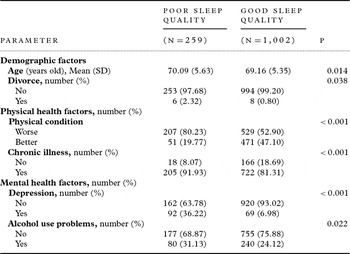
The average age of the participants was 69.35 (± 5.42), ranging from 60 to 82 years. The average PSQI score of the participants was 3.60 (± 2.66). According to the case definition of a score of PSQI > 5 indicating a poor sleeper, 20.54% of all study participants were defined as poor sleepers. Of the sample, 25.59% experienced alcohol use problems, with a score of CAGE ≥ 2. Some 12.95% and 58.51% of all study participants were identified as depressed and as elders in worse physical condition, respectively. Table 1 shows that those participants classified as “older age” (t = 2.47, p = 0.0136), “divorced” (χ2 = 4.32, p = 0.0377), “worse physical condition” (χ2 = 63.11, p < 0.0001), “chronic illness” (χ2 = 14.55, p = 0.0001), “depression” (χ2 =153.29, p < 0.0001), or “alcohol use problems” (χ2 = 5.27, p = 0.0217) had a higher prevalence of poor sleep quality than their counterparts.
Distribution of demographic factors and physical and mental health factors associated with poor or good sleep quality

Note: Some of the variables have missing cases; the total number is therefore not 1261.
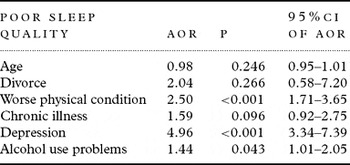
Table 2 shows the predictive variables of poor sleep quality using six significantly different factors. After adjusting for these variables, only three variables were still significantly important factors of identified poor sleep quality: “depression” (AOR =4.96, p < 0.0001), “worse physical condition” (AOR = 2.50, p < 0.0001), and “alcohol use problems” (AOR = 1.44, p = 0.0433).
Adjusted odds ratio (AOR) and p-values for poor sleep quality associated with age, depression, worse physical condition, alcohol use problems, chronic illness and divorce

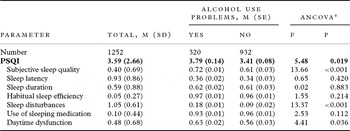
Table 3 shows the comparison of the PSQI and its components among the groups of subjects with or without alcohol use problems. After adjusting for “age,” “depression,” “worse physical condition,” “alcohol use problems,” “chronic illness,” and “being divorced”, the score of the PSQI was 3.59 (± 2.66). The PSQI score (F = 5.48, p = 0.0194) and three of the PSQI components – subjective sleep quality (F = 13.66, p = 0.0002), sleep disturbances (F = 13.37, p = 0.0003), and daytime dysfunction (F = 4.41, p = 0.0359) – were significantly different across participants with and without alcohol use problems. Moreover, participants with alcohol use problems showed a higher score (poorer sleep) in subjective sleep quality, sleep disturbances, and daytime dysfunction than those without alcohol use problems. The other PSQI components – sleep latency (F = 0.65, p = 0.4202), sleep duration (F = 0.02, p = 0.8829), habitual sleep efficiency (F = 1.55, p = 0.2136), and use of sleeping medication (F = 2.53, p = 0.1121) were not significantly different across participants with or without alcohol use problems.
Adjusted alcohol use problems differences in the PSQI and its components among elderly aboriginal women

aANCOVA was performed to evaluate the score differences between the two groups in terms of alcohol use problems, using age, divorce, worse physical condition, chronic illness, and depression as covariates. Data are presented as the total mean (standard deviation) in the total sample of participants and the adjusted mean (standard error) in the two groups with or without alcohol use problems.
Discussion
Of our participants, all of whom were elderly aboriginal Taiwanese women, 20.54% suffered from poor sleep quality, and 25.59% had alcohol use problems. Of these, 12.95% and 58.51% respectively were identified as depressed and as elders in worse physical condition. Those with alcohol use problems have 1.44 times poorer sleep quality than others. Moreover, the PSQI components that are significantly related to alcohol use problems are sleep disturbances, subjective sleep quality, and daytime dysfunction.
The prevalence of poor sleep quality (20.54%) is in the middle range compared with that of other elderly individuals, such as 8% for non-institutionalized women in urban communities in Taiwan (Su et al., Reference Su, Huang and Chou2004), 25.7% for the elderly in communities in Taiwan city (Yao et al., Reference Yao, Yu, Cheng and Chen2008), 53.8% for women in communities in Taiwan city (Tsai et al., Reference Tsai, Chen, Wang, Liu, Wu and Lin2000), and 37.2% for female household residents in Brazil (Blay et al., Reference Blay, Andreoli and Gastal2008). The poor sleep quality of elderly aboriginal women is thus no more severe than that of the general population. However, they still have a higher mean score of sleep disturbances (1.05 ± 0.61) than Taiwanese community elderly (0.81 ± 0.49) (Lin et al., Reference Lin, Pan and Yeh2006) and Japanese community women (0.72 ± 0.53) (Sekine et al., Reference Sekine, Chandola, Martikainen, McGeoghegan, Marmot and Kagamimori2006); however, this is not the case for the other PSQI components. Therefore, elderly aboriginal women's sleep disturbances should be assessed in order to develop a sleep intervention program.
We found that the rate of alcohol use problems among Taiwanese elderly aboriginal women is in the high range (25.59%) compared with that of other populations, such as 4.51% for elders in a small Italian town (Di Bari et al., Reference Di Bari2002), 1.8% for the women of Li ethnic minority in villages in Hainan, China (Tang et al., Reference Tang, Chen, Li, Stanton and Li2005), 12.2% for Scottish women (Cameron et al., Reference Cameron, Morris and Forrest2006), 7.4% for adults in Spain (Carballo et al., Reference Carballo2006), or 16.5% for adults in New Mexico (Woerle et al., Reference Woerle, Roeber and Landen2007). Therefore, the high prevalence of alcohol use problems among Taiwanese elderly aboriginal women is likely to be associated with their poor sleep quality, depression, and worse physical condition.
Our results demonstrate that depression (AOR = 4.96, p < 0.001) and worse physical condition (AOR = 2.50, p < 0.001) are risk factors for poor sleep quality. Depression is importantly correlated with poor sleep quality (Ford and Kamerow, Reference Ford and Kamerow1989; Lin et al., Reference Lin, Pan and Yeh2006; Szklo-Coxe et al., Reference Szklo-Coxe, Young, Finn and Mignot2007; Yao et al., Reference Yao, Yu, Cheng and Chen2008). There are significant differences in PSQI scores between elders suffering from depression (8.4 ± 3.9) and normal elders (3.5 ± 2.7) (Motivala et al., Reference Motivala, Levin, Oxman and Irwin2006). Although the prevalence of depression among our elders (12.95%) is higher than among elders in Taiwanese cities (6%) (Wu, Reference Wu2002), their PSQI score (3.59 ± 2.66) is similar to normal elders (3.5 ± 2.7) (Motivala et al., Reference Motivala, Levin, Oxman and Irwin2006). Moreover, 58.51% of them were defined as elders in worse physical condition. Depression in the elderly is reportedly associated with worse physical condition (Niti et al., Reference Niti, Ng, Kua, Ho and Tan2007). Therefore, the coexistence of depression and worse physical condition in elderly aboriginal women is important in assessing their poor sleep quality.
Age-related psychosocial and physiological factors can contribute to alcohol use problems (Loukissa, Reference Loukissa2007). After adjusting for sleep-related variables, most of the elderly aboriginal women with alcohol use problems have 1.44 times poorer sleep quality than others, which is compatible with previous reports (Ford and Kamerow, Reference Ford and Kamerow1989; Stevenson and Masters, Reference Stevenson and Masters2005). However, some researchers have stated that daily habitual drinking is related to improved sleep quality in the elderly. Analyzing this study in detail, the use of a single item with a yes/no response to record the daily habitual alcohol consumption did not provide satisfactory research validity and reliability (Yao et al., Reference Yao, Yu, Cheng and Chen2008). Therefore, this result is contrasted with polysomnographic sleep parameter evidence that alcohol consumption decreases the percentage of rapid eye movement (REM) sleep, prolongs the REM latency, and increases the standard deviation of REM cycle (Rupp et al., Reference Rupp, Acebo, van Reen and Carskadon2007b). Basically, the elderly should avoid alcohol consumption immediately prior to going to bed (Watts, Reference Watts2007) or should avoid using large quantities of alcohol on a long-term basis (Unwin et al., Reference Unwin, Gracey and Thomson1995) in order to avoid poor sleep quality.
Our results indicate that elderly aboriginal women with alcohol use problems have poor sleep quality. Their sleep disturbances, subjective sleep quality, and daytime dysfunction are poorer than those women without alcohol use problems. These results are supported by the polysomnographic sleep research that alcohol affects sleepiness when sleep-wake homeostatic and circadian timing influences promote high levels of sleepiness (Rupp et al., Reference Rupp, Acebo and Carskadon2007a). The quantity and percentage of slow wave sleep (SWS) is usually reduced and sometimes absent (Gann et al., Reference Gann2004). The sleep quantity and continuity are most often disturbed, and the REM sleep pressure is most often increased (Yang et al., Reference Yang, Ko and Wen1996). These findings demonstrate that drinking alcohol usually influences people's subjective sleep parameters. These results are supported by our study that women with alcohol use problems have poor sleep quality in sleep disturbances, subjective sleep quality, and daytime dysfunction components. However, a previous study revealed persistently abnormal polysomnographics indices after abstinence from alcohol. Short REM latency, increased REM%, and possibly increased REM density indices are factors in the prediction of subsequent alcohol relapse (Gillin et al., Reference Gillin, Smith, Irwin, Butters, Demodena and Schuckit1994). People may be using alcohol to self-medicate for depression, anxiety or pain-related poor sleep quality (Watts, Reference Watts2007). Elderly women often used alcohol to fall asleep and had less sleep latency (Stevenson and Masters, Reference Stevenson and Masters2005) in order to avoid facing new sets of antecedents related to challenges in the older phases of life, such as widowhood, retirement, “empty nest,” limited mobility, and illness (Epstein et al., Reference Epstein, Fischer-Elber and Al-Otaiba2007). Therefore, we suggest that future research should provide the longitudinal epidemiological data to examine the bidirectional relationship between poor sleep quality and alcohol use problems. In addition, the polysomnographic sleep research indicated that a moderate dose of alcohol just before bedtime results in a short-lived increase in sleep intensity (van Reen et al., Reference van Reen, Jenni and Carskadon2006). This finding suggests that women who consume alcohol just before bedtime should have a short sleep latency; however, this was not found in our study. We suggest that future biochemical and genetic researchers examine whether race differences influence sleep latency or alcohol use problems. Furthermore, we recommend that future researchers add convergent validity to their study and improve their sleep quality measurement by using monitors. In addition, not only should alcohol amount and intake time be reported in future studies, but also subjective and objective data. If objective methods cannot be provided, health professionals who assess alcohol use problems should focus their assessments on subjective sleep quality, sleep disturbances, and daytime dysfunction.
Many countries have been developing successful interventions for cost effective reduction in the harm associated with alcohol use problems (Solberg et al., Reference Solberg, Maciosek and Edwards2008), such as educational interventions (Turner et al., Reference Turner, Perkins and Bauerle2008), screening/behavioral counseling (Solberg et al., Reference Solberg, Maciosek and Edwards2008), or social norms interventions (Perkins and Craig, Reference Perkins and Craig2006) Therefore, we recommend a modification of successful interventions that decrease alcohol use problems in order to improve the sleep quality of elderly aboriginal women.
The limitations of this study are threefold. First, the stratified random sampling in the recruited samples still resulted in limited generalization of the results to the minority aboriginal groups or to the women who were absent during our home visits. For those people who are homeless or temporarily or permanently in hospitals or nursing homes, where poor sleep quality is common, alcohol use problems are likely to be higher. Therefore, the prevalence estimates are probably conservative. The second limitation of the cross-sectional design is that it prevents determination of the causative relationship between poor sleep quality and the alcohol use problem being examined. The third limitation of the present study is that the measurement of the sleep parameter is limited because the use of subjective reports provides estimates without objective verification through actigraphy or a home-based polysomnography monitor.
Conflict of interest
None.
Description of authors' roles
M. S. Yang, S. M. Chiou, and K. H. Chueh designed the study, collected the data, and supervised the data. M. S. Yang, C. S. Chen, and K. H. Chueh wrote the paper and were responsible for the statistical design of the study and for carrying out the statistical analysis.