Theories of diversionary war suggest that leaders manufacture foreign policy crises to redirect public attention from domestic to international politics. While scholars, journalists, and policymakers have long acknowledged the straightforward and intuitive logic of such a strategy, identifying an empirical basis for diversionary war theory has been challenging for a variety of reasons including the complex determinants of conflict onset and the relative rarity of war. We suggest extending the existing literature on diversionary conflict strategies by examining diversionary threat rhetoric—emphasis on risks to the nation that diverts citizen focus away from serious and credible domestic political concerns and toward foreign affairs. Because of the high costs associated with conflict, leaders—particularly those unable to credibly wage a diversionary war—may seek to direct the public's gaze overseas without having to actually fight a foreign rival.
Although both democratic and authoritarian regimes employ diversionary threat rhetoric, dictatorships are particularly disposed to engaging in this type of rhetorical strategy. Autocrats often seek to monopolize political information and, as a result, their pronouncements about foreign threats and plots tend to go unchallenged in the public domain. While much of the existing literature on diversionary war focuses on the behaviors of democracies (e.g., Smith Reference Smith1996; Gelpi Reference Gelpi1997; Leeds and Davis Reference Leeds and Davis1997; Gowa Reference Gowa1998), an exploration of diversionary threat rhetoric also bridges existing scholarship on diversionary strategies and a burgeoning literature on authoritarian media. Because diversionary threat rhetoric occurs more commonly than diversionary war, it is also more amenable to empirical exploration including the use of automated text analysis.
To empirically explore the use of diversionary threat rhetoric, we examine Arabic-language material from Syria's three main regime-controlled newspapers—Tishreen, Al-Thawrah, and Al-Ba'th.Footnote 1 For the period before online news, we have hand-coded the front-page of almost every issue of the Syrian daily Tishreen from 1987 to 2002 for headlines about Israel. We find that headlines about Israel—which are exclusively negative—make up a quarter of all newspaper headlines and decrease with improvements in Syria–Israel relations, such as during the peace talks in the 1990s. One interpretation for this empirical regularity is that the Assad regime was preparing the Syrian public for a normalization of bilateral political relations through a dialing back of diversionary threat rhetoric related to Israel.
For the period from 2005 to 2018, we have digitally “scraped” the home page of Al-Thawrah and used topic-modeling to uncover changing patterns of media coverage. During the period before the Arab Uprisings of 2011, Israel remained an important topic of newspaper discourse and regime rhetoric. After the start of the 2011 Syrian uprisings, however, regime propaganda shifted away from Israel toward increasing discussion of foreign plots and conspiracies against the Syrian regime. This suggests that exogenous shocks to domestic political circumstances can lead to changes in diversionary threat rhetoric.
Finally, we conduct qualitative content analysis of articles from Al-Thawrah and Al-Ba'th newspapers during the early months of the Syrian uprisings in order to understand in a more fine-grained way how regime discourse evolved during critical periods of political change. We find that Syrian protesters were described as “terrorists” and that Syria was the victim of “foreign plots” initiated by Israel, the United States, and other states. Across all three methodological approaches—analysis of hand-coded headlines, topic modeling of online articles, and qualitative content analysis of news coverage—a theme that remains consistent throughout is that the Assad regime long sought to focus public attention on forces external to the regime, consistent with a logic of diversionary threat.
While it is easy to dismiss authoritarian regime rhetoric as little more than state propaganda, there is reason to believe that individuals within Syria may be influenced by the authoritarian media campaign. Scheller (Reference Scheller2013, 25) argues that “government rhetoric highlighting resistance and a common Arab cause against perceived external conspiracies has...always appealed to large segments of the population.” Corstange and York (Reference Corstange and York2018) find that framing matters for how respondents view the Syrian conflict in a survey of Syrian refugees living in Lebanon. There is also evidence to suggest that rhetoric of this type matters in neighboring Arab societies. In a sample of Egyptian and Saudi respondents, Nyhan and Zeitzoff (Reference Nyhan and Zeitzoff2018) find that belief in anti-Western and anti-Jewish conspiracies is common with more than 80 percent of respondents endorsing two or more conspiracy theories. These findings are consistent with the idea that publics in Muslim-majority societies develop their understanding of political affairs, at least in part, through the ways that events are framed by competing local political elites (Blaydes and Linzer Reference Blaydes and Linzer2012). Diversionary threat rhetoric may also provide political cover for individuals who want to maintain solidarity with the regime in a socially permissible way through an emphasis on concerns about national unity.
This project makes several contributions. First, it demonstrates how autocrats in places like Syria use diversionary threat rhetoric to shore up their political interests. During normal times, these autocrats focus on traditional threats—Israel, in the Syrian case—to compensate for poor political performance. During periods of crisis, however, regimes shift their rhetorical emphasis to perceived domestic enemies and alternative foreign threats. Through our exploration of Syrian media, we also demonstrate the methodological opportunities associated with topic modeling to explore Arabic-language texts. While political scientists increasingly rely on machine learning to analyze large datasets made up of text,Footnote 2 Arabic-language materials remain relatively unexplored.Footnote 3 Analysis of large numbers of texts from traditional Arab media remains limited, and this project demonstrates the potential value of analyzing Arabic-language materials as a tool for understanding autocratic politics.
Diversionary threat rhetoric in authoritarian discourse
Much has been written about the ways that political leaders use external conflict as a way to generate domestic support. Fearon (Reference Fearon1998, 303) defines the diversionary use of force as “foreign policy adventurism for the sake of keeping the leader in power rather than advancing the foreign policy interests of the public.” According to diversionary war theory, challenging domestic circumstances encourage leaders to launch overseas military conflicts for domestic political gain (Morgan and Bickers Reference Morgan and Bickers1992). Participation in foreign conflicts can have cohesive effects. By focusing public attention on a foreign enemy, the public overcomes internal divisions and becomes united against the foreign enemy. Scholars also emphasize the scapegoating effect of diversionary conflicts. When there is wide discontent with the situation at home, leaders can launch diversionary conflicts in order to blame failed policies on foreign enemies (Levy Reference Levy and Midlarsky1989; Tir and Jasinski Reference Tir and Jasinski2008). Thus, diversionary conflicts can serve to create the perception of a foreign enemy, bolstering political support for the incumbent elite (Morgan and Bickers Reference Morgan and Bickers1992).Footnote 4
Despite the intuitive appeal of diversionary war theory, scholars have offered a number of pointed critiques. Chiozza and Goemans (Reference Chiozza and Goemans2003) show that international crises make leaders insecure, working against the strategic logic of diversionary conflict; Chiozza and Goemans (Reference Chiozza and Goemans2004) also find only limited support for a strategic theory of diversionary conflict. Pickering and Kisangani (Reference Pickering and Kisangani2005) find that theories of diversionary war are contingent on regime type. Powell (Reference Powell2014) suggests that leaders who have put into place “coup proofing” institutions are less likely to use diversionary tactics. The challenges associated with finding empirical support for theories of diversionary war have encouraged attempts to broaden conventional conceptualizations of diversionary strategies to better fit empirical realities. These include the targeting of domestic ethnic minorities (Tir and Jasinski Reference Tir and Jasinski2008) as well as conflicts that involve a “territorial diversion” (Tir Reference Tir2010).
An alternative approach for understanding diversionary foreign policy strategies involves expanding the scope of empirical exploration to include actions that fall short of conflict initiation. Such an approach builds on Morgan and Bickers (Reference Morgan and Bickers1992, 32) who argue that “lower levels of hostile action, such as threats to use force, shows of force, and uses of force short of war, may be adequate to create the perception of a foreign threat, are less costly and less risky, and may actually be more effective at increasing domestic cohesion.” Kisangani and Pickering (Reference Kisangani and Pickering2007) also argue that leaders will prefer to undertake “low-politics” diversions, like humanitarian interventions, because of the relatively low cost and minimal risk of escalation. Kanat (Reference Kanat2014) critiques the existing literature on diversionary war theory as being overly focused on one-off diversionary attacks rather than describing the full set of strategies for generating a rally-round-the-flag effect.Footnote 5
We use this literature on diversionary conflicts as a conceptual frame for exploring 30 years of data from authoritarian Syria. Specifically, we claim that a focus on diversionary threat rhetoric represents an important strategy for leaders to highlight enemies to the nation in order to divert citizen focus away from domestic concerns. Such an approach does not involve the downside risk of initiating a costly foreign conflict but still may generate some of the “rally-round-the-flag” benefits enjoyed as a result of fearmongering about external enemies. While diversionary threat strategies are not the exclusive domain of autocratic regimes, dictatorships may be particularly prone to the use of diversionary threat rhetoric.Footnote 6
A theory of diversionary threat also connects to a growing literature within political science focused on the practices of authoritarian regimes with regard to the media. This literature has paid particular attention to how authoritarian regimes manage challenges, including economic bad news (Rozenas and Stukal Reference Rozenas and Stukal2019). Research on this subject has been especially well developed in the context of Chinese politics (King et al. Reference King, Pan and Roberts2013, Reference King, Pan and Roberts2017; Huang et al. Reference Huang, Boranbay-Akan and Huang2019). In post-Soviet countries of Central Asia, like Turkmenistan and Uzbekistan, authoritarian regimes have used propagandistic discourse about foreign policy (Anceschi Reference Anceschi2014). The next sections consider the extent to which we can empirically observe and measure diversionary threat rhetoric within Syria.
Authoritarian media in Syria
Information policies are believed to be among the Syrian leaderships’ “main concerns” (Wedeen Reference Wedeen1999; George Reference George2003, 126). As a result, the domestic media under Hafez and Bashar al-Assad has long been carefully controlled by the state. The Ministry of Information—which has historically been overseen directly by the presidency—is responsible for both publishing and censoring state newspapers (George Reference George2003, 126). In addition to national-circulation newspapers, the state also broadcasts television and radio channels that repeat content published in print media (George Reference George2003, 8). While there does exist underground publishing, long prison terms await individuals who overstep government red lines (George Reference George2003).
Since Hafez al-Assad's accession to the presidency in 1970, the authoritarian regime in Syria has emphasized the country's position as a front-line state in the Arab–Israeli conflict where it has served as a bulwark against Israel in the Arab world. Syria's role as a pivotal state in the conflict has come to define its external relations, with profound implications for the country's domestic politics. The country's participation in the 1967 and 1973 wars against Israel provided a powerful incentive for the country to grow its armed forces and associated security apparatus. Israel's occupation of the Golan Heights, in particular, was seen as a legitimate reason to increase the size of the military and to increase the importance of the armed forces in public life (Perthes Reference Perthes1995, 148). Assad saw the recovery of lost Syrian territory as an imperative and promoted the importance of this goal to both the military and the general public (Roberts Reference Roberts1987, 108). The size and sophistication of the Syrian military grew and in the late 1970s, the regime launched a second wave of military build-up (Clawson Reference Clawson1989, 3). Between 1977 and 1988, Syria spent about $40 billion on the state's security apparatus (Clawson Reference Clawson1989, 13). In the mid-1980s, about half a million Syrians were in the armed forces (Clawson Reference Clawson1989, 21). During this period, about half of all state employees were employed by the security apparatus, representing about 15 percent of the total workforce (Perthes Reference Perthes1995, 147).
Barnett (Reference Barnett1992, 3) has argued that states take “extraordinary measures” during times of war and that the state's new powers often persist even after the war has ended; as a result, he concludes, “if there is a winner during war, it appears to be the state over domestic forces.” Following the 1973 war, Assad appeared to enjoy wider powers in an army that was firmly under his control (Roberts Reference Roberts1987, 110). The net result was the emergence of what one analyst has called a “national-security state” with the twin goals of “national and regime security” (Perthes Reference Perthes1995, 133). In times of crisis, the Syrian regime has exhibited a tendency to invoke “foreign policy to silence the internal opposition, blaming it for jeopardizing Syrian security or accusing it of cooperating with foreign interests” (Scheller Reference Scheller2013, 13–14).
Despite a significant military buildup, Syria has been poorly positioned to fight a conventional war with Israel for decades. As a result of Syria's disastrous showings in wars against Israel, Hafez al-Assad was keenly aware of Syria's military vulnerabilities.Footnote 6 The Syrian leadership has long signaled that it has no interest in pursuing a “hot” war with Israel (Perthes Reference Perthes2004, 54). Rather, the Israeli occupation of the Golan Heights allows the Syrian regime to play the “resistance card” to foreign threats (Perthes Reference Perthes2004, 57). Hafez al-Assad—long considered a pragmatic realist—sought the Israeli withdrawal from the Golan Heights knowing that a Syrian defeat of Israel would not be possible (Roberts Reference Roberts1987, 108).Footnote 7
Rubin has argued that diversionary tactics have long been core to the Syrian regime's survival strategies. By keeping attention focused on the Israeli threat, “foreign policy” has served as a substitute for actual governance of Syria (Rubin Reference Rubin2007, 102). Rubin (Reference Rubin2007, 24) cites an incident in March 2001 when Ba'th Party members attending a public meeting asked Vice President Abdel Halim Khaddam why more has not been done to stem rampant corruption—Khaddam's response was that Syria was at a state of war and, as such, domestic reforms were not the priority. This type of diversionary threat maintenance has not been limited to Syria—other Arab states have also sought to ratchet up anti-Israeli rhetoric as it offers regimes “a degree of immunity from radical criticism at home” (Rubin Reference Rubin2007, 20).
Enemies of the regime are regularly described as foreign agents or anti-nationalists (George Reference George2003, 49). According to Rubin (Reference Rubin2007, 227), “fighting Israel—or more often just talking about fighting Israel or praising others for doing it—was the highest of all virtues.” As a result, all societal struggles, even those related to the domestic economy, became subsumed by the “main battle” against the twin evils of imperialism and Zionism (Sottomano Reference Sottomano2008, 19). The persistent reference to foreign threats continued after the accession to power of Bashar al-Assad where “national patriotic appeal” regularly served as Bashar's “trump card” (Rubin Reference Rubin2007, 174). According to Saleh (Reference Saleh2017, 60), it is a “policy of outdoing everyone else in radical opposition to Israel” while at the same time demanding everyone “continually assert their true patriotic spirit.”Footnote 8
Blaydes and Linzer (Reference Blaydes and Linzer2012) describe the circumstances under which anti-American sentiment has become the type of “all-purpose” issue in the Islamic world around which populations of different ideological persuasions can mobilize. Similarly, in authoritarian Syria where Israel is extremely unpopular both for its handling of the Palestinian issue as well as continued Israeli occupation of the Golan Heights, anti-Israel nationalism was long cultivated as the regime's answer to generating popular loyalty. By maintaining focus on the Israel issue, the regime stays on non-controversial ideological ground. This is in contrast to a focus on other important but potentially controversial issues including the role of religion in political life and the liberalization of political or economic spheres. The need to emphasize a non-controversial ideological theme—like anti-Israel sentiment—was particularly significant given Syria's Arab nationalist origins. According to Hinnebusch (Reference Hinnebusch2001, 163), peace with Israel would require the regime to find an “ideological substitute for the Arab nationalism that for so long had endowed it with a modicum of legitimacy.”
If our arguments about the use of diversionary threat rhetoric are correct, we should observe a number of empirical regularities that are consistent with this perspective for the Syrian context. First, since Israel has constituted a salient threat to Syrians over a long period of time, we expect that the Syrian regime will draw attention to Israel and its actions as a form of diversionary threat rhetoric. But what happens during periods of time when the Syrian regime anticipates the possibility of normalized political relations between Israel and Syria, like when active and productive peace negotiations are taking place? Because the Assad regime may want to prepare the Syrian public for normalization of relations with Israel, we should expect coverage of Israel to decrease during these times.
For most of the period that we analyze, we expect discourse about Israel to represent the primary channel for Syria's expression of diversionary threat rhetoric. The 2011 uprisings represented a major shock to the Syrian regime, however, forcing a recalibration of Syrian state rhetoric in light of a rapidly changing set of political circumstances. As political dissent in Syria began to escalate, the regime was forced to draw attention to new sets of external actors—foreign agents and countries working to support opposition parties within Syria.
The next two sections explore these empirical expectations in the context of Syria under Hafez and Bashar al-Assad from the period between 1987 and 2018. While authoritarian Syria is the empirical focus of this paper, a set of more general principles can be derived from our arguments. Authoritarian regimes, particularly ones that lack alternative sources of popular legitimacy, have incentives to use diversionary threat rhetoric. This is especially the case when the costs of engaging in an actual conflict are too high. In addition, major shocks to the political system—like a popular uprising, coup d'etat attempt, or onset of a civil war—can induce changes to the nature of diversionary threat rhetoric as the regime considers a (potentially) widening set of external threats upon which to focus. The empirical analysis that we provide serves as a proof of concept for diversionary threat rhetoric, demonstrating the feasibility of the core ideas and expectations.
An analysis of Tishreen, 1987–2002
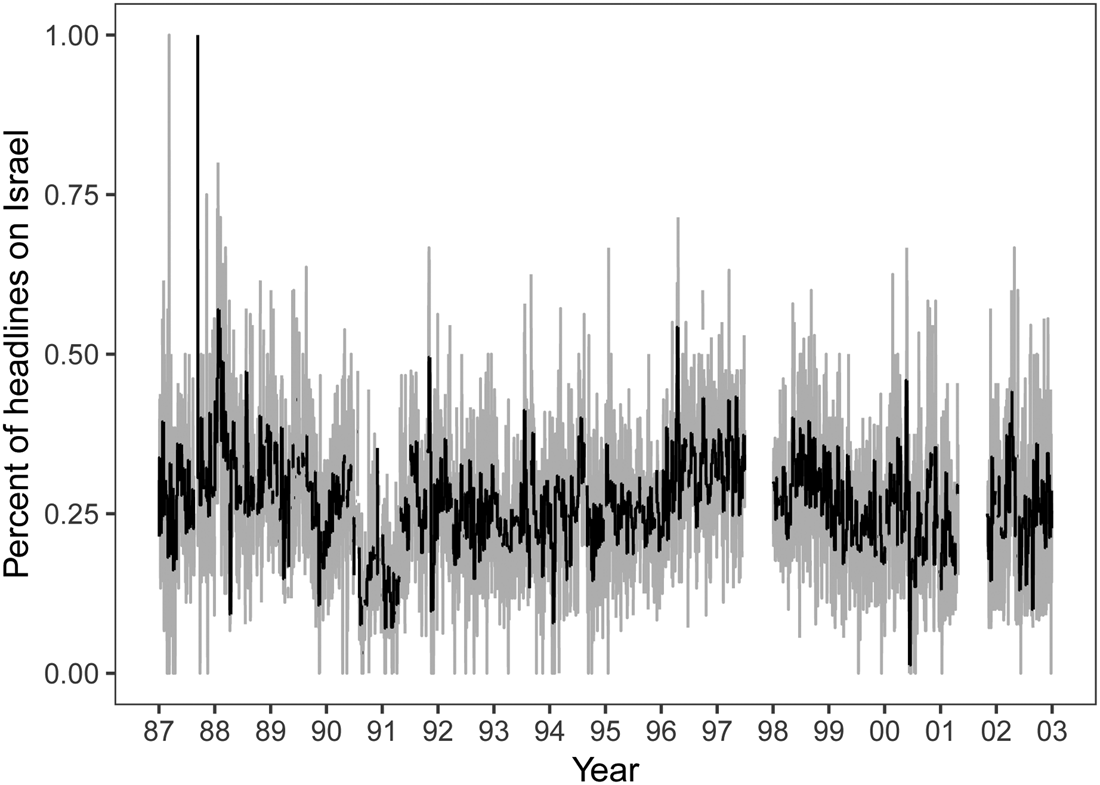
How can we characterize media discourse in Syria over a relatively long time horizon? In this section, we show the general trends in the coverage of Tishreen based on a hand-coding of the newspaper's front page. Figure 1 plots trends in the coverage of Israel in Tishreen, beginning in 1987 and ending in 2002. The gray lines plot the daily average of front page headlines that are dedicated to Israel and the black lines detail the weekly average. Dates for which data are missing are left blank. Over the entire period covered by the data, around one-quarter of the headlines involve Israel. The patterns presented in Figure 1 suggest that discourse about Israel has been a prominent and continual feature of Syrian public discourse.
Percentage of Tishreen front-page headlines referencing Israel, 1987–2002.

Under what conditions do we observe increases or decreases in rhetoric about Israel? Not surprisingly, increased tension in Arab–Israel relations generated heightened levels of discourse. For example, the start of the First Palestinian Intifada in December 1987 is accompanied by a spike in Syrian state discourse about Israel. Israeli Operation “Grapes of Wrath”—a military campaign against Lebanon that took place in April 1996—was also associated with a visible increase in Syrian state coverage of Israel and its actions. These two episodes represent two of the highest average weekly levels of front-page headlines referencing Israel between 1987 and 2002.
The data also suggest another pattern with respect to discourse on Israel. During periods of time when there is a possibility of normalization of relations between Israel and Syria, we observe a decrease in levels of discussion of Israel. Because of the intensely negative tone of Syrian rhetoric to Israel, a lack of discussion about Israel actually represents an improvement of Assad regime's posture toward Israel. This line of reasoning is largely consistent with arguments by scholars focused on the study of Syrian foreign policy. For example, Scheller (Reference Scheller2013, 78) argues that “Hafez al-Assad slowly began to prepare the public for the prospect of peace...the regime modified the language used in the official media with the aim of assuring the public that peace was a strategic choice to advance Syrian interests.” In addition to modifications in language, we view the omission of discussion as a way in which the Assad regime attempted to prepare the Syrian public for the possibility of peace with Israel.
During the temporal scope of this study, Syria underwent important changes in its political situation, especially related to changing Cold War dynamics. Rabinovich (Reference Rabinovich1991) argues that by the late 1980s, Hafez al-Assad had come to realize that developments taking place within the Soviet Union were going to have far reaching consequences for Syria. In particular, a decline in the stature of the USSR, a decreasing relevance of the Soviet–American rivalry, and an improvement in Soviet–Israeli relations were all going to have a negative impact on Syria's standing (Rabinovich Reference Rabinovich1991). Shad et al. (Reference Shad, Boucher and Reddish1995) suggest that Hafez al-Assad would have liked to have remained both anti-Western and anti-Israel in rhetoric where he was able to maintain forms of support from the Soviet Union.Footnote 9
Operationalizing the potential for normalization of relations between Israel and Syria is made challenging as a result of the “on and off” nature of negotiation progress. The Madrid Conference of October 1991 represented a major breakthrough as Syria joined Jordan, Lebanon, and the Palestinians in the US-brokered peace conference. There were different steps along the road to Madrid, however, each represents a crucial juncture in the road to negotiations. In a May 1989 speech at the American Israel Public Affairs Committee (AIPAC), Secretary of State James Baker laid out a Bush administration vision for Middle Eastern peace, signaling to many the start of a new era in mediated negotiations.Footnote 10 In December 1989, Syria announced the re-establishment of full diplomatic relations with Egypt while simultaneously softening its position on Israel (Williams and Nick Reference Williams and Nick1989; Shad et al. Reference Shad, Boucher and Reddish1995). In 1990, Hafez al-Assad signaled a willingness to speak with the Israelis, a decision that was likely a function of a deliberative process that had started some time before (Shad et al. Reference Shad, Boucher and Reddish1995).
Shad et al. (Reference Shad, Boucher and Reddish1995) argue that there was an overhaul of Syrian foreign policy following its participation in an American-led coalition against Iraq in the 1991 Gulf War. Assistance provided to the US during the Gulf War provided a chance for Syria to signal its desire for improved relations with the US and Western actors (Shad et al. Reference Shad, Boucher and Reddish1995). In March 1991, President George H.W. Bush addressed the US Congress saying that “the time has come to put an end to the Arab-Israeli conflict.”Footnote 11 After that point, Baker embarked on intensive shuttle diplomacy leading to the Madrid Conference.Footnote 12
Between 1992 and 1996, considerable progress was made toward peace between Israel and Syria such that both Syrian and Israeli leaders came “to believe in the possibility of peace and to prepare for it.”Footnote 13 Identifying the end point for the negotiations is relatively straightforward as the talks were stopped abruptly in 1996 by Prime Minister Shimon Peres with no formal agreements signed or charges to continue. Ironically, the break came just after the conclusion of one of the most productive periods in Syrian–Israeli negotiations.Footnote 14
While the negotiations of the early 1990s did not lead to a peace agreement, efforts to broker an agreement did not cease. Between December 1999 and January 2000, President Clinton attempted to bring together the Syrians and Israelis in another round of negotiations. Although the Shepherdstown West Virginia talks failed at reaching a peace deal, it is widely believed that the two sides, again, came close to reaching an agreement.
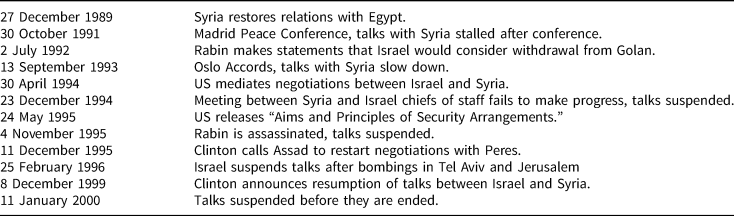
Table 1 summarizes major milestones associated with peace talks between Israelis and Syrians since the late 1980s.Footnote 15 Table 2 shows the results from a regression of mentions of Israel in the headlines of Tishreen (as percent of total front page articles that day) on an indicator for the peace talks.Footnote 16 The first column examines the period between December 1989 (when Syria restored relations with Egypt and the Madrid Peace Conference in October 1991 (after which time Syria–Israel talks were put on the backburner).Footnote 17
Timeline of peace negotiations between Israel and Syria

Coverage of Israel in Tishreen during peace talks

***p < 0.001, **p < 0.01, *p < 0.05.
The second column considers the period between July 1992 (when Israeli Prime Minister Yitzhak Rabin indicated willingness to partially withdraw from the Golan Heights) and ends with the Oslo Accords (after which talks with Syria slowed down).Footnote 18 The third column focuses on the period between April and December 1994, during which the US mediated talks between Israel and Syria. In December 1994, these talks were suspended after an unsuccessful meeting between the chiefs of staff of Syria and Israel (Seale Reference Seale2000). Following the failure of these talks, the US released a paper that outlined the “Aims and Principles of Security Arrangements” in May 1995, an attempt to resume talks. These negotiations continued until November 1995 when Israeli Prime Minister Yitzhak Rabin was assassinated (Seale Reference Seale2000). The next column shows coverage of Israel on Tishreen front pages from this period.
The US attempted to restart the talks with Shimon Perez, who succeeded Rabin as Israeli Prime Minister, and Syrian negotiators. These talks—which are represented in column five—faltered after a series of attacks by Palestinians in Jerusalem and Tel Aviv (Seale Reference Seale2000). The final column shows coverage of Israel during a final attempt by the Clinton administration to bring the two sides together between December 1999 and January 2000.Footnote 19
As suggested by the results presented in Table 2, coverage of Israel in Tishreen consistently decreases during periods of time when Syria and Israel have taken steps toward normalizing relations. The results range in magnitude between 2 and 10 percentage point reduction in coverage of Israel on the front page of Tishreen; this decline represents between 0.20 and 0.83 standard deviations.Footnote 20 In sum, our results for this section demonstrate that while discourse about Israel was frequently invoked by the Assad regime, its value as a topic of diversionary discourse decreased during periods of time when the probability of Syrian–Israeli normalization increased.Footnote 21
Analysis of Al-Thawrah, 2005–2018
Over the course of the 2000s, Syria underwent important changes in terms of access to the Internet, development of state-sponsored media, and public access to news sources. In particular, Syrian daily newspapers began to publish their articles online in a bid to modernize their distribution mechanisms for news. As a result, for the period beginning in 2005, we are able to gather data that goes beyond the hand-coded headlines that we describe in the previous section. In particular, we downloaded 64,977 articles from Al-Thawrah that cover the period from 3 January 2005 through 3 January 2018.
Topic modeling allows us to empirically model and characterize aspects of the content in these articles. Topic modeling uses the co-occurrence of words to find “topics.” As is typical in this literature, we assume that articles are “bags of words”—that is, that the ordering of words and associated punctuation do not matter in the analysis.Footnote 22 To find the parameters of the model, we assume that the articles were generated in a two-step process. First, the topic proportions are drawn in each article. Second, conditional on the topic proportions, the actual words are drawn. Structural topic modeling (Roberts et al. Reference Roberts, Stewart, Tingley, Lucas, Leder-Luis, Gadarian, Albertson and Rand2014) allows us to add covariates to improve the estimation of the topics and their prevalence. As such, we include an indicator for the Syrian uprising (which began on 15 March 2011) as a covariate. We specify 40 topics in the model.Footnote 23 Appendix A reports the topics as well as the top terms associated with each topic, in addition to the expected proportion of each topic.
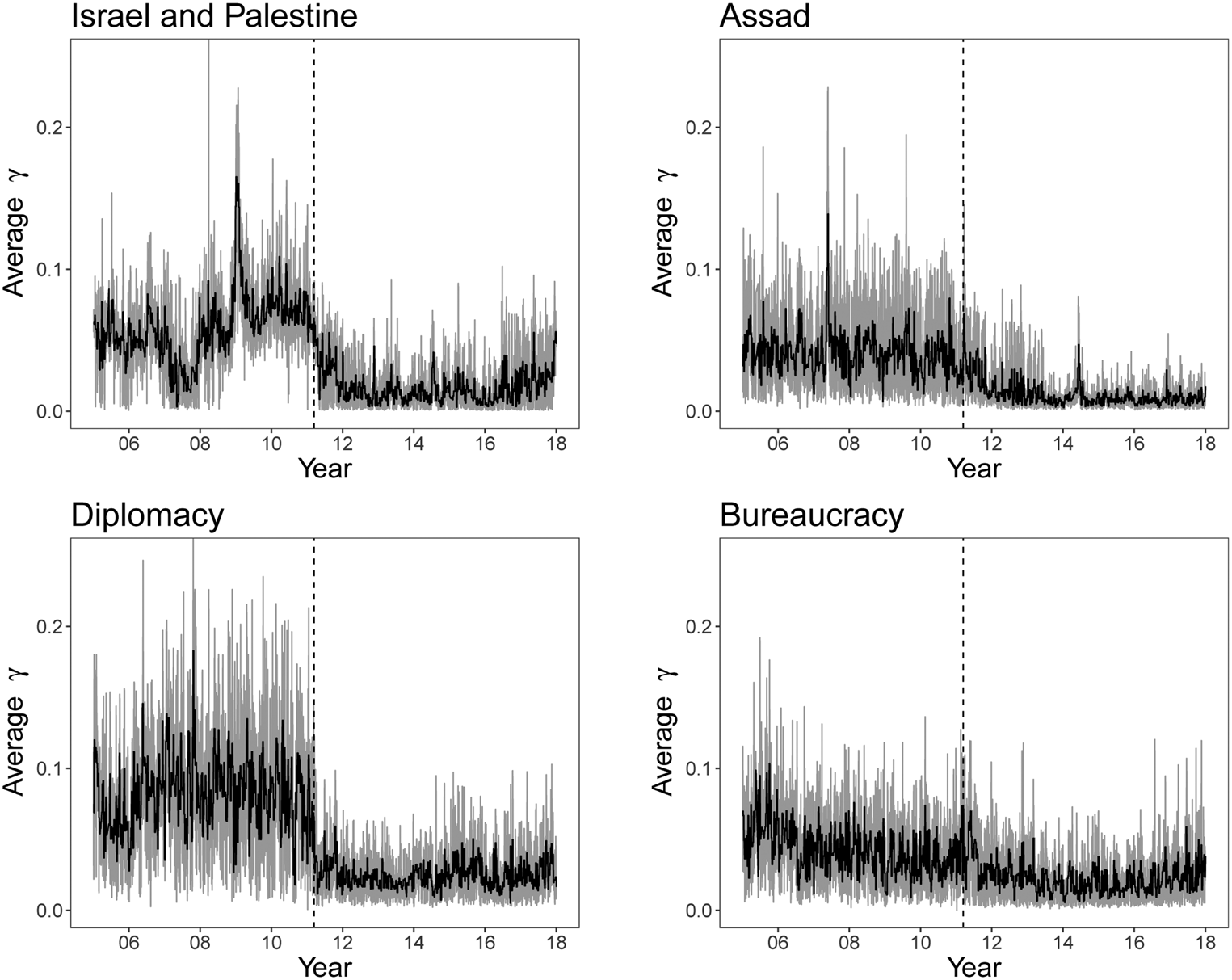
Figure 2 shows the trends in coverage for four topics, before and after the Syrian uprising—Assad, Israel and Palestine, diplomacy, and the economy.Footnote 24 Discourse on these topics includes a combination of everyday reporting on the diplomatic and other activities of the president along with anti-Israel writing and reporting of economic announcements. The x-axis in this figure represents the time while the y-axis shows the daily average of γ, where γ represents the per-article-per-topic probability. The black lines represent the weekly averages of these probabilities. Looking at these trends before 2011, we observe that these four topics made up a relatively large percentage of the discourse.
Decline of historically common topics in Al-Thawrah, 2005–2018.

Using structural topic modeling, we can examine how the prevalence of these topics changed following the uprisings.Footnote 25 As can be seen in Appendix B,Footnote 26 terms related to Assad and to Israel and Palestine have decreased following the uprising by an average of 2.8 and 3.5 percentage points respectively, representing close to one standard deviation.Footnote 27
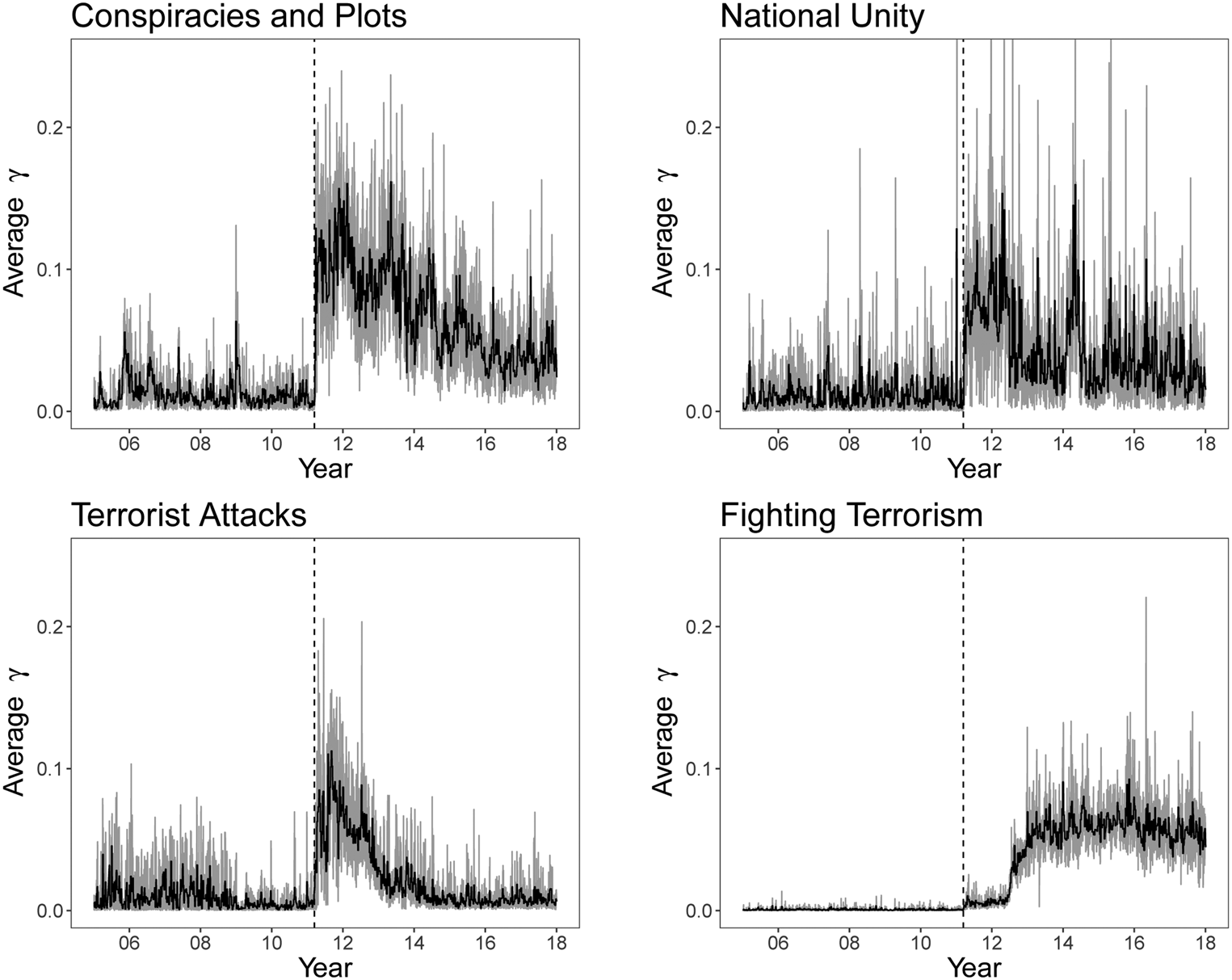
What types of topics were replacing the historically common topics of concern? After 2011, the regime pivoted in terms of areas of discussion. Figure 3 shows that topics associated with national unity, for example, increased considerably after the uprising. On average, the beginning of the Syrian uprising was associated with a 3.1 percentage point increase in discussion of national unity. Given the decreasing popularity of Bashar al-Assad following the uprising, the regime appears to have pivoted to discourse about Syrian nationalism and unity in the face of external threats. Increasingly, Syria's news agencies focused on the existence of international conspiracies against the Syrian state (Scheller Reference Scheller2013, 2). Following the uprising, discussion of conspiracies increased by 5.1 percentage points, on average. This tendency may have been particularly salient in the early period of the conflict with the regime, blaming the country's problems on “foreign-sponsored conspiracy” (Scheller Reference Scheller2013, 14). Saleh (Reference Saleh2017, 59) sums up this perspective when he argues that the Syrian regime had a tendency to fling “accusations of treason in every direction” in order to “foster an atmosphere of collective paranoia, putting the majority of the population on permanent guard against the many conspiracies allegedly being planned against them.”
Rise of New Topics in Al-Thawrah from 2005 through early 2018.

Part of this involved the branding of protesters associated with the Syrian uprisings as saboteurs and terrorists. In particular, discussion of terrorist attacks increased significantly almost immediately as the uprising began suggesting a strategy in which activists and insurgents were labeled as terrorists by the regime. By linking terrorism to protest, Athamneh and Sayej (Reference Athamneh and Sayej2013) argue that rebellion becomes part of a foreign conspiracy. Saleh (Reference Saleh2017, 59) writes that in such a context “the patriotism of every citizen can be questioned at any instant, and the world around him is an evil and dangerous place to be guarded against the distrusted.”
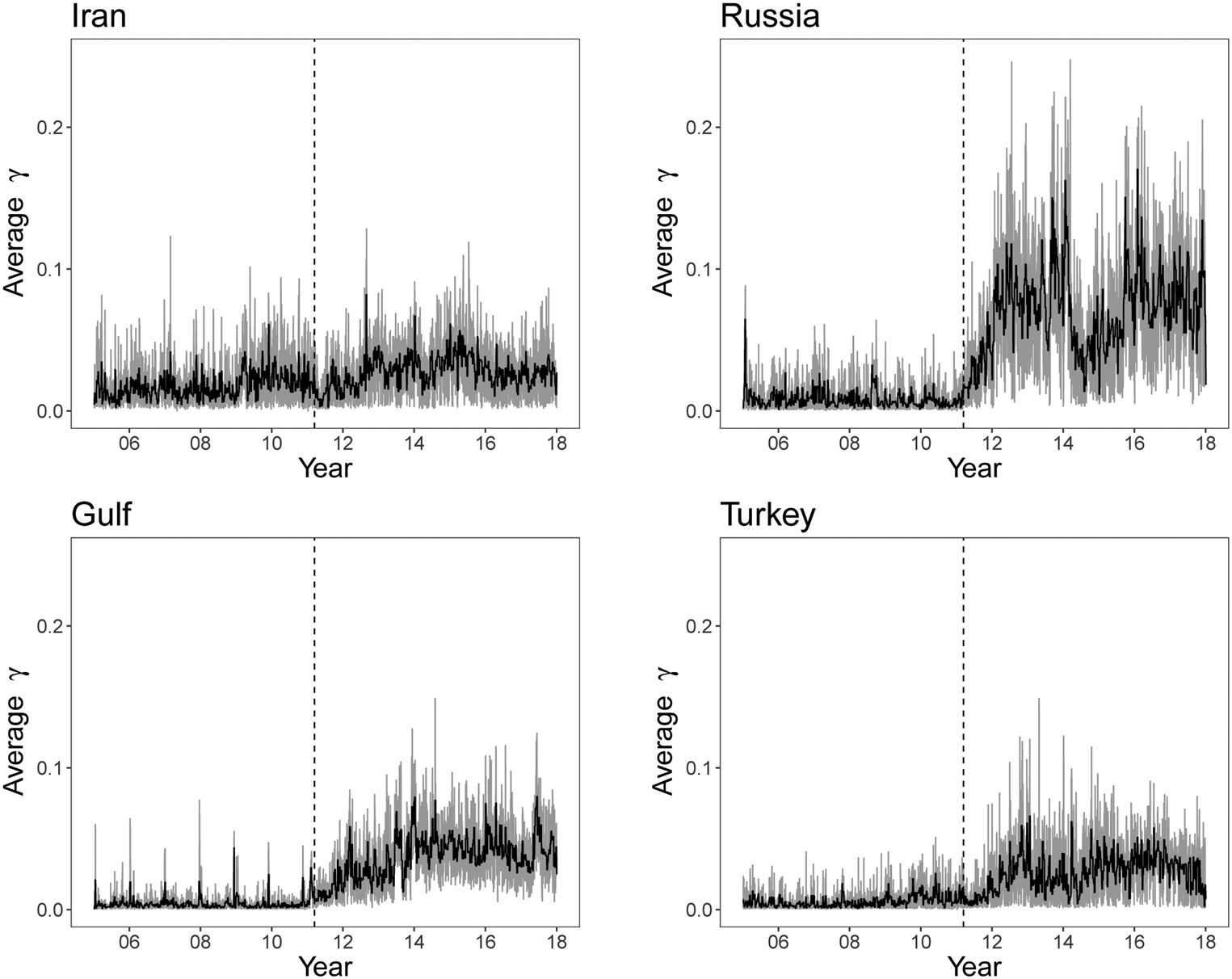
Shortly after protests began in Damascus in March 2011, a new set of foreign threats emerged for the Syrian regime. Several countries came to endorse the protesters before offering them support.Footnote 28 In addition, as the conflict grew in size, regional actors began to endorse rebel or state actors. While the Gulf states and Turkey typically supported the rebels, Iran and Russia offered material and other support for the Syrian regime. As a result, all four of these actors began to figure more prominently in the media. Figure 4 reflects some of these trends. Since threats from these countries became more salient, regime papers seemed to substitute discourse about Israel with threats from these countries. This perspective is summarized by Fawwaz Traboulsi who suggests:
“The regime has a penchant for what used to be known as ‘externalizing crises,’ i.e., placing responsibility for them on foreign parties—either accusing them of pulling strings behind the scene or bringing them in as mediators in the conflict between the regime and significant segments of its population”(quoted in Al-Attar (Reference Al-Attar2013))
The outside culpability for crisis continued to be a theme despite the fact that the target changed. Israel was no longer a high-salience target of regime rhetoric but the basic tactic of the regime to “externalize crisis” have remained consistent over time.
Changing focus on international actors in Al-Thawrah from 2005 through early 2018.

Syrian rhetoric during the Arab uprisings, 2011–2012
On the eve of the Arab uprisings, few Arab citizenries had grievances as long-standing and legitimate as those held by Syrians living under the authoritarian regime of first Hafez, and later, Bashar al-Assad. Among the most repressive regimes in the world, the Assad dynasty all but banned political parties, running organized elections that made plebiscites in neighboring autocracies, like Egypt and Jordan, appear genuinely competitive. As rulers were challenged and began to step down in Tunisia and Egypt, there were doubts that revolt would ever reach authoritarian Syria. But in the spring of 2011, the rebellion in Syria began on a small scale, eventually growing in size and reaching major population centers like Aleppo. This section examines state media coverage of protest during 2011 and 2012 in a more fine-grained way. We analyze news coverage from the online editions of the Syrian dailies, Al-Thawrah and Al-Ba'th. In this section, we seek to qualitatively explain how regime shifts in discourse occurred with a more focused discussion about the precise language used during this critical period of regime crisis.
Large-scale protests associated with the Arab Spring first erupted in Syria on March 15 in the southern city of Der'a. The first mention of events in Der'a did not appear in Al-Ba'th until March 22 when the newspaper reported that a commission had been established to investigate destroyed property; the article was accompanied by a photograph of a burned and mangled car. The next day, Al-Ba'th published a photo of people walking casually in the streets of Der'a. In one photo, a man carried a plastic shopping bag, insinuating markets were functioning normally. On March 29, Al-Thawrah ran an article with a headline stating, “What is going on is an attempt to destabilize Syria and its national unity.” The article suggested that various plots were seeking to destabilize national unity but that these plots would only make Syria “more steadfast, proud, and united.” On March 30, a number of articles in Al-Thawrah pointed to the role of foreign actors in conspiring against Syria. According to one article, “Lebanese personalities” told Al-Thawrah that subversive acts in Syria were done in the service of Israel as part of the “Zionist enemy's project” to divide Arab countries. On the same day, Al-Ba'th ran an article with the headline “The People Want Bashar al-Assad” and an image which showed citizens celebrating and waving Syrian flags under a huge poster of the president.
On March 31, Al-Ba'th reported that Assad delivered a speech which claimed that Syria was the subject of a foreign plot. On the same day, Al-Thawrah published an article entitled “Widespread condemnation of the conspiracy targeting Syria and its national unity” which discussed conspiracies to support resistance emanating from overseas. Throughout April, Al-Ba'th reported on the activities of armed gangs while also discussing foreign conspiracies. On April 13, Al-Thawrah reported on confessions from a terrorist cell funded by Lebanese actors. Indeed, Al-Thawrah reported on conspiracies against Syria on nearly a daily basis while simultaneously emphasizing national unity.
These themes continued in the months to follow. On May 18, Al-Ba'th first reported on attempts by demonstrators to meet with an advisor of Israeli Prime Minister Benjamin Netanyahu. On May 26th, Al-Ba'th reported that the US and Israel were trying to control the Arab uprisings and referred to Netanyahu as the Zionist enemy. On June 9th, Al-Ba'th ran an article which blamed recent terrorist attacks within Syria on the US and Israel. Similar themes—particularly Israeli involvement in Syrian violence and the US role in a conspiracy against the regime—were repeated on June 28. On September 4, Al-Thawrah ran an article that named a little-known Jordanian “political activist” and described him as “member of the proceedings committee of the Jordanian People's Assembly to support Syria against conspiracy and external interference.”
Over the course of 2012, news articles in Al-Thawrah began to describe foreign enemies of Syria with more specific details. On February 2, Al-Thawrah published an article which stated that Qatar has been pushing for the “shedding the blood of Syrians and undermining stability by pumping money, weapons and media hysteria” into Syria. The article also discussed how Qatar's policy of money spending “cannot bring [the Qataris] political glory... and will only bring them the indignation of everyone as well as God's wrath and anger.” The article criticized Qatar for allowing “American and Western planes to fly from their national territory to destroy Arab cities and kill thousands of Arabs.”
On March 14, an article in Al-Thawrah asserted that the United States had pit Saudi Arabia and Qatar against one another to see which would “lead the American-Israeli conspiracy against Syria and the Syrian people.” The article described the “ferocity of the evil war on Syria” and further threatened the “fall of the Al-Saud and Al-Thani regimes” when the Syrian people proved their firmness against the foreign plots. On May 15, an article in Al-Thawrah claimed that Saud al-Faisal, the Saudi foreign minister at the time, had attacked the Syrian media for “exposing his conspiratorial role.” The article stated that Saud al-Faisal was sending terrorists to Syria but failed to achieve his objectives, which led al-Faisal to be in a “state of hysteria.”
Turkey also featured in media discourse during 2012. On April 11, Al-Thawrah cited a Turkish opposition figure as saying that “the Turkish government is pursuing serious provocative policies against Syria” and that Turkey is sending its agents to the border with Syria in order to fabricate excuses to cross the border and intervene in Syrian affairs. On August 29, Al-Thawrah cited an opposition figure in Turkey who claimed that the Erdogan's Justice and Development Party (AKP) was responsible for “the bloodshed in Syria,” asserting that “history will record this crime.”
Conclusions
Authoritarian governance strategies are often opaque, and even more so the case for personalist regimes where power tends to be concentrated in the hands of a single ruler. Under rare circumstances, scholars are able to access the internal files and meeting transcripts of dictators (e.g., Blaydes Reference Blaydes2018). Yet more often, researchers are forced to focus on the public transcript of dictatorship where the rhetorical strategies that appear in authoritarian media reflect a ruler's ideational objectives. In this paper, we take advantage of original data as well as new methodological developments in the study of Arabic text in order to explore the ways in which the Assad regime in Syria has used diversionary rhetoric to divert public attention abroad.
We show that state discourse about Israel has been a feature of Syrian print media for decades, perhaps crowding out demand for meaningful domestic political reforms. We also demonstrate how diversionary rhetoric about Israel decreases during times of active peace negotiations, probably as the Assad regime sought to prepare the Syrian public for a possible normalization of political relations with Israel.
In the absence of major shocks to the political system, this pattern may have persisted for years, even decades. Societal disruptions associated with the Arab uprisings of 2011, however, led to notable changes in regime rhetoric. We show that the 2011 uprisings were associated with new forms of state discourse, especially rhetoric on emerging sources of external threats. Specifically, since 2011, the Assad regime has made use of discourse on the need to maintain national unity in the face of foreign threats and conspiracies. Discussion of plots against the Syrian state sowed confusion and may have damaged support for oppositional forces in ways that played to sectarian divisions. The Assad regime maintained its “insistence that imperialist powers are conspiring to harm Syrians” (Athamneh and Sayej Reference Athamneh and Sayej2013, 170). This is consistent with the idea that the regime has presented itself as the “the protector and defender of the Syrian people against external hostilities” (Scheller Reference Scheller2013, 40).
While this project has focused on 30 years of state discourse in authoritarian Syria, the core concept that we have promulgated—diversionary threat rhetoric—might be applied to both democratic and authoritarian political contexts. Because authoritarian regimes often seek to monopolize public discourse, we believe that diversionary rhetorical strategies may be especially applicable to the study of autocracies. Our analysis suggests that diversionary threat rhetoric can make up a large percentage of state-media discourse and that regimes can make use of such rhetoric over long periods of time. But periods of political crisis compel a change in regime rhetoric, disrupting long-standing rhetorical patterns. We believe that this project represents a first attempt to quantify some of these ideas but that future analysis might be extended to a variety of contemporary and historical authoritarian regimes.
Supplementary material
To view supplementary material for this article, please visit https://doi.org/10.1017/psrm.2020.28.
Acknowledgments
The authors would like to acknowledge Tareq al-Samman, Eric Chaney, William Marble, Kenneth Schultz, Mathew Tyler, and participants at the 2018 annual meeting of the Empirical Studies of Conflict Project for their assistance and feedback.