Introduction
Dietary fibre (DF) is defined as the dietary components resistant to degradation by mammalian enzymes but degradable by microbial fermentation (Bach Knudsen, Reference Bach Knudsen2001). It is a component of organic matter (OM) in most ingredients and constitutes a major fraction in co-products from the vegetable food and agro industries and, more recently, from the production of bio fuels. From an economical and sustainability point of view, promoting fibre-rich materials in pig feeds may limit the competition for plant foods between animal and human. However, the presence of DF in diets decreases the apparent total tract digestibility (ATTD) of dietary energy and nutrients (Le Goff and Noblet, Reference Le Goff and Noblet2001) due to the low digestibility of DF and possible negative interactions with other nutrients. The extent of the effect of DF has been largely studied and depends on the characteristics of DF (Chabeauti et al., Reference Chabeauti, Noblet and Carré1991; Noblet and Bach Knudsen, Reference Noblet and Bach Knudsen1997) and on production factors such as body weight (Noblet and Shi, Reference Noblet and Shi1994), physiological stage (Noblet and Le Goff, Reference Noblet and Le Goff2001) and genotype (Morales et al., Reference Morales, Perez, Martin-Orue, Fondevila and Gasa2002; Len et al., Reference Len, Lindberg and Ogle2007). In addition, most feeds are processed before feeding (Benhke, Reference Benhke1996) and treatments such as extrusion, toasting, or pelleting may affect the digestibility of nutrients. Pelleting is used in animal feeding because it decreases segregation by animals, facilitates the handling of feeds, limits feed wastage and reduces the level of dust in pig houses. Pelleting treatment involves a mechanical pressure coupled with moderate temperatures over a very short time. Also, the passage through diet may reduce the particle size and disrupt cell walls and structures (Saunders et al., Reference Saunders, Walker and Kohler1969). Consequently, intracellular nutrient contents are released, thus improving OM digestibility. Depending on the heat treatment intensity associated with pelleting treatment, significant improvements in digestibility were found for CP (Wondra et al., Reference Wondra, Hancock, Behnke, Hines and Stark1995; Lahaye et al., Reference Lahaye, Ganier, Thibault and Sève2004), fat (Skiba et al., Reference Skiba, Noblet, Callu, Evrard and Melcion2002; Noblet and Champion, Reference Noblet and Champion2003; Xing et al., Reference Xing, Heugten, Li, Touchette, Coalson, Odgaard and Odle2004) or starch (Bengala-Freire et al., Reference Bengala-Freire, Aumaitre and Peiniau1991), whereas pelleting did not modify the ATTD of NDF and ADF (Stein and Bohlke, Reference Stein and Bohlke2007). However, to our knowledge, few studies have been carried out to determine the impact of pelleting on the ATTD of nutrients and energy of fibre-rich diets. This question is important since the DF content of pig diets is expected to increase markedly in the near future. In particular, studies carried out in adult sows fed fibrous-rich diets have rarely been reported with pelleted diets. Based on the literature, we hypothesized that the ATTD of nutrients and the energy of fiber-rich diets may be improved after pelleting.
The objectives of the current study were to first determine the impact of feed form (mash v. pellets) in growing pigs on the ATTD of energy and nutrients of diets over a large range of DF contents; second, to determine whether the level of DF affects nutrient digestibility in pelleted diets fed to adult sows; and third, to predict nutrients digestibility from DF content.
Material and methods
The experiments were carried at the French National Institute for Agricultural Research (INRA), Saint-Gilles, France. Experimental protocols for the care and use of animals were in accordance with the guidelines established by the French Ministry of Agriculture (authorization no. 04739 to Jean Noblet).
Experimental diets, animals and feeding
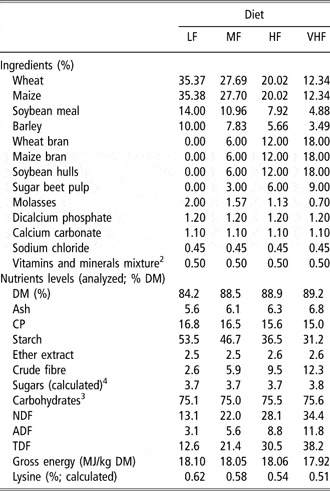
Four diets differing in NDF concentrations were formulated. The ingredients and the chemical composition of each diet are given in Table 1. The diets were based on wheat, maize, barley, soybean meal and a combination of fibrous ingredients (sugar beet pulp, wheat bran, maize bran and soybean hulls) at levels ranging from 0% (low fibre (LF)) to 21% (medium fibre (MF)), 42% (high fibre (HF)) and 63% (very high fibre (VHF)) in the diet. The corresponding NDF contents ranged from 116 g/kg in the LF diet to 192 g/kg in the MF diet, 268 g/kg in the HF diet and 344 g/kg in the VHF diet. All ingredients were ground through a 2.5-mm screen. The four diets were then processed as mash or as pellet. For pelleting, the temperature in the conditioner averaged 42°C and the pellets temperature after pelleting averaged 64°C; their diameter was 4.5 mm.
Ingredients and chemical composition of the experimental dietsFootnote 1

LF=low fibre; MF=medium fibre; HF=high fibre; VHF=very high fibre; DM=dry matter; TDF=total dietary fibre.
1 Values correspond to the means of chemical characteristics obtained from mash and pelleted diets.
2 Supplied per kilogram of feed: retinyl palmitate, 2.7 mg; cholecalciferol, 25 μg; dl-α-tocopherol acetate, 20.0 mg; thiamine, 2.0 mg; riboflavin, 4.0 mg; pyridoxine, 1.0 mg; cobalamin, 20 μg; niacin, 15 μg; d-panthotenate, 9.9 mg; biotin, 200 μg; folic acid, 1 mg; menadione, 2.0 mg; choline chloride, 500 mg; Zn, 80.5 mg (as ZnO); Cu, 4.0 mg (as CuSO4); Mn, 28.6 mg (as MnO4); Fe, 38.5 mg (as FeCO3); I, 131 μg (as CaI2); Co, 38.0 μg (as CoSO4) and Se, 38.5 μg (as Na2SeO3).
3 Carbohydrates = 100 − (ash + CP + ether extract).
4 Calculations were done according to Sauvant et al. (Reference Sauvant, Perez and Tran2004).
In experiment 1, 32 [Piétrain × (Large White × Landrace)] castrated male pigs (average BW of 62 kg) were assigned to the eight treatments in two successive replicates of 16 pigs (two pigs per treatment) and according to a factorial design including four diets (LF diet to VHF diet) and two types of feed form (mash v. pellets). The pigs’ BW at the start of the adaptation period were balanced between treatments. Pigs were adapted to the diets and the metabolic cages for 8 to 10 days before total collection of faeces and urine for 10 days. The feeding level of each pig was progressively increased during the adaptation period in order to attain 2.0 kg of feed per day at the start of the collection of excreta, which is equivalent to a daily supply of about 2 MJ metabolisable energy (ME) per kg BW0.60 for the LF diet (Sauvant et al., Reference Sauvant, Perez and Tran2004). It was increased up to 2.2 kg over the collection period and it was equalized between treatments. This feeding level represents for the lowest DF level approximately 85% of the ad libitum intake recorded in previous studies on similar pigs kept in the same conditions (Quiniou et al., Reference Quiniou, Dourmad and Noblet1996). Pigs were provided ad libitum access to water.
In experiment 2, four Large White × Landrace sows (average BW of 235 kg) were assigned to the four dietary pelleted diets of experiment 1 according to a 4 × 4 Latin square design. Sows were ovariectomized in order to avoid any effect of cycling and oestrus on feed intake and digestibility measurements. Each sow received alternately one of the four experimental pelleted diets during four successive 20-day periods. During each period, sows were adapted to the diet for 12 days before total collection of faeces and urine for 8 days; the four sows were kept continuously in metabolic cages. Feeding level of each sow was adjusted for each period to provide the same daily estimated (Sauvant et al., Reference Sauvant, Perez and Tran2004) ME/kg metabolic BW (500 kJ/kg BW0.75 per day). During excreta collection, sows were housed in respiration chambers for heat production measurements; these latter data will not be presented in the present paper.
Sows and pigs were weighed at the beginning and the end of the excreta collection period. For each diet and for each animal, a sample of diet was collected in each replicate for experiment 1 and in each period for experiment 2, and analysed for their dry matter (DM) content; the dietary samples of replicates were pooled per diet and per experiment for subsequent chemical analyses. Feed refusals were collected daily and measured for their DM content. Faeces were collected daily, stored at 4°C and weighed, homogenized by a Stephan homogenizer (Stephan and Sympac France, Lognes, France) and subsampled at the end of the period. Then, faeces samples, for each collection period, were freeze-dried (Froilabo, Froilabo-Firlabo, Emerainville, France) for further chemical analyses. Urines were also collected daily and daily aliquots were pooled for each animal.
Analytical methods
For feed samples, moisture, ash, CP (N × 6.25), Weende crude fibre (CF), and ether extract (EE) were analysed according to AOAC 777 (1990). Gross energy (GE) content was measured using an adiabatic bomb calorimeter (IKA, Staufen, Germany). DF (NDF, ADF and ADL) was determined according to the methods of Van Soest and Wine (Reference Van Soest and Wine1967) using a sequential procedure with prior amylolytic treatment. Total DF (TDF) contents were also quantified according to the method of Prosky et al. (Reference Prosky, Schweizer, Devries and Furda1988). Starch content was determined using Ewer’s polarimetric method (European Economic Community, 1972). Moisture, ash, CP, DF and GE analyses were also carried out on each faecal sample. In addition, EE was measured on pooled faecal samples (one per diet and per treatment) using an automated extractor (Soxtec, Foss, France) after HCl hydrolysis. Nitrogen in urine was analysed on fresh material whereas GE content was obtained after freeze-drying approximately 30 ml of urine in polyethylene bags. Analyses on feed samples were performed in triplicates, while analyses on excreta were performed in duplicates.
Calculations and statistical analyses
ATTD coefficients of OM, nutrients, and GE, and digestible energy (DE), and ME contents were calculated according to Noblet et al. (Reference Noblet, Fortune, Dubois and Henry1989). The ME value was calculated as the difference between DE value and energy losses in urine. According to Graham et al. (Reference Graham, Hesselman and Aman1986) and Bach Knudsen and Hansen (Reference Bach Knudsen and Hansen1991), starch and sugars are assumed to be 100% digestible at the faecal level.
Data were subjected to ANOVA analysis of Statistical Analysis Systems Institute (SAS) (SAS Institute Inc., Cary, NC, USA). Linear and quadratic effects of diet composition on digestibility coefficients and nitrogen balance were analysed using a contrast statement. The proc GLM with a level of significance of P < 0.05 was used. In experiment 1, the model consisted of replicate (ni = 2), diet (nj = 4) and feed form (nk = 2) as the main effects, and the interaction between diet and feed form (jk). The experimental unit was the animal and the error term was the residual error of the model. In experiment 2, sow data were analysed according to a latin square design with diet (n = 4), period (n = 4) and sow (n = 4) as the main effects. The experimental unit was the animal and the error term was the residual error of the model.
In order to analyse the effect of DF content on the ATTD of nutrients and energy, regression equations were calculated for each experiment with NDF as an indicator of DF level; in experiment 1, the effect of feed form and the interaction between feed form and diet were also tested according to a covariance model.
Results
The four experimental diets were formulated to provide different levels of DF (Table 1). To raise the DF level in diets, wheat, maize, barley and soybean meal were partly substituted by sugar beet pulps, wheat bran, maize bran and soybean hulls. Therefore, concomitant with increasing DF levels, diets contained decreasing contents of ST and CP. The chemical composition of each diet was identical for both feed forms and values used in the calculations were averaged for each diet.
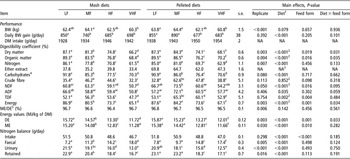
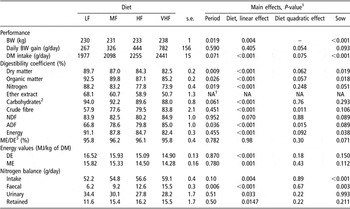
All animals remained healthy throughout the duration of the experiment. In experiment 1, according to the experimental design, growing pigs were fed a constant amount of feed, which resulted in DE intakes that were lower when feeding diets with higher DF contents. No refusals were observed. Pigs grew at an average rate of 760 g/day and, concomitant with the DE intake reduction, their average daily gain (ADG) decreased with DF increase (P < 0.05; Table 2); feed form did not affect ADG. In experiment 2, according to the experimental design, adult sows were fed the same ME level during the experimental period. Since the energy intake was above their requirements (data not presented), their growth was positive (450 g/day) but not affected by diet composition (Table 4).
Effects of dietary fibre level and pelleting on performance, nitrogen balance and nutrients and energy digestibility in growing pigs

LF = low fibre; MF = medium fibre; HF = high fibre; VHF = very high fibre; DM = dry matter; TDF = total dietary fibre.
1P-value is that of the linear contrast.
2Quadratic contrast, P-value < 0.05.
3NA: not applicable: ether extract of faeces was measured on samples pooled per diet and per feed form; digestibility coefficients could not be calculated for each pig.
4Carbohydrates = 100 − (ash + CP + ether extract).
5Metabolisable energy/digestible energy ratio.
A value followed by different superscript letter was statically different (P < 0.05).
Effect of DF level on digestibility of energy and nutrients in growing pigs (experiment 1)
As indicated in Table 2, the digestibility of OM and energy decreased linearly with DF increase (P < 0.001); the decrease averaged about one percentage point per percentage point NDF for OM, nutrients and energy (E) (Table 3). The DF levels decreased (quadratic; P < 0.05) the digestibility of DF (i.e. CF, NDF, ADF or TDF) with the highest values obtained with MF diet. The DF levels did not affect the ME/DE ratio. According to the negative effects of DF on energy digestibility, increasing DF reduced DE and ME values (linear and quadratic effects for DE; P < 0.01): a decrease of 4 MJ/kg of DM was measured between LF diet and VHF diet. Increasing DF reduced N and energy intakes and retained N; more nitrogen was excreted in faeces and less in urines (P < 0.001).
Effect of dietary NDF level (g/kg) on apparent total tract digestibility (%) of organic matter (ATTD OM), crude protein (ATTD CP) and energy (ATTD E) according to diet form (mash and pellet) in growing pigs

aEquations were obtained according to a covariance model with feed form as fixed effect and NDF as covariate.
bResidual standard deviation.
Separate equations are given when the intercepts differ (P < 0.05) between diet preparations; the interaction between NDF content and feed form was not significant (P = 0.80, 0.66 and 0.95 for OM, CP and energy, respectively).
Effect of pelleting on diets digestibility in growing pigs (experiment 1)
Pelleting of diets improved the digestibility of OM and energy by about one percentage point (80.6% v. 79.5% for OM and 78.1% v. 76.6% for energy; P < 0.05, Table 2). With regard to DF, pelleting improved digestibility of NDF (P = 0.016) or TDF (P = 0.004) and tended (P = 0.098) to improve CF digestibility. In the case of NDF, digestibility for pelleted diets (63.7% v. 58.5%) was five points greater than for mash diets. An unexpected interaction between diet characteristics and feed form was observed for digestibility coefficients of OM and energy (interaction, P < 0.05), which is mainly explained by the higher difference between mash and pellets forms for the MF diet, either for OM, energy or DF fractions. Even if it has not been statistically demonstrated, the digestibility of fat for the pelleted diets was numerically greater than the values obtained for the mash diets (61% v. 36%, s.e. = 1.6). The ME/DE ratio was not affected by feed form. In summary, pelleting increased DE and ME contents (+0.3 MJ/kg of DM; P < 0.01). The effect of NDF content on the digestibility of OM, N or E was not affected by pelleting (i.e. no significant interaction; Table 3); the intercept of the relationship was higher for pelleted diets but the difference was significant only for energy (P = 0.054; Table 3).
Effect of dietary fibre level on the digestibility of pelleted diets in adult sows (experiment 2)
As indicated in Table 4, the digestibility of OM and energy decreased linearly with DF increase (P < 0.001) while the digestibility of DF (i.e. CF or ADF) increased (P < 0.001) or remained at a high level (i.e. NDF) (quadratic, P < 0.05). The reduction averaged about 0.35, 0.70 and 0.40 percentage point per percentage point NDF for OM, N and energy, respectively (Table 5). The DF levels did not affect the ME/DE ratio. According to the negative effects of DF on energy digestibility, DF increase reduced DE and ME values (P = 0.001): a decrease of 1.5 MJ/kg of DM was measured between LF diet and VHF diet. Due to the greater dry matter intake and DE values slightly higher than expected with the high-DF diets, the DE intakes increased with increase of the DF level (Table 5). More nitrogen was excreted in faeces (P < 0.001) and less in urines when feeding diets with higher DF contents.
Effects of dietary fibre level on energy and nutrients digestibility in adult sows

LF = low fibre; MF = medium fibre; HF = high fibre; VHF = very high fibre; DM = dry matter.
1NA: not applicable: ether extract of faeces was measured on samples pooled per diet, and digestibility coefficients could not be calculated for each pig.
2Carbohydrates = 100 − (ash + CP + ether extract).
3Metabolisable energy/digestible energy ratio.
Effect of dietary NDF level (g/kg) on apparent total tract digestibility (%) of organic matter (ATTD OM), crude protein (ATTD CP) and energy (ATTD E) of diets in adult sows

aEquations were obtained according to a covariance model with sow as fixed effect and NDF as covariate.
bResidual standard deviation.
Discussion
Introduction of fibre in feeds for pigs
In agreement with literature data, increasing the DF content in the diets led to a reduction of the ATTD of nutrients and energy (Yin et al., Reference Yin, McEvoy, Schulze, Hennig and Souffrant2000; Le Goff and Noblet, Reference Le Goff and Noblet2001). The extent of this reduction depends on DF sources with more accentuated effects with lignified DF (straw for instance) and reduced effects with more digestible DF (soybean hulls or sugar beet pulp for instance) (Chabeauti et al., Reference Chabeauti, Noblet and Carré1991). The reduction of one percentage point of digestibility per one percentage point NDF increase in the diet observed in the present study with a mixture of DF sources is quite consistent with the reduction calculated by Noblet and Perez (Reference Noblet and Perez1993) and Le Goff and Noblet (Reference Le Goff and Noblet2001) on a large number of diets (50 to 70) prepared with different DF sources. The depressive effects of DF on OM and energy digestibilities and DE and ME values and their variations are caused firstly by the replacement of highly digestible nutrients such as CP or starch by partly undigestible cell wall materials (lignin, non-starch polysaccharides (Bach Knudsen et al., Reference Bach Knudsen, Jensen and Hansen1993; Noblet and Shi, Reference Noblet and Shi1993)). Secondly, the presence of DF influences the digestion and absorption processes along the gastrointestinal tract (Cummings and Englyst, Reference Cummings and Englyst1995). In the small intestine, soluble DF raises the luminal viscosity (Ellis et al., Reference Ellis, Roberts, Low and Morgan1995) and increases the water-binding capacity of digesta (Glitsø et al., Reference Glitsø, Brunsgaard, Højsgaard, Sandström and Bach Knudsen1998). Depending on their physico-chemical properties such as viscosity (Larsen et al., Reference Larsen, Moughan and Wilson1993) and water-holding capacity (Leterme et al., Reference Leterme, van Leeuwen, Thewis and Huisman1996), the presence of DF increases protein endogenous losses due to excessive saliva, gastric and pancreatic secretions (Zebrowska and Low, Reference Zebrowska and Low1987) and a mechanical erosion of mucosa with an important desquamation of cells (Montagne et al., Reference Montagne, Pluske and Hampson2003); it also accelerates the rate of passage of digesta in the gut with reduced duration for fermentation in the hindgut (Le Goff et al., Reference Le Goff, van Milgen and Noblet2002b; Wilfart et al., Reference Wilfart, Montagne, Simmins, Noblet and van Milgen2007). The DF fermentation is also associated with a higher microbial activity in the large intestine (Wenk, Reference Wenk2001), which results in a transfer of urinary N to faecal microbial proteins (Le Goff et al., Reference Le Goff, Le Groumellec, van Milgen, Dubois and Noblet2002a). Finally, the quadratic response of DF digestibility with DF increase observed in our study would suggest that the growing pig has limited capacities for DF degradation at high levels of inclusion.
Feed form: mash v. pellets
In agreement with literature data (Wondra et al., Reference Wondra, Hancock, Behnke, Hines and Stark1995), pelleting the diet improved the ATTD of OM and energy, with the greatest impact on the MF and the VHF diets in our study in connection with a better digestibility of fat and some DF fractions. Although our results on fat digestibility need statistical approbation, the important numerical difference in fat digestibility between mash and pelleted diets is consistent with the positive effect of pelleting on fat digestibility in diets with full-fat rapeseed (Skiba et al., Reference Skiba, Noblet, Callu, Evrard and Melcion2002), high-oil corn (Noblet and Champion, Reference Noblet and Champion2003) or linseed (Noblet et al., Reference Noblet, Jaguelin-Peyraud, Quemeneur and Chesneau2008). It is suggested that the thermal treatment associated with pelleting may change the physical structure of fat and improves its digestive utilization (Keogh and O’Kennedy, Reference Keogh and O’Kennedy1999). In contrast with some studies (Canibe, Reference Canibe1997; Stein and Bohlke, Reference Stein and Bohlke2007), our study suggests that pelleting may improve the digestibility of some DF fractions. In some cases, pelleting would improve the nutrients solubility with a subsequent higher digestion by endogenous enzymes (Björck et al., Reference Björck, Nyman and Asp1984). But that effect depends on diets composition (cereals, co-products and leguminous) and nutrients (fat, proteins, starch and DF) and the treatment conditions (temperature, moisture and particle size). Moreover and in contrast with our digestibility results, we have not observed any modification of DF fraction composition (NDF, ADF, etc.) for the four diets after pelleting; this effect requires confirmation in connection with the origin of DF, particle size and characteristics of the mechanical and thermal treatment. In agreement with other studies, pelleting treatment failed to improve faecal N digestibility (Vande Ginste and De Schrijver, Reference Vande Ginste and De Schrijver1998; Stein and Bohlke, Reference Stein and Bohlke2007).
In summary, prediction equations of nutrients and energy digestibility according to the NDF concentration indicate that pelleting treatment increases the digestibility of nutrients such as fat and DF with a significant effect on energy digestibility and DE value independent of the DF level in the diet. However, this positive impact is not sufficient to compensate the negative effect of DF introduction in diets on energy digestibility and DE value.
Adult sows
The changes in apparent digestibility of nutrients and energy according to DF level obtained in our study with pelleted diets fed to adult sows are similar to those obtained on large sets of diets, usually given as mash (Le Goff and Noblet, Reference Le Goff and Noblet2001). Our study was not designed to test the effect of pelleting on nutrient digestibility for the adult sows, but we can speculate that this effect is smaller than in growing pigs and can therefore be ignored. The numerical comparison between adult sows and growing pigs indicates both higher average digestibility coefficients and a lower reduction of energy and nutrients digestibility with DF increase in adult sows. These results are in agreement with literature data obtained generally with mash feeds (Le Goff and Noblet, Reference Le Goff and Noblet2001). This difference is likely attributed to a more developed digestive tract with increased BW of animals (Noblet and Shi, Reference Noblet and Shi1994; Le Goff and Noblet, Reference Le Goff and Noblet2001) and a subsequently slower rate of passage of digesta (Le Goff et al., Reference Le Goff, van Milgen and Noblet2002b) in the hindgut compartment. The positive effect of BW is the highest when adult sows fed at maintenance level are compared to ad libitum growing pigs (Noblet and Shi, Reference Noblet and Shi1993); this situation combines the positive effects of a higher BW and of reduced feeding levels, which maximizes the retention time of digesta in the gut. However, the effect of feeding level in adult sows is rather negligible (Noblet, Reference Noblet2005) and the difference between restrictively fed adult sows and liberally fed growing pigs in our study is almost exclusively due to the direct effect of BW and associated development of the digestive tract. The variation of energy and nutrients digestibility with BW or physiological stage also depends on diet characteristics. Indeed, the improvement of energy and OM digestibilities is mostly associated with an improved degradation of the DF fractions (Le Goff and Noblet, Reference Le Goff and Noblet2001). Consequently, the difference between adult sows and growing pigs is as great as the DF content is increased. This is clearly illustrated in the present study with a depressive effect of NDF on energy digestibility, which is approximately 60% lower in adult sows than in growing pigs (Table 5).
In conclusion, results of the present study indicate that increasing DF in diets decreases the digestibility of all macronutrients and energy in both pigs and sows. But, in sows, the DF digestibility is maintained constant or increases with increasing DF in the diets while it decreases in growing pigs. Although a positive effect has been observed for some nutrients, the pelleting effect is minor on OM and energy digestibility in diets based on cereals and soybean meal and their high-DF by-products.
Acknowledgments
The authors thank R. Vilboux and G. Guillemois for diets preparation, and F. Le Gouevec and B. Janson for care of animals.