When processing written language, second language readers face many uncertainties about how people and objects are connected to one another. This is, in part, because second language (L2) speakers may lack the grammatical information needed to establish correct dependencies between word strings in the L2, making the comprehension process particularly challenging. Another factor that may complicate the comprehension of sentences in an L2 is that speakers bring to the task a fully developed grammatical system and set of processing strategies from their first language (L1). Although the computation of sentence structure may be facilitated when the information needed to perform syntactic processing is the same in the L1 and the L2, learners may encounter difficulties when the correct interpretation of a sentence is linked to the application of information specific to the L2. Recent research using a variety of psycholinguistic techniques has examined the extent to which L2 speakers are able to learn different types of information about the L2 (e.g., lexically-specific syntactic information, semantic and/or discourse information) and to what extent they use this information in real time as they map words in the L2 onto slots in a syntactic frame. Such research not only contributes to our understanding of how L2 speakers comprehend target language input, but also sheds new light on how lexical and syntactic information is stored in and retrieved from memory (e.g., Ullman, Reference Ullman2001), and why even highly proficient L2 speakers may never attain native-like knowledge in their L2 (e.g., Ladiere, Reference Ladiere1998; see White, Reference White2003, for an extensive review of this question).
Findings from these studies examining L2 sentence processing highlight two key questions that, as of yet, remain unresolved:
• Can highly proficient L2 speakers utilize information unique to the L2 during on-line processing?
• When faced with cross-linguistic differences in processing preferences, do L2 speakers adopt native-like preferences, do they maintain the preferences from their L1, or do they exhibit preferences that parallel neither the L1 nor the L2?
The present study examines how L2 German speakers (English L1) process subject versus object wh-questions in German, constructions for which previous monolingual research has demonstrated different processing preferences between the two languages (Juffs and Harrington, Reference Juffs and Harrington1995; Fanselow, Kliegl and Schlesewsky, Reference Fanselow, Kliegl, Schlesewsky, Kemper and Kliegl1999; Meng and Bader, Reference Meng and Bader2000; Juffs, Reference Juffs2005; Dussias and Piñar, in press). These cross-linguistic differences stem, at least in part, from the robust case-marking system in German. Although this case-marking system is part of the core grammar of German (cf. Lenerz, Reference Lenerz1977; Zubin, Reference Zubin, Fasold and Shuy1977), it often presents major difficulties for L2 learners of German whose L1 is English because such a system is not part of their L1 grammar (cf. Ritterbusch, LaFond and Agustin, Reference Ritterbusch, LaFond and Agustin2006; Jackson, Reference Jackson2007). Furthermore, even when proficient L2 German speakers are able to exploit case-marking information with regard to comprehension accuracy, they may not be sensitive to such information during on-line processing (Hopp, Reference Hopp2006). Thus, results from the present study shed additional light on two questions central to our understanding of how L2 speakers process grammatical information when reading in their non-native language.
The article is organized as follows. First, we summarize recent findings that examine how L2 speakers process sentences in their non-native language when confronted with grammatical information not present in their L1 grammar. Secondly, we summarize literature that investigates cross-linguistic variability in processing preferences and how this variability has an impact on L2 speakers' processing preferences. The next section outlines in greater detail the cross-linguistic differences between English and German that are relevant for the current study, as well as other L2 processing research investigating related wh-constructions. This is followed by our predictions and an explanation of our methods. We then present our results and, finally, we discuss how these results relate to previous findings.
1. L2 sentence processing research
1.1 Processing of L2-specific information
A key source of evidence indicating processing similarities between native and second language speakers has come from studies involving the manipulation of a verb's argument structure. In an early study conducted by Frenck-Mestre and Pynte (Reference Frenck-Mestre and Pynte1997), English–French and French–English bilinguals read sentences in both their L1 and their L2 that contained temporary subject/object ambiguities, as in Every time the dog obeyed the pretty girl showed her approval. In English the verb obey is optionally transitive. Therefore, it is ambiguous whether the noun phrase the pretty girl is the object of the verb obeyed or the subject of the ensuing clause. In French, however, this syntactic ambiguity does not exist because the French equivalent of obey must be interpreted as an intransitive verb. Eye-movement records from both groups failed to show any qualitative differences between the native and second language speakers at the point of disambiguation, indicating that L2 speakers were able to activate the correct lexical representation of the L2 verbs, even when these lexical representations were different in each language (see Juffs Reference Juffs1998, for additional support for the claim that L2 speakers make use of L2 lexical–semantic information during L2 sentence processing).
In a related study, Hoover and Dwivedi (Reference Hoover and Dwivedi1998) investigated syntactic processing in highly fluent L2 French speakers while reading sentences containing constructions that did not exist in their L1 English. The structure under investigation involved pre-verbal pronominalization in French causative and non-causative constructions. Their findings revealed similar patterns of reading times for L2 French speakers and French native speakers, indicating, once again, that L2 readers exhibited target-like syntactic processing during the on-line analysis of structures not found in their L1.
Other evidence, however, has challenged the view that L2 speakers are able to access and use morphosyntactic information unique to the L2 while processing language in real time. For example, Jiang (Reference Jiang2004) investigated L2 speakers' sensitivity to grammatical violations when their L1 and L2 differed with regard to whether they marked subject–verb agreement. He showed that highly proficient Chinese–English speakers exhibited nearly perfect performance on a written grammar test that asked learners to select the correct verbal form in sentences, such as The crime in the cities (was/were) a reflection of the violence in today's society, but were insensitive to the same morphosyntactic manipulation in an on-line comprehension task. This finding indicates that even when Chinese–English speakers demonstrate explicit knowledge of subject–verb agreement in English, they may not be sensitive to this information during on-line comprehension.
1.2 Cross-linguistic processing differences and L2 processing
Recently, researchers have also exploited the existence of cross-linguistic differences in the way that temporarily ambiguous structures are resolved to examine whether L2 learners use the same processing strategies employed by native speakers of the target language or whether they transfer processing strategies from their L1 to the L2. The central question in these studies is whether processing strategies are kept largely independent when bilinguals compute or “parse” an initial syntactic structure for the sentences they read, or whether strategies from one language influence parsing decisions in the other language. This issue has been investigated most extensively by examining the resolution of relative clause attachment ambiguities (e.g., Frenck-Mestre, Reference Frenck-Mestre, Sorace, Heycock and Shillcock1997, Reference Frenck-Mestre, Heredia and Altarriba2002; Fernández, Reference Fernández, Klein and Martohardjono1999, Reference Fernández2003; Dussias, Reference Dussias and Nicol2001, Reference Dussias2003; Felser, Roberts, Gross and Marinis, Reference Felser, Roberts, Marinis and Gross2003; Papadopoulou and Clahsen, Reference Papadopoulou and Clahsen2003), in part because the cross-linguistic differences in relative clause attachment preferences provide fertile ground to test whether L2 sentence processing is influenced by a reader's native language. To illustrate, the sentence in (1) and its translated equivalent in (2) mean something very different in English and German.
(1) The robber shot the daughter of the actress who was on the balcony.
(2)


In both languages, the relative clause who was on the balcony/die auf dem Balkon war is temporarily ambiguous because it can modify either the first noun (NP1) or the second noun (NP2) in the complex NP. Therefore, a full syntactic analysis of this sentence requires the disambiguation of the relative clause attachment. Where English and German differ is in how each language resolves the ambiguity. In English, the general preference is to attach the relative clause to NP2 (low attachment), resulting in a reading where the actress was on the balcony. In contrast, German research has generally shown a preference to attach the relative clause to NP1 (high attachment), giving rise to the interpretation in which the daughter was on the balcony (e.g., Hemforth, Konieczny and Scheepers, Reference Hemforth, Konieczny, Scheepers, Crocker, Pickering and Clifton2000).
A number of studies have examined how L2 speakers resolve relative clause ambiguities of the type exemplified above using different language pairs (e.g., Spanish–English, German–English, Spanish–Greek, Spanish–French), but the findings are inconclusive. While some studies have shown that learners transfer strategies from the L1 when processing the L2, others have found evidence against the transfer of L1 processing strategies. Factors known to modulate these findings are similarities between L1 and L2 parsing strategies, as well as proficiency level and years of exposure to the L2 (e.g., Frenck-Mestre, Reference Frenck-Mestre, Sorace, Heycock and Shillcock1997, Reference Frenck-Mestre, Heredia and Altarriba2002). Lexical–semantic properties of the preposition linking the two noun phrases have also been shown to influence attachment preferences in native speakers and L2 speakers alike (e.g., Felser et al., Reference Felser, Roberts, Marinis and Gross2003; Fernández, Reference Fernández2003; Papadapoulou and Clahsen, Reference Papadopoulou and Clahsen2003).
In several studies, L2 speakers have not shown a preference for either high or low attachment in certain linguistic contexts. For example, Papadopoulou and Clahsen (Reference Papadopoulou and Clahsen2003) asked native speakers of high-attaching languages to read temporarily ambiguous sentences in their L2 Greek, a language where high attachment is also the preferred strategy. They found that proficient L2 speakers showed no preference for high or low attachment when processing an L2 that also favored high attachment, and interpreted the findings as evidence that L2 speakers do not rely on structure-based information to the same extent that native speakers do (for similar findings, see Felser et al., Reference Felser, Roberts, Marinis and Gross2003; but see Frenck-Mestre, Reference Frenck-Mestre, Sorace, Heycock and Shillcock1997, Reference Frenck-Mestre, Heredia and Altarriba2002; Dussias, Reference Dussias2003; Miyao and Omaki, Reference Miyao, , Bamman, Magnitskaia and Zaller2006; Dussias and Sagarra, Reference Dussias and Sagarra2007 for counter-evidence). Interestingly, in their study, participants did not simply follow the attachment preference in their L1, since there was no preference for either high or low attachment. Thus, Papadapoulou and Clahsen argued that the participants' behavior could not be explained by language transfer from the L1.
Based on this and other evidence on the lack of intermediate gap effects during L2 reading (e.g., Marinis, Roberts, Felser and Clahsen, Reference Marinis, Roberts, Felser and Clahsen2005), Clahsen and Felser (Reference Clahsen and Felser2006) have recently argued that the structure-building processes during on-line L2 sentence comprehension are fundamentally different from the representations built by native speakers of the target language. According to their Shallow Structure Hypothesis, the syntactic representations that L2 speakers construct while processing input in their L2 are “shallower” and less detailed than those computed by adult L1 speakers. In their view, whereas L1 speakers prioritize “structure-driven” strategies and syntactic information during sentence processing, L2 speakers privilege lexical–semantic and pragmatic information. Furthermore, even though L2 speakers may be able to process morphological information in a native-like manner, this does not necessarily imply that they will incrementally build the full syntactic structure of a sentence during on-line parsing. Although it seems indisputable that the evidence on L2 sentence comprehension is tilted in support of the claim that L2 speakers are guided by lexical–semantic information during L2 sentence parsing (cf. Clahsen and Felser, Reference Clahsen and Felser2006 and references therein; Gass, Reference Gass1987; Harrington, Reference Harrington1987; Sasaki Reference Sasaki1991; Su, Reference Su2001; Fernández, Reference Fernández2003; Papadopoulou and Clahsen, Reference Papadopoulou and Clahsen2003), the need for more research in this area is clear, given that the claim that L2 speakers never adopt structure-based parsing principles has not been convincingly challenged.
2. The processing of wh-questions
2.1 Wh-questions in English
One area that has addressed the extent to which L2 speakers adopt structure-based parsing principles during L2 processing is research investigating how L2 speakers parse so-called filler–gap constructions. Converging evidence stemming from monolingual research which examines the processing of such constructions (e.g. Who did the boy believe he saw on the playground?) suggests that when the human sentence parser is confronted with a wh-element, like who, it attempts to integrate this element into the target sentence as quickly as possible (e.g., Frazier and Clifton, Reference Frazier and Clifton1989; see Carlson and Tanenhaus, Reference Carlson, Tanenhaus and Wilkins1988; Pritchett, Reference Pritchett1992; Fodor, Reference Fodor, Altmann and Shillcock1993 for discussion of various theoretical approaches to explaining this phenomenon). Positing a landing site, or a gap, for the wh-element can have consequences for both the syntactic structure of a sentence and the assignment of thematic and grammatical roles for the wh-element in question. The construction of syntactic structure and the assignment of thematic roles can lead to processing difficulties when later syntactic and lexical information in the sentence forces the reanalysis of an initial parse.
For example, Williams, Möbius and Kim (Reference Williams, Möbius and Kim2001) explored whether English native speakers and L2 English speakers (Korean, Chinese or German L1) differed regarding whether the semantic plausibility of a potential filler modulated the postulation of a gap during parsing. In their study they compared the processing of sentences like (3) and (4) using a self-paced, plausibility judgment task.
(3) Which girl did the man push the bike into late last night?
(4) Which river did the man push the bike into late last night?
The findings showed that both the native speakers and the L2 participants were more likely to make stop-making-sense decisions at the verb site in sentences like (4), where the wh-phrase which river was an implausible filler as the object of the verb push, thus providing evidence for gap postulation and simultaneous incorporation of semantic information. Interestingly, the authors also found that both native and L2 speakers showed slower reading times at the post-verbal noun-phrase region (the bike) in sentences like (3), where the wh-filler is plausible (Which girl did the man push?). They argued that this is because when the filler is plausible as the direct object of the verb, it is more costly to discard it as the actual gap filler. By contrast, when the wh-filler is implausible as the direct object of the verb, as in (4) (Which river did the man push?), there is less resistance to reanalysis and, therefore, reading times are faster at the position of the real filler (the bike). This comparison between native English and L2 English groups suggests that adult L2 English speakers parse wh-questions using strategies that are very similar to those adopted by native speakers, even when the parallel structures in their native languages look very different.
However, using a self-paced reading task, Marinis et al. (Reference Marinis, Roberts, Felser and Clahsen2005) found that L2 English speakers (Chinese, Japanese, German and Greek L1) did not utilize the same processing strategies as English native speakers when parsing sentences containing long-distance wh-dependencies, such as (5) and (6).
(5) The nurse who the doctor argued ___ that the rude patient had angered ___ is refusing to work late.
(6) The nurse who the doctor's argument about the rude patent had angered ___ is refusing to work late.
Both the English native speakers and the L2 English speakers exhibited longer reading times at had angered compared to non-extraction control sentences, suggesting that both groups had difficulty integrating the wh-element with its subcategorizing verb. Among the English native speakers, this difficulty was mitigated in sentences like (5), which contained an intermediate landing site for the displaced wh-element.Footnote 1 In contrast, no such intermediate gap effects were found in the L2 speaker group. Similar to selected findings for relative clause attachment preferences among L2 speakers (e.g., Felser et al., Reference Felser, Roberts, Marinis and Gross2003; Papadopoulou and Clahsen, Reference Papadopoulou and Clahsen2003), Marinis et al. concluded that the lack of intermediate gap effects among the L2 speakers provides evidence that L2 speakers do not utilize syntactic information, nor do they build the same degree of syntactic structure during on-line processing as native speakers.
Some studies also suggest that L2 speakers employ processing resources to the degree that is necessary to perform the task at hand. In Williams (Reference Williams2006), participants were required to read filler–gap sentences, presented one word at a time, and to perform one of two tasks: (i) to press a button as soon as they thought that a sentence displayed on a computer screen had stopped making sense, and (ii) to perform a memory task that required the completion of a sentence using a word that had appeared in a previously displayed sentence. The results showed that the L2 speakers processed the input incrementally, just like the native speakers did, when the task encouraged such type of processing (i.e., in the stop-making-sense task). However, when the task imposed memory demands, the non-native readers did not process the input incrementally, most likely because they were not able to allocate sufficient resources to perform such type of processing. This suggests that L2 speakers may be able to overcome processing limitations under the appropriate task conditions.
With regard to the assignment of thematic roles to wh-elements, a second set of studies has also examined how L2 English speakers with a variety of L1s process filler–gap constructions, such as examples (7) and (8).
(7)
(8)


In line with the human sentence parser's general attempt to incorporate the wh-element into the target sentence quickly, upon initially reading the word who, English readers attempt to integrate this element into the main clause, Who did Jane believe?. When later information in a sentence renders this interpretation untenable, readers must adjust their initial assumptions regarding the syntactic structure of the sentence.
L2 processing studies (Juffs and Harrington, Reference Juffs and Harrington1995; Juffs, Reference Juffs2005; Dussias and Piñar, in press) have found that when forced to reanalyze their initial interpretation, both English native speakers and L2 learners of English exhibit greater processing difficulties on subject-extractions, such as (7), than on object-extractions, such as (8), with lower accuracy rates when judging whether such sentences are grammatical or ungrammatical, and longer reading times for the complement clause in sentence (7) compared to the complement clause in sentence (8). Furthermore, L2 English speakers exhibit this sensitivity to extraction type regardless of whether or not their L1 permits wh-movement (Juffs, Reference Juffs2005). Based on additional findings that neither English native speakers nor L2 English speakers had difficulties processing wh-extractions out of nonfinite clauses (e.g., Who does the boss expect ___ to meet the customers next Monday?), Juffs hypothesized that L2 speakers in particular may be garden-pathed on subject-extractions from finite clauses, as in (7), not because of difficulties with wh-extractions in general, but due to “the juxtaposition of two tensed verbs in embedded finite clauses” (Juffs, Reference Juffs2005, p. 144).
Pritchett (Reference Pritchett1992) suggests that the parser employs information about a verb's thematic roles to make early structural commitments during sentence processing, and constantly updates the syntactic structure it assigns to a string of words in accordance with principles of syntax. This is captured in the principle of Generalized Theta Attachment (GTA), “Every principle of the syntax attempts to be maximally satisfied at every point during processing” (Pritchett, Reference Pritchett1992, p.138). One prediction made by the GTA is that there will be a cost for reanalysis when it involves changes in theta and Case properties of an A-bar chain (Juffs and Harrington, Reference Juffs and Harrington1995; but see Juffs, Reference Juffs2005). In example (8) above, it should be relatively easy to recover from an initial misparse. Here, the noun phrases that have appeared by the time the first verb is encountered will be evaluated with respect to the possible thematic roles associated with the verb. Thus, when believe enters the parse, its argument structure becomes available, and the arguments who and Jane are provisionally assigned the “theme” (object) and “agent” (subject) thematic roles, respectively (i.e., Who did Jane believe?), based on word order information. This analysis becomes impossible when the next word Mary is processed. The parser is forced to reanalyze who as the object of likes, which requires a change in theta role assigner, from believe to likes, but keeps the theme theta role of who intact. In contrast, when a wh-word is extracted from the subject position, as in Who did Jane believe ___ likes Mary?, reanalysis should be more costly (as evidenced, for example, by longer reading times compared to a control condition). As in the previous case, when the argument structure of believe is accessed, who and Jane are assigned the roles of “theme” and “agent”. However, when likes is encountered, the initial analysis must be relinquished and the parser must restructure the string to allow the filler to be the subject of a new clause. Such reanalysis requires, in addition to a change in theta/Case assigner, a change of the features of the A-bar chain: (a) a change in theta role (from internal to external) and (b) a change in case (from “accusative” to “nominative”). It is, therefore, presumed to be more costly than extraction from an object position, which only requires a change in theta/Case assigner.
2.2 Wh-questions in German
In contrast to English, German exhibits a subject-preference for this type of wh-question (cf. Fanselow et al., Reference Fanselow, Kliegl, Schlesewsky, Kemper and Kliegl1999; Meng and Bader, Reference Meng and Bader2000). Unlike English, where one uses word order or contextual information to determine the subject or the object in a sentence, German relies largely on case-marking information, provided on the article or adjective preceding the noun, to indicate grammatical roles in a sentence. At the same time, however, case syncretism leads to a certain degree of ambiguity. In particular, case information for feminine and neuter nouns is identical in both the nominative case, used to identify the grammatical subject in a sentence, and accusative case, used to identify the direct object. In contrast, masculine nouns are unambiguous in both the nominative and accusative case.
Meng and Bader (Reference Meng and Bader2000) exploited this difference between unambiguous and ambiguous case markings, presenting ambiguous and unambiguous wh-questions, like those provided below, alongside ungrammatical controls in a speeded grammaticality judgment task.
(9)
(10)
(11)
(12)


There was no significant difference in judgment accuracy for subject- versus object-extractions in either ambiguous or unambiguous sentences. Furthermore, there was no significant difference in reaction times for judging unambiguous sentences, regardless of extraction type. However, reaction times for judging ambiguous sentences that disambiguated to object-extractions, such as (10), were significantly longer than ambiguous subject-extractions, such as (9). These findings support a general subject-first preference among German native speakers (e.g., Bader and Meng, Reference Bader and Meng1999; Gorrell, Reference Gorrell, Hemforth and Konieczny2000; Schlesewsky, Fanselow, Kliegl and Krems, Reference Schlesewsky, Fanselow, Kliegl, Krems, Hemforth and Konieczny2000), in that participants were garden-pathed on ambiguous sentences that later disambiguated to object-first sentences. At the same time, reaction times on unambiguous sentences suggest that unambiguous case-marking information may alleviate the difficulty of object-first sentences. Furthermore, the lack of differences in judgment accuracy across conditions highlights that even when initial assumptions about grammatical role assignment in ambiguous sentences turn out to be false, German native speakers can recover from an initial misparse by successfully processing case-marking information.
While Bader and Meng (Reference Meng and Bader2000) found no significant differences for unambiguous object-extractions compared to unambiguous subject-extractions, Fanselow et al. (Reference Felser, Roberts, Marinis and Gross1999), using a self-paced reading task, did find a subject-preference, even in unambiguous wh-questions, like those in (13)–(16).
(13)
(14)
(15)
(16)


At the initial wh-phrase, welcher/welchen Mann “which man”, Fanselow et al. reported longer reading times for wh-phrases unambiguously marked as the direct object compared to those marked as the grammatical subject. Similarly, reading times at the finite verb kennt “knows” were longer in object-extractions than in subject-extractions. Furthermore, this difficulty with object-extractions appeared at the finite verb in the complement clause regardless of the tense, and, thus, regardless of the relative length and syntactic complexity of the matrix clause.
The theoretical implications these German data have for Pritchett's (Reference Pritchett1992) theory of Generalized Theta Attachment are beyond the scope of the present study. However, the findings from previous L1 German research, when presented alongside results involving the same sentence constructions among L1 English speakers, highlight a difference in processing preferences between these two languages. Furthermore, this preference for subject-extractions over object-extractions in the L1 German literature may be due, at least in part, to the morphological case-marking system in German, whereby wh-phrases can be unambiguous with regard to their grammatical roles.
2.3 Present study
Given that this morphological feature of German is not present in English, the first research question posed in the current study is whether or not highly proficient L2 speakers of German (English L1) can incorporate an L2 morphosyntactic structure into their L2 grammar that is not present in their L1. If highly proficient L2 German speakers have integrated the German case-marking system into their L2 and can utilize this information during on-line processing, then they should exhibit differences in reading times at crucial portions of subject-extractions versus object-extractions, like (17) and (18), similar to native speakers of German. If, however, L2 speakers of German are unable to utilize case markings during on-line processing, then no differences in the relative processing difficulty of subject- versus object-extractions should appear while reading the target sentences (cf. Jiang, Reference Jiang2004).
(17)
(18)


The second question posed in the current study is whether or not L2 speakers can adopt native-like processing preferences when cross-linguistic processing differences between their L1 and their L2 stem from differences in the core grammar of each language. Even if highly proficient L2 German speakers are sensitive to German case markings and are able to utilize this information during on-line processing, they may continue to rely on processing preferences from their L1 when processing L2 sentences (cf. Frenck-Mestre, Reference Frenck-Mestre, Sorace, Heycock and Shillcock1997). Alternatively, they may adopt preferences that parallel neither L1 nor L2 strategies (cf. Felser et al., Reference Felser, Roberts, Marinis and Gross2003; Papadapoulou and Clahsen, Reference Papadopoulou and Clahsen2003). If highly proficient L2 German speakers continue to utilize L1 English processing strategies, then they should demonstrate a preference for object-extractions, with longer reading times on subject-extractions compared to object-extractions at the complement clause. If they are able to adopt native-like L2 processing strategies, then L2 German speakers should demonstrate a preference for subject-extractions, with longer reading times on object-extractions compared to subject-extractions at the complement clause. Finally, if highly proficient L2 German speakers exhibit no clear preference for either subject- or object-extractions when reading the complement clause, this will provide evidence that L2 speakers may utilize neither L1 nor L2 strategies when processing L2 input.
Examining the processing of this type of wh-question among L1 and L2 German speakers also provides the opportunity to test Juffs' (Reference Juffs2005) hypothesis that parsing difficulties on wh-extractions out of finite clauses stem from the adjacency of two finite verbs and not necessarily because of the inherent complexity of this type of wh-question. Juffs developed this hypothesis based on L1 and L2 English results involving two different syntactic structures, namely wh-extractions from finite clauses compared to wh-extractions from nonfinite clauses. In German, by varying the tense of the matrix clause, one can manipulate whether or not the verb in the complement clause is adjacent to a finite element in the matrix clause while holding the syntactic structure of the complement clause constant. German syntax requires that all verbal elements appear in the second or final position of the clause (cf. Grewendorf, Reference Grewendorf1988). Furthermore, in wh-extractions out of a finite clause, when there is no overt complementizer introducing the complement clause, the finite verb must be moved to the phrase immediately following the matrix clause. As a result, when the matrix clause is in the present tense, as in (19) below, the subject of the matrix clause separates the matrix clause verb from the verb in the complement clause, meaning that these two finite verbs are not adjacent to one another. In contrast, in present perfect tense sentences, as in (20), the complement clause verb is immediately preceded by the past participle in the matrix clause.
(19)
(20)


If, as proposed by Juffs, parsing difficulties on wh-extractions from finite clauses arise from encountering the finite verb in the complement clause immediately after processing a finite element from the matrix clause, then differences between subject- and object-extractions should only appear when the matrix clause is in the present perfect tense, as in (20). If, however, there are inherent differences in the difficulty of processing this type of wh-question, then differences between subject- and object-extractions should appear regardless of the verb tense in the matrix clause.
3. Method
3.1 Participants
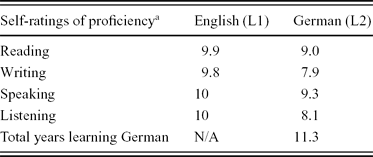
Twenty highly proficient L2 speakers of German participated in the study. One participant was first exposed to German at age 7, but he still considered English his dominant language. All other participants began learning German after age 11. At the time of the study, all but one participant were enrolled in graduate coursework in German at one of two large American universities and all participants used German on a regular basis. As part of the experiment, participants were asked to fill out a language background questionnaire to provide information including self-ratings of proficiency and language dominance. Results from this questionnaire are presented in Table 1. These ratings show that the participants were clearly more dominant in English but still considered themselves to be very proficient in German, particularly in the area of reading, which is directly relevant to the present study. Given that people often either overestimate or underestimate their abilities when asked to self-rate their L2 proficiency, all L2 participants also completed a 30-question on-line proficiency task offered by the Goethe Institute. All participants scored at least 21 points on this task (M = 25.9). This corroborated the information from the language background questionnaire and ensured that all of these L2 participants were, in fact, highly proficient L2 speakers of German. In addition to the L2 German speakers, 24 German native speakers were tested in Leipzig, Germany, and served as a baseline for comparison.
Biographical information for L2 speakers of German.

aSelf-ratings of proficiency are on a scale of 1 to 10: 1 = least native-like; 10 = most native-like.
3.2 Materials
The experiment consisted of 32 target sentences and 96 filler items. Target sentences varied according to whether the extracted wh-element was the grammatical subject or the direct object of the complement clause, and whether the matrix clause was in the present tense or the present perfect tense.Footnote 2 Examples of the target sentences are presented in (21)–(24) (for a complete list of target sentences, see the appendix).
(21)
(22)
(23)
(24)


As seen in the sentences above, case-marking information disambiguated whether the wh-element was the subject (wer “who”) or the direct object (wen “whom”) of the complement clause in each target sentence. The remainder of the matrix clause was constructed such that verbal agreement on the matrix verb precluded the possibility that the initial wh-element could be the subject of the matrix clause. Similarly, the matrix verb in all target sentences was chosen such that the wh-element could not be a plausible object of the matrix clause verb. This was done by relying on verbs that require a dative-marked indirect object, like denken “to think”, verbs that are implausible with wen “whom” as a direct object, like behaupten “to claim”, or verbs that are biased towards a sentential complement, like vermuten “to suspect”. Thus, in present tense sentences, it would become clear that the wh-element would not preferably attach to the matrix clause verb once participants encountered the matrix verb, regardless of whether the sentence was a subject-extraction or an object-extraction. In present perfect sentences, encountering the auxiliary verb hast “have” would hint to participants that the wh-element in subject-extractions could not attach to the matrix clause verb; in object-extractions the past participle would hint that the wh-element would not preferably attach to the matrix clause verb. Finally, each sentence ended with a prepositional phrase or an adverbial time phrase (e.g., letzten Sonntag “last Sunday”). This insured that any potential sentence wrap-up effects would not coincide with a critical region of the target sentence.
In addition to the 32 target sentences, participants also read 32 grammatical declarative sentences (see (25) below) and 64 ungrammatical filler items (see (26)–(29) below).
(25)
(26)
(27)
(28)
(29)


Half of the ungrammatical filler items were ungrammatical due to case markings, containing two nominative-marked subjects, as in (26), or two accusative-marked direct objects, as in (27). The other half were ungrammatical due to word order violations, with the finite verb appearing in verb second position in the subordinate clause of declarative sentences, as in (28), or in verb final position in wh-extractions, as in (29).
Four 128-item lists were created. Each list contained 32 experimental items, namely 8 sentences for each experimental condition, along with 32 declarative filler sentences and 64 ungrammatical filler sentences. These sentences were presented in a semi-randomized order, ensuring that two experimental sentences in the same condition never appeared consecutively.
3.3 Procedure
All participants were tested individually on a computer in a quiet room. Target sentences were presented using a non-cumulative self-paced reading, or moving-window, format (cf. Just, Carpenter and Wooley, Reference Just, Carpenter and Woolley1982) and were presented using the software program E-Prime (cf. Schneider, Eschmann and Zuccolotto, Reference Schneider, Eschmann and Zuccolotto2002). Before beginning the task, participants were provided with instructions for the task in German, presented both orally and in written form. Participants were told that for each sentence, they would see a row of dashes representing each word in the target sentence. Each time they pressed the space bar, the next word or phrase in the sentence would appear and the previous word or phrase would disappear. Noun phrases were presented simultaneously with their corresponding article, and prepositional and adverbial phrases were also presented in their entirety; all other words in the sentences were presented individually. An example of how the target sentences were divided into segments is provided in (30).Footnote 3
(30) Wer / denkst / du, / bewunderte / den Sportler / nach dem Spiel?
“Who do you think admired the athlete after the game?”
Before beginning each sentence, the word bereit “ready” appeared on the computer screen, indicating that participants should prepare themselves to begin reading the next sentence.Footnote 4 When participants pressed the space bar, this fixation word disappeared and the first word of the sentence appeared. Participants were instructed to read each sentence in the task silently as quickly and as accurately as possible.
Upon completing each sentence, participants were prompted to decide if the sentence they had just finished reading was grammatical or ungrammatical by pressing the corresponding J button, for ja “yes”, or N button, for nein “no”.Footnote 5 In order to help participants become accustomed to this self-paced reading format, they also completed 10 practice items at the beginning of the task.
4. Results
4.1 Judgment accuracy
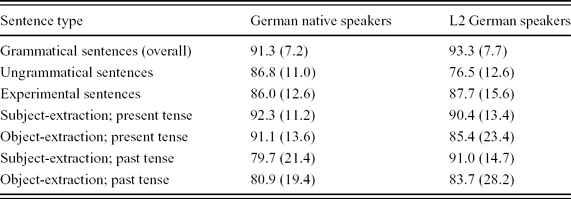
The grammaticality judgment results for both grammatical and ungrammatical items are presented in Table 2. A one-way ANOVA revealed no significant difference in judgment accuracy for the grammatical sentences, including both experimental items and the grammatical fillers, between the German native speaker and L2 German speaker groups (F < 1). There was a significant difference in performance on the ungrammatical filler items (F(1, 42) = 8.38, p < .01), indicating that the German native speakers were more accurate in identifying ungrammatical filler sentences compared to the L2 German speakers. However, as seen in Table 2, even the L2 German speakers scored above chance when judging the ungrammatical sentences. Furthermore, all participants judged at least 70% of the sentences in the entire task correctly, providing further evidence that both the L1 and the L2 speakers were paying attention to the task. One experimental item was excluded from the analysis due to computer error.
Percent of correct responses for grammatical and ungrammatical wh-extractions (standard deviations in parentheses).

A 2 × 2 × 2 repeated-measures ANOVA was performed on the mean percentage of correct responses for the experimental items, with verb tense (present tense vs. past tense) and word order (subject-extraction vs. object-extraction) as within-participants variables, and group (native speakers vs. L2 speakers) as a between-participants variable. Analyses were conducted treating both participants (F1) and items (F2) as a random factor. The results revealed a main effect for verb tense (F1(1, 42) = 9.29, MSE = 168.19, p < .01; F2(1, 30) = 11.54, MSE = 177.81, p < .01). There was no main effect for word order (F1(1, 42) = 1.18, MSE = 356.40, p > .1; F2(1, 30) = 1.54, MSE = 271.62, p > .1) nor was there a main effect for group (F1 and F2 < 1). There was a significant verb tense × group interaction (F1(1, 42) = 7.57, MSE = 168.19, p < .01; F2(1, 30) = 10.17, MSE = 194.20, p < .01). No other interactions were significant (word order × group: F1(1, 42) = 1.18, MSE = 356.40, p > .1; F2(1, 30) = 2.27, MSE = 195.40, p > .1; all other F1 and F2 < 1).
To explore the significant verb tense × group interaction, separate 2 × 2 ANOVAs were conducted with each group, treating verb tense and word order as within-participants variables. For the German native speakers, this ANOVA revealed a significant effect for verb tense (F1(1, 23) = 14.33, MSE = 217.06, p = .001; F2(1, 30) = 20.44, MSE = 197.02, p < .0001), indicating that judgment accuracy on present tense sentences (M = 91.7%) was significantly higher than on past tense sentences (M = 80.3%). Among the native speakers, there was no significant effect for word order and no significant verb tense × word order interaction (F1 and F2 < 1). In contrast, for the L2 German speakers, there was no main effect for verb tense (F1 and F2 < 1). There was, however, a main effect for word order that was significant in the item analysis only (F1(1, 19) = 1.38, MSE = 556.40, p > .1; F2(1, 30) = 4.25, MSE = 202.43, p < .05), suggesting that accuracy on subject-extractions (M = 90.7%) was higher than accuracy on object-extractions (M = 84.5%). Finally, for the L2 speakers, there was no significant verb tense × word order interaction (F1 and F2 < 1).
4.2 Reading times
As is common in psycholinguistic research, only reading times for sentences that were correctly judged as grammatical were included in the reading time analyses. Excluding reading times for incorrect responses resulted in the elimination of 14.0% of the reading time data for the German native speakers and 12.3% of the reading time data for the L2 German speakers. In addition, reading times that were more than 2.5 standard deviations from the mean reading time for a given condition for a particular phrase were also excluded from the analysis, eliminating an additional 2.9% of the reading time data for the native speakers and 2.9% of the reading time data for the L2 speakers. This step was taken to eliminate reading times that were artificially high due to momentary loss of concentration or other factors independent of the variables under investigation.
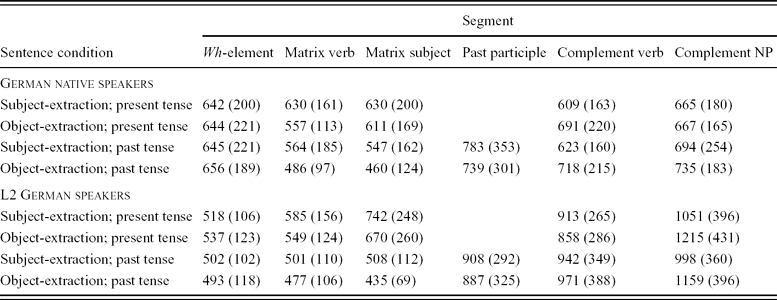
Reading times for each sentence condition are presented in Table 3. In the matrix clause it appears that for both groups, present tense sentences took longer to read than past tense sentences, and that subject-extractions took longer than object-extractions. Upon reaching the complement clause, however, this word order preference reversed, with object-extractions exhibiting longer reading times compared to subject-extractions, although it seems that this reversal occurred directly at the complement verb among the German native speakers and not until the complement noun among the L2 German speakers.
Mean reading time results in milliseconds (standard deviations in parentheses).

There were six critical regions for analysis: the wh-element, the matrix verb, the matrix subject, the past participle (for past tense sentences only), the complement verb, and the complement noun phrase. No analyses were conducted on the final prepositional or adverbial phrase given that reading times were higher overall, and exhibited greater variance, due to sentence wrap-up effects and because participants were already beginning to make their grammaticality judgment decision (cf. Juffs, Reference Juffs2005). A 2 × 2 × 2 repeated-measures ANOVA was performed on the mean reading times for these crucial phrases in the sentence, with verb tense (present tense vs. past tense) and word order (subject-extraction vs. object-extraction) as within-participants variables, and group (native speakers vs. L2 speakers) as a between-participants variable. At the wh-element there was no effect for verb tense (F1 and F2 < 1), nor for word order (F1 and F2 < 1). There was a main effect for group (F1(1, 42) = 8.08, MSE = 97147.51, p < .01; F2(1, 30) = 101.54, MSE = 9530.58, p < .0001), indicating that overall, the native speakers read this segment more slowly than the L2 speakers. There were no significant interactions (verb tense × group: F1(1, 42) = 2.24, MSE = 6871.28, p >.1; all other F1 < 1; all F2 < 1).
At the matrix verb there was a main effect for verb tense (F1(1, 42) = 36.52, MSE = 6415.30, p < .0001; F2(1,30) = 25.68, MSE = 13824.64, p < .0001), suggesting that across both groups, reading times for present tense sentences were longer (M = 580 ms) than for past tense sentences (M = 507 ms). This finding is not surprising given that in past tense sentences, the matrix verb was a form of the auxiliary verb haben “have”, which presumably would take less time to read than a thematic verb, such as denken “think”, which carries additional information about syntactic and thematic structure. There was also a main effect for word order (F1(1,42) = 14.60, MSE = 8130.49, p < .0001; F2(1,30) = 32.19, MSE = 5501.37, p < .0001) due to longer reading times across groups on subject-extractions (M = 570 ms) compared to object-extractions (M = 518 ms). There was a main effect for group that was significant in the item analysis only (F1 < 1; F2(1,31) = 7.82, MSE = 4583.55, p < .01), suggesting that reading times were longer in the German native speaker group compared to the L2 German speaker group. At the matrix verb, there were no significant interactions (word order × group: F1(1, 42) = 2.78, MSE = 8130.49, p > .1; F2(1, 30) = 2.50, MSE = 8717.56, p > .1; all other F1 and F2 < 1), indicating that the main effects for verb tense and word order did not interact with one another, nor did they differ significantly across groups.
At the matrix subject, there was a main effect for verb tense (F1(1, 42) = 67.99, MSE = 19796.16, p < .0001; F2(1, 30) = 84.17, MSE = 21879.21, p < .0001), showing that present tense sentences took longer to read than past tense sentences. There was also a main effect for word order (F1 (1, 42) = 17.00, MSE = 10185.54, p < .0001; F2(1, 30) = 11.82, MSE = 18171.75, p < .01), due to longer reading times on subject-extractions compared to object-extractions. There was also a main effect for group that was significant in the item analysis only (F1 < 1; F2(1, 30) = 5.09, MSE = 15976.56, p < .05), suggesting that reading times for the German native speakers were faster than reading times for the L2 German speakers. These main effects were qualified by a significant verb tense × group interaction (F1(1, 42) = 7.57, MSE = 19796.16, p < .01; F2(1, 30) = 8.54, MSE = 16820.19, p < .01). No other interactions were significant (word order × group: F1 < 1; F2(1, 30) = 1.10, MSE = 22352.44, p > .1; verb tense × word order: F1(1, 42) = 1.44, MSE = 9086.61, p > .1; F2 < 1; verb tense × word order × group: F1(1, 42) = 1.29, MSE = 9086.61, p > .1; F2(1, 30) = 1.37, MSE = 22739.18, p > .1).
To explore the significant verb tense × group interaction, 2 × 2 ANOVAs were conducted on each group individually, treating verb tense and word order as within-participants variables. Among the German native speakers, there was a main effect for verb tense (F1(1, 23) = 55.30, MSE = 5943.96, p < .0001; F2(1, 30) = 27.01, MSE = 17711.85, p < .0001), due to longer reading times on present tense sentences (M = 620 ms) compared to past tense sentences (M = 503 ms). There was also a main effect for word order that was significant in the participant analysis only (F1(1, 23) = 11.17, MSE = 6089.99, p < .01; F2(1, 30) = 2.82, MSE = 16716.91, p > .1), suggesting that reading times were longer on subject-extractions (M = 589 ms) compared to object-extractions (M = 535 ms). There was no significant verb tense × word order interaction, although it approached significance in the participant analysis (F1(1, 23) = 3.38, MSE = 8075.32, p < .1; F2(1, 30) = 2.15, MSE = 14777.39, p > .1).
The results from the 2 × 2 ANOVA for the L2 German speakers were similar to those of the German native speakers. The L2 German speakers exhibited a main effect for verb tense (F1(1, 19) = 30.01, MSE = 36564.61, p < .0001; F2(1, 30) = 71.80, MSE = 20987.56, p < .0001), due to longer reading times on present tense sentences (M = 706 ms) compared to past tense sentences (M = 471 ms). The ANOVA for the L2 speakers also revealed a main effect for word order (F1(1, 19) = 6.99, MSE = 15143.32, p < .05; F2(1, 30) = 8.07, MSE = 23807.29, p < .01), in that reading times for subject-extractions (M = 625 ms) were longer than for object-extractions (M = 552 ms). Among the L2 speakers, there was no significant verb tense × word order interaction (F1 and F2 < 1).Footnote 6
At the past participle, the mixed ANOVA revealed no main effect for word order (F1 and F2 < 1). There was a main effect for group in the item analysis only (F1(1, 42) = 2.68, MSE = 151883.20, p > .1; F2(1, 30) = 24.58, MSE = 39815.35, p < .0001), due to longer reading times in the L2 German speaker group compared to the German native speakers. At the past participle, there was no significant word order × group interaction (F1 and F2 < 1).
Turning now to the complement clause, at the complement verb there was no main effect for verb tense (F1(1, 42) = 2.25, MSE = 41175.48, p > .1; F2(1, 30) = 1.94, MSE = 46249.60, p > .1). There was no main effect for word order, although it approached significance in the item analysis (F1(1, 42) = 2.48, MSE = 25450.60, p > .1; F2(1, 30) = 3.13, MSE = 43623.28, p < .1). There was a main effect for group (F1(1, 42) = 16.57, MSE = 179106.86, p < .0001; F2(1, 30) = 78.37, MSE = 54779.07, p < .0001), in that reading times were longer among the L2 German speakers compared to the German native speakers. This main effect was qualified by a significant word order × group interaction (F1(1, 42) = 4.49, MSE = 25450.60, p < .05; F2(1, 30) = 4.87, MSE = 44398.39, p < .05). No other interactions were significant (all F1 and F2 < 1).
To explore the significant word order × group interaction, 2 × 2 ANOVAs were conducted within each group, treating verb tense and word order as within-participants variables. Among the German native speakers, this ANOVA revealed no effect for verb tense (F1 and F2 < 1). There was, however, a main effect for word order (F1(1, 23) = 13.04, MSE = 14656.32, p = .001; F2(1, 30) = 23.45, MSE = 14864.17, p < .0001), due to longer reading times on object-extractions (M = 705 ms) compared to subject-extractions (M = 616 ms). There was no significant verb tense × word order interaction (F1 and F2 < 1). This indicates that upon reaching the complement clause, the German native speakers had difficulty with object-extractions regardless of verb tense and, thus, regardless of whether or not two finite verbs were adjacent to one another. In contrast to the German native speakers, the 2 × 2 ANOVA revealed no significant effects or interaction among the L2 German speakers at the complement verb (verb tense: F1(1, 19) = 1.48, MSE = 69246.72, p > .1; F2(1, 30) = 1.07, MSE = 79725.57, p > .1; all other F1 and F2 < 1), showing that their reading times did not differ across conditions at the complement verb.
Results from the mixed ANOVA at the complement noun phrase were similar to results from the mixed ANOVA at the complement verb. Results revealed no main effect for verb tense (F1 and F2 < 1). There was a main effect for word order (F1(1, 42) = 13.33, MSE = 27497.45, p = .001; F2(1, 30) = 7.01, MSE = 62111.46, p < .05), in that reading times for object-extractions were longer than reading times for subject-extractions. There was also a main effect for group (F1(1, 42) = 27.86, MSE = 270715.10, p < .0001; F2(1, 30) = 224.05, MSE = 40425.07, p < .0001), due to longer reading times for the L2 German speakers compared to the German native speakers. The verb tense × group interaction approached significance in the participant analysis, but was not significant in the item analysis (F1(1, 42) = 3.82, MSE = 30067.61, p < .1; F2(1, 30) = 2.17, MSE = 49219.73, p > .1). However, there was a significant word order × group interaction in the participant analysis that approached significance in the item analysis (F1(1, 42) = 7.87, MSE = 27497.45, p < .01; F2(1, 30) = 3.54, MSE = 69043.15, p < .1). There was no significant verb tense × word order interaction, nor was the three-way verb tense × word order × group interaction significant (F1and F2 < 1).
To examine the significant word order × group interaction, separate 2 × 2 ANOVAs were conducted with each group, treating verb tense and word order as within-participants variables. Among the German native speakers, there was a main effect for verb tense that was significant in the participant analysis and approached significance in the item analysis (F1(1, 23) = 4.44, MSE = 12765.21, p < .05; F2(1, 30) = 3.41, MSE = 18050.41, p < .1), suggesting that reading times for past tense sentences (M = 715 ms) were longer than reading times for present tense sentences (M = 666 ms). Unlike results at the complement verb, however, there was no main effect for word order (F1 and F2 < 1). There was also no significant verb tense × word order interaction (F1 < 1; F2(1, 30) = 1.10, MSE = 16845.09, p > .1).
Results from the 2 × 2 ANOVA with the L2 German speakers yielded different results. While there was no main effect for verb tense (F1(1, 19) = 1.14, MSE = 51012.62, p > .1; F2 < 1), there was a main effect for word order (F1(1, 19) = 11.48, MSE = 45735.54, p < .01; F2(1, 30) = 5.73, MSE = 116162.28, p < .05). This word order effect indicates that among the L2 German speakers, reading times for object-extractions (M = 1187 ms) were longer than reading times for subject-extractions (M = 1025 ms). At the same time, there was no significant verb tense × word order interaction (F1 and F2 < 1), suggesting that for the L2 German speakers, object-extractions were more difficult than subject-extractions, regardless of verb tense, upon reading the complement noun phrase.
To summarize, both the German native speakers and the L2 German speakers had greater difficulty parsing subject-extractions than object-extractions while processing the matrix clause. Both groups also had greater difficulty with present tense sentences compared to past tense sentences. Upon reaching the complement clause, however, object-extractions posed greater difficulties than subject-extractions. For the German native speakers, this difficulty appeared immediately at the complement verb, and disappeared by the time they read the following noun phrase. In contrast, this difficulty did not arise until the complement noun phrase for the L2 German speakers. For both groups, this difficulty with object-extractions in the complement clause occurred regardless of whether the matrix clause was in the present tense or in the past tense, suggesting that at the complement clause, participants found it harder to parse object-extractions compared to subject-extractions regardless of whether or not two finite verbs were adjacent to one another.
5. Discussion
By and large, the results from both the L2 speakers of German and the German native speakers parallel previous findings in the German monolingual research. Both groups exhibited longer reading times for object-extractions compared to subject-extractions in the complement clause. Among the native speakers, this difference appeared immediately at the complement verb and among L2 German speakers this difference appeared at the complement noun. In addition, there was a trend in the L2 speaker group that object-extractions were more difficult to correctly judge as grammatical compared to subject-extractions. These findings point to a preference for subject-extractions over object-extractions, supporting previous German research that has demonstrated a subject-first preference, both for this type of wh-question (cf. Fanselow et al., 1999; Meng and Bader, Reference Meng and Bader2000) and in general (e.g., Bader and Meng, Reference Bader and Meng1999; Gorrell, Reference Gorrell, Hemforth and Konieczny2000; Schlesewsky et al., Reference Schlesewsky, Fanselow, Kliegl, Krems, Hemforth and Konieczny2000).
At the same time, the results from this study diverge from previous research with regard to reading times in the matrix clause. Fanselow et al. (Reference Fanselow, Kliegl, Schlesewsky, Kemper and Kliegl1999) showed that German native speakers exhibited faster reading times for subject-extractions compared to object-extractions at the initial wh-phrase, followed by no differences in reading times across conditions for the remainder of the matrix clause. In contrast, both the German native speakers and the L2 German speakers in the current study exhibited significantly longer reading times for subject-extractions compared to object-extractions at both the matrix verb and the matrix subject. This divergence in findings can be attributed to task differences between the two studies. Even though both tasks employed a self-paced reading paradigm (cf. Just et al., Reference Just, Carpenter and Woolley1982), participants in the original Fanselow et al. study completed a sentence-matching task after reading each sentence, whereas participants in the current study were prompted to judge whether the sentence they had just read was grammatical or ungrammatical. Similar to previous German monolingual research (cf. Fanselow et al., Reference Fanselow, Kliegl, Schlesewsky, Kemper and Kliegl1999; Meng and Bader, Reference Meng and Bader2000), agreement information on the matrix verb precluded the possibility that the initial wh-element could be the subject of the matrix clause. Thus, after reading the initial wh-element, which in the case of subject-extractions was unambiguously identified as a grammatical subject via nominative case markings, participants then encountered a finite verb that did not agree with this nominative-marked wh-element. This mismatch appears to have led to greater processing difficulties on subject-extractions, difficulties that potentially were increased by task demands that required participants to make a grammaticality judgment about the sentence once they had finished reading it.
Returning to our original research questions, the first question asked whether or not L2 speakers would utilize L2 morphosyntactic information during on-line processing when such information is not part of their L1 grammar. The results from this study demonstrate that the L2 German speakers were sensitive to case-marking information during L2 processing. They correctly identified the wh-element, wer “who”, as a nominative-marked subject, and as such, tried to integrate this element into the matrix clause. When this was not possible due to agreement features on the matrix verb, reading times at the matrix verb and matrix subject were longer compared to object-extractions, similar to the German native speakers. These findings differ from the reading time results reported by Jiang (Reference Jiang2004), in which L2 English speakers (Chinese L1) did not exhibit any on-line sensitivity to idiosyncrasies or disagreement in number agreement when reading English sentences. Instead, the present findings are more in line with studies that have shown that highly proficient L2 speakers quickly integrate L2-specific information during on-line processing (e.g., Juffs and Harrington, Reference Juffs and Harrington1995; Frenck-Mestre and Pynte, Reference Frenck-Mestre and Pynte1997; Hoover and Dwivedi, Reference Hoover and Dwivedi1998; Frenck-Mestre, Reference Frenck-Mestre, Heredia and Altarriba2002; Juffs, Reference Juffs2005).
The second research question asked whether L2 German speakers would transfer a processing preference for object-extractions from their L1 English or whether they could adopt a subject-preference, similar to German native speakers. Previous research exploring how L2 speakers interpret sentences when faced with cross-linguistic variability in processing preferences has focused largely on relative clause attachment ambiguities (e.g., Frenck-Mestre, Reference Frenck-Mestre, Sorace, Heycock and Shillcock1997, Reference Frenck-Mestre, Heredia and Altarriba2002; Fernández, Reference Fernández, Klein and Martohardjono1999, Reference Fernández2003; Dussias, Reference Dussias and Nicol2001, Reference Dussias2003; Felser et al., Reference Felser, Roberts, Marinis and Gross2003; Papadopoulou and Clahsen, Reference Papadopoulou and Clahsen2003). However, the contradictory findings reported in these studies may stem from the fact that these preferences are not part of the core grammar of a language, highlighted by the fact that additional factors, such as prosody and lexical-semantic information, can influence relative clause attachment preferences even among monolinguals (cf. Fodor, Reference Fodor1998; Hemforth et al., Reference Hemforth, Konieczny, Scheepers, Crocker, Pickering and Clifton2000). In contrast, the cross-linguistic variability investigated in the present study can be traced to differences between the core grammar of English and German. The results from the present study favor an account in which highly proficient L2 speakers' processing preferences parallel those of native speakers (e.g., Frenck-Mestre, Reference Frenck-Mestre, Heredia and Altarriba2002; Dussias, Reference Dussias2003), in that the L2 German speakers exhibited a subject-preference similar to German native speakers, as opposed to maintaining an L1 preference for object-extractions or exhibiting no clear preference in on-line processing for either subject- or object-extractions.
At the same time, the greater difficulty for object-extractions appeared at different locations in the complement clause for each group. Whereas longer reading times for object-extractions appeared immediately at the complement verb for the German native speakers (cf. Fanselow et al., Reference Fanselow, Kliegl, Schlesewsky, Kemper and Kliegl1999), comparable reading time differences for the L2 German speakers did not appear until the following phrase, at the complement noun. One possibility for this difference is that the L2 German speakers had greater difficulty processing the target sentences compared to the German native speakers, resulting in a delay in the effect for object-extractions in the complement clause. Similar delayed effects among L2 speakers compared to native speaker controls have been reported elsewhere in the L2 processing literature (e.g., Hoover and Dwivedi, Reference Hoover and Dwivedi1998; Williams et al., Reference Williams, Möbius and Kim2001; Dussias and Piñar, in press). While this may point to slower processing overall among L2 speakers or a greater difficulty in recovering from an initial misanalysis, it would nevertheless suggest an overall similarity in processing strategies between native speakers and highly proficient L2 speakers of a language.
Alternatively, because the difficulty with object-extractions did not appear until the complement noun phrase among the L2 German speakers, one could argue that the L2 speakers did not, in fact, process the target sentences in a manner similar to the native speakers. In line with Clahsen and Felser's (Reference Clahsen and Felser2006) Shallow Structure Hypothesis, the L2 speakers could have postponed building the syntactic structure of the target sentence until reading crucial case-marking information at the complement noun phrase. Only at that point did they attempt to integrate the wh-element into the complement clause, leading to longer reading times for the dispreferred object-extractions. This explanation would suggest that while L2 speakers are able to process L2-specific morphological information, they may not rely on the relationship between morphological and syntactic information to incrementally build the syntactic structure of a sentence in the same way native speakers do during on-line parsing. Indeed, a reliance on more linear-based processing strategies among the L2 speakers could have been strengthened by the nature of the task itself and the inclusion of ungrammatical filler items containing case violations. In an effort to correctly judge both target and filler items, the L2 speakers may have adopted a strategy in which they paid attention to the case-marking information on the initial wh-element and then attempted to match this information with the relevant case-marking information on the complement noun phrase, potentially at the expense of processing other information in the target sentence (see Williams, Reference Williams2006, for the relevance of task-induced processing strategies among L2 speakers). The extent to which the delayed processing effects reported here represent a more generalized preference for linear-based processing strategies among L2 speakers, as opposed to an artifact of the specific task demands cannot be determined at this time. However, research using the same target sentences with other grammatical filler items, in which both L1 and L2 participants must answer a comprehension question after reading each sentence is currently in progress to address this issue.
In spite of the fact that reading difficulties in the complement clause manifested themselves at different points for the German native speakers and for the L2 German speakers, the fact remains that both groups exhibited greater processing difficulties with object-extractions compared to subject-extractions. This suggests that even if both groups may have processed the target sentences in a different manner, the English L2 speakers of German were not transferring processing strategies from their L1. If transfer had occurred, these participants should have displayed a preference for object-extractions instead (e.g., Juffs and Harrington, Reference Juffs and Harrington1995). In addition, the present results are not in line with studies in which L2 speakers have demonstrated no preferences during on-line processing (e.g., Felser et al., Reference Felser, Roberts, Marinis and Gross2003; Papadopoulou and Clahsen, Reference Papadopoulou and Clahsen2003). Instead, similar to other research examining how L2 speakers process wh-questions (e.g., Juffs and Harrington, Reference Juffs and Harrington1995; Williams et al., Reference Williams, Möbius and Kim2001; Juffs, Reference Juffs2005; Dussias and Piñar, in press), these results provide evidence that, like native speakers, L2 speakers attempt to incorporate wh-phrases into a sentence as early as possible, and run into difficulty when doing so leads to a dispreferred structure.
Finally, the third research question under investigation was whether or not difficulties with this type of wh-question can be traced to the adjacency of two finite verbs, as has been suggested by Juffs (Reference Juffs2005), based on findings using the same research methodology to examine the same type of sentence in English. Both the L2 German speakers and the German native speakers exhibited processing difficulties at the complement clause in object-extractions, regardless of the verb tense in the matrix clause, and, therefore, regardless of whether two finite verbs were adjacent to one another. While these results do not rule out the possibility that the adjacency of two finite verbs exacerbates the relative processing difficulty of wh-extractions from finite clauses, they suggest that linear position alone cannot explain why both L1 and L2 speakers have difficulty processing this type of wh-question.
To conclude, the present study investigated whether highly proficient L2 speakers of German were sensitive to morphological case-marking information when reading L2 sentences, even though this morphological structure is of little importance in their L1 grammar. Results showed that the L2 speakers' performance was similar to that of German native speakers, indicating that they had not only incorporated the German case-marking system into their L2 linguistic system, but that they could also utilize this information during on-line processing. These findings underscore the possibility that L2 speakers can reach a proficiency level in which even “difficult” aspects of the L2 grammar can be rapidly accessed under certain circumstances, even when use of such grammatical features may remain non-native-like during language production (Ritterbusch et al., Reference Ritterbusch, LaFond and Agustin2006). Furthermore, this study and others like it demonstrate how the application of methodological tools common in the field of monolingual sentence processing provide a fruitful avenue for measuring L2 speakers' knowledge of L2 grammatical structures – methodologies that can measure not only whether L2 speakers possess such linguistic knowledge in the first place, but if, when, and how they can take advantage of such knowledge during real time language processing.
Appendix: Target items
Four versions of each experimental sentence were created, corresponding to each of the experimental conditions, as seen in sentence (1) below. For the remaining sentences, only condition (a) (subject-first; present tense) is shown.
- (1)
a. Wer denkst du, bewunderte den Sportler nach dem Spiel?
Who do you think admired the athlete after the game?
b. Wen denkst du, bewunderte der Sportler nach dem Spiel?
Who do you think the athlete admired after the game?
c. Wer hast du gedacht, bewunderte den Sportler nach dem Spiel?
Who did you think admired the athlete after the game?
d. Wen hast du gedacht, bewunderte der Sportler nach dem Spiel?
Who did you think the athlete admired after the game?
(2) Wer meinen Sie, beschrieb den Manager während der Besprechung?
Who do you believe described the manager during the meeting?
(3) Wer behauptest du, besuchte den Senator jeden Freitag?
Who do you claim visited the senator every Friday?
(4) Wer sagst du, ärgerte den Schüler nach der Stunde?
Who do you say angered the pupil after the class?
(5) Wer glaubst du, beleidigte den Reporter bei der Pressekonferenz?
Who do you believe insulted the reporter at the press conference?
(6) Wer berichten sie, beruhigte den Pfarrer nach dem Unfall?
Who do they report calmed the pastor after the accident?
(7) Wer betonen sie, kannte den Ingenieur in der Firma?
Who do they stress knew the engineer at the company?
(8) Wer vermuten Sie, beobachtete den Spion letztes Jahr?
Who do you suspect watched the spy last year?
(9) Wer meinen Sie, sah den Jogger auf der Straße?
Who do you believe saw the jogger on the road?
(10) Wer behaupten Sie, überraschte den Arbeiter in seinem Büro?
Who do you claim surprised the worker in his office?
(11) Wer sagst du, weckte den Jungen um acht Uhr?
Who do you say awoke the boy at eight o'clock?
(12) Wer glauben Sie, liebte den Komiker von ganzem Herzen?
Who do you believe loved the comedian with all his heart?
(13) Wer denkst du, vermisste den Lehrer in den Ferien?
Who do you think missed the teacher during the vacation?
(14) Wer berichten sie, unterbrach den Regisseur während seiner Rede?
Who do they report interrupted the director during his speech?
(15) Wer betonen sie, verstand den Verkäufer nur mit Schwierigkeiten?
Who do they stress understood the salesman with difficulty?
(16) Wer vermutest du, langweilte den Professor während der Vorlesung?
Who do you suspect bored the professor during the lecture?
(17) Wer meinst du, heiratete den Mechaniker letzten Sonntag?
Who do you believe married the mechanic last Sunday?
(18) Wer behauptest du, störte den Gärtner gestern Nachmittag?
Who do you claim disturbed the gardener yesterday afternoon?
(19) Wer sagen Sie, grüßte den Zahnarzt jeden Tag?
Who do you say greeted the dentist every day?
(20) Wer glaubst du, fand den Dieb hinter dem Haus?
Who do you believe found the thief behind the house?
(21) Wer denken Sie, traf den Kaufmann am Dienstag?
Who do you think met the businessman on Tuesday?
(22) Wer berichten sie, tröstete den Kellner gestern Abend?
Who do they report consoled the waiter yesterday evening?
(23) Wer betonen sie, besiegte den Schwimmer bei der Meisterschaft?
Who do they stress beat the swimmer at the championship?
(24) Wer vermuten Sie, erschreckte den Räuber bei dem Überfall?
Who do you suspect scared the robber during the holdup?
(25) Wer meinst du, enttäuschte den Musiker beim Konzert?
Who do you believe disappointed the musician at the concert?
(26) Wer behaupten Sie, ermordete den Koch im Restaurant?
Who do you claim murdered the cook in the restaurant?
(27) Wer sagen Sie, erkannte den Bäcker gestern Vormittag?
Who do you say recognized the baker yesterday morning?
(28) Wer glauben Sie, empfing den Minister am Donnerstag?
Who do you believe welcomed the secretary on Thursday?
(29) Wer denken Sie, lobte den Richter nach dem Prozess?
Who do you think praised the judge after the trial?
(30) Wer berichten sie, kritisierte den Politiker letzte Woche?
Who do they report criticized the politician last week?
(31) Wer betonen sie, tötete den Einbrecher letzte Nacht?
Who do they stress killed the burglar last night?
(32) Wer vermutest du, entführte den Arzt vor einem Monat?
Who do you suspect kidnapped the doctor a month ago?