Introduction
The lichen genus Pyxine was established by Elias Fries in 1825 and it is a prominent member of the family Physciaceae. The genus is characterized by closely appressed, radiating, whitish to bluish grey, foliose thalli with narrow lobes often covered with pruina, maculae and pseudocyphellae. The apothecia have a lecanorine to lecidine margin, K+ purple epihymenium, hyaline hymenium and brown hypothecium. Ascospores are mostly 2-celled, brown, thick-walled, ellipsoidal and mischblastiomorphic-type. Pyxine is very close to Dirinaria, which can be differentiated by the absence of rhizines (placodioid condition), K− epihymenium, and medullary chemistry. Molecular phylogenetic studies have shown that there is a close relationship between these two genera but they are clearly separated as distinct lineages (Helms et al. Reference Helms, Friedl and Rambold2003). In Pyxine, the colour of the medulla can range from white to stramineous or sometimes distinctly yellow or orange ochraceous and it plays an important role in the taxonomy of the genus. The species of Pyxine mostly contain atranorin and several unidentified terpenes as secondary metabolites. Some species contain lichexanthone rather than atranorin and such thalli emit a creamish, yellow fluorescence when viewed under long wavelength ultraviolet light (350 nm).
The genus Pyxine is mainly pantropical to subtropical with several species extending into temperate or oceanic regions, and comprises c. 65 species (Elix Reference Elix and McCarthy2009). Index Fungorum (www.indexfungorum.org) holds a total of 162 records for Pyxine, which include 96 species and several infra-specific taxa. However, many taxa in that list need validation (e.g. P. consocians Vain. is mentioned as synonym of P. subcinerea Stirt.). A number of studies on Pyxine throughout the world are available. Swinscow & Krog (Reference Swinscow and Krog1975) reported 23 species from East Africa. Initially Rogers (Reference Rogers1986) studied Pyxine from Australia but this treatment was later updated by Kalb (Reference Kalb1994) and Elix (Reference Elix and McCarthy2009), where 26 species were reported. Amtoft (Reference Amtoft2002) studied Pyxine from the eastern United States, Imshaug (Reference Imshaug1957) from North and Middle America, Kalb (Reference Kalb, Nash, Ryan, Gries and Bungartz2001) from the Greater Sonoran Desert Region, Hu & Chen (Reference Hu and Chen2003) from China, Moberg (Reference Moberg1983) from Europe and Kashiwadani (Reference Kashiwadani1977a , Reference Kashiwadani b , Reference Kashiwadani c ) from Japan. Obermayer & Kalb (Reference Obermayer and Kalb2010) studied three species of Pyxine found in Tibet and adjacent regions. Awasthi (Reference Awasthi1982) studied Pyxine in India and reported 21 species, including six new taxa. Risbud & Patwardhan (Reference Risbud and Patwardhan1989) treated 9 species of Dirinaria and Pyxine occurring in the Andaman Islands. Later Awasthi (Reference Awasthi2007) added two more species to the Indian flora and Singh & Sinha (Reference Singh and Sinha2010) listed 23 species from the country. Recently, Bajpai et al. (Reference Bajpai, Dwivedi, Upreti and Nayaka2009) reported P. isidiophora (Müll. Arg.) Imshaug as a new record for India, although it actually occurred in neighbouring Sri Lanka. During the recent exploration of lichens from southern India, two interesting Pyxine specimens were encountered and are described here as new to science.
Materials and Methods
The external morphology of the Pyxine specimens was studied with a Leica S8APO stereo-zoom microscope, while anatomical characters of apothecia were observed under a Leica DM500 compound microscope. Thin hand-cut sections of the apothecia were initially mounted in water to record the colour and measurements of various structures. The sections were then observed after applying aqueous KOH solution and Lugol's solution (CDH, New Delhi) used for iodine reactions. The colour tests were performed by using routine reagents; an aqueous solution of KOH (K), calcium hypochlorite (C) and para-phenalenediamine (P), and TLC was performed using solvent system A following Walker & James (Reference Walker and James1980).
The Species
Pyxine punensis Nayaka & Upreti sp. nov.
MycoBank No.: MB 801196
Thallus saxicolous, closely appressed, lobes 0·3–0·6 mm wide, isidia nodular to cylindrical, medulla yellow, apothecia absent, UV+ (lichexanthone present).
Type: India, Maharashtra, Pune City, Taljai, Parvati Paschgaon, alt. 580 m, on rock, 31 January 2006, S. Nayaka 06-005070 (LWG—holotype).
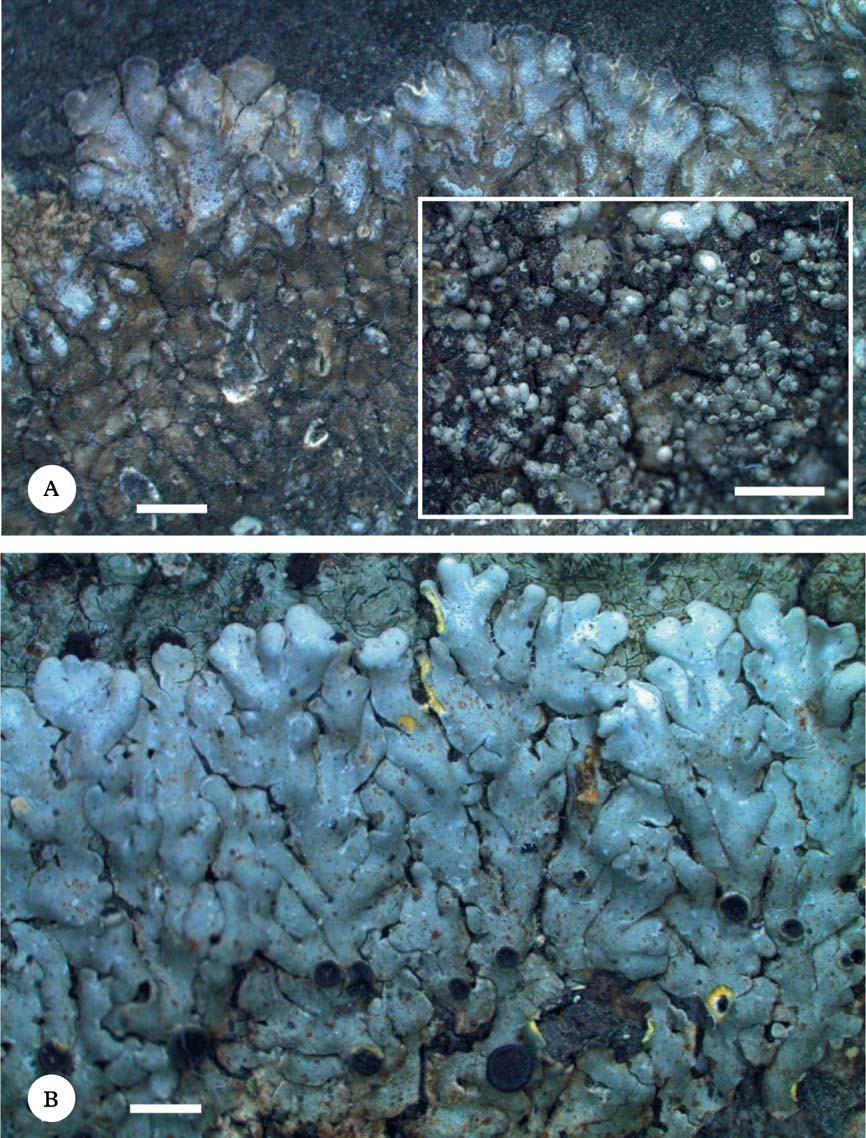
(Fig. 1A)
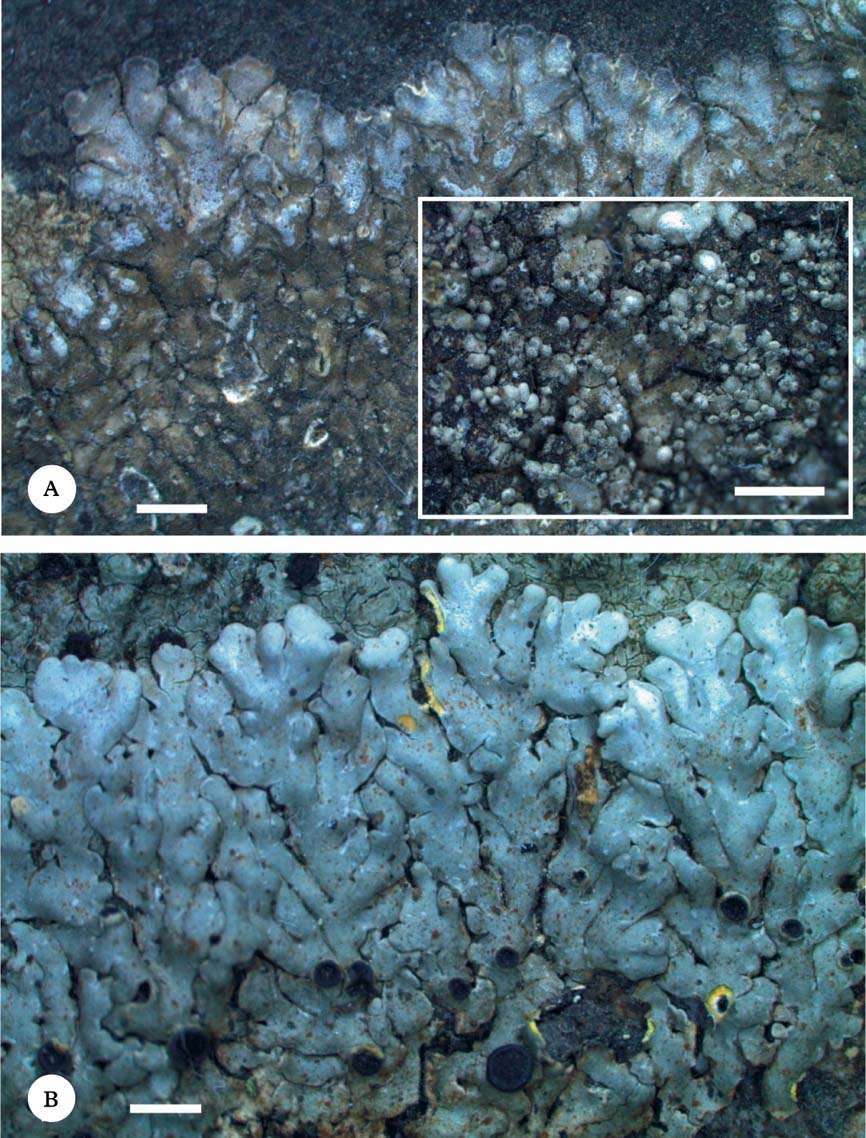
Pyxine species, habit. A, P. punensis (holotype), inset enlarged portion of the thallus showing nodular isidia; B, P. yercaudensis (holotype). Scale=1 mm.
Thallus saxicolous, orbicular to sub-orbicular, 1·5–9·0 cm wide, closely appressed to the substratum. Upper surface whitish grey, older parts becoming greenish brown from the centre to periphery, maculae and pseudocyphellae poorly developed, submarginal to laminal. Isidia sparse to dense, nodular or globose, rarely cylindrical, simple or rarely branched, mostly present towards the centre of the thallus, sometimes closely aggregated to form dactyls or polysidiangia and bursting apically, but not producing soredia. Lobes irregularly branched, 0·3–0·6 mm wide, flat, rotund, pruinose, pruina as agglutinated flakes, dense to sparse. Lower surface dark greenish grey to black, shiny, rhizinate, rhizines sparse. Medulla yellow throughout.
Apothecia and pycnidia not seen.
Chemistry
Cortex K−, P−, C−, KC−, UV+ bright yellow. Medulla K− or becoming intense yellow, P−, C−, KC−. TLC: Zeorin, triterpenes at Rf class 6 and 7, lichexanthone between Rf class 6–7, yellow-grey spot at Rf class 4.
Etymology
The species epithet refers to the name of the locality, Pune, from where it has been collected.
Ecology and distribution
Pyxine punensis was found growing luxuriantly over rocks in jungle scrub in hillocks near Pune City in Maharashtra, at an altitude of 580 m. It is found growing in association with other saxicolous species such as Buellia sp., Diplotomma sp., Diploschistes sp., Lecanora indica (Stirt.) Zahlbr., Rinodina oxydata (A. Massal.) A. Massal., and Xanthoparmelia pseudocongensis Hale.
Remarks
Pyxine punensis is characterized by an isidiate thallus with a yellow medulla and UV+ cortex. The isidia are concolorous with the younger parts of the thallus and distinctly visible from the dark background of the older part of the thallus. Pyxine punensis is close to P. physciaeformis (Malme) Imshaug with respect to the isidia and UV+ yellow cortex; however, in the latter species the dactyls ultimately burst apically to form soredia. Pyxine punensis is a predominantly isidiate species and never forms soredia. The medulla in P. physciaeformis is pale yellow in upper layers and white below, whereas in P. punensis the medulla is distinctly yellow throughout. Furthermore, P. physciaeformis is a corticolous species distributed in Africa (Kenya, Tanzania, Zambia) and South America (Brazil) at an altitude of between 1000–2400 m and in coastal woodland of Australia (Elix Reference Elix and McCarthy2009), whereas P. punensis is saxicolous and currently known only from the type locality.
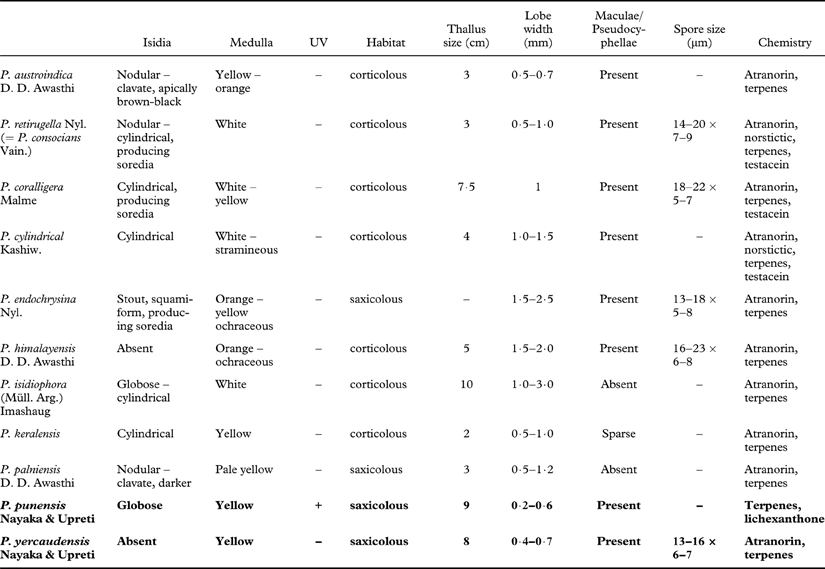
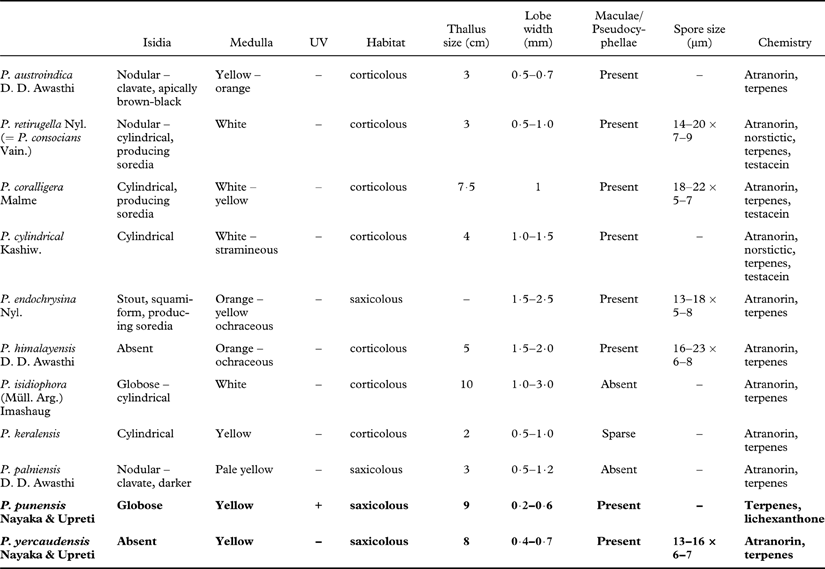
Pyxine lyei Swinscow & Krog is also saxicolous, where the thallus is firmly appressed, has a UV+ yellow and isidiate upper surface, but differs from P. punensis in having a white medulla. Pyxine isidiolenta R. W. Rogers, an Australian species, has isidia and a yellow medulla; however, it is a corticolous species and lacks lichexanthone (UV−). Among the Indian species, P. palniensis D. D. Awasthi and P. endochrysina Nyl. are similar to P. punenis with respect to their saxicolous habitat, yellow medulla and isidiate upper surface, but they have a UV− thallus. A comparison of P. punensis with other isidiate Pyxine species in India is given in Table 1.
Comparison of Pyxine species with yellow medulla and with or without isidia in India. New species in bold
Additional specimen examined. India: Maharashtra: Pune City, Chandini Chowk, NDA Hill, 580 m, on rock, 2006, S. Nayaka 06-005079 (LWG).
Pyxine yercaudensis Nayaka & Upreti sp. nov.
MycoBank No.: MB 801197
Similar to Pyxine himalayensis D. D. Awasthi, but differs in the saxicolous habitat, tropical distribution and smaller ascospores of average size 14·4±0·7×6·0±0·8 µm.
Type: India, Tamil Nadu, Shivroy Hills, 10 km from Salem bus stand towards Yercaud, alt. 500 m, 7 February 2012, on rock, Nayaka, Ponmurugan, Balakrishnan & Ayyappadasan 12-017394 (LWG—holotype).
(Fig. 1B)
Thallus saxicolous, orbicular, 4–8 cm diam., closely appressed to the substratum. Upper surface mineral grey to whitish grey, sometimes darker at the centre, maculae and pseudocyphellae linear, marginal to submarginal and occasionally laminal. Isidia and soredia absent. Lobes with dispersed pruina, flat, rotund, 0·4–0·7 mm wide, irregularly branched. Lower surface dark brown to black, rhizinate. Medulla yellow to dark yellow, but not orange.
Apothecia frequent, round, laminal, 0·30–1·25 mm diam. Disc black, epruinose, plane to concave. Margin prominent, thick, appearing lecanorine when young, soon becoming lecideine (cocoes-type, sensu Elix Reference Elix and McCarthy2009).
Anatomy of immature apothecia. Exciple lecanorine, with algal cells up to hymenial level. Epihymenium olive-brown or greenish brown, 20–23 µm thick, K+ purple, KI+ bluish, I+ blue. Hymenium hyaline, 80–110 µm thick, KI−, I−. Hypothecium brown, 94–100 µm thick, KI−, I−. Internal stipe hyaline or yellow, KI−, I−.
Mature apothecia. Exciple lecideine, algal cells occurring below the hypothecium level. Epihymenium brown to dark brown, 20–25 µm thick, K+ purple, KI+ bluish, I+ blue. Hymenium hyaline to slightly yellowish, 80–95 µm thick, KI+ blue, I+ dark blue. Hypothecium dark brown, 95–125 µm thick, KI−, I−. Internal stipe hyaline or yellow, KI−, I−. Asci 8-spored, 74·7–95·5×11·8–15·6 µm. Ascospores brown, 2-celled, mischoblastiomorphic type, narrowly ellipsoidal, 13·2–16·2×5·1–6·9 µm (average size 14·4±0·7×6·0 ± 0·8 for 20 ascospores).
Pycnidia not seen.
Chemistry
Cortex K+ yellow, P−, C−, KC−, UV−. Medulla K−, P−, C−, KC−. TLC: Atranorin and a major triterpene at Rf class 6.
Etymology
The species epithet refers to the type locality Yercaud.
Ecology and distribution
Pyxine yercaudensis was found growing on rock in a moist area, under shade in a deciduous forest of the Shevroy Hills. Although luxuriant on the vertical face, it was difficult to collect in large quantity. Currently it is known only from the type locality.
Remarks
Pyxine yercaudensis is characterized by a yellow medulla, UV− thallus which lacks vegetative propagules, and would appear close to P. himalayensis D. D. Awasthi. Other characters that are similar in these two species are the colourless internal stipe of the apothecia, the mischoblastiomorphic ascospores and presence of atranorin. However, P. himalayensis has a corticolous habitat and temperate distribution (altitude 2550 m), while P. yercaudensis is saxicolous and found growing in a hilly tropical area of the Eastern Ghats (altitude 500 m). The distributional differences may be considered as one rationale for separating the two species. Furthermore, P. himalayensis has an orange to ochraceous medulla, wider lobes and larger ascospores (16–23×6–8 µm).
Pyxine vermiformis Swinscow & Krog is similar to P. yercaudensis but differs in having reticulate laminal pseudocyphellae, a brown internal stipe and norstictic acid. Pyxine rhodesiaca Vain. ex Lynge is close to P. yercaudensis with respect to the colour of the medulla, spore size (15–18×6–7 µm), the colourless internal stipe and the presence of atranorin, but differs in being corticolous and having more or less reticulate pseudocyphellae and a much darker or orange medulla. Pyxine elixii Kalb and P. pungens also resemble P. yercaudensis given the small ascospores, K− internal stipe, UV− thallus and the presence of atranorin. In addition, P. elixii has narrow, rotund lobes, obscurascens-type apothecia and is saxicolous, while P. pungens has much broader lobes, cocoes-type apothecia and can grow on both rock and bark. However, both species differ in their K and P reaction on the medulla, turning K+ violet and P+ purple in P. elixii, and K+ purple to purple-brown and P+ purple-brown in P. pungens. The difference in the colour spot test may be due to the presence of some unknown pigments.