Introduction
‘Healthy ageing’ has been defined as a keystone for a sustainable Europe by the European Commission (2007). Efforts across Europe to improve healthy life expectancy, as well as the living conditions of older individuals, have been at the centre of most countries' public health agendas. One of the key aims of the ‘healthy ageing’ policy is to enable people to remain active and participate in society for longer (European Commission 2007; Jamieson Reference Jamieson2006). Being socially active, among other actions, is generally thought to reduce social exclusion as well as to delay deteriorations in health. However, the actual contribution of social activity in preventing health declines in later life remains a topic of on-going public as well as academic debate (Smith and Christakis Reference Smith and Christakis2008).
One reason why the relationship between social networks or social participation and health in general remains unclear is because they may affect health via different pathways. On the one hand, they may promote healthy lifestyles (such as stopping smoking or engaging in physical activities) through ‘peer pressure’ (Brown et al. Reference Brown, Scheffler, Seo and Reed2006). Social networks might also have negative effects by constraining healthy behaviours or encouraging unhealthy ones (Smith and Christakis Reference Smith and Christakis2008). At the same time, larger social networks can represent a source of information for medical services or related financial matters (Berkman Reference Berkman1995; Stephens and Rimal Reference Stephens and Rimal2004). On the other hand, social networks may affect individuals' psychological health directly and indirectly (Smith and Christakis Reference Smith and Christakis2008). Furthermore, reliable social networks may function as a ‘buffer’ (Melchior et al. Reference Melchior, Berkman, Niedhammer, Chea and Goldberg2003) from stress and also lead to greater self-efficacy, which is generally associated with better health. However, poor mental health may also be a reason for withdrawal from social activities as well as the loss of social relationships.
Several studies have found social participation or volunteering to be associated with better health among older individuals (Borgonovi Reference Borgonovi2008; Kondo et al. Reference Kondo, Minai, Imai and Yamagata2007; Lum and Lightfoot Reference Lum and Lightfoot2005; Morrow-Howell Reference Morrow-Howell2010; Sirven and Debrand Reference Sirven and Debrand2008; Veenstra Reference Veenstra2000). For example, one study found that older individuals' self-rated health (SRH) improved significantly more as a result of volunteering efforts compared to younger individuals (Van Willigen Reference Van Willigen2000). Similarly, Li and Ferraro (Reference Li and Ferraro2006) found that the association between social participation and health was greater among older than younger individuals. Further, studies point out that the withdrawal from the labour market increases the time available for voluntary activities which might give even greater benefits (Mutchler, Burr and Caro Reference Mutchler, Burr and Caro2003). At the same time, older individuals may experience fewer constraints with regard to family obligations such as child care and may therefore have more time at their disposal for voluntary activities. For older individuals, an engagement in voluntary associations may compensate for the loss of other social roles and support the maintenance of a high level of self-esteem and wellbeing. In addition, engagement in associations may keep older individuals physically active and also increase social support networks (Cornwell and Waite Reference Cornwell and Waite2009).
Despite the wealth of studies on the subject, one question which has attracted relatively little attention is the issue of reciprocity arising from the circumstance that good health may be both a result of social participation, but also a precondition for being socially active (Melchior et al. Reference Melchior, Berkman, Niedhammer, Chea and Goldberg2003; Smith and Christakis Reference Smith and Christakis2008). With regard to the specific relationship between social networks and health, the effect of ‘self-selection’ (e.g. healthier individuals are more likely to be engaged in social activities) is likely to be very important as studies have repeatedly shown that good health is associated with engagement in social activities (Erlinghagen and Hank Reference Erlinghagen and Hank2006; Pearce and Davey Smith Reference Pearce and Davey Smith2003).
In this context, a number of recent studies, using comparative data from the Survey of Health, Ageing and Retirement in Europe (SHARE), have highlighted the importance of analysing social connectedness in general, and volunteering more specifically, when looking at the wellbeing of older people (Hank and Erlinghagen Reference Hank and Erlinghagen2010; Hank and Stuck Reference Hank and Stuck2008; Haski-Leventhal Reference Haski-Leventhal2009; Kohli, Hank and Künemund Reference Kohli, Hank and Künemund2009; Siegrist and Wahrendorf Reference Siegrist and Wahrendorf2009; Sirven and Debrand Reference Sirven and Debrand2008, Reference Sirven and Debrand2012). One of the main findings of this body of work is that social activities, social capital and networks are highly inter-related. At the same time, studies have clearly shown that levels of social connectedness are strongly associated with socio-economic characteristics as well as health, generally showing that individuals with higher education, who are wealthier or in better health, are significantly more likely to engage in formal as well as informal activities at age 50 and above.
Whereas some studies have looked at causality in the relationship and found a beneficial impact of social capital on health in the general population (Folland Reference Folland2007; d'Hombres et al. Reference d'Hombres, Rocco, Suhrcke and McKee2010; Ronconi, Brown and Scheffler Reference Ronconi, Brown and Scheffler2012), evidence on older individuals is still very limited and often prone to criticism as the reciprocity of the relationship between social participation and health is mostly not accounted for. A notable exception is a study by Sirven and Debrand (Reference Sirven and Debrand2008), which found that the effect of health on social participation appears to be significantly stronger than the effect of social participation on health, implying that older people in good health have a higher propensity to take part in social activities and to benefit from this participation. This result could indicate that social participation might exacerbate the inequality gradient in health. Sirven and Debrand went further in their analysis in the 2012 study looking at several health outcomes including subjective and objective measures. However, as the authors state, the methodology to analyse the reciprocal relationship has its shortcomings and more needs to be done to understand the linkage in detail. More specifically, the models applied by Sirven and Debrand (Reference Sirven and Debrand2012) do not consider continuation of old activities versus new ones and their analysis of country effects is limited to the fixed ones only (i.e. they assumed that the individual specific effects are correlated with the independent variables) and is not considered in depth. As the authors point out, more research is needed to look at various measures of health in order to come to a wider agreement.
This paper builds on this recent literature by providing further evidence of the reciprocal relationship between social participation and health. It attempts to overcome some of the limitations of the methodology applied in the literature as well as exploring both objective and subjective measures of health which have been overlooked in the past. In addition, it highlights the impact of both continuing and taking up new social activities, which has not been fully explored in the past. By using longitudinal data from SHARE for 11 European countries, we analyse how changes in subjective as well as objective health over time are related to changes in social participation. In particular, our aim is to answer the following questions:
-
1. Does the uptake and continuation of activities outside the household improve the subjective and objective health of older individuals?
-
2. Does health status influence the uptake and continuation of external activities?
The modelling of longitudinal data to account for change in both directions and the inclusion of two health indicators, both objective and subjective, represent the key contribution of this study. In addition, the modelling of the data using random (i.e. we assume that the individual effects are not correlated to the independent variables) as well as fixed effects at the country level is a further contribution to the research field. If the random effects assumption is proved to be correct, the modelling would be more efficient.
One of the key advantages of the SHARE data-set is that it includes a variety of measures of both subjective as well as objective health. As a measure of subjective health, we use the question about general SRH status, which has increasingly become a widespread practice in various disciplines such as sociology, psychology or epidemiology. The question is widely considered a reliable indicator for an individual's overall health status (Kaplan and Baron-Epel Reference Kaplan and Baron-Epel2003). This SRH measure has been shown to be a strong predictor for a range of health outcomes such as chronic conditions, behavioural risk factors, functional limitations or impairments (Baron-Epel and Kaplan Reference Baron-Epel and Kaplan2001; Kaplan and Baron-Epel Reference Kaplan and Baron-Epel2003). In particular, depression seems to be a strong predictor for self-assessed health. However, health measures based on respondent's self-assessment have also been shown to encompass a strong subjective element depending on perceptions, attitudes and psycho-social factors, as a study based on SHARE has shown (Verropoulou Reference Verropoulou2009).
In light of these issues related to the use of SRH, grip strength (GS) has become a widely accepted reliable indicator of objective health with an independent explanatory power (Hank et al. Reference Hank, Jürges, Schupp and Wagner2009). The measure has been shown to be a strong predictor, especially of functional limitations, frailty, disabilities as well as mortality in old age (Andersen-Ranberg et al. Reference Andersen-Ranberg, Petersen, Frederiksen, Mackenbach and Christensen2009; Frederiksen et al. Reference Frederiksen, Gaist, Petersen, Hjelmborg, McGue, Vaupel and Christensen2002; Jürges Reference Jürges2007; Hank et al. Reference Hank, Jürges, Schupp and Wagner2009; Rantanen et al. Reference Rantanen, Guralnik, Foley, Masaki, Leveille, Curb and White1999); however, less so for mental health (Hank et al. Reference Hank, Jürges, Schupp and Wagner2009). One of the key advantages of the GS measure seems that, unlike SRH, it is not affected by respondent's education or income once biometric characteristics such as weight or height are controlled for. In SHARE, GS was measured twice using a hand-held dynamometer in both hands and reported as the maximum value reached in four trials (in kilograms). GS also represents one of the best measures to be considered when comparing across countries as it is not affected by health system differences (Andersen-Ranberg et al. Reference Andersen-Ranberg, Petersen, Frederiksen, Mackenbach and Christensen2009; Frederiksen et al. Reference Frederiksen, Gaist, Petersen, Hjelmborg, McGue, Vaupel and Christensen2002).
To the best of our knowledge, the use of both measures in the same study has been limited and not been fully explored with SHARE data before, with the exception of Sirven and Debrant (2012). Our study shows the need to investigate the use of these measures when analysing the impact of social activities on health.
As for the measure of social participation, SHARE contains a number of items designed to capture individuals' engagement in social activities which are asked in two separate modules. One of the advantages of the questions included in the activity module is that they ask whether respondents had been actively involved in certain activities during the month before the interview. This can be regarded as a much more conservative measurement of actual engagement than in other studies which rely on membership of organisations or retrospective questions with long recalls (Hank and Stuck Reference Hank and Stuck2008). On the other hand, this measure has the disadvantage of considering a very short time-frame, potentially excluding information on a very long engagement in a social activity before the last month when illness or temporary circumstances might have prevented such activities.
Methods
Data
The data for this study come from the first two waves of SHARE (Börsch-Supan et al. Reference Börsch-Supan, Brugiavini, Jürges, Kapteyn, Mackenbach, Siegrist and Weber2008). In its conception, SHARE draws largely on the Health and Retirement Study (HRS) as well as the English Longitudinal Study of Ageing (ELSA), so that many of the main items are comparable. SHARE is a multi-disciplinary and cross-national panel database of micro-data on health, socio-economic status, and social and family networks of individuals aged 50 and over in 11 European countries (Sweden, Denmark, Netherlands, Germany, Belgium, France, Switzerland, Austria, Italy, Spain, Greece) and Israel. The data for the first wave were collected in 2004–2005 and for the second wave in 2006–2007. For the purposes of this study, we have excluded data on Israel as it is outside Europe, and the Czech Republic and Poland as these countries only joined for the second wave of data collection.
One of the main aims of SHARE is to provide internationally comparative data for the countries included. Therefore, special attention was given to harmonisation of the data. However, partly due to different national sampling frames, the household response rate at the first wave ranged from 39 per cent in Switzerland to 81 per cent in France, with an overall average of 62 per cent. A response analysis of sub-groups suggested that there are only small differences in the patterns of survey participation by gender and age group (Börsch-Supan et al. Reference Börsch-Supan, Brugiavini, Jürges, Kapteyn, Mackenbach, Siegrist and Weber2008). Within SHARE, of the 28,296 respondents interviewed in the baseline study in 2004–2005, around 68 per cent (19,309) also participated in the second wave in 2006–2007. After adjustments, the attrition rate is about 28 per cent (Börsch-Supan et al. Reference Börsch-Supan, Brugiavini, Jürges, Kapteyn, Mackenbach, Siegrist and Weber2008).
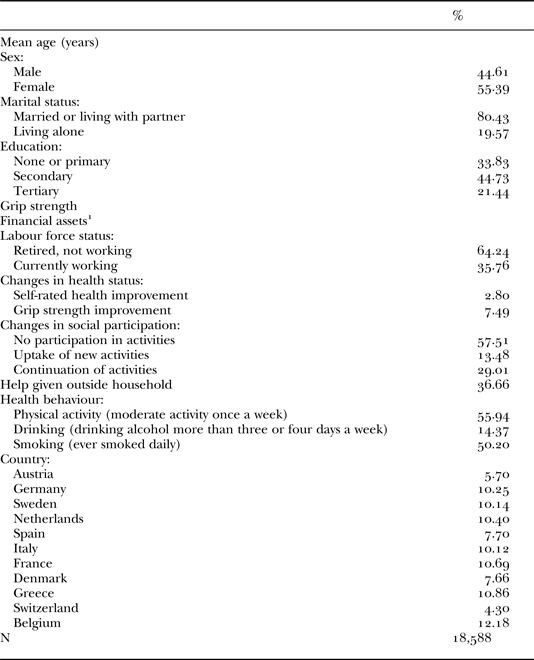
For this study, we selected participants aged 50–74 from 11 European countries for which longitudinal data from the first two waves of SHARE were available. Whereas age 50 is the youngest interview age in SHARE, we chose age 74 as the upper age-limit in order to reduce a potential bias due to higher survival chances of healthier individuals. However, the results were very robust to changing the upper age-limit. The initial total sample size comprised 18,588 individuals (Table 1). About 55 per cent of the sample were females and the average age for men and women was 64 years.
SHARE sample characteristics at wave 2

Note: 1. Euro purchasing power parity.
Measures of subjective and objective health
In order to measure health changes, we derived two binary variables which capture whether there has been an improvement in the individual's health between the two waves. Regarding subjective health, our measure captures whether respondents' SRH changed from not good (including the categories very bad, bad and fair) to good (including the categories good and very good) versus no change or decline in health status. This was done to account for the reciprocal relationship and avoid issues related to the limitations of the data in reporting the timing of change, as explained below. The major limitation of this approach is the lack of nuance going from one level of bad to another. However, the use of SRH is highly influenced by culture and when doing cross-country analysis the binary approach is less prone to national variation. To measure changes in objective health, we first derived country, age and sex-specific quartiles of GS (in kilograms) and in a second step derived a binary variable indicating whether individuals were in a higher quartile at wave 2 than at baseline versus those whose GS did not change or worsened. GS is standardised by age but although individuals' GS would decline with advanced age, the GS value could well increase due to relative improvements in objective health.
Measures of social participation
Our measures are based on the specific activity module in SHARE. In this module, respondents were asked if they had done any of a number of social activities in the past month. The list of activities includes (a) ‘doing voluntary or charity work’, (b) ‘attending education or training course’, (c) ‘going to a sport, social or other kind of club’, (d) ‘taking part in a religious organisation’ (church, synagogue, mosque, etc.), (e) ‘taking part in a political or community-related organisation’ and (f) ‘cared for a sick or disabled adult’.
For the analysis of outcomes of social participation, we derived a variable with three categories indicating whether individuals had (a) not participated in activities or given up any activity since wave 1; (b) taken up new activities; and (c) continued with the same number of activities. Thereby, individuals who did not participate in any activities in both waves were grouped in category 1. There is a limitation in category 1 as we are grouping those who never take up an activity with those who have given up one. We took this decision in order to maintain a reasonable sample size for each of the categories but mainly to highlight our main outcome which is uptake of new activities. We believe that the loss of information would be minimal.
We only consider activities (a) to (e) and exclude ‘caring for a sick or disabled adult’. However, we control for this dimension together with involvement in ‘help given outside the household’ to family members, friends or neighbours.
Covariates
The control variables were selected from wave 2 and selection was based on findings from previous research, particularly SHARE, showing the influence of socio-demographic characteristics such as income, education and employment status as strong predictors for individual's health and social engagement (e.g. Avendano et al. 2009; Hank and Stuck Reference Hank and Stuck2008; Kohli, Hank and Künemund Reference Kohli, Hank and Künemund2009; Mutchler, Burr and Caro Reference Mutchler, Burr and Caro2003). However, our principal aim was not to analyse the influence of these characteristics in detail but rather to minimise their confounding effect on the outcome.
As demographic controls we include age, sex and marital status (living with spouse or partner versus living alone).
In terms of socio-economic status we include controls for the highest educational level (none/primary, secondary or tertiary) and (adjusted) total household assets (in country-specific quintiles). We also include a control for respondents' employment status (currently working versus retired).
Finally, we control for health behaviours including smoking (having ever smoked daily), drinking (having drunk alcohol on more than three or four days last week) as well as physical activity (undertaking mild physical activity at least once a week).
Statistical analysis
The first part of the analysis used logistic models to measure change for both GS and SRH between waves 1 and 2. The second part of the analysis considered multinomial logistic models to measure the determinants of the uptake of new activities or continuation of old ones between the two waves. Separate models were built to consider SRH first and then GS effects.
An iterative modelling routine was conducted to first test the suitability of fixed versus random effects, and secondly of the multilevel approach. Fixed and random effects models that would account for variability within and between countries were used to explain variations that occur because of cultural as well as public policy differences. To the best of our knowledge, the fixed as well as the random approach to this analysis has not been done previously. We believe this is key in order to account for cluster as well as country effects. Only the fixed effects are shown in the Results section as the multilevel modelling was not significant.
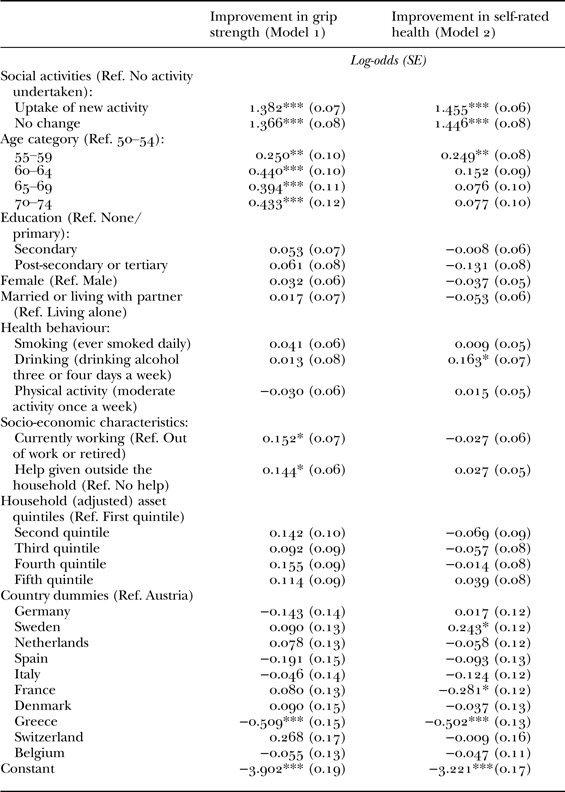
The variables which were included were both a combination of best fit for the model and compromise over comparability (i.e. they were significant in most models) across all models (Table 2).
Social participation and changes in health

Notes: SD: standard error. Ref.: reference category.
Significance levels: * p < 0.10, ** p < 0.05, *** p < 0.01.
All four final models also include country dummies to control for factors which vary uniformly between countries.
Results
Social participation and changes in GS and SRH
As shown in Model 1 (Table 2), the risk of improvements in GS between waves 1 and 2, measured as being in a higher country- and sex-specific quartile, increases significantly for people who took up new activities compared to those who did not do any activities. Similarly, the likelihood of improvements in GS also increased significantly for those individuals who stayed on their prior activity level.
When looking at the relationship between changes in activities and changes in SRH, the results in the third column of Table 2 (Model 2) suggest that taking up new activities is significantly related to improvements in SRH from not good to good. Similarly, compared to those individuals who did not participate in any activities, those who remained active over the two-year time period also had significantly higher chances of improvements in SRH.
Improvements seem to be recorded more in the sixties for GS while the only significant group for SRH is in the high fifties. GS improvements seem to be associated with older age. Smoking and taking up a physical activity show no difference in the chances of improvements in SRH or GS, whereas not drinking increases the chances of improvements in SRH. Help given outside the household is positively related to the chances of improvements in GS but not in SRH. Being in employment is positively related to the chances of health improvements, but only significantly for GS. Country dummies do not show very significant results with the exception of Greece reporting negative change in SRH and GS and Sweden reporting improvements in SRH. The former is also one of the countries with the lowest levels of volunteering and the lowest in SRH (Hank et al. Reference Hank, Jürges, Schupp and Wagner2009), whereas the latter has one of the highest volunteering levels and generally an overall satisfaction with the health-care system. Greeks have the lowest percentage of volunteering in all activities but religious ones where they have the highest (31%), which might be a reason behind the results. However, in Sweden the positive impact of activities on SRH might also be influenced by the strong input the government has on social participation, but also by the typology itself. Swedish people have some of the highest percentages when it comes to providing help to family and friends (38%) and sports (15%), as well as training and education (15%). All these activities can contribute a positive boost for SRH.
Changes in GS and SRH and social participation
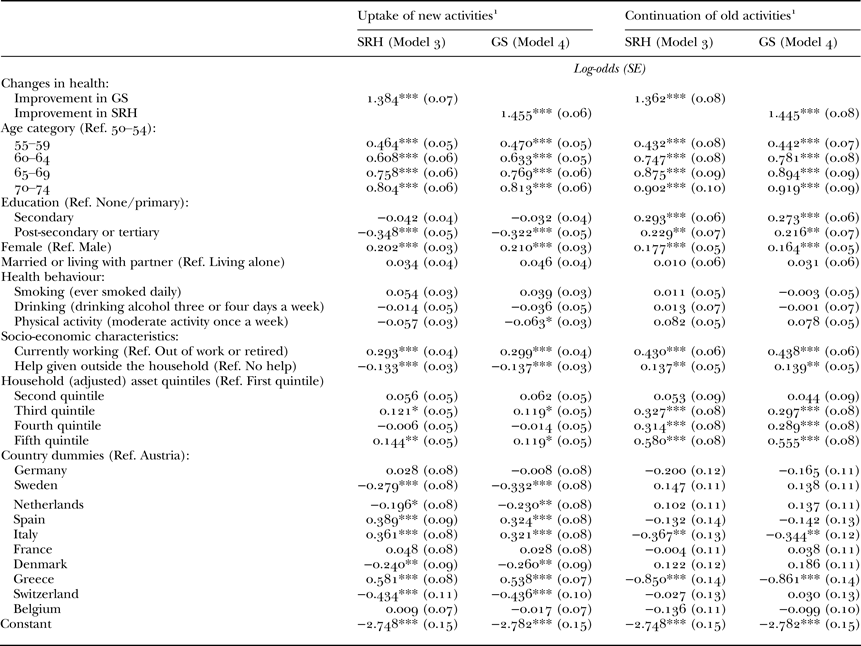
After testing the relationship between changes in social participation and health, we assessed the magnitude of reciprocal effects. Table 3 shows the multinomial logistic models used to measure the effects of changes in GS (Model 3) as well as SRH (Model 4) on the uptake of new activities and the continuation or decrease in the number of activities.
Multinomial logistic regression, changes in health and uptake of new activities

Notes: 1. Reference category (Ref.): No activities. GS: grip strength. SRH: self-rated health.
Significance levels: * p < 0.10, ** p < 0.05, *** p < 0.001.
As the results in Table 3 show, both improvements in GS as well as in SRH are significantly positively related to the chances of taking up new activities. In Model 3 (GS), the uptake of new activities as well as continued involvement in social activities show equal signs of improvement between the two waves. Age does not show a significant relationship with continued activities. More interestingly, a high level of education has a negative impact on the relative risk of taking up new activities (−0.348, p < 0.01 and −0.322, p < 0.01 for GS and SRH models, respectively). Gender is significantly associated with both outcomes, with women having a higher likelihood of either taking up or continuing social activities. Being in employment has a negative impact on taking up new activities, whereas individuals who are giving help to others are less likely to start a new activity (−0.133, p < 0.01). Asset quintiles are positively correlated to the risk of both outcomes, with continuing activities being more significant.
The key differences between the uptake of new activities and continuation of activities (Table 3) are in the impact of education, employment and help given outside the house (positive for continued activities while negative for the uptake of new ones). If the individual is engaged in other activities already (e.g. giving help outside the house), the uptake of new activities seems to be more unlikely. Wealth quintiles have a more significant correlation with the continuation of activities (positive for both categories).
Finally, the country effect seems to be different as well in the two categories. While in Sweden and Switzerland, uptake is negative and not significant on continuation, Spain has a positive effect on uptake and not significant on continuation of activities. Greece and Italy have a positive impact on uptake and negative on continuation of activities.
Discussion and conclusions
One of the principal aims of this paper was to analyse how the uptake and continuation of social activities impact on the subjective and objective health of older individuals in 11 European countries. Our results suggest that there is a significant positive effect of participation in social activities, represented by being engaged in social activities or giving help to others. The uptake of new activities as well as the continuation of previous activities do have a positive impact on health outcomes, both at the subjective and objective level. Notwithstanding the limitations of the data and the caution that needs to be taken in the interpretation of the results using just two waves, this highlights the importance of promoting both the uptake of new activities and the continuation of existing social engagement(s). Given weaknesses in previous studies' methodologies and the lack of research on both subjective and objective health outcomes, our paper adds to the debate on the emphasis on social activities in older age. More specifically, our paper adds to the methodological advances made by Sirven et al. (2012), in particular on the impact on GS and the role of countries which had not been explored fully before.
Our hypotheses were supported, and going back to our initial research questions, this paper has shown that:
-
1. The uptake of social activities has a positive effect on both subjective and objective health measures, even when accounting for the reciprocal effect of health on the undertaking of activities outside the household using longitudinal data.
-
2. Improvements in health status do have a positive impact on uptake as well as continuation of social activities, showing further evidence of the reverse causality.
Our finding that social ties have a positive effect on individual health is consistent with most existing studies (Smith and Christakis Reference Smith and Christakis2008). The same is the case for the reverse relationship between health and social networks (Erlinghagen and Hank Reference Erlinghagen and Hank2006). However, our work further emphasises the impact on GS compared to Sirven et al. (2012), showing a lower effect of the relationship if compared to subjective health, where the role of social capital is definitely more significant (full comparison not feasible as the categorisation of the outcome variable is different).
The key contribution of this study lies in the analytical approach which gives further details on the dynamics of social participation and health. Firstly, this study allowed us to look at differences in impact for both subjective and objective health. Secondly, we were able to differentiate between new activities and continuation of old ones. The first approach is important as often the impact of social activities on health is deemed to be mainly psychological. The second approach allows us to point out the importance of focusing on new uptake as well as continuation of activities, which has been neglected when considering policy making in the past. Finally, this study showed that country effect only plays a minor role in assessing the relationship between social activities and health. This was demonstrated by the lack of significance of the random effects at the country level and primary sampling unit level, as well as the lack of strongly significant categories for the country dummies. Only for Sweden and Greece was the relationship rather significant, showing that in most cases when accounting for individual circumstances most of the cultural factors could be negligible. However, the data and variables used in this analysis to account for cultural factors are limited and a more detailed analysis would need to be conducted.
On the more substantive findings of the study, what is interesting is the impact of the uptake of new social activities versus none on the GS improvements. While GS declines with age, volunteering may slow down GS decline, mainly in the post-retirement ages. Continuing to be involved in social activities has a positive impact regardless of how many the individual does. This last result should be considered carefully for any policy implication, in particular in light of the data limitations. While it might be easier to advertise new activities, retention of old ones is just as important, as our results have shown.
These results are counterfactual as social activities are usually associated with the interaction with more social groups and social networks which makes individuals less lonely and less likely to be affected by depression, which is in turn shown to be associated with a faster decline in both objective and subjective health (Hank and Erlinghagen Reference Hank and Erlinghagen2010; Sirven and Debrand Reference Sirven and Debrand2012; Smith and Christakis Reference Smith and Christakis2008). As well as the positive effect of social activities, we find the positive effect of the provision of help outside the household on health. On the one hand – when help is provided for friends and neighbours it could mean that the individual is healthier – this finding is in line with most other studies. On the other hand, as previously mentioned, several studies have found that helping can also include the provision of care which has been found to be associated with declining mental and physical health because of high demands (Smith and Christakis Reference Smith and Christakis2008). Since in this study we do not control for the precise nature of help-provision, the results can only be interpreted with regard to a ‘structural’ dimension, i.e. to the extent that help-provision outside the household, on average, is associated with positive health effects. Our results suggest that individuals with better health are more likely to engage in these activities. Thus, the issue of endogeneity seems to be equally evident in this case.
In addition, the self-selection component of volunteering needs to be accounted for, in particular when campaigning to increase the number of elderly that volunteer (Hank et al. Reference Hank, Jürges, Schupp and Wagner2009). It is possible that agencies might recruit elderly who are healthy to start with. By considering the longitudinal impact of volunteering we have somehow removed the self-selection component and demonstrated that the benefits are strong.
One of the more detailed results shows that age might be associated with retirement. However, the interaction between age and employment was not significant and being in employment shows a contrasting result. Furthermore, while GS declines with age, this variable could possibly explain the speed of decline of GS given its standardisation. Our result shows that GS declines faster at younger ages, slows down and then speeds up again for the oldest groups. Education and wealth did not show significant results in contrast with the leading literature, a finding which needs to be further explored (Hank and Erlinghagen Reference Hank and Erlinghagen2010; Hank and Stuck Reference Hank and Stuck2008; Haski-Leventhal Reference Haski-Leventhal2009; Kohli, Hank and Künemund Reference Kohli, Hank and Künemund2009; Siegrist and Wahrendorf Reference Siegrist and Wahrendorf2009; Sirven and Debrand Reference Sirven and Debrand2008).
There are several limitations to this study which need to be considered and that should make the interpretation of the results more cautious. Among others, the study only considered a short period (two years); in addition, we were not able to time the uptake of the new activity nor for how long the old ones were going on. We also considered all activities together to ease comparison across individuals and countries. A more detailed analysis of the types of activities could help in understanding country differences as well as more targeted policies. Furthermore, the nuances in slight improvements in the health status of the SRH were missed due to the binary recode but, as we mentioned previously, this was done in order to avoid cultural connotations of the variable.
The modelling approach could have been done in different ways including simultaneous modelling. As mentioned in the literature, no single approach is definitive and multiple ones are needed in order to come to an agreement. Finally, but not least importantly, the level of attrition was considerable. However, we tackled it by using the longitudinal weights as recommended by the SHARE staff (Mannheim Research Institute for the Economics of Ageing 2011).
Implications
The impact of activities on subjective health and objective health supports the need for positive advertising of an active life which leads to a healthier status. However, we speculate that the impact of various activities might be differential according to their type and country, as the country dummy variables have shown. We would need to know more about the nature of the activities to come to a meaningful conclusion on the type of policy intervention needed.
The European Union has taken the initiative to promote greater participation in voluntary work; however, more is needed to try to see how country-specific initiatives which would go beyond volunteerism could be ‘tailor-made’ to attract the right groups of the older population. In particular, there is a need to consider how to exploit the potentialities of early retirees, who could achieve benefits later on in life. Finally, volunteering might be understood and perceived differently in different cultures.
The issues highlighted here include whether to motivate older people or to oblige them to participate in more activities outside the home; whether to use a network approach through social diffusion or through individualistic strategies where pressure might be counteractive. Finally, it is important for health interventions to focus on the network as well as the individual: the cumulative impact of a preventive intervention is the sum of the direct health outcome in the individual plus the collateral health outcomes in those to whom he or she is connected.
Acknowledgements
Part of this article is based on research undertaken for a project funded by the European Commission, DG Employment, Social Affairs and Equal Opportunities, on health status and living conditions in the European Union (contract number VC/2008/932). All the views expressed are the authors' own. This paper uses data from SHARE release 2.3.1, as of 29 July 2010. SHARE data collection in 2004–2007 was primarily funded by the European Commission through its fifth and sixth framework programmes (project numbers QLK6-CT-2001-00360; RII-CT-2006-062193; CIT5-CT-2005-028857). Additional funding by the US National Institute on Aging (grant numbers U01 AG09740-13S2; P01 AG005842; P01 AG08291; P30 AG12815; Y1-AG-4553-01; OGHA 04-064; R21 AG025169) as well as by various national sources is gratefully acknowledged (see http://www.share-project.org for a full list of funding institutions).