Natural disasters are a major worldwide problem. There was an average of more than 500 natural disasters worldwide per year over the last decade that either affected more than 100 people or resulted in a call for international assistance (Pielke, Reference Pielke2006). There were over 800 000 deaths worldwide over that same time period caused by natural disasters (Guha-Sapir et al. Reference Guha-Sapir, Hargitt and Hoyois2004). Financial losses in the US due to natural disasters averaged more than $50 billion a year during the decade of the 1990s and were dramatically higher in the first decade of the new millennium. The United Nations estimated that the worldwide costs of natural disasters were $109 billion in 2010, the highest annual total in recorded history (http://www.businessinsurance.com/article/20110124/NEWS01/110129973). The costs of natural disasters were even higher in 2011, however, due to the $235 billion damage caused by the Japanese earthquake and tsunami (http://www.economist.com/blogs/dailychart/2011/03/natural_disasters).
The prevalence of major natural disasters has risen sharply over the past half-century (Pielke, Reference Pielke2006). This has been partly due to objective increases in occurrences of both weather-related events (hurricanes and tornadoes) and hydro-meteorological events (floods and earthquakes), but human factors have also been involved. The latter include population growth, migration to areas near water, environmental degradation (e.g. destruction of mangroves in coastal areas associated with population growth and changes in patterns of building and residence to meet population growth), and global warming (International Federation of Red Cross and Red Crescent Societies, 2006). The distinction between natural disasters and human-made disasters is consequently somewhat artificial. It is consequently important to note in this regard that serious risks exist of future increases in major human-made disasters, such as a pandemic linked to increases in long-distance travel and commerce. Although pandemics have occurred approximately once every 10–30 years over the last two centuries, it has been nearly four decades since the last pandemic. Increases in toxic chemical spills and accidental airplane crashes are also likely due to the financial fraying of the international transportation industry and increases in hazardous waste landfills associated with the rapid industrialization of developing countries (Krey, Reference Krey2006).
Research suggests that natural disasters can lead to increased population prevalence of mental illness in the range from 5% (Canino et al. Reference Canino, Bravo, Rubio-Stipec and Woodbury1990) to 40% (Madakasira & O'Brien, Reference Madakasira and O'Brien1987); although most disasters are associated with increases in the lower half of this range (Norris et al. Reference Norris, Perilla, Riad, Kaniasty and Lavizzo1999; Cao et al. Reference Cao, McFarlane and Klimidis2003; Shultz et al. Reference Shultz, Russell and Espinel2005; van Griensven et al. Reference van Griensven, Chakkraband, Thienkrua, Pengjuntr, Cardozo, Tantipiwatanaskul, Mock, Ekassawin, Varangrat, Gotway, Sabin and Tappero2006). While many of the mental disorders caused by such disasters are self-limiting, others persist for many years (McLaughlin et al. Reference McLaughlin, Berglund, Gruber, Kessler, Sampson and Zaslavsky2011). Interventions to address these mental health problems should be a central part of government response to natural disasters not only for humanitarian reasons but also because successful physical recovery and reconstruction depend on the psychological functioning of the affected population. A major difficulty in developing such interventions, though, is that large between-disaster variation exists in the prevalence of post-disaster mental disorders that is only weakly associated with objective disaster severity (Galea et al. Reference Galea, Brewin, Gruber, Jones, King, King, McNally, Ursano, Petukhova and Kessler2007, Reference Galea, Tracy, Norris and Coffey2008; McLaughlin et al. Reference McLaughlin, Fairbank, Gruber, Jones, Lakoma, Pfefferbaum, Sampson and Kessler2009). This makes it very difficult to estimate the need for mental health services for intervention planning purposes.
Owing to this complexity, needs assessment surveys should be carried out to estimate magnitude of need for post-disaster mental health interventions, to target the types of interventions needed and the segments of the population most in need, and in the ideal case to monitor intervention success so as to provide a rational basis for mid-stream intervention modifications (Kessler et al. Reference Kessler, Keane, Ursano, Mokdad and Zaslavsky2008). There are daunting methodological problems involved in implementing such surveys involving special problems in sampling and fieldwork (North & Norris, Reference North, Norris, Norris, Galea and Friedman2006). There are also practical challenges of integrating needs assessment survey results into intervention planning efforts.
One of the implementation challenges of most interest to us involves the fact noted above that objective disaster features do not explain most post-disaster mental illness. Recent research suggests that this is true largely because secondary stressors unique to particular disaster situations often have more impact than the disasters themselves (Galea et al. Reference Galea, Brewin, Gruber, Jones, King, King, McNally, Ursano, Petukhova and Kessler2007). For example, Wang et al. (Reference Wang, Gruber, Powers, Schoenbaum, Speier, Wells and Kessler2008) found that one of the most important challenges in treating mental disorders in the wake of Hurricane Katrina was that many low-income people with severe-persistent mental disorders lost their anti-psychotic medications along with other possessions in the flood while the pharmacies where they filled their prescriptions and their medical records were destroyed by the flood.
In an effort to illustrate the difficulties involved in tracing out the extent to which the web of stressors caused by natural disasters accounts for post-disaster mental disorders, we present here data from the WHO World Mental Health (WMH) Surveys, a coordinated series of community epidemiological surveys of mental disorders carried out in a number of countries throughout the world (Kessler et al. Reference Kessler, Aguilar-Gaxiola, Alonso, Chatterji, Lee, Ormel, Üstun and Wang2009). We focus on three issues: the prevalence of exposure to natural disasters around the world; the extent to which people exposed to natural disasters also experience a range of other secondary stressors in conjunction with these disasters; and the effects of these related stressors in accounting for the overall effects of natural disasters on mental disorders.
Methods
Samples
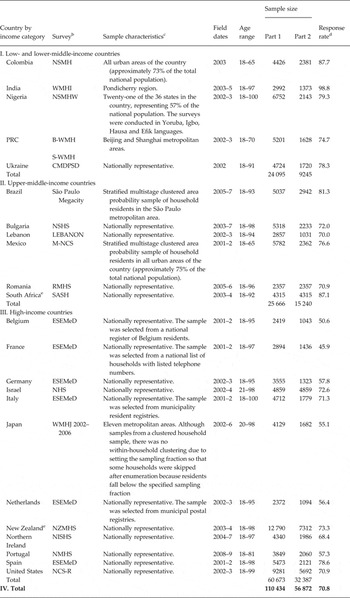
We consider WMH surveys in 23 countries, five classified by the World Bank as low or lower-middle-income countries, six upper-middle-income countries, and 12 high-income countries. (Table 1) The total sample includes 110 434 respondents. Respondents were selected in most surveys using a stratified multistage clustered-area probability sampling strategy with an average response rate across all countries of 70.8%. All surveys used multi-stage clustered area probability household samples representative of specific regions (Brazil, Colombia, India, Japan, Mexico, Nigeria and P.R. China) or of the entire nation (the remaining countries). WMH sampling procedures are described in detail elsewhere (Heeringa et al. Reference Heeringa, Wells, Hubbard, Mneimneh, Chiu, Sampson, Berglund, Kessler and Üstun2008).
WMH sample characteristics by World Bank income categoriesa

a World Bank (2008).
bNSMH (The Colombian National Study of Mental Health), WMHI (World Mental Health India), NSMHW (The Nigerian Survey of Mental Health and Wellbeing), B-WMH (The Beijing World Mental Health Survey), S-WMH (The Shanghai World Mental Health Survey), CMDPSD (Comorbid Mental Disorders during Periods of Social Disruption), NSHS (Bulgaria National Survey of Health and Stress), LEBANON (Lebanese Evaluation of the Burden of Ailments and Needs of the Nation), M-NCS (The Mexico National Comorbidity Survey), RMHS (Romania Mental Health Survey), SASH (South Africa Health Survey), ESEMeD (The European Study Of The Epidemiology Of Mental Disorders), NHS (Israel National Health Survey), WMHJ 2002–2006 (World Mental Health Japan Survey), NZMHS (New Zealand Mental Health Survey), NISHS (Northern Ireland Study of Health and Stress), NMHS (Portugal National Mental Health Survey), NCS-R (The US National Comorbidity Survey Replication).
cMost WMH surveys are based on stratified multistage clustered area probability household samples in which samples of areas equivalent to counties or municipalities in the US were selected in the first stage followed by one or more subsequent stages of geographic sampling (e.g. towns within counties, blocks within towns, and households within blocks) to arrive at a sample of households, in each of which a listing of household members was created and one or two people were selected from this listing to be interviewed. No substitution was allowed when the originally sampled household resident could not be interviewed. These household samples were selected from Census area data in all countries other than France (where telephone directories were used to select households) and the Netherlands (where postal registries were used to select households). Several WMH surveys (Belgium, Germany, and Italy) used municipal resident registries to select respondents without listing households. The Japanese sample is the only totally un-clustered sample, with households randomly selected in each of the four sample areas and one random respondent selected in each sample household. Sixteen of the 23 surveys are based on nationally representative (NR) household samples.
dThe response rate is calculated as the ratio of the number of households in which an interview was completed to the number of households originally sampled, excluding from the denominator households known not to be eligible either because of being vacant at the time of initial contact or because the residents were unable to speak the designated languages of the survey. The weighted average response rate is 70.8%.
eSouth Africa and New Zealand interviewed respondents 16+ but for the purposes of cross-national comparisons we limit the sample to those 18 + .
Surveys were administered face-to-face in respondent households by trained lay interviewers. Interviewer training and field quality control procedures are described elsewhere (Pennell et al. Reference Pennell, Mneimneh, Bowers, Chardoul, Wells, Viana, Kessler and Üstun2008). Interviews were completed in two parts in most countries. The Part I interview assessed core DSM-IV mental disorders and was administered to all respondents. Part II then assessed additional mental disorders and a wide range of potential disorder correlates. The Part II interview was administered to 100% of Part I respondents who met lifetime criteria for any Part I mental disorder and a probability sub-sample of approximately 25% other Part I respondents. Part II samples were weighted to adjust for the under-sampling of Part I non-cases. Trauma exposure, including exposure to natural disaster, was assessed in Part II. The analyses reported here are based on the weighted Part II sample (n = 56 872). Recruitment and consent procedures were approved by a local Human Subjects committee in each country. A more detailed description of WMH weighting is presented elsewhere (Harkness et al. Reference Harkness, Pennell, Villar, Gebler, Aguilar-Gaxiola, Bilgen, Kessler and Üstun2008; Heeringa et al. Reference Heeringa, Wells, Hubbard, Mneimneh, Chiu, Sampson, Berglund, Kessler and Üstun2008).
Measures
Mental disorders
Mental disorders were assessed with the WHO Composite International Diagnostic Interview (CIDI) Version 3.0 (Kessler & Üstun, Reference Kessler and Üstun2004), a fully structured lay-administered interview that generates DSM-IV diagnoses. Our analysis focused on anxiety disorders (generalized anxiety disorder, panic disorder, agoraphobia without panic disorder, specific phobia, social phobia, post-traumatic stress disorder, and separation anxiety disorder) and mood disorders (major depression/dysthymia, and bipolar disorder [bipolar I disorder, bipolar II disorder, and sub-threshold bipolar disorder]). DSM-IV organic exclusion rules were used as well as diagnostic hierarchy rules. As detailed elsewhere (Haro et al. Reference Haro, Arbabzadeh-Bouchez, Brugha, de Girolamo, Guyer, Jin, Lepine, Mazzi, Reneses, Vilagut Saiz, Sampson and Kessler2006), blinded clinical reappraisal interviews with the Structured Clinical Interview for DSM-IV (SCID) (First et al. Reference First, Spitzer, Gibbon and Williams2002) in four WMH countries found generally good concordance between diagnoses based on the CIDI and SCID. Age-of-onset (AOO) of lifetime disorders was assessed retrospectively using a special question sequence shown experimentally to yield more plausible distributions than standard AOO questions (Knauper et al. Reference Knauper, Cannell, Schwarz, Bruce and Kessler1999).
Trauma exposure
Exposure to natural disasters and other traumatic events was assessed in the post-traumatic stress disorder section of the CIDI, which assessed lifetime exposure to 27 potentially traumatic events. The item regarding natural disaster asks, ‘Were you ever involved in a major natural disaster, like a devastating flood, hurricane, or earthquake?’ The other 26 traumatic events included 13 types of interpersonal violence (e.g. rape, assaultive violence exposure either as a child by a caregiver, as an adult by a romantic partner, or by someone else), five types of threat to one's physical integrity not involving violence (e.g. life-threatening automobile accident, and other life-threatening illness or injury), and eight threats to the physical integrity of others (e.g. death of a loved one, life-threatening illness or injury of a loved one, and witnessing the injury or death of another person). Two additional open-ended question obtained information about qualifying events that were not included in our list or events that respondents did not report because of embarrassment. Positive responses were followed by probes to assess the age when the event first occurred and the number of times it occurred.
Based on analysis showing that natural disasters are associated strongly with exposure to a wide range of other traumatic events in the same year as the natural disaster (odds ratios (ORs) in the range of 2.9–7.1), we differentiated between what we refer to as simple natural disasters (i.e. those in which no other trauma occurred in the same year) and complex natural disasters (i.e. those in which at least one other traumatic event occurred in the same year). Other types of traumatic experience commonly related to natural disasters include such things as death of a loved one, witnessing serious injury or death, and exposure to interpersonal violence.
Analysis methods
Cross-tabulations were used to estimate exposure to simple and complex natural disasters. Associations between natural disasters and first onset of anxiety − mood disorders were estimated with a series of discrete-time survival models that used person-year as the unit of analysis (Efron, Reference Efron1988) and included controls for country, respondent age at interview, and sex. These models predicted first lifetime onset of an anxiety − mood disorder after the respondent's first exposure to a natural disaster. For purposes of this illustrative analysis, we focused on first lifetime natural disasters and we ignored the effects of disasters on recurrence of prior lifetime disorders. The models we estimated began by considering the gross associations between first disaster exposure and first onset of anxiety and mood disorders pooled across all the disorders considered here. When we speak of pooled analyses, we refer to parallel analyses of the associations of exposure to natural disasters with first onset of each anxiety − mood disorder constraining the magnitude of associations to be constant across disorders. More fine-grained analyses could relax the assumption of constant association, but this assumption was made to simplify the brief presentation made here.
After estimating initial models, we introduced controls for the occurrence of other traumatic events that occurred for the first time in the same year as the natural disaster. This was done to evaluate the extent to which the gross association between natural disasters and disorder onsets was accounted for by related traumas. We then developed a more complex model that examined the separate associations of simple and complex disasters with disorders. The survival coefficients and their standard errors in each of these models were exponentiated and are presented here as ORs with 95% confidence intervals. To adjust for the weighting and clustering of the WMH data, standard errors were estimated using the Taylor series method (Wolter, Reference Wolter1985) implemented in the SUDAAN software system (Research Triangle Institute, 2002). Multivariate significance was evaluated with Wald χ 2 tests based on design-corrected coefficient variance–covariance matrices. Statistical significance was consistently evaluated using 0.05-level two-sided tests.
Results
Prevalence of exposure to natural disasters
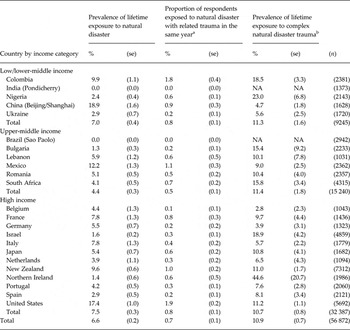
Lifetime exposure to natural disasters was reported by 6.6% (0.2) of WMH respondents, including 7.5% (0.3) in high-income countries, 4.4% (0.3) in upper-middle-income countries, and 7.0% (0.4) in low/lower-middle-income countries. (Table 2) Within-country estimates of exposure range from a low of 0.0% (0.0) in the city of Pondicherry in India and the city of Sao Paolo in Brazil to a high of 18.9% (1.6) in a combined sample across several urbanized areas in China.
Prevalence of exposure to natural disaster in the WHO World Mental Health Surveys (n = 56 872)

aProportion of respondents exposed to a natural disaster who also experienced an additional related trauma in the same year as the natural disaster. See Methods section for details.
bTotal proportion of respondents exposed to complex natural disaster trauma. Complex natural disaster trauma involves exposure to a natural disaster and at least one additional related trauma in the same year as the natural disaster. See Methods section for details.
Among respondents exposed to natural disaster, 10.9% (0.7) reported the occurrence of another related traumatic event in the same year and were consequently classified as having experienced a complex natural disaster. The proportion of respondents experiencing complex natural disasters among those with lifetime exposure to a natural disaster was similar in high-income, upper-middle-income, and low/lower-middle-income countries (10.7–11.4%, SE [0.8–1.8]).
Associations of natural disasters with anxiety − mood disorders
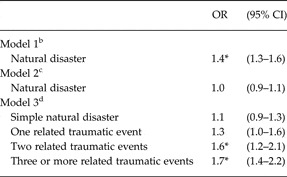
Exposure to natural disaster was associated with a significantly elevated odds of first onset of anxiety − mood disorders in the year of the disaster (OR = 1.4, χ 21 = 44.7, p < 0.001) (Table 3). This is a lower-bound estimate, as it considers only first lifetime onset of disorders and excludes effects of disasters on recurrence of prior lifetime disorders. The first model did not control for related traumas that occurred in conjunction with the disaster. When controls were introduced for these related traumas, the association between natural disasters and onset of anxiety − mood disorders became insignificant (OR = 1.0, χ 21 = 0.1, p = 0.76), implying that it is not the natural disaster per se but the network of related traumas that accounts for the gross association between disaster and onset of these disorders.
Multivariate associations (ORs) between natural disaster trauma and onset of DSM-IV/CIDI mood and anxiety disordersa

a A separate person-year file was created for each of the 9 mood and anxiety disorders, and these 9 files were then stacked. The models were estimated in a discrete-time survival framework with person-year as the unit of analysis using this stacked dataset, thereby forcing the slopes to be the same across the 9 disorders. Each model controlled for person-year, 8 dummy variables for the outcome disorder, country, age, and sex.
bThe model included a single dummy variable for lifetime exposure to natural disaster.
cThe model included a dummy variable for lifetime exposure to natural disaster and an additional dummy variable for exposure to each any other traumatic event occurring in the same year as the natural disaster.
dThe model included one dummy variable for lifetime exposure to simple natural disaster and additional dummy variables for complex natural disasters in which the respondent was exposed to 1, 2, and 3 or more related traumatic events in the same year as the natural disaster.
*Significant at the 0.05-level, two-sided test.
We next examined the associations of simple and complex natural disasters with disorder onset. Complex natural disasters were disaggregated into those with exactly 1, exactly 2, and 3+ related traumas. Simple natural disaster was not significant in this model (OR = 1.1, χ 21 = 0.5, p = 0.46), while a monotonic relationship was found between the number of additional traumatic events and disorder onset. ORs increase from 1.3 for complex natural disasters with one additional trauma (χ 21 = 3.4, p = 0.06) to 1.6–1.7 for those with two or more additional traumas (χ 21 = 10.1–24.4, p = 0.002 to <0.001).
Discussion
The empirical findings reported here are limited by the fact that they focus only on first lifetime natural disasters, consider only first lifetime onset of anxiety − mood disorders, pool across all such disorders, and consider only a narrow range of associated traumatic stressors. We know from the WMH interviews that many people who experience natural disasters are exposed to such multiple disasters in their lifetime. We know that natural disasters can lead not only to first onsets but also to recurrences of mental disorders. We also know that many of the associated stressors that promote post-disaster mental illness are non-traumatic (Galea et al. Reference Galea, Brewin, Gruber, Jones, King, King, McNally, Ursano, Petukhova and Kessler2007). All these limitations make the results conservative.
Within the context of these limitations, the WMH results show clearly that a substantial proportion of people in the WMH countries have been exposed to natural disasters, that a meaningful proportion of these people experience secondary disaster-related traumas, and that the significant associations of disaster exposure with anxiety − mood disorders are due to these secondary stressors. We can only assume that the evidence reviewed in the introduction on trends in natural disaster prevalence will make these estimates of exposures and adverse effects even larger in the future.
The importance of secondary stressors complicates the already challenging public health problem of estimating need for treatment of mental disorders in disaster settings. This is true both because the important role played by these stressors makes it difficult to estimate overall magnitude of need and because it complicates our understanding of the kinds of need that must be addressed. Regarding the second of these complications, an analysis of secondary stressors among survivors of Hurricane Katrina found that a substantial part of the mental illness caused by the hurricane was complex grief associated with personal losses (Shear et al. Reference Shear, McLaughlin, Ghesquiere, Gruber, Sampson and Kessler2011) and anxiety − depression associated with the slow pace of practical recovery efforts (i.e. housing, utilities and jobs) (Galea et al. Reference Galea, Brewin, Gruber, Jones, King, King, McNally, Ursano, Petukhova and Kessler2007). The kinds of clinical interventions that are likely to be most effective in treating these kinds of emotional problems (Shear et al. Reference Shear, Frank, Houck and Reynolds2005) are quite different from those that are likely to be effective in addressing other post-disaster mental health needs, such as intervening to prevent post-traumatic stress disorder (Shalev et al. Reference Shalev, Ankri, Israeli-Shalev, Peleg, Adessky and Freedman2011).
Given the difficulties associated with inferring the magnitude and nature of disaster-related mental health problems from early information about the objective characteristics of disasters, it is important that needs assessments take place at an early stage in disaster response activities. As the WMH data make it clear, it is also important that such assessments be open to the discovery of unanticipated stressors that might be important causes of disaster-related mental illness and that might require special types of clinical intervention. General short-term psychological interventions can also be of vital importance in disaster situations (Rodriguez & Kohn, Reference Rodriguez and Kohn2008), but maximum long-term value of intervention efforts might require more differentiated interventions tailored to special needs. Post-disaster services focus primarily on safety, stabilization, and medical treatment of physical injuries and health problems. Integration of targeted mental health care into these services could lead to meaningful reductions in the mental health sequelae of natural disasters and these effects, in turn, could play an important part in facilitating larger recovery efforts focused on the restoration of population health and functioning.
Appendix. The WHO World Mental Health Survey Consortium
Members of The WHO World Mental Health Survey Consortium are: Sergio Aguilar-Gaxiola, School of Medicine, Center for Reducing Health Disparities, University of California, Davis, Davis, CA, USA; Jordi Alonso, Health Services Research Unit (IMIM-Hospital del Mar) Professor Pompeu Fabra university (UPF) Carrer del Doctor Aiguader, 88, Edifici PRBB E-08003 Barcelona, Spain; Laura Andrade, Section of Psychiatric Epidemiology, LIM 23, Institute of Psychiatry, University of São Paulo, School of Medicine, São Paulo, Brazil; Evelyn Bromet, Department of Psychiatry, State University of New York at Stony Brook, Stony Brook, NY, USA; Brendan Bunting, Psychology Research Institute, University of Ulster, Londonderry, UK; Somnath Chatterji, World Health Organization, Geneva, Switzerland; Giovanni de Girolamo, IRCCS Centro S. Giovanni di Dio Fatebenefratelli Brescia, Italy; Koen Demyttenaere, Department of Psychiatry, University Hospital Gasthuisberg, Leuven, Belgium; Silvia Florescu, National School of Public Health, Management and Professional Development, Bucharest, Romania; Oye Gureje, University College Hospital, Ibadan, Nigeria; Elie G. Karam, St. George Hospital University Medical Center, Balamand University, Faculty of Medicine, Institute for Development, Research, Advocacy & Applied Care (IDRAAC), Medical Institute for Neuropsychological Disorders (MIND), Beirut, Lebanon; Norito Kawakami, Department of Mental Health, School of Public Health, the University of Tokyo, Tokyo, Japan; Jean-Pierre Lépine, Hôpital Saint-Louis Lariboisière Fernand Widal Assistance Publique Hôpitaux de Paris INSERM U 705 CNRS UMR 8206, Paris, France; Zhaorui Liu, Institute of Mental Health, Peking University, Beijing, People's Republic of China; Herbert Matschinger, Institute of Social Medicine, Occupational Health and Public Health, Public Health Research Unit, University of Leipzig, Leipzig, Germany; María Elena Medina Mora, National Institute of Psychiatry, Mexico City, Mexico; Maya Mladenova, New Bulgarian University, Sofia, Bulgaria; J. Hans Ormel, Interdisciplinary Center for Psychiatric Epidemiology, Department of Psychiatry, University Medical Center Groningen, University of Groningen, the Netherlands; José A. Posada-Villa, Instituto Colombiano del Sistema Nervioso, Bogota D.C., Colombia; Kate Scott, Department of Psychological Medicine, Otago University, Dunedin, New Zealand; Arie Y. Shalev, Hadassah University Hospital, Jerusalem, Israel; Suman Kumar Sinha, Department of Psychiatry, Lady Hardinge Medical College, Government of India, New Delhi, India; Dan J. Stein, Department of Psychiatry and Mental Health, University of Cape Town, Cape Town, South Africa; Miguel Xavier, Department of Mental Health – CEDOC, Faculdade Ciencias Medicas – UNL, Portugal.
Acknowledgements
The World Health Organization World Mental Health (WMH) Survey Initiative is supported by the National Institute of Mental Health (NIMH; R01 MH070884), the John D. and Catherine T. MacArthur Foundation, the Pfizer Foundation, the US Public Health Service (R13-MH066849, R01-MH069864, and R01 DA016558), the Fogarty International Center (FIRCA R03-TW006481), the Pan American Health Organization, Eli Lilly and Company, Ortho-McNeil Pharmaceutical, GlaxoSmithKline, and Bristol-Myers Squibb. We thank the staff of the WMH Data Collection and Data Analysis Coordination Centres for assistance with instrumentation, fieldwork, and consultation on data analysis. Additional support for the preparation of this paper was provided by NIMH grants K01-MH092526 (McLaughlin) and R01-MH093612 (Koenen). None of the funders had any role in the design, analysis, interpretation of results, or preparation of this paper. The views and opinions expressed in this report are those of the authors and should not be construed to represent the views of the sponsoring organizations, agencies, or governments. Each WMH country obtained funding for its own survey. The São Paulo Megacity Mental Health Survey (Brazil) is supported by the State of São Paulo Research Foundation (FAPESP) Thematic Project Grant 03/00204-3. The Bulgarian Epidemiological Study of common mental disorders EPIBUL is supported by the Ministry of Health and the National Center for Public Health Protection. The Chinese World Mental Health Survey Initiative is supported by the Pfizer Foundation. The Colombian National Study of Mental Health (NSMH) is supported by the Ministry of Social Protection. The ESEMeD project is funded by the European Commission (Contracts QLG5-1999-01042; SANCO 2004123), the Piedmont Region (Italy), Fondo de Investigación Sanitaria, Instituto de Salud Carlos III, Spain (FIS 00/0028), Ministerio de Ciencia y Tecnología, Spain (SAF 2000-158-CE), Departament de Salut, Generalitat de Catalunya, Spain, Instituto de Salud Carlos III (CIBER CB06/02/0046, RETICS RD06/0011 REM-TAP), and other local agencies and by an unrestricted educational grant from GlaxoSmithKline. The Epidemiological Study on Mental Disorders in India was funded jointly by Government of India and WHO. The Israel National Health Survey is funded by the Ministry of Health with support from the Israel National Institute for Health Policy and Health Services Research and the National Insurance Institute of Israel. The World Mental Health Japan (WMHJ) Survey is supported by the Grant for Research on Psychiatric and Neurological Diseases and Mental Health (H13-SHOGAI-023, H14-TOKUBETSU-026, and H16-KOKORO-013) from the Japan Ministry of Health, Labour and Welfare. The Lebanese National Mental Health Survey (LEBANON) is supported by the Lebanese Ministry of Public Health, the WHO (Lebanon), National Institute of Health/Fogarty International Center (R03 TW006481-01), anonymous private donations to IDRAAC, Lebanon, and unrestricted grants from Janssen Cilag, Eli Lilly, GlaxoSmithKline, Astra Zeneca, Hikma Pharm and Novartis. The Mexican National Comorbidity Survey (MNCS) is supported by The National Institute of Psychiatry Ramon de la Fuente (INPRFMDIES 4280) and by the National Council on Science and Technology (CONACyT-G30544-H), with supplemental support from the PanAmerican Health Organization (PAHO). Te Rau Hinengaro: The New Zealand Mental Health Survey (NZMHS) is supported by the New Zealand Ministry of Health, Alcohol Advisory Council, and the Health Research Council. The Nigerian Survey of Mental Health and Wellbeing (NSMHW) is supported by the WHO (Geneva), the WHO (Nigeria), and the Federal Ministry of Health, Abuja, Nigeria. The Northern Ireland Study of Mental Health was funded by the Health & Social Care Research & Development Division of the Public Health Agency. The Portuguese Mental Health Study was carried out by the Department of Mental Health, Faculty of Medical Sciences, NOVA University of Lisbon, with collaboration of the Portuguese Catholic University, and was funded by Champalimaud Foundation, Gulbenkian Foundation, Foundation for Science and Technology (FCT) and Ministry of Health. The Romania WMH study projects ‘Policies in Mental Health Area’ and ‘National Study regarding Mental Health and Services Use’ were carried out by National School of Public Health & Health Services Management (former National Institute for Research & Development in Health, present National School of Public Health Management & Professional Development, Bucharest), with technical support of Metro Media Transilvania, the National Institute of Statistics – National Centre for Training in Statistics, SC. Cheyenne Services SRL, Statistics Netherlands were funded by Ministry of Public Health (former Ministry of Health) with supplemental support of Eli Lilly Romania SRL. The South Africa Stress and Health Study (SASH) is supported by the US National Institute of Mental Health (R01-MH059575) and National Institute of Drug Abuse with supplemental funding from the South African Department of Health and the University of Michigan. The Ukraine Comorbid Mental Disorders during Periods of Social Disruption (CMDPSD) study is funded by the US National Institute of Mental Health (RO1-MH61905). The US National Comorbidity Survey Replication (NCS-R) is supported by the National Institute of Mental Health (NIMH; U01-MH60220) with supplemental support from the National Institute of Drug Abuse (NIDA), the Substance Abuse and Mental Health Services Administration (SAMHSA), the Robert Wood Johnson Foundation (RWJF; Grant 044708), and the John W. Alden Trust. A complete list of all within-country and cross-national WMH publications can be found at http://www.hcp.med.harvard.edu/wmh/.
Declaration of Interest
Dr Kessler has been a consultant for AstraZeneca, Analysis Group, Bristol-Myers Squibb, Cerner-Galt Associates, Eli Lilly & Company, GlaxoSmithKline Inc., HealthCore Inc., Health Dialog, Integrated Benefits Institute, John Snow Inc., Kaiser Permanente, Matria Inc., Mensante, Merck & Co, Inc., Ortho-McNeil Janssen Scientific Affairs, Pfizer Inc., Primary Care Network, Research Triangle Institute, Sanofi-Aventis Groupe, Shire US Inc., SRA International, Inc., Takeda Global Research & Development, Transcept Pharmaceuticals Inc., and Wyeth-Ayerst; has served on advisory boards for Appliance Computing II, Eli Lilly & Company, Mindsite, Ortho-McNeil Janssen Scientific Affairs, Plus One Health Management and Wyeth-Ayerst; and has had research support for his epidemiological studies from Analysis Group Inc., Bristol-Myers Squibb, Eli Lilly & Company, EPI-Q, GlaxoSmithKline, Johnson & Johnson Pharmaceuticals, Ortho-McNeil Janssen Scientific Affairs, Pfizer Inc., Sanofi-Aventis Groupe, and Shire US, Inc. The remaining authors report nothing to disclose.