Introduction
Today, the family Eomeropidae (Mecoptera) consists of a single species, Notiothauma reedi MacLachlan, which inhabits the Valdivian southern beech (Nothofagus Blume, Nothofagaceae) forests of central Chile. It has a cockroach-like form and habits, active nocturnally on the forest floor in the leaf litter, where it apparently feeds on plant material (Peña Reference Peña1968; Penny Reference Penny1975; and see review by Archibald et al. Reference Archibald, Rasnitsyn and Akhmetiev2005).
Soszyńska-Maj et al. (Reference Soszyńska-Maj, Krzemiński, Kopeć and Coram2016) recently reviewed the fossil record of the family and provided a genus-level phylogenetic analysis and a discussion of the evolution of key wing characters. Its oldest known member is the Early Jurassic Jurachorista bashkuevi Soszyńska-Maj et al. from the United Kingdom, followed by the Middle Jurassic Chinese Tsuchingothauma shihi Ren and Shih and Jurathauma simplex Zhang et al., and two Cretaceous species, Typhothauma yixianensis Ren and Shih and Typhothauma excelsa Zhang et al., also from China (Ren and Shih Reference Ren and Shih2005; Zhang et al. Reference Zhang, Shih, Petrulevičius and Ren2011, Reference Zhang, Shih and Ren2012; Soszyńska-Maj et al. Reference Soszyńska-Maj, Krzemiński, Kopeć and Coram2016).
Four species are known in the Cenozoic, all belonging to the genus Eomerope Cockerell. Eomerope macabeensis Archibald et al. from the McAbee locality of the Okanagan Highlands in British Columbia, Canada, and E. asiatica Ponomarenko from the Tadushi Formation in Primorye (Primorskiy Kray), Russia are both Ypresian. Eomerope tortriciformis Cockerell from Florissant, Colorado, United States of America is Priabonian, and E. pacifica Ponomarenko from the Amgu locality in Primorye, is also Priabonian, or perhaps Rupelian (Cockerell Reference Cockerell1909; Ponomarenko and Rasnitsyn Reference Ponomarenko and Rasnitsyn1974; Archibald et al. Reference Archibald, Rasnitsyn and Akhmetiev2005). Archibald et al. (Reference Archibald, Rasnitsyn and Akhmetiev2005) discussed the biogeography and ecology of the family in the Cenozoic.
Here, we describe two new species of Eomerope from the Ypresian Okanagan Highlands series in British Columbia, Canada: one from the Allenby Formation near the town of Princeton in southern-most British Columbia, and the second from the McAbee locality in south-central British Columbia near the towns of Cache Creek and Ashcroft.
Materials and methods
We examined three new fossils in Okanagan Highlands laminated lacustrine shale, two from the McAbee locality in south-central British Columbia in the collections of Thompson Rivers University (Kamloops, British Columbia, Canada), and the third from the Vermilion Bluffs Shale unit of the Allenby Formation near Princeton, British Columbia in the Royal British Columbia Museum (Victoria, British Columbia, Canada). We also examined specimens of E. asiatica from the Tadushi Formation of Primorye in Pacific-coastal Russia, housed in the collections of the A.A. Borissiak Paleontological Institute, Russian Academy of Sciences (Moscow, Russia). Line drawings were made of these specimens from new photographs.
While the specific Allenby Formation locality where the specimen examined here was recovered has not been dated, an age of 52.08±0.12 million years old was estimated by U-Pb analysis of zircons for an exposure of the Vermilion Bluffs Shale at nearby Hospital Hill in Princeton (Moss et al. Reference Moss, Greenwood and Archibald2005). McAbee has been dated as 52.90±0.83 million years old by 40Ar/39Ar decay (Archibald et al. Reference Archibald, Bossert, Greenwood and Farrell2010). There is no precise age estimate for the Tadushi Formation in Primorye, but it is also Ypresian by stratigraphy (Popov and Grebennikov Reference Popov and Grebennikov2001, not late Paleocene as in Archibald et al. Reference Archibald, Rasnitsyn and Akhmetiev2005).
Abbreviations: PIN, the A.A. Borissiak Paleontological Institute, Russian Academy of Sciences, Moscow, Russia; PDM, Princeton and District Museum and Archives, Princeton, British Columbia, Canada; RBCM, Royal British Columbia Museum, Victoria, British Columbia, Canada; TRU, Thompson Rivers University, Kamloops, British Columbia, Canada. Terminology of wing venation follows that of Willmann (Reference Willmann1989) as employed by Archibald et al. (Reference Archibald, Rasnitsyn and Akhmetiev2005) and by Soszyńska-Maj et al. (Reference Soszyńska-Maj, Krzemiński, Kopeć and Coram2016), in which Rs includes MA sensu Ponomarenko and Rasnitsyn (Reference Ponomarenko and Rasnitsyn1974).
Eomerope simpkinsae Archibald and Rasnitsyn, new species
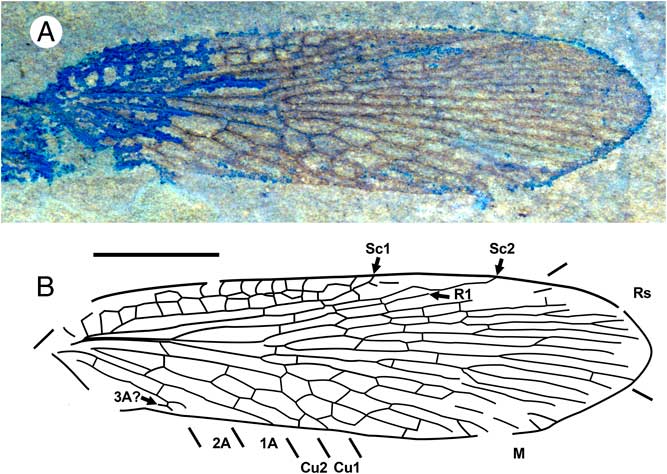
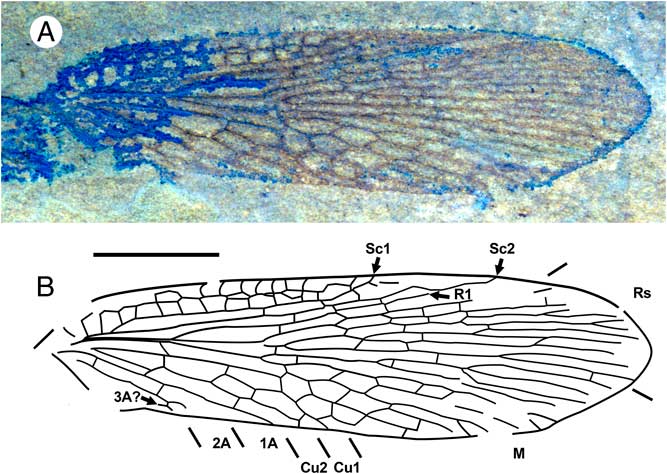
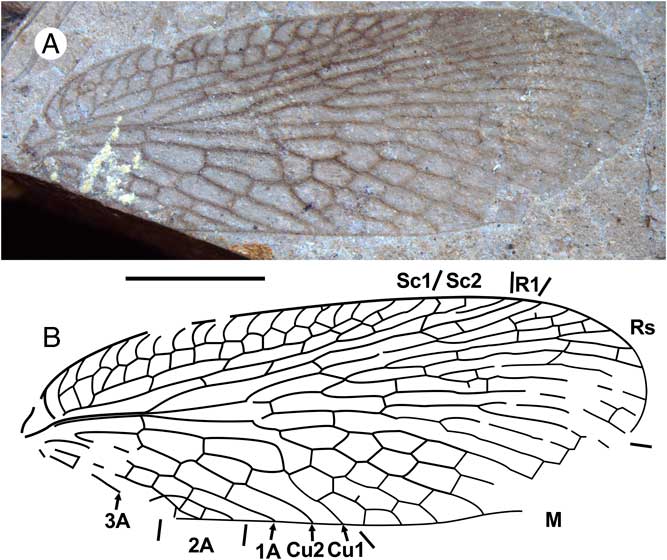
Eomerope simpkinsae new species, holotype forewing. A, Photograph, wetted with ethanol; B, drawing. Scale bar=5 mm, both to scale.
Etymology
The specific epithet is formed from the surname of Kathy Simpkins, collections manager of fossils at the PDM, who found and donated the holotype specimen.
Type specimen
Holotype RBCM.EH2017.003.0001.001, part, no counterpart, a single forewing, mostly rather well preserved. Housed in the collections of the RBCM.
Locality and age
An exposure of the Vermilion Bluffs Shale unit of the Allenby Formation on Black Mine Road, near the town of Princeton, British Columbia, Ypresian.
Diagnosis
Easily separated from other species of Eomerope by its narrow forewing, width to length ratio 1:3.7 (E. macabeensis, 1:2.8; E. eonearctica, 1:2.6–2.8; E. pacifica, 1:2.3; E. tortriciformis and E. asiatica forewings incomplete, but preserved portions indicate similar shape to E. macabeensis and E. eonearctica, i.e., not narrow); also by combination of the following: 1A, 2A rather straight (E. macabeensis, zigzagged); two rows of cells with occasional third cell between C, Sc1 (E. asiatica and E. macabeensis, two rows (some variation in E. asiatica, see Fig. 5); E. tortriciformis, three rows in much of this space; E. pacifica, three rows in distal half of space).
Description
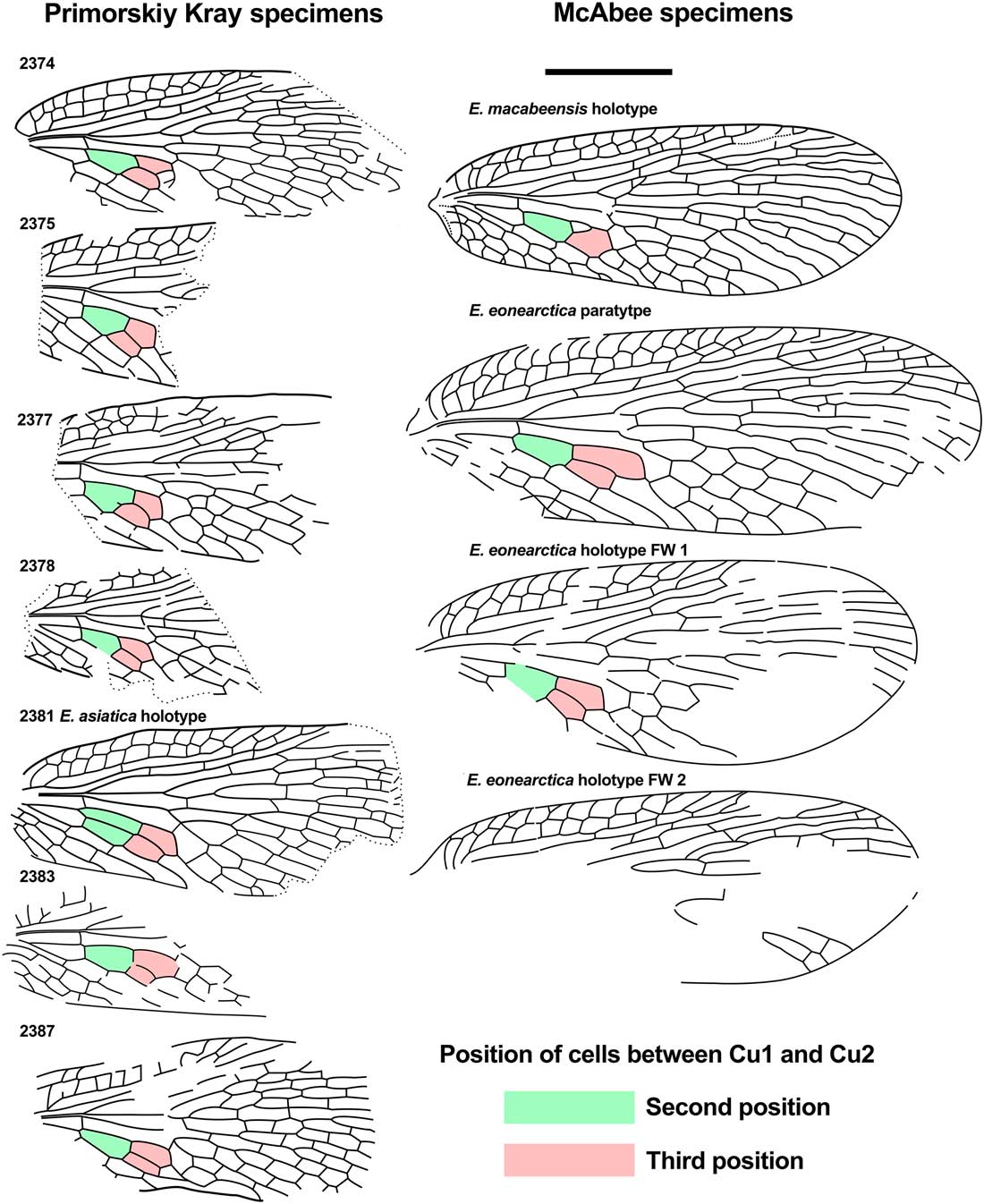
Forewing as in diagnosis, and: length 24.0 mm, width 6.5 mm, broad costal space, apparently (as preserved) bowed out from base, i.e., without narrow basal-most portion (compare with E. pacifica, E. torticiformis); veins thickened in approximately basal half, then narrower; no colouration detected; costal space mostly with double-cell row but also a few cells between these to make three cells deep, ending with Sc1 just over half wing length; Sc with two branches, forking about one-eighth the wing length; R forks at basal one-fourths; R1 rather straight (somewhat zigzagged by crossveins in places), apical quarter not preserved; Rs with at least 11 branches (indistinctly preserved near apex); base of M close to R, M with 12 branches as preserved; Cu branched immediately basad branching of Sc; Cu1 and Cu2 apparently simple, both zigzagged by crossveins, Cu1 bent sharply posteriad approximately two-thirds length; Cu2 not sharply bent; 1A, 2A mostly preserved, straight; small portion of 3A preserved. Crossveins numerous, stronger basally, faintly preserved apically, creating irregular cells between branches of Cu; crossvein connecting two crossveins that join Cu1 and Cu2 creates two cells between Cu1 and Cu2 at maximum width, i.e., area of sharp bend of Cu1 (“third position” of Fig. 5, red).
Discussion
The narrow shape of the wing is surely not due to plastic deformation of the rock. While some small amount of distortion is at times seen in Allenby Formation fossils, it is never seen to the extent that would be required to transform a forewing shaped like those of all other Eomerope species to the shape of the E. simpkinsae forewing. Some slight deformation can be seen in the McAbee specimen F-780 (note minor difference between left and right wings in Figs. 2–3, 5), and some specimens of E. asiatica show more extreme distortion (Figs. 5–6, and see Ponomarenko and Rasnitsyn Reference Ponomarenko and Rasnitsyn1974, fig. 7), but again, never near the extent necessary to transform one to this shape.
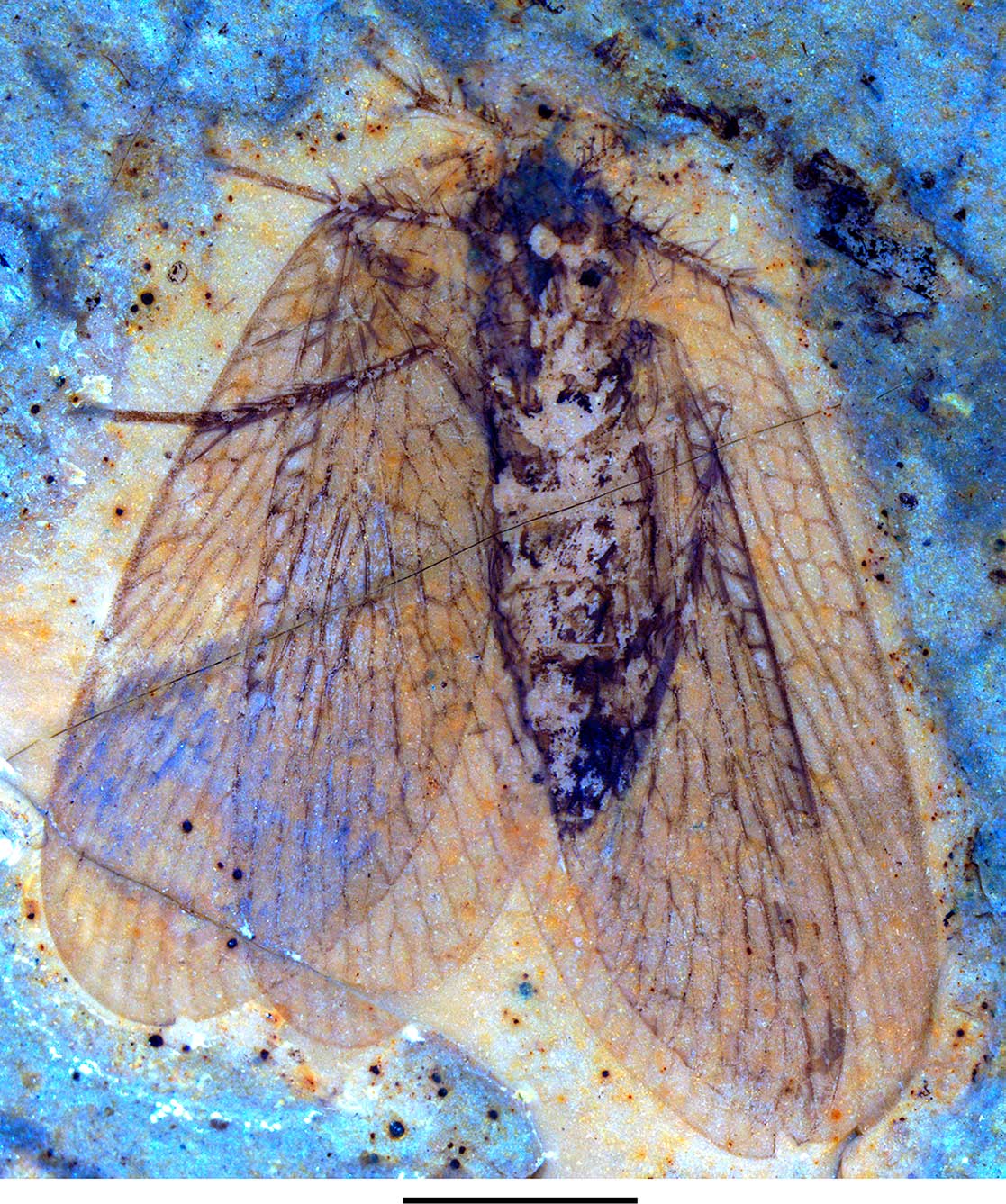
Eomerope eonearctica new species, holotype (F-780). Photograph of the specimen wetted with ethanol. Scale bar=5 mm.
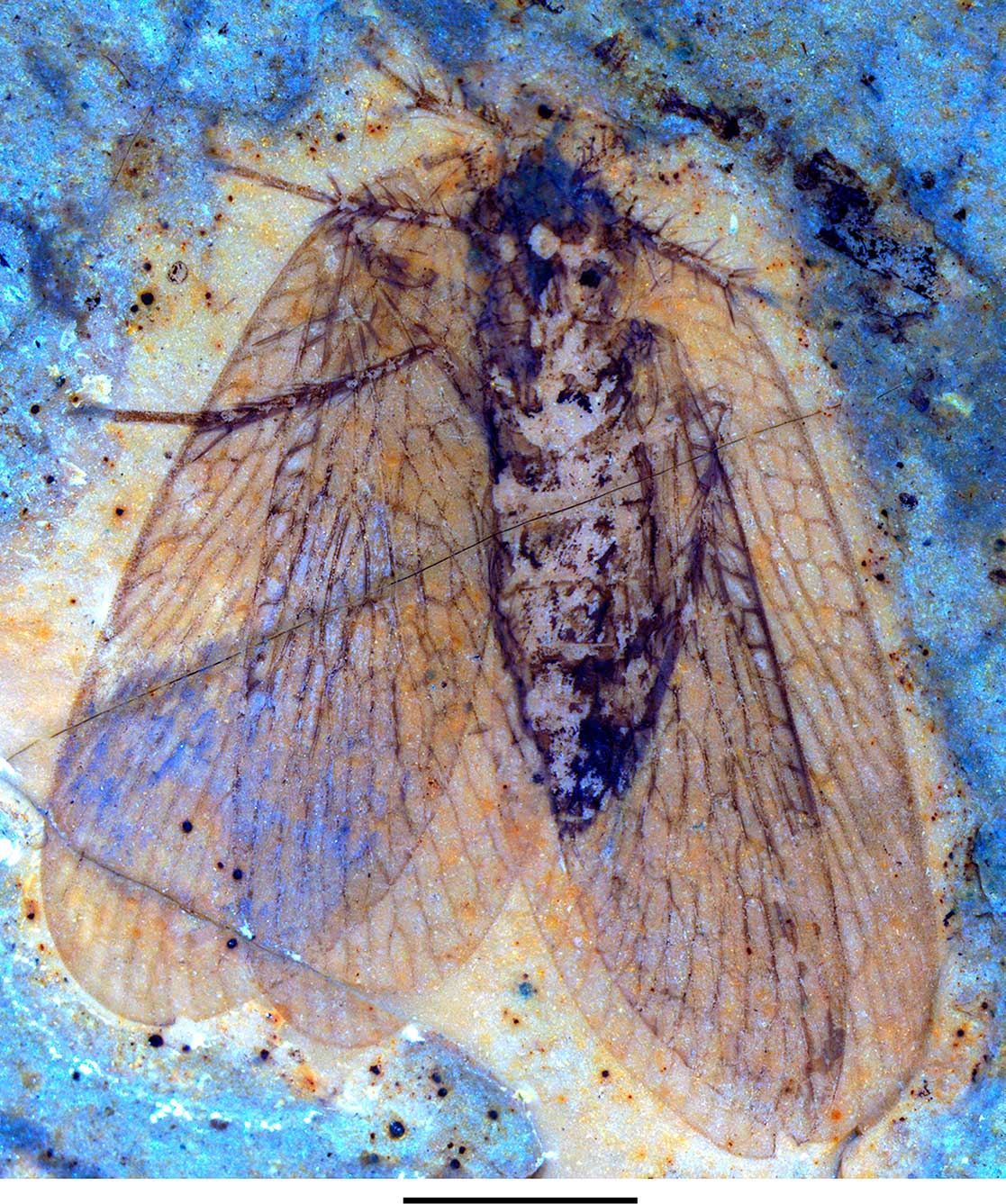
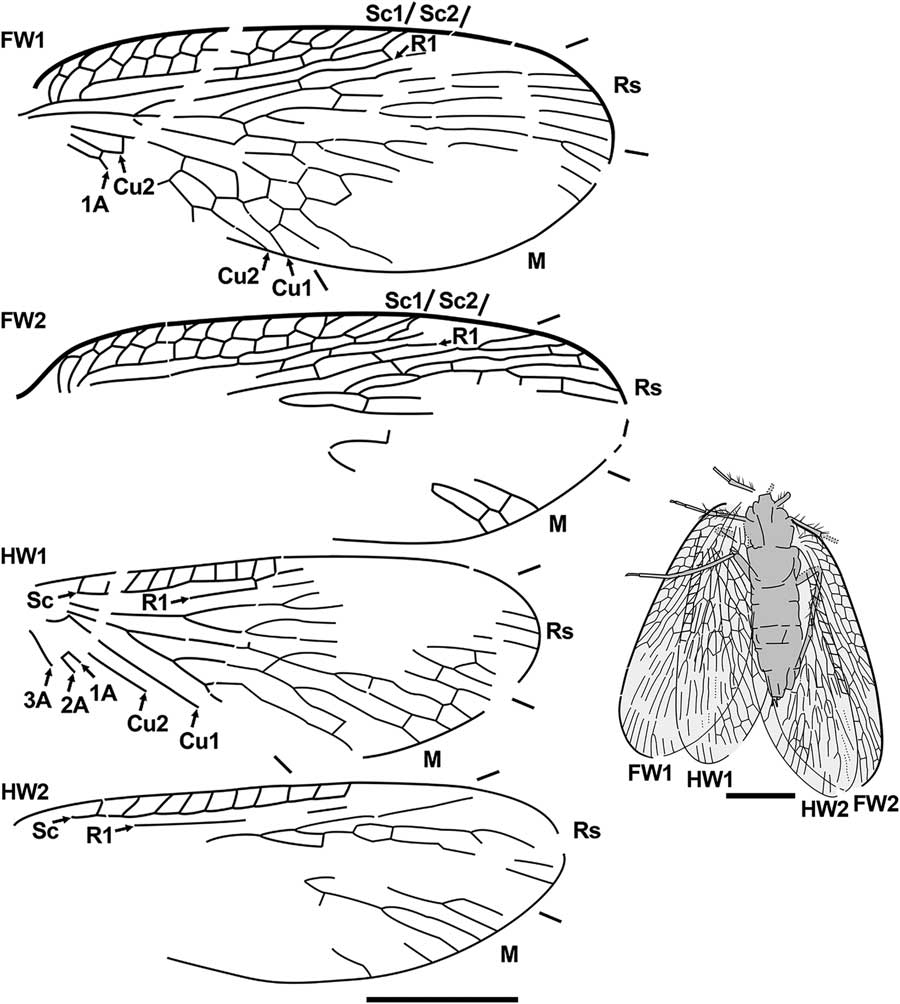
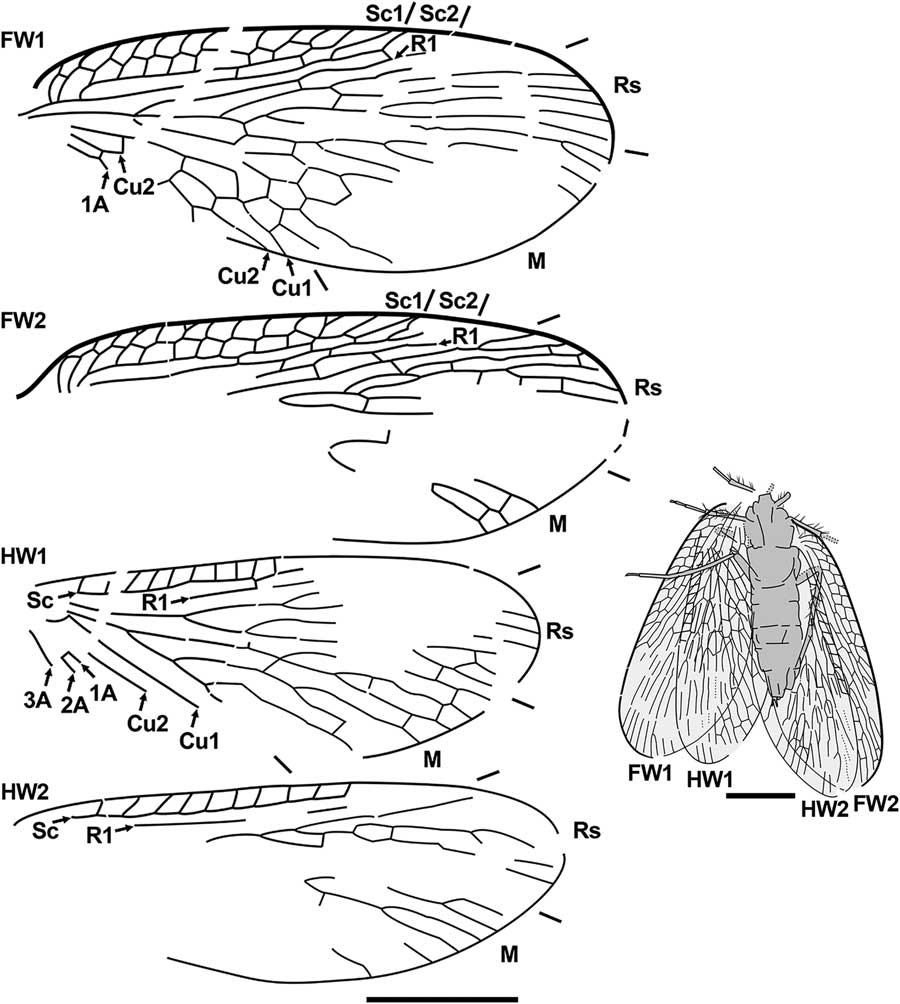
Eomerope eonearctica new species, holotype (F-780). Drawings of the wings (colouration omitted and veins in overlapping portions of wings that cannot be confidently assigned to either are omitted) and positions of the wings indicated by a drawing of the complete specimen. Scale bars=5 mm.
We assign the new species to Eomerope primarily by venation of the anterior portion of the wing. All Eomerope species have between two and three rows of cells in the C-Sc1 space and a few crossveins in the Sc1-Sc2 space, as in Eomerope simpkinsae (two rows of cells with occasional cells between C and Rs1). This excludes it from Notiothauma MacLachlan (many rows between C and Sc, Sc simple) and the Mesozoic genera Tsuchingothauma Ren and Shih (five rows between C and Sc2), and Jurathauma Zhang et al. (one row between C and Sc1 and a few crossveins between Sc1 and Sc2). Only Typhothauma Ren and Shih has a configuration in this space like that found in Eomerope, with two rows of cells between C and Rs1, and an Rs1-Rs2 space with a few crossveins. Eomerope is distinct from Typhothauma, however, by the branching of Cu1 in the forewing: three branches in the holotype of T. yixianensis, and four as preserved in the holotype of T. excelsa. Cu1 is simple where it is known in Eomerope, although this is unknown by preservation in the type species of the genus, E. tortiriciformis.
Eomerope eonearctica Archibald and Rasnitsyn, new species
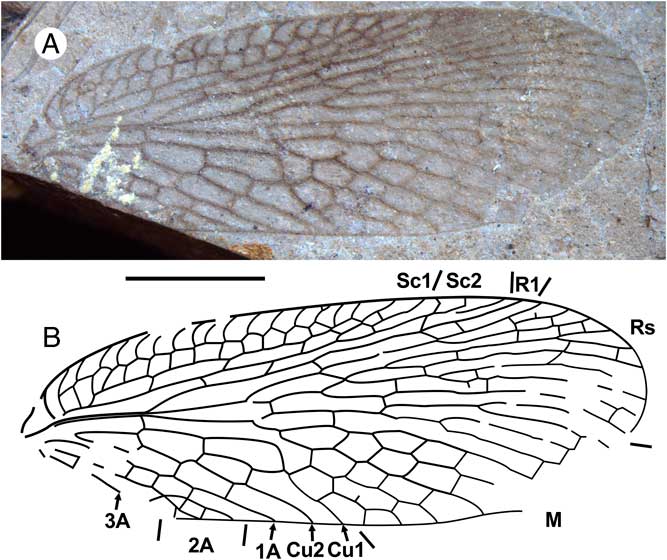
Eomerope eonearctica new species, paratype forewing (F-781). A, Photograph; B, drawing (colouration omitted). Scale bar=5 mm, both to scale.
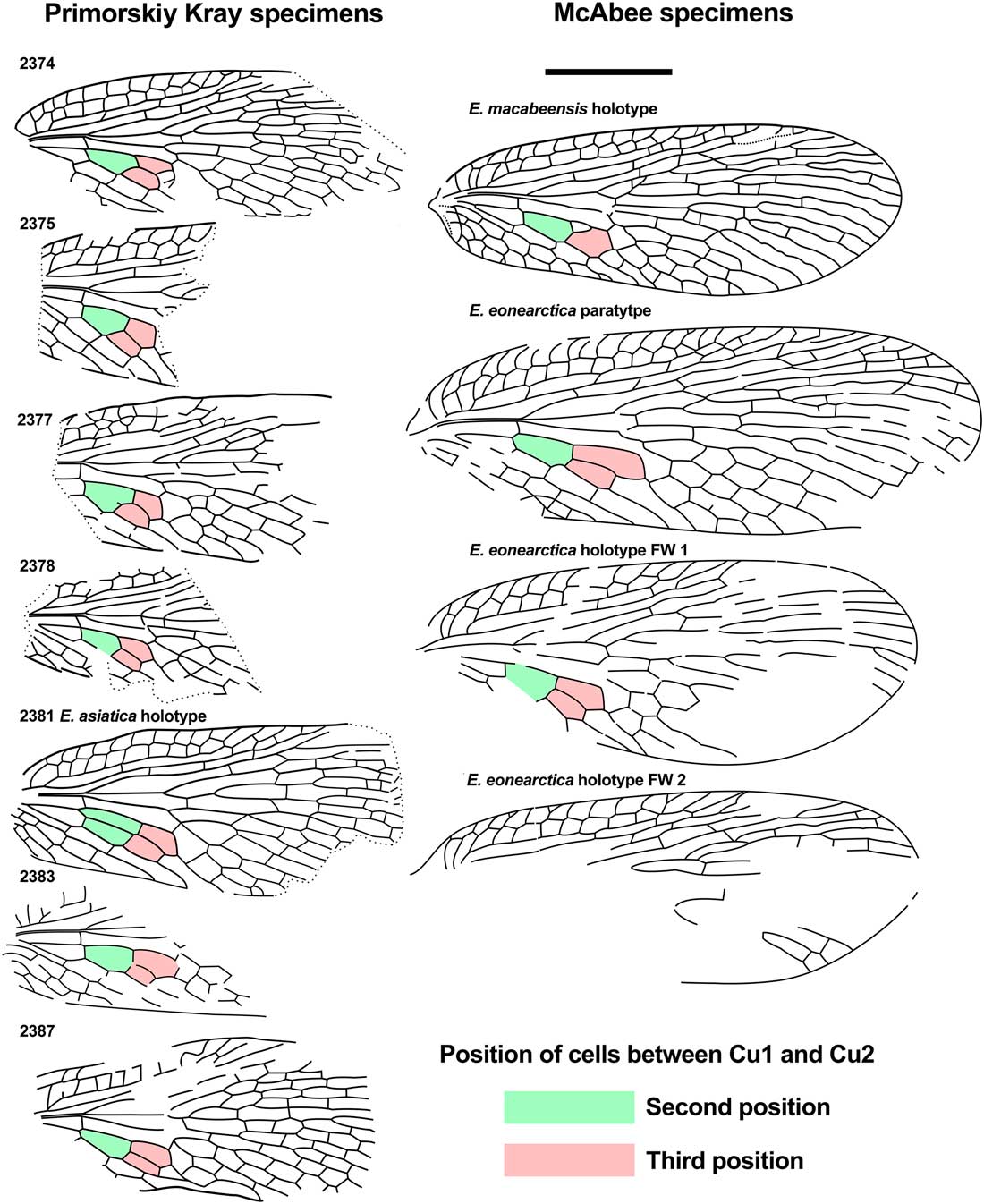
Drawings of the forewings of Eomerope asiatica from Primorye, Russia (except specimen 2383, see text) based on combined morphology preserved on the part and counterpart (where available) compared with those of the McAbee E. eonearctica (F-780 and F-781) and E. macabeensis. Scale bar=5 mm, all to scale. Wing colouration omitted.
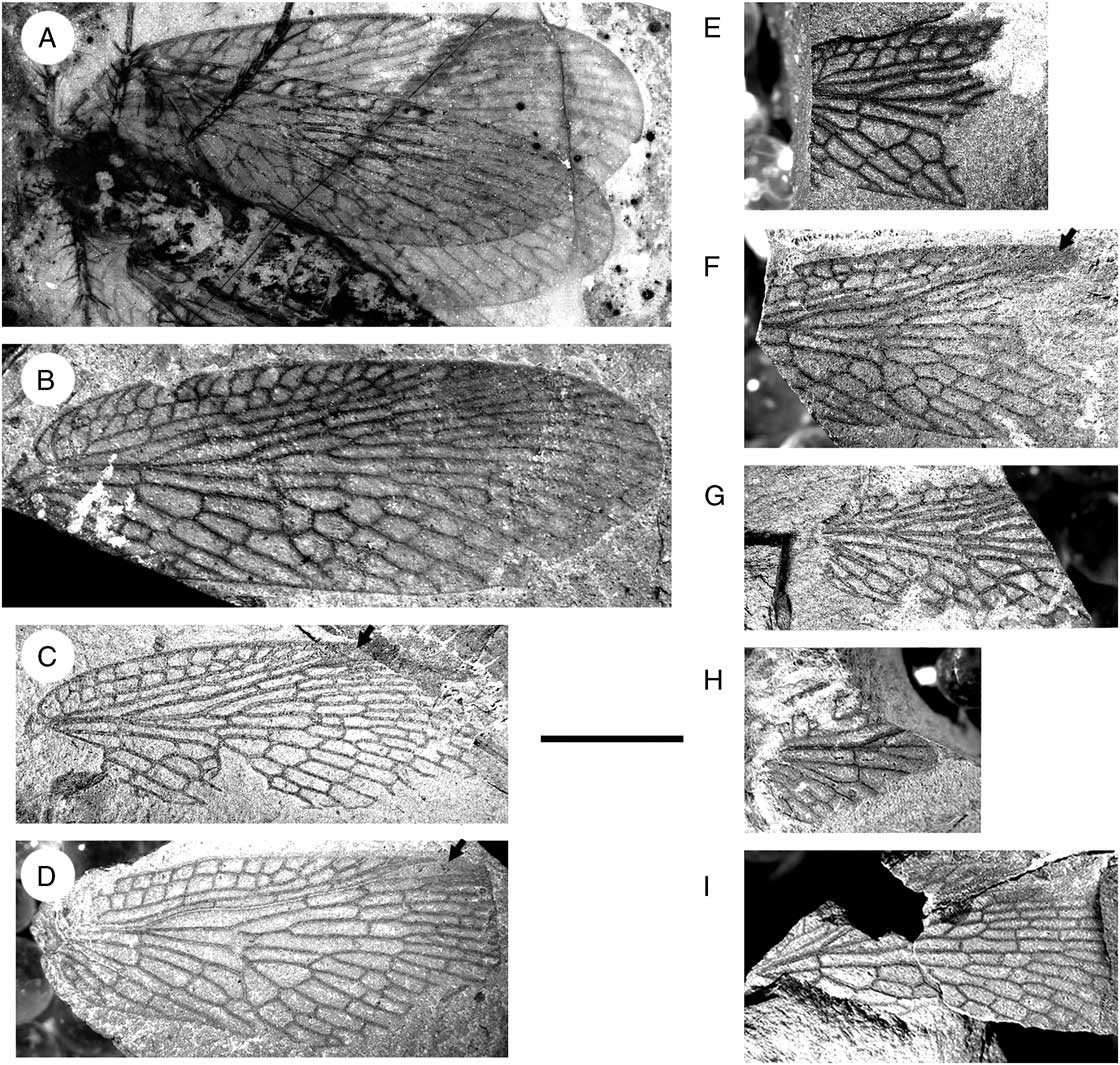
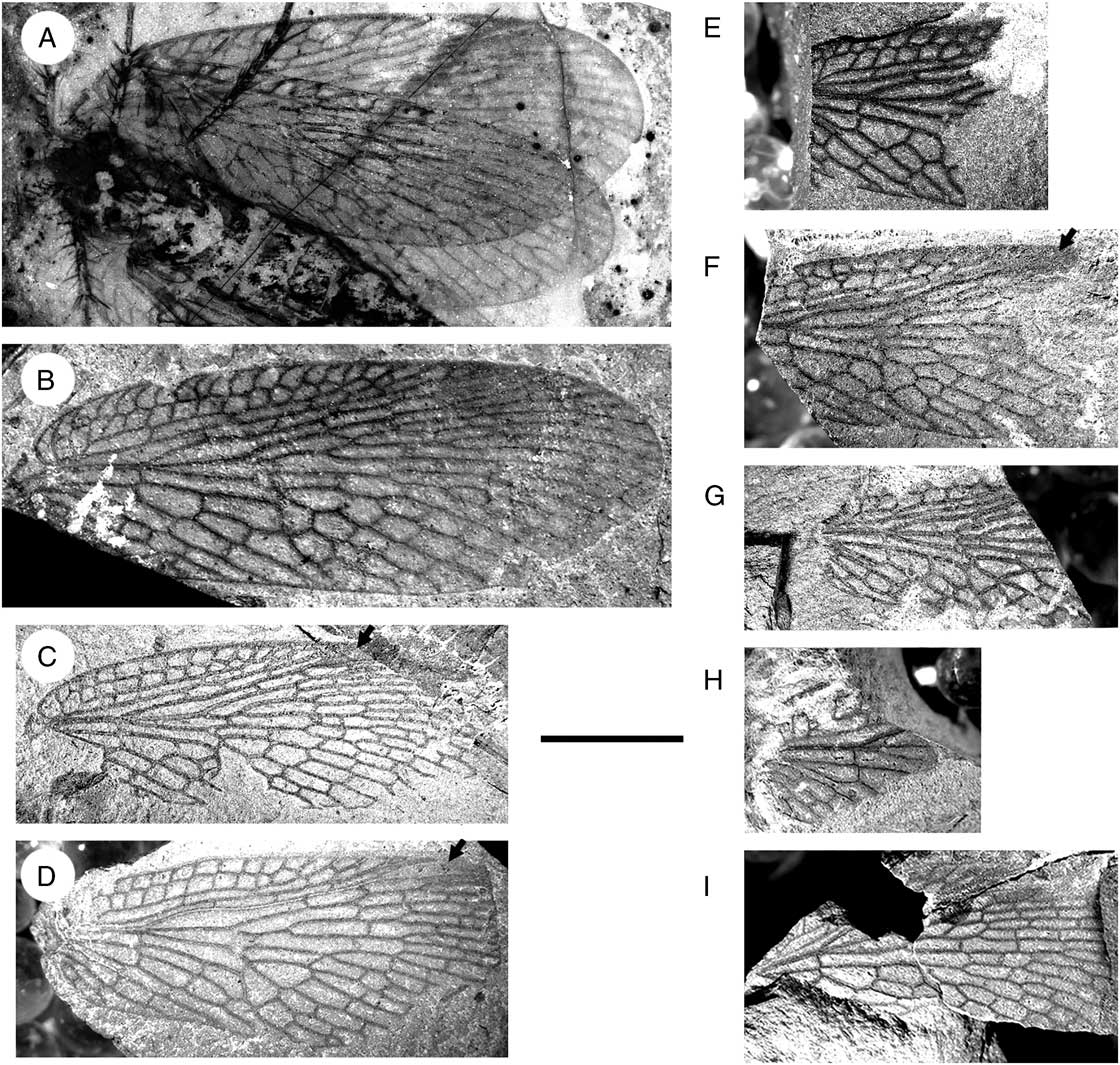
Primorye and Eomerope eonearctica forewings in greyscale with increased contrast to show infuscate membrane in E. eonearctica forewings and Primorye specimen 2383 (Eomerope (?) indeterminate, see text), and hyaline membrane (except for the pterostigma, see arrows) in E. asiatica. A, Eomerope eonearctica holotype (F-780); B, E. eonearctica paratype (F-781); C, E. asiatica paratype (2374); D, E. asiatica (2381); E, E. asiatica (2375); F, E. asiatica (2377); G, E. asiatica (2378); H, Eomerope (?) indeterminate (2383); I, E. asiatica (2387). Some differ from their drawings in Fig. 5, as those combine morphology from both the part and counterpart. Scale bar=5 mm, all to scale.
Etymology
The specific epithet combines Eo-, Greek for “dawn”, from Eocene, and Nearctic, alluding to the very similar E. asiatica and to the intercontinental dispersal of plants and animals around this time. The name should be treated as an adjective in the nominative singular.
Type specimens
Holotype TRU F-780 (Figs. 2–3, 5–6), a complete specimen, female, preserved in ventral aspect, with forewings partly overlapping hind wings. Paratype TRU F-781 (Fig. 3, 5–6), a well-preserved forewing. Both collected by unknown persons at the McAbee site, housed in the collections of TRU.
Locality and age
McAbee, British Columbia, Ypresian.
Diagnosis
Forewing is distinguished from those of other species of Eomerope most easily by the following: from E. tortriciformis and E. pacifica by two rows of cells in the C-Sc1 space (E. tortriciformis, three in part; E. pacifica, three in part); further from E. pacifica by elongate shape, width:length ratio of 1:2.6–2.8 (E. pacifica, 1:2.3); from E. macabeensis by third Cu1-Cu2 cell divided (E. macabeensis, not so divided: Fig. 5, red); from E. asiatica by infuscation throughout wing (E. asiatica, membrane hyaline except for pterostigma), by ranging to larger size (see discussion below); from E. simpkinsae by shape as in its diagnosis, above.
Description
Holotype TRU F-780 (Figs. 2, 4–6). Female. Body dark in colouration, length 14.8 mm. Head. Indistinctly preserved. Legs. As in E. macabeensis, with many thick, long setae on tibiae. Thorax, abdomen difficult to interpret as preserved, but apparently generalised as in other Cenozoic female Eomeropidae. Abdomen tapers caudad. Wing membrane, veins infuscate throughout. Right forewing (FW1 of Figs. 3, 5). Length ~20.0 mm, width ~8.0 mm (width:length, 1:2.6), expanded costal space; veins thicker basally; C bowed outward basally, then rather straight to apical quarter; costal space with regular double-cell row ending about 2/3 wing length; Sc with two branches, forking one-eighths wing length; R forks at basal quarter; R1 slightly zigzagged, apical portion not preserved; Rs with at least eight branches (indistinctly preserved in part); base of M not preserved; apical region of M not clearly preserved; Cu: Cu1 and Cu2 apparently simple, Cu1 strongly bent posteriad approximately two-thirds length; Cu2 zigzagged, not sharply bent; small portion of 1A preserved; crossveins numerous; many between branches of Rs and M, stronger basally, a few preserved apically; crossvein connecting two crossveins that join Cu1 and Cu2 creates two cells between Cu1 and Cu2 at maximum width, i.e., area of sharp bend of Cu1 (Fig. 5, red). Left forewing (FW2 of Figs. 3, 5) most clearly preserved in anterior region, more in mid wing. Length ~20.0 mm, width ~7.5 mm (width:length, 1:2.7). All preserved parts agree with right wing as above, with minor differences in crossveins. Right hind wing (HW1 of Figs. 3, 5). Length ~16.9 mm, width ~6.6 mm as preserved (basal-most portion not clear). C not bowed out, anterior margin rather straight to apical quarter; Sc not branched, with one row of cells in C-Sc space, not preserved apically; R1 not preserved (but space present where it should be); Rs branches about basal third wing length, with four branches preserved, apical region of Rs not preserved; M with at least six branches preserved. Portions of presumably Cu1 and Cu2 preserved, straight. Small portions of presumably 1A, 2A, 3A preserved. Left hind wing (HW2 of Figs. 3, 5) ~18.0 mm, width ~6.5 mm as preserved. Much of Sc and single cell row in C-Sc1 space preserved, extending at least three-quarters the wing length, then not preserved. Some apical branching of Rs and portions of distal branches of M preserved.
Paratype
F-781 (Figs. 4–6). Forewing. Length 22.5 mm, width 8.0 mm, broad (width:length, 1:2.8), veins thickened in approximately basal half, narrower apically; membrane infuscate; wide costal space apparently without narrow basal-most portion; C-Sc1 space with regular double-cell row ending after middle of wing length; Sc with two branches, forking one-eighth the wing length; R forks at basal quarter; R1 rather straight to anterior margin; Rs with at least 10 branches (indistinctly preserved near apex); base of M very close to R, straight or only slightly bent at forking of R1 and Rs; irregularly branched to approximately nine at margin; Cu branched immediately basad branching of Sc; both Cu1 and Cu2 apparently simple, Cu1 strongly zigzagged by crossveins, bent sharply posteriad approximately two-thirds length; Cu2 not sharply bent, rather straight (some zigzag); three anal veins preserved, 1A and 2A, rather straight (some zigzag), 3A straight where partially preserved; crossveins numerous; many between branches of Rs and M, stronger basally, not preserved in most of apical portion; crossvein connect two other crossveins that join Cu1 and Cu2 creating two cells between Cu1 and Cu2 at maximum width, i.e., area of sharp bend of Cu1 (Fig. 5, red).
Discussion
The new species is assigned to Eomerope by the same reasons as discussed under E. simpkinsae, above. The forewings of the McAbee specimens F-780 and F-781 are very similar to those of E. asiatica (Fig. 5). Ponomarenko and Rasnitsyn (Reference Ponomarenko and Rasnitsyn1974) examined 12 specimens of the species, which showed extensive variability, particularly in the radial sector. We examined 10 of these in the PIN collections: numbers 2374 (paratype), 2375, 2376, 2377, 2378, 2380, 2381 (holotype), 2383 (paratype), 2384, and 2387. Specimen 2384 is quite compressed, incomplete, and the remaining specimens are fragmentary and/or distorted, and these were excluded as not informative here. Specimens 2376 and 2380 are hind wings, which are quite damaged and fragmentary, and not usefully comparable with the hind wings of F-780. We compared the remaining seven with the McAbee specimens (Figs. 5–6).
Other venational characters vary in this collection. Specimen 2377 shows two cells separating the regular cell rows between C and Sc1, creating an occasional three cells width, as does 2372 (a fragmentary specimen not examined by us, but illustrated by Ponomarenko and Rasnitsyn Reference Ponomarenko and Rasnitsyn1974, fig. 7d). The holotype has two cells wide separating Cu1 and Cu2 between the basal-most cell and two wide separating these veins at the bend in Cu1 (“second position” of Fig. 5, green). All other specimens that we examined had a single cell in this position, although 2377 bears a vein stub in this position (Fig. 5), further supporting the notion of plasticity of this character state within the species rather than separating 2381 as a distinct species from others with a single cell in this position. There are numerous minor differences in the positioning of crossveins.
The wing membrane of the holotype of E. asiatica (2381) is hyaline except for the pterostigma (Fig. 6). This is consistent with five of the other six specimens examined (Fig. 6). Colouration of the pterostigma in specimens where this region is preserved supports the notion that if the wing membrane was infuscate throughout in these as in E. eonearctica, this would be preserved. We consider this to separate E. asiatica from E. eonearctica. Wing colouration is consistent in specimens examined of the nearest living relative, N. reedi, in the Museum of Comparative Zoology, Harvard University (Cambridge, Massachusetts, United States of America). Only in specimen 2383 (designated as a paratype of E. asiatica) is the preserved portion of the wing membrane generally infuscate. We treat this specimen as “Eomerope (?) indeterminate”, also hesitating to firmly assign it to genus by its fragmentary nature.
Although the E. asiatica forewings in the sample examined are incomplete, their preserved portions indicate a variation in size with 2378 about 70% as large as 2381. Eomerope eonearctica appears to have a similar size range, with F-780 about 75% the size of F-781 supporting the supposition that these specimens are conspecific (Fig. 5).
The existence of closely related species of Eomerope in Primorye, Russia and British Columbia, Canada, in the Ypresian is consistent with described dispersals across the Bering Land Bridge between Asia and North America preceding and during the Ypresian, well documented in plants and vertebrates (e.g., Woodburne and Swisher Reference Woodburne and Swisher1995; Beard and Dawson Reference Beard and Dawson1999; Manchester Reference Manchester1999; Tiffney Reference Tiffney2000; Manchester and Tiffney Reference Manchester and Tiffney2001; Tiffney and Manchester Reference Tiffney and Manchester2001; Bowen et al. Reference Bowen, Clyde, Koch, Ting, Alroy and Tsubamoto2002; Manchester et al. Reference Manchester, Chen, LU and Uemura2009; Brikiatis Reference Brikiatis2014). Plant taxa commonly found at McAbee that only persist in eastern Asia today include, e.g., Ginkgo (Ginkgo Linnaeus, Ginkgoaceae), Katsura (Cercidiphyllum Siebold and Zuccarini, Cercidiphyllaceae), dawn redwood (Metasequoia Miki, Cupressaceae), and Chinese golden larch (Pseudolarix Gordon, Pinaceae) (Greenwood et al. Reference Greenwood, Archibald, Mathewes and Moss2005; Moss et al. Reference Moss, Greenwood and Archibald2005). Ypresian forests grew in the Arctic above 72°N (Suan et al. Reference Suan, Popescu, Suc, Schnyder, Fauquette and Baudin2017). The Dinopanorpidae (Mecoptera) is only known from Okanagan Highlands sites, including McAbee, and Primorye, at the Amgu locality of the Khutsin Formation and from the Tadushi Formation (Cockerell Reference Cockerell1924; Zherikhin Reference Zherikhin1978; Archibald Reference Archibald2005). The myrmeciine ant genus Ypresiomyrma Archibald et al. (Hymenoptera: Formicidae) was distributed widely across the Holarctic in the Eocene, in the Ypresian at McAbee (Archibald et al. Reference Archibald, Cover and Moreau2006) and in Denmark (Rust and Andersen Reference Rust and Andersen1999), and in the Priabonian of Primorye (Dlussky et al. Reference Dlussky, Rasnitsyn and Perfilieva2015).
Acknowledgements
The authors thank Kathy Simpkins, collections manager at the PDM, for alerting us to the Allenby Formation specimen; Rika Ruebsaat and the Princeton and District Museum board for donating it to the RBCM; curator Richard Hebda and collections manager Marji Johns of the RBCM for its loan; Nancy Van Wagoner, manager of the fossil collections at TRU, for the loans of the McAbee specimens; and Dong Ren of Capital Normal University (Beijing) for discussion of Typhothauma. S.B.A. thanks Rolf Mathewes of Simon Fraser University for funding (Natural Sciences and Engineering Research Council of Canada Discovery grant 3835) and further facilitating research. A.P.R. was supported by the Presidium of Russian Academy of Sciences Program “Origin and evolution of the geo-biological system”.