Introduction
The genus Pyrenula (Pyrenulaceae, Ascomycota) comprises crustose lichens typically growing on smooth, shaded bark. In a recent key to the species of the genus, Aptroot (Reference Aptroot2012) accepted 169 species out of the c. 745 published taxa. Many species are restricted to undisturbed forests, mainly in the tropics but also in temperate regions.
The availability of a world key to the genus has made it much easier to recognize undescribed taxa, and it was to be expected (Aptroot et al. Reference Aptroot, Schumm and Cáceres2012) that new species would soon be found. However, this proved to be true on an unexpected scale. Twenty-one new species of Pyrenula are described here from South America. They originate from two sources:
-
1. Examination of the neotropical material of Pyrenula in the herbarium at Berlin-Dahlem, including many specimens collected by the two first authors during fieldwork for the Flora of the Guyanas project (Aptroot Reference Aptroot1991; Aptroot & Sipman Reference Aptroot, Sipman and Gorts-van Rijn1993), revealed several species that were not identifiable with the recently published world key. Interestingly, several of them show characters that were not previously reported in the genus and are rare or new to lichenized fungi, viz. yellow, orange or red (KOH+ green) oil inspersion in the hymenium, yellow oil in young ascospores or longitudinal ridges on the ascospore wall.
-
2. A ten day field trip in 2012 by the first and last authors to undisturbed lowland rainforest in Rondônia, Brazil, and adjacent Amazonia yielded several undescribed Pyrenula species. Surprisingly, some of these were quite common in Rondônia, and the undescribed species together make up the majority of the Pyrenula flora in that area, in terms of both species number and collections. Apparently, we encountered a previously undiscovered hot spot of Pyrenula diversity.
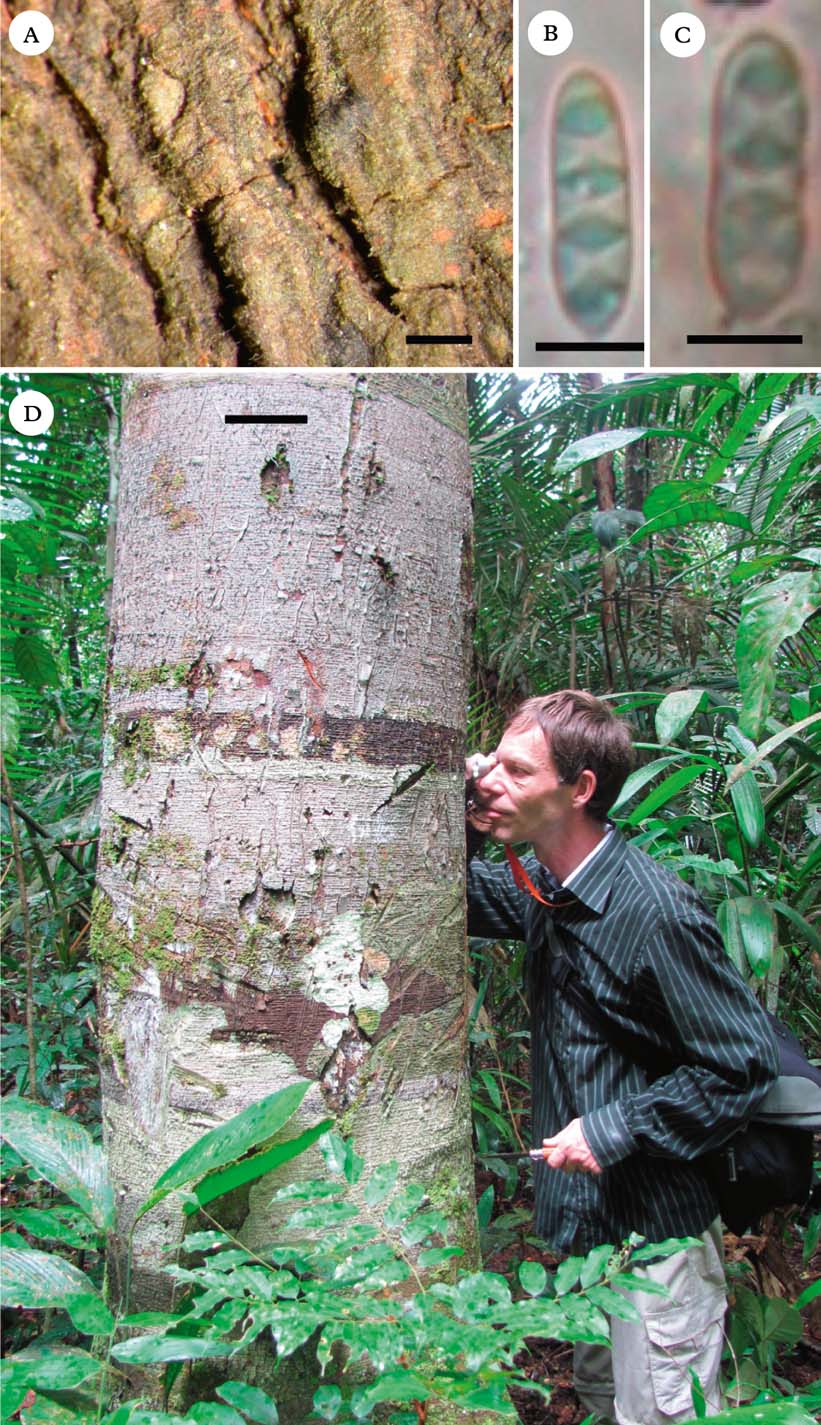
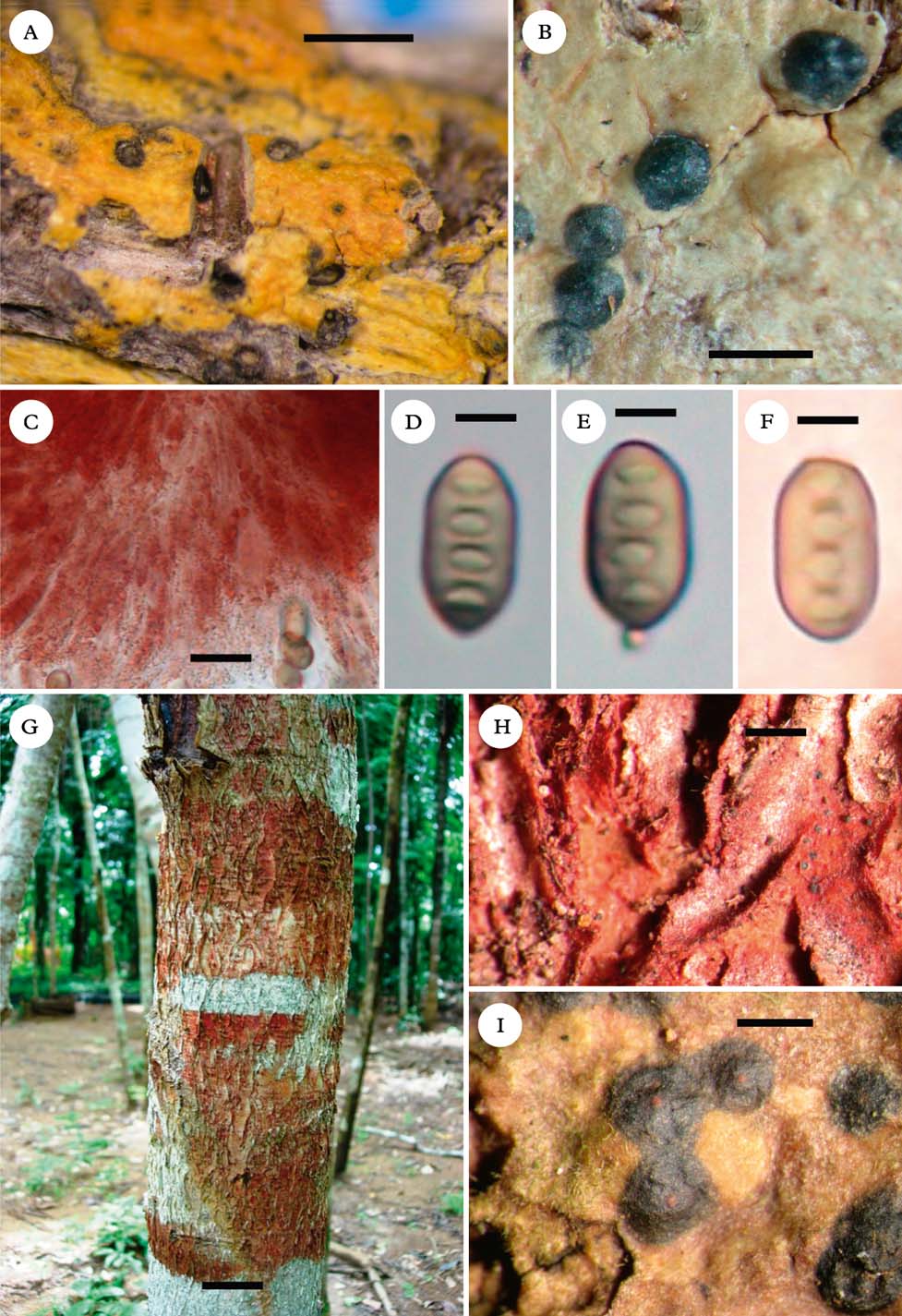
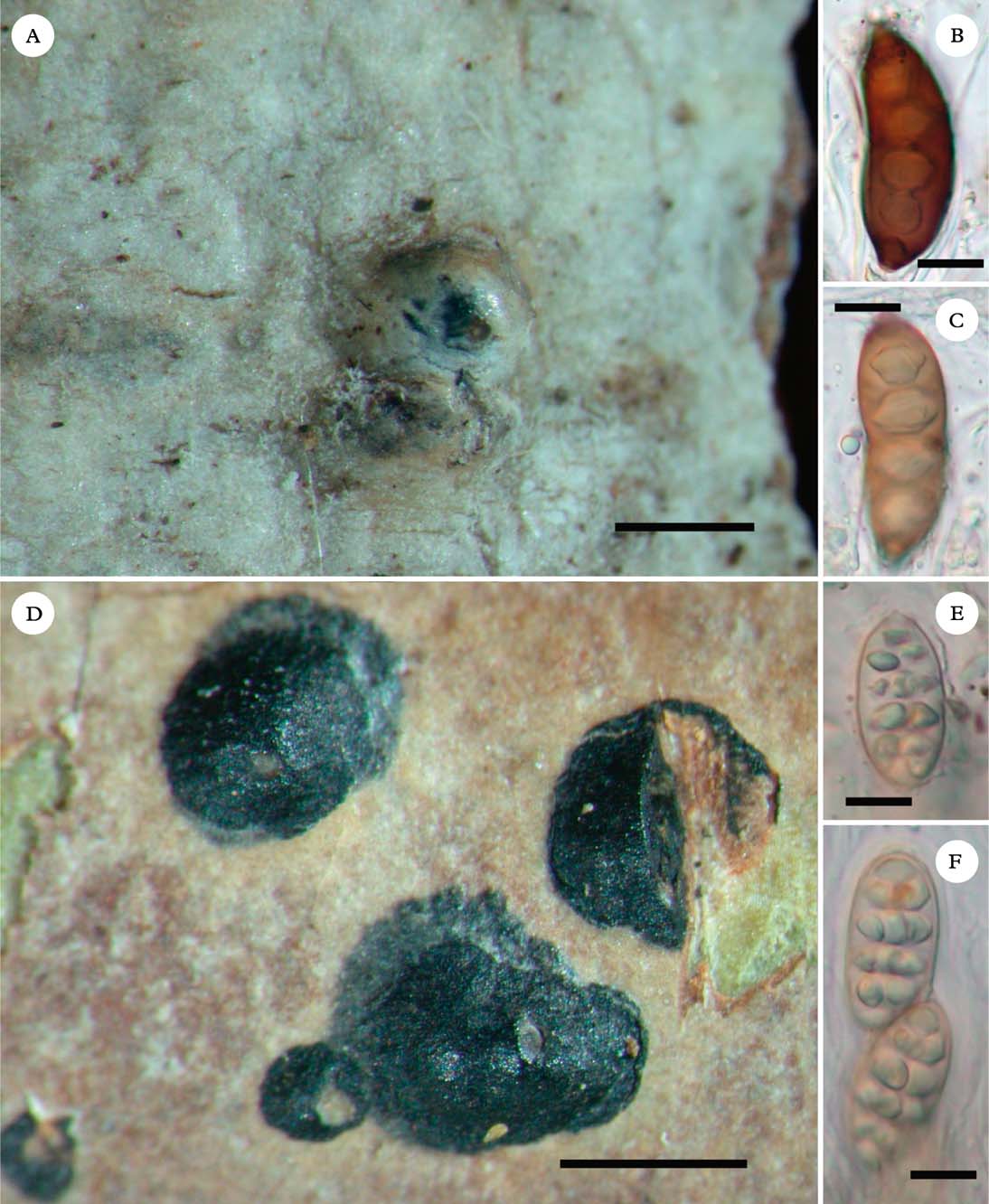
The forests visited in Rondônia were mostly undisturbed rainforests with a nearly 100% lichen cover on the trees. This high level of cover is probably a result of the poor soils that sustain only a relatively open forest. Lowland rainforests elsewhere in the world are usually denser and bryophytes dominate the epiphytic vegetation on the tree trunks, the preferred stratum for Pyrenula species. Several Pyrenula species can tolerate light-poor environments, but many species seem to require better light conditions and probably occur higher on the trunks, where sampling is rarely possible. Only in relatively open forests do these species occur at ground level, within reach of standard lichen sampling. It is therefore quite possible that the many species newly described here from Rondônia are not restricted to the area, but represent a flora element that is under-recorded. It should also be pointed out that several of the new species, including the most frequent ones, have a very dark thallus on which the ascomata are not clearly contrasting. They commonly occur as rather large (dm2) patches that resemble patches of empty bark without lichens (Fig. 5D). They could therefore easily have been overlooked by general lichen collectors.
While working intensively with the key in Aptroot (Reference Aptroot2012), at our respective laboratories as well as on a lichen identification course after the IAL7 congress in Thailand, we came across some range extensions and other imperfections in this text, the most important of which are listed here as well. Also added are illustrations of post-mature ascospores, a neglected character.
Altogether, 195 species of Pyrenula are now accepted, including two reinstated species treated below, a recently described species from Sri Lanka (Wijeyaratne et al. Reference Wijeyaratne, Lücking and Lumbsch2012) and three further species from Brazil that are currently being published elsewhere (Lima et al. Reference Lima, Mendonça, Maia, Aptroot and Cáceres2013). This confirms that the Neotropics are clearly the centre of diversity for the genus.
Materials and Methods
The morphology of all species was studied in Soest using an Olympus SZX7 stereomicroscope and an Olympus BX50 compound microscope with differential interference contrast optics, both with a Nikon Coolpix digital camera attached to a third tube. Some specimens were studied in Itabaiana, using a Leica EZ4 stereomicroscope and a Leica DM500 compound microscope. Chemistry was investigated by long-wave UV (360 nm) and occasionally by TLC (Orange et al. Reference Orange, James and White2001). Sections were mounted in tap water, in which all measurements were also taken.
The New Species
Pyrenula aggregataspistea Aptroot & M. Cáceres sp. nov.
MycoBank No.: MB 801158
Pyrenula with aggregated ascomata and small ascospores of 11–13×3·5–5·0 µm.
Type: Brazil, Rondônia, Porto Velho, Parque Natural Municipal, 8°41′10″S, 63°52′05″W, alt. c. 100 m, in primary rainforest, on Ceiba samauma tree bark, 9–12 March 2012, M. Cáceres & A. Aptroot 11216 (ISE—holotype; ABL—isotype).
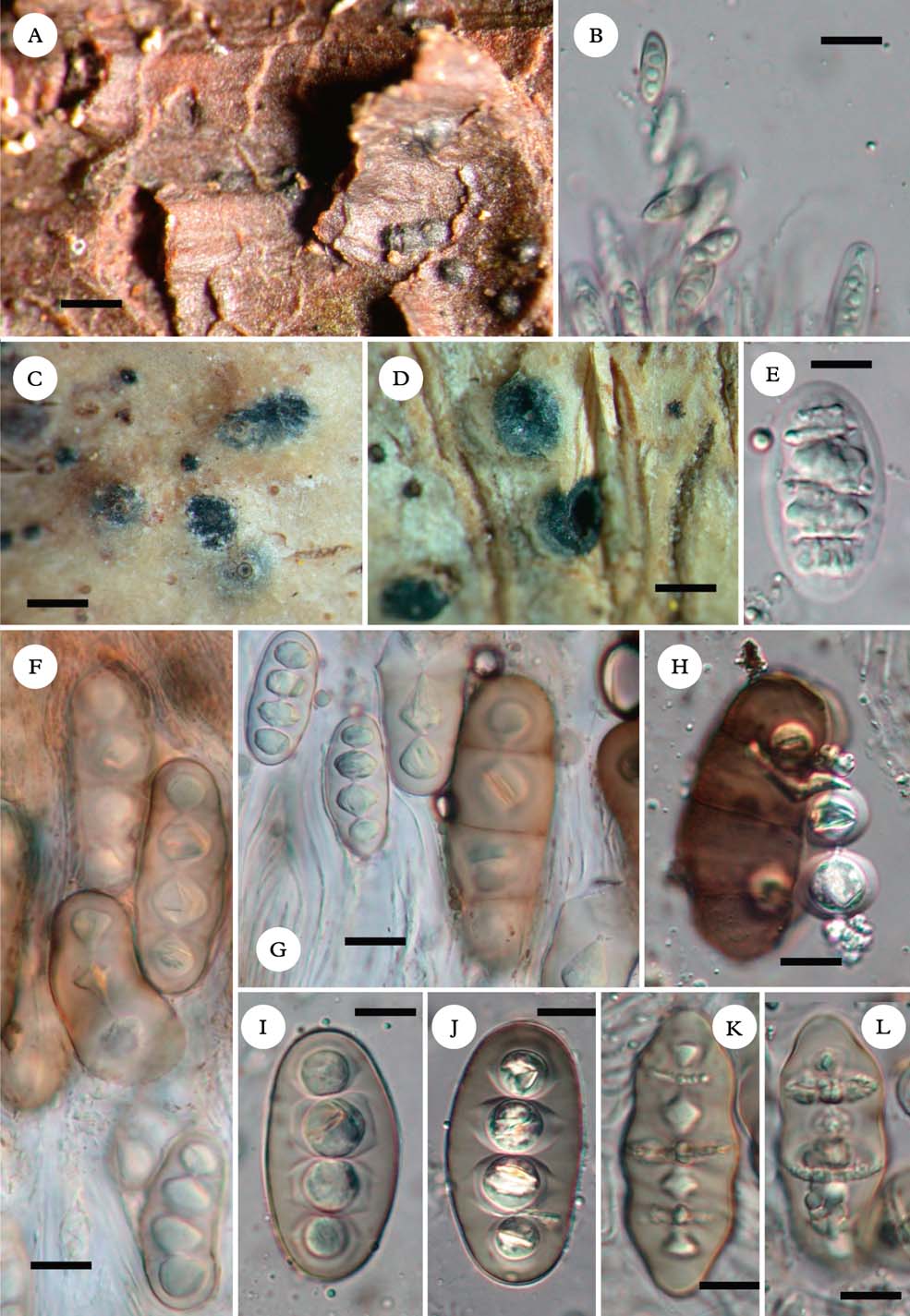
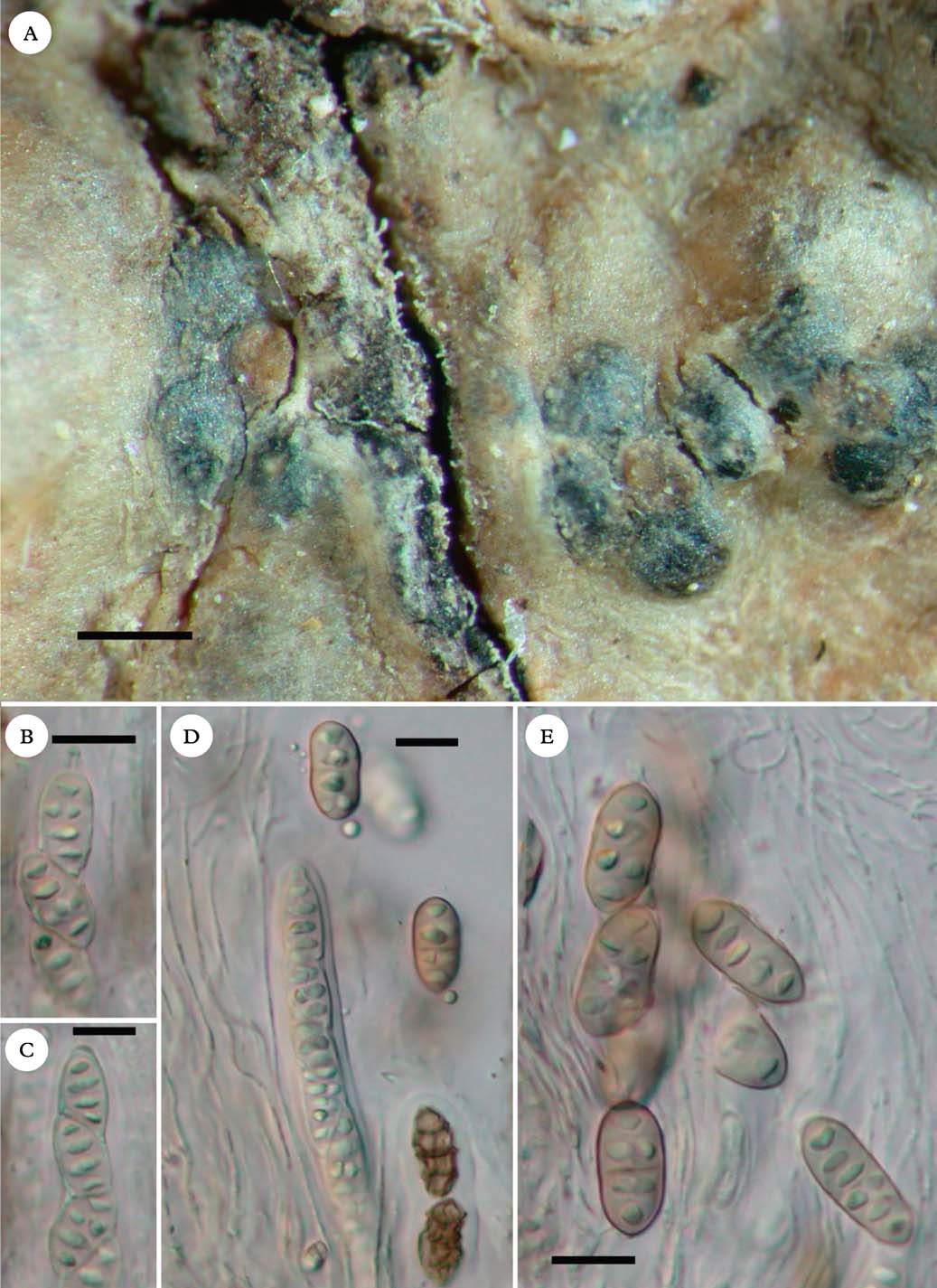
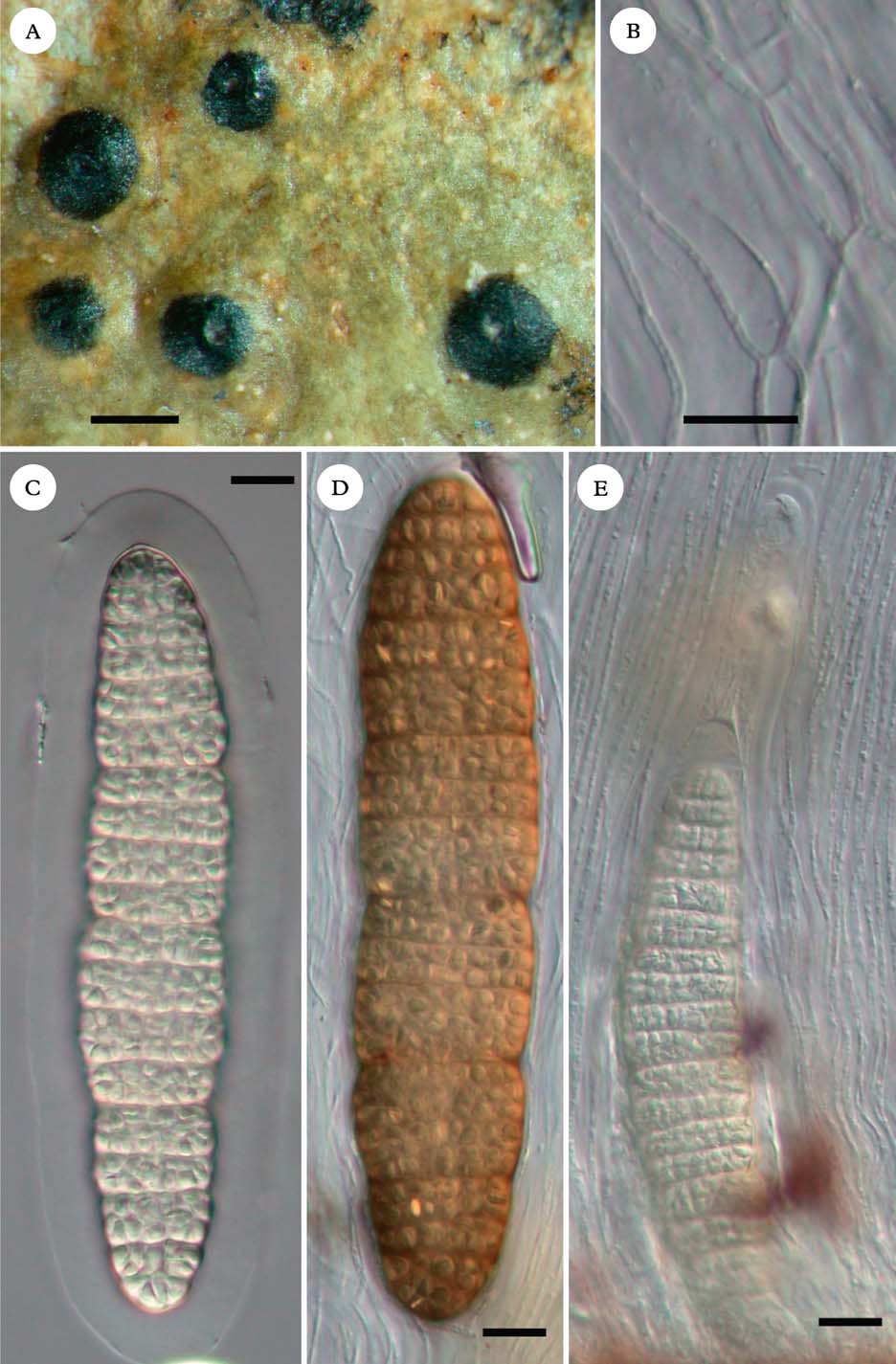
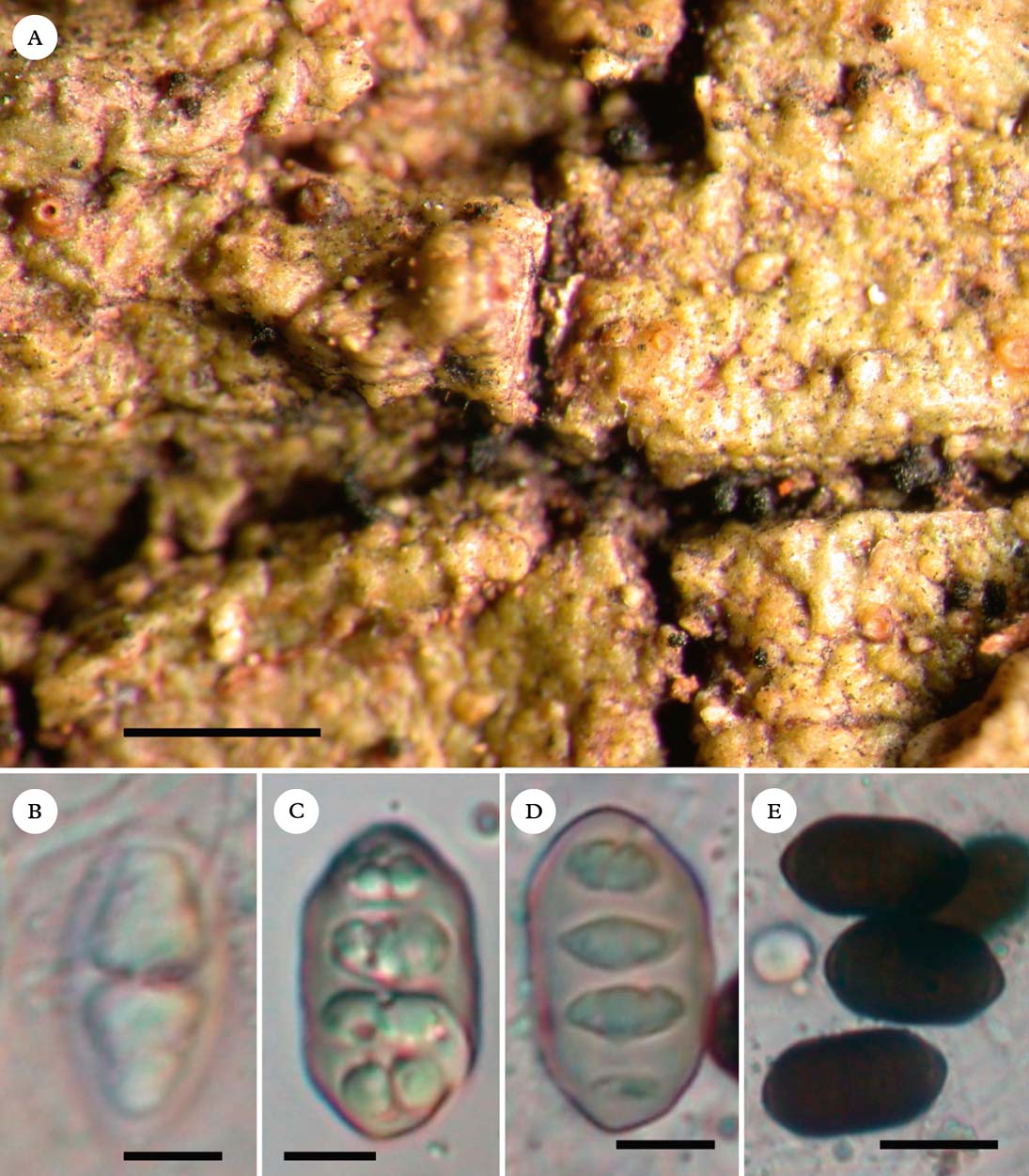
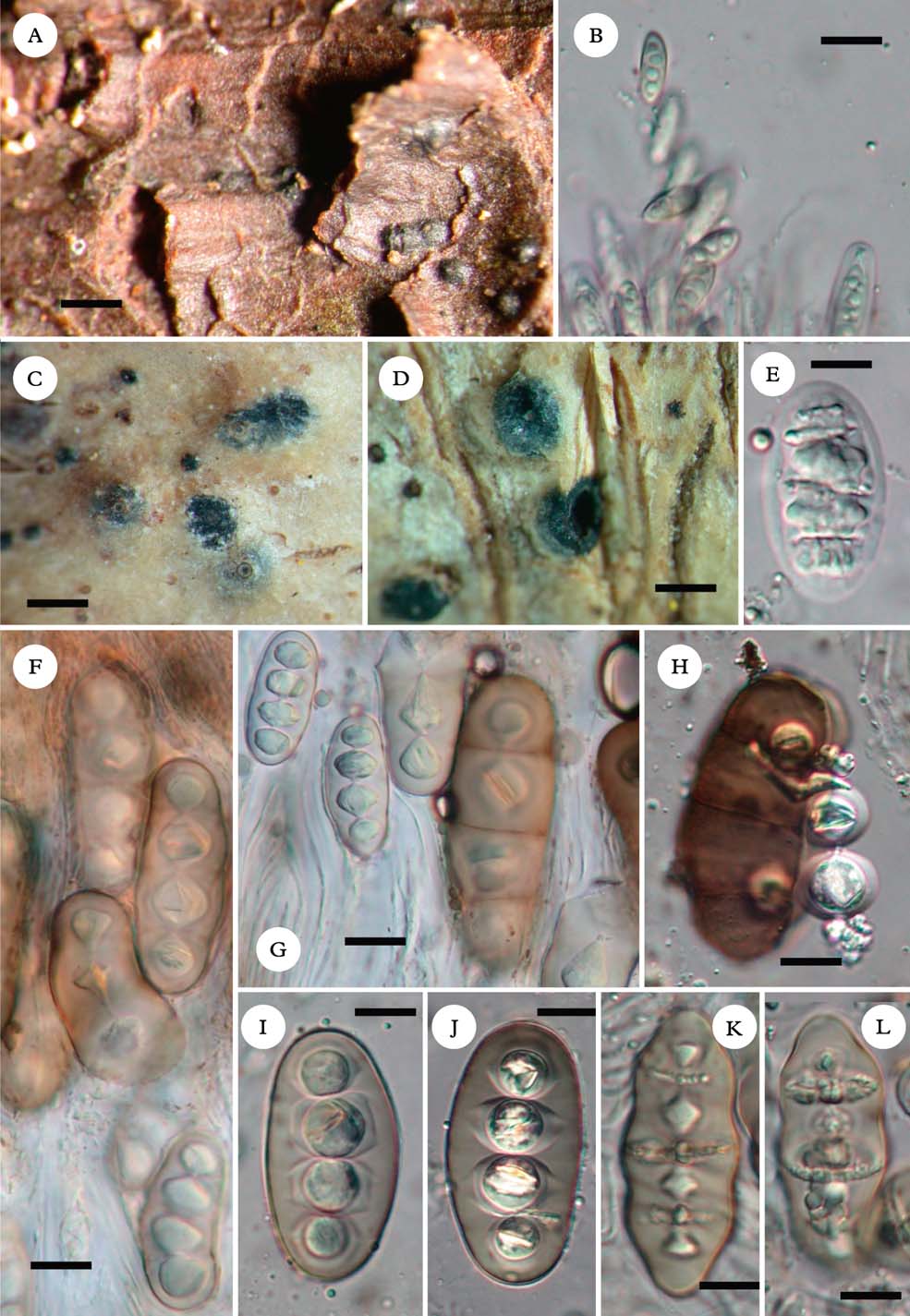
A & B, Pyrenula aggregataspistea Aptroot & M. Cáceres (holotype); A, thallus; B, ascospores. C–L, P. aurantioinspersa Aptroot & Sipman (holotype); C–D, thallus; E–L, ascospores; E, young, hyaline ascospores without thickened septa; F–G, mature ascospores which are greyish brown; H, post-mature ascospore breaking open, revealing thickenings around the lumina that are apparently firm, gelatinous balloons and all four are connected to each other; I–J, older ascospores with thickenings around the lumina; K & L, old ascospores with ring-shaped thickenings around the septa and constricted walls between them. Scales: A, C & D=1 mm; B=10 µm; E–L=15 µm. In colour online.
Thallus thin, chocolate brown, glossy, widely spreading, without pseudocyphellae, without a prothallus.
Ascomata superficial, conical, 0·3–0·4 mm diam., mostly in groups of 3–20 and partly fused sideways with incompletely fused walls and separate ostioles. Ostiole apical, yellowish. Hamathecium not inspersed. Ascospores 8 per ascus, irregularly biseriate, 3-septate, 11–13×3·5–5·0 µm, lumina angular, central lumina wider than long, end lumina longer than wide, with a thick layer of endospore in the spore tips.
Pycnidia not observed.
Chemistry
No substances detected.
Ecology and distribution
On smooth bark in lowland rainforest. Known only from Brazil.
Discussion
This species is reminiscent of Pyrenula aspistea (Ach.) Ach., but differs by the aggregated ascomata and the large-sized, glossy, dark brown thallus.
Pyrenula aurantioinspersa Aptroot & Sipman sp. nov.
MycoBank No.: MB 801159
Pyrenula with hamathecium inspersed with orange, KOH+ greenish oil droplets.
Type: Venezuela, Mérida,Valley of Rio Chama near Mérida, bottom of little tributary valley at end of Calle Pueblecito, alt. 1600 m, forest remnants with small fields, epiphyte on shady tree trunk, 21 January 1979, H. Sipman 10981 (B 60 0044477—holotype; MERF—isotype).
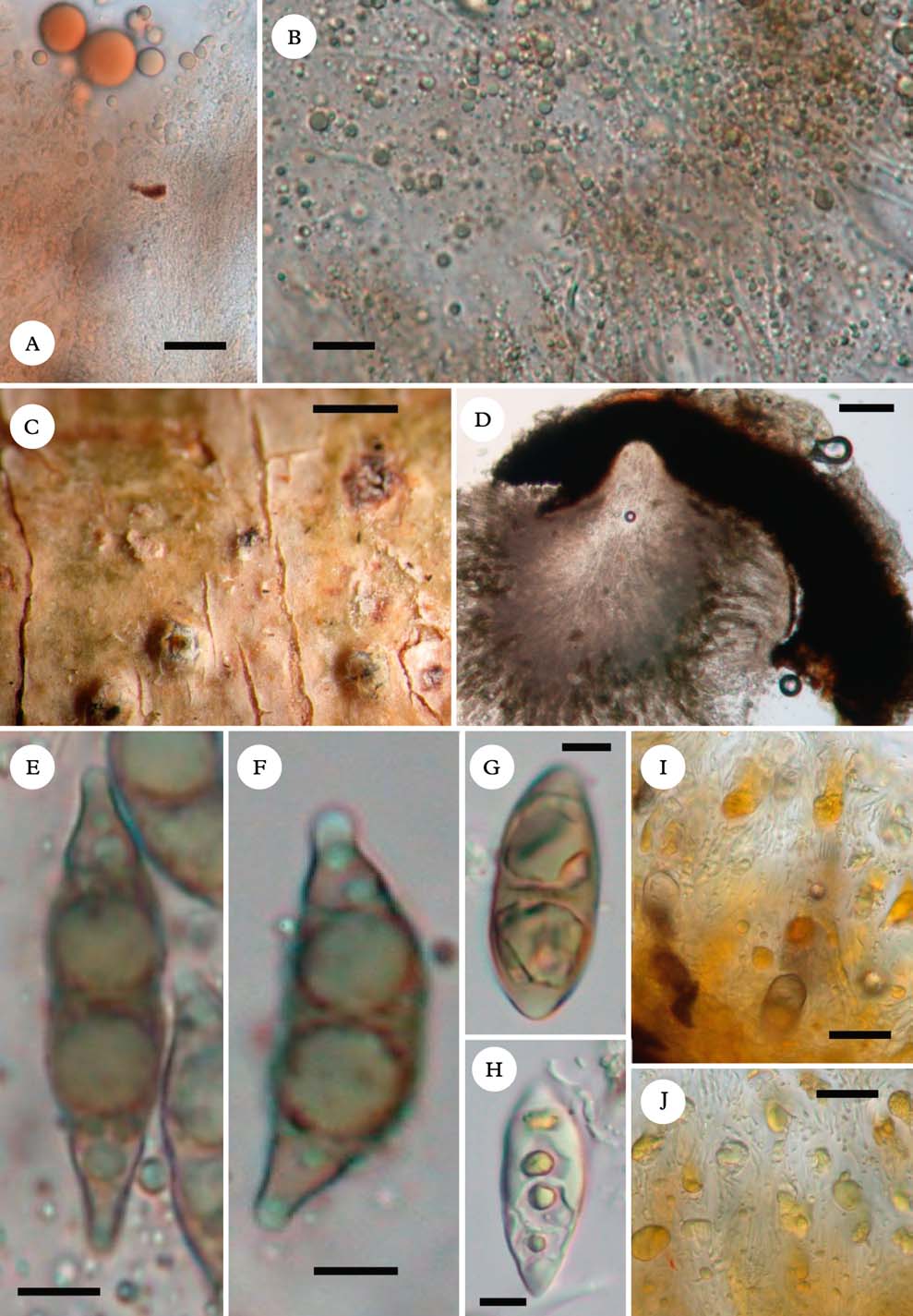
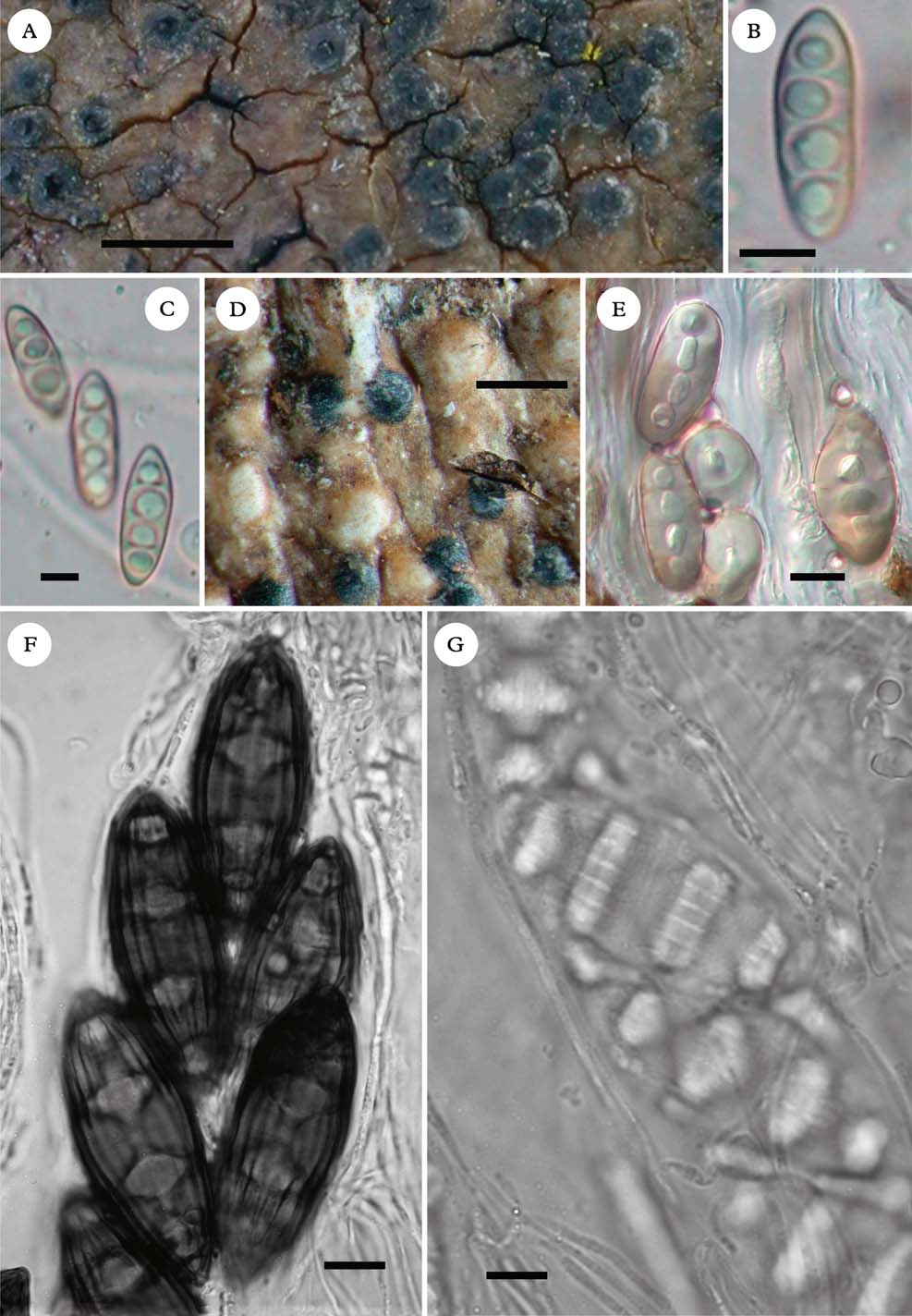
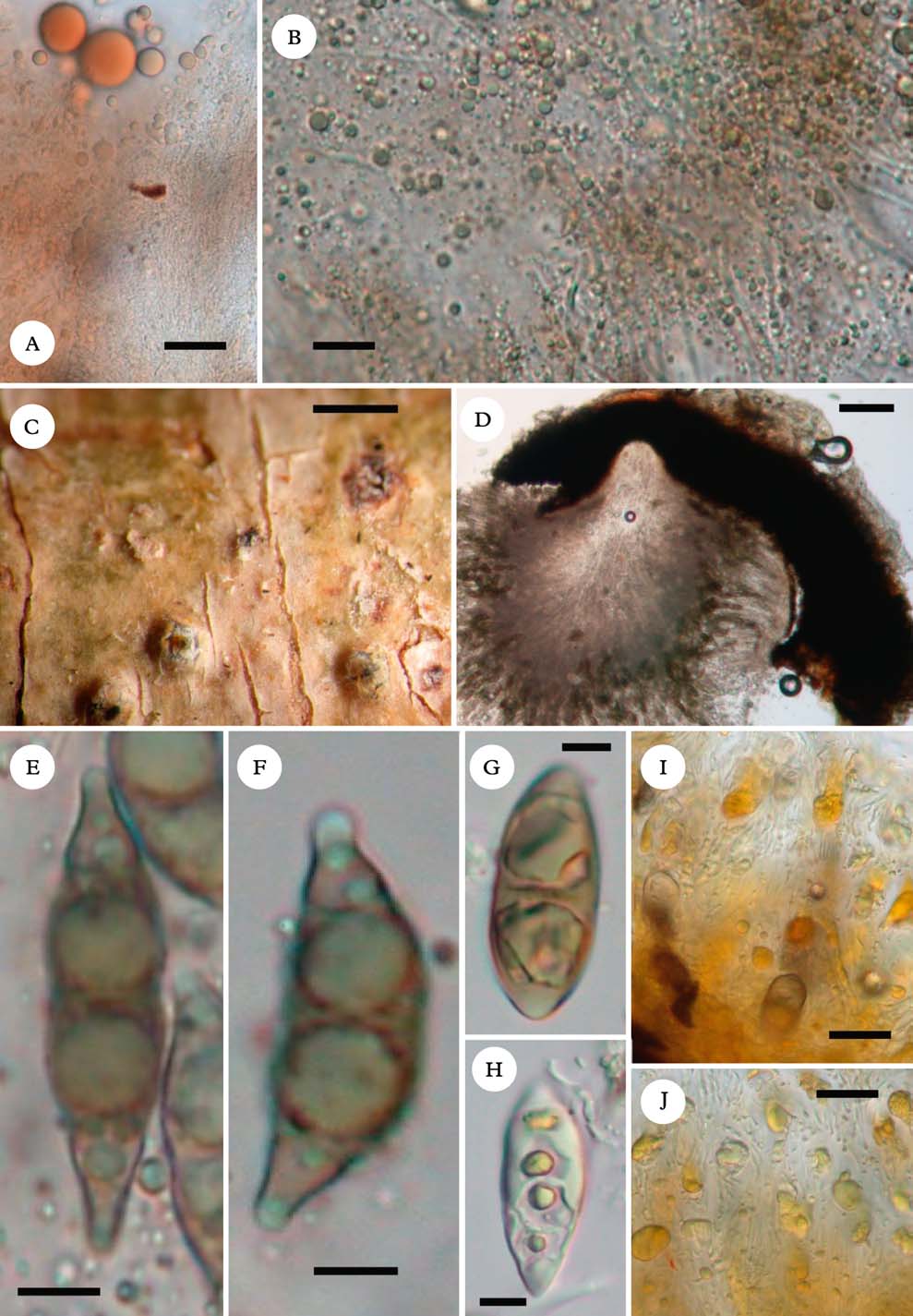
A & B, Pyrenula aurantioinspersa Aptroot & Sipman (holotype); A, hamathecium in tap water showing orange oil globules; B, hamathecium in KOH showing green oil globules. C–F, P. cornutispora Aptroot & M. Cáceres (holotype); C, thallus; D, section through ascoma; E & F, ascospores. G–J, P. flavoinspersa Aptroot & Sipman (holotype); G & H, ascospores; I & J, hamathecium in tap water showing yellow oil globules. Scales: A, I & J=20 µm; B=10 µm; C=1 mm; D=50 µm; E–H=5 µm.
Thallus oily, yellowish grey, quite thick, with pseudocyphellae.
Ascomata erumpent, nearly globose, simple, 0·8–1·3 mm diam. Ostiole apical, brown. Hamathecium inspersed with orange, KOH+ greenish oil droplets which coalesce after sectioning. Ascospores 8 per ascus, irregularly biseriate, 3-septate, 60–75×24–28 µm, lumina mostly rounded, wall relatively thick, with a thick layer of endospore in the spore tips. Ascospores vary greatly in appearance with age; young ascospores hyaline and without thickened septa (Fig. 1E); when mature they are greyish brown, with thickenings around the lumina (Fig. 1I & J); thickenings are apparently firm, gelatinous balloons and all four are connected to each other, as can be seen when a post-mature ascospore breaks open (Fig. 1H); older ascospores with ring-shaped thickenings around the septa (Fig. 1K & L) and the walls between them become constricted.
Pycnidia present along the thallus margins.
Chemistry
Hamathecium with orange, KOH+ greenish anthraquinone.
Ecology and distribution
On smooth bark in mountain forest. Known only from the type.
Discussion
This species is close to Pyrenula laii Aptroot and P. montocensis Lücking, but differs from both by the orange, KOH+ greenish inspersion of the hamathecium, which is unique in the genus.
Pyrenula cornutispora Aptroot & M. Cáceres sp. nov.
MycoBank No.: MB 801160
Pyrenula with ascospores (21–)25–29(–32)×8–10 µm with pointed ends and end lumina longer than wide.
Type: Brazil, Amazonas, Fazenda São Francisco off BR319, 30 km N of Porto Velho, 8°24′33″S, 63°58′56″W, alt. c. 100 m, in primary rainforest, on tree bark, 15 March 2012, M. Cáceres & A. Aptroot 11938 (ISE—holotype; ABL—isotype).
Thallus thin, yellowish brown, widely spreading, without pseudocyphellae, without a prothallus.
Ascomata emergent, hemispherical, mostly completely covered by the thallus except for the ostiole, 0·4–0·7 mm diam., solitary. Ostiole apical, black. Hamathecium inspersed with hyaline oil globules. Ascospores 8 per ascus, irregularly biseriate, 3-septate, (21–)25–29(–32)×8–10 µm, dark brown (ends paler), lumina angular, central lumina wider than long, end lumina longer than wide, without endospore in the spore tips, tips pointed to attenuated, mostly slightly bent, slightly constricted at the septa.
Pycnidia not observed.
Chemistry
No substances detected.
Ecology and distribution
On smooth bark in lowland rainforest. Known only from the type specimen from Brazil.
Discussion
This species has unique ascospores which are curved and have long protruding ends. It is also macroscopically unusual with the large, protruding ascomata that are still completely covered by the thallus.
Pyrenula flavoinspersa Aptroot & Sipman sp. nov.
MycoBank No.: MB 801161
Pyrenula with hamathecium inspersed with yellow, KOH− oil droplets.
Type: Ecuador, prov. Zamora-Chinchipe, Cordillera Numbala, Reserva Biologica San Francisco, S of road Loja-Zamora, Quebrada 5, Forest experiment plot K, alt. c. 1900 m, 3°58′S, 79°04′W, on tree trunk in mountain forest, within reach from the soil, 21 August 2003, H. Sipman & N. Mandl 51404 (B 60 0128515—holotype; LOJA—isotype).
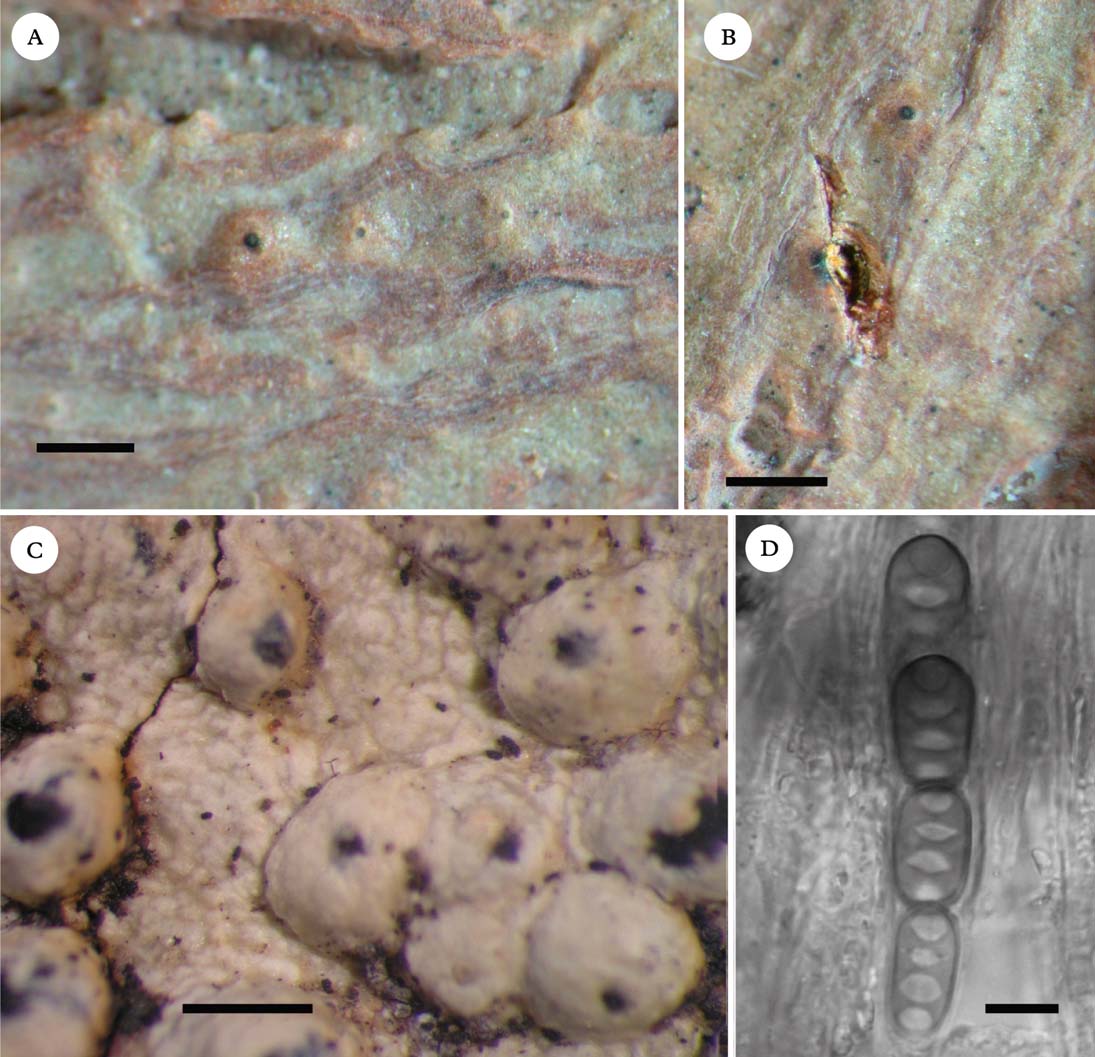
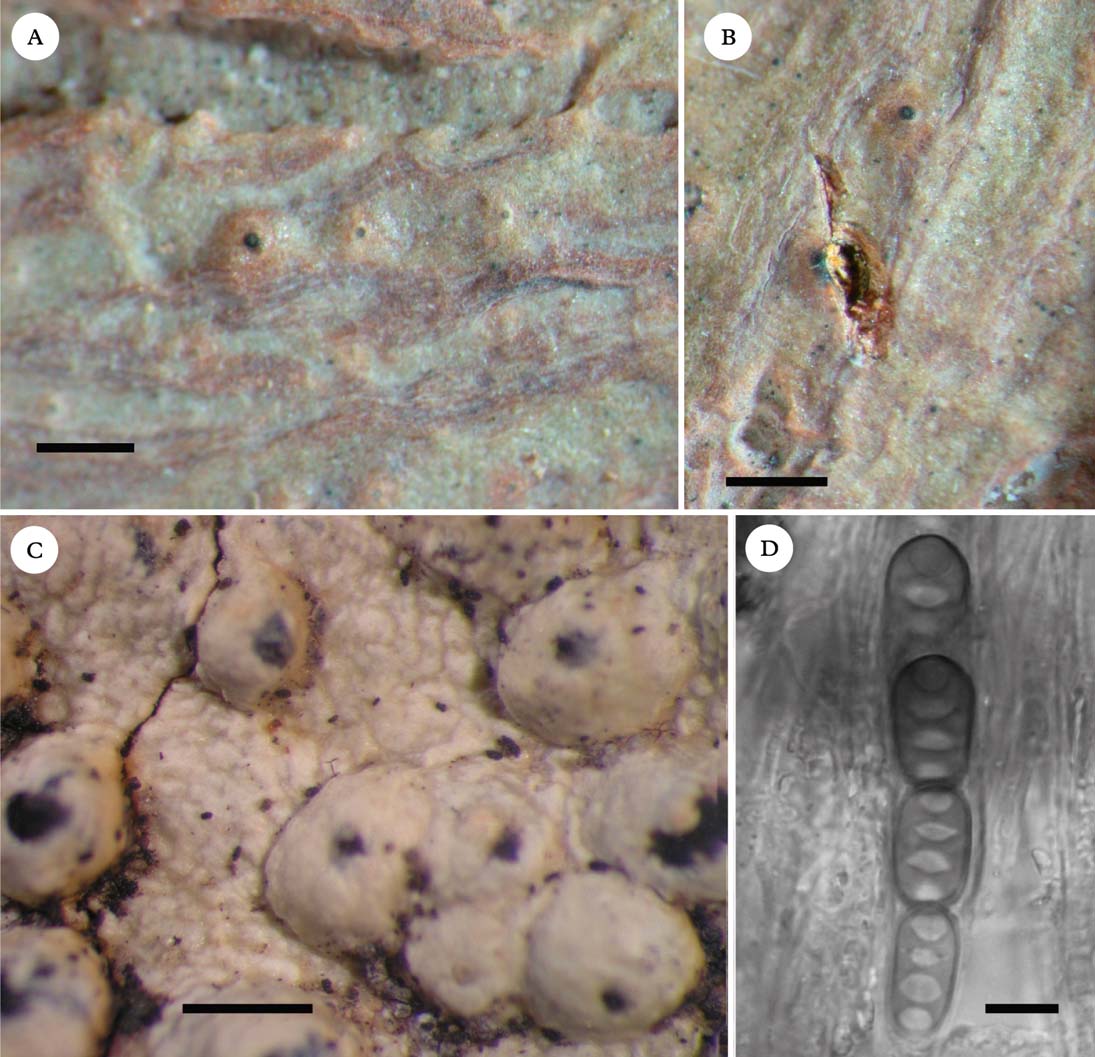
A & B, Pyrenula flavoinspersa Aptroot & Sipman (holotype), thallus. C–D, P. guyanensis Sipman & Aptroot (isotype); C, thallus; D, ascospores. Scales: A–C=1 mm; D=10 µm. In colour online.
Thallus oily, yellowish grey, quite thick, without pseudocyphellae, UV+ yellow.
Ascomata nearly fully immersed, subglobose, 0·4–0·7 mm diam., simple. Ostiole apical, black. Hamathecium inspersed with yellow, KOH− oil droplets which coalesce after sectioning. Ascospores 8 per ascus, irregularly biseriate, 3-septate, 29–35×11–13 µm, lumina angular to diamond-shaped, nearly fused and partly filled with yellow oil when young, with a thick layer of endospore in the spore tips.
Pycnidia not observed.
Chemistry
Thallus UV+ yellow (lichexanthone), hamathecium with yellow pigment.
Ecology and distribution
On smooth bark in mountain forest. Known only from the type.
Discussion
This species is close to Pyrenula mastophoroides (Nyl.) Zahlbr., but differs by the yellow, KOH− inspersion of the hamathecium, which is unique in the genus.
Pyrenula guyanensis Sipman & Aptroot sp. nov.
MycoBank No.: MB 801162
Pyrenula with pale yellowish grey, epiphloeodic thallus with thin cortical layer and large, c. 1 mm wide, thick-walled ascomata, ascospores 14–20×7–10 µm.
Type: Venezuela, Estado Bolívar, Cerro Guaiquinima, near NE edge of upper plateau (near camp 2), alt. c. 1250 m, c. 5°54′N, 63°27′W, rocky sandstone area with scrub on exposed ridge, on tree bark, 8 February 1990, H. Sipman 26779 (VEN—holotype; B 60 0083767—isotype).
Thallus growing on trunk bark, several cm in diam., c. 50–100 µm thick, more or less verruculose, pale yellowish grey, UV+ yellow, without white spots, often bordered by a black prothallus line, epiphloeodic, covered by a c. 5 µm thick cortical layer of thin-walled, densely conglutinated hyphae (textura intricata).
Ascomata immersed in well-delimited, basally somewhat constricted, semiglobose, 0·8–1·2 mm wide thallus warts, subglobose, to c. 1 mm wide, with 100–200 µm thick, heavily carbonized wall. Ostiole apical, black. Hamathecium densely inspersed with c. 1–3 µm wide, hyaline droplets; filaments c. 0·5 µm wide, unbranched; asci c. 150×15 µm. Ascospores 8 per ascus, uniseriate, 3-septate, 14–20×7–10 µm, pale grey-brown, with lenticular central lumina and more rounded terminal lumina, without endospore in the spore tips.
Pycnidia not seen.
Chemistry
Lichexanthone present (UV!, TLC!).
Ecology and distribution
Known only from the Guyana Highland and surroundings (Guyana, Venezuela), where it was found in stunted, open forest and savannah scrub on poor, white, sandy soil.
Discussion
The only other species with an epiphloeodic, warty, UV+ yellow thallus with a thin cortex and rounded ascospores is P. micromma (Mont.) Trevis. Pyrenula guyanensis differs clearly by its larger ascomata, to c. 1 mm wide versus 0·4–0·6 mm wide, and inspersed hymenium.
The ascospores when young are with an equally thickened outer wall, when old turning brown and without a unilocular stage.
Specimen Sipman 26524 looks aberrant because its perithecia are naked and conical, and its spores are larger, c. 26×13 µm. Its thallus is thin and looks damaged and abraded. Therefore it is included here provisionally.
A reinvestigation of the lectotype of Pyrenula obvoluta (Nyl.) R. C. Harris & Aptroot (H-NYL 1229, see Aptroot Reference Aptroot1991) showed that it agrees more with P. guyanensis than with P. micromma because of the thick perithecium walls. However, it differs from P. guyanensis because the fertile warts are smaller, 0·6–0·8 mm wide. The specimen is too poor for microscopic examination so that it was not possible to check if the ascospores are of the same type as in P. guyanensis and P. micromma, or whether the hymenium is inspersed. Therefore, the possibility cannot be excluded that it is an independent species, and it is not synonymized with one of the two species here. It was synonymized with P. dermatodes by Aptroot (Reference Aptroot2012).
Additional specimens examined. Venezuela: Estado Bolívar: Cerro Guaiquinima, in central part of upper plateau (near camp 4), alt. c. 950 m, c. 5°40′N, 63°34′W, low, mossy forest on rocky sandstone slope towards stream, 1990, H. Sipman 26634b (B 60 0083770, VEN); ibid., near NE edge of upper plateau (near camp 2), alt. c. 1250 m, c. 5°54′N, 63°27′W, rocky sandstone area with scrub on exposed ridge, 1990, H. Sipman 26741 (B 60 0083768, VEN); ibid., near NE edge of upper plateau (near camp 2), alt. c. 1200 m, c. 5°54′N, 63°27′W, low, well-lit forest on slope of narrow valley, 1990, H. Sipman 26838 (B 60 0083764, VEN); ibid., in central part of upper plateau (near camp 4), alt. c. 1000 m, c. 5°40′N, 63°34′W, rocky area with boggy Stegolepis vegetation, 1990, H. Sipman 26524 (B 60 0083771, VEN).—Guyana: Upper Takutu district, c. 35 km S of Aishalton, c. 4 km N of Kuyuwini Landing, along track to Karaudanawa, alt. c. 250 m, c. 2°08′N, 59°15′W, epiphyte on scattered shrubs and trees along and on small savannah, 1992, H. Sipman 57038 (B 60 0164415, BRG).
Pyrenula infraleucotrypa Aptroot & M. Cáceres sp. nov.
MycoBank No.: MB 801163
Pyrenula with aggregated ascomata and ascospores 15–18(–22)×5–7(–9) µm.
Type: Brazil, Rondônia, Porto Velho, Parque Circuito, 8°43′54″S, 63°54′04″W, alt. c. 100 m, in plantation, on Hevea brasiliensis bark, 11 March 2012, M. Cáceres & A. Aptroot 11468 (ISE—holotype; ABL—isotype).
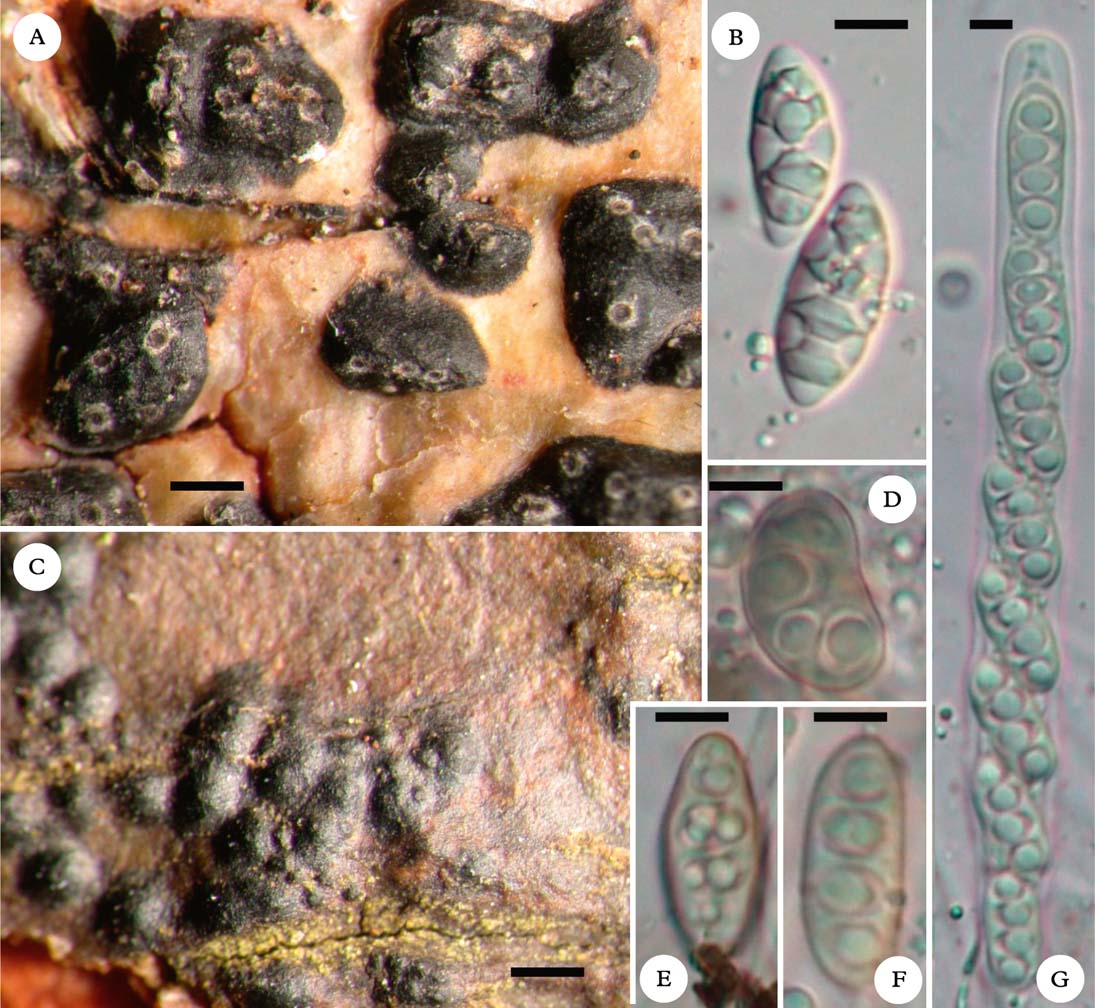
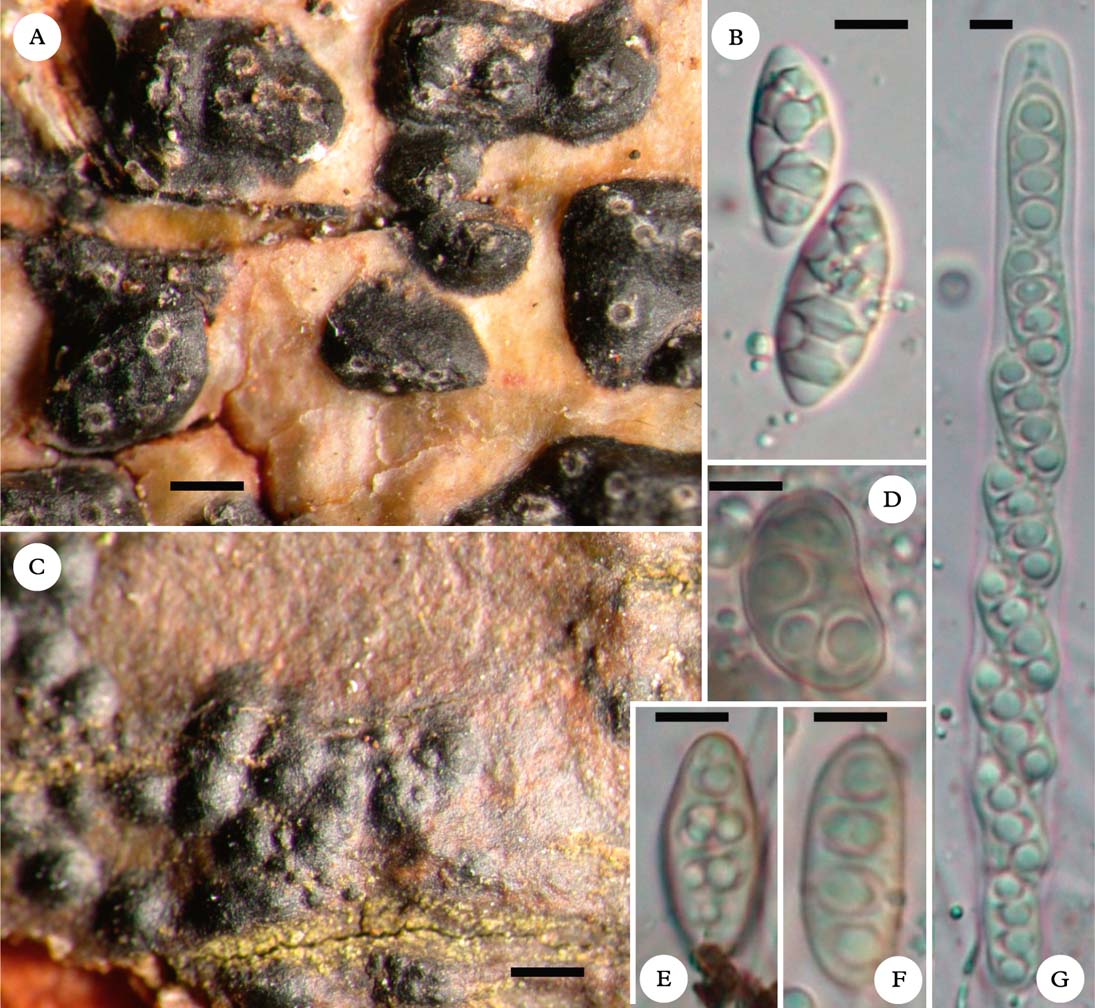
A & B, Pyrenula infraleucotrypa Aptroot & M. Cáceres (holotype); A, thallus; B, ascospore. C–G, P. infraleucotrypa Aptroot & M. Cáceres (Cáceres & Aptroot 11191); C, thallus; D, aberrant ascospore; E & F, ascospores; G, ascus. Scales: A & C=1 mm; B=10 µm; D–G=5 µm. In colour online.
Thallus thin, oily, yellowish brown to olive-green or olive-brown, glossy, widely spreading, without pseudocyphellae, without a prothallus.
Ascomata superficial, conical, 0·4–0·7 mm diam., mostly in groups of 3–40 and partly to completely fused laterally with only partly fused walls and separate ostioles. Resulting stromata superficial, black, often strongly contrasting in colour with the pale thallus. Ostiole apical, black or with whitish pruinose ring. Hamathecium not inspersed. Ascospores 8 per ascus, irregularly biseriate, 3-septate, 15–18(–22)×5–7(–9) µm, ends often pointed, lumina angular to rounded, often wider than long, with a thick layer of endospore in the spore tips.
Pycnidia not observed.
Chemistry
No substances detected.
Ecology and distribution
On smooth bark in lowland rainforest. Known only from Brazil.
Discussion
This species shares many details with the palaeotropical Pyrenula leucotrypa (Nyl.) Upreti, which has larger ascospores (21–25 µm long; Aptroot Reference Aptroot2012), and with the sympatric, and in this paper newly described, P. aggregataspistea, which has smaller ascospores.
Additional specimens examined. Brazil: Rondônia: same as the type, M. Cáceres & A. Aptroot 11484 (ISE, ABL); Porto Velho, UNIR Federal University campus S of city, 8°50′14″S, 63°56′25″W, alt. c. 100 m, in forest remnant, on tree bark, 2012, M. Cáceres & A. Aptroot 11012, 11060, 11107, 11139, 11147 (ISE, ABL); Porto Velho, Parque Natural Municipal, 8°41′10″S, 63°52′05″W, alt. c. 100 m, in garden, on Mangifera indica bark, 2012, M. Cáceres & A. Aptroot 11191, 11205 (ISE, ABL); ibid., in primary rainforest, on tree bark, 2012, M. Cáceres & A. Aptroot 11277, 11409 (ISE, ABL); Porto Velho, Nova Esperança, private property 7014, 8°42′55″S, 63°52′35″W, alt. c. 100 m, in garden, on Anacardium occidentale bark, 2012, M. Cáceres & A. Aptroot 11506 (ISE, ABL). Paraiba: Mata Pau Ferro, Brejo de Altitude, 2012, A. B. X. Leite transect 1 tree 1 (ISE). Ceará: Chapada do Araripe, 2012, A. A. de Menezes P10-A3-T-CA (ISE).
Pyrenula inframamillana Aptroot & M. Cáceres sp. nov.
MycoBank No.: MB 801164
Pyrenula with hamathecium inspersed with hyaline oil globules and ascospores uniseriate, 10–15×3·5–4·0 µm.
Type: Brazil, Rondônia, Porto Velho, Parque Natural Municipal, 8°41′10″S, 63°52′05″W, alt. c. 100 m, in primary rainforest, on tree bark, 9–12 March 2012, M. Cáceres & A. Aptroot 11290 (ISE—holotype; ABL—isotype).
Pyrenula inframamillana Aptroot & M. Cáceres (holotype); A, thallus; B & C, ascospores; D, habitus in the field (the brownish streaks). Scales: A=1 mm; B & C=5 µm; D=10 cm. In colour online.
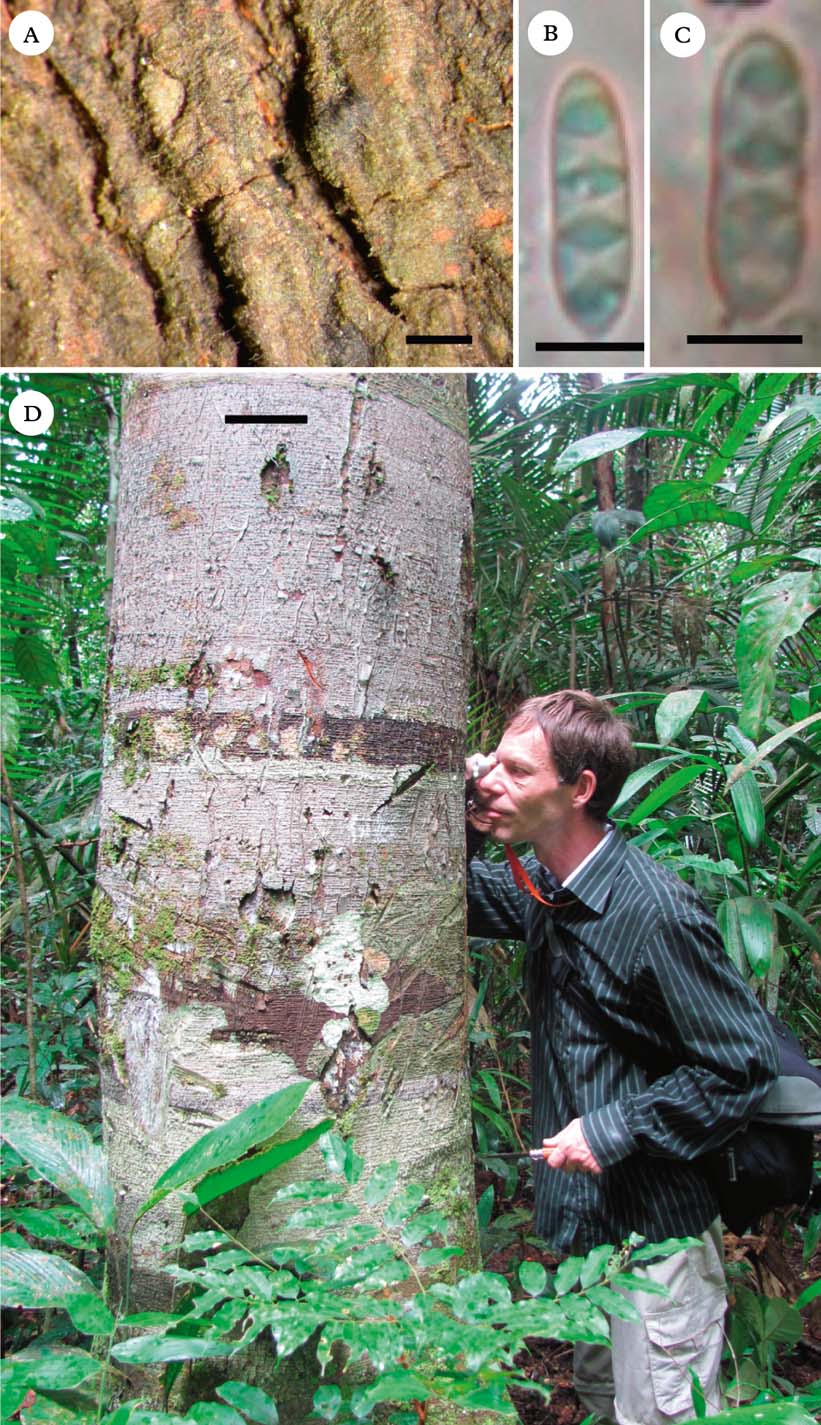
Thallus thin, olive-green to olive-brown, smooth but not glossy, widely spreading, often occupying a large area (dm2), without pseudocyphellae, without prothallus.
Ascomata superficial, conical, 0·4–0·9(–1·2) mm diam., solitary. Ostiole apical, brown to black. Hamathecium inspersed with hyaline oil globules. Ascospores 8 per ascus, uniseriate, 3-septate, 10–15×3·5–4·0 µm, lumina rounded to angular, not longer than wide, with a thick layer of endospore in the spore tips.
Pycnidia not observed.
Chemistry
No substances detected.
Ecology and distribution
On smooth bark in lowland rainforest. Known only from Brazil.
Discussion
This species is close to the common Pyrenula mamillana (Ach.) Trevis., with which it co-occurs, but which differs mainly by the much longer ascospores (17–21 µm long; Aptroot Reference Aptroot2012). It shows the same variation in ascoma dimensions. Both species seem equally common in Rondônia, which is remarkable given the difference in known world distribution (pantropical versus Amazonian).
Additional specimens examined. Brazil: Rondônia: same as the type, M. Cáceres & A. Aptroot 11272, 11273, 11584 (ISE, ABL); ibid., on Ceiba samauma tree bark, 2012, M. Cáceres & A. Aptroot 11220 (ISE, ABL); Porto Velho, UNIR Federal University campus S of city, 8°50′14″S, 63°56′25″W, alt. c. 100 m, in forest remnant, on tree bark, 2012, M. Cáceres & A. Aptroot 11139b (ISE, ABL). Amazonas: Fazenda São Francisco off BR319, 30 km N of Porto Velho, 8°24′33″S, 63°58′56″W, alt. c. 100 m, in primary rainforest, on tree bark, 2012, M. Cáceres & A. Aptroot 11891, 11897 (ISE, ABL). Paraiba: Mata Pau Ferro, Brejo de Altitude, 2012, A. B. X. Leite transect 5 tree 2 (ISE).
Pyrenula infrastroidea Aptroot & Sipman sp. nov.
MycoBank No.: MB 801165
Pyrenula with ascomata generally 3–6 together with fused lateral ostioles, ascospores muriform, 15–19×6–9 µm.
Type: Guyana, Potaro-Siparuni Region, surroundings of Paramakatoi village, alt. c. 800 m, 4°42′N, 59°43′W, forest along trail to Kawatipu, epiphytic on canopy branches of felled tree (tree C), 22 February 1996, H. Sipman 41155 (B 60 0175243—holotype; BRG—isotype).
Pyrenula infrastroidea Aptroot & Sipman (holotype); A, thallus; B–E, ascospores. Scales: A=1 mm; B–E=10 µm. In colour online.
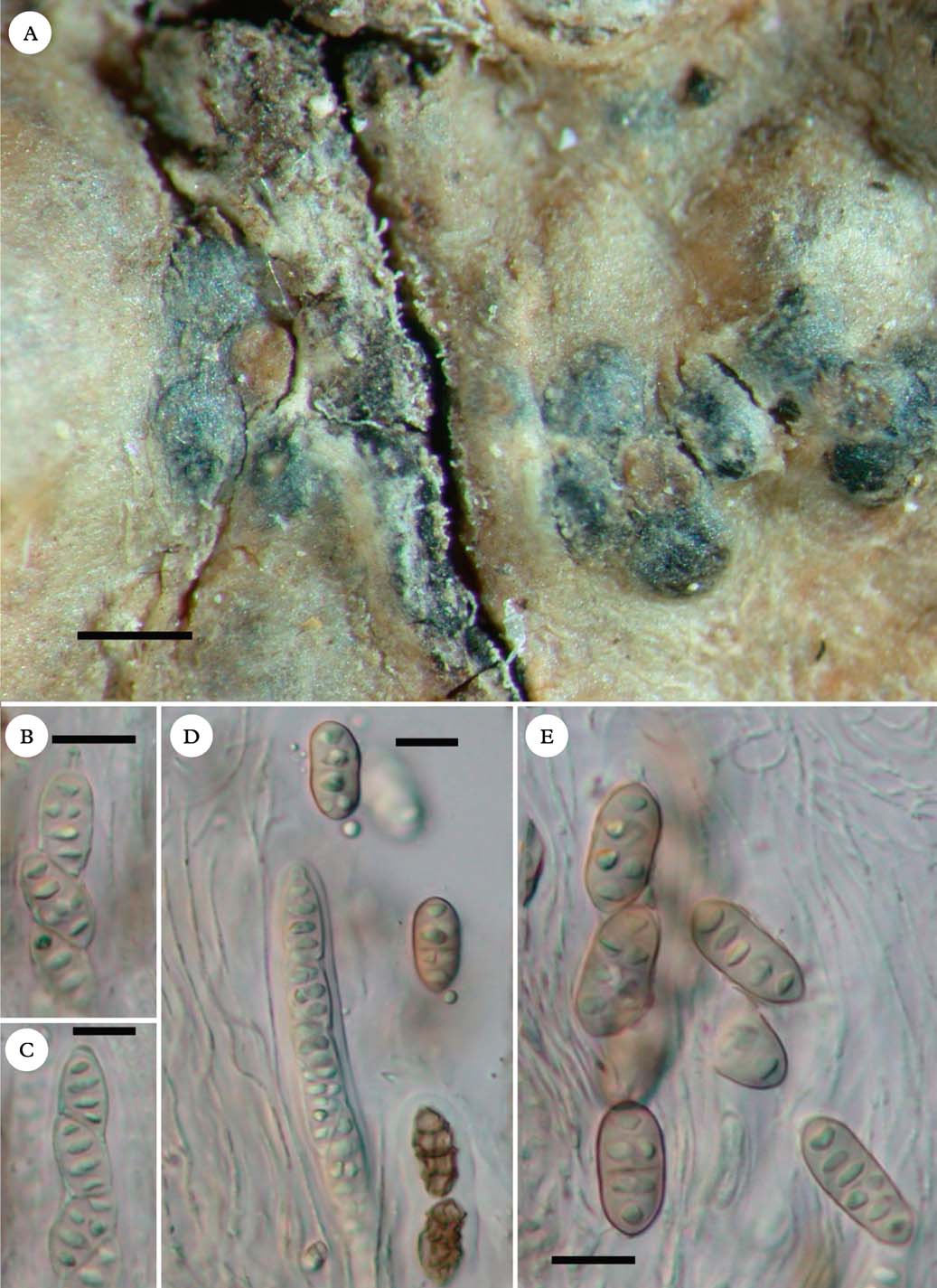
Thallus oily, yellowish grey, quite thick, with pseudocyphellae, without prothallus.
Ascomata mostly immersed, nearly globose, 0·4–0·7 mm diam., generally in groups of 3–6 with fused, lateral, ostioles. Ostiole yellowish brown. Hamathecium not inspersed. Ascospores 8 per ascus, irregularly biseriate, muriform, 3–5×0–2-septate, 15–19×6–9 µm, a small proportion 3–5-septate or submuriform, lumina rounded, with a thick layer of endospore in the spore tips.
Pycnidia not observed.
Chemistry
No substances detected.
Ecology and distribution
On smooth bark in mountain forest. Known only from the type.
Discussion
This species is close to Pyrenula astroidea (Fée) R. C. Harris in ascospore shape and the pattern of fused ascomata, but that species differs by the much longer ascospores (25–45 µm long; Aptroot Reference Aptroot2012).
Pyrenula maritima Sipman & Aptroot sp. nov.
MycoBank No.: MB 801166
Pyrenula similar to Pyrenula nitidella but without reddish crystals and with ascospores longitudinally plicate when over-mature.
Type: Chile, Aconcagua, coastal headlands at Punto Los Molles, alt. 10 m, 32°14′S, 71°31′W, on twigs and branches of Lucuma valparadisiaca in a small isolated grove, 13 November 1976, W. A. Weber s. n. (B 60 0000206—holotype; B 60 0157160—isotype; further isotypes distributed in W. A. Weber, Lichenes Exsicc. 556, issued as Parathelium sp.).
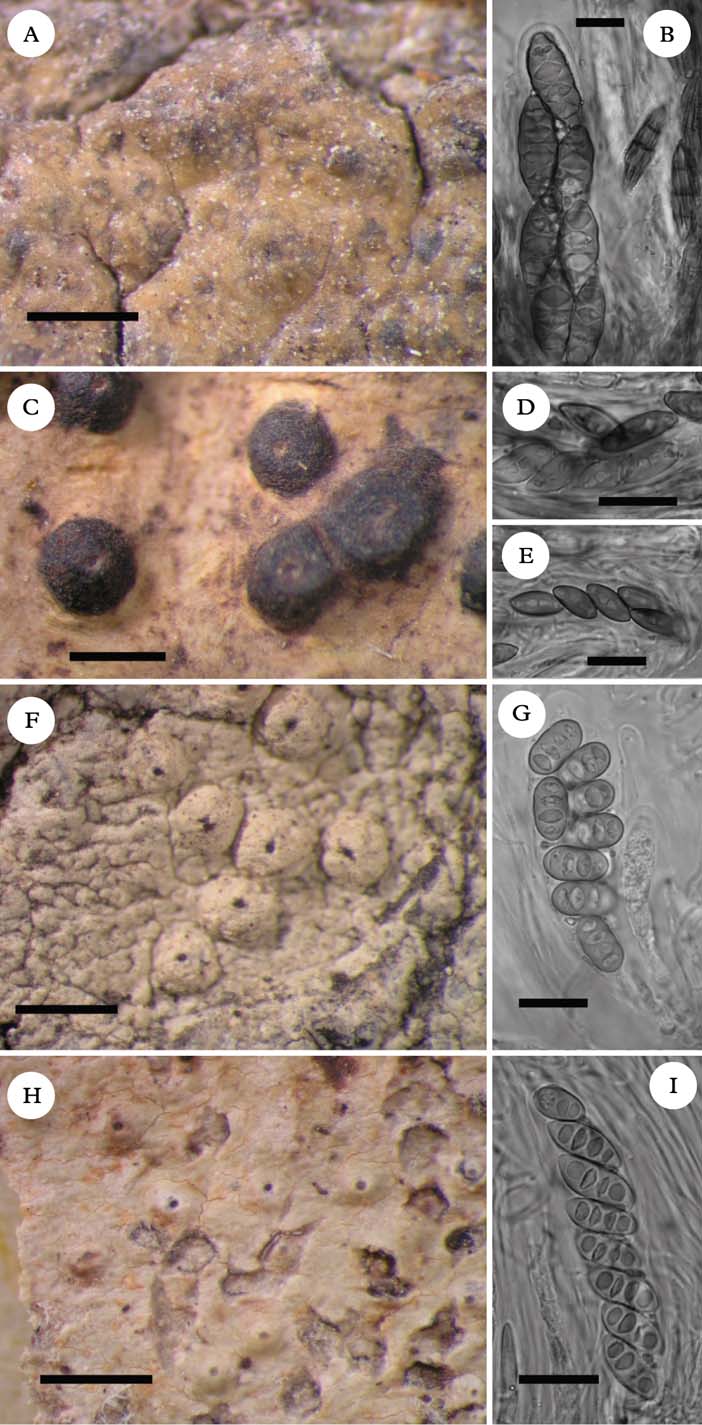
A & B, Pyrenula maritima Sipman & Aptroot (holotype); A, thallus; B, ascospores. C–E, P. mattickiana Sipman & Aptroot (holotype); C, thallus; D & E, ascospores. F & G, P. micromma (Jansen-Jacobs et al. 2369); F, thallus; G, ascospores. H & I, P. dermatodes (Sipman 33909); H, thallus; I, ascospores. Scales: A, C, F & H=1 mm; B=10 µm; D, E, G & I=20 µm. In colour online.
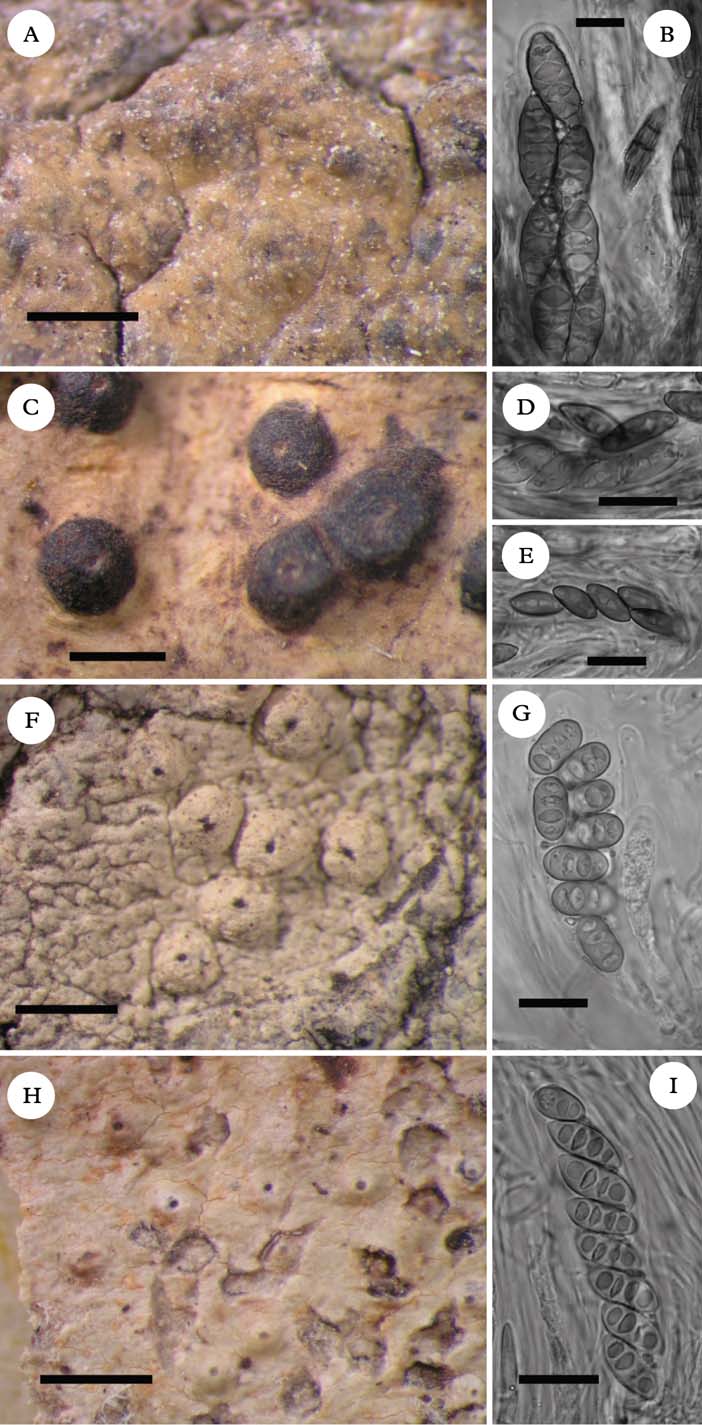
Thallus growing on shrub branches and trunks, up to few cm in diam., c. 50–100 µm thick, smooth, pale olivaceous or yellowish brown, UV−, with white spots, often in mosaics of many small individuals delimited by black prothallus lines, mainly epiphloeodic, but continuing in the uppermost phloem cells, covered by a c. 10–25 µm thick prosoplectenchymatic cortical layer.
Ascomata immersed in the thallus or in slightly raised, low and poorly delimited, c. 0·5 mm wide warts or apically exposed and black, subglobose, to c. 0·5 mm wide, with 25–75 µm thick, carbonized wall, without crystals. Ostiole apical or subapical, black. Hamathecium usually not inspersed; filaments c. 1 µm wide, unbranched; asci c. 110×12 µm. Ascospores 8 per ascus, uniseriate, 3-septate, 15–25×6–10 µm, pale grey-brown, with lenticular lumina, with a thick layer of endospore in the spore tips, when young with apical wall thickenings appearing before the secondary septa.
Pycnidia sometimes present, along the hypothallus lines, forming c. 150 µm wide, low black warts; pycnospores filiform, curved, c. 25×0·5 µm wide.
Chemistry
No lichen substance detected.
Ecology and distribution
This species is most notable for its habitat choice: coastal scrub in the arid zone of Central Chile, influenced by fog from the ocean.
Discussion
Pyrenula maritima closely resembles P. micheneri R. C. Harris and P. nitidella. It deviates from the first because its spores are usually smaller and the crystals around the ostioles are absent, and from the second by the absence of red, K+ purple crystals in the ascoma wall. Moreover, the ostioles are often subapical and its ecology is very different; subtropical coastal scrub instead of temperate/mountain forest.
The ascospores turn brown and become wrinkled when old, without a unilocular stage, and with pronounced longitudinal wrinkles.
The records of Pyrenula nitida (Weigel) Ach. from central Chile (Follmann Reference Follmann1961) may refer to this species. Pyrenula nitida differs by the presence of red crystals inside the excipulum, which give a purplish solution in KOH, and by large ascomata over 0·5 mm.
Additional specimens. Chile: Valparaíso: Zapallar, Quebrada El Tigre, 32°34′S, 71°26′W, 1960, G. Follmann 12279 (B 60 0180997), 12673 (B 60 0181055), 13163 (B 60 0181172), 13177b (B 60 0180091), s. n. (B 60 0181341).
Pyrenula mattickiana Sipman & Aptroot sp. nov.
MycoBank No.: MB 801167
Pyrenula with conical, exposed ascomata and small 3-septate ascospores with weak septa and elongated central lumina.
Type: Brazil, Edo. Rio de Janeiro, Parque Nacional da Serra dos Orgãos, alt. c. 1600–2000 m, c. 22°30′S, 43°03′W, along track from Abrigo 2 upward, on tree bark, 1 October 1952, F. Mattick 93a (ISE—holotype; B 60 0044813—isotype).
Thallus growing on bark, several cm in diam., c. 50–100 µm thick, smooth, yellowish brown, UV−, without white spots, endophloeodic except for the outer part of the c. 25 µm thick prosoplectenchymatous cortical layer.
Ascomata exposed on the thallus, scattered or aggregated in small groups, dark brown, rather conical, c. 0·7–1·0 mm wide, with heavily carbonized wall, c. 300 µm thick laterally, much thinner on the bottom, without red, K+ violet crystals. Ostiole impressed, apical, pale brown. Hamathecium clear; filaments c. 1 µm wide, unbranched; asci c. 80×10 µm. Ascospores 8 per ascus, mostly uniseriate, 3-septate, 17–18×6·5–7·5 µm, pale reddish brown, with thin septa and rounded or triangular terminal and elongated central lumina, with a thick layer of endospore in the spore tips.
Pycnidia not observed.
Chemistry
No lichen substance detected.
Ecology and distribution
This species is so far known only from a single collection from bark in the Serra dos Orgãos in SE Brazil.
Discussion
Pyrenula mattickiana differs from most other species in the genus by its ascospores, which have a slightly reddish tinge and weakly developed septa. In this respect it resembles only P. circumfiniens Vain., which deviates by the lateral ostioles and the absence of endospore at the ascospore tips.
The endospore of the young ascospores appears in a rather equal layer along the outer wall.
Pyrenula micromma (Mont.) Trevis.
Thallus growing on bark, several cm in diam., c. 30–50 µm thick, more or less verruculose, pale greenish grey, UV+ yellow, without white spots, often bordered by a black prothallus line, epiphloeodic, covered by a cortical layer, c. 5 µm thick, of thin-walled, densely conglutinated hyphae (textura intricata).
Ascomata immersed in well-delimited, basally somewhat constricted, semiglobose, 0·4–0·8 mm wide thallus warts, subglobose, to 0·4–0·6 mm diam., with c. 50 µm thick, carbonized wall. Ostioles apical, black. Hamathecium clear; filaments c. 0·5 µm wide, unbranched; asci c. 80×15 µm. Ascospores 8 per ascus, ±biseriate, 3-septate, 15–22×8–10 µm, pale grey-brown, with elliptic central lumina and more rounded terminal lumina, with a thin layer of, or without, endospore in the spore tips.
Pycnidia not seen.
Chemistry
Lichexanthone present (UV+ yellow!).
Ecology and distribution
The species is known from Mexico, Costa Rica, Colombia, Guyana and Brazil (Pernambuco), suggesting that it is a widespread but not very common neotropical species with a wide altitudinal amplitude.
Discussion
This species is treated here because it was not recognized as a separate species by Aptroot (Reference Aptroot2012). There it was synonymized with P. dermatodes (Borrer) Schaer., although it was keyed out before as a separate species in Cáceres (Reference Cáceres2007). It certainly resembles P. dermatodes (Fig. 7H & I) by the small, subglobose perithecia immersed in a UV+ yellow thallus and the small, 3-septate ascospores. However, its thallus has an unusual, greenish grey colour instead of the olivaceous to brownish colour of most Pyrenula species and reminds one of the genus Porina. Anatomically the thallus has a thin, c. 5 µm thick, cortical layer composed of thin-walled, densely agglutinated hyphae, while P. dermatodes has a strong, c. 25–40 µm thick, prosoplectenchymatous cortex. This thallus type seems very unusual in Pyrenula and is so far known only from one other species, P. guyanensis (see above). Moreover, the ascomata in P. micromma are immersed in 0·4–0·8 mm wide, semi-globose, basally often constricted warts, and in P. dermatodes immersed in low to inapparent, indistinctly delimited, 0·3–0·5 mm wide warts. Furthermore, in P. micromma the ascospores are 15–22×8–10 µm, without or with scarce endospore at the tips, and in P. dermatodes they are somewhat smaller and narrower, c. 14–20×5–8 µm, with thick endospore layer in the tips.
The ascospores are, when young, with equally thickened outer wall, when over-mature often with pale pinkish grey unilocular stage before shrivelling
Pyrenula cocoes Müll. Arg. agrees in its (usually) UV+ yellow thallus and spore size and type, but differs by its endophloeodic, smooth thallus and erumpent perithecia not immersed in warts. The question may be raised if it represents a growth form of the same species on soft bark, where the thallus develops inside the bark phloem. However, there also seems to be a different ecological preference, P. cocoes being frequent on free-standing trees along the coasts.
There has been some confusion about this species in the past, because the original specimens are partly Porina, partly Pyrenula. However, the type in PC clearly conforms to the current concept (R. Lücking, pers. comm.).
Pyrenula minoides Aptroot & Sipman sp. nov.
MycoBank No.: MB 801168
Pyrenula similar to Pyrenula minae but asci 4-spored and ascoma without anthraquinone.
Type: Guyana, Upper Mazaruni district, N-slope of mount Roraima (campsite 6), alt. c. 1400 m, 5°17′N, 60°43′W, in c. 25 m tall virgin humid mossy forest on steep N-facing slope, 1 m high on 30 cm diam. tree trunk, 14–18 February 1985, H. Sipman & A. Aptroot 18837 (B—holotype; ABL—isotype).
Pyrenula minoides Aptroot & Sipman (holotype); A, thallus; B, hamathecium; C & D, mature ascospores; E & F, immature ascospores. Scales: A=1 mm; B–F=10 µm. In colour online.

Thallus thin, medium to dark brown, smooth but not glossy, widely spreading, occupying a large area (several dm2), without pseudocyphellae, without prothallus.
Ascomata superficial, low conical, flattened, 1·0–2·5 mm diam., solitary and widely separate. Ostiole apical, brown to black. Hamathecium not inspersed. Ascospores 4 per ascus, uniseriate, 3-septate, 27–32×12–16 µm, dark brown, constricted at the central septum, ends rounded, lumina much wider than long, without endospore in the spore tips.
Pycnidia not observed.
Chemistry
No substances detected.
Ecology and distribution
On smooth bark in mountain forest. Known from Guyana and Ecuador.
Discussion
This species is close to Pyrenula minae Aptroot & Lücking, which has the same type of Pyrgillus-like ascospores, but differs by the asci having 8 ascospores and the patches of anthraquinone on the ascomata.
Additional specimen examined. Ecuador: Prov. Pichincha: Santo Domingo, km 19 South, alt. 400 m, secondary rainforest, 1982, A. Aptroot & R. Hensen 11236 (ABL).
Pyrenula monospora Aptroot & Sipman sp. nov.
MycoBank No.: MB 801169
Pyrenula with ascospores 1 per ascus, densely muriform with 2–7 eusepta and numerous distosepta, c. 100×8–septate, 205–350×30–45 µm.
Type: Guyana, Upper Mazaruni district, N-slope of mount Roraima (campsite 5), alt. 700 m, 5°17′N, 60°46′W, in c. 25 m tall virgin mossy forest, on fallen log, 12–19 February 1985, H. Sipman & A. Aptroot 18779 (B 60 0057512—holotype).
Pyrenula monospora Aptroot & Sipman (holotype); A, thallus; B, hamathecium; C–E, ascospores. Scales: A=1 mm; B–E=20 µm. In colour online.

Thallus oily, yellowish grey, quite thick, with pseudocyphellae, without prothallus.
Ascomata erumpent, nearly globose, simple, 0·7–1·2 mm diam. Ostiole apical, depressed, pale brown to black. Hamathecium not inspersed, IKI+ reddish. Ascospores 1 per ascus, densely muriform with 2–7 eusepta and numerous distosepta, c. 100×8-septate, 205–350×30–45 µm, lumina rounded, constricted at the eusepta, outer wall thin, with a thick layer of endospore in the spore tips.
Pycnidia not observed.
Chemistry
No substances detected.
Ecology and distribution
On smooth bark in mountain forest. Known from Guyana and Puerto Rico.
Discussion
This is the first reported species of Pyrenula with a single ascospore in the ascus.
Additional specimens examined. Guyana: Upper Mazaruni district: Jawalla village, at confluence of Kukui and Mazaruni rivers, alt. 500 m, 5°40′N, 60°29′W, cultivated, well-lit area near the village, epiphyte on Persea, 1985, H. Sipman & A. Aptroot 18301 (B 60 0057513).—USA: Puerto Rico: Distr. Ponce, Caribbean National Forest, Toro Negro Division, at km 25 of road 143, alt. c. 1150 m, c.18°09′N, 66°34′W, mossy forest remnants on mountain top, 1989, H. Sipman 25887 (B 60 0078622).
Pyrenula paraminarum Aptroot & M. Cáceres sp. nov.
MycoBank No.: MB 801170
Pyrenula similar to Pyrenula minarum, but ascospores smaller, 16–18×5–6 µm.
Type: Brazil, Rondônia, Porto Velho, Parque Circuito, 8°43′54″S, 63°54′04″W, alt. c. 100 m, in plantation, on Hevea brasiliensis bark, 11 March 2012, M. Cáceres & A. Aptroot 11471 (ISE—holotype; ABL—isotype).
A–C, Pyrenula paraminarum Aptroot & M. Cáceres (holotype); A, thallus; B & C, ascospores. D & E, P. perfecta Aptroot & Sipman (holotype); D, thallus; E, ascospores. F & G, P. plicata Sipman & Aptroot (holotype); F, mature ascospores; G, immature ascospores. Scales: A & D=1 mm; B & C=5 µm; E–G=10 µm. In colour online.
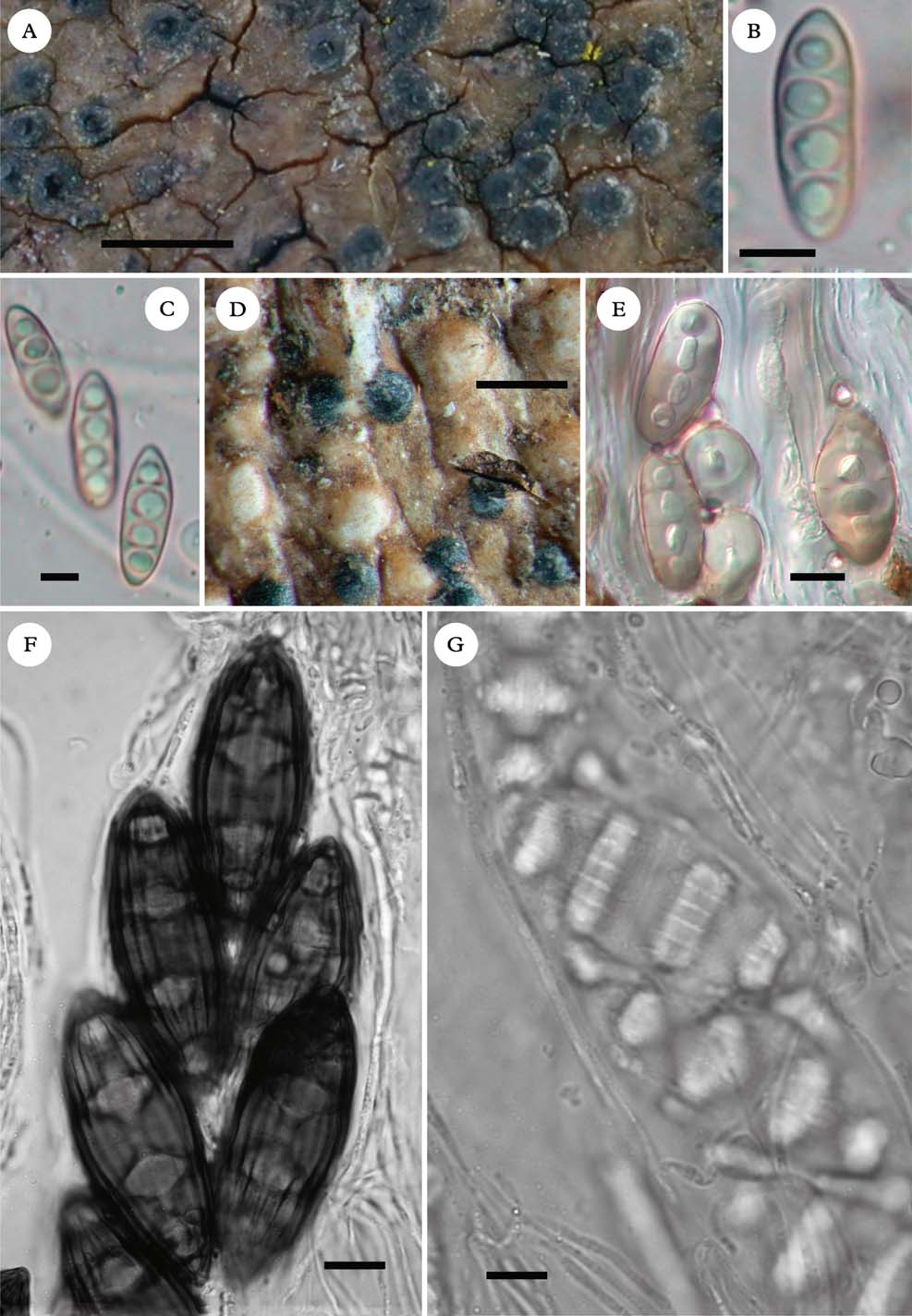
Thallus oily, olive-brown, smooth but not glossy, without pseudocyphellae, without prothallus.
Ascomata erumpent to superficial, hemispherical, 0·3–0·5 mm diam., mostly 2–8 grouped but only partly fused sideways and with only partly fused walls and separate ostioles. Ostiole apical, impressed, black but often surrounded by a thin ring of whitish pruina. Hamathecium inspersed with hyaline oil globules. Ascospores 8 per ascus, irregularly biseriate, 3-septate, 16–18×5–6 µm, lumina rounded to somewhat angular, not wider than long, with a thick layer of endospore in the spore tips.
Pycnidia abundant, in groups dispersed on the thallus. Conidia filiform, curved, 17–22×0·5 µm.
Chemistry
No substances detected.
Ecology and distribution
On smooth bark in lowland rainforest. Known only from Brazil.
Discussion
This species is reminiscent of Pyrenula minarum Vain., although that has much longer ascospores (25–40 µm long; Aptroot Reference Aptroot2012).
Pyrenula perfecta Aptroot & Sipman sp. nov.
MycoBank No.: MB 801171
Pyrenula similar to Pyrenula subelliptica, but hamathecium not inspersed.
Type: Guyana, Upper Takutu district, southern Rupununi savannah, Dadanawa ranch, Arakwai outpost c. 3 km along trail to Aishalton, alt. c. 120 m, c. 2°46′N, 59°29′W, epiphyte in scrub along creek in savannah (Kaidiwau?), 21 September 1992, H. Sipman 57451 (B 60 0167686—holotype; BRG—isotype).
Thallus thin, yellowish grey, without pseudocyphellae, without prothallus.
Ascomata superficial, hemispherical, 0·3–0·6 mm diam., simple. Ostiole apical, brown. Hamathecium not inspersed. Ascospores 8 per ascus, irregularly biseriate, 3-septate, 30–35×13–16 µm, lumina elongated, nearly fused into one band when young, separated by dark lines of euseptum material, with a thick layer of endospore in the spore tips.
Pycnidia not observed.
Chemistry
No substances detected.
Ecology and distribution
On smooth bark in mountain forest. Known only from the type.
Discussion
This species is close to Pyrenula subelliptica (Tuck.) R. C. Harris, and differs mainly by its absence of inspersion of the hamathecium. Interestingly, P. subelliptica is a temperate to subtropical species.
Pyrenula plicata Sipman & Aptroot sp. nov.
MycoBank No.: MB 801172
Pyrenula with ascospores 55–63×19–22 µm, longitudinally plicate, and thallus orange-coloured.
Type: Chile, Coquimbo Province, Parque Nacional Fray Jorge, Alto de Talinay, Caleta Ramadita, 30°39′S, 71°42′W, on dead branchlets, 16 May 1980, L. I. Ferraro & J. Redón 2158 (B 60 0160493—holotype, ex hb. Follmann-KOELN 32076).
(Figs 10F & G, 11A)
A, Pyrenula plicata Sipman & Aptroot (holotype), thallus. B–F, P. rubroinspersa Aptroot & Sipman (isotype); B, thallus; C, hamathecium in tap water showing red oil globules; D–F, ascospores. G & H, P. rubronitidula Aptroot & M. Cáceres (holotype); G, habitus; H, thallus. I, P. rubrostigma Aptroot & M. Cáceres (holotype), thallus. Scales: A & B=1 mm; C=20 µm; D–F=5 µm; G=10 cm; H & I=0·5 mm.
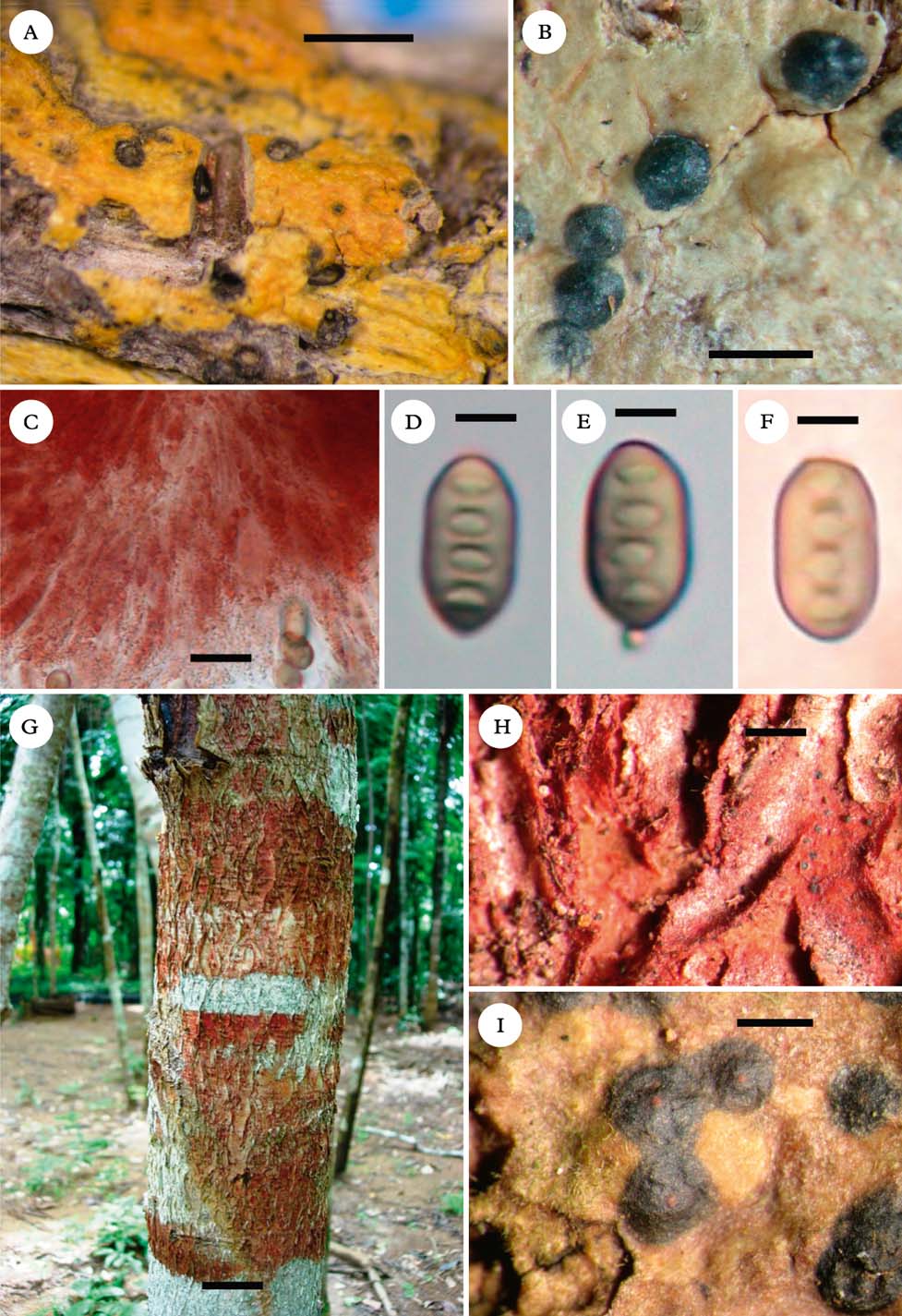
Thallus growing on dead branchlets, several cm in diam., c. 150 µm thick, smooth, orange in full light, pale brownish in shade, K+ purplish red where pigmented, UV− (weakly reddish), distinctly white-spotted (pseudocyphellate), occasionally bordered by a black prothallus line, endophloeodic except for the uppermost c. 50 µm, covered by a prosoplectenchymatous cortex, c. 10 µm thick, and a layer of tiny yellow crystals just below it, with trentepohlioid photobiont cells c. 4×4–8 µm, with scattered large crystal aggregates showing in polarized light.
Ascomata immersed in smooth thallus, globose, c. 0·5(0·3–0·8) mm diam., with carbonized, c. 50 µm thick, equally thickened wall. Ostioles apical, black. Hamathecium clear; filaments 1·0–1·5 µm wide, unbranched between the asci, branched and anastomosing above; asci c. 200×40 µm, with small ocular chamber. Ascospores 8 per ascus, biseriate, 3-septate, c. 55–63×19–22 µm, pale grey-brown, with lenticular lumina, with a thick layer of endospore in the spore tips, longitudinally plicate with c. 20 folds.
Pycnidia not seen.
Chemistry
Parietin present (see below).
Ecology and distribution
The new species is known from the type locality only, growing over wood and bark remnants of dead twigs, associated with Diploicia canescens (Dicks.) A. Massal., Chrysothrix pavonii (Fr.) J. R. Laundon, Caloplaca and Rinodina species, in the coastal fog zone of the central Chilean desert, where the species probably grows on scattered shrubs on the seaside of a coastal mountain range, not far above sea level. It may be another member of the very specialized lichen flora that has developed in this fog zone, particularly comprising members of the Roccellaceae (Follmann & Redón Reference Follmann and Redon1972).
Discussion
The bright orange colour of the thallus and the very large, longitudinally plicate spores make this an unmistakable lichen. In the field it is probably most easily confused with Trypethelium aeneum (Eschw.) Zahlbr., which has a similar colour and thallus, but smaller, hyaline, non-plicate ascospores (Aptroot et al. Reference Aptroot, Lücking, Sipman, Umaña and Chaves2008). In the genus Pyrenula, the species P. cerina Eschw. has a similar yellow thallus colour; it grows on mangroves and has smaller, smooth ascospores 26–42 µm long (Harris Reference Harris1989).
Follmann & Huneck (Reference Follmann and Huneck1976) investigated the chemistry, erroneously under the name Pyrenula cerina (a corresponding specimen from hb. Huneck is filed in B under No. B 60 0166452). They report the presence of parietin, the same substance which they found previously in Pyrenula ochraceoflava (Nyl.) R. C. Harris.
The apically anastomosing hamathecium filaments may seem atypical for the genus Pyrenula, known to have unbranched filaments, and recall the related family Trypetheliaceae. However, anastomoses are also present in the apical parts of the hamathecium of astrothelioid species such as P. astroidea (Fée) R. C. Harris (specimens Sipman 34841, 35065 in B tested), in particular in the canal towards the common ostiole. In Trypetheliaceae, in contrast, the filaments are richly anastomosing throughout the hamathecium, and also between the asci.
During their development, the ascospores remain colourless up to a size of over 50 µm in length. The juvenile spores develop endospore along the central septum and at the tips before the two additional septa become visible; afterwards, the endospore thickness increases, mainly at the poles and the septa, so that the lumina assume a lenticular shape. The folds appear when the spores are still hyaline, and are strongest in the post-mature spores in which the septation becomes indistinct, and which assume a fusiform shape with acute poles.
Additional specimen. Chile: Coquimbo: Fray Jorge, G. Follmann? (B 60 0166452; dupl. ex Follmann/KASSEL 12689).
Pyrenula rubroinspersa Aptroot & Sipman sp. nov.
MycoBank No.: MB 801173
Pyrenula with hamathecium inspersed with red, KOH+ green droplets of isohypocrellin.
Type: Venezuela, Estado Bolivar, Cerro Guaiquinima, near NE edge of upper plateau (near camp 2), alt. c. 1200 m, c. 5°54′N, 63°27′W, low, well-lit forest on slope of narrow valley, on tree bark, 9 February 1990, H. Sipman 26834a (VEN—holotype; B 60 0083765—isotype).
Thallus rather thick, yellowish grey, without pseudocyphellae.
Ascomata superficial, hemispherical, simple, 0·5–0·8 mm diam. Ostiole apical, black. Hamathecium inspersed with red, KOH+ green droplets of isohypocrellin which coalesce after sectioning. Ascospores 8 per ascus, uniseriate, 3-septate, 13–16×6–8 µm, lumina rounded, wider than long, separated by short dark lines of euseptum material (only between the lumina, not extending to the wall), with a thick layer of endospore in the spore tips.
Pycnidia not observed.
Chemistry
Hamathecium with a red, KOH+ greenish anthraquinone.
Ecology and distribution
On smooth bark in mountain forest. Known only from the type.
Discussion
This species is close to Pyrenula rubrostoma R. C. Harris, but differs by the red, KOH+ greenish inspersion of the hamathecium, which is unique in the genus.
Pyrenula rubronitidula Aptroot & M. Cáceres sp. nov.
MycoBank No.: MB 801174
Pyrenula with dark, carmine red thallus and end lumina which are not separated from the outer wall by endospore.
Type: Brazil, Rondônia, Porto Velho, Parque Natural Municipal, 8°41′10″S, 63°52′05″W, alt. c. 100 m, in primary rainforest, on tree bark, 9–12 March 2012, M. Cáceres & A. Aptroot 11332 (ISE—holotype; ABL—isotype).
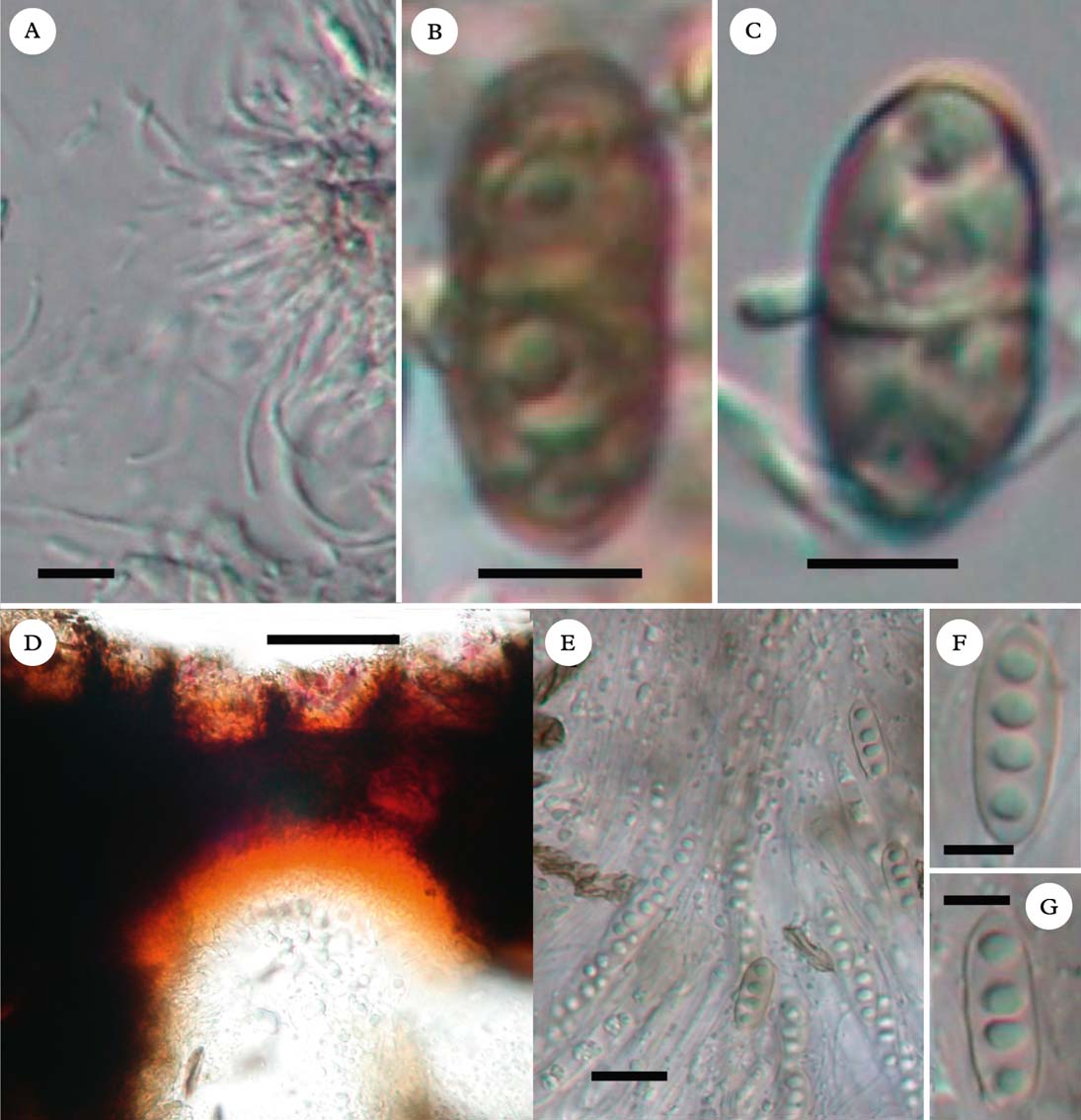
A–C, Pyrenula rubronitidula Aptroot & M. Cáceres (holotype); A, conidia; B & C, ascospores. D–G, P. rubrostigma Aptroot & M. Cáceres (holotype); D, section through ostiole; E, hamathecium; F & G, ascospores. Scales: A–C=5 µm; D=50 µm; E=20 µm; F & G =10 µm. In colour online.

Thallus thin, dark carmine red, smooth and partly glossy, without pseudocyphellae, without prothallus.
Ascomata immersed in the bark, more or less pyriform to globose, 0·2–0·4 mm diam., solitary and widely separate. Ostiole apical, tiny, black, the only part of the ascoma that is visible from outside. Hamathecium not inspersed. Ascospores 8 per ascus, irregularly biseriate, 3-septate, 16–19×6–7 µm, ends rounded, lumina rounded to angular, not wider than long, with a thick layer of endospore in the spore tips.
Pycnidia immersed in the bark, dispersed on the thallus, c. 0·1 mm diam. Conidia filiform, curved, c. 10–14×0·5 µm.
Chemistry
Thallus with a red, KOH+ purple anthraquinone.
Ecology and distribution
On smooth bark in lowland rainforest. Known only from Brazil.
Discussion
This species is so aberrant that it was already recognized in the field as a probably undescribed Pyrenula, because of the large red thalli with immersed, or at least not contrasting, ascomata. It is the only known Pyrenula with this dark, carmine red thallus colour, except for another species recently described from Brazil, P. reginae E. L. Lima, Aptroot & M. Cáceres (Lima et al. Reference Lima, Mendonça, Maia, Aptroot and Cáceres2013), which differs by the thicker thallus and the presence of an endospore layer all around the lumina.
Additional specimen examined. Brazil: Rondônia: Estação Ecológica de Cuniã, km 760 on road BR 319 N of Porto Velho, 8°02′44″S, 63°29′11″W, alt. c. 100 m, in primary rainforest, on tree bark, 13 March 2012, M. Cáceres & A. Aptroot 11613 (ISE, ABL).
Pyrenula rubrostigma Aptroot & M. Cáceres sp. nov.
MycoBank No.: MB 801175
Pyrenula with ostiole with red, KOH+ purple anthraquinone and hamathecium inspersed with hyaline oil globules.
Type: Brazil, Rondônia, Estação Ecológica de Cuniã, km 760 on road BR 319 N of Porto Velho, 8°02′44″S, 63°29′11″W, alt. c. 100 m, in primary rainforest, on tree bark, 13 March 2012, M. Cáceres & A. Aptroot 11697 (ISE—holotype; ABL—isotype).
Thallus thin, olive-brown, smooth but not glossy, without pseudocyphellae, surrounded by a thin black prothallus line.
Ascomata superficial, conical, somewhat flattened, 0·6–1·2 mm diam., solitary. Ostiole apical, red. Hamathecium inspersed with hyaline oil globules. Ascospores 8 per ascus, irregularly biseriate, 3-septate, 15–18×6–7 µm, ends rounded, lumina rounded to angular, often somewhat wider than long, with a thick layer of endospore in the spore tips, sometimes with distinct eusepta between the lumina.
Pycnidia not observed.
Chemistry
Ostiole with a red, KOH+ purple anthraquinone.
Ecology and distribution
On smooth bark in lowland rainforest. Known only from Brazil.
Discussion
There is only one other species known with red ostioles containing an anthraquinone, viz. Pyrenula rubrostoma R. C. Harris, which differs by the absence of hamathecium inspersion. Ostioles of some other species are sometimes orange, but never contain anthraquinones.
Pyrenula seminuda (Müll. Arg.) Sipman & Aptroot comb. nov.
MycoBank No.: MB 801179
Basionym: Anthracothecium seminudum Müll. Arg., Nuovo G. Bot. Ital. 23: 278 (1891); type: Victoria Island, between Singapore and Sarawak, 12 May 1890, Camille Pictet s.n., (G—holotypus).
(Fig. 13C)
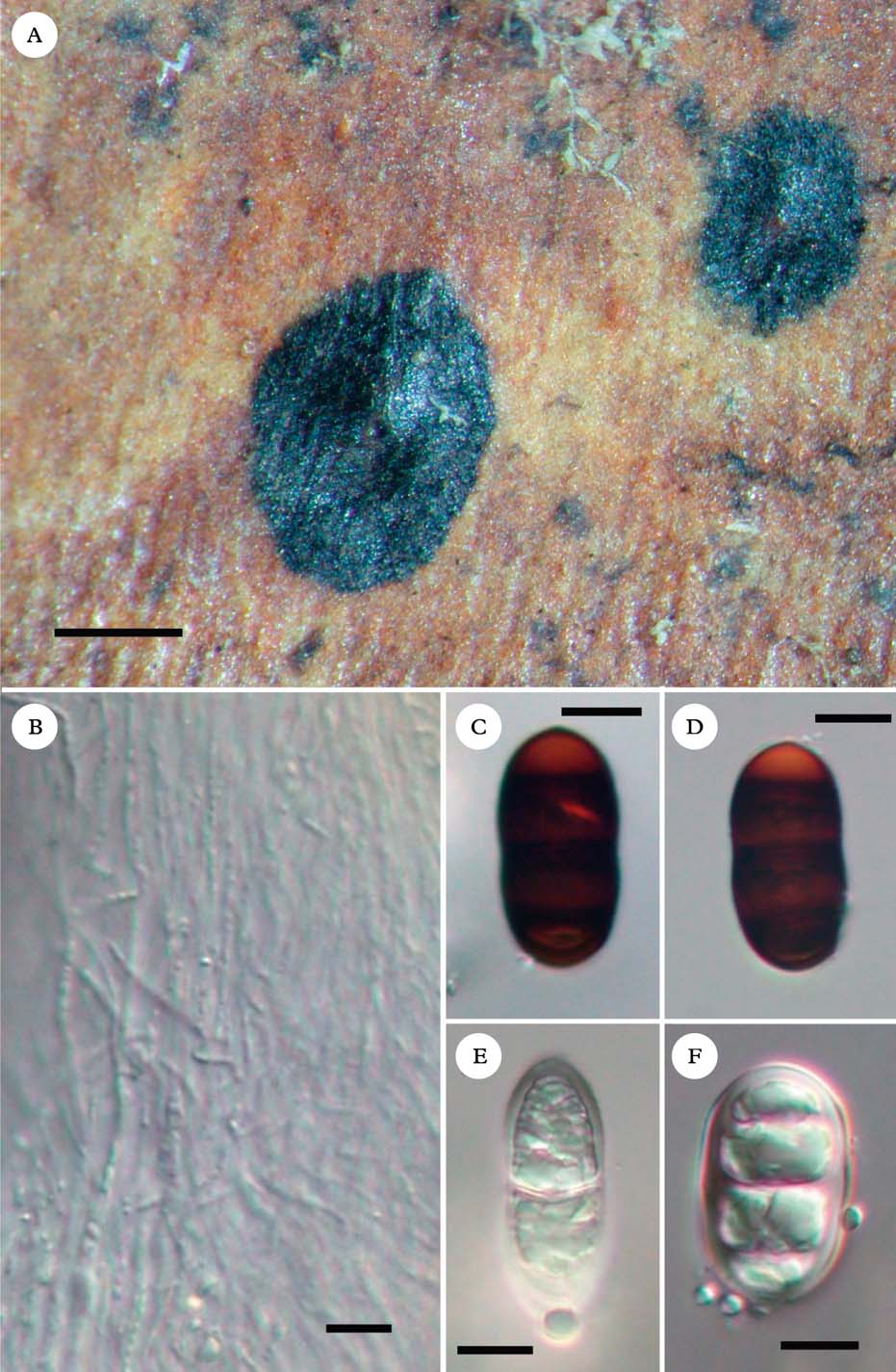
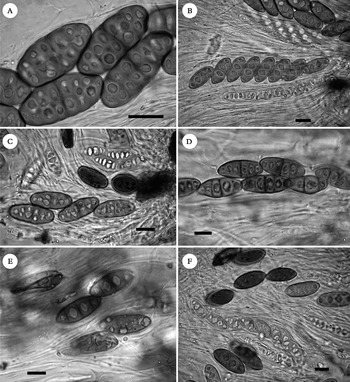
A, Pyrenula breutelii (Schumm 3087), ascospores. B, P. bahiana (Sipman 37008), ascospores. C, P. seminuda (Müll. Arg.) Sipman & Aptroot (Sipman 34968), ascospores. D, P. sexlocularis (Sipman 45502), ascospores. E, P. quassiaecola, over-mature ascospores with colourless oily content. F, P. bahiana, over-mature ascospores with reddish granular content. Scales: A–F=10 µm.

Discussion
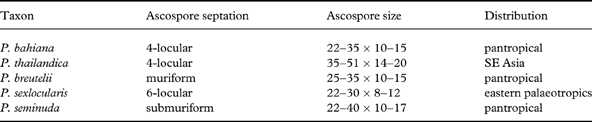
The Pyrenula species in which over-mature spores become reddish and simple before shrivelling are all morphologically and ecologically similar. They have small, subglobose perithecia with thin and often incompletely carbonized walls, which are immersed in the white-punctate thallus and often quite dense. They grow in open, rather eutrophic places, often in secondary vegetation, on cultivated land or near the coast. The species of the group are differentiated by the ascospore septation (Table 1). The most widespread, pantropical taxon has 4-locular spores, size in the range of 22–35×10–15 µm (specimens in B), and corresponds to P. bahiana Malme (Fig. 13B & F). A few 4-locular specimens from SE Asia deviate by their very large spore size, 35–50 µm long, and merit a separate status, P. thailandica Aptroot (Aptroot et al. Reference Aptroot, Schumm and Cáceres2012). The second most common taxon, equally pantropical, has muriform spores in the range 25–35×10–15 µm, with 6–8×2–3 locules. It corresponds with P. breutelii (Müll. Arg.) Aptroot (Fig. 13A). The fourth taxon has 6-locular, bacillar spores in the range 22–30×8–12 µm, and corresponds with P. sexlocularis (Nyl.) Müll. Arg. (Fig. 13D). It could be considered a depauperate stage of P. breutelii, but seems to have a different distribution, all available specimens originating from the eastern Palaeotropics. A small number of specimens remain, with submuriform spores in the range of 22–40×10–17 µm, with 6×1–2 locules, most transverse locules being single and few with an oblique or longitudinal division. They originate both from the Palaeotropics and the Neotropics and are therefore distinct from the predominantly palaeotropical P. sexlocularis. They differ from the truly muriform P. breutelii because this often has more than six longitudinal rows of locules. They agree with the species described as Anthracothecium seminudum Müll. Arg.
Pyrenula species in which over-mature spores become reddish and simple before shrivelling.
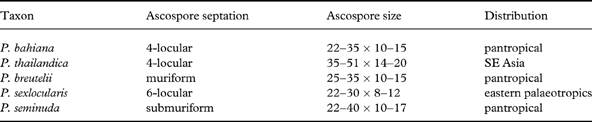
Harris (Reference Harris1989) divides the group into only two species, 4–6 loculate P. concatervans (Nyl.) R. C. Harris (a synonym of P. bahiana) and muriform P. macularis (Zahlbr.) R. C. Harris (a synonym of P. breutelii), while he indicated the presence of specimens with submuriform spores and an available name for such specimens, Anthracothecium seminudum Müll. Arg. In our experience, the specimens with 4-locular spores are always well separated from those with 6-locular spores. There are no intermediate specimens with healthy spores both 4- and 6-locular, and the 4-locular spores are somewhat thicker. Thus the separation of P. bahiana and P. thailandica seems unquestionable. Also, P. breutelii is usually easily separable because its spores are mostly over 12 µm wide and all longitudinal segments except the tips have longitudinal septa. The more difficult separation is between the submuriform group and P. sexlocularis, because 6-celled spores may be mixed in the same apothecium section with those having one or two longitudinal septa. Since these specimens have a different distribution from P. sexlocularis, we suggest treating them as a separate, pantropical species, and present the required combination.
Selected specimens examined. Costa Rica: Guanacaste: Tropica Verde Reforestation Project, 15 km SSE of Nicoya, near Hojancha, access road to site, alt. 850–900 m, 10°01′N, 85°23′W, exposed trees and fence posts along pasture, on bark (lower trunk), rather shady site, 2004, A. Aptroot 60910 (B 60 0166102). Puntarenas: near Las Cruzes Garden (distr. Coto Brus), c. 4 km SSE of San Vito, alt. c. 1300 m, c. 8°43′N, 82°57′W, premontane rainforest zone, on thin Croton gossypifolium tree trunks along path among pastures on hill ridge, 1978, H. Sipman 11902 (B 60 0044517), 11924 (B 60 0044518).—Papua New Guinea: Central Province: Motupore Island, in Bootless Bay, 12 km SE of Port Moresby, alt. 1 m, 9°32′S, 147°16′E, epiphyte in coastal scrub, 1987, H. Sipman 21842 (B 60 0072415, UPNG), 21870 (B 60 0072420, UPNG). Madang Province: Madang city, park in town centre, alt. 1 m, 5°15′S, 145°45′E, on tree trunks in park, 1987, H. Sipman 24178 (B 60 0073341, LAE); near Bogia, coastal forest E of Boroi river mouth, alt. c. 1 m, 4°06′S, 144°48′E, along the beach, epiphytic on Pandanus stem, 1992, H. Sipman 34968 (B 60 0097232).—Singapore: Fort Canning Park, in town centre, alt. c. 30 m, 1°17·5′N, 103°51′E, on tree trunks in park on hilltop, on Plumiera, 2000, H. Sipman 46222 (B 60 0153476).
Pyrenula tetraspora Aptroot & Sipman sp. nov.
MycoBank No.: MB 801176
Pyrenula with 5-septate ascospores in 4-spored asci.
Type: Venezuela, Estado Bolívar, Cerro Guaiquinima, in central part of upper plateau, along Rio Carapo (near camp 3-nuevo), alt. c. 800 m, c. 5°49′N, 63°32′W, upper part of rocky area with low forest in deep clefts, on tree bark, 12 February 1990, H. Sipman 27046 (VEN—holotype; B 60 0083761—isotype).
A–C, Pyrenula tetraspora Aptroot & Sipman (isotype); A, thallus; B & C, ascospores. D–F, P. triangularis Aptroot & Sipman (holotype); D, thallus; E & F, ascospores. Scales: A & D=1 mm; B & C=15 µm; E & F=10 µm. In colour online.
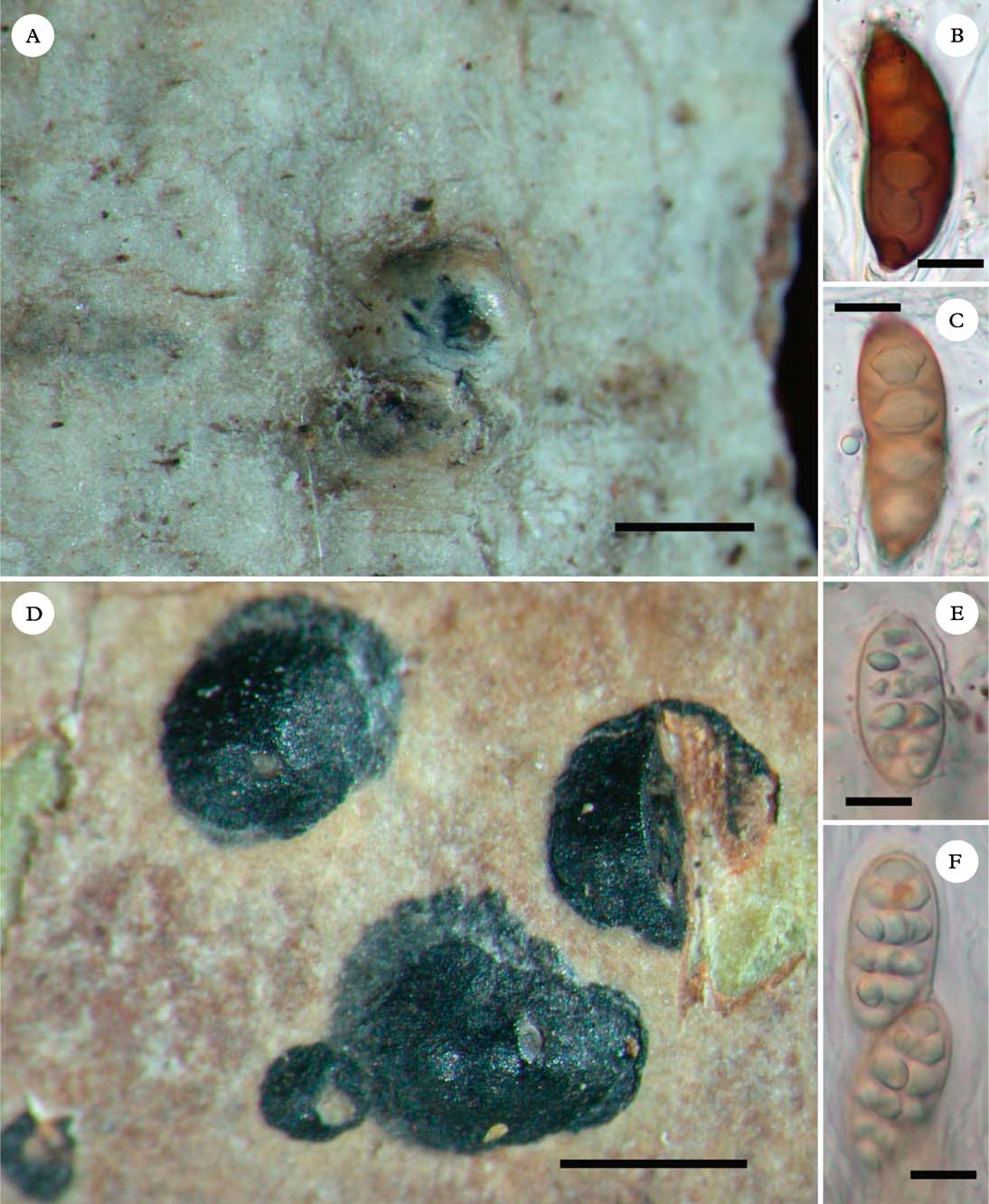
Thallus rather thick, pale grey, without pseudocyphellae, without prothallus.
Ascomata superficial, but mostly covered by a thin thallus layer, hemispherical, 0·7–1·2 mm diam., simple. Ostiole slightly skewed, pointing in various directions, brown. Hamathecium inspersed with hyaline oil droplets, IKI+ reddish. Ascospores 4 per ascus, 5-septate, 60–65×18–24 µm, lumina angular to diamond-shaped, without endospore in the spore tips.
Pycnidia not observed.
Chemistry
No substances detected.
Ecology and distribution
On smooth bark in mountain forest. Known only from the type.
Discussion
This is one of the very few Pyrenula species with consistently 5-septate ascospores. It is, moreover, characterized by 4-spored asci and a pale grey thallus covering large ascomata with skewed ostioles. It could key out as Pyrenula pleiomera (Nyl.) Aptroot, but that species has 8 pointed ascospores per ascus and nearly immersed ascomata.
Pyrenula triangularis Aptroot & Sipman sp. nov.
MycoBank No.: MB 801177
Pyrenula with ascomata usually 2–4 fused with joint ostioles and joint walls into pseudostromata with often triangular outline and ascospores 25–31×12–16 µm.
Type: Guyana, Upper Mazaruni district, E-bank of Waruma river, c. 20 km S of confluence with Kako river (campsite 4), alt. 550 m, 5°19′N, 60°46′W, in c. 20 m tall virgin riverine forest, on 5 cm diam. stemlet, 11 February 1985, H. Sipman & A. Aptroot 18669 (B 60 0057625—holotype).
Thallus very thin, greyish brown, surrounded by a black prothallus.
Ascomata superficial, conical, 0·6–1·0 mm diam., usually 2–4 fused with joint ostioles and joint walls into superficial black pseudostromata, in outline often triangular, in section conical, of 1·0–2·0 mm diam. Ostiole lateral, often depressed and whitish. Hamathecium not inspersed. Ascospores 8 per ascus, irregularly biseriate, muriform, 5×1–3-septate, 25–31×12–16 µm, lumina rounded, with a thick layer of endospore in the spore tips.
Pycnidia not observed.
Chemistry
No substances detected.
Ecology and distribution
On smooth bark in mountain forest. Known only from the type.
Discussion
This species is unique in the genus due to its mostly triangular pseudostromata with fused ascomata. The organization of the ascomata is not immediately apparent from a surface view but is only revealed when sections are cut through the ascomata, both vertically and parallel to the thallus surface.
Pyrenula viridipyrgilla Aptroot & M. Cáceres sp. nov.
MycoBank No.: MB 801178
Pyrenula with ascomata deeply immersed in the bark and ascospores with dark bands between the lumina, 19–22×9·0–10·5 µm.
Type: Brazil, Amazonia/Rondônia-border, Fazenda São Francisco off BR319, 30 km N of Porto Velho, 8°24′33″S, 63°58′56″W, alt. c. 100 m, in primary rainforest, on tree bark, 15 March 2012, M. Cáceres & A. Aptroot 11864 (ISE—holotype; ABL—isotype).
Pyrenula viridipyrgilla Aptroot & M. Cáceres (holotype); A, thallus; B, immature ascospore; C–E, mature ascospores. Scales: A=1 mm; B–D=5 µm; E=10 µm. In colour online.
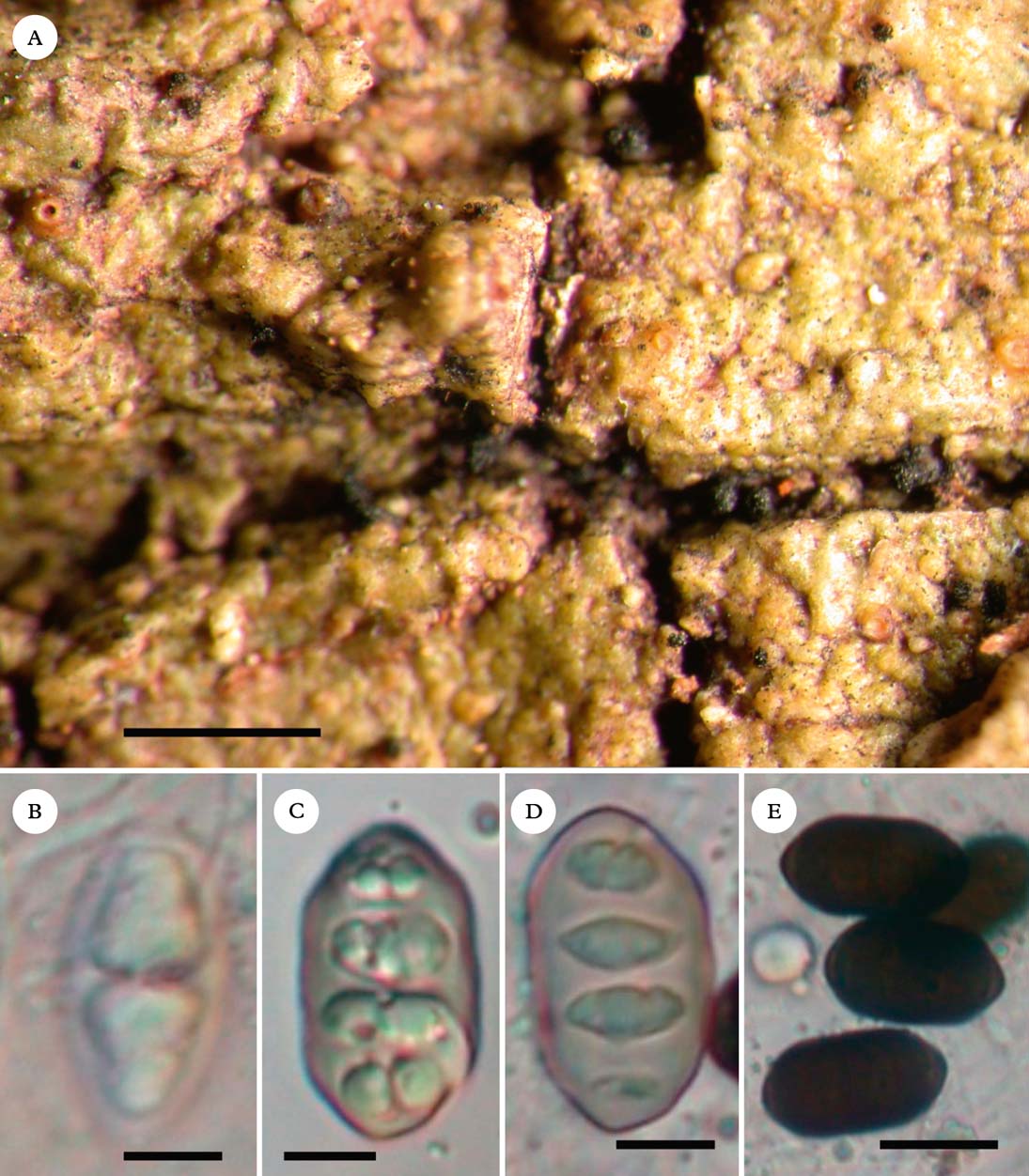
Thallus thin, olive-green, smooth, glossy, widely spreading, occupying a large area (several dm2), without pseudocyphellae, without prothallus.
Ascomata deeply immersed in the bark, pyriform, 0·4–0·7 mm diam., solitary. Ostiole eccentric, pale yellowish, waxy, hemispherical with a depression in the centre, c. 0·2 mm diam. Hamathecium not inspersed. Ascospores 8 per ascus, irregularly biseriate, 3-septate, 19–22×9·0–10·5 µm, dark brown, constricted at the central septum, ends rounded, lumina much wider than long, without endospore in the spore tips, with dark bands of granular euseptum material between the lumina.
Pycnidia not observed.
Chemistry
No substances detected.
Ecology and distribution
On rough bark in lowland rainforest. Known only from the type specimen from Brazil.
Discussion
This species is close to Pyrenula pyrgillospora Aptroot, which has the same type of Pyrgillus-like ascospores with dark bands between the lumina, but differs by the superficial ascomata with apical ostioles.
Over-mature ascospores
Harris (Reference Harris1989) was the first to point out the significance of degradation stages of ascospores for the taxonomy of the genus Pyrenula. He recognized spores with red and with colourless oily substances, without giving further details.
Our observations confirm his and suggest that, during the degradation of over-mature ascospores, the endospore dissolves and the remaining, dark brown outer wall and septa shrivel. In a few species, an intermediate stage occurs in which the endospore has dissolved while the outer spore wall is still smooth, making the decayed spore look simple. This is particularly evident in a group of species where the old spores assume a reddish tinge. Here the wall becomes red-brown and the contents pinkish with orange reddish granules which develop from remains of the lumina. This is the type described as containing red oily substances by Harris (Reference Harris1989), occurring in for example P. bahiana Malme (Fig. 13F) and P. breutelii (Müll. Arg.) Aptroot (see the discussion under P. seminuda). In a second type, the over-mature spores do not assume a reddish tinge, while in the spore content colourless oil drop-like masses are segregated. This type was described as containing colourless oil, and is characteristic of P. quassiaecola (Fée) Fée (Fig. 13E). Over-mature, simple spores without differentiated content can be seen occasionally, such as in P. anomala (Ach.) Vain. and P. micromma. Their taxonomic relevance is as yet unclear, probably because this stage lasts only a short time and is therefore infrequently observed.
A different development is shown by Pyrenula aurantioinspersa. The ascospores are initially hyaline and without thickened septa (Fig. 1E). When they mature they are greyish brown with thickenings around the lumina (Fig. 1I & J). These thickenings are apparently firm, gelatinous balloons and all four are interconnected, as can be seen when a post-mature ascospore breaks open (Fig. 1H). Older ascospores develop ring-shaped thickenings around the septa (Fig. 1K & L) and the ascospore outline between them becomes constricted.
Some further annotations to the world key of Aptroot (Reference Aptroot2012)
Pyrenula approximans (Krempelh.) Müll. Arg. was also found in material from Mexico and Guyana (specimens in B).
Pyrenula dusenii Malme was misspelled as dussii.
Pyrenula macounii R. C. Harris is also known from Japan (Kashiwadani et al. Reference Kashiwadani, Aptroot and Moon2009).
Pyrenula supracongruens Aptroot & Schumm (Schumm & Aptroot Reference Schumm and Aptroot2011) is not synonymous with P. fulva (Krempelh.) Müll. Arg. (which is thus known only from Borneo) but differs by having a thickened endospore layer at the tips of the ascospores; it should key out at B115 in Aptroot (Reference Aptroot2012).
Two species with Pyrgillus-like ascospores, viz. Pyrenula minae Aptroot & Lücking and P. xanthominuta Aptroot, were keyed out as having a layer of endospore in the spore tips but they only have a relatively thick outer ascospore wall.
The CNPq – Conselho Nacional de Desenvolvimento Científico e Tecnológico (Process 501633/2009-0) is thanked for a research grant to M.E.S.C. Robert Lücking is warmly thanked for checking the type of Pyrenula micromma in PC. The curator of H is acknowledged for sending the type of Pyrenula obvoluta on loan. The Stichting Hugo de Vries-Fonds is thanked for a travel grant to A.A.