Democracy depends on mass civic engagement: the motivation of citizens to vote, the cultivation of civic skills and knowledge about politics, and the exercise of political rights. For much of the twentieth century, labor unions were central to the political activation of large sections of society, as they formed workers into powerful voting blocs and mobilized them for political parties (Collier and Collier Reference Collier and David1991). Since the 1990s, however, scholars have argued that social and economic changes have diminished the relevance of labor unions in political life. A smaller share of the workforce is now unionized, and formal sector workers have struggled to protect their economic interests and have lost political clout (Roberts Reference Roberts2014; Posner et al. Reference Posner, Viviana and Jean2018).
This decrease in union membership has contributed to social atomization and collective action problems that prevent lower-class voters from becoming a coherent political force (Kurtz Reference Kurtz2004). Furthermore, although political parties connected with voters via mass member organizations in the past, today they increasingly appeal to voters directly through the media (Boas Reference Boas2005; Boas and Hidalgo 2011) and mobilize them via clientelistic exchange (Szwarcberg 2015; Zarazaga Reference Zarazaga2014; Stokes et al. Reference Stokes, Thad, Marcelo and Valeria2013). Meanwhile, among labor unions and popular sector organizations that have retained their member base, many have become patronage machines headed by political brokers who exchange contingent, particularistic benefits for member votes (Larreguy et al. 2017; Palmer-Rubin Reference Palmer-Rubin2019). Overall, the strength of labor unions and the roles they play in politics have shifted markedly.
Do labor unions still matter to democracy? If so, what do they do to promote political engagement? While overall union density has declined in the context of globalized supply chains, some private sector unions have survived despite the neoliberal economic model. Moreover, public sector unions have become stronger in many contexts and may continue to shape political engagement.
This research examines the teachers’ union in Bogotá, Colombia to assess whether and how labor unions with a mass member base are able to promote active citizenship and political participation. The study employs a multimethod research design that begins with a quantitative analysis of a survey of teachers. The results show that union affiliation is associated with higher levels of motivation to vote. This finding is especially robust for down-ballot elections, where voter participation is lowest. The analysis then uses evidence from field research and interviews to explore causal mechanisms. Qualitative analysis reveals how union advocacy and competitive internal union elections promote active engagement among members. This helps to rule out an alternative explanation, that the types of teachers who affiliate with the union already have a strong predisposition to participate in politics.
This article contributes to a growing literature on political representation and democracy in Latin America. The analysis demonstrates how, despite economic and social change, unions continue to motivate citizens to vote. Moreover, this research offers a distinct perspective on the political representation of labor by shifting analysis to the subnational level. Scaling down to the union branch organization allows us to closely consider the linkages between the leadership and the rank and file to understand how unions politically activate their members. While much current scholarship suggests that unions become entrenched in clientelist networks of mobilization, this research shows that the teachers’ union in Bogotá relies significantly on cultivating a sense of civic engagement among its members. These findings indicate that unions may play a key role in improving the quality of democracy in the region.
Labor Unions and Voter Mobilization in Comparative Research
The relationship between social organization and political participation has long been of interest to political scientists and sociologists. The impact of labor unions on the political engagement of their members has drawn particular attention because the policies preferred by the working class have historically served as a critical counterbalance to those championed by well-organized business interests (Lijphart Reference Lijphart1997). Additionally, scholars have hypothesized that union activity increases political activation in society more broadly. Union mobilization, for example, encourages nonunion members–neighbors, friends, and family–to participate, through both informal contact and get-out-the-vote campaigns. Furthermore, to the extent that unions are successful in electing politicians who favor policies that are preferable to workers, this may spark political engagement among the lower and middle classes more generally, because prolabor representatives improve perceptions of government legitimacy and make meaningful change seem possible (Flavin and Radcliff Reference Flavin and Benjamin2011; Leighley and Nagler Reference Leighley2007; Radcliff and Davis Reference Radcliff and Patricia2000).
Recent research on political behavior in Latin America, however, has largely ignored unions. Instead, the focus has been on partisan identities and clientelism (Singer and Ramalho Tafoya Reference Singer and Tafoya2020). Among the reasons for this lack of attention, as already noted, are the sharp declines in union membership and political power that have accompanied an economic model in which firms compete by holding down the cost of labor. Likewise, in many countries, social class has become less salient or more complex among voters, as a variety of new social and cultural identities have emerged (Hoffman and Centeno Reference Hoffman and Miguel2003). Alongside these changes, political parties have developed new strategies of electioneering that involve professional campaign consultants, marketing, and direct media-based appeals, relying less on labor organizations to mobilize voters.
Still, despite these changes, unions do survive in Latin America, as they do across the world. Some of the strongest, to be sure, are in the public sector, where workers are protected by civil service laws and sheltered from global market competition. Yet there are signs of life in the private sector, too, as electoral victories for the left have helped to revitalize trade unions in some countries. In Mexico, provisions bolstering legislative protections for collective bargaining in the renegotiated NAFTA, the United States-Mexico-Canada Agreement (USMCA), are also likely to strengthen private sector unions (Villarreal Reference Villarreal2019). Given that unions have not disappeared from political life and that they have the potential to significantly improve democratic quality, these organizations continue to deserve attention from scholars.
This study focuses on two key questions: does the evidence show that unions are indeed associated with greater political engagement? and if they are, what mechanisms do unions use to facilitate this engagement, particularly among their members? Regarding the first question, a number of studies have tested the relationship between unions and voter turnout in the United States, where data are most abundant. Radcliff (Reference Radcliff2001) finds that variation in union density between 1950 and 1994 had a significant impact on overall voter turnout. Likewise, Leighley and Nagler (Reference Leighley2007) find strong evidence to support the conclusions both that union members are more likely to vote in elections and that greater union density across US states increases turnout in general. Zullo (Reference Zullo2008) finds that variation in union density across counties had a substantial effect on turnout in the 2000 US presidential election.
Francia and Orr (Reference Francia2014) find that union affiliation increased registration and turnout among Latino voters for elections between 2004 and 2010. Examining teachers, Sarah Anzia (Reference Anzia2011, 2014) finds that labor unions promote political activation among union members. Using evidence from school board elections, she shows how institutional differences (i.e., on vs. off-cycle elections) affect the magnitude of the political and policy influence of organized groups.Footnote 1 Taken together, there is widespread agreement that unions in the United States can and do activate their members to participate in politics.
Since Verba et al.’s 1978 examination of variation in participation across 7 countries, however, there has been very little inquiry into the relationship between unions and voter turnout in countries beyond the United States. An exception is Radcliff and Davis (Reference Radcliff and Patricia2000), who supplement their analysis of the United States with an examination of 19 other advanced democracies and find evidence of a strong relationship between the proportion of workers represented by unions and voter turnout. Likewise, Gray and Caul (Reference Gray and Miki2000) find evidence that the fall in turnout across 18 industrial democracies is partly a function of the decline in union density.
These rich contributions notwithstanding, few studies have examined the relationship between labor unions and turnout in Latin America. Scholars have approached the edges of this topic, analyzing macrolevel dynamics involving the formation and transformation of labor-based parties, populism, and organizational linkages (Levitsky and Roberts Reference Levitsky and Roberts2011; Silva and Rossi Reference Silva and Rossi2018). Garay (Reference Garay2009) examines Argentina, Chile, Peru, and Venezuela to understand how associational linkages to labor unions shape access to state programs and the propensity to protest. Barnes and Saxton (Reference Barnes2019) provide evidence that individual evaluations of legislative representation tend to be more positive in countries with inclusive institutions that have a greater share of legislators from working-class backgrounds. Nolan-García and Inclán (Reference Nolan-García and Inclán2017) analyze whether union type–corporatist or independent–affects the political identity of members. However, none of these contributions has looked specifically at the question of how union affiliation shapes members’ motivation to vote.
To answer this question, this study tests the hypothesis that unions activate their members to turn out and vote. H1a derives from the literature cited above and anticipates that unions do indeed increase political engagement among their members. H1b considers the lack of scholarly attention to the impact of unions on behavior to be warranted, for two possible reasons. First, the decline in union density may have weakened the capacity of unions to mobilize their members. Second, the increase in media-based appeals that bypass intermediary organizations may have rendered unions less influential.
H1a. Teachers who are members of the union are more motivated to vote in elections than those who are not.
H1b. Teachers who are members of the union are no more motivated to vote in elections than those who are not.
The focus on individual workers and their affiliation with a specific union (rather than broad, cross-national measurements of union density) also facilitates an exploration of the mechanisms by which unions affect political behavior. Here the analysis scrutinizes two possible ways this might occur: a civic development approach, in which unions help their members acquire skills and information; and a clientelist model whereby union leaders coerce members to participate in elections through the disbursement of material rewards or the threat of their withdrawal.
The first approach views unions (and other civil society organizations) as nurturing their members’ interest in politics while also equipping them with the skills to be effective citizens. In their model of civic volunteerism, Verba et al. (Reference Verba, Schlozman and Brady1995) argue that participation in organizations leads to experiences likely to spark curiosity about the political world and the acquisition of skills that make the public sphere easier to navigate. These “civic skills” effects are likely to be especially large in unions that have achieved a degree of internal democracy, like the typographical union (Lipset et al. Reference Lipset, Trow and James Samuel1956). Additionally, because the union leadership is deeply invested in achieving its preferred policy outcomes, it is likely to encourage the political activation of its members. Thus, union leaders foster a sense of solidarity in members’ shared interests and encourage political activity, such as election canvassing and voting (Verba et al. Reference Verba, Nie and Kim1978). Workers become critically engaged with the public sphere and use their judgment to act independently as political actors. The overall picture is one in which unions play a constructive role in improving democratic quality.
In contrast, the second approach views unions as employing clientelism to achieve political goals. Labor organizations have often used coercion and “selective incentives” to mobilize members (Olson Reference Olson1965). In Latin America, the corporatist labor organizations that developed early in the twentieth century have been described as using such an approach. With access to state subsidies and armed with favored government status, these unions distributed resources to mobilize and control members (Collier and Collier Reference Collier and David1979).
A more recent and expanding literature sees the role of labor unions and interest organizations as fundamentally involving political brokerage networks that extend and reinforce clientelism. For example, in highlighting the role of interest organizations as vote brokers, Holland and Palmer-Rubin (Reference Holland and Brian2015) describe clientelist networks in Latin America in which organizational leaders extract rents from parties and use them to mobilize their members. Likewise, in an experiment in Mexico, Palmer Rubin et al. (Reference Palmer-Rubin, Garay and Poertner2020) find that citizens are more likely to join interest organizations when presented with the potential for particularistic rewards, thus leading to individualistic behavior among members rather than group solidarity. In the educational sector, Hecock (Reference Hecock2014) finds that state-level teachers’ unions in Mexico captured the merit pay program to reward teachers loyal to the dominant union in the state.
We do not argue that these different mechanisms of political mobilization are mutually exclusive. Certainly, some organizations may rely on the nurturing of civic engagement while others favor the distribution of rents. In many cases, both approaches may be at work simultaneously. However, given the divergent impacts on democratic quality implied by each approach, it is important to assess their relative importance. Furthermore, because many studies characterize unions, especially in developing countries, as corrupt political agents, evidence of their role in developing active and independent modes of citizenship would merit attention. As such, we examine two competing hypotheses:
H2a. Union members are more likely to vote because of the cultivation of civic skills by the union.
H2b. Union members are more likely to vote because of their clientelist relationship with the union.
Teachers, Unions, and the Political Arena in Bogotá
To test our hypotheses, we examine the Association of Educators of the District of Bogotá (ADE). Teachers are an important group to understand because increasingly, they are the new face of labor. Across the United States, they have recently leveraged collective action to win a series of concessions from state governments during the so-called Red State Revolt in 2018 (Blanc Reference Blanc2019). Moe and Wiborg (Reference Moe and Wiborg2017, 7) describe teachers’ unions as a “massive presence” that is “geographically distributed across the entire country … everywhere in the world.” In Colombia– as well as other Latin American countries, such as Argentina, Brazil, Chile, and Mexico–teachers are the single largest sector of labor.
There are reasons to expect teachers to be more engaged in politics than the general population. Teachers are better educated than other occupational groups; they are government workers, so their jobs depend on decisions made by political leaders; their expertise in pedagogy, civics, and social studies might make them avid consumers of the news; and through their contacts with students and their families, they are engaged in the community. Therefore, a teachers’ union presents a strong test of the hypothesis that union affiliation will have an independent, positive effect on political participation. Likewise, if even teachers become more civically engaged through their involvement with the union, this will be strong evidence in support of H2a and the civic development model. As such, support for our hypotheses should have implications for other workers, beyond teachers, who are less educated and less politically active and therefore even more reliant on unions.
At first glance, focusing on Colombian education workers might seem like a case that is quite different from other groups of workers in Latin America. In most of the region, union leaders and workers do not fear violence from drug cartels, guerrillas, and paramilitaries. Although in Colombia union leaders have been targeted for their activism, notably during the administration of President Álvaro
Uribe (2002–10) (Archila Reference Archila2012), large Colombian cities like Bogotá have been relatively free of political violence. To be sure, insecurity and crime have certainly been a problem; and in poorer, peripheral parts of the city, the line between organized crime and the remnants of paramilitary groups can be unclear. Still, compared to the rest of the country, citizens are freer to vote their conscience, participate in protests, and organize for new political parties. Thus, in many ways, the case of the teachers’ union in Bogotá is comparable to cases of other unionized workers in cities throughout Latin America.
Moreover, while much of the literature focuses on national labor centrals, scaling down allows us to examine a single organization’s characteristics at close range and to observe the process of political mobilization. ADE is Bogotá’s union branch organization, which is affiliated with a well-organized national union, the Colombian Federation of Teachers (FECODE). According to the teacher payroll data, ADE unionized 82.5 percent of Bogotá’s public school teachers (25,609 of 30,151). Moreover, 65 percent of teachers were members of financial cooperatives for savings and loans, which have close ties to ADE (Londoño and Sáenz Reference Londoño and Javier2011,216–17). Compared to other public and private sector unions in the city of Bogotá, ADE is by far the largest labor organization, with many more members than associations of transportation workers, utility workers, and public employees. Indeed, since the early 2000s, teachers have occupied important leadership positions in the national labor federation, the Unitary Workers’ Central (CUT).
ADE is very active in politics in Bogotá and has been integral to the success of center-left politicians in the city. When leftists won the mayor’s office in 2003, 2007, and 2011, teachers, who formed a coalition with progressive middle- and lower-class voters, were critical to these victories. Indeed, the connections between the union and public officials run deep. Abel Rodríguez, a former president of FECODE and a vocal advocate for teachers, served as Colombia’s secretary of education from 2003 to 2009. Leaders of the teachers’ union also won seats on the City Council, including Celio Nieves, Boris Montes, Laureano García, and Álvaro Argote. Other candidates regularly claim credit for defending teachers’ labor rights and protecting public education. Teachers are core constituents for parties on the left, such as the Democratic Alternative Pole, the Progressives, and the Green Alliance, and all these parties have prominently featured teacher and education issues in their platforms.
Center-left mayors in Bogotá brought about a subnational “left turn” in terms of education policy. The position of mayor of Bogotá, the second most important public office in the country, has been held by center-left politicians in 2003–6 (Lucho Garzón), 2007–10 (Samuel Moreno), and 2011–15 (Gustavo Petro) (Eaton Reference Eaton2020). During these administrations, education spending increased from just 12 percent of the city budget in 2004 to 35 percent in 2012. Moreover, charter schools and publicly funded private school programs shrank while traditional public schools saw increased support; teacher training and grants for continuing teacher education were expanded; curricular reforms were passed; and special pedagogical programs were implemented that aimed to support teachers in the classroom. There were improvements to school infrastructure and an expansion of school nutrition programs that covered all students, regardless of means.
Political institutions have incentivized the political activation of teachers. Electoral rules amplify the political strength of small, organized groups. For example, City Council members are elected in a single, at-large district that covers the entire city. In a typical City Council election, well over 500 candidates compete to win one of 45 City Council seats. With the electorate highly fragmented and votes dispersed among many contenders, groups that coordinate their vote on a small number of candidates have a greater likelihood of securing representation.
Furthermore, because of low turnout in certain contests, the union is in a position to have an outsized impact. Turnout in legislative elections is especially low compared to presidential elections. Elections are not concurrent; presidential and legislative elections take place in different months, and local and national elections take place in different years. Moreover, since the national legislature is selected through open-list proportional representation, voters confront a dizzying number of candidate photos, names, and partisan affiliations. Participation in legislative elections is further hindered by a complex ballot design, which leads to a high rate of spoiled ballots (Pachón et al. Reference Pachón, Carroll and Barragán2017). Despite reforms to simplify voting procedures, participation in down-ballot elections has been consistently low at the national and local levels.
The political context, Bogotá, Colombia, provides a useful contrast with the existing literature. Scholars tend to study labor unions in national political arenas with strong labor-based parties, such as Argentina, Brazil, Mexico, and Uruguay. However, ADE is embedded in a municipal-level political arena. Moreover, unions promoting turnout at the local level are especially important in the context of policy decentralization, since important decisions are handled by local officials. In addition, ADE is a strong union in a country where labor-based parties are weak. The center-left mayors who won power in Bogotá were backed by fragmented coalitions rather than a strong, encompassing labor-based party. Cases in which unions are strong but labor-based parties are weak promise to bring a valuable new perspective to comparative research.
Data, Concepts, and Variables
To investigate whether the teachers’ union in Bogotá, Colombia influences voter turnout, we analyze the results of a survey, Profiles of Public Sector Teachers in Bogotá, which was conducted by Colombian sociologists Rocio Londoño and Javier Sáenz. These scholars were hired by the Secretariat of Education to develop and implement a questionnaire covering a range of themes. Conducted in August 2009, it occurred before the national legislative elections of March 2010, the presidential elections that were held in May of the same year, and the local elections that took place in October 2011.Footnote 2
The teacher survey used a randomized cluster sample, in which 91 schools in Bogotá’s 20 localities were sampled, followed by a sample of teachers in those schools. In total, 4,119 teachers were surveyed, representing 14 percent of the 30,151 teachers in the city. There were 103 total questions, and all teachers were asked standard questions about socioeconomic characteristics, income, and other demographic traits. Then half of the sample was asked questions about their attitudes toward teaching, civic culture, and school-related matters. The other half responded to questions about political attitudes, behavior, and beliefs. We focus on this second section for a total sample of 1,998.
Payroll data from 2009 on union dues deducted from teacher salaries show that 83 percent of teachers in Bogotá were unionized at that time and 75 percent were members of ADE (Londoño and Sáenz Reference Londoño and Javier2011, 216). However, in the survey, which was conducted the same year, only 42 percent of teachers reported being union members, as indicated in the question, “With which of the following organizations are you affiliated or do you belong to right now?” A major reason for this discrepancy is that teachers are members of the union unless they opt out, so many do not know or do not remember that they are affiliated.
To corroborate findings from the survey and to investigate how unions might influence the political behavior of teachers, fieldwork was conducted between 2012 and 2014.Footnote 3 The interview subjects were union leaders, politicians representing teachers, officials in the Secretariat of Education of Bogotá, and classroom teachers. Questions were asked about how politicians targeted teachers during political campaigns, their base of support, and how they represented teachers in politics. In total, 27 interviews were conducted with city officials, City Council members, union organizers, and teachers. Participant observation was also undertaken at schools and union headquarters to better understand how teachers interacted with the union. Overall, the fieldwork sheds light on whether unions inspire civic engagement and transmit civic skills or whether they use coercion and clientelism to get their members to participate in politics.
Combining qualitative data collected through fieldwork with a cross-sectional survey of teachers in the city has several analytic advantages. First, it provides more robust inferences, since causal claims are corroborated through multiple observations that are gathered independently of each other. The analysis draws on policy analysis, campaign appeals, electoral results, the survey, interviews with various actors, and participant observations. What is critically important here is that this evidence helps to illuminate the direction of the causal arrow in any statistical relationship between union membership and civic engagement. The case-oriented research contextualizes the survey results and illuminates causal processes that do not easily lend themselves to statistical modeling. Moreover, where research on political representation often focuses on one aspect of representation (i.e., the elite component), this design provides both an elite and a grassroots perspective.
We use a survey question about Motivation to vote for various public offices as the dependent variable. When individuals are asked about motivation to vote in a survey context, they are sharing an attitude that implies intrinsic interest and selfefficacy in politics. Survey research has shown that the question of motivation to vote in future elections is a more reliable measure of actual (future) voting behavior than questions about past voting participation. This is because it suffers from fewer problems of social desirability bias related to respondents’ falsely reporting that they voted (Belli et al. Reference Belli, Traugott, Margaret and McGonagle1999). The question asked in the survey was, “In general, how motivated are you to vote for each of the following institutions of public decisionmaking?” We examined motivation to vote in elections for president, mayor, the Senate, the lower house, the City Council, and the local Neighborhood Council (JAL). The possible responses were extremely (bastante), not much (no mucho), very little (muypoco), and don’t know (no sabe). To simplify matters, we created a binary variable of motivated (extremely) vs. not motivated (not much, very little, don’t know, and did not respond).Footnote 4
Empirical Results
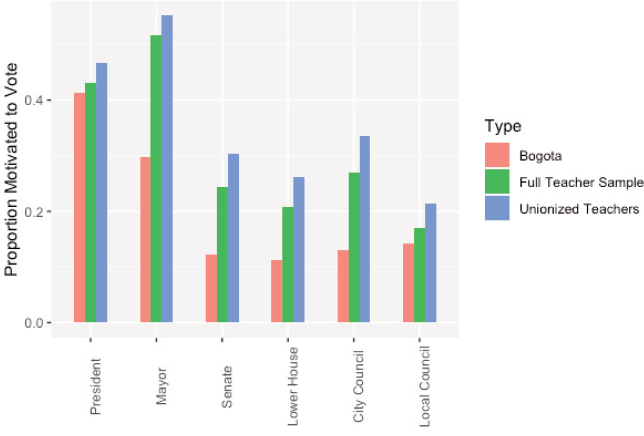
Figure 1 compares the percentage reporting motivation to vote in the various elections among teachers in general, unionized teachers, and citizens of Bogotá in general from the 2009 Biannual Survey of Cultures in Bogotá (Secretaría de Cultura, Recreación y Deporte 2009). All three groups report more motivation to vote in “top of the ticket” races (i.e., presidents and mayors) than in “down the ballot” contests (Senate, lower house, City Council, and local Neighborhood Council). Notably, teachers reported more motivation to vote for mayor than for president compared to citizens of the city.Footnote 5
Proportion Motivated to Vote

Overall, teachers are more motivated to vote than citizens in general, and unionized teachers are more motivated to vote than the general teacher population. Although unionized teachers are more motivated than other teachers to vote for the presidency and the mayoralty, the difference is rather small: 3.5 percent for president and mayor. For the down-ballot elections, the differences between the motivation to vote of unionized versus nonunionized teachers are larger: 6 percent for the Senate, 5.5 percent for the lower house, 6.6 percent for the City Council, and 4.5 percent for the local council. Overall, this figure lends plausibility to H1a, the expectation that unionized teachers are more motivated to vote than their unaffiliated colleagues.
To better evaluate the association between union membership and motivation to vote, we estimated multivariate logistic regressions that control for potential confounding variables.Footnote 6 These include demographic factors; namely, gender, age, income, and urban vs. rural residence. We also included an ordinal measure of Economic outlook, or how teachers expected their economic situation to look in five years: better, the same, or worse. Pessimism about the future might be associated with a lack of motivation to take part in politics.
In addition, we included two variables that existing scholarship finds to be powerful predictors of voter turnout: Affiliation with a political party and Political ideology, both of which we expected to have strong positive effects on political motivation. Teachers were asked, “Are you affiliated with a party or political group?” This variable was coded 1 if they said yes and 0 if they said no or did not respond. Only 13 percent reported that they were party members. The variable ideology has many categories–left, center-left, center, center-right, right, nontraditional, no preference, and nonresponse. The analysis included a dummy variable for whether or not teachers were aligned with the left or center-left. We focus on left and centerleft because union leaders in Bogotá are affiliated exclusively with these parties, and these parties are most likely to target teachers as voters.Footnote 7 For each outcome, we specified two models, one that controls for all but party and ideology and one that includes these control variables as well.
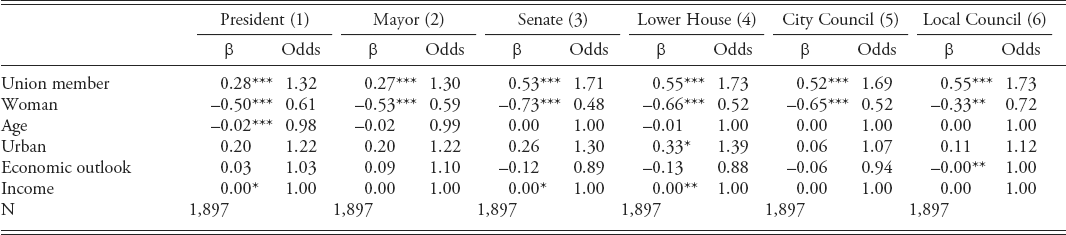
Table 1 shows the results. When ideology and partisanship are not included, union membership has a statistically significant effect on motivating teachers to vote for all offices, lending further support for H1a. The reported odds ratios indicate that a union member is 1.3 times more likely to report being motivated to vote for president and mayor than a nonunion member, but 1.7 times more likely to report being motivated to vote for Senate, lower house, City Council, and local council.
Logit Regression of Union Member on Motivation to Vote, Demographic Controls

*p < 0.1; **p< 0.05, ***p < 0.01
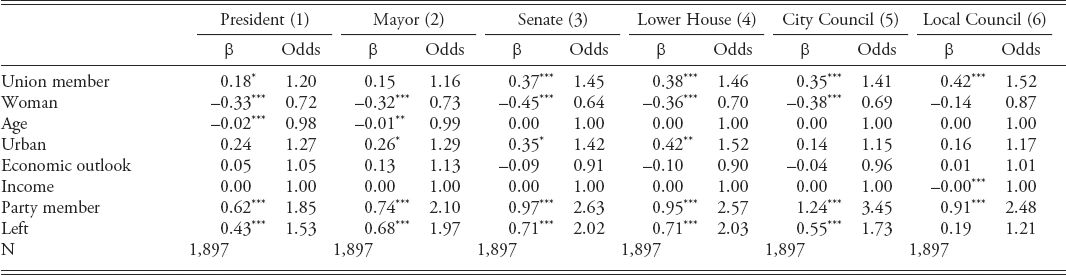
Table 2 shows the results when we also control for partisanship and left ideology. Consistent with the literature, the results show that both variables have substantial effects on the motivation to vote–effects that are indeed larger than for union membership. Union membership is statistically significant only for the motivation to vote for president at the p < 0.1 level and not statistically significant for mayor. By contrast, for down-ballot elections, the relationship is positive and statistically significant at the p < 0.01 level, providing further support for H1a. Looking at the odds ratios, this analysis shows that a union member is 1.2 times more likely to report interest in voting for president or mayor than a nonunion member but 1.5 times more likely to report interest in voting for the Senate, lower house, or local council, and 1.4 times more likely to report interest in the City Council, holding other variables constant.
Logit Regression of Union Member on Motivation to Vote, All Controls

*p < 0.1; **p< 0.05, ***p < 0.01
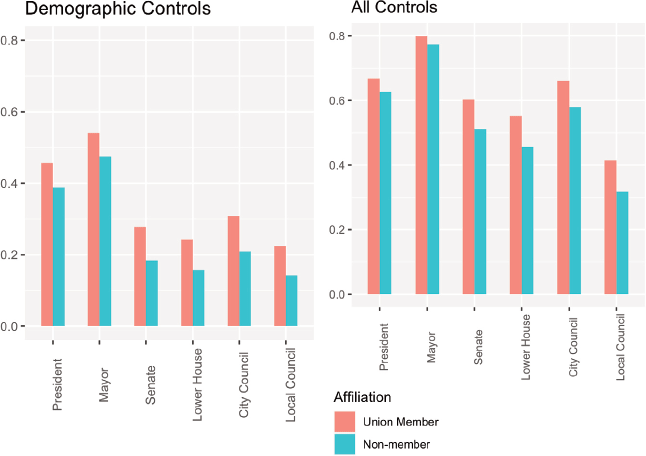
Figure 2 reports the predicted probabilities of being motivated to vote by union membership, comparing the models in table 1 (demographic controls) to table 2 (all controls). The left-hand plot compares teachers who are union members and nonmembers by setting all the demographic covariates to their means or most frequent category while excluding party member and ideology. This figure shows the probability of being motivated to vote for a given office for a teacher who is a 44-year-old urban woman with a positive economic outlook who makes 2.6 million Colombian pesos per month (roughly 1,400 US dollars). For president and mayor, the predicted probability of being motivated to vote is 6.8 and 6.6 points higher, respectively, for union members. For Senate, lower house, City Council, and local council, the difference is greater: 9.4, 8.6, 10, and 8.1 points higher, respectively for union members.
Predicted Probabilities for Motivation to Vote

The right-hand plot adds all the controls. The figure shows the probability of being motivated to vote for a given office for a teacher who is a 44-year-old urban woman with a positive economic outlook who makes 2.6 million Colombian pesos, who is a party member and also a leftist. Again, we compare teachers who are union members vs. nonmembers. For president and mayor, the predicted probability of being motivated to vote is 4.2 and 2.5 points higher, respectively, for union members. For Senate, lower house, City Council, and local council, the difference is 9.1, 9.5, 8.1, and 9.7 points higher, respectively, for union members.
The finding that evidence for a union effect on turnout is consistently stronger for down-ballot races–a finding that holds in both the bivariate and multivariate models–is notable. It is consistent with the research of Sarah Anzia on teachers in a far different context from Bogotá: school board elections in the United States (Anzia Reference Anzia2011,2014). In particular, Anzia finds that teachers’ unions have greater policy leverage when school board elections are not concurrent with major state or national elections, and thus where overall turnout is lower. The inference is that because unions can motivate their members to vote in these elections while other voters are more likely to stay home, unions are more successful in installing allies on school boards and extracting higher salaries from local officials. Something similar appears to be happening in Bogotá. It is these down-ballot offices that may have the most impact on education policy, and perhaps the union targets them for this reason.
Qualitative Evidence
Overall, these survey results provide evidence for the claim that unions motivate their members to participate more actively in politics–whether through coercive methods or by inculcating civic attitudes and serving as a laboratory for democratic citizenship. However, the survey evidence is limited in at least two ways. First, the results may be driven by a selection effect. Perhaps the teachers who were attracted to the union were already more politically motivated before becoming union members; this would mean that the union had not changed political behavior. Second, the survey does not provide the information needed to test hypotheses 2a and 2b, regarding the relative importance of a union-driven civic development effect versus clientelism. Evidence from field research, presented below, addresses both shortcomings, providing strong evidence that the union does mobilize members and that it does so largely by fostering civic skills and providing information.
In interviews, teachers in Bogotá often reported that they became involved in the union based on problems that they or their colleagues encountered at school or with the education bureaucracy. For many, union membership acts as a sort of insurance policy for unanticipated problems with the school principal or the secretariat of education. As such, the decision to become a union member can be thought of, at least in part, as exogenous to the political behavior of teachers, since many teachers approach the union to help mitigate problems in their day-to-day working lives.
Bullying by school principals is one problem that prompts teachers to reach out to the union (Interviews, June 21, 2012; September 4, 2013). For example, one interviewee told the story of a young female colleague who faced a serious illness and was pressured by the school principal to resign, so she turned to the union to keep her job. The interviewee described herself as apolitical, but she said she was becoming more concerned about the need to defend labor rights because of this case and the activities of union representatives at her school: “We have to fight for our rights, we cannot let [the school principal] take advantage of us” (Interview, June 21, 2012). In other schools, principals were often described as dictatorial or incompetent. Complaints alleged that they interfered in the classroom, micromanaged teachers, overscheduled them, arbitrarily disciplined them for minor infractions, pressured teachers to take early retirement, and threatened retaliation against those who questioned their decisions. In addition to problems with school administration, teachers sought help dealing with the vicissitudes of the education bureaucracy. Teachers approached the union when they were eligible for health services and pensions but faced bureaucratic and legal hurdles when attempting to access them.
Thus, workplace problems are often the catalyst that motivates teachers to become union members and to participate in union meetings. Through advocacy work, teachers who previously had little interaction with the union begin to meet regularly with union leaders and jointly file petitions with relevant government agencies. They visit the union headquarters, and union leaders go to the schools to meet with them to make sure that the administrative processes for resolving problems move forward. When complaints are resolved, teachers reported, union leaders maintain contact to ensure that no problems recur. Through this collaborative work, union leaders and teachers develop relations of trust and solidarity. Teachers learn how the union works, and they gain an understanding of the various ways that the union interacts with the local government.
This advocacy work by the union has a different logic from political clientelism. Teachers and union leaders work together to solve problems, and teachers view it as a partnership rather than a relationship with asymmetric power dynamics. Whereas a clientelist broker has the discretion to hand out or rescind goods or services, an advocate invests resources and energy into casework for teachers. Miguel Pardo, a leader of ADE, described starting work by 6 A.M., due to the demands of the teacher caseload (Interview, November 28, 2013). Moreover, how long any particular case will take to resolve is uncertain, and there is no guarantee that the resolution will be in the teachers’ favor. Therefore, the relationships that develop between teachers and union leaders often evolve over a long period. For one teacher, it took more than a year for the public administration to process her petition against an abusive principal (Interview, September 4, 2013). Unlike clientelism, advocacy work is slow moving, and the benefits are not always tangible.
Through advocacy work, members of the union leadership (junta directiva) have an opportunity to cultivate support among teachers and to convince them that they are good leaders. In interviews, teachers repeatedly mentioned the trust that developed with these union officials through face-to-face interactions. One teacher in the locality of Engativá described supporting a union leader because “I thought he was honest and genuinely helped me in the school and helped others as well” (Interview, September 4, 2013). After the labor conflict was resolved, the teacher decided to volunteer to help the union leader in his campaign to be re-elected in ADE’s internal elections.
While teachers become more attuned to politics through this advocacy work, union democracy also contributes to making teachers more civically engaged. The teachers’ union in Bogotá is internally democratic and regularly holds elections for union leadership positions. In each school, teachers convene to elect a colleague who serves as the union representative for their school. Moreover, the union holds elections for seats on the ten-member junta directiva. There is vigorous multiparty competition for teacher votes; union leaders running under the banner of a variety of political parties and factions often win seats; and teachers participate in these elections at high rates. Indeed, in the 2012 election for ADE’s leadership, 18,134 teachers, more than 70 percent of the union membership, cast votes.
Competitive internal union elections also foster habits among teachers that make them more knowledgeable about politics and more motivated to vote outside of union elections. Since potential leaders compete against one another for votes, they invest energy in educating and informing teachers. During internal union elections, candidates for the junta directiva were given the same amount of space in newspapers and on the radio (Interview, Miguel Pardo, November 28, 2013). The union also disseminates information to teachers through social and recreational events, pedagogical seminars, and canvassing.
The churn of competition among union leaders contributes to debates about politics and education policy. The union then builds on this by informing teachers about politics outside the organization. For example, the union produces a radio program, maintains a social media presence, and publishes and distributes printed newspapers and newsletters. It uses its media venues to endorse mayoral candidates and provides opportunities for legislative candidates with links to the union to describe their candidacies and policy proposals. By gaining information through the union, teachers described becoming more motivated to participate in the political sphere.
Teachers who were elected to positions in the union, as well as those elected to public office, attributed their success in politics to advocacy work. When pursuing higher office, union officials rely heavily on their reputations, knowledge about education policy, and work in the union. In Bogotá, union leaders are usually described as cuadros, or opinion leaders, like Abel Rodríguez, who, after stepping down as president of FECODE, became the rector of the pedagogical university and later secretary of education of Bogotá. Rodríguez had a tremendous capacity to persuade teachers to vote because of his experience working in education and his knowledge of education policy. Former City Council member Laureano Alexi García, a veteran activist and former leader in ADE, described how he gained “a good reputation among teachers; they [the teachers] knew who I was” (Interview, June 14, 2012).
City Council member Celio Nieves described union officials who entered politics as being “very good union leaders, we had the respect, we worked with teachers, and teachers demanded leadership from us. We were committed to the programmatic defense of public education and the labor rights of teachers” (Interview, June 5, 2012). Nieves went on to describe politics as a respectful relationship of working with teachers (acompañamiento), rather than a relationship of dependence. City Council member Boris Montes de Oca said, “many people remember my leadership in the Federation of Colombian Teachers (FECODE) and the work I did for teachers” (Interview, June 26, 2012). In other words, the reputations and records of union leaders, in terms of advocacy work, served as the basis for success in politics.
There was no evidence that the clientelistic exchange of votes for favors was the primary mode of electoral mobilization through the union. While patronage politics (i.e., political influence over jobs in the Secretariat of Education) and influence peddling (i.e., political influence over contracts in the Secretariat of Education) were reported, these practices occurred outside the teachers’ union.Footnote 8 When asked about clientelism, interviewees responded that it was not a central feature of the union’s internal operation (Interview, Miguel Pardo, November 28, 2013). Even if union leaders wanted to engage in clientelistic modes of exchange, they simply lacked the time and resources to distribute favors in a discretionary way to the thousands of teachers that made up the rank and file.
Furthermore, clientelism generates resistance and dismay among many teachers, who expressed cynicism about the practices of politicians from the traditional parties but strong support for union leaders and representatives in their schools. Indeed, in ADE, teacher support for political candidates who were union leaders was conditional on their performance in office; when politicians did not effectively represent teacher interests, they were held to account: “new, more qualified leaders come and the democratic dynamic of the union movement emerges. [The old leaders] lose their seats [in public office] because teachers punish” (Interview, Celio Nieves, June 5, 2012). This is evidence for civic engagement: teachers become critically engaged, politically independent, and vote based on their own evaluations of the candidates.
Thus, qualitative evidence from interviews strongly suggests that the relationship between union membership and voter motivation emerging from the survey analysis is not an artifact of endogeneity; the union does indeed increase political mobilization. Taken together, the evidence represents strong confirmation of H1a. The field research also reveals some of the mechanisms by which this process of mobilization occurs: advocacy and union democracy. To be sure, some of the strategies employed by union leaders to engage with government officials involve patronage and corruption. Observed dismay with these strategies among some teachers could actually decrease their political self-efficacy and their propensity to participate in politics.
Yet there is strong evidence for H2a: mobilization through the development of civic engagement. The union’s role in resolving workplace problems provides an avenue for teachers to become more actively engaged in politics. Once engaged, the union has significant infrastructure designed to inform and educate teachers about politics, especially in the context of competitive internal union elections. Through union activities, teachers come to have contact with candidates for office, and they develop a vested interest in both the issues and the elections. Indeed, the evidence indicates that the union motivates teachers who are relatively nonpartisan and nonideological to take part in politics. So while scholars are correct to focus on the pernicious effects of clientelism that exists at the nexus of elections and organized interests in Latin America, we argue that more attention should be given to positive impacts on democratic quality made by unions that contribute to the development of a robust civil society.
Conclusions
This research falls at the intersection of two subjects of great interest to scholars of comparative politics: the causes of voter engagement and participation and the political impact of labor organizations in an age of declining union membership. Our examination of the political attitudes of teachers and the mobilizing strategies of the teachers’ union in Bogotá shows that labor unions, at least in the public sector, continue to be effective in motivating their members to engage politically. This has significant implications for the role of civic organizations like labor unions in maintaining and improving the quality of democracy. This is especially important in the context of a broad weakening of support for democracy in the region (Zechmeister and Lupu 2019; Levitsky Reference Levitsky2018).
Consistent with Anzia (Reference Anzia2011, 2014), our findings are particularly robust with regard to teachers’ motivation to vote in low-turnout elections. On the one hand, this is not terribly surprising: if a constant share of a subgroup (e.g., teachers) of the overall electorate turns out for elections, the impact of this group will be greater in elections that generate less interest in general. Yet the ramifications of this are significant, especially in the context of the dwindling membership, resources, and political power of labor organizations throughout the world. When facing trade-offs due to resource constraints, such groups should seek policy gains by mobilizing their members to affect low-turnout, down-ballot elections that are often overlooked.
Although we find that patronage and clientelism exist in the interplay of the teachers’ union and elections in Bogotá, the union activates teachers primarily by developing their interest in politics. Democratic procedures within the union further instill enduring voting habits in members that motivate them to participate in elections for public office. Furthermore, as the union mobilizes its members to vote and campaign for specific candidates, it amplifies this effect. Hence, in line with Verba et al. (Reference Verba, Schlozman and Brady1995), we conclude that unions provide members with civic skills and opportunities to participate, which, in turn, engenders more active patterns of political engagement. The importance of this finding is clear, especially in a region experiencing disengagement and declining support for democracy. Future research should seek to examine further the extent to which unions themselves serve as laboratories for democracy.
Supporting Information
For replication data, see the author’s file on the Harvard Dataverse website: https://data-verse.harvard.edu/dataverse/laps