It is widely accepted that lying produces systematic changes in behavior on the part of the sender of the lie; however, people generally perform at chance or only slightly above chance when attempting to distinguish between truthful and deceptive behavior in others (Bond & DePaulo, Reference Bond and DePaulo2006). This level of performance extends to those who routinely make veracity judgments as part of their professional role (Vrij, Reference Vrij2004). It seems that people have a tendency to rely on cognitive heuristics (Levine & McCornack, Reference Levine and McCornack2001), overestimate dispositional factors (O'Sullivan, Reference O'Sullivan2003), overestimate nonverbal cues (Vrij, Reference Vrij2008), and generally attend to incorrect cues (Akehurst, Köhnken, Vrij, & Bull, Reference Akehurst, Köhnken, Vrij and Bull1996; Mann, Vrij, & Bull, Reference Mann, Vrij and Bull2004). Therefore, research efforts have focused on identifying objectively quantifiable cues that discriminate between truth and deception, independent of the human observer (Zhou, Burgoon, Nunamaker, & Twitchell, Reference Zhou, Burgoon, Nunamaker and Twitchell2004).
Language behaviors show great potential in this endeavor as they draw on processes that have been associated with deception including working memory, attention, motivation, and impression management (e.g., Burgoon & Floyd, Reference Burgoon and Floyd2000; Zuckerman, DePaulo, & Rosenthal, Reference Zuckerman, DePaulo, Rosenthal and Berkowitz1981). In the current study we focused on one language behavior in particular, the use of the so-called filler “um” in real-life high-stakes lies. We analyzed the truthful and deceptive language of a convicted murderer, Scott Peterson, by examining speech which he produced in two different contexts: when speaking with suspicious and unfamiliar person/s (formal media interviews) and when speaking with a supposedly naive but familiar person (personal telephone conversations with a mistress, Amber Frey). This study augments our recent study (Arciuli, Mallard, & Villar, Reference Arciuli, Mallard and Villar2010) where we examined the discriminative ability of “um” in laboratory elicited low-stakes lies versus truth.
THE DISCRIMINATIVE UTILITY OF “UM”
As discussed by Arciuli et al. (Reference Arciuli, Mallard and Villar2010), there are two possibilities regarding the discriminative utility of “um.” One hypothesis predicts more frequent use of “um” during deception when compared with truthful speech. The alternative hypothesis predicts less frequent use of “um” during deceptive speech.
It has often been argued that utterances such as “um,” “ah,” and “mm” constitute filled pauses (e.g., Maclay & Osgood, Reference Maclay and Osgood1959) or errors that produce disfluent speech (Chomsky, Reference Chomsky1965; Goldman-Eisler, Reference Goldman-Eisler1968). Disfluencies are ubiquitous in spoken language and although there is substantial variation between individuals, there is evidence to suggest that up to 6% of language may be considered disfluent (Fox Tree, Reference Fox Tree1995). It has been suggested that the association between disfluency and deception operates via increased arousal (i.e., in response to anxiety) and/or cognitive load that often occurs during lying (e.g., Vrij, Edward, Roberts, & Bull, Reference Vrij, Edward, Roberts and Bull2000). According to such a view, increased use of “um” during deceptive speech does not reflect strategic processes on the part of the deceiver per se, but is a byproduct of the increased emotional and cognitive effort associated with self-regulatory behaviors during the construction and execution of a lie.
Alternatively, less frequent use of “um” in deceptive speech might reflect a deliberate attempt to evade detection, particularly within the framework of interpersonal communications. Certainly, there is a folk belief that instances of “um” indicate production problems (Fox Tree, Reference Fox Tree2007) that are strongly associated with deceptive behavior (DePaulo, Rosenthal, Rosenkrantz, & Green, Reference DePaulo, Rosenthal, Rosenkrantz and Green1982; Vrij, Edward, & Bull, Reference Vrij, Edward and Bull2001); hence, deceivers may seek to control their use of these utterances to improve credibility (Akehurst et al., Reference Akehurst, Köhnken, Vrij and Bull1996). Central to this hypothesis is the view that liars are able to strategically monitor their deceptive behaviors in an attempt to conceal “leakage” of cues (Johnson, Henkell, Simon, & Zhu, Reference Johnson, Henkell, Simon and Zhu2008). Of relevance here is the claim that “um” may not be accurately conceptualized as a speech disturbance but may instead have lexical status similar to other English words (Clark & Fox Tree, Reference Clark and Fox Tree2002). Presumably, lexical status would enable a higher degree of strategic control over the production of such utterances. It has been demonstrated that speech content is easier to control than nonverbal behavior during deception (DePaulo & Kirkendol, Reference DePaulo, Kirkendol and Yuille1989). In studies unrelated to deception, speakers can and do successfully reduce their usage of “um” through conscious control (Clark & Fox Tree, Reference Clark and Fox Tree2002; Kowal et al., Reference Kowal, O'Connell, Forbush, Higgins, Clarke and D'Anna1997).
THE IMPORTANCE OF EXAMINING “UM” AS A STAND-ALONE VARIABLE
Of importance, “um” and other types of utterances such as “uh” may serve divergent communicative functions. For instance, Smith and Clark (Reference Smith and Clark1993) proposed that “um” and “uh” differ from each other in the length of the delay they signal, perhaps in order to better inform the listener of subsequent information. Specifically, “um” signals a long delay and “uh” signals a short delay. Furthermore, “um” tends to occur more frequently at the beginning of a sentence and is used more often when additional delays are anticipated. Thus, despite the common perception that “um,” “uh,” and other such utterances are interchangeable in that they serve the same function, they may not be. In the deception literature, “um” has almost always been operationalized in combination with other utterances such as “uh,” “er,” and “mmh.”
In a study unrelated to deception, the work of Kasl and Mahl (Reference Kasl and Mahl1965) appears to be the genesis for this particular taxonomy. In their study of the relationship between speech hesitations and anxiety, Kasl and Mahl claimed that “um,” “eh,” and “er” are variants of “ah.” They combined these utterances to form a single variable they labeled “ah disturbances” (p. 426). In contrast, they labeled sentence changes, repetitions, stutters, tongue slips, sentence incompletions, word omissions, and incoherent sounds as “non-ah speech disturbances” (p. 430). In the deception literature there are a number of references to this particular taxonomy and it appears to have been widely applied in the investigation of speech disfluencies and pauses (e.g., Bond, Reference Bond2008; Bond, Kahler, & Paulicelli, 1984; DePaulo et al., Reference DePaulo, Rosenthal, Rosenkrantz and Green1982; DePaulo et al., Reference DePaulo, Lindsay, Malone, Muhlenbruck, Charlton and Cooper2003; Kraut, Reference Kraut1978; Kraut & Poe, Reference Kraut and Poe1980; Riggio & Friedman, Reference Riggio and Friedman1983; Vrij, Akehurst, Soukara, & Bull, Reference Vrij, Akehurst, Soukara and Bull2004; Vrij et al., Reference Vrij, Edward, Roberts and Bull2000; Vrij & Mann, Reference Vrij and Mann2001). Consequently, the grouping of “ah,” “er,” “mmh,” and “um” together has been routinely accepted in the deception literature and perpetuated from study to study. However, during the past five decades the field of psycholinguistics has produced some important findings regarding the role of so-called fillers such as “um.” As a result, some of the assumptions in the work of Kasl and Mahl may benefit from a reappraisal in light of this contemporary knowledge. We contend that grouping “ah,” “er,” “mmh,” and “um” together may be obscuring the discriminative ability of “um” where deceptive language is concerned.
To illustrate, consider three studies that have examined “um” in real-life high-stakes lying (Davis, Markus, Walters, Vorus, & Connors, Reference Davis, Markus, Walters, Vorus and Connors2005; Mann, Vrij, & Bull, Reference Mann, Vrij and Bull2002; Vrij & Mann, Reference Vrij and Mann2001). Vrij and Mann (Reference Vrij and Mann2001), in their study of a convicted murderer who later confessed to the crime, found no significant difference in the frequency of what they labeled “uh disturbances”: “frequency of saying ‘uh’ or ‘mmm’ between words” (p. 192). It is unclear whether “um” was also included as an “uh disturbance.” In a subsequent study, in which Mann et al. (Reference Mann, Vrij and Bull2002) examined the verbal and nonverbal behavior of 16 suspects during police interviews, “um” may have been included in a broader category labeled “speech disturbances”: “frequency of saying ‘ah’ or ‘mmm,’ etc. between words, frequency of word and/or sentence repetition, sentence change, sentence incompletion, stutters etc.” (p. 370). Mann et al. (Reference Mann, Vrij and Bull2002) found no significant differences between lying and truth telling on this variable. Similarly, Davis et al. (Reference Davis, Markus, Walters, Vorus and Connors2005) grouped “um” with “uhs, sighs, gutturals” (p. 691) under the heading of “nonlexical sounds.” This variable was positively associated with truthful utterances. The authors suggested that the discriminative ability of these “nonlexical sounds” may have emerged in this study because, unlike previous studies, these sounds had been measured separately from “other forms of speech disturbance” (p. 700), such as word/phrase repetition, sentence incompletion, stutters and so on. They recommend that, in future studies, “ums,” “uhs,” sighs, and gutturals be measured together as a separate variable from other speech disturbances. We posit that “um” be measured independently.
To further illustrate, consider two frequently cited meta-analyses of cues to deception (DePaulo et al., Reference DePaulo, Lindsay, Malone, Muhlenbruck, Charlton and Cooper2003; Sporer & Schwandt, Reference Sporer and Schwandt2006). In the first of these, DePaulo et al. (Reference DePaulo, Lindsay, Malone, Muhlenbruck, Charlton and Cooper2003) examined 14 studies to conclude that the “fluency” category of “filled pauses” (defined as “utterances such as ‘ah,’ ‘um,’ ‘er,’ ‘uh,’ and ‘hmmm,’” p. 114) is not a reliable indicator of deception. However, several of those studies did not specify whether “um” was included in their analysis (Bond et al., Reference Bond, Kahler and Paolicelli1985; Bond, Omar, Mahmoud, & Bonser, Reference Bond, Omar, Mahmoud and Bonser1990; Cody, Lee, & Chao, Reference Cody, Lee, Chao, Forgas and Innes1989; Hocking & Leathers, Reference Hocking and Leathers1980; Riggio & Friedman, Reference Riggio and Friedman1983; Vrij, Reference Vrij1995; Vrij & Heaven, Reference Vrij and Heaven1999; Vrij & Winkel, 1990). Of the remaining studies that did specify the inclusion of “um,” it formed part of a composite variable with other so-called fillers such as “uh,” “er,” “mmh,” and occasionally with sighs, guttural sounds, false starts, and the like (DePaulo et al., Reference DePaulo, Rosenthal, Rosenkrantz and Green1982; Feeley & deTurck, Reference Feeley and deTurck1998; Knapp, Hart, & Dennis, Reference Knapp, Hart and Dennis1974; Miller, DeTurck, & Kalbfleisch, Reference Miller, DeTurck and Kalbfleisch1983; Porter & Yuille, Reference Porter and Yuille1996). None of the studies in this meta-analysis included a measure of “um” as a variable in its own right.
In the second meta-analysis Sporer and Schwandt (Reference Sporer and Schwandt2006) examined 35 studies and quantitatively summarized the results of 121 estimates of so-called “paraverbal” cues to deception. These cues included filled and unfilled pauses, message duration, number of words, pitch, repetitions, response latency, speech errors and speech rate. In this meta-analysis, “um” was included in the category of “filled pause,” along with “speech disturbances such as uh, er . . . ah, etc.” (p. 424). Like DePaulo et al. (Reference DePaulo, Lindsay, Malone, Muhlenbruck, Charlton and Cooper2003), Sporer and Schwandt concluded that filled pauses are not reliable indicators of deception. However, only 5 of the 35 studies (DePaulo et al., Reference DePaulo, Rosenthal, Rosenkrantz and Green1982; Ebesu & Miller, Reference Ebesu and Miller1994; Knapp et al., Reference Knapp, Hart and Dennis1974; Kraut, Reference Kraut1978; Vrij & Winkel, Reference Vrij, Winkel, Bleichrodt and Drenth1991) examined filled pauses and none of these measured “um” as a variable in its own right. Once again, the effects for “um” may have been obscured.
A search of the deception literature between the years of 1994 and 2009, using data-bases from a range of disciplines including psychology, linguistics, and computer sciences, revealed that only two published studies (Arciuli et al., Reference Arciuli, Mallard and Villar2010; Benus, Enos, Hirschber, & Shriberg, Reference Bond, Omar, Mahmoud and Bonser2006) have measured “um” as a variable separate from the others with which it is commonly grouped. The findings from our laboratory based study, in addition to the findings of Benus et al. (Reference Benus, Enos, Hirschberg, Shriberg, Hoffmann and Mixdorff2006), suggest that when “um” is measured independently of other variables, its increased usage is associated with truth relative to lies. However, both of these studies examined only low-stakes lies. Because of the practical and ethical difficulties associated with investigating real-life high-stakes lies, few studies have been able to provide comparative data to demonstrate that the same patterns of behavior are seen across a variety of types of lies. Several authors have noted that cues to deception may be moderated by how motivated the deceiver is to evade detection and it is possible that the indicators of deceit that are observed in low-stakes lies will be different to those observed in high-stakes lies (e.g., Burgoon & Floyd, Reference Burgoon and Floyd2000; DePaulo et al., Reference DePaulo, Lindsay, Malone, Muhlenbruck, Charlton and Cooper2003; Hancock, Curry, Goorha, & Woodworth, Reference Hancock, Curry, Goorha and Woodworth2008).
In summary, operationalizing “um” in combination with other variables may obscure the discriminative utility of this variable. The present research was designed as a companion study for our recent investigation of the use of “um” during low-stakes lies, in order to further explore the discriminative ability of “um” in the real-life high-stakes lies of a convicted murderer.
PREDICTIONS OF THE CURRENT STUDY
Because our recent research revealed significantly decreased use of “um” during deception in laboratory elicited lies (Arciuli et al., Reference Clark and Fox Tree2010), we expected that “um” might be observed less frequently in Peterson's deceptive language, although it was an open empirical question as to whether patterns seen in low-stakes lies would also be seen in high-stakes lies. Given the ubiquitous nature of “um” in everyday language, we predicted that any discriminative utility of “um” would be apparent in both Peterson's private telephone conversations with his mistress (i.e., the Frey Tapes) and his media interviews.
METHOD
Design
It is a nontrivial task to establish ground truth in research that is conducted using real-life high-stakes lies that were elicited outside of the laboratory. In the current study, in order to establish which stimuli are truthful and which were not, determinations of veracity were not based on verdict. We instead included only those utterances that could be firmly established as either truth or lie by independent information.
First, it was necessary to separate the data into two subsets for separate analysis (Frey Tapes and Media Interviews) because the production contexts may have differed in several ways. For instance, it may be a more complex task to attempt to successfully evade detection in the audiovisual modality (television interviews) compared with the audio modality alone (taped phone calls). Specifically, on television both verbal and nonverbal behavior is on display. Second, it is not known whether Scott Peterson may have prepared more for the televised interviews compared with the telephone conversations. There is some suggestion that Peterson employed a media consultant to coach him in preparation for his public television appearances. As a result, some of his responses may have been partially scripted or rehearsed and, depending upon the questions Peterson anticipated being asked, this may have impacted upon the cues to deception that were observed. Third, the target of the deception (his mistress Amber Frey versus interviewer/millions of viewers) and the subsequent interpersonal use of language may have differed between contexts. Fourth, the content differed somewhat between production contexts.
Participant
We analyzed the speech of Scott Lee Peterson, a North American Caucasian male with no prior convictions who was arrested in April 2003 for the murder of his pregnant wife, Laci Peterson, who disappeared from their home in Modesto California on Christmas Eve 2002. Peterson was subsequently charged, convicted, and sentenced to death under the California Penal Code for the double murder of his wife and their unborn son in 2004. Peterson was born in San Diego, California, on October 24, 1972. English is his first language and his highest level of academic achievement is a university degree in agricultural business. Prior to Peterson's arrest he was employed as a fertilizer salesman.
Case details
When Scott Peterson reported Laci Peterson missing on December 24, 2002, the 27-year-old was due to deliver her first child, to be named Conner, 6 weeks later. Peterson was first interviewed by police on the day of Laci's disappearance and then on several further occasions as the search for Laci continued. Search warrants had been issued on his home, vehicles, and place of business and he was under police surveillance from early January 2003. Although Peterson told police in his first interview that he was not involved with another woman, 6 days after Laci was reported missing, a woman by the name of Amber Frey contacted police to say she had been having a romantic relationship with Peterson for several weeks since November 19, 2002. She claimed that during that time Peterson had lied to her about his real circumstances by presenting the guise of a recently bereaved widower living in Sacramento, who traveled routinely for business. Frey claims she had only been told of his real identity on the day of her contact with police by a friend who recognized Peterson from news reports.
Frey agreed to cooperate with police by secretly taping her telephone conversations with Peterson from December 31 and he continued to call Frey following the disappearance of his wife. During this time, Peterson repeatedly denied to police that he had been having a relationship with a woman other than his wife, even when he was eventually confronted with a photograph of Frey. At this point, Peterson told Frey he had lied to her about his circumstances and confessed to her about the search for his missing pregnant wife. Their affair became public knowledge on January 24, 2003, when Frey made a statement at a news conference orchestrated by the police. In response to the heated public response to Peterson's relationship with Frey, Peterson conducted four televised media interviews from January 27–29, 2003, during which he was later found to have lied on at least one occasion.
On April 18, 2003, Scott Peterson was arrested by police for the murders of his wife and unborn child following the discovery of the bodies of Laci and Connor on the shores of San Francisco Bay on March 12. The case went to trial in June 2004, where Peterson pled not guilty of the charges—5 months later the jury found him guilty of murder in the first degree for his wife and murder in the second degree for his unborn son.
Materials
Transcripts of four televised media interviews in which Peterson spoke about his wife's disappearance (each between 20- and 30-min duration) and approximately 11 hr of taped telephone conversations between Peterson and his mistress Amber Frey (recorded over a period of 5 weeks), all of which were admitted as evidence at trial, formed the data for this study. Peterson did not actually testify at his own trial, so there were no samples of testimony speech data for examination. However, the trial transcript itself was still required in the analysis for verification purposes: it was used to isolate segments in Peterson's speech that were subsequently identified as truth or lie at trial.
Procedure
A single person coded the data using the procedures outlined in our earlier paper (Arciuli et al., Reference Arciuli, Mallard and Villar2010). Prior to analysis of the speech data, each of the transcripts was compared to the original audio of the interviews (where these were available) and telephone conversations to ensure they were a complete and accurate record of the interviews. Consistent with the methodology used by Vrij and Mann (Reference Vrij and Mann2001), Mann et al. (Reference Mann, Vrij and Bull2002), and Davis et al. (Reference Davis, Markus, Walters, Vorus and Connors2005), portions of each interview and telephone conversation that could be verified as being truth or lie, were identified in the data. This involved a meticulous reading of each of the media and wiretap transcripts to isolate any utterances that could be strongly supported, by evidence presented at trial or from another reputable source, as either truthful or deceptive. Deceptive utterances were identified as those samples of speech where information was manufactured, hidden, or manipulated.
Consistent with the methodology originally employed by Mann et al. (Reference Davis, Markus, Walters, Vorus and Connors2002), fragments were isolated so as to ensure any uncorroborated material or topic changes were excluded. Consequently, fragments were of varying length and independent of sentence structure to some extent. The majority of speech data available in the interviews were discarded because there was no way of corroborating it as truth or lie. For instance, it is impossible to verify Peterson's thoughts or personal opinions. One example of this is when Peterson responds to a question by the media interviewer Diane Sawyer who asked Peterson why his mistress, Amber Frey, came forward to provide the police with information about their relationship. Peterson responds, “It's the appropriate thing to do. It really shows what a person of character she is, um and it allows us to um get back to looking for Laci.” Clearly, this segment must be discarded because we cannot know whether this was Peterson's true opinion.
Each sample was coded for the presence of the target variable “um” using Wmatrix (Rayson, Reference Rayson2008), a Web-based interface tool for linguistic analysis of English text that generates word frequency profiles from a concordance of each sample. The presence of “um” in each of the four conditions was calculated as a percentage of the total number of words per sample.
RESULTS
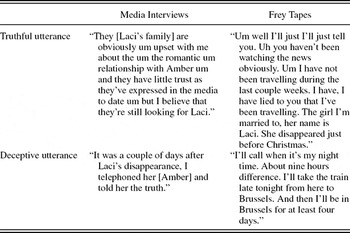
The sample sizes of each of the four conditions (measured as the total number of words per condition) differed: 180 words for the media interviews/deception condition, 690 words for the media interviews/truth condition, 840 words for the Frey tapes/deception condition, and 1,018 words for the Frey tapes/truth condition. Table 1 provides examples of speech from each condition.
Examples of deceptive and truthful utterances in each condition

To test the discriminative utility of “um,” word frequency profiles were generated for each sample and analysed using the log likelihood ratio (LR) test. LR in the present study refers to the logarithm of the ratio between the likelihood that the truthful and deceptive speech inputs from the participant have the same linguistic profile and the likelihood that the linguistic profiles differ from each other. LR is less likely to overestimate significance than traditional statistical tests such as z ratios that rely upon assumptions of a normal distribution. Of particular relevance to the present study, LR has the added benefit of being suitable for comparison of texts of differing lengths (Dunning, Reference Dunning1993; Rayson, Berridge, & Francis, Reference Rayson, Berridge, Francis, Purnelle, Fairon and Dister2004).
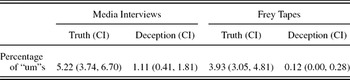
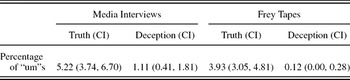
The frequency of “um” as a percentage of the total number of words in each of the four conditions, including confidence intervals as an indication of the true range in which the effect is likely to occur, is shown in Table 2.
Frequency of “um” as a function of veracity
Note: CI, 95% confidence interval.
The critical value for LR (Λ) at an alpha level of .05 was calculated at 3.84. Log linear comparisons of the presence of “um” revealed there was a significant main effect of veracity, with lying accompanied by fewer “um”s (0.25%) compared to during truth telling (7.45%; Λ = 108.89, df = 1, p = .000). The main effect of speech production modality was not significant, with only marginally more “um”s appearing during the media interviews (4.37%) than during the Frey tapes (4.25%) (Λ = 0.02, df = 1, p = .89). There was no significant interaction between veracity and speech production conditions (Λ = 0.10, df = 1, p .75).
DISCUSSION
Humans are ineffective lie detectors. Thus, researchers have focused their attention on identifying objective quantifiable cues to deception. There is a growing body of evidence suggesting a link between language and deceptive behaviors (Newman, Pennebaker, Berry, & Richards, Reference Newman, Pennebaker, Berry and Richards2003; Zhou et al., Reference Zhou, Burgoon, Nunamaker and Twitchell2004), although questions remain regarding the nature and role of particular linguistic cues, especially in real-life high-stakes circumstances. We analyzed the use of “um” in the truthful and deceptive speech of a convicted murderer in two different production contexts (media interviews vs. personal telephone conversations).
There are two possibilities regarding the use of “um.” One hypothesis predicts more frequent use of “um” during deceptive compared to truthful speech, possibly in response to speech-planning problems associated with the additional emotional and/or cognitive processing demands generated by lying (e.g., Vrij et al., Reference Vrij, Edward, Roberts and Bull2000). The alternative hypothesis predicts less frequent use of “um” during deceptive speech, possibly because the sender attempts to strategically plan and monitor the content of the message to prevent such interjections (e.g., Johnson et al., Reference Johnson, Henkell, Simon and Zhu2008). The findings of the current study supported the latter hypothesis with “um” observed less frequently in deceptive compared with truthful speech. This effect was observed in both production contexts of informal telephone conversations and more formal media interviews. Overall, these results are in line with our recent study examining low-stakes laboratory elicited lies relative to truth (Arciuli et al., Reference Arciuli, Mallard and Villar2010), which demonstrated that the increased use of “um” is negatively associated with deception.
There is a folk belief that “um” is a marker of uncertainty and, particularly, of deceptive behavior. Thus, its reduced usage during deceptive speech may indicate that the speaker is attempting to control the frequency of “um” in order to appear more credible. Data from the present study emphasize the strategic nature of deceptive behavior. Furthermore, our findings suggest that rather than representing a speech error or disfluency, “um” may be more accurately viewed as a word (such as an interjection), used thoughtfully and purposefully, and under the strategic control of the speaker. It would be valuable for future studies to consider whether “um” should indeed be (re)conceptualized as a lexical term, with all the accompanying lexical properties of phonology, prosody, syntax, semantics, and pragmatics.
Note that the effects observed here, although striking from a statistical viewpoint, are rather subtle from the perspective of the human observer. However, “um” offers the key advantage of being well suited to automatic parsing of transcribed speech (as just like any other word “um” can be identified and counted using basic concordance systems). Thus, once transcribed, “um” can be systematically and objectively identified and tracked, for later comparison with baseline speech samples from the same individual.
There are some limitations associated with the current study that are specific to the case itself, and also speak to the methodological challenges implicit in research on real-life lies. Within the media interviews, it is unclear whether there were any practice effects from interview to interview; however, there is research to suggest that contrary to commonly held beliefs by forensic investigators, verbal cues to deception may remain fairly stable over repeated interrogations (Granhag & Strömwall, Reference Granhag and Strömwall2002). In addition, there are temporal issues to consider in this data—the telephone conversation speech data span a 4-week period and the interview data span a 2-day period. Last, it is acknowledged that a single-case design has some disadvantages, namely, in terms of generalizability to other persons. However, the current research is intended as a companion study for our recent laboratory study (Arciuli et al., Reference Arciuli, Mallard and Villar2010). Moreover, reporting on case studies is a long and well-accepted tradition, a method that provides rich contextual information, which may otherwise be obscured in large group comparison designs (Yin, Reference Yin2003). Important findings have emerged in psycholinguistics using this methodology (e.g., the seminal work of Garrard, Maloney, Hodges, & Patterson, Reference Garrard, Maloney, Hodges and Patterson2005, that revealed linguistic markers of cognitive decline in dementia). Case studies such as the present one provide the unique opportunity to investigate real-life high-stakes lies elicited from circumstances that are ethically and practically impossible to simulate in the laboratory.
It is well accepted that there are linguistic behaviors that mark the likelihood of the presence of deception. The current study demonstrates in a real-world forensic context the discriminative ability of the use of “um.” The results suggest that in an attempt to successfully deceive, humans may strategically alter their linguistic behavior. Furthermore, these findings suggest that a (re)conceptualization of “um” as a lexical term that is under the control of the speaker, as opposed to an unplanned speech error or filler, warrants further investigation.