


Introduction
Within the context of person-centred care, patient experience is an integral component to the evaluation and enhancement of any contemporary health care service, Reference Ocloo and Matthews1 with levels of acceptance shown to provide an effective barometer of adherence to treatment. Reference Hugon, Roustit and Lehmann2,Reference Jacobs, Pensak and Sporn3 Understanding the service user experience through patient reported outcome measures (PROMs) is one such engagement process, questionnaires being a common instrument of assessment. Reference Prinsen, Mokkink and Bouter4 The use of PROMs in healthcare has been shown to improve patient quality of life, satisfaction and wellbeing. Reference Basch, Deal and Kris5,Reference Nipp and Temel6 This is especially vital for therapies in which a high level of patient compliance is crucial for treatment success. However, within radiotherapy where these attributes are paramount, there is a scarcity of information evaluating patient experience of treatment, set-up or comfort. Reference Cheng and Wang7,Reference Olausson, Holst Hansson, Zackrisson, Edvardsson, Östlund and Nyholm8 A distinct lack of consensus exists on what constitutes comfort in the literature, the concept being culturally sensitive, environmentally influenced and encompassing aspects of personal wellbeing. Reference Malinowski and Stamler9 While there is an appreciation that it is crucial to examining the patient experience and treatment-related anxiety, Reference Wensley, Botti, Mckillop and Merry10 there are few well-defined, validated comfort outcome measures available to study. Reference Goldsworthy, Palmer, Latour, McNair and Cramp11
With the introduction and increasing uptake of commercial hybrid magnetic resonance linear accelerator systems (MR Linacs), it seems inevitable that magnetic resonance imaging (MRI) for both planning and treatment will be heavily incorporated into future radiotherapy pathways. Reference Cobben, de Boer and Tijssen12–14 While the MR Linac is first and foremost a radiotherapy treatment machine, the patient facing elements of the treatment process and physical system layout are much more closely aligned to that of a conventional MRI scanner. Reference Van Herk, McWilliam, Dubec, Faivre-Finn and Choudhury15 The design choices made to achieve this merging of technologies has the potential to directly impact on the patients experience of the therapeutic environment, their comfort, anxiety levels and the radiographers ability to provide meaningful support. Reference Merchant, O’Connor and Halkett16 Furthermore, the closed bore dimensions, increased noise during sequence acquisitions and the potential for clinically discernible tissue heating are all features not present within mainstream radiotherapy, yet have been shown to negatively impact. Reference Munn and Jordan17,Reference Watt18 The use of fast switching gradients within some MRI acquisitions creates the potential for peripheral nerve stimulation (PNS) within this patient population. Reference Davids, Guerin, Endt, Schad and Wald19 This undesirable biological effect can compromise patient comfort by inducing tingling sensations and ultimately producing involuntary movement as a consequence. Reference Brunnquell, Hoff, Balu, Nguyen, Oztek and Haynor20 As a result, the experience of patients undergoing MR Linac-based treatment has the potential to be vastly dissimilar to those of patients receiving conventional cone beam computed tomography (CBCT) based radiotherapy, yet these metrics remain largely unquantified.
Gaining an understanding of patient issues related to this innovative technique is paramount, since the much-lauded technical potential of the MR Linac could be undermined if a significant reduction in the quality of the patient experience is found. Reference Tetar, Bruynzeel and Bakker21 Furthermore, for a novel therapy in which such gains in accuracy are yet to be translated into meaningful clinical outcomes Reference Van Herk, McWilliam, Dubec, Faivre-Finn and Choudhury15,Reference Winkel, Bol and Werensteijn-Honingh22 it could be unjustified, at this present time, to subject a patient to MR-guided radiotherapy (MRgRT) if the conventional alternative is found to be better tolerated. While the individual sequences used for treatment purposes are significantly shorter than a diagnostic equivalent, the overall treatment duration can be substantially longer than a conventional cone beam-based session. Reference Chin, Eccles and McWilliam23 This is significant when considering that treatment session duration is regarded to be a key contributor to patient discomfort. Reference Boda-Heggemann, Mai and Fleckenstein24,Reference Peguret, Dahele, Cuijpers, Slotman and Verbakel25 Despite the use of immobilisation devices, many cancer patients have comorbidities, making their ability to maintain a stable treatment position over this extended period difficult. Reference Datta, Aznar, Dubec, Parker and O’Connor26 MRI sequences can be highly susceptible to image distortion, such as those introduced through voluntary patient motion, Reference Bangard, Paszek and Berg27,Reference McWilliam, Rowland and van Herk28 the chances of which are likely to increase the longer the patient is on the treatment bed. Reference Bayley, Catton and Haycocks29 In a diagnostic environment, these scans would simply be repeated, however, in radiotherapy they could potentially compromise the geometric integrity of the treatment itself. Additionally, intrafraction internal target and organ at risk (OAR) motion have both been shown to correlate with time, Reference Gill, Dang, Fox, Bressel, Kron and Bergen30 further increasing both treatment complexity and duration.
Throughout the majority of the MR Linac treatment duration, patients spend extended periods with no MR acquisition taking place. Still enclosed within the machine bore, these periods of apparent inactivity may lead patients to be more cognisant of their relative comfort within the clinical environment, such as position, immobilisation and ambiance. The repeated change in stimuli from the more partitioned and protracted approach to sequence acquisition on patient anxiety and acceptability is a factor unexplored and unique to the MR Linac workflow. MRI scan terminations relating to patient anxiety and claustrophobia, necessitating repeat acquisitions, have been reported as high as 9%. Reference Napp, Enders and Roehle31 In a diagnostic setting, such aberrant events are detrimental both financially and to productivity. Reference Dewey, Schink and Dewey32 However, for a therapeutic context in which significant resources have been invested at the pre-treatment and planning stages, this is likely to have a pronounced adverse impact. Anxiety or discomfort over the treatment duration has the potential to seriously undermine the precision afforded by the increased image quality, potentially lowering the therapeutic value. It is therefore imperative to understand the unique factors relating to MRgRT from the perspective of the service users. This work reports the results of the first patient experience comparison for prostate radiotherapy on CBCT and MR Linac-guided systems.
Materials and Methods
At our institution, MRgRT was first implemented in May 2019 on the Elekta Unity system (Elekta AB, Stockholm, Sweden). The unit combines a Philips 1·5 Tesla magnet (Best, The Netherlands) with a 7 MV linear accelerator (Elekta AB, Stockholm, Sweden), allowing for online adaptive planning and real-time tumour tracking throughout treatment delivery.
This audit was undertaken with approval from the local quality assurance and clinical improvement committee (QICA ref: 2610). All patients treated with prostate cancer (PCa) on the MR Linac between May 2019 and October 2020 enrolled in the MOMENTUM study (Clinicaltrials.gov NCT04075305) were included in this audit. During the same timeframe, a matched cohort of patients undergoing prostate radiotherapy on a conventional CBCT-based IGRT system were also included for comparison. Patients received a PROMs questionnaire to compare their treatment experience between the two modalities. Patients from both cohorts were positioned on similar immobilisation consisting of support under the head and knee’s, with arms rested across the chest. Patients undergoing CBCT-based IGRT underwent imaging for the first 3 fractions and then weekly as standard local practice, while the MR Linac cohort underwent multiple image acquisitions on a daily basis. Any premature scan terminations between the cohorts were recorded.
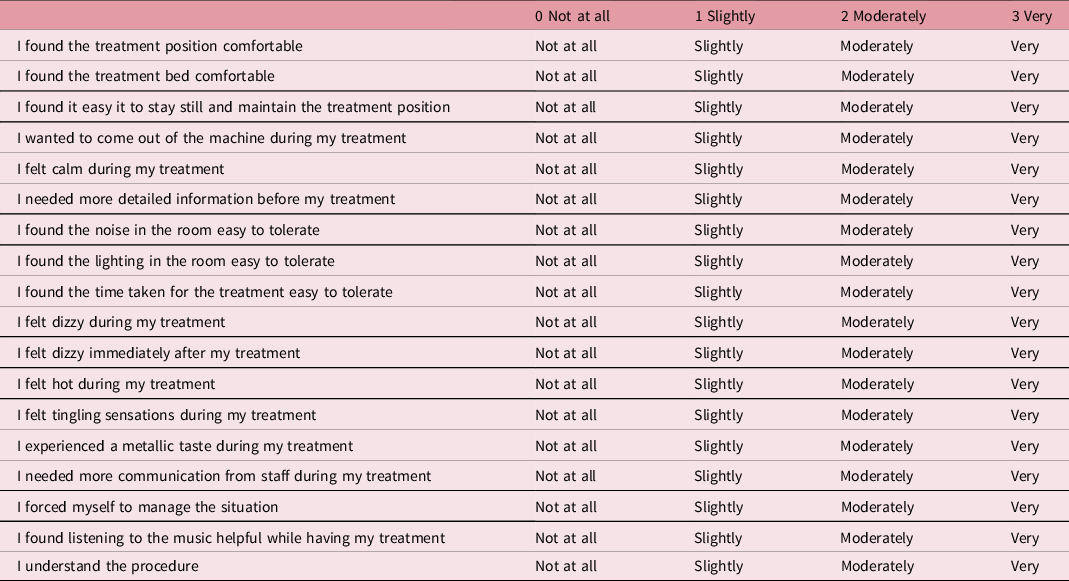
The included questionnaire was developed by McNair and colleagues and adapted from questionnaires created by Ahlander et al. Reference Ahlander, Årestedt, Engvall, Maret and Ericsson33 and Olausson et al. Reference Olausson, Holst Hansson, Zackrisson, Edvardsson, Östlund and Nyholm8 The resulting 18 items generated have subsequently been validated as a tool for accurately reporting patient experience on the MR Linac Reference Barnes, Alexander and Bower34 (Table 1). The questionnaire contains qualitative and quantitative information on coping and discomfort, primarily relating to a range of physical and environmental factors inherent to MR and RT, respectively. Patient responses were recorded on a 4-point Likert scale, 0 denoting a response of ‘Not at all’, 1 ‘Slightly’, 2 ‘Moderately’ and 3 signifying ‘Very’. Questionnaires were distributed on the patient’s first and last fraction, allowing analysis of changes in attitudes and opinions between the two time points. Patients unable to read and write in English were ineligible to take part in the study due to a lack of translational material. No patient demographic data was collected as part of the study.
Eighteen-item patient experience questionnaire
Comments:
Questionnaire developed by Helen A McNair, adapted from Olausson et al., Technical Innovations & Patient Support in Radiation Oncology, 2017 and Ahlander et al. Journal of Advanced Nursing.
Parametric methods were used in the analysis of results as the distance between Likert responses was approximately equal across the range of answers. Two sample t-tests were used to compare mean Likert responses for the 2 modalities, and paired t-tests were used to assess change in Likert responses between fraction 1 and fraction 20. A significance level of p < 0·01 was used in order to offset the increased chance of false positives due to multiple statistical tests used. Analysis was performed using Stata version 16.
Results
Forty patients in total participated in this study from both the MR Linac (n = 20) and conventional CBCT linacs (n = 20). All patients received 20 fractions of radiotherapy with a total dose of 6000 cGY. Average treatment length on a conventional linac was 14 minutes (range 8–22 minutes). For the MR Linac cohort, the average treatment length was 39 minutes (range 33–43 minutes).
Comparison of modalities
The differences between the MR Linac and CBCT mean Likert responses were small, ranging from 0·56 to −0·30 across the 18 questions. None of the 2 sample t-tests comparing these mean responses were statistically significant at the 0·01 level. However, there are some trends worth noting.
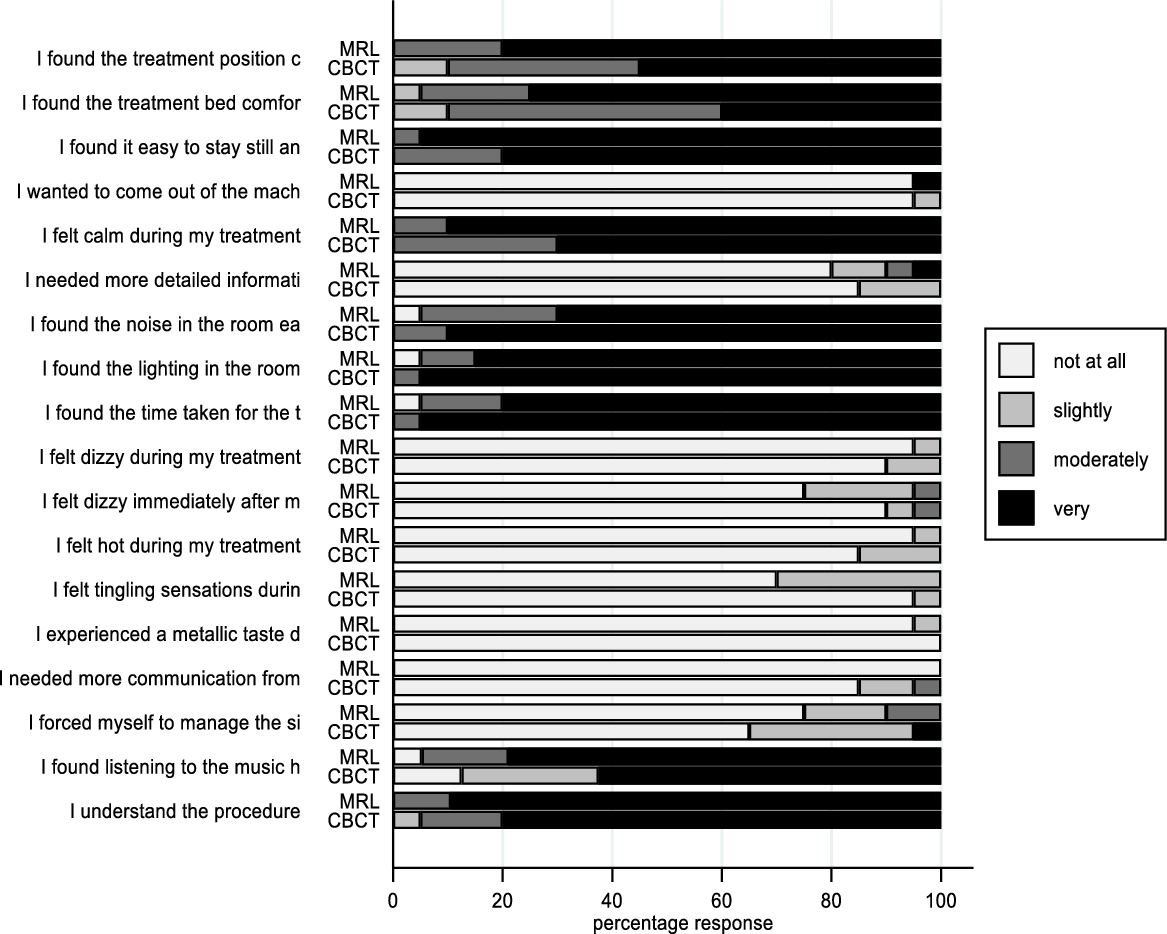
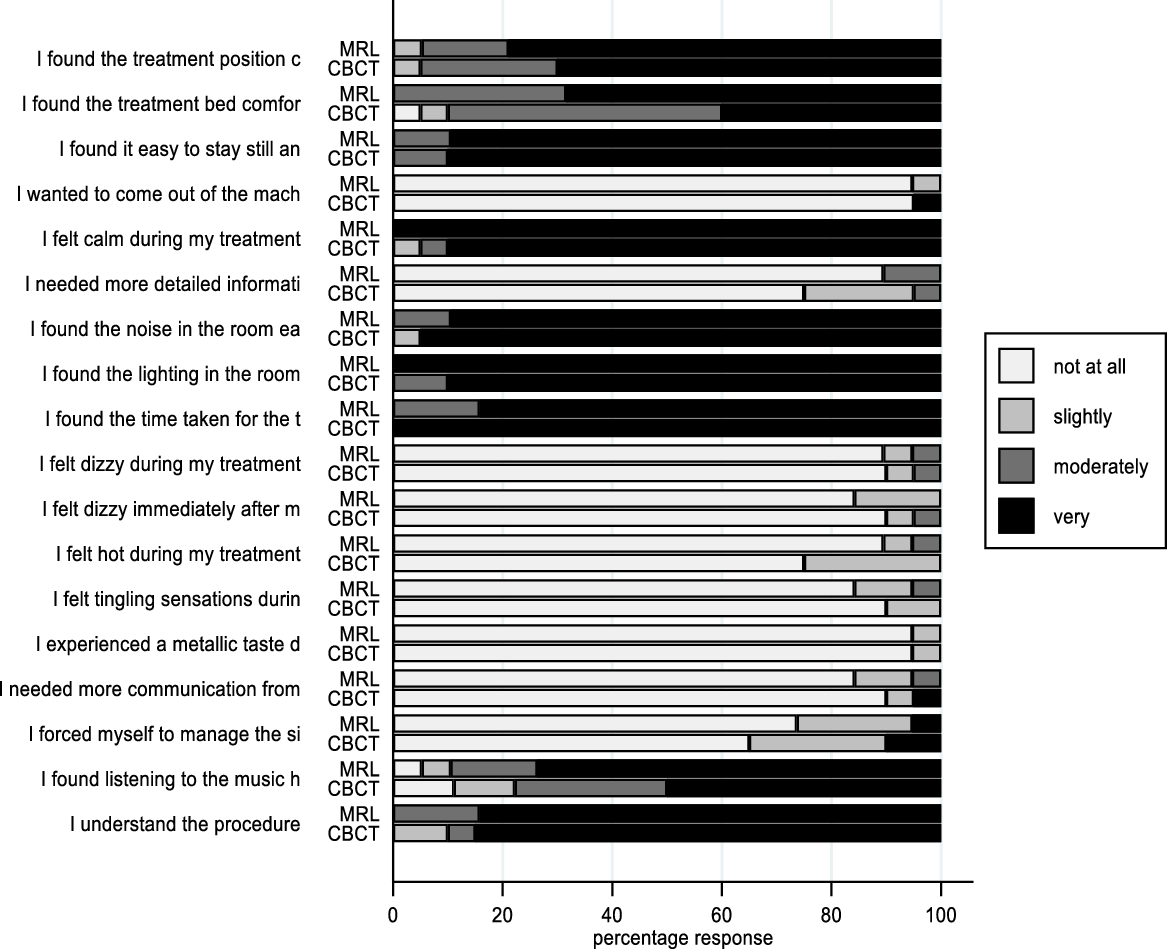
At each measured time point, the mean Likert response for question 2 ‘I found the treatment bed comfortable’ was higher for the MR Linac patients compared to CBCT treatment, indicating a more favourable opinion of the MR Linac treatment couch. The differences between mean response for question 2 were 0·40 (95% CI: 0·01, 0·79, p = 0·047) for fraction 1 and 0·43 (95% CI: 0·01, 0·86, p = 0·045) for fraction 20. For question 9, ‘I found the time taken for the treatment easy to tolerate’ the mean responses were consistently reported in favour of CBCT-based treatment for both fractions 1 and 20, −0·25 (95% CI: −0·60, 0·10, p = 0·153) and −0·16 (95% CI: −0·33, 0·01, p = 0·067), respectively. Patients in the MR Linac cohort deemed listening to music during treatment (Q. 17) more helpful than the CBCT cohort and this opinion remained static for the two time points measured, with a difference in mean response for fraction 1 of 0·56 (95% CI: −0·12, 1·24, p = 0·103) and 0·41 (95% CI: −0·22, 1·04, p = 0·192) for fraction 20. Patients on the MR Linac also reported tingling sensations at higher rates than their CBCT counterparts (Q. 13) with a difference in mean response of 0·25 (95% CI: 0·01, 0·49, p = 0·038), but also expressed feeling calm during their treatment (Q. 5) session at comparatively higher levels. The differences between mean response for question 5 were 0·20 (95% CI: −0·05, 0·45, p = 0·120) at fraction 1, and 0·15 (95% CI: −0·08, 0·38, p = 0·190) for fraction 20. At fraction 1, the MR Linac cohort expressed the need for fewer communication requirements (Q15) than the patients undergoing CBCT, with a mean difference in scores of −0·20 (95% CI: −0·44, 0·04, p = 0·095); however, by fraction 20, this disparity had all but disappeared (mean: 0·01, 095% CI: −0·39, 0·41, p = 0·958). Figures 1 and 2 compare Likert responses for the 2 cohorts, for fractions 1 and fraction 20, respectively.
Percentage Likert scale of CBCT and MR Linac cohort responses fraction 1.
Percentage Likert scale of CBCT and MR Linac cohort responses fraction 20.
Comparison of first to last treatment
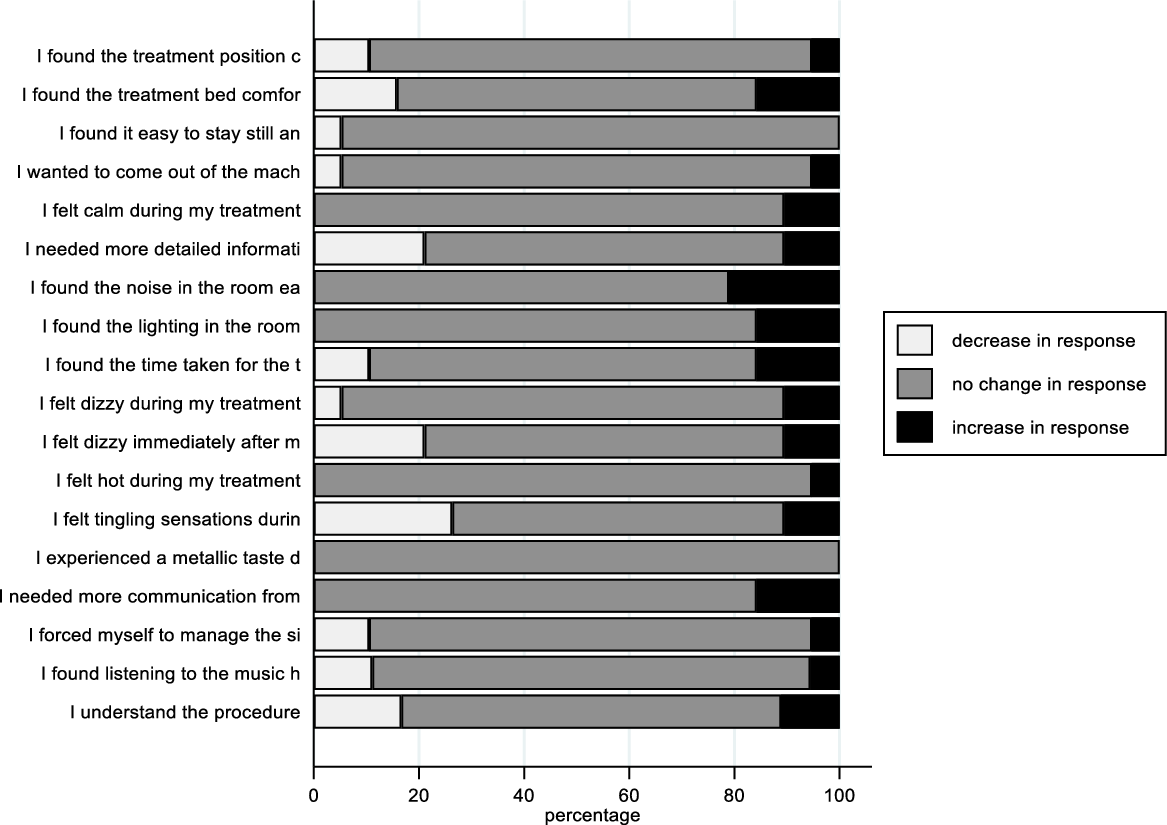
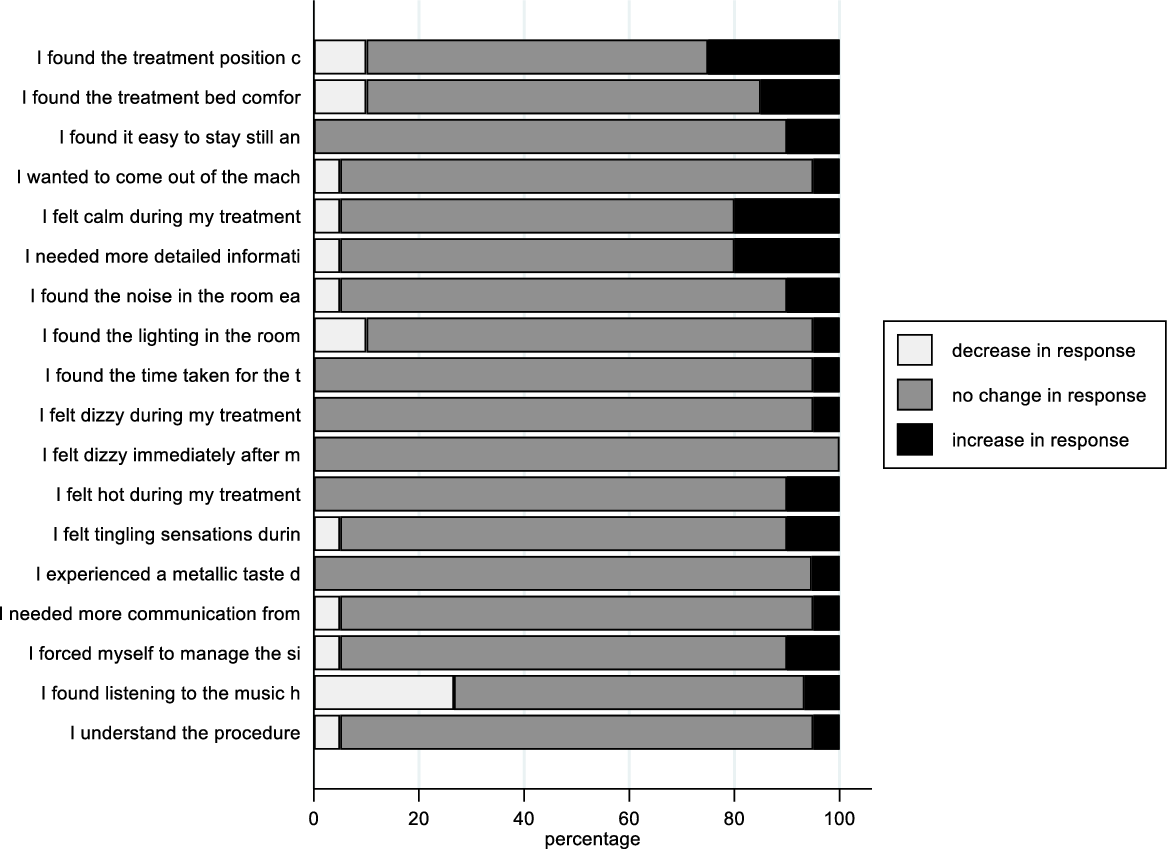
Mean change from fraction 1 to fraction 20 ranged from 0·32 to −0·16 for the MR Linac cohort and from 0·20 to −0·13 for CBCT, across the 18 questions. None of the paired t-tests comparing these mean changes to 0 were statistically significant at the 0·01 level.
On the whole, responses for all items remained stable between first and last fraction, for both modalities. The largest trend identified related to question 7 ‘I found the noise in the room easy to tolerate’, the mean difference between Likert responses for fractions 1 and 20 in the MR Linac cohort being 0·32 (95% CI: −0·02, 0·65, p = 0·083). This indicates that some patients found the noise in the room easier to tolerate at fraction 20 compared to fraction 1. Of note, within this cohort, the requirement for communication during treatment (Q15) increased between the start and end of treatment with the mean difference in the Likert score being 0·21 (95% CI: −0·03, 0·45, p = 0·104).
Question 4 ‘I wanted to come out of the machine during my treatment’ showed no significant mean change in Likert response for either the MRL − 0·11 (95% Cl: −0·44, 0·23, p = 0·54) or CBCT 0·10 (95% Cl: −0·21, 0·41, p = 0·54) cohort between the first and last fractions. Congruent with this, there was no premature scan terminations reported from either cohort throughout the treatment duration. Three MR Linac patients had incomplete data, including one patient who failed to complete the final fraction questionnaire. Five CBCT patients failed to answer individual questions, the vast majority related to the question ‘I found listening to music helpful whilst having my treatment’, likely because no music was playing during their treatment. Patients were omitted from analysis for which their responses were missing.
Overall, results suggest that whether PCa treatment is delivered on a conventional CBCT linac or the MR Linac, there is very little difference in patient experience with minimal temporal variation within a single modality (Figures 3 and 4). No useful qualitative information relating to patient experience was ascertained from the questionnaires and therefore this has not been included within the study results.
Percentage scale of response change for MR Linac patients between fractions 1 and 20.
Percentage scale of response change for CBCT patients between fractions 1 and 20.
Discussion
Since patients disproportionately focus upon the potential adverse impact of treatment and procedural discomforts when making care-focused decisions, Reference Kao, Aranda, Krishnasamy and Hamilton35,Reference Covvey, Kamal and Gorse36 it is valuable to know that there is little variation between treatment as experienced on a CBCT-based conventional linac, when compared to the MR Linac. There is a paucity of research describing the experience of patients treated on hybrid MR linear accelerators. Those few that do exist suggest the technique is well tolerated, Reference Tetar, Bruynzeel and Bakker21,Reference Barnes, Alexander and Bower34,Reference Klüter, Katayama and Spindeldreier37,Reference Andratschk, Day and Schüler38 however, all fail to compare findings across modalities.
Aligned with the high level of acceptance as evidenced by patients willing to remain in the machine bore for a sustained period (Q.4), our study reported no premature scan terminations from the MR Linac cohort. Such claustrophobic events have been shown to correlate with the area of the body being imaged, with lower extremity and pelvic scans showing the least non-completions. Reference Munn, Moola, Lisy, Riitano and Murphy39 Likewise, it is well documented that when the head and neck are immobilised in a thermoplastic shell, the level of anxiety and therefore propensity for such events increases dramatically. Reference Sharp, Lewin, Johansson, Payne, Gerhardsson and Rutqvist40–Reference Nixon, Brown and Pigott43 Since our cohort had their pelvic region treated with their upper body relatively free of restraint, generalisations from these results should therefore not be readily applied to other cohorts of patients treated on the MR Linac for disparate disease sites. Furthermore, since our sample of patients had already undergone MRI scans as part of their diagnostic and treatment pathway, it is likely the patients in this study were already familiar and relatively comfortable with the MR environment. Consequently, since the sample was not randomised between the two interventions, more nervous patients may have opted for CBCT radiotherapy and in turn this could have influenced responses to the questionnaire.
More patients from the MR Linac cohort found both the treatment bed and treatment position comfortable on both their first and last fractions when compared with the CBCT cohort. This is likely a result of the slight variation in immobilisation and thin foam mattress used for MR Linac-based treatment. There is the potential that any further gains in comfort may have been negated by the longer time spent maintaining the position for the MR Linac cohort. This corroborates that, when asked whether the time taken for treatment was easy to tolerate, the MR Linac patients answered less favourably than their CBCT counterparts. The merit of a longer, but potentially more comfortable treatment session on the MR Linac is yet to be investigated in relation to treatment accuracy and patient compliance. One centre-specific variable which may have lessened a potential source of discomfort experienced is that the author’s institution employs an empty bladder protocol for this patient group. It has been shown that a substantial source of patient anxiety may arise from the requirement to hold a full bladder for the treatment duration. Reference Sutton, Lane and Davis44 The effect of this untested scenario with regard to longer treatment fractions on the MR Linac may therefore be more explicit in other centres employing this preparation. Of note, the MR Linac cohort reported modestly more experience of tingling sensations throughout the treatment duration; however, this does not appear to have significantly impacted on their relative comfort levels. For this particular cohort, in which short sequences devoid of rapidly switching gradients are employed means this could be expected. For future patient groups with more intensive functional acquisitions, this question will need to be re-addressed. Of note, one limitation of the study is that researchers were more likely to find higher levels of tingling in the MR cohort since it is not a reported complication of CBCT treatment. This is true for a number of questions, for example, the experience of a metallic taste, however, to omit such incidences from the questionnaire tool would exclude information pertinent to patient tolerability.
Although not investigated in this study, the holistic view of patient experience suggests that there may be a relationship between anxiety and the psychological and physical determinants of comfort, with patients who are more anxious at treatment less likely to tolerate maintaining a treatment position. Reference Clover, Oultram, Adams, Cross, Findlay and Ponman45 PCa patients generally report relatively low levels of anxiety at baseline compared to patients from other disease sites, Reference Cox and Davison46 and this may be a factor in the perceived indifference to the change of treatment environment between the two modalities. Similar PCa patient apathy to positional variations and novel immobilisation devices has been reported in the literature. Reference Cox and Davison46,Reference Nutting, Khoo and Walker47 The concept of passivity has been used to describe how patients may cope with unpleasant treatment situations, sacrificing comfort for medical necessity. This heightened level of acceptability has been reported to be more prominent in males, Reference Grassi, Johansen and Annunziata48,Reference Cardoso, Graca, Klut, Trancas and Papoila49 with levels of anxiety often found to be higher in their spouses, Reference Couper, Bloch, Love, Macvean, Duchesne and Kissane50 a possible consequence of hegemonic masculinity. Reference Goldsworthy, Tuke and Latour51 Across the cancer spectrum this may be applied to explain the relatively low uptake of males to seeking cancer information provision, Reference McCaughan, Prue, McSorley, Northouse, Schafenacker and Parahoo52 support services Reference Oliffe, Ogrodniczuk, Bottorff, Hislop and Halpin53,Reference Hedden, Pollock, Stirling, Goldenberg and Higano54 and notably the propensity for our patient sample to disproportionately choose the most extreme favourable response to any given question. The literature reports that regular communication with patients is an effective way to reduce their anxiety regarding radiotherapy immobilisation and treatment, especially at the first fraction. Reference Merchant, O’Connor and Halkett16,Reference Nixon, Cartmill and Turner42 In our study, there was no significant shift in the desire for information provision between modalities or treatment time points. This was perhaps because on the MR Linac, patients were routinely spoken to at multiple time points throughout the treatment duration. On the CBCT units, this was not employed for this patient group since the treatment duration was significantly shorter by comparison.
Due to the relative age and nature of disease, our patient sample was unlikely to be in pain or suffering from significant comorbidities which may have made the treatment less tolerable. Reference Andratschk, Day and Schüler38 This is positive, since it means that the difference in environment and experiential factors between the two modalities will have been judged more objectively, without the influence of patient-specific confounding factors. The provision of music between the two patient cohorts was not tightly controlled in this study and did differ across modalities. This variation, while reflective of the real clinical practice, could potentially have impacted the macrocosmic perception of treatment. However, multiple studies have been unable to find a significant link between music interventions and a subjective experience of radiation treatment. Reference Smith, Casey, Johnson, Gwede and Riggin55–Reference O’Callaghan, Sproston and Wilkinson57 The lack of qualitative data points within this research imposes limits on important, useable data that could have been generated. Future studies should aim to make more explicit use of such data sources in order to add depth to feedback.
This study has reported on the experience of a specific cohort of patients undergoing radiotherapy on two different treatment modalities. Future research in this field should expand on this work to include other disease sites, where variations in imaging duration, levels of comorbidity and immobilisation may elicit more significant differences in response.
Acknowledgements
The authors gratefully acknowledge support from Elekta, the NIHR Manchester BRC, Manchester CRN, ARTNET and the work of Helen McNair and The Royal Marsden NHS Foundation Trust in developing the patient experience questionnaire upon which this study is based.



