
Introduction
Nanoscale platinum (Pt) catalysts are essential components in a wide variety of industrial, environmental, and synthetic applications. Pt nanoparticles (NPs) have been well established as one of the most efficient materials for a diverse array of catalytic applications, including performance in polymer electrolyte and direct methanol fuel cells, non-linear optics, photonics, information storage, and a wide variety of chemical and biological sensing applications.[ Reference Wang, Daimon, Onodera, Koda and Sun 1 – Reference Leong, Schulze, Strand, Maloney, Frisco, Dinh, Pivovar and Richards 5 ] Nanoscale Pt catalysts also have extremely high activity for redox reactions that include hydrogen and oxygen reduction as well as methanol, carbon monoxide, and formic acid oxidation.[ Reference Wang, Daimon, Onodera, Koda and Sun 1 , Reference Leong, Schulze, Strand, Maloney, Frisco, Dinh, Pivovar and Richards 5 ] This excellent catalytic ability makes nanoscale Pt indispensable for photocatalytic water splitting, C–C hydrogenation and bond formation, and photodegradation of organic pollutants.[ Reference Long, Chien, Hayakawa, Hirata, Lakshminarayana and Nogami 3 , Reference Chen, Lim, Lee and Xia 6 ] The efficiency of catalyzed redox and water-splitting reactions is greatly increased by characteristics intrinsic to nanoscale Pt, such as an increased number of active atoms at edges and corners and an increase in available catalytically active surface area.[ Reference Bonnemann and Khelashvili 7 ] The size and shape of Pt NPs can be controlled to select for specific catalytic reactions, and can also influence interparticle interactions, self-assembly, dielectric properties, and light absorption and scattering.[ Reference Wang, Daimon, Onodera, Koda and Sun 1 , Reference Kang, Li, Cai, Cargnello, Diaz, Gordon, Wieder, Adzic, Gorte, Stach and Murray 8 – Reference Rostamzadeh, Adireddy and Wiley 10 ] In particular, small (<10 nm) Pt nanocrystals offer a variety of benefits such as solvent dispersibility, production of a localized surface plasmon resonance, and facet-selective catalytic enhancements.[ Reference Long, Thi, Nogami and Ohtaki 4 , Reference Leong, Schulze, Strand, Maloney, Frisco, Dinh, Pivovar and Richards 5 , Reference Gharibshahi and Saion 11 , Reference Wang, Daimon, Lee, Kim and Sun 12 ] Those with a cubic morphology are useful for selectively promoting the hydrogen evolution reaction, and show an increased tendency toward self-assembly that may benefit applications in plasmonics and sensing.[ Reference Long, Thi, Nogami and Ohtaki 4 , Reference Leong, Schulze, Strand, Maloney, Frisco, Dinh, Pivovar and Richards 5 , Reference Kang, Li, Cai, Cargnello, Diaz, Gordon, Wieder, Adzic, Gorte, Stach and Murray 8 , Reference Rostamzadeh, Adireddy and Wiley 10 ] Highly dispersible Pt NPs offer increased flexibility for constructing nanoarchitectures for catalysis, expanding the functional possibilities of the NPs beyond deposition onto a substrate and facilitating their incorporation into more diverse constructs.[ Reference Peng and Yang 2 ] Colloidal Pt NPs have been incorporated into mesoporous oxide and silica matrices via capillary inclusion and NP encapsulation methods to make highly efficient heterogeneous catalysts.[ Reference Leong, Schulze, Strand, Maloney, Frisco, Dinh, Pivovar and Richards 5 , Reference Kang, Li, Cai, Cargnello, Diaz, Gordon, Wieder, Adzic, Gorte, Stach and Murray 8 , Reference Kang, Pyo, Ye, Diaz, Gordon, Stach and Murray 13 , Reference Rioux, Song, Grass, Habas, Niesz, Hoefelmeyer, Yang and Somorjai 14 ] The high loading selectivity enabled by these NPs is ideal for controlling and minimizing catalyst loadings, which can significantly impact the durability, cost-effectiveness, and performance of fuel cells.[ Reference Long, Thi, Nogami and Ohtaki 4 , Reference Miyabayashi, Nakamura and Miyake 15 ]
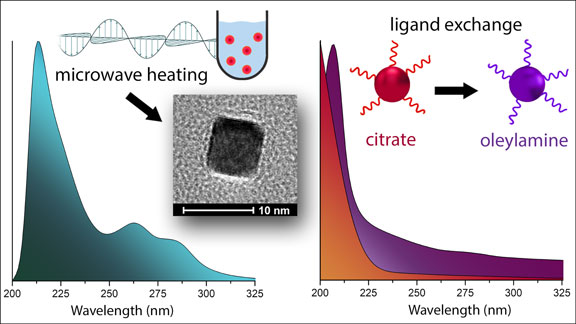
Despite the widespread use of nanoscale Pt for catalysis, only a few facile synthetic strategies for producing monodispersed Pt NPs have been reported.[ Reference Leong, Schulze, Strand, Maloney, Frisco, Dinh, Pivovar and Richards 5 , Reference Kang, Pyo, Ye, Diaz, Gordon, Stach and Murray 13 ] While high-temperature organic-phase synthesis methods can produce highly crystalline Pt NPs, these methods rely on the toxic Fe(CO)5 to facilitate nucleation and are not consistently repeatable.[ Reference Wang, Daimon, Onodera, Koda and Sun 1 , Reference Wang, Daimon, Lee, Kim and Sun 12 , Reference Kang, Pyo, Ye, Diaz, Gordon, Stach and Murray 13 , Reference Dahal, García, Zhou and Humphrey 16 ] Our studies on creating an alternative approach for a safe, facile, and reproducible synthesis found that highly crystalline, shape-controlled, dispersible Pt NPs could be reliably produced using a “one pot” microwave (MW) heating method. MWs have been significant to chemistry applications as diverse as analytical, biochemistry, assembly of catalytic heterostructures, organometallics, polymers, and organic synthesis.[ Reference Hayes 17 ] MW methods allow the rapid transfer of energy directly to the reaction, utilizing localized instantaneous superheating to quickly and efficiently heat solvents.[ Reference Hayes 17 , Reference Baghbanzadeh, Carbone, Cozzoli and Kappe 18 ] This results in a significant reduction in reaction times as well as increased ability to fine-tune reaction parameters. Since it is well documented that the formation of Pt NPs is extremely sensitive to changes in temperature, the greater degree of control offered by MW heating allows a much greater tunability of both NP size and shape.[ Reference Kang, Li, Cai, Cargnello, Diaz, Gordon, Wieder, Adzic, Gorte, Stach and Murray 8 , Reference Dahal, García, Zhou and Humphrey 16 , Reference Baghbanzadeh, Carbone, Cozzoli and Kappe 18 ] Previously, MW syntheses of Pt NPs have been reported, but these have not produced highly crystalline or morphologically selected NPs.[ Reference Komarneni, Li, Newalkar, Katsuki and Bhalla 19 – Reference Wang, Ren, Deng, Gui and Tang 21 ]
Recent interest in the use of Pt NPs for advanced applications such as plasmonic photocatalysis has encouraged a renewed focus on conducting detailed optical characterization of high-quality particles. Optical studies of noble metal NPs typically reference a standard calculated absorbance spectrum when analyzing their observed spectra; the widely cited 1991 study by Creighton and Eadon is considered the reference standard for the calculated spectra of metallic NPs.[ Reference Creighton and Eadon 22 ] Their approach used equations derived from Mie theory and the Drude model to predict the ultraviolet (UV) and visible (Vis) absorbance spectra for NPs of 52 different metallic elements and accounts for such variables as NP size, solvent refractive index, and the wavelength-dependent complex dielectric constants ɛ 1 and ɛ 2. Resulting values for the absorbance cross-section (C) and molar absorption coefficient (α) of each metal were then used to simulate absorbance spectra in the UV and visible ranges. Modeling of 10 nm spherical Pt NPs in water predicted an absorbance spectrum with a well-defined plasmonic absorbance peak at 215 nm.[ Reference Creighton and Eadon 22 ]
Despite the widespread acceptance and accuracy of Creighton and Eadon's calculated spectra for other noble metal NPs, those for Pt NPs remain widely disputed and inconsistent.[ Reference Duff, Edwards and Johnson 23 – Reference Henglein, Ershov and Malow 25 ] This warranted further investigation to determine the possible causes of this inconsistency, as well as to find any optical data for the type of high-quality, faceted Pt NPs used in catalytic studies. To the best of the authors’ knowledge, published methods that produce highly crystalline, dispersible Pt NPs give detailed catalytic data but exclude any type of optical data. Detailed optical studies of Pt NPs tend to use synthesis methods such as citrate stabilization and polyol reduction; while these are known to produce quality Au and Ag NPs, the corresponding Pt NPs exhibit low crystallinity and irregular spherical morphology.[ Reference Wang, Ren, Deng, Gui and Tang 21 , Reference Duff, Edwards and Johnson 23 , Reference Furlong, Launikonis, Sasse and Sanders 24 ] The vast majority of these optical studies on small (≤10 nm) Pt NPs report a broad, featureless absorbance spectrum over the entire range of 200–800 nm. In contrast, several groups report observing the predicted LSPR absorbance peak at 215 nm from colloidal 10 nm Pt nanospheres that were produced by alternative methods such as radiolytic and hydrogen reduction.[ Reference Henglein, Ershov and Malow 25 , Reference Rivadulla, Vergara, Blanco, Lopez-Quintela and Rivas 26 ]
The benefits of a NP that possesses good size and shape tunability as well as high catalytic activity have motivated increased studies on the synthesis, utilization, and optical properties of sub-10 nm Pt NPs for plasmonic and photocatalytic applications.[ Reference Shiraishi, Tsukamoto, Sugano, Shiro, Ichikawa, Tanaka and Hirai 27 , Reference Zhang, Han, Xu, Foley, Zhang, Codrington, Gray and Sun 28 ] It is clear that understanding the optical properties and plasmonic characteristics of small Pt NPs is important to the development of advanced catalytic materials. Moreover, the extreme sensitivity of the Pt plasmonic response to the NP surface exemplifies the importance of promoting a facile synthesis method for highly crystalline, well-dispersed Pt NPs in the sub-10 nm size range. Herein we describe such a facile and reproducible synthesis method for the production of 8 nm Pt nanocubes along with optical data that strongly support a plasmonic character for the well-defined absorbance peak observed at 213 nm.
Experimental section
Materials
Oleylamine (OAm) (technical grade, 70%), Pt(II) acetylacetonate [Pt(acac)2] (97%), L-ascorbic acid (≥99%), and trisodium citrate dihydrate (≥99%) were purchased from Sigma-Aldrich. A dispersion of commercially produced Pt NPs was also purchased from Sigma-Aldrich. Toluene (certified ACS, 99.8% anhydrous), hexane (95% anhydrous), and absolute ethanol (200 proof) were purchased from the Fisher Scientific.
Synthesis of Pt NPs via MW heating
Determination of the optimum parameters for producing 8 nm cubic Pt NPs using MW heating was conducted by systematically varying reaction time and temperature. Time and temperature parameters were set using the T260 EasyCONTROL software, which provided the user interface to the instrument. MW synthesis was performed using a Milestone StartSYNTH Microwave Synthesis Labstation (Milestone Srl, Italy) equipped with a single magnetron generator with a rotating diffuser operating at 2.45 GHz, and a microprocessor-controlled power output of up to 1200 W. Temperature control was achieved by the instrument based on input from a contact-less internal infrared sensor. Reaction temperatures in the range 125–150 °C were examined, with trials for each temperature conducted for 30, 45, and 60 min. Maximum power and ramp rate could also be varied through the software, but in our study these were held at constant levels in order to allow focus on the parametric examination of time and temperature effects. For all trials, a maximum power setting of 1200 W and a ramp rate of 3.5 °C/min was used, with temperature elevation rate controlled via applied power from the instrument. Samples were prepared by inserting a MW-absorbing Weflon™ (graphite-doped Teflon) button and PTFE-coated magnetic stir bar into an empty 15-bar StartSYNTH glass reaction vessel. Use of the Weflon™ button was necessary due to the inability of the non-polar solvent toluene to effectively absorb MW radiation. Two hundred micrograms Pt(acac)2 (0.5 mmol), 50 mg L-ascorbic acid (0.28 mmol), 5 mL OAm (15 mmol), and 5 mL toluene (45 mmol) were added to the reaction vessel. The initial mixture was magnetically stirred at 650 rpm for 1 min prior to insertion into the MW, after which the reaction vessel was sealed and secured within the rotor body of the StartSYNTH Microwave Synthesis Labstation. To ensure optimal distribution of heat and chemical species throughout the reaction mixture, magnetic stirring at 650 rpm was set via the T260 EasyCONTROL software and maintained consistently throughout the reaction by the instrument's internal magnetic rotor. After the reaction, the vessel was cooled to room temperature at 10 °C/min. Caution: One should inspect glass MW vessels before each reaction; glass defects might lead to hotspots and result in an explosion. Dark brown Pt NPs were isolated from solution by adding 25 mL EtOH to the product, followed by centrifugation for 10 min at 6000 rpm. The light yellow-brown supernatant was discarded and the precipitate was redispersed in toluene. This precipitation–redispersal procedure was repeated three times to obtain OAm-capped Pt NPs. Finally, the Pt NPs were dispersed in 15 mL of toluene and sonicated, then transferred to a glass scintillation vial.
Ligand exchange on commercial Pt NPs
To support the investigation of possible ligand quenching effects, a ligand exchange procedure was performed to replace the citrate capping ligands on the as-obtained commercial Pt nanospheres (C-NPs). These spherical C-NPs (Sigma-Aldrich, 99.99% trace metals basis) had an average size of 3.4 nm and were dispersed in an aqueous citrate buffer. The citrate surface groups were replaced with OAm capping ligands (found on the as-synthesized MW-NPs) to produce ligand-exchanged commercial NPs (LC-NPs). Details on the exchange procedure are presented in the Supporting Information.
Characterization
X-ray diffraction (XRD) data were collected on a Philips X'Pert diffractometer utilizing Cu Kα radiation (λ = 1.5418 Å) and a curved graphite monochromator at a voltage of 45 kV and a current of 40 mA. Peak positions of the Pt NPs diffraction patterns were compared with reference values to confirm face-centered cubic Pt.[ Reference Davey 29 ] Peak broadening was examined by measuring the full-width at half-maximum of the peak at ~40° 2θ in order to estimate NP size via the Scherrer formula.[ Reference Boita, Nicolao, Alves and Morais 30 ] For transmission electron microscopy (TEM) measurements, Pt NPs were dispersed in toluene, sonicated, and dropcast onto 200-mesh copper grids. Both standard and high-resolution TEM (HR-TEM) images as well as selected area electron diffraction (SAED) patterns were obtained using an FEI G2 F30 Tecnai Twin TEM at an accelerating voltage of 300 kV. For SAED imaging, a camera length of 630 mm was used. ImageJ software was used to obtain measurements of NP average size, size distribution, and standard deviation. The software was also used to analyze the lattice fringes present in HR-TEM images of Pt NPs in order to identify crystal facets.
Optical and vibrational spectroscopy measurements were collected for as-synthesized MW-NPs, as-obtained C-NPs, and LC-NPs. UV–Vis spectra were collected on a Cary 500 UV–Vis/NIR spectrometer in quartz cuvettes containing dilute suspensions either the MW-NPs (in hexane), the C-NPs (both as-obtained in citrate buffer, and after centrifugation and redispersal in DI water), or the LC-NPs (in EtOH). Note: Limitations in sample dispersibility caused by the capping ligands necessitated the use of different solvents in order to obtain high-quality optical data. Solvent effects are accounted for in the Mie theory-based equations that are used for the prediction and analysis of the optical properties of metals, and it has been established that varying solvent characteristics (composition, polarity, refractive index) do not have a significant effect on the optical spectra of sub-10 nm NPs. [ Reference Creighton and Eadon 22 ]
Analysis of UV–Vis spectra for Pt NPs was conducted using equations derived from the Mie theory, and experimental spectra were compared with calculated and observed spectra from the literature. Confirmation of ligand exchange was conducted via Fourier-transform infrared (FTIR) spectroscopy, which was performed using a Perkin Elmer System 2000 FTIR spectrometer.
Results
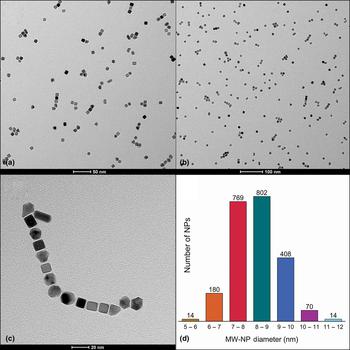
MW syntheses of the Pt(acac)2 precursor in toluene with OAm as a stabilizing agent and ascorbic acid as a mild reducing agent readily produced highly dispersible cubic Pt NPs with an average diameter of 8 nm [Figs. 1(a) and (b)]. Although octahedral and irregularly shaped NPs were observed under some conditions, the cubic morphology was predominant in all samples [Fig. 1(c)]. Optimal reaction conditions were determined by systematically varying reaction time and temperature, and then observing the impacts on NP size and morphology via TEM. It was determined that a 30 min reaction at 132 °C was the optimal condition, reliably producing samples with excellent dispersibility in non-polar solvents, a high prevalence of cubic morphology, and a narrow size distribution with an average diameter of 8.2(4) nm [Fig. 1(d)]. Systematic temperature variation showed that the lowest temperature (125 °C) produced the smallest Pt NPs, with an average size of 5.1(2) nm [Fig. S1(a)]. In general, temperatures at or below 130 °C produced morphologically polydispersed samples in which irregular, polycrystalline NPs were observed among significant increases and decreases of octahedral and cubic morphologies, respectively [Fig. S1(b)]. Studies to optimize the reaction time indicated that the reaction mixture must be held at the desired temperature for no less than 30 min to achieve good size and shape consistency throughout. Reaction times below 30 min produced a mixture of two distinct morphologies: smaller nanocubes and larger octahedra. Increasing the reaction time to 60 min at higher temperatures led to wider distributions of both size and morphology, with a greater proportion of irregular polyhedral NPs [Fig. S1(c)]. These samples also featured prominent areas of agglomerated particles [Fig. S1(d)]. The effects of reaction time and temperature on MW-NP size are summarized in Fig. S2.
(a, b) Transmission electron micrographs of MW-NPs synthesized via optimized reaction conditions of 132 °C and 30 min, (c) dominant cubic morphology with some irregular polyhedral morphology MW-NPs, (d) size distribution of MW-NPs at optimal reaction conditions.

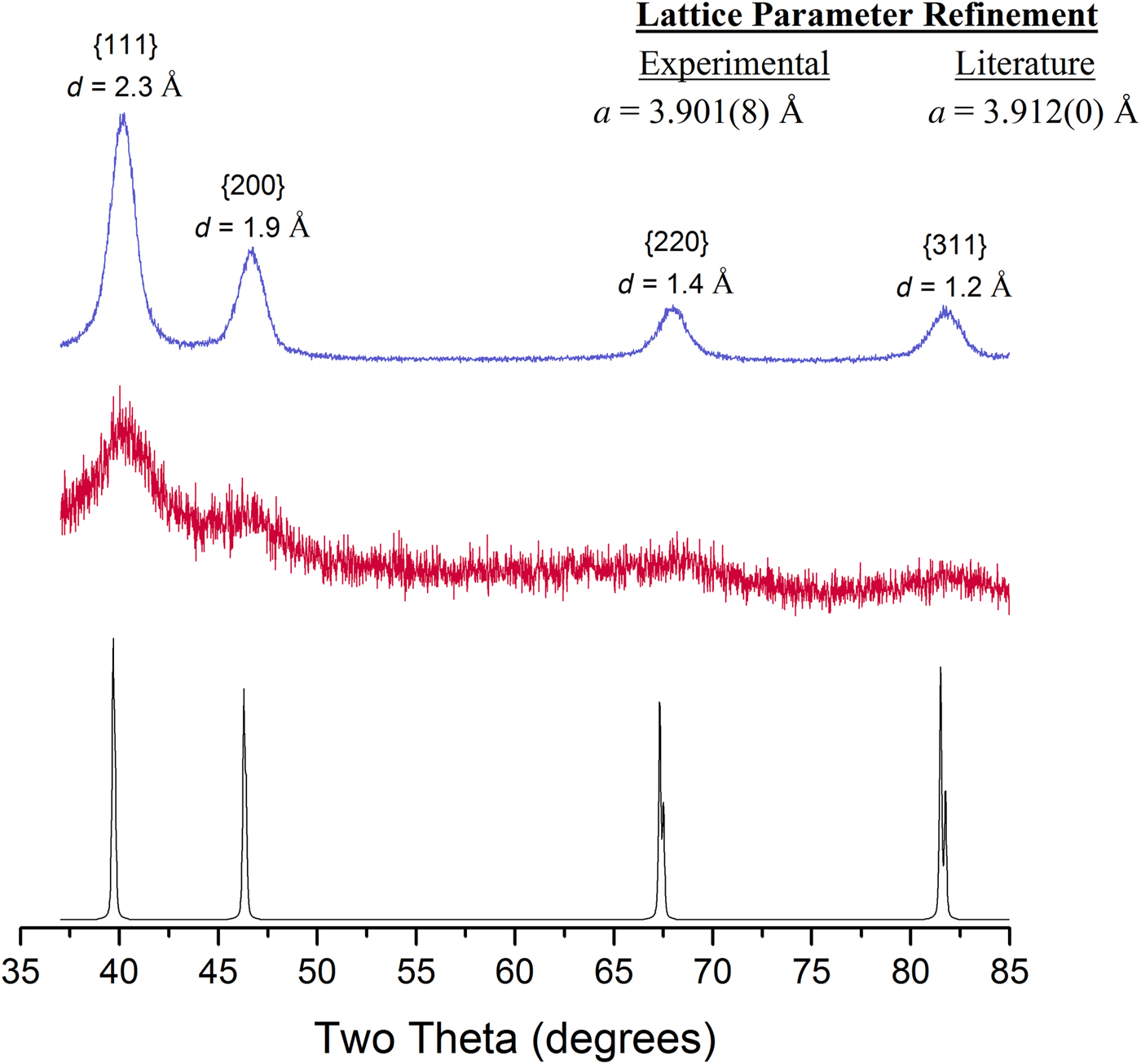
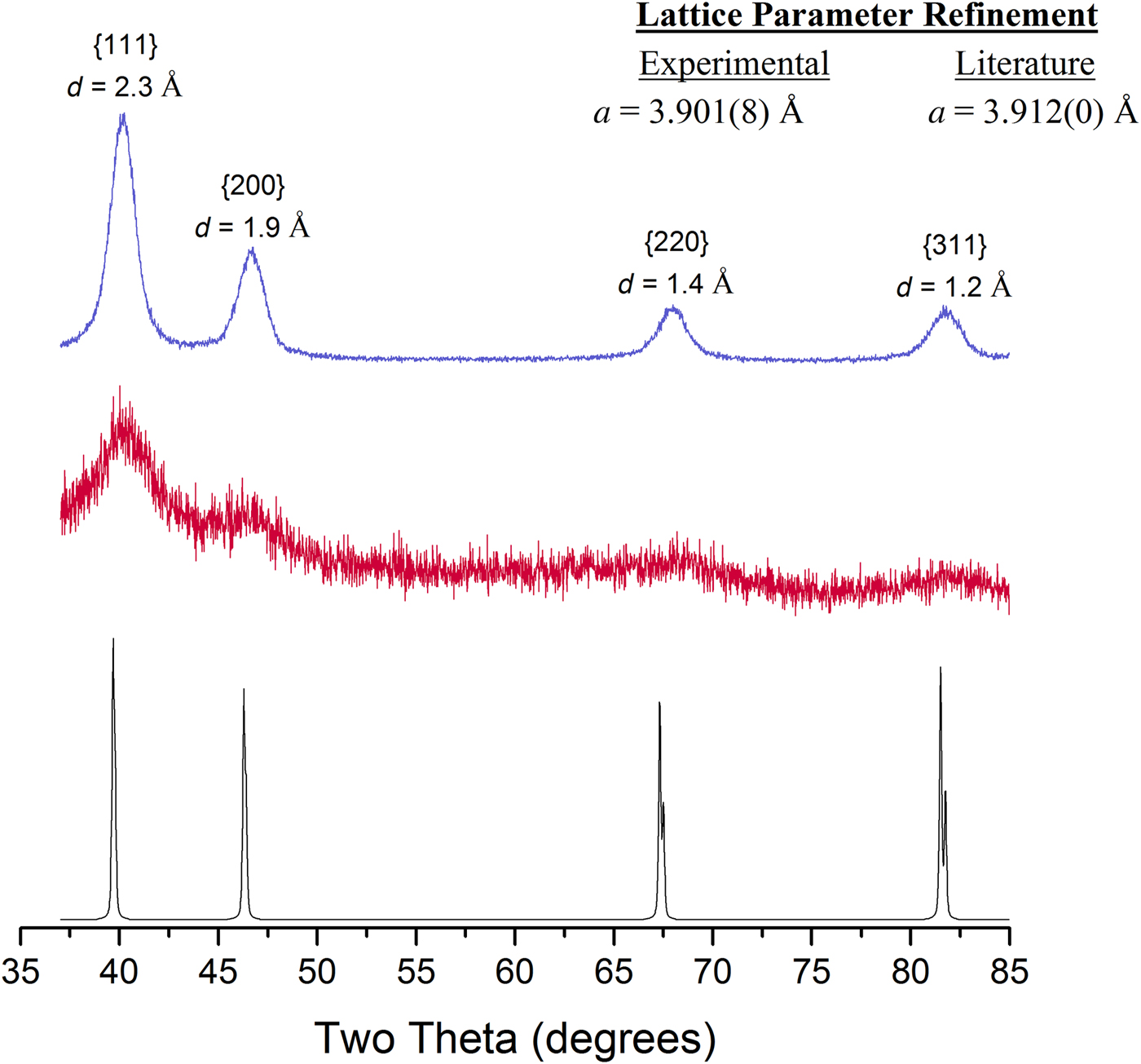
Characterization of NP composition and crystallinity was performed via XRD, TEM, and HR-TEM. Observed peak positions in the XRD patterns of samples were compared with those of a Pt reference pattern[ Reference Davey 29 ] to confirm the formation of face-centered cubic Pt (Fig. 2). XRD was also used to assess the crystallinity of the MW-NPs, and diffraction patterns of MW-NPs were compared with those of C-NPs. In Fig. 2, the MW-NP pattern shows diffraction peaks that are well defined and symmetrical, with peak intensities that correspond to a random three-dimensional ordering of polyhedral Pt NPs.[ Reference Zhang, Ding and Chow 31 ] In contrast, the spectra recorded for the C-NPs showed very broad peaks with lower intensities (Fig. 2), which is consistent with the smaller size and lack of well-defined crystallographic facets in the spherical particles.[ Reference Boita, Nicolao, Alves and Morais 30 ]
X-ray diffraction pattern of MW-synthesized 8 nm Pt nanocubes (top) compared with 3.4 nm commercial Pt NPs (middle) and the reference pattern for Pt* (bottom). *Adapted from Ref. [Reference Davey29], Phys. Rev., 1925.
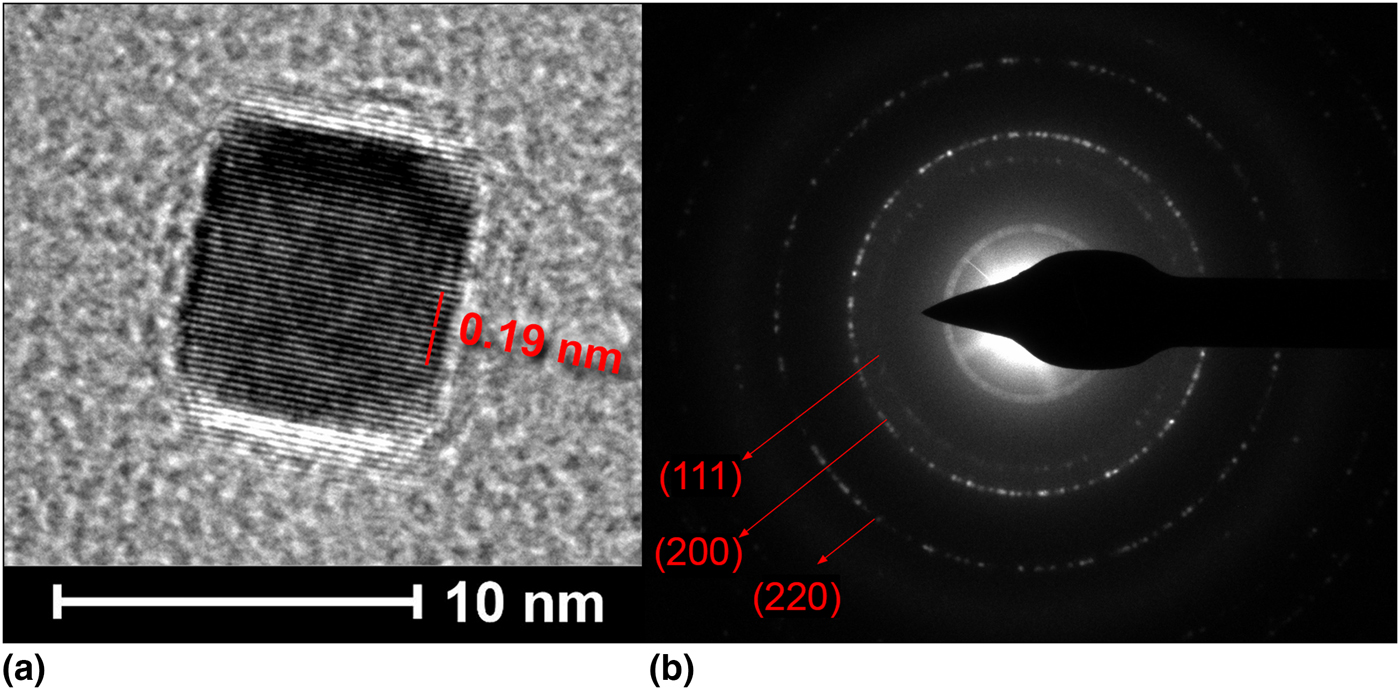
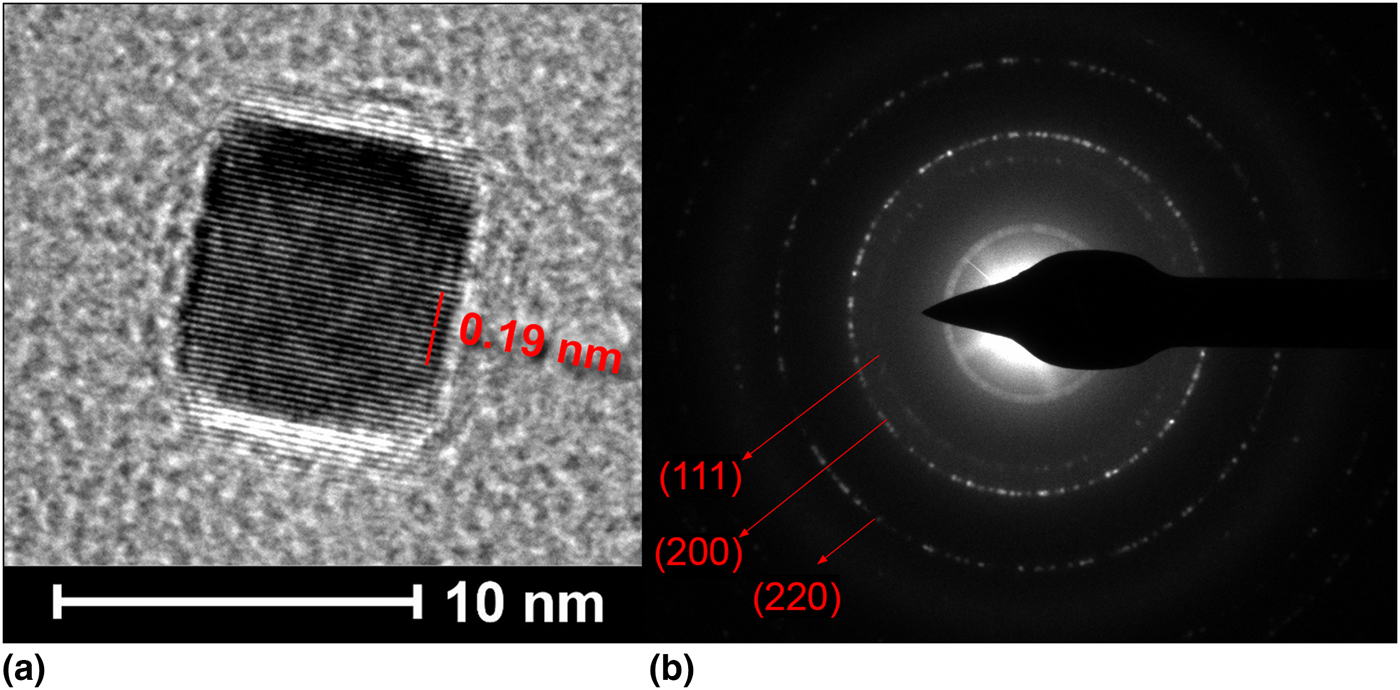
Morphological characterization and facet identification of the MW-NPs was conducted via HR-TEM and SAED imaging. Highly crystalline samples of Pt NPs are expected to display electron diffraction patterns that contain spectral features associated with the dominant morphological facets; for a small sample of cubic NPs, the dominant {100} facet should produce a bright electron diffraction ring with a radius corresponding to the 0.19 nm d-spacing of the (200) crystallographic plane.[ Reference Kang, Li, Cai, Cargnello, Diaz, Gordon, Wieder, Adzic, Gorte, Stach and Murray 8 , Reference Zhang, Ding and Chow 31 ] Additionally, unidirectional lattice fringes with 0.19 nm interfringe spacing should be observed on Pt nanocube surfaces under HR-TEM.[ Reference Kang, Li, Cai, Cargnello, Diaz, Gordon, Wieder, Adzic, Gorte, Stach and Murray 8 , Reference Zhang, Ding and Chow 31 ] HR-TEM images of the MW-synthesized nanocubes were indexed by measuring the spacing of the lattice fringe [Fig. 3(a)]. As expected, the average lattice spacing of 0.19 nm corresponded to the known value of the {100} facets that comprise the surfaces of cubic MW-NPs.[ Reference Kang, Li, Cai, Cargnello, Diaz, Gordon, Wieder, Adzic, Gorte, Stach and Murray 8 , Reference Zhang, Ding and Chow 31 ] SAED patterns of small groups of nanocubes were also indexed in order to confirm the formation of (200) planes in the nanocubes. The measured radii of the diffraction rings were consistent with the 0.23 and 0.19 nm spacings of the (111) and (200) planes, respectively [Fig. 3(b)].[ Reference Kang, Li, Cai, Cargnello, Diaz, Gordon, Wieder, Adzic, Gorte, Stach and Murray 8 , Reference Zhang, Ding and Chow 31 ]
(a) High-resolution transmission electron micrograph of a cubic MW-NP showing lattice fringe spacing that corresponds to the {100} surface of Pt, (b) selected area electron diffraction micrograph of several cubic MW-NPs with the brightest diffraction ring corresponding to expected (200) spacing. Both measurements support highly crystalline cubic morphology.
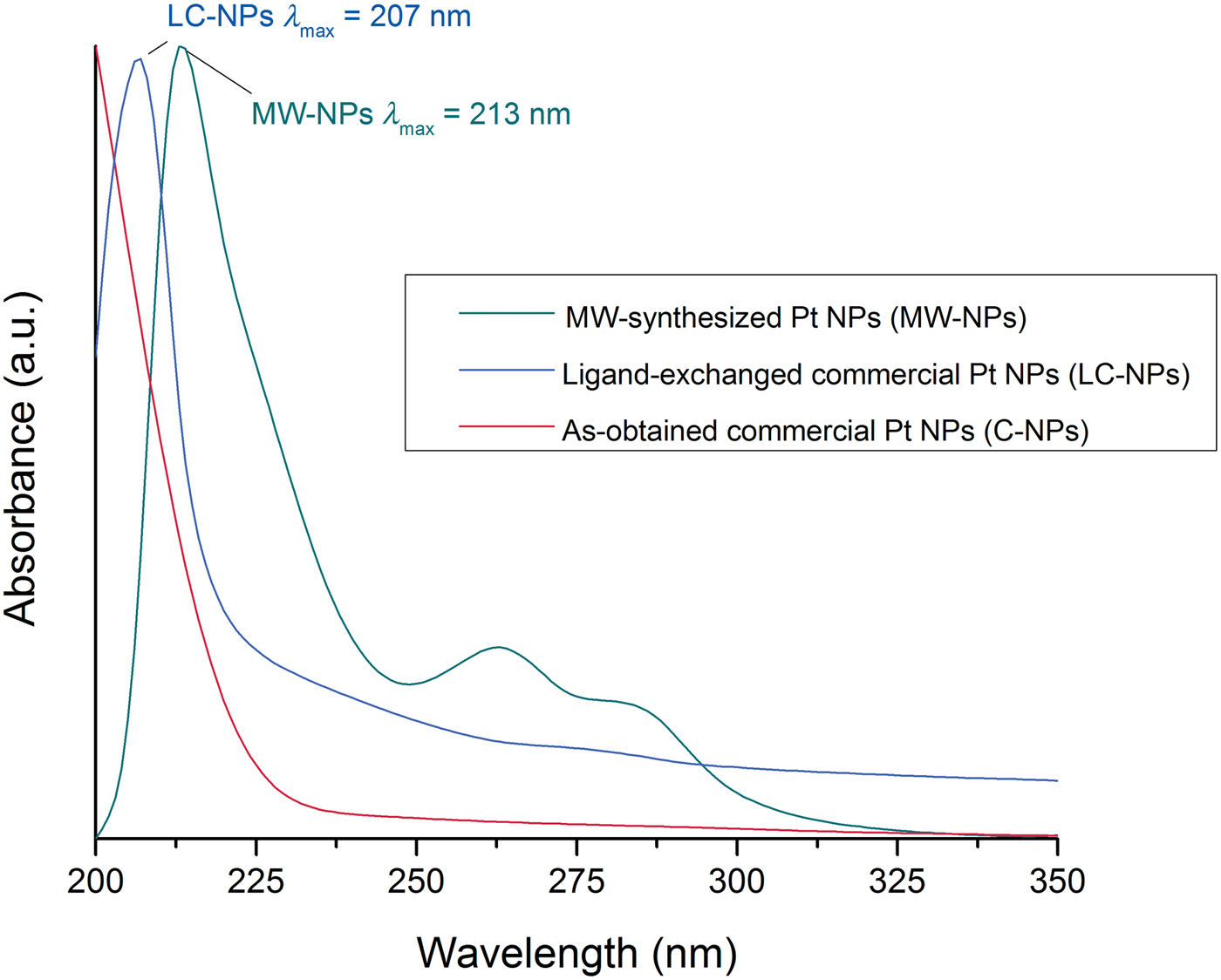
The optical properties of the Pt NPs were studied with UV–Vis spectroscopy. As a noble metal, nanoscale Pt can be expected to display plasmonic effects.[ Reference Rivadulla, Vergara, Blanco, Lopez-Quintela and Rivas 26 ] Although calculated spectra for free Pt NPs in the 10 nm size range indicate that localized surface plasmons are not expected to form under visible light irradiation, Mie theory calculations do predict a distinct absorbance peak under UV irradiation at 215 nm for spherical 10 nm Pt NPs in an aqueous solvent.[ Reference Creighton and Eadon 22 ] Absorbance spectra collected for the 8 nm cubic MW-NPs in hexane consistently showed a strong peak at 213 nm (Fig. 4). The data for this study would suggest that the major band at 213 nm is plasmonic in nature, given the agreement of both spectral shape and position with the LSPR band at 215 nm predicted by Mie theory.[ Reference Creighton and Eadon 22 , Reference Henglein, Ershov and Malow 25 , Reference Rivadulla, Vergara, Blanco, Lopez-Quintela and Rivas 26 ] In contrast, absorbance spectra of the spherical 3.4 nm C-NPs in water did not show any distinct peaks from 200 to 800 nm, but instead showed a gradual increase over most of the visible range followed by a much steeper increase from 200 to 250 nm (Fig. 4). This is consistent with the literature spectra for Pt NPs of similar size and morphology produced by the citrate reduction method.[ Reference Duff, Edwards and Johnson 23 , Reference Furlong, Launikonis, Sasse and Sanders 24 ] The impact of solvent type on optical properties has been shown to be minimal for sub-10 nm NPs.[ Reference Gharibshahi and Saion 11 , Reference Kang, Pyo, Ye, Diaz, Gordon, Stach and Murray 13 , Reference Rioux, Song, Grass, Habas, Niesz, Hoefelmeyer, Yang and Somorjai 14 ]
UV–Visible absorbance spectra of 8 nm cubic MW-synthesized Pt NPs (MW-NPs), as-obtained 3.4 nm spherical commercial Pt NPs (C-NPs), and ligand-exchanged commercial Pt NPs (LC-NPs).
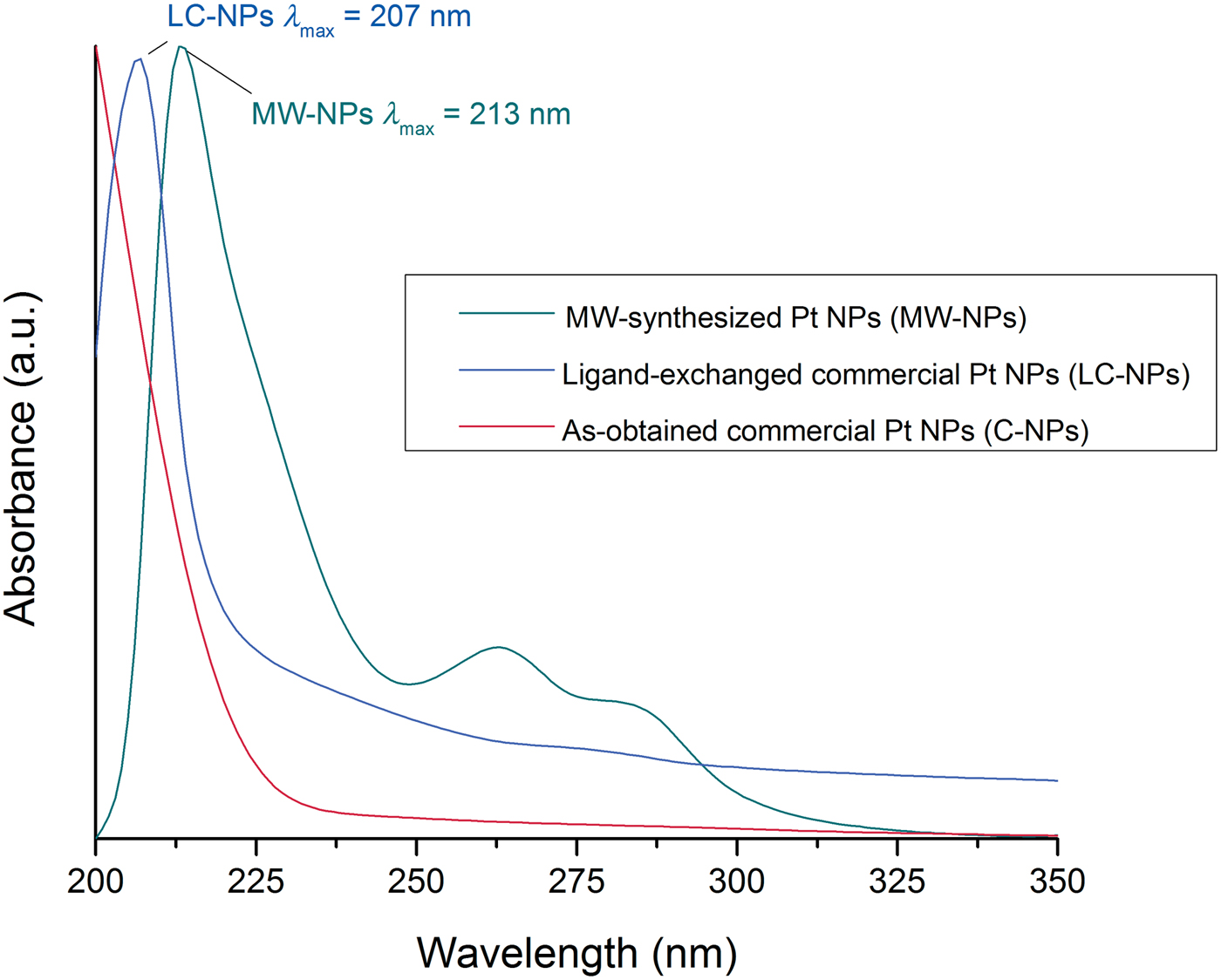
To assess the possible quenching effects on the appearance of LSPR peaks in absorbance spectra of the C-NPs, UV–Vis spectra of the LC-NPs were recorded after replacement of their original citrate capping ligand with OAm (to facilitate comparison with MW-NPs). Confirmation of successful ligand exchange via FTIR spectroscopy can be found in Fig. S3. UV–Vis spectra of the LC-NPs do support a quenching effect from citrate with the emergence of a distinct peak at 207 nm, which based on its location is likely to be plasmonic in nature (Fig. 4).[ Reference Creighton and Eadon 22 ] This value is slightly blue-shifted with respect to the absorbance peak observed at 213 nm for the MW-NPs. This may be due to the smaller size and poorer crystallinity of the 3.4 nm C-NPs, as supported by XRD measurements (Fig. 2).
Discussion
Although the synthesis of colloidal metal NPs has been studied for several decades, only a small number of methods have been developed that reliably yield monodispersed products. The synthesis of highly crystalline, shape-controlled, highly dispersible Pt NPs is usually achieved via high-temperature organic phase methods that rely on an injection of Fe(CO)5 to facilitate a distinct, homogeneous nucleation event.[ Reference Wang, Daimon, Onodera, Koda and Sun 1 ] When Fe(CO)5 is not used, the Pt NPs produced are shown to be highly agglomerated, with wide distributions of size and shape. Due to the importance of well-controlled, dispersible Pt NPs to applications in catalysis, photonics, and sensing, an efficient and high-output synthesis method that avoids the health, environmental, and safety risks of Fe(CO)5 is highly desirable.
MW heating is a versatile and facile method for the production of high-quality Pt NPs. Our MW method eliminates the use of Fe(CO)5 and uses only common, cost-effective reagents to safely and rapidly produce a highly crystalline product. By offering a convenient, economical, large-scale synthesis under mild conditions, MW heating methods may possess great potential for expanding the applications and impact of Pt-based nanomaterials. Our facile, “one-pot” MW synthesis is a highly reproducible and efficient method with high-output capabilities, which may help accelerate the technology readiness of advanced catalytic materials. The greater degree of control and precision offered by MW heating methods present further advantages for catalytic NPs, since NP shape and surface structure play important roles in catalytic activity and reaction durability.[ Reference Wang, Daimon, Onodera, Koda and Sun 1 , Reference Long, Chien, Hayakawa, Hirata, Lakshminarayana and Nogami 3 , Reference Leong, Schulze, Strand, Maloney, Frisco, Dinh, Pivovar and Richards 5 , Reference Chen, Lim, Lee and Xia 6 , Reference Kang, Li, Cai, Cargnello, Diaz, Gordon, Wieder, Adzic, Gorte, Stach and Murray 8 , Reference Wang, Daimon, Lee, Kim and Sun 12 ]
Early studies on the MW heating synthesis of Pt NPs utilized the polyol reduction method and were performed using domestic MWs.[ Reference Komarneni, Li, Newalkar, Katsuki and Bhalla 19 – Reference Wang, Ren, Deng, Gui and Tang 21 ] When compared with Pt NPs synthesized using conventional heating methods, the MW-produced Pt NPs were found to have a much narrower size distribution. This result was attributed to uneven heat conduction to the reaction mixture by the conventional heating methods.[ Reference Komarneni, Li, Newalkar, Katsuki and Bhalla 19 – Reference Wang, Ren, Deng, Gui and Tang 21 ] While those studies presented a facile and effective method for producing colloidal Pt NPs, the products still lacked crystallinity and shape selectivity. More recent research into the synthesis of morphologically controlled metallic NPs suggests that the greatest benefit of MW heating comes from the ability of MW irradiation to instantly and uniformly penetrate a reaction vessel.[ Reference Dahal, García, Zhou and Humphrey 16 ] In the traditional conductive heating methods used in NP synthesis, energy transfer to the reaction mixture may be hindered by differences in the thermal conductivity of the reaction vessel or solvent.[ Reference Dahal, García, Zhou and Humphrey 16 – Reference Baghbanzadeh, Carbone, Cozzoli and Kappe 18 ] In contrast, MW irradiation involves the coupling of MWs directly with molecules in the reaction mixture through an MW-transparent reaction vessel. This leads to a much more rapid rise in temperature.[ Reference Dahal, García, Zhou and Humphrey 16 – Reference Baghbanzadeh, Carbone, Cozzoli and Kappe 18 ] This fast and uniform heating promotes the rapid reduction of a metal precursor salt evenly throughout the solution, providing a distinct and homogeneous nucleation event. These conditions are considered essential to the formation of monodispersed colloidal metal NPs.[ Reference Long, Chien, Hayakawa, Hirata, Lakshminarayana and Nogami 3 , Reference Leong, Schulze, Strand, Maloney, Frisco, Dinh, Pivovar and Richards 5 ]
When optimizing our reaction mixture for use with MW irradiation, we found that more precise size and shape control were achieved by utilizing OAm and ascorbic acid as a facet-selective surfactant and a mild reducing agent, respectively. An important surface-selective capping agent, OAm can promote cubic morphology by adsorbing to the Pt {100} surface by bonding with the amine group.[ Reference Wang, Daimon, Lee, Kim and Sun 12 , Reference Yu, Tu and Liu 20 ] Furthermore, OAm's long hydrophobic chains provide steric hindrance to prevent agglomeration in the growing NPs.[ Reference Peng and Yang 2 ] Ascorbic acid facilitated a distinct nucleation burst via reduction of the precursor salt.[ Reference Boita, Nicolao, Alves and Morais 30 ] When combined with OAm, this provided sufficient reducing power without causing agglomeration. The narrow size and shape distribution of our MW-NPs support the occurrence of distinct nucleation and growth phases, indicating that MW irradiation effectively replaced Fe(CO)5 to induce rapid and homogeneous precursor reduction throughout the reaction mixture.
The observation of two distinct morphologies at lower temperatures [Figs. S1(a) and (b)] may give some insight into the reaction mechanism of Pt NP synthesis via MW irradiation. Lower temperatures have been shown to promote the dominance of {111} faceted octahedra.[ Reference Kang, Li, Cai, Cargnello, Diaz, Gordon, Wieder, Adzic, Gorte, Stach and Murray 8 , Reference Kang, Pyo, Ye, Diaz, Gordon, Stach and Murray 13 ] Results of a recent study by Kang et al., in which conventional heating methods were used on a reaction mixture very similar to that of the present work, showed that lowering temperature to reduce the reaction rate could be used to reliably select morphology.[ Reference Kang, Pyo, Ye, Diaz, Gordon, Stach and Murray 13 ] The highest reaction temperature produced Pt cubes, while intermediate and lower temperatures produced cuboctahedra and octahedra, respectively. Interestingly, they also observed that extending reaction times at low temperatures led to a transition from the initial cubic morphology to smaller octahedra. The authors believed this to be a result of an etching and dissolution process of the cubes along the 〈111〉 direction.[ Reference Kang, Pyo, Ye, Diaz, Gordon, Stach and Murray 13 ] It is possible that a similar phenomenon influenced the morphology of the NPs seen in Fig. S1(a) and (b), which were produced by 1 h reactions at the lowest temperatures used in this study (125 and 130 °C, respectively).
The primary result of our optical study on small, cubic Pt NPs was the distinct UV-range plasmonic absorbance peak seen in Fig. 4. Ligand-exchange studies also supported a quenching effect associated with species used in popular Pt NP synthesis methods (Fig. 4), which may be significant to researchers in the areas of plasmonic photocatalysis and the development of advanced catalytic nanomaterials. Previously, detailed optical studies were most commonly performed on small spherical Pt NPs synthesized via low-temperature reduction of a Pt precursor salt in an aqueous solvent with sodium citrate or poly(N-vinyl-2-pyrrolidone) (PVP) as stabilizing agents.[ Reference Duff, Edwards and Johnson 23 , Reference Furlong, Launikonis, Sasse and Sanders 24 , Reference Boita, Nicolao, Alves and Morais 30 , Reference Bigall, Härtling, Klose, Simon, Eng and Eychmüller 32 ] In 1984, Furlong et al. published their widely cited and replicated study on the citrate-reduction synthesis and optical properties of colloidal Pt NPs.[ Reference Furlong, Launikonis, Sasse and Sanders 24 ] UV–Vis spectra of these small (~3 nm) citrate-capped Pt NPs became the accepted standard spectrum: steadily increasing in intensity as wavelength decreases from 800 to 200 nm but showing no peaks or other spectral features over the entire range.[ Reference Furlong, Launikonis, Sasse and Sanders 24 ] This widely reproduced featureless spectrum has been used as evidence against the ability of small Pt NPs to produce a localized surface plasmon resonance, despite analyses of Pt's electronic band structure and complex dielectric function that clearly indicate that a distinct LSPR absorbance maximum (λ max) in the UV range should be produced.[ Reference Creighton and Eadon 22 , Reference Henglein, Ershov and Malow 25 , Reference Rivadulla, Vergara, Blanco, Lopez-Quintela and Rivas 26 ]
The weakness of Pt's absorbance (compared with that of Ag and Au) may allow Pt's LSPR peaks to be hidden or quenched by species that strongly absorb near 215 nm or severely alter the dielectric environment such that Pt's resonance condition is not met.[ Reference Zhang, Chen, Liu and Tsai 33 ] In a study on the synthesis of colloidal Pt NPs in water/oil microemulsions, Rivadulla et al. found that differences in synthesis methods could change the surface dielectric constant of the Pt NPs, resulting in the production, alteration, or suppression of the 215 nm LSPR λ max.[ Reference Rivadulla, Vergara, Blanco, Lopez-Quintela and Rivas 26 ] They attributed the optical effects to the presence of NP surface adsorbates such as capping ligands and stabilizers, which changed electron density and thus altered the dielectric properties of the NP surface.[ Reference Rivadulla, Vergara, Blanco, Lopez-Quintela and Rivas 26 ]
A study by Henglein et al. compared the absorbance spectra of Pt NPs synthesized via citrate reduction to spectra for Pt NPs of similar size and morphology produced by radiolytic and hydrogen-reduction methods.[ Reference Henglein, Ershov and Malow 25 ] Only the citrate-stabilized Pt NPs showed a featureless absorbance spectrum, while the hydrogen-reduced and radiolytic Pt colloids gave a strong, distinct absorbance peak that corresponded in both shape and location to Creighton and Eadon's predicted LSPR band at 215 nm.[ Reference Creighton and Eadon 22 , Reference Henglein, Ershov and Malow 25 ] It is important to note that the citrate and polyol reduction methods use precursors H2PtCl6 and A 2PtCl4 (A = Na, K) that are known to form species that absorb in the same region as the predicted LSPR λ max for small Pt NPs, and may remain present in colloidal NP suspensions during optical spectroscopy.[ Reference Boita, Nicolao, Alves and Morais 30 , Reference Janata, Henglein and Ershov 34 ]
In this work, absorbance spectra of amine-capped NPs (both as-synthesized MW-NPs and LC-NPs) were collected and compared with the spectra of the as-obtained citrate-capped C-NPs. Spectra recorded of samples before and after the replacement of the citrate ligand with the amine ligand showed the emergence of a distinct peak at 207 nm (Fig. 4, LC-NPs), which was not present in the same samples’ featureless spectra recorded before the ligand exchange (Fig. 4, C-NPs). This result supports the existence of an LSPR quenching effect that is likely related to the citrate capping ligand or its associated species.
Further analysis will be performed on the optical properties observed in this study, which may include other quenching phenomena, NP morphology, or interparticle interactions. The red-shift of the MW-NPs peak with respect to that of the LC-NPs is most likely due to the larger size of the MW-NPs (8 nm versus 3.4 nm), a phenomenon that is supported in the literature.[ Reference Kelly, Coronado, Zhao and Schatz 9 , Reference Bigall, Härtling, Klose, Simon, Eng and Eychmüller 32 , Reference Zhang, Chen, Liu and Tsai 33 ] Broadening and red-shifting of the LSPR λ max has also been shown to occur due to interparticle coupling and the formation of self-assembled one-dimensional NP arrays, which have frequently been observed in monodispersed colloidal nanocubes.[ Reference Kelly, Coronado, Zhao and Schatz 9 , Reference Rostamzadeh, Adireddy and Wiley 10 , Reference Zhang, Chen, Liu and Tsai 33 ] The minor inflection seen in the MW-NPs spectrum between 250 and 275 nm (Fig. 4) is likely due to some amount of self-assembly by the cubic MW-NPs, which was confirmed by TEM observation of those samples. The absence of SAED and other detailed morphologic characterization from detailed optical studies may indicate that many of these Pt NP systems are not highly crystalline, in which case surface defects also could contribute to LSPR quenching.[ Reference Kelly, Coronado, Zhao and Schatz 9 , Reference Rostamzadeh, Adireddy and Wiley 10 , Reference Langhammer, Yuan, Zorić and Kasemo 35 ]
Further detailed optical studies of MW-synthesized Pt nanocubes could provide useful insight into these optical phenomena and their implications for use in advanced heterogeneous photocatalysts. Plasmonic studies of NP morphology suggest that cubic and other polyhedral NPs are more likely to generate distinct, higher intensity LSPR peaks, which are thought to produce an enhancement of the electric field that could be utilized in plasmonic photocatalysis.[ Reference Kelly, Coronado, Zhao and Schatz 9 , Reference Zhang, Chen, Liu and Tsai 33 ] Recent research suggests that Pt's higher energy LSPR bands may introduce advantages such as more efficient degradation of organic pollutants and broader utilization of the solar spectrum when incorporated into composite structures with semiconductors, substrates for enhanced scattering, or sensitizing species.[ Reference Shiraishi, Tsukamoto, Sugano, Shiro, Ichikawa, Tanaka and Hirai 27 , Reference Langhammer, Yuan, Zorić and Kasemo 35 ] Recent studies have recognized the shortcomings of the traditionally used Ag and Au NPs: lack of durability due to oxidation by air and water of Ag NPs and poor catalytic potential compared with other metals for Au NPs.[ Reference Zhang, Han, Xu, Foley, Zhang, Codrington, Gray and Sun 28 , Reference Zhang, Li, Barreda, Gutiérrez, González, Moreno, Everitt and Liu 36 ] Zhang et al. found that cubic Rh NPs helped focus EM fields, and the UV plasmonic response had excellent potential for applications such as label-free detection of biomolecules and studying UV-light photodegradation of Raman active molecules.[ Reference Zhang, Li, Barreda, Gutiérrez, González, Moreno, Everitt and Liu 36 ] Zhang et al. observed that small (<10 nm) Pt NPs can be made to absorb visible light by altering their dielectric environment, using the Pt NPs to absorb light scattered by the dielectric surface of an SiO2 support as part of a TiO2-based nanocomposite.[ Reference Zhang, Han, Xu, Foley, Zhang, Codrington, Gray and Sun 28 ] These studies illustrate that the benefits offered by Pt's superior catalytic properties for use in plasmonic photocatalytic architectures are numerous, and provide strong support for the research described in this report.
Supplementary material
The supplementary material for this article can be found at https://doi.org/10.1557/mrc.2017.137