INTRODUCTION
The current study investigates the development of two inflectional systems in Hebrew – noun plurals, an obligatory system, and noun possessives, a non-obligatory inflectional system, in a longitudinal design. The study targeted first grade as a critical time of introduction to Hebrew literacy, an intensive period of exposure to both spoken and written language, and explicit instruction about their relationship.
Grammaticizable notions expressing a limited set of relational meanings constitute a special domain of language, usually denoted by a small, limited and closed set of grammatical morphemes and constructions. According to Slobin (Reference Slobin, Bowerman and Levinson2001: 410), these grammatical elements provide a schematization of experience for language users. Among them, inflectional morphemes – ‘prototypical grammatical morphemes … affixed to content words … general in meaning, phonologically reduced, and not etymologically transparent’ (p. 413) mark the grammatical relations of a word within larger structures (Bickel & Nichols, Reference Bickel, Nichols and Shopen2007). From a semantic point of view, inflection can exhibit transparency, regularity and predictability. From a distributional point of view, inflection is extremely productive, characterized by high token frequency and general and obligatory applicability (Bybee, Reference Bybee1985).
These semantic and distributional aspects of inflection render it highly salient for young children and facilitate the initial mapping of meaning or function onto inflectional segments. Therefore, inflection is marked early on in child language across a wide variety of languages (Brown, Reference Brown1973; Dabrowska & Szczerbinski, Reference Dabrowska and Szczerbinski2006; De Houwer & Gillis, Reference De Houwer, Gillis, Gillis and De Houwer1998; Narasimhan, Reference Narasimhan2005; Slobin, Reference Slobin1985). It is no surprise, then, that the vast majority of developmental studies of inflection focus on children's emerging inflectional categories and how they ‘break into the system’ in early childhood (Lieven, Reference Lieven and Brown2005; Tomasello, Reference Tomasello2003).
However, inflectional systems are also fraught with morphological and morphophonological complexity, opacity, inconsistency, irregularity and unpredictability. These structural aspects of inflection render the acquisition of such systems a long developmental route well into the school years (Laaha, Ravid, Korecky-Kröll, Laaha & Dressler, Reference Laaha, Ravid, Korecky-Kröll, Laaha and Dressler2006; Levin, Ravid & Rapaport, Reference Levin, Ravid and Rapaport2001; Ravid, Reference Ravid1995). During this time, children are exposed to numerous and diverse inflected lexical items in different communicative contexts and learn to draw appropriate generalizations from both spoken and written language. The current study focuses on this later phase of the acquisition of inflection in Hebrew.
Hebrew, a Semitic language with a rich inflectional morphology, marks gender, number, person and tense on the three content word classes, and in addition incorporates these grammatical features on prepositions and several other closed-class categories (Schwarzwald, Reference Schwarzwald and Goldenberg2006). The current study focuses on two systems of nominal inflection in Hebrew. One – noun plurals – falls within the conventional characterization of inflection as an obligatory and highly frequent system. The other – noun possessives – constitutes a Hebrew-specific case of non-obligatory and less frequent inflectional system, with interesting implications for the study of inflectional acquisition. Knowledge of these two systems was tested in a longitudinal design in six- to seven-year-old children, at a time when first-graders' linguistic abilities change dramatically under the impact of reading and writing instruction.
Obligatory inflection: noun plurals
Count nouns refer to discrete, individuated entities designating ‘a bounded region’ in some domain which form class membership on the basis of their kind, and can be quantified as plural nouns (Langacker, Reference Langacker1991: 69). Quantification is critically important to children's emerging understanding of noun properties: noun plurals constitute an interpretable or inherent inflection (in contrast to uninterpretable inflection such as agreement), marking information which is to a large extent selected in order to carry a meaningful distinction about nouns (Chomsky, Reference Chomsky1995). Slobin (Reference Slobin, Bowerman and Levinson2001: 413) cites plural markers on nouns – together with temporal inflection on verbs – as examples of prototypical and early emerging grammatical morphemes.
Hebrew nouns are pluralized by stem suffixation as in bakbuk/bakbuk-im Footnote 1 ‘bottle/s’, typical of Hebrew inflectional processes which are mostly linear (Ravid, Reference Ravid2006). Plural suffixes fall into two categories: regular masculine nouns take the plural suffix -im (e.g. sir/sirim ‘pot/s’), while regular feminine nouns take the plural suffix -ot (e.g. sira/sirot ‘boat/s’). Choice of plural noun suffix is determined by the inherent gender of the singular noun, formally expressed in its final phonology. Singular feminine nouns end with stressed -a (e.g. sira ‘boat’) or with -t Footnote 2 (saparit ‘hairdresser,Fem.’). Singular masculine nouns end with a consonant (e.g. pil ‘elephant’) or with -e (e.g. mixse ‘lid’).Footnote 3 Evidence for the early emergence of noun plurals in Hebrew comes from a variety of sources – longitudinal case studies (Levy, Reference Levy1980), sampling of spontaneous speech (Ravid, Reference Ravid1995) and cross-sectional experimentation in Hebrew-speaking preschoolers (Berman, Reference Berman1981; Ravid, Reference Ravid1995). These studies indicate that the masculine plural suffix -im is learned very early on in toddlerhood, governed by the high frequency of masculine noun plurals suffixes in the core lexicon of Classical Hebrew (Tubul, Reference Tubul2003) and in current child-directed Hebrew (Ravid et al., Reference Ravid, Dressler, Nir-Sagiv, Korecky-Kröll, Souman, Rehfeldt, Laaha, Bertl, Basbøll, Gillis and Behrens2008).
Suffix (ir)regularity
Problems in plural suffixation arise when nouns take irregular plural suffixes. In the current study, we mainly focus on one type of irregular plurals termed lexical exceptions. In such cases, the stem has regular gender phonology but takes the opposite gender suffix. That is, masculine nouns may take the feminine plural suffix -ot (e.g. rexov/rexovot ‘street/s’ rather than regular rexovim), while feminine nouns may take the plural masculine suffix -im (e.g. mila/milim ‘word/s’, rather than regular milot). A second category of irregular plurals which is not analyzed separately here involves nouns with misleading phonological markers, such as feminine nouns with masculine phonology, i.e. ending in a consonant, e.g. kaf ‘spoon’ (Ravid & Schiff, Reference Ravid and Schiff2009). Suffix irregularity constitutes a stumbling block to young children acquiring Hebrew plurals (Berman, Reference Berman1981; Reference Berman and Slobin1985; Ravid et al., Reference Ravid, Dressler, Nir-Sagiv, Korecky-Kröll, Souman, Rehfeldt, Laaha, Bertl, Basbøll, Gillis and Behrens2008). Research reveals a long developmental route in the acquisition of irregular noun plurals, which are less frequent in everyday Hebrew (Kaplan, Reference Kaplan2008; Ravid, Reference Ravid1995; Ravid & Schiff, Reference Ravid and Schiff2009).
Optional inflection: noun possessives
In addition to prototypical obligatory inflection such as noun plurals, Hebrew has several systems of optional inflection originating in Classical periods in the history of the language. The term ‘optional morphology’ refers to grammatical categories which may take either morphological form by attaching a bound suffix to a lexical stem; or else syntactic form by a semantically synonymous periphrastic construction (Cahana-Amitay & Ravid, Reference Cahana-Amitay, Ravid, Howell, Fish and Keith-Lucas2000). The morphological option is denser and more structurally opaque, while the analytic option is perceptually salient and transparent. This type of construction alternation – using two different constructions for the same grammatical phenomenon – is not widespread in the languages of the world.Footnote 4
The optional system under investigation in this study is possessive, expressed either by noun inflection as in armon-a ‘palace-her=her palace’, or by syntax, as in ha-armon shela ‘the-palace of-her=her palace’.Footnote 5 Possessive nouns optionally incorporate the number, gender and person of the possessor, e.g. beyt-xa ‘house-your+Sg.,Masc.=your house’. The linguistic literature is unclear in terminology regarding the classification of such incorporation, which usually designates genitive constructions in languages with case systems (Lyons, Reference Lyons1968). Thus we have decided to label nouns incorporating possessor markers as possessive nouns, rather more in line with Croft's possessive constructions in the typology of the world's languages (1990: 145–46).
The main expression of possession, one of the initial acquisitions in Hebrew around age 2 ; 0, is syntactic, while command of the inflected option is gained during the school years (Berman, Reference Berman and Slobin1985; Reference Berman and Pontecorvo1997; Cahana-Amitay & Ravid, Reference Cahana-Amitay, Ravid, Howell, Fish and Keith-Lucas2000). Although optional morphology involves no fundamental semantic changes, it does require language users to condense more information than noun plurals, incorporating the gender–number–person coordinates and the possessive meaning to the stem. This incorporation may be one of the reasons possessive nouns do not constitute part of preschool language development (Levin et al., Reference Levin, Ravid and Rapaport2001). Another reason may be the dense and often opaque morphology of noun possessives, which detracts from their saliency. For example, the third person masculine singular suffix alternates between -o as in imo ‘his mother’ and -iv as in axiv ‘his brother’. In addition, noun possessives contribute to clause complexity by creating heavy noun phrases (Ravid & Berman, Reference Ravid and Berman2010). Importantly for our theme of child language acquisition, occurrence of possessive nouns crucially depends on the acquisition of nominals serving as ‘landing sites’ for the possessive suffixes. Acquisition of optional possessives thus requires attention to nominal morphology and a large open-class vocabulary from which to extract generalizations.
The optionality and opacity of noun possessives entails their scarcity in child-directed speech and their concomitant status as a literate high-register marker (Ravid & Berman, Reference Ravid and Berman2009). Possessive nouns are rare in everyday spoken communication, except for a small class of kinship terms (e.g. aviv ‘his father’) and formulaic expressions used during playtime (e.g. torxa ‘your turn’. They characterize expert written, especially literary, style, including children's literature, belles letters, essays, reportage, encyclopedias and textbooks. In contrast, their incidence in texts produced by non-expert, though experienced, older Hebrew speakers/writers is not high (Cahana-Amitay & Ravid, Reference Cahana-Amitay, Ravid, Howell, Fish and Keith-Lucas2000). Optional morphology can thus be taken as a yardstick for acquiring ‘the language of literacy’ in Hebrew (Berman & Ravid, Reference Berman, Ravid, Olson and Torrance2008), and therefore it is important to examine its acquisition in depth and detail at the time of formal literacy instruction. Increased exposure to written texts, literacy-related activities and growing familiarity with a diverse array of lexical items should enable learners to extract the generalizations necessary for the construal of possessives during the school years, despite their relative scarcity.
The current analysis of possessives is grounded in two kinds of extant data. Children's spontaneous productions show anecdotal use of bound forms as a strategy deployed by grade-schoolers – sometimes even imprecisely by kindergarten-age children when trying to produce higher-register language (Berman, Reference Berman1981). Levin et al. (Reference Levin, Ravid and Rapaport2001) examined the acquisition of noun possessives experimentally as one task in the framework of a longitudinal study from kindergarten (ages five–six) to first grade (ages six–seven) investigating the relationship between orthographic skills and language knowledge. This seminal study showed that kindergarteners can understand noun possessives, and that by first grade they reach 50 percent correct scores in possessives with first person suffixes. We can thus assume that possessive nouns will follow plural nouns in acquisition.
Stem changes
The two inflectional constructions under investigation share the structural factor of stem change. Nominal suffixation processes in Hebrew generally shift the stress to the final syllable in native words, as in plural xatul-ím ‘cat-s’, possessive xatul-á ‘her cat’, or derived xatul-í ‘feline’ – all based on xatúl ‘cat’ (Meir, Reference Meir2006). In addition, the bound nominal stem may undergo morphophonological changes as in possessive cel/cil-a ‘shadow / her shadow’ or plural kélev/klav-im ‘dog/s’ (see Ravid & Schiff, Reference Ravid and Schiff2009, for a full presentation of stem change types). Toddlers prefer to retain the original structure of nouns in their initial inflections, e.g. juvenile zaken/zakena ‘old man / old woman’ for correct zkena, or ca'if/ca'ifim ‘scarf/scarves’ for correct ce'ifim (Ravid, Reference Ravid1995). Beyond early childhood, substantial stem changes (e.g. the combination of vowel reduction and -t insertion) and changes to less common morphophonological classes such as CiCCa continue to challenge schoolchildren (Kaplan, Reference Kaplan2008; Lavie, Reference Lavie2006). Early and extensive encounters with plural and feminine formation serve as an initial window on nominal operations and a testing ground for this crucial nominal property (Ravid & Shlesinger, Reference Ravid and Shlesinger2001). Initial knowledge about nominal stem changes can then be applied to less familiar morphological classes such as possessive nouns and denominal adjectives encountered in children's stories and school-type texts (Levin et al., Reference Levin, Ravid and Rapaport2001; Ravid, Reference Ravid2006; Ravid & Levie, Reference Ravid and Levie2010). Thus we can assume that stem changes will affect the development of both plural and possessive noun inflection.
Against this background, the current study systematically compares, for the first time, the development of these two similar yet different Hebrew nominal inflections – the obligatory plurals and the optional possessives – in first-graders aged six–seven. At this time, children receive explicit reading and writing instruction, focusing on the phonological properties of Hebrew words, with increased exposure to both spoken and written discourse – and are thus expected to be especially susceptible to the acquisition of complex linguistic information.
Predictions
Based on the literature review, we expected obligatory inflection – represented by the noun plurals task – to score higher at both Times I and II. We also expected changing stems to score lower on both tasks. Finally, we expected regular plural suffixes, on the one hand, and first person possessive suffixes, on the other, to achieve higher scores than their counterparts. The reasoning for regular plural suffixation is obvious; the prediction for first person is based on the early emergence of first person singular pronouns in children (Chiat, Reference Chiat, Fletcher and Garman1986), as well on the Hebrew-specific findings in Levin et al. (Reference Levin, Ravid and Rapaport2001) and Kaplan (Reference Kaplan2008), showing that children produce many more first person verbs, prepositions, double compounds and optional possessives than the same constructions with other person markings.
METHODS
The current developmental study compares the production of obligatory versus optional inflection in Hebrew-speaking first-grade children using an experimental longitudinal design, which ensured that the same children were tested twice on the same task.
Participants and procedures
The study population consisted of 107 first-graders – 53 boys and 54 girls aged six to seven years. They were all native, monolingual speakers of Hebrew with no diagnosed hearing impairment, learning or reading disability, from a middle-high socioeconomic background. We focused on six- to seven-year-old first-graders since by this time children have acquired the bulk of Hebrew inflection and some of its morphophonological variations (Berman, Reference Berman and Slobin1985; Ravid, Reference Ravid1995). This ensured that the tasks were not too difficult and that all typically developing children could cope with them.
Participants were tested twice on the same tasks at two data collection points: in October (Time I of testing, the beginning of the school year) and in June (Time II of testing, the end of the school year). At Time I, our participants had a mean age of 6 ; 2 (range 6 ; 0–6 ; 9), and at Time II, their mean age was 6 ; 10 (range 6 ; 8–7 ; 5). Developmental school-age studies of morphology and the lexicon often focus on longer time intervals (e.g. Berman, Reference Berman2008). We, however, were interested in finding out whether the combination of metalinguistic instruction and intensive exposure to written language in first grade would result in developmental changes despite the short time frame between the two points of data collection (eight months).
Tasks were administered orally and individually in a quiet room at the children's school, by a trained investigator (the third author).
Plurals
Participants were presented with a set of sentences containing singular nouns, with the target noun repeated at the end, and were prompted to produce its plural form, e.g. Danny saw pil‘an elephant’ at the zoo. One pil‘elephant’ – many … ?’. Testing started after three training demonstrations.
Possessives
Participants were presented with a set of sentences containing analytic possessive constructions, with the target noun repeated at the end, and were prompted to compose a bound possessive form from the analytical components. For example, Danny saw Acc. ha-xatul shelo‘the-cat his’. How would you say ha-xatul sheloin one word? Although this method of testing differed from the classical ‘wug-like’ plural task, it was necessary to elicit the optional bound form. Testing started after three training demonstrations. Children's responses were recorded and scored for stem and suffix correctness.
Materials
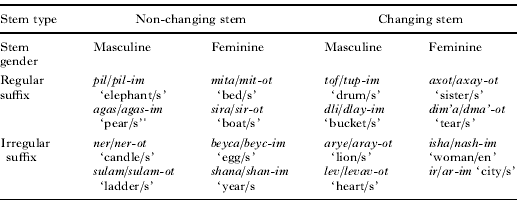
Two measuring tools were employed in this study: The Noun Plurals Task and Noun Possessives Task. The Noun Plurals task was constructed to reflect the combination of the two main components in Hebrew plurals – stem and suffix types – and thus consisted of thirty-two words in four morphophonological categories (eight items in each category): (i) non-changing stem with regular suffix; (ii) non-changing stem with irregular suffix; (iii) changing stem with regular suffix; (iv) changing stem with irregular suffix. Each category represented both masculine and feminine nouns (four words in each gender class). In the absence of word frequency data for Hebrew child-directed speech, task items were all concrete nounsFootnote 6 (Ravid, Reference Ravid2006) selected in consultation with kindergarten teachers to ensure that they were familiar to children attending first grade. Table 1 presents the structure of the Noun Plurals task, first used in Ravid & Schiff (Reference Ravid and Schiff2009), with sixteen examples.
Structure of the plural task, with sixteen examples

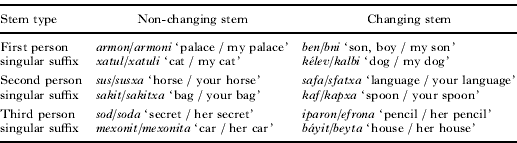
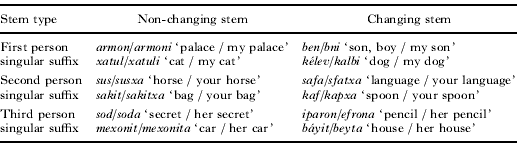
The Noun Possessives Task also contained two stem types – changing and non-changing stems; and three suffix types – first person, second person and third person singular. Singular and plural possessive nouns take different allomorphs of the same suffix, e.g. efron-i ‘my pencil’ vs. efronot-ay ‘my pencils’; moreover, non-first person suffixes have different forms for masculine and feminine, e.g, efron-xa ‘your pencil,Masc.’ vs. efron-ex ‘your pencil,Fem.’. These variations render the full possessive paradigms too complex to test in first grade. We thus selected only singular noun stems for our task, focusing on the three different person suffixes, sampling one stem gender for each. The possessive task thus consisted of twenty-four concrete nouns in six morphophonological categories – four items in each category: (i) non-changing stem with first person suffix; (ii) changing stem with first person suffix; (iii) non-changing stem with second person suffix (masculine); (iv) changing stem with second person suffix (masculine); (v) non-changing stem with third person suffix (feminine); (iv) changing stem with third person suffix (feminine). Table 2 presents the structure of the Noun Possessives task (constructed along the lines of the task used in Levin et al., Reference Levin, Ravid and Rapaport2001), with twelve examples.
Structure of the possessive task, with twelve examples
All items used in the two tasks denoted known (that is, real) rather than nonce (or pseudo) nouns. Due to the low predictability of stem and suffix types, it is impossible to construct this task with nonce stems. To demonstrate this problem regarding stem changes, consider the three identical forms ec ‘tree’, nes ‘miracle’ and cel ‘shadow’. Despite their phonological identity, the three nouns behave differently under pluralization due to historical reasons: ec has a non-changing stem, therefore ecim in plural; nes involves vowel change, thus nisim in plural; and cel has a completely changing stem, thus clalim. Regarding suffixes, again irregular suffixation prevents the use of nonce nouns. Consider mila/milim ‘word/s’, a feminine noun taking a masculine suffix, compared to mita/mitot ‘bed/s’, a feminine noun taking a regular feminine suffix. Thus similar form does not ensure similar, predictable, morphological behavior; rather, suffix and stem types derive from historical categories rendered incoherent by the passage of time (Ravid, Reference Ravid1995), resulting in low predictability and requiring lexical learning.
RESULTS
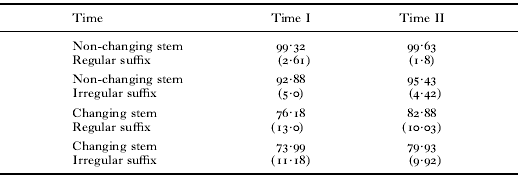
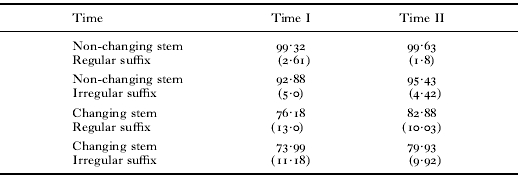
The dependent variable was a percentage of correct responses for all items for each category (plurals, possessives) per child. Tables 3 and 4 present success scores on noun plurals and noun possessives respectively at the beginning (October) and the end (June) of first grade. We conducted a three-way ANOVA on the plurals data in Table 3 with three within-subject factors of time (2: October, June)×stem type (2: non-changing, changing)×suffix type (2: regular, irregular) with repeated measures for each of the three factors. All three variables were significant: time (F(1, 106)=56·44, p<0·001, ηp2=0·35) – correct scores improve from the beginning of first grade (M=85·59, SD=5·97) to its end (M=89·47, SD=4·8); stem type (F(1, 106)=691·09, p<0·001, ηp2=0·87) – non-changing stems score higher (M=96·81, SD=2·16) than changing stems (M=78·25, SD=8·16); suffix type (F(1, 106)=68·19, p<0·001, ηp2=0·39) – regular suffixes score higher (M=89·5, SD=4·88) than irregular suffixes (M=85·56, SD=5·74).
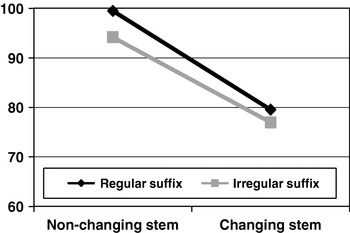
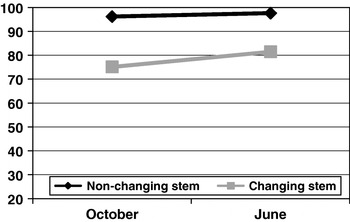
Two interactions emerged. One, stem type and suffix type (F(1, 106)=9·85, p<0·003, ηp2=0·09), appears in Figure 1. Post-hoc Bonferroni analyses show differences between regular and irregular suffix types on changing stems. A second interaction of time and stem type (F(1, 106)=30·39, p<0·001, ηp2=0·22) is depicted in Figure 2. Figure 2 shows that what actually changes at the two points of data collection is success on stems: While high-scoring non-changing stems do not change from October to June, there is a significant improvement in noun plurals with changing stems. No other interactions emerged.
Interaction of stem and suffix types in the Plurals Task.

Mean percentages and standard deviations of correct responses on the Plurals Task, by time of testing and morphophonological category
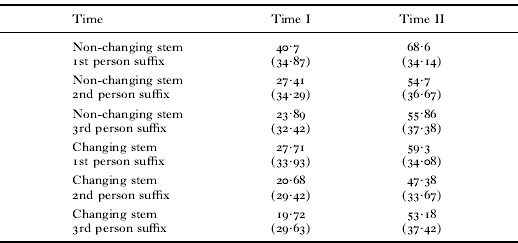
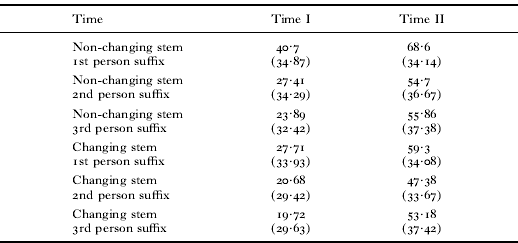
Mean percentages and standard deviations of correct responses on the Possessives Task, by time of testing and morphophonological category
Interaction of time and stem type in the Plurals Task.

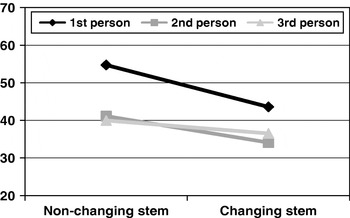
A three-way ANOVA with three within-subject factors of time (2: October, June)×stem type (2: non-changing, changing)×suffix type (3: first, second, third persons) was conducted on the possessives data in Table 4. Here, again, all three variables were significant: time (F(1, 106)=105·17, p<0·001, ηp2=0·50) – correct scores improve from the beginning of first grade (M=26·69, SD=27·95) to its end (M=56·5, SD=31·08); stem type (F(1, 106)=57·51, p<0·001, ηp2=0·35) – non-changing stems score higher (M=45·19, SD=26·61) than changing stems (M=38, SD=25·2); suffix type (F(2, 212)=36·77, p<0·001, ηp2=0·26) – first person suffixes score higher (M=49·08, SD=27·18) than both second person (M=37·55, SD=26·16) and third person suffixes (M=38·16, SD=27·65). An interaction of stem type and suffix type (F(2, 212)=5·52, p<0·006, ηp2=0·05) emerged, as depicted in Figure 3.
Interaction of stem and suffix types in the Possessives Task.

Post-hoc Bonferroni analyses show that, as predicted, the difference between first person, on the one hand, and second and third person, on the other, is larger in non-changing stems than in changing stems.
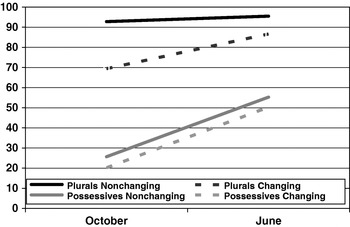
The analyses carried out so far indicate that stem changes are important variables in both domains of investigation. In order to compare development in both domains, we removed the suffix factor altogether, as it was different in the two categories. We then conducted a three-way ANOVA with three within-subject factors of construction (2: noun plurals, noun possessives)×time (2: October, June)×stem type (2: non-changing, changing). All three variables were significant: construction (F(1, 106)=409·03, p<0·001, ηp2=0·79) – noun plurals scores outdo noun possessives (M=86·08, SD=4·50, M=37·85, SD=25·91); time (F(1, 106)=146·06, p<0·001, ηp2=0·58) – correct scores improve from the beginning of first grade (M=52·01, SD=15·26) to its end (M=71·93, SD=17·32); stem type (F(1, 106)=315·84 p<0·001, ηp2=0·75) – non-changing stems score higher (M=67·31, SD=14·68) than changing stems (M=56·63, SD=13·82). All three two-way interactions were significant – between construction and stem (F(1, 106)=91·15, p<0·001, ηp2=0·46), between construction and time (F(1, 106)=36·75, p<0·001, ηp2=0·26) and between stem and time (F(1, 106)=61·93, p<0·001, ηp2=0·37). Most important, the three-way interaction between construction, stem type and time was significant (F(1, 106)=48·73, p<0·001, ηp2=0·32), as depicted in Figure 4.
Interaction of task (Plurals, Possessives), time and stem type.

The post-hoc analyses showed that the high-scoring non-changing plural stems did not improve with time from October to June, while all other categories – changing plural stems as well as both stem types in the low-scoring possessive stems – did. Moreover, both plural stem types outscored possessives at both time-points.
Finally, we carried out a Pearson correlation analysis between the two constructions – noun plurals and noun possessives – at the two time-points. Success on the two constructions was not correlated at the beginning of first grade (October), but was significantly correlated (r=0·39, p<0·001) at its end (June).
DISCUSSION
The study compared for the first time how two different inflectional constructions develop in Hebrew-speaking children aged six–seven years during a relatively short yet critical period of eight months in the course of first grade. Noun plurals are a typical inflectional category with obligatory application, while noun possessives constitute an optional inflectional category preceded in acquisition by the syntactic alternative. A major finding is that performance on both constructions increased during this short period – noun plurals improved from about 85% to 90%, while noun possessives improved from about 25% to over 55%. Success on the two constructions was, moreover, correlated at the end of the school year (June). This significant increase in performance within this short period is not self-explanatory. It indicates an intense period of extracting information about morphological classes from a growing and increasingly diverse lexical inventory. First grade provides a felicitous environment for this dramatic growth in morphological knowledge: in learning to read and write, first-graders are focused on language in a way that may not be paralleled at other grade levels. They are exposed to vast amounts of spoken and written language, are the target of intensive reading and writing instruction, and engage in a variety of structured activities intended to enhance their sensitivity to linguistic constructs – especially to phonology and the lexicon. Thus, although morphology is not formally or systematically taught in first grade, children's sensitivity to word structure is strengthened by the constant occupation with words, their sounds and their meanings. For example, word-final phonology is critical for establishing nominal gender, and attention to it will improve performance on both plurals and possessives. Moreover, reading and spelling are acquired early on by Israeli grade-schoolers, due to the transparency of the vocalized orthographic version used in literacy instruction, and early reliance on morphological cues: Hebrew-speaking first-graders read accurately by the spring (Share & Levin, Reference Share, Levin, Harris and Hatano1999), and spell function letters with 90% accuracy by the summer (Gillis & Ravid, Reference Gillis and Ravid2006; Ravid, Reference Ravid, Joshi and Aaron2005). Thus, orthographic representations are already in place by the end of first grade, and these support and reinforce the relationship between morphological forms and semantics in lexical items – entrenching lexical representations and enabling efficient generalizations of morphological structures.
Plurals versus possessives across first grade
Another finding is the difference between the start-off points and amount of improvement in the two constructions. Two related aspects of plurals versus possessives can be invoked here – morphological complexity and patterns of distribution.
Suffix complexity
Since plurals and possessives share stem changes (see below) we will focus in this section on the differences in suffix complexity. Plural suffixation takes into consideration grammatical noun gender and its phonological marking on the singular stem as a cue to plural suffix, as in masculine pil/pil-im ‘elephant/s’ vs. feminine pila/pil-ot ‘elephant,Fem./s’. The challenge to young learners arises when the plural suffix is in clash with stem gender and/or phonology – as shown by the fact that performance on regular suffixes such as mita/mit-ot ‘bed/s’ was better than on irregular suffixes such as mila/mil-im ‘word/s’ by about 4 percent. First-graders' errors on plural suffixation (at both time-points) are not random and reveal their robust command of Hebrew gender. There are almost no suffix errors in inanimate nouns with regular suffixes such as ec/ecim ‘tree/s’ or feminine matana/matanot ‘present/s’. A few errors occur in animate nouns, such as pluralizing masculine xatul ‘cat’ as feminine xatulot, given young children's propensity to regards cats as female; or sometimes pluralizing axot ‘sister’ as axim ‘brothers’ and isha ‘woman’ as anashim ‘men’ (Ravid, Reference Ravid1995; Ravid & Schiff, Reference Ravid and Schiff2009). Beyond these scarce examples, all suffix errors reflect children's sensitivity to inherent gender and its phonological marking. For example, all errors on feminine shana ‘year’ and nemala ‘ant’ consisted of matching the ubiquitous singular -a with the feminine plural suffix to yield erroneous shanot and nemalot respectively. Likewise, 29 out of a total of 39 errors on masculine nahar ‘river’ involved using the masculine suffix -im, compatible with stem gender and phonology.
Even more interesting were cases where stem phonology clashed with stem gender as in feminine ir ‘city’ and kaf ‘spoon’ ending with a consonant, a masculine feature. In such cases, the only way to determine noun gender is to consider adjective or verb agreement with the noun, as in ir gdola ‘city,Fem. big,Fem.=big city’. Children's errors reflected their attempts to reconcile the gender/phonology clash. Consider, for example, ir ‘city’, where the correct plural form arim requires stem change and a masculine suffix. Erroneous responses on ir contained an almost equal number of 21 irot with feminine suffix, following inherent gender, and 22 irim with masculine suffix, following stem phonology. Most telling were the 3 erroneous cases of draxot instead of correct draxim ‘ways’. These errors highlight children's correct construal of dérex ‘way’ as a feminine noun despite not only its masculine phonology, but also the fact that it pertains to the highly frequent masculine morphological pattern CéCeC.
Forming possessive nouns requires even more complex morphological machinery. Possessive nouns are marked not only for their own gender and number, but also incorporate ten different suffixes indicating number, gender and person of the possessor – e.g. pil/pil-ex ‘elephant / your,Fem. elephant’, pil/pil-o ‘elephant / his elephant’, pil/pil-am ‘elephant / their elephant’. The form of the possessive suffix may, moreover, change with stem number. For example, compare the forms of the first person singular suffix on a singular stem pil-i ‘my elephant’ and on a plural stem, pil-ay ‘my elephants’. In addition, the same suffix may take allomorphic forms on different stems, e.g. av-iv ‘his father’ vs. im-o ‘his mother’. The enormous variety of children's erroneous responses on possessive nouns reflects their ongoing struggle in learning the different suffixes, their forms and their allomorphs, and attempts to assign them to stems. One set of erroneous responses reveals children's actual difficulty with the very morphological task of creating an inflected possessive noun. First, every single item on the possessive task elicited the non-bound stem – e.g. responding with ná'al ‘shoe’ to ha-ná'al shela ‘her shoe’ instead of incorporating the third person singular feminine pronoun into the correct inflected form na'ala. Each such error occurred several times. In contrast, only 8 out of the 24 plural items resulted in the free singular stem, and each error occurred just once. Moreover, almost every item elicited possessive responses, i.e. repeating the possessive pronoun in the task item or producing an inappropriate one, e.g. shelánu ‘our’ for ha-mora shlaxem ‘your teacher’, where the correct response should have been moratxem. Finally, every item on the task elicited a syntactic response including the same or a different pronoun than in the task item, e.g. ha-báyit sheli ‘my house’ in response to ha-báyit shelo ‘his house’, where the correct response should have been the bound form beyto. In addition to the numerous non-morphological responses, children produced possessive nouns with incorrect possessive inflections, mostly changing the target person, as in armonex ‘your,Fem. palace’ for the required armoni ‘my palace’, or susénu ‘our horse’ for susxem ‘your,Pl. horse’. There were also several gender errors, as in kafxa ‘your,Masc. spoon’ for correct kapex ‘your,Fem. spoon’, or calaxtam ‘their,Masc. plate’ for calaxtan ‘their,Fem. plate’.
In this context, and as predicted, first person possessives were found to be relatively easier than the second and third person suffixes. They had the highest scores of all possessives at both time-points and showed vigorous growth between them. Moreover, every single item elicited erroneous responses with first person singular, either as a possessive pronoun sheli or as an inflected form, e.g. sakiti ‘my bag’ for correct sakitex ‘your,Fem. bag’. This finding is in line with cross-linguistic evidence for the early emergence of children's first person pronouns and inflections (Berman, Reference Berman and Slobin1985; Chiat, Reference Chiat, Fletcher and Garman1986; de Villiers & de Villiers, Reference De Houwer, Gillis, Gillis and De Houwer1985; Schieffelin, Reference Schieffelin and Slobin1985). It is also supported by previous studies on optional bound morphology in Hebrew (Levin et al., Reference Levin, Ravid and Rapaport2001; Kaplan, Reference Kaplan2008). The relative prominence of first person inflections may be attributed to children's early interest in their own possessions or to the frequent occurrence of the speaker role in conversation (Clark, Reference Clark1996).
To sum up this analysis, most possessive items (including first person) elicited a long list of suffixation errors – free stems, free possessive pronouns, syntactic phrases expressing possession, and several different inflection errors. Taken together, this array of suffixation errors demonstrates that children need to be familiar with all of the different aspects of number–gender–person combinations to succeed in inflecting possessive nouns. In that sense, plural inflection places a lighter demand on children's evolving morphological abilities than possession suffixes. Our results indicate that while plural inflection is in general at a high level by the end of first grade, learning the more complex possessive inflection makes considerable progress in first grade – but still has a long way to go in reaching adult-like performance (Lavie, Reference Lavie2006; Kaplan, Reference Kaplan2008).
Distributional patterns
Morphological complexity is related to the distributional issues presented in the ‘Introduction’. The plural inflection is not only simpler, it is also obligatory with general application in all appropriate contexts, and therefore noun plurals occur across the board, and their number increases with age in both child-directed input and children's output regardless of register. Possessive incorporation is optional, since noun possessives are usually expressed syntactically in everyday language, and certainly in input to children and in their own output, as evidenced in the many syntactic errors described above. The bound morphological option is rarer, typical of higher register, specifically written, formal or narrative language (Ravid & Berman, Reference Ravid and Berman2009). Thus children are exposed to noun plurals earlier and in larger quantities than to noun possessives, and they are also obliged to compose plural forms morphologically from early on, whereas the major possessive expression remains syntactic. The dramatic increase in correct possessives across first grade would then correspond to the exposure to written language (Berman & Ravid, Reference Berman, Ravid, Olson and Torrance2008), characterized by rich and diverse optional bound morphology.
Stem changes across development
Beyond the differences between the two constructions in terms of suffix complexity and distribution, our analyses highlighted a shared area of difficulty in the developmental trajectories we found – that is, stem changes under linear morphological operations.
Performance on non-changing plural stems such as ner/ner-ot ‘candle/s’ was better than on changing stems such as tof/tup-im ‘drum/s’ by about 20%. An interesting finding in this category showed that the high results in plural formation to a large extent derive from the non-changing stems with both regular and irregular suffixes, which do not change between the two time-points. The locus of change in noun plurals is in changing stems, which increase from 75% in October to over 81% in June. This growth includes both changing stems with regular suffixes, e.g. masculine dli/dlay-im ‘bucket/s’, as well as those with irregular suffixes, e.g. masculine lev/levav-ot ‘heart/s’ with the feminine plural suffix.
Error analysis illustrates how morphological and morphophonological factors impact on learning about Hebrew stem changes. For example, the lack of root and pattern structure in monosyllabic nouns, which may seem simpler than bisyllabic nouns from a non-Semitic point of view, is an obstacle to learning. Many participants found it especially challenging to perform single-vowel changes in monosyllabic items such as xec ‘arrow’ (correct plural xic-im), ir ‘city’ (correct plural ar-im), leaving the stem unchanged. They also found it difficult to exchange stop for spirant, e.g. responding to kaf ‘spoon’ with plural kaf-im or kaf-ot for correct kap-ot. The combination of vowel change and stop/spirant alternation was especially daunting in tof/tupim ‘drum/s’, where most erroneous responses did not make any stem change, yielding tof-im, or else either failed to change the vowel (top-im) or the consonant type (tuf-im). However, making ‘heavy’ stem changes in the highly frequent noun pattern CéCeC was not at all demanding for first graders, so that the items dérex/draxim ‘way/s’, mélex/mlaxim ‘king/s’, and éven/avanim ‘stone/s’ had almost no stem errors – in line with previous finding of the early acquisition of CéCeC and its morphophonological changes (Ravid, Reference Ravid1995). However, the two items with nominal pattern CiCCa, which requires similar structural changes as CéCeC, entailed dozens of errors – virtually all errors on giv'a ‘hill’ and ricpa ‘floor’ left the stem intact instead of changing it into the required CCaC-ot format. This may be due to the low frequency of CiCCa nouns in child-directed input and child speech, since non-animate feminine patterns, CiCCa included, denote mostly abstract entities (Ravid, Reference Ravid2006).
An additional set of errors points at how morphological and orthographic knowledge begin to interface in first grade (Ravid, Reference Ravid, Joshi and Aaron2005). One of the most salient markers of Hebrew feminine nouns is the final -t, which deletes before the plural suffix as in axot/axayot ‘sister/s’. About 10 erroneous responses failed to perform this change (giving axotot or axotim), most probably since final -t deletion is more frequently associated with penultimate structures and following vowels e and a, e.g. rakévet rakav-ot ‘train/s’ or mikláxat/miklax-ot ‘shower/s’. Note that -t is homophonous, and the orthographic variation marking feminine gender is spelled with T  . In first grade, this orthographic knowledge is not yet firmly entrenched (Gillis & Ravid, Reference Gillis and Ravid2006): seven of the errors on máxat ‘needle’ deleted the final t, a stem consonant spelled with
 , to yield plural máxot instead of correct mexatim.
While noun plurals improved only in the changing stems, all possessive categories with both changing and non-changing stems improved in first grade, most of them doubling their score within the eight months between October and June. This general difference in rate of development is probably due to the large margin for improvement in knowledge of this optional construction. But there was yet another difference between plurals and possessives. In optional possessives, too, performance was better on non-changing stems (e.g. mexonit ‘car’ / mexonit-a ‘her car’) than on changing stems (e.g. tmuna ‘picture’ / tmunat-a ‘her picture’), but the overall difference between the two stem types was only 7 percent. This small difference between changing and non-changing stems requires an explanation. We believe that this is due to the fact that possessive stem changes are somewhat less complex than plural changes. The main area of difference is the higher transparency of feminine stems in possessive nouns. This is achieved in two ways. One is the preservation of the final -t on feminine stems which would delete in plurals but not in possessives. Compare, for example, plural xanut/xanuy-ot ‘shop/s’, axot/axay-ot ‘sister/s’, and mapit/mapiy-ot ‘napkin/s’ with their respective possessive forms xanut/xanut-i ‘shop / my shop’, axot/axot-a ‘sister / her sister’, and mapit/mapit-am ‘napkin / their napkin’. Moreover, -a final stems require t insertion in possessive forms (e.g. mora/morat-xem ‘teacher,Fem. / your,Pl. teacher’. The result is clear and consistent representation of stem gender by t, which makes one type of possessive stem easier to process. This observation is supported by the distribution of errors on possessive nouns: stem errors are fewer because feminine items ending with -t (such as mexonit ‘car’ or caláxat ‘plate’) and -a (mora ‘teacher,Fem.’, tmuna ‘picture’) mostly preserve the stem or add t to it. Children's sensitivity to feminine t is reflected in errors where feminine t is inappropriately inserted where not required, an error which never occurs in plurals: for example, in masculine stems such as armonati for armoni ‘my palace’, or pitxa for píxa ‘your,Masc. mouth’; and in feminine ná'al to yield na'alato for na'alo ‘his shoe’. Stem errors mostly occurred in masculine possessive items, e.g. kafex for kapex ‘your,Fem. spoon’, péxa for píxa ‘your,Masc. mouth’, or klavi for kalbi ‘my dog’.
Frequency issues
As noted above, task items were concrete nouns familiar to first-graders. In the absence of word frequency lists for current Hebrew, we could not formally assess the impact of word frequency on success in plural or possessive formation. Nevertheless, the analysis of error distribution indicated that the issue of frequency is quite complex and involves several aspects of word knowledge. First, pattern frequency was clearly involved in correctly marking plural items, as demonstrated above by the comparison of items in frequent CéCeC versus rare CiCCa. Pattern consistency was also important, as shown by the virtual absence of -im errors in iparon ‘pencil’, since all items of masculine pattern CiCaCon consistently take the feminine suffix -ot (Ravid, Reference Ravid1995). Moreover, frequency measures should address not only the singular stem (lemma) but also the inflected word forms. Plural-dominant nouns, where the plural form occurs at least as frequently as the singular, entailed fewer errors, as was the case with irregular beyca/beycim ‘egg/s’ and stem-changing and irregularly suffixed arye/arayot ‘lion/s’ and éven/avanim ‘stone/s’. On the other hand, nouns which occur more frequently in their singular form entailed many errors, such as pluralizing irregular shana ‘year’ as shanot (for correct shanim) or stem-changing and irregularly suffixed isha ‘woman’ as ishot (instead of correct nashim). In possessive nouns, items with the highly frequent first person suffix had higher scores than those with second and third person suffixes. In this respect, future studies of plurals and possessives should delve deeper and more extensively into noun gender, which did not constitute a variable in this study.
Conclusion
This study contributes to our knowledge about later language development by showing that inflectional learning is vigorously under way in Hebrew-speaking six–seven-year-old first-graders, and that acquisition of noun plurals is much further along the way than the acquisition of possessive incorporation. While plural marking is one of the first inflections to emerge in toddlers, the main challenge in mastering plural marking is morphophonological: children aged six–seven years have learned much of the irregular plural suffixation, but still have to gain command of the various types of stem changes in plural nouns. Possessive marking, a high-register, optional construction typical of formal, mostly written Hebrew, gains much ground during the relatively short period during which first-graders learn to read and write Hebrew and turn to the written modality as their main source of linguistic input. The fact that success on the two inflectional tasks was correlated at the end (but not at the beginning) of first grade testifies to the impact of the crucial shift from spoken language to the ‘language of literacy’ on children's construal of Hebrew morphology.