For over a hundred years, UT Austin's statue of Jefferson Davis rested on seemingly firm foundations. But over the summer of 2015, that ground beneath its feet crumbled. To be clear, the granite plinth was doing fine—it was the cultural foundation that was in trouble. In bad shape for at least thirty years, it had been loudly creaking since June. Nevertheless, its demise was swift and surprising. The summer semester had been unusually busy as students, community members, activists, and academics debated what to do with Davis, as well as the university's three other Confederate statues. Periodically the subject of ire and debate, their presence appeared to become untenable after the racially motivated shooting of nine black churchgoers in Charleston, South Carolina, on June 17, 2015. That tragedy galvanized opposition to such monuments across the nation, and UT's statues were being regularly vandalized with slogans such as “Davis Must Fall” and “Black Lives Matter.” So after six weeks of taskforce deliberations and public debate, the university's president, Gregory Fenves, decided to relocate the Davis statue—across campus to the Dolph Briscoe Center for American History for re-contextualization within an exhibit setting.
The removal from the South Mall took place in broad daylight as a snarky but peaceful gaggle of students, scholars, and reporters (as well as the odd curmudgeon) looked on. Problematic, but ultimately deemed tolerable, the three other statues—of Confederate generals Robert E. Lee and Albert Sydney Johnston, as well as Davis's postmaster John H. Reagan—remained in place. (The latter two were Texans.) After eighteen months of research, design, and fabrication, the Davis statue exhibit opened in April, 2017.Footnote 1 As a cultural object, the statue had been unmistakably downgraded. It had gone from being a public symbol in a place of honor (which implied endorsement of its meanings) to being an artifact in an archive, its meanings open to critical analysis and its visibility and value pegged to educational utility.
Matters seemed settled, but four months later the national spotlight once more turned on Confederate statues. On August 11 and 12 at the small university town of Charlottesville, Virginia, tiki-torch wielding alt-right agitators protested against the proposed removal of a Lee statue from Emancipation Park. Counter-rallies ensued, scenes turning ugly and then deadly. Like the Charleston shooting two years earlier, the violence in Charlottesville had implications for Confederate symbols hundreds of miles from the Carolinas. The following weekend, construction crews were back on the UT campus for Lee and his two Texans. This time, they were removed after dark (on the night of August 20) and without prior warning.
Charleston and Charlottesville were local tragedies. Nevertheless, both were quickly deemed nationally significant and symptomatic of pathological historical legacies. Together, the two events demarcate a major shift in aggregate public sentiments toward Confederate monuments. In short, they've gone from being viewed as embarrassing, quaint, unfashionable, or offensive, to being viewed as intolerable reminders of a shameful heritage, as well as a disturbing ally of nascent neo-supremacist movements. Accompanying this major shift is a minor one—evident at UT, but also in Baltimore, New Orleans, and more recently the University of North Carolina, Chapel Hill. We might crudely summarize this as the transition from “put them in a museum” to “just get them out of here.”
Confederate monuments exude a false sense of silence, legitimacy, and permanence. In reality, they are dynamic, communicative, mobile—and utterly dependent on public sentiment for their survival in public spaces. They rest on sturdy stone plinths, but also on shifting cultural foundations that crack and crumble over time. This isn't surprising, even though these long-term processes of erosion are often masked by sudden collapses after specific events. Less obvious is how such foundations could shift during the very period within which Confederate monuments were being designed and constructed. Those shifts could be as profound and consequential as those witnessed between 2015 and 2017. That was certainly the case for UT's Confederate statues. Commissioned in 1919 but not erected until 1933, they were subject to the intrigues, tempers, and competing egos of project stakeholders throughout the 1920s, either side of being cast in bronze. However, more important still was the effect of the First World War in creating a new commemorative landscape within which newer memories and identities vied for prominence with older values and practices. Opposition to Confederate iconography is often conceptualized as a modern phenomenon. However, the history of UT's monumental architecture demonstrates how such symbols could be contested and repudiated much earlier and with surprising success.
George Littlefield was a wealthy banker and Confederate veteran. Born in Mississippi in 1842, his slave-owning family had successfully trafficked their enterprise to Gonzales County, Texas, during the 1850s. He was critically wounded in the hip by shrapnel while fighting for the Confederacy during the Civil War. He spent several years on crutches and likely suffered from pain as well as limited mobility for the rest of his life.Footnote 2 He spoke little about the horrors of the battlefield, but an account given by Nathan Stokes (Littlefield's enslaved body servant who accompanied him in battle) described torn limbs on the ground, corpses with half of their heads shot off, and endless shelling.Footnote 3 After the war, Littlefield ditched cotton for cowboying. By 1919 he had become an exceptionally wealthy rancher and banker, and one of the university's chief patrons. Nevertheless, even in old age he remained, according to one biographer, “an unreconstructed rebel” as well as a “sucker for any veteran of the grey who approached him with a mournful tale.”Footnote 4
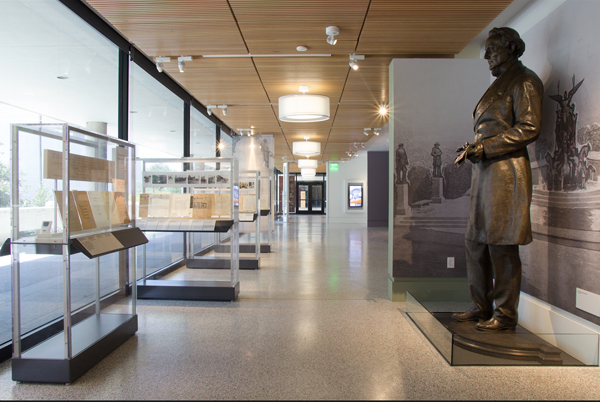
The Davis Statue on display at the Dolph Briscoe Center for American History, The University of Texas at Austin, as part of the permanent exhibit, “From Commemoration to Education.”

Littlefield found meaning in his traumatic war experiences by tying them to the wider historical narratives of the Lost Cause. This was well known locally. A 1918 article in Austin's Statesman described him as working “to keep alive the traditions of the southern confederacy. … He is zealous of those things which the generation that is now rapidly passing away stood for and believed in.”Footnote 5 By then, the Lost Cause had become an established component of the cultural system in Texas—a region always, if not solely, Southern. Supported by a set of organizations, rituals, and memorials, the Lost Cause's decentralized nature left it in the pocket of men like Littlefield, who used their wealth and privilege to colonize public spaces with an intentionally curated set of values and remembrances. He held particular admiration for Jefferson Davis whom he thought of as “the greatest man the South ever produced. He characterized his commemoration efforts as “for our Southern cause … noble work which the Southern people will appreciate … but few of us are left to do such work.”Footnote 6
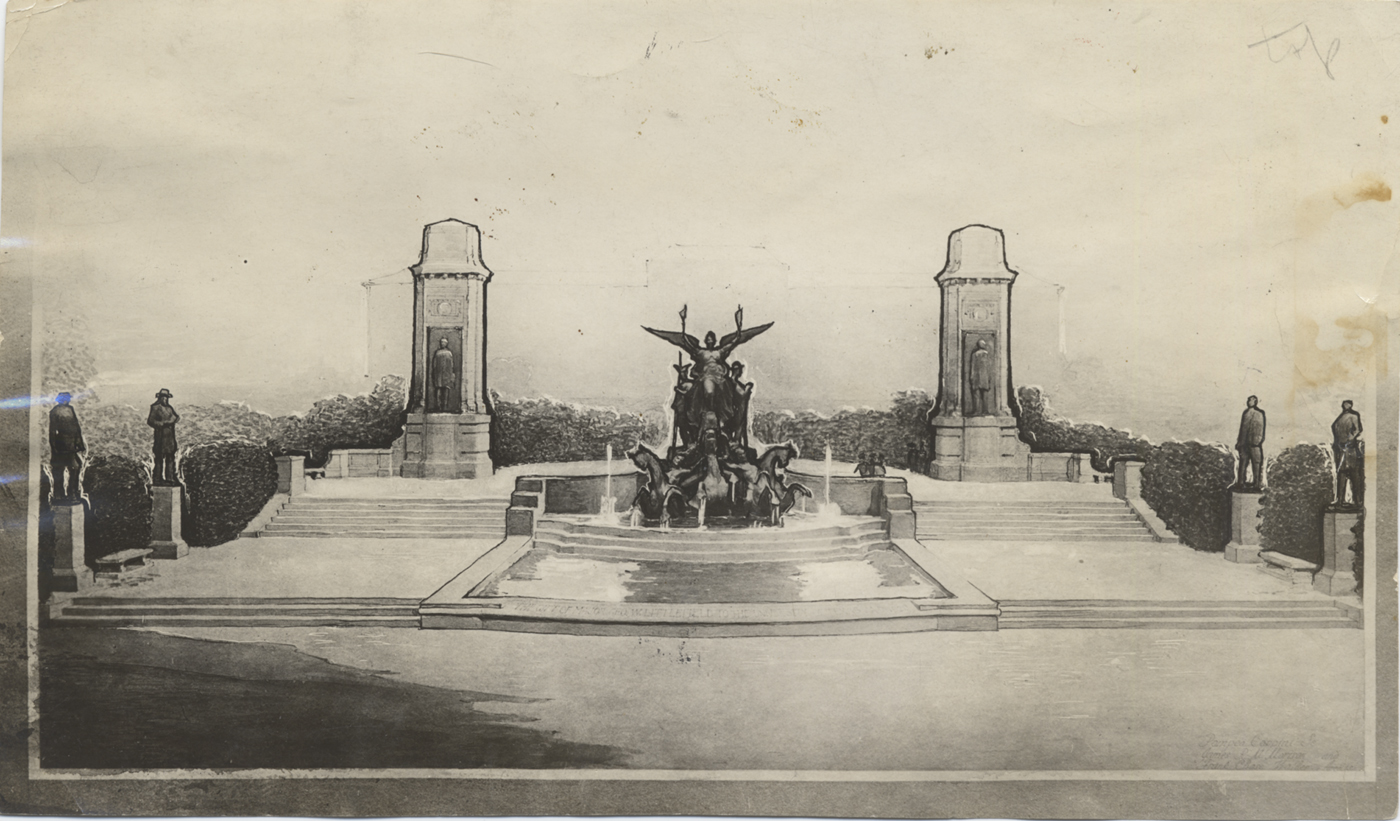
In 1919, Littlefield commissioned Pompeo Coppini, an Italian-born sculptor who had become one of Texas's most prolific public artists, to construct a gigantic monumental complex of bronze and concrete. It would be called the “Littlefield Gate” and would be placed on the South Mall of the university. Coppini's design centered on a shallow fountain that housed an allegorical grouping of statues aboard a ship. The ship was piloted by Columbia, the goddess of liberty, and was attended to by semi-naked (and rather buff) members of the U.S. Army and Navy. The ship was propelled by wild seahorses of war (with fishtails and webbed hoofs) that were barely restrained by wiry, man-like demigods representing the restraining influence of civilization upon warfare. The scene represented the American military crossing the Atlantic to defeat Germany in World War I.Footnote 7 Surrounding the fountain scene was a court of southern political leaders: President Woodrow Wilson, Jefferson Davis, Texas Governor James Stephen Hogg, Confederate postmaster John H. Reagan, and Confederate generals Robert E. Lee and Albert Sydney Johnston. Wilson and Davis were situated behind pillars that represented the North and South—regions of the nation united once more through service in the Great War. Together, the six figures cheered on the World War I generation for emulating and continuing their legacy.
The design was architecturally imposing and ideologically charged (not least in the way it omitted black World War I veterans from its narrative). On the surface, at least, it was a reconciliatory tableau, a point elucidated by the university's president, Robert Vinson, who spun the memorial as:
Setting forth of the division [i.e. slavery] which existed in American life practically from the beginning of the history of the republic, which found climatic expression in the civil war, the result of which was to destroy the cause of the previous division and to furnish the opportunity through which national life in the future might become fused into one complete whole.Footnote 8
The Littlefield Gate was thus:
Intended to express the thought that this fusion was not completed until the army and the navy of the United States crossed the Atlantic Ocean in the Great War of 1917 and 1918, and when men from North and South, East and West, fought shoulder to shoulder for the deliverance of Europe and the world from autocracy. For this reason, everything in the gate converges upon the heroic group in the center … all grouped as a court of honor about this central figure of a united and victorious America.Footnote 9
Many students and alumni welcomed plans for the Littlefield Gate with aplomb. However, behind closed doors, Vinson and other university leaders stood aghast—and would spend the next decade quietly undermining the project.Footnote 10 Ostensibly, they objected to the aesthetic impact the design would have on campus. However, they were also suspicious of the central message that the Gate emitted—that the services of Civil and World War veterans were mystically connected and morally congruent.
University leaders were aided in their intrigues against the Gate by three key developments. First, Littlefield died in 1920, leaving the project (and its funds) to a committee of three trustees, one of whom was always the university's president. The only person now fully committed to the original design of the Gate was Coppini, who wasn't a trustee. Second, the 1920s marked a period of expansion at the university. New sources of revenue from resource rich land endowments led to a construction boom on campus while also making the university less reliant on academic mafiosos like Littlefield. Finally, the Great War had radically altered the commemorative priorities of Texans.
Correspondence between Coppini and the university demonstrate these dynamics. On September 24, 1921, William Battle unleashed a scathing indictment of the Gate's design. Tasked by Vinson with traveling to Chicago and reviewing a selection of Coppini's plaster models, Battle made no bones about his distaste for the project. In his report to Vinson, Battle complained that the Davis statue's torso was too short and that the Johnston statue was “stolid.” Both lacked “the vigor and life which are the notes of the best American sculpture today.” Battle also objected to the “serene thoughtfulness” of Davis on account of the fact that he was “a temperamental excitable man.” The statue was “not likely either to satisfy his admirers nor compel his critics to appreciation.”Footnote 11 Such criticism was designed to irk and offend Coppini, which was why Vinson forwarded it on to the volatile sculptor with a blanket endorsement and a request to pause the project. However, Battle's critique went further. There was, he wrote, “grave danger that the monument may be out of scale with or not stand in suitable relation to the future buildings on the campus.” In addition, “the conception … seems to me open to serious objections … every single statue represents a Southern man. How can a group composed of men from only one section stand for a united nation?”Footnote 12
The Accepted Sketch, 1920. Source: Coppini-Tauch Paper, Dolph Briscoe Center for American History.

Such criticisms were all the more emphatic considering how mightily the Great War had chilled academic freedom at UT only several years previous. During that time, professors had been fired and students expelled for criticizing the war effort. (Indeed, Littlefield had been a member of the Board of Regents that presided over such draconian measures.)Footnote 13 Predictably outraged, Coppini labeled Battle “a snake, a mean rattler,” and dismissed his criticism as amateur and “villainous.”Footnote 14 He also refused Vinson's request to stop sculpting. A vain and opinionated man, Coppini was motivated by pragmatism as well as narcissism—his contract with Littlefield stipulated that he would be paid on a per statue basis. Coppini suspected that Vinson, Battle, and others at the university wanted to scuttle the memorial and siphon off the funds into other campus projects. With this in mind, why did Coppini not publicly accuse them of as much? Why not leak the letters to the press, regents, or Littlefield's heirs? Because he correctly perceived that such action would be ineffective, and possibly even counterproductive. Coppini knew that Littlefield's views were those of an aging generation swiftly passing. Unlike pacifist views during the Great War, Battle's critique of Davis and the Gate simply wasn't taboo.
Furthermore, students, faculty, and alumni were simultaneously engaged in constructing an even more imposing monument on campus, one that would commemorate the World War I dead exclusively. At thirteen acres, the structure would be one of America's largest war monuments: the Texas Memorial Stadium. Completed in 1924, the stadium was paid for by students, faculty, and alumni. It hosted football games and housed a plaque that listed the names of the 5,000 Texans soldiers who died during the war. The stadium represented a quiet repudiation of Littlefield's commemorative practices. It focused on soldiers instead of generals. It was utilitarian (and entertainment facility no less) rather than aesthetic and romantic. It was crowd-funded rather than bankrolled. Finally, it was a space where people forgot about war (by watching sports) rather than remembered it. Like Vinson and Battle, the student body was never very explicit in their ideological criticisms of the Littlefield Gateway. Nevertheless, they had their own projects and practices in the works that took a radically different approach to a veteran's remembrance. Naturally, Coppini was resistant to the idea that his design had become passé in the postwar period. In any case, he was painfully aware that many thought so and as such he had little choice but to sculpt, invoice, and hope for the best.
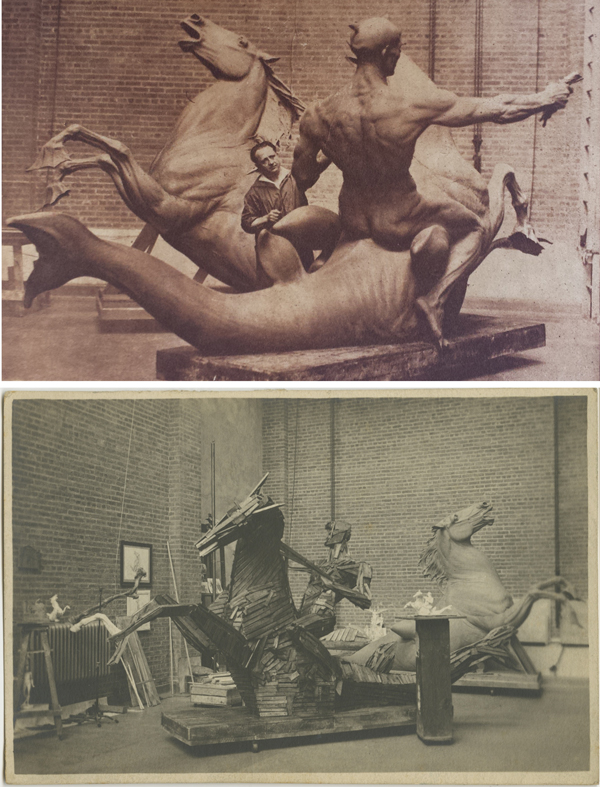
Coppini at work on the Fountain statuary, ca. 1926. Source: Coppini-Tauch Papers, Dolph Briscoe Center for American History.

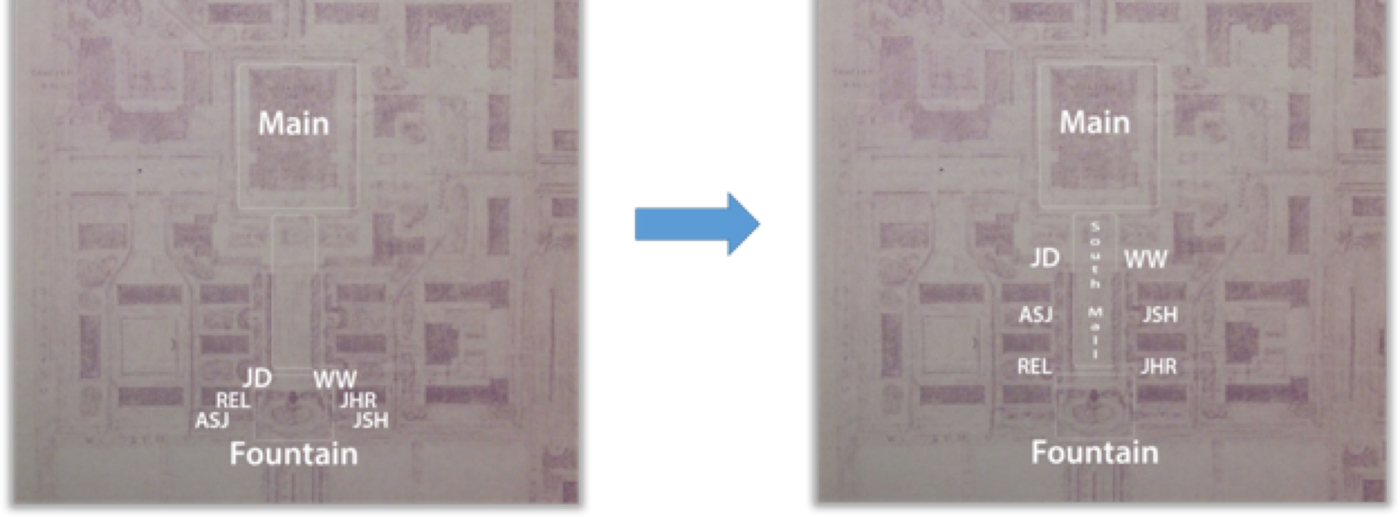
Diagram by author summarizing Cret's 1930 redesign of the Littlefield Gate. (By author.)

Battle's critique was just the beginning. What followed was a decade of rancor and wrangling, disputes and delays. By 1929, the project was in limbo. Coppini had completed (and been paid for) the sculptural parts of the Gate. The six portrait statues were on temporary display at the Texas state capitol and the fountain statues were warehoused in New York ready for shipment. However, the university had no intention to install any of them on the South Mall per the original design. Instead, the regents hoped to place the Gate on the far eastern edge of campus—“or not at all.”Footnote 15 In response, Coppini appears to have refused to ship the fountain statues from Brooklyn to Austin. He also threatened litigation. But with the university content to cut its losses with the project, he was effectively out of cards. At this point, the spat became public. Frustrated with Coppini's recalcitrance, the university's new president (and therefore a project trustee) Harry Benedict labeled the Gate “a derelict plane hovering around, no one knows where it is going to land.”Footnote 16 Even more telling, UT regent Sam Neathery told a reporter that the Gate was “out of keeping with the spirit of the times. … The work will keep up the antagonism of the South against the North before the people of Texas.” Picking up on the comment, the Alcalde, an alumni publication, spilled the beans: “There have been frequent unofficial expressions of aesthetic and patriotic opposition to the Gateway for some time … the aesthetes say it is not good art; the patriots say what Regent Neathery said.”Footnote 17 This opposition may have been both “aesthetic and patriotic,” but the former often operated as a euphemism for the latter. Again, it was clear was that the university community was refusing to buy into Littlefield's ideological and artistic vision. Not only did they reject the concept of Civil War and World War veterans from the South being united in some sort of common historical quest for justice and honor, they took umbrage and resisted it.
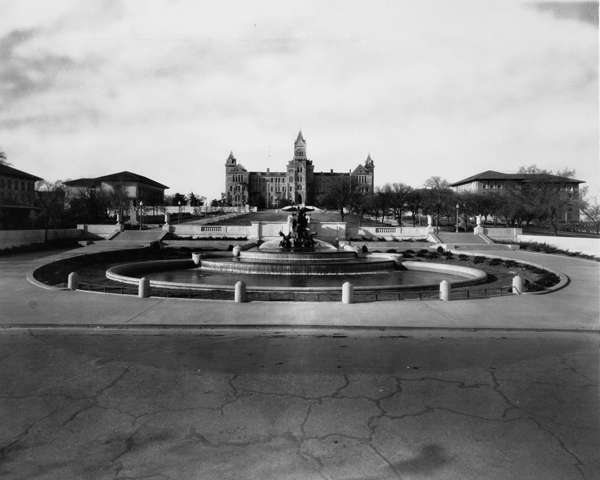
Several months later, early in 1930, Coppini finally relented, accepting a face-saving compromise brokered by Paul Cret, the university's consulting architect. Cret's plan called for the fountain to be placed at the base of the South Mall per the original plan. However, he removed the north and south pillars and redistributed the portrait statues along the mall in recessed, leafy nooks, rather than in a horseshoe around the fountain.Footnote 18 After further delays (the university's interest in the project had clearly waned), construction was completed in the spring of 1933 per Cret's design. His solution addressed many of the most pressing visual and practical dilemmas but at the cost of dismembering the original symbolism of the Gate. The message of reconciliation between (white) Northerners and Southerners, of the nation's journey from Civil War to World War, was dependent on the close proximity of portrait and fountain statuary. Cret's solution therefore decoupled the two commemorative themes—Confederate and Great War memory—from one another.
The Littlefield Gateway, completed in 1933. Source: Dolph Briscoe Center for American History.

Several other factors suggest this was all quite deliberate. First, the Gate was dedicated in April 30, 1933, rather than on June 3 (Jefferson Davis's birthday) as had been planned by Littlefield and his heirs. Second, the Gate was dedicated with nine other buildings rather than being given the spotlight craved by its cheerleaders (which included the local chapter of the Daughters of the Confederacy). Finally, plans to add a statue of George Washington to the Gate were approved shortly before construction commenced. That statue, finally erected in 1955, was sculpted by Coppini. He even ended up donating a portion of his papers to UT, but not before wryly asking a university librarian if they “would receive the same treatment as my works.”Footnote 19
No doubt Littlefield would express mortification in light of the spate of Confederate statue removals that have taken place since 2015. (To think what he would make of an integrated campus.) Less obvious is how objectionable he would have found the project's delays, the university's ambivalence to it, Cret's redesign, and Memorial Stadium. His concept for the Gate furnishes historians with a sort of Gilded Age fossil—antiquated tastes and ideology ossified in architecture—that we can observe pitted against the shifts in memory and identity that took place during the 1920s as a new generation of veterans (and memories) came to the fore. Those shifts were as profound and disruptive as those delineated by Charleston and Charlottesville more recently. Littlefield was keen to mobilize his vast economic resources in order to tie the memory of the Civil War with that of the Great War in the public imagination. But his vision of white soldiers marching off to defend self-determination (states’ rights) in a foreign land with a Southern-born president (Wilson) at the helm and another cheering them on from beyond the grave (Davis) was unappealing to the university community, not just today but in the 1920s as well.
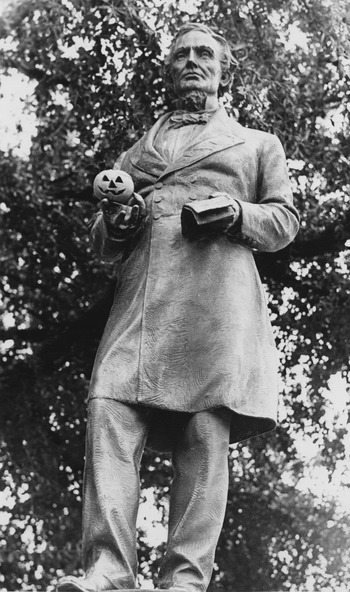
Davis avec Pumpkin ca. 1975. Source: Prints and photographs Collection. Source: Dolph Briscoe Center for American History.

Cret's solution was to spatially segregate competing memories of the Great War and the Civil War on campus. This was to have profound consequences over the next eighty years. Coppini's World War I fountain became a benign, even cherished, feature of the campus landscape, while the Confederate statues (Davis in particular) were increasingly the subject of protest and debate. Between 1955 and 1990, students mostly ignored or ridiculed them. However, from 1990 onward, calls for their removal were frequent. This development was accompanied (and to a certain extent assuaged) by successful efforts to diversify the symbolic message of campus statuary. Statues of Martin Luther King (1999, planned since 1991), Cesar Chavez (2007), and Barbara Jordan (2009) were erected as counterweights. Even so, a pattern had emerged: whenever the university's record on integration and inclusivity was questioned, the Confederate statues came back into focus.
In light of the events of Charleston and Charlottesville, Confederate symbols can no longer be seen simply as benign anachronisms of a bygone era. Their power appears only to be dormant. They seem both dark and dynamic—endorsing, energizing and encouraging modern-day racism and authoritarianism. In other words, they're gross—in every sense of its millennial meaning—and always have been, bearing in mind the backdrop of racial violence, foul play, and prejudice that usually accompanied their construction. Nevertheless, we can overplay their mystique. By historicizing them, scholars can significantly dull their foreboding patina. Their stories show them to be pathetic as well as powerful; comical as well as cruel; the product of personal egoes as well as communal ids. With his wealth, ambition, and influence, Littlefield stood near the pinnacle of the power pyramid in Texas. Nevertheless, his letters betray an understanding of how fragile Confederate memory could be. Indeed, he often conceived his efforts to construct monuments as defensive moves. Time was running out for his generation, and he lamented that many younger people thought differently about what it meant to be an American, a Southerner, or a Texan. “I am a sick man … but few of us are left to do such work,” he confided in 1918 to his fellow Lost Cause crusader Bennet Young of Kentucky.Footnote 20 In the end, the university's determination to redesign the Gate on its own terms vindicated Littlefield's anxiety and pointed to the decline of the Lost Cause after World War I, a decline as steep (if not as decisive) as the one we have experienced more recently.